Likes
Comments
Share
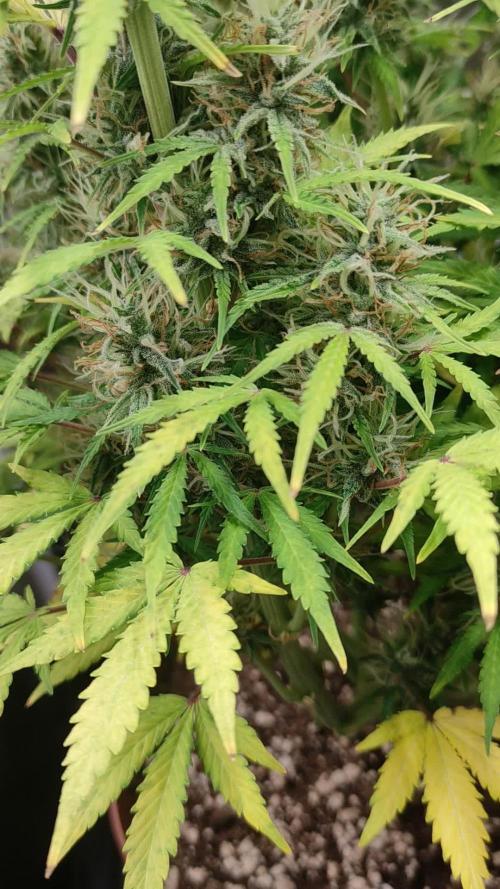
Day 50 Cloudy Day 51 Showers Day 52 Sunny Day 53 Sunny Day 54 Sunny Day 55 Sunny Day 56 Sunny Week review: The plant had 2 waterings this past week. Day 53 in the morning and day 55 in the evening at sunset. The temperatures started to rise in the back half of the week. I also noticed that 2 leaves have a growth shooting out of the center vein of the leaf. I took a picture of it front and back. 😍
Likes
18
Share
She has suffered some root damage due to lack of co2 at the root zone so I dried the cup out before I repotted her to give the roots some space. Good news is she seems to be bouncing back. She now stands at 7 cm
Likes
4
Share
@PapaTerps
Follow
Glue 31 - Compound Genetics Day 100 🚿 Watered every 3 days with 2L of RO tap water pH'd to 6.3. As she is approaching harvest, I have slowly reduced the nutrients until she was receiving just plain water. From today, she is just about half way through flush, so another watering and then she'll be left to dry back. ✂️ I've removed some of her larger sugar leaves from around the flowers at the top canopy to improve light penetration, as well as the usual inspections for mold and pests👍🏻 🌸 Week 9 of bloom, Her flower has bulked out really nicely and she has just been maturing for the last few days - her trichomes are mostly all cloudy and her pistils have dried and turned amber 👌🏻 By looking at her, I'd say she's just about ready for harvest, so I'll water her once more, let her dry back and then she'll be harvested 🙌🏻
Likes
24
Share
This experiment has taught me a great deal about all of these strains. I switched half way to NPK Raw and watched all the Harley Smith videos I could find. These strains all displayed differing deficiencies at different times. My 10L res PH, supporting 4 x 5g Buckets, plummets Daily failing from 6.5 to 5.3. Exclusivly H20 topups. Co-planting deficiency overall is that you can’t cater to anyone on a shared resivoir.
Likes
20
Share
These are hands down the best geno/phenos I’ve ever dealt with the growth rate is mad compared to my other grows I really like these genetics and definitely won’t be growing any shit again 😂
Likes
1
Share
Everything is still going very well. Resin production is already very strong, and the resin has a delicious aroma. No fertilizer has been applied, and the two lamps are running together at a combined 250 watts. The distance between the lamps and the plants is actually too small, but this doesn't seem to bother them.
Likes
3
Share
Hello growers welcome to harvest day 82 I did cut her down at day 75 so very quick plant indeed for the first 10 days I gave her water from my tap not ph at all from there she got bio grow/bloom until I see her first pistols from there I gave her bio grow/bloom/top max/bio heaven up to day 61 I then flushed for two weeks then cut her down I had her in a 20/4 light cycle from start to finish she was very easy to grow and has give me some very nice buds smelling like pear drops bang bang that’s it for now happy growing and be safe ✌️
Likes
48
Share
@AsNoriu
Follow
Day 29. Garden is just perfect. Will update more after first feed, monday - most likely !!! Day 30. Its Jungle officially !!! ;))) Size of some leaves impress and gives big hopes for me a lot ! Girls are super strong and healthy, thinking to do defoliation session at the end of the week. First feed done ! Next watering they will get silica acid. Day 31. Plan change in feed, they got Great White Mycorrhizar tea, next watering will be without aditives and then Silica acid. Girls are very healthy, so healthy that powdery mildew not far away ;))))) had to take down loads of leaves to improve air circulation. Heavy defoliation for most big girls, all bottoms cleaned from weak branches, HST to all toped plants too... But size of leaves!!@!! All girls are very strong plants, really nice genetics from Zamnesia ! Happy Growing !
Likes
2
Share
18 hours in seconds, 60x60x18 = 64,800 seconds, now multiply by the 833μMol/s reading off the PAR metre. μMol/s (micromol) is the unit in which P.A.R. is expressed. 64,800x833=53,784,000μMol 53,784,000μMol = 54 Mol 54 DLI @ 800ppm, powerful combination. Pushing photosynthesis to peak capacity, accelerated growth and increased biomass. Applied net, stretching her around for a week. Maintaining a minimum air velocity of 0.3m/s within the inner canopy. E=MC2 looks like a simple multiplication problem; it describes a fundamental physical truth: mass and energy are the same thing. The equation doesn't just calculate a value; it reveals that mass is effectively "congealed" energy. Energy is just numbers. Energy isn't a physical "substance" you can hold or touch. It is essentially an abstract, calculated number that we assign to a system to predict how it will change, interact, or move. A numerical label we attach to matter to track how it behaves. Because the universe runs on laws of symmetry (specifically, that the laws of physics don't change over time), a single global number must be conserved. We call that number "energy". How well a seedling grows is down to how much knowledge one can acquire to increase the level of conversion to occur. Applying knowledge effectively requires intuition, which comes from hands-on experience. A seasoned stoner learns to read subtle signs—like a slight change in leaf turgor (stiffness), subtle color shifts, or the specific texture of the soil—before a textbook diagnosis can be made. Ultimately, growing is the application of botanical science blended with active observation. Knowledge dictates your potential, but adaptability and attentiveness to the plant's immediate environment determine your results. The human eye is capable of distinguishing more shades of green than any other color in the visible spectrum. 1.618 Nature mathematically optimizes quantum energy transfer and light absorption efficiency within the photosynthetic machinery, as it naturally dictates energy scaling hierarchies and resonance dynamics. External vibration or electromagnetic wave that perfectly matches a plant's natural frequency directly influences plant growth. Low-frequency sound waves and targeted electromagnetic fields stimulate cellular processes and boost photosynthetic efficiency. An angular frequency aligned with the Golden Ratio is often used in wave mechanics and quantum physics to optimize energy transfer. Does it produce better yields? All I know is the IVM loves being aligned with it. Here is how I "think" of it to simplify it for myself when I give it thought. Quantum is the firmware, DNA is the software read/write expression. Alignment with that of which already exists. Law of nature, not my opinion: Constructive interference occurs when two or more overlapping waves meet in phase, meaning their crests and troughs perfectly align. Their amplitudes add together, creating a new, amplified wave with greater intensity than the individual components. Constructive interference is the foundational mechanism that establishes a resonance hierarchy across physical, structural, and acoustic systems. "Frequencies utilizing this ratio naturally minimize resistance (or impedance) and allow for highly efficient resonance, which can facilitate an increase in Electron Transfer Reactions (ETR) or energy pathways in molecular structures." Quantum coherence in photosynthesis occurs when a photon of sunlight strikes a leaf; the energy it carries must travel to a reaction center to be converted into chemical energy. This process operates at nearly 100% efficiency. If the energy moved in a traditional "bunching" or random hopping manner, a large portion of it would be lost as heat. Instead, plants utilize quantum superposition. The energy particle (exciton) doesn't just take one path; it exists in a wave state and explores multiple pathways simultaneously. It essentially "chooses" the most efficient route to the reaction center simultaneously. Research shows that molecular vibrations and the specific network arrangements of chlorophyll molecules (like the naturally evolved Chlorophyll A & B ratios) actively protect against energy overflow, optimizing light capture across different light intensities. Enzymes are the biological catalysts that speed up chemical reactions within a plant's cells, allowing them to grow, metabolize, and repair. Rather than relying solely on the classical kinetic energy of molecules colliding, plants use quantum tunneling. Subatomic particles like electrons and protons (hydrogen ions) can literally "teleport" through energy barriers that they normally wouldn’t have the energy to climb over. This makes vital metabolic reactions happen far faster than classical physics could ever explain! Chloryphyll b has peak absorption at 460nm (Blue) and at 647nm(Red). If we take the blue peak wavelength 460nm and a UV-B, UVR8 peak absorption wavelength 285nm, Tryptophan-285 (W285) Sensing protein. 460/285=1.618 Φ If we take chlorypyhll b's Red absorption peak 647nm and a UV-A of 400nm, we get 647/400=1.618 Φ. "Structure of light". The cryptochrome photoreceptor (CRY) is a UV-A/blue light receptor that shares this dual sensitivity with several other biological structures and functions, including significant sequence similarity and a common evolutionary ancestor with DNA photolyase enzymes. These are light-activated enzymes that use blue/UV-A light to repair DNA damage caused by UV-B radiation in plants. Synergistic. Effective quantum efficiency of photosystem II, often denoted as ΦPSII, represents the proportion of light absorbed by Photosystem II (ΦPSII) that is actually used in photosynthetic electron transport. It is a key indicator of how efficiently a plant is using light for photosynthesis, as opposed to losing it as heat or fluorescence. ΦPSII (effective quantum yield of photosystem II) functions primarily as a "multiplier" (a coefficient of efficiency) rather than an additive factor when estimating the overall photosynthetic electron transport rate (ETR). Multipliers are considered far more beneficial than additions because they generate exponential growth, leverage existing resources to their full potential, and create sustainable, self-multiplying capacity, rather than just incremental, linear increases. This fascinating observation is rooted in the intersection of subatomic geometry, fractal scaling, and quantum dynamics. In specific molecular arrangements—such as in conjugated polymer networks or biomolecular architectures—the Golden Ratio (PHI) naturally dictates energy scaling hierarchies and resonance dynamics. Mathematically tied to the fine-structure constant, which defines the strength of the electromagnetic interaction. The Golden Ratio can be mapped geometrically as the Golden Angle (137.5 degrees) in atomic structures, linking the charge of the electron to fundamental quantum constants like Planck's constant. An electromagnetic wave is neither electric nor magnetic, but a combination of both. 137.5 The Golden Angle (137.5) This angle is derived from the Golden Ratio (1.618). It is the smaller of two angles created when a circle is divided such that the ratio of the arcs equals the Golden Ratio. An electromagnetic wave (like light or radio waves) is not a static electric field or a static magnetic field, it is a self-propagating combination of both. An oscillating electric field creates an oscillating magnetic field, which then regenerates the electric field. They feed off each other and travel together through space at the speed of light, carrying energy without needing a material medium. The Fine-Structure Constant Alpha (Α/α): In quantum physics, is the approximate denominator of the fine-structure constant (often represented by the Greek letter Alpha (Α/α). It is a fundamental, dimensionless number that dictates how strongly charged particles (like electrons) interact with the electromagnetic field. Its value has puzzled physicists for over a century, as it bridges quantum mechanics, electromagnetism, and relativity. In quantum mechanics, Omega (Ω/ω) usually represents angular frequency. When applied to "quantum coherence"—the ability of particles to exist in overlapping states without immediately degrading—is key to calculating how long these states last. The Golden Angle, the value 137.5° is the geometric Golden Angle. It is derived from the Golden Ratio (1.618) and is famously responsible for the beautiful, mathematically optimized spiral patterns found in nature (such as sunflower seeds, pinecones, and leaf arrangements). Because of this, theoretical physicists and mathematicians have long speculated about why nature relies so heavily on the number 137 and the golden angle to govern everything from subatomic light interactions to the macroscopic geometry of the universe. Quantum coherence allows particles to maintain superposition and entanglement. In realistic, open environments, interactions with a noisy background typically cause decoherence, destroying the system's quantum information. A major challenge in quantum physics and quantum computing is preventing this decoherence at large scales. In quantum optics and driven systems, the Greek letter Omega (Ω/ω) often represents the Rabi frequency, which dictates the strength of the coherent driving laser or electromagnetic field interacting with the quantum system. The interaction of light and water generates specific Coherent Domains. Trapped electromagnetic fields cause water molecules to vibrate in unison at a coherent frequency, separating the liquid into structured quantum areas and an unstructured phase. When water interacts with hydrophilic (water-attracting) surfaces, the energy from UV and Infrared light can drive the formation of larger, structured layers known as Exclusion Zone (EZ) water. Exclusion Zone (EZ) water represents a structured, negatively charged phase of water critical to cellular biology. Driven by light energy and hydrophilic surfaces, this ordered state acts as a natural biological battery, with far-reaching implications for cell function and human health. In this domain, water molecules arrange themselves into a highly ordered, negatively charged lattice that excludes solutes and particles. At higher energy levels, UV light acts as a catalyst for photochemical reactions. Photons can provide enough energy to break the hydrogen and oxygen bonds in molecules, resulting in free radicals and a plasma of quasi-free electrons. This transfer of electrons forms the fundamental basis for redox reactions and energy metabolism in ALL biological systems. Input: The energy, time, and focus you dedicate. Process: Continuous growing, refining, and learning. Output: A superior, highly polished final product.
Likes
4
Share
@Slobasian
Follow
Sunday last day of week 11 expecting to cut it down fed banana, molasses, and honey for a final flush with ice, Friday final ice flush. In the dark for 12 hours then cut down for harvest
Likes
36
Share
Day 122 / Week 7 of Flo: Since the colour of the fanleaves is fading away pretty quickly, i decided to add in a little nitrogen (in form of BioGrow). I havent been feeding any nitrogen since the beginning of the 5th Week of Flowering. Only the little that is in BioBloom, that is only 2% The complete solution i used is following: 16l Water (4 each plant) 8ml Bio Grow 48 ml Bio Bloom 16ml TopMax 48ml BioHeaven 48ml ActiVera Day 125 / Week 7 of Flo: I am not adding any more nutrients at this stage and i started watering every plant with 2,5l of water every two days as their demand is not that high anymore and i wanna keep humidity down to a minimum to prevent bud rot. To give you an idea in early Flowering i was watering every plant with 5-6l every 3 day's, from 5th week on i was giving them 4l every 3 days and now only 2,5l. As two of the plants (Plant #2 and Plant #4) are starting to look like they are close (about 10-12 days) to harvest i am considering to flush them one of the next days. The other two plants (Plant #1 and Plant #3) seem to be of the same phenotype and look like they can take a few days more, let's see.. Also they grew bigger and stretched more in flowering then the other two, maybe a little more sativa genes.. Day 127 / Week 7 of Flowering: Today i flushed plant #2 (back left) and plant #4 (front right) with 20l of fresh water 💦 from the well. Plants #1 and #3 are recieving 2,5l of plain water every second day for a few more days. Soon i will flush them too.
Likes
11
Share
Some kind of deficiency going on. Threw some organic nutes at it and good ol cal mag plus. Trimmed those nasty leaves. She looks better, time will tell.
Likes
6
Share
Another good week getting ready. They are all very well, as envisaged last week I will switch to Extreme mode of the table Aptus. I hope not to make mistakes, my mixture is ready but I find it very busy, but I tell myself that I follow the guide Aptus. We'll see 😥😱?
Likes
35
Share
Info: Unfortunately, I had to find out that my account is used for fake pages in social media. I am only active here on growdiaries. I am not on facebook instagram twitter etc All accounts except this one are fake. Hi everyone :-) It has developed really well so far :-). Next week she will be put in the flower tent and before that cuttings will be taken :-) It was poured twice with 1 liter each this week. Otherwise everything was cleaned and cleaned. Have fun and stay healthy 🙏🏻 You can buy this Strain at : https://www.exoticseed.eu/ Type: Herz Og ☝️🏼 Genetics: Larry OG X Kosher Kush Indica 60 % / Sativa 40 % 👍 Vega lamp: 2 x Todogrow Led Quantum Board 100 W 💡 Bloom Lamp : 2 x Todogrow Led Cxb 3590 COB 3500 K 205W 💡💡☝️🏼 Soil : Canna Coco Professional + ☝️🏼 Fertilizer: Green House Powder Feeding ☝️🏼🌱 Water: Osmosis water mixed with normal water (24 hours stale that the chlorine evaporates) to 0.2 EC. Add Cal / Mag to 0.4 Ec Ph with Organic Ph - to 5.5 - 5.8 .
Likes
4
Share
Vamos familia, actualizamos la cuarta semana de vida de estas Permanent Maker de Seedstockers. Tuve problemas con la temperatura que estuvo alta 28/26 grados y humedad dentro de los rangos correctos, la única queja es la temperatura por empezar pronto, 16 horas luz, 8 oscuridad, estiraron un poco, pero van lentas por el momento, que cojan fuerza. El trasplante a sido realizado a la maceta definitiva, 7L con sustrato Top crop. Hasta aquí todo, Buenos humos 💨💨💨
Likes
27
Share
always love growing do si dos, very reliable strain, euphoric
Likes
7
Share
Start of week 2flower buds forming nicely will update at end of week Updated 4th July 2020 really bouncing back after pH corrected
Likes
40
Share
Just time to finish these guys with a flushing agent then we HARVEST!!
Likes
Comments
Share
@Danylo
Follow
She has turned an absolutely beautiful pine/dark red. Buds appear to be medium sized ROCKS. Trimming this one will be an absolute breeze. Trichomes keep developing but mainly on the lower decks. (Upper decks are mostly populated I guess...) SHE IS NOW SMELLING LIKE EARTHY+SPICY ORANGES/PEEL. - From skunkyfunky to funkyfruity to this has been a super-fun olfactory ride! In the early flower weeks I had been skeptic where this is going, but now I'm convinced! If she just stays like this I'll be fucking thrilled.. but she has about two weeks to go and we'll see where she ends up. I'm excited to see/smell! Still super fucking happy with her root system/infrastructure. I'm feeding her (late bloom now) at about 1.6/1.7 EC with 20:9:18 N:P:K and 13x/4x mg Cal/Mag per L. No deficiencies no nothing 😍 Also: no further defoliation 😊
Likes
8
Share
@420cfm
Follow
so excited. They just keep stacking! Smell and stickiness is coming on now. Definitely get the pepper smell people have noted on the power plant. Some pistals going orange but as we're week 5-6 I'm ok with this. Best grow for me yet. Genetics and lights FTW!