


Likes
Comments
Share

@J4kpvp
Follow
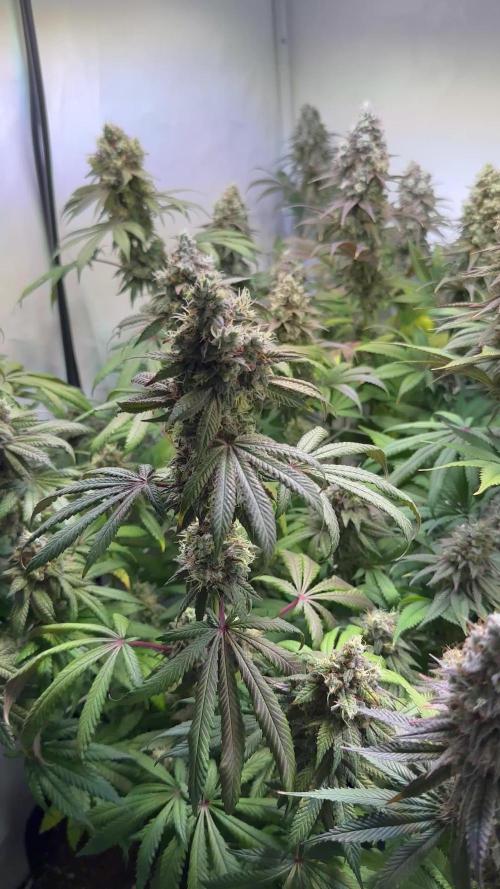
Hey guys:) looks like I was too impatient again. Trichomes still look very milky but barely any amber, almost no change from previous week. The white truffle is closest to being done and the mac n cheese looks like it will take the longest. This is now flowerday 62 so I hope we‘re done soon:) at least they are still getting bigger so I‘m not complaining:)

Likes
148
Share


@Ju_Bps
Follow
Hello growmies 👩🌾👨🌾🌲🌲,
👋 Here we are my friend, the last week, she's very beautiful for the last days, with all this colors 💚💜😍
🌲Buds keep maturation 🍊 ❄️
I've given flash cleaner and harvested the plant day 69,
Buds look delicious 😋,
I'll publish harvest asap.
💧 Give water each 2/3 days.
1,5l Water + Flash Cleaner
PH @6
💡Mars Hydro - SP 3000
100% 57 cm.
🔥 Thanks community for follow, likes, comments, always a pleasure 👩🌾👨🌾💚🌲.
Mars Hydro - SP 3000 💡💡
https://www.mars-hydro.com/sp-3000-samsung-lm301b-greenhouse-led-grow-light
RQS - Epsilon F1🌲🌲
https://www.royalqueenseeds.com/f1-hybrid-cannabis-seeds/620-epsilon-f1.html


Likes
Comments
Share

@smoking_hills9
Follow
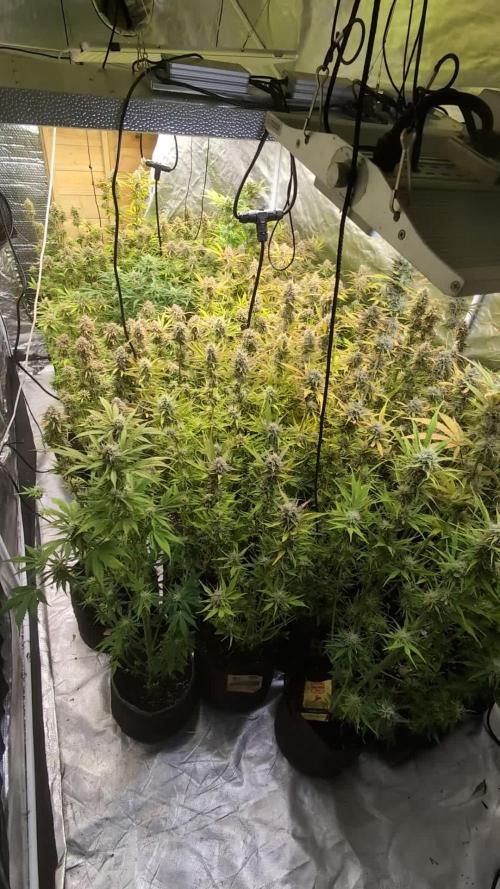
These cali genetics are blowing my mind 🤯 super sticky, very frosty rock dence buds with extra strong smells. All 3 strains are 10 out of 10, very impressed. Done last defoliation few days ago, preparing for the harvest so it's much easier. Stalks are super fat, same as buds.
Got big surprise from Atami, plant food, and many extras. Crazy. Thanks a lot guys. 💚 Start adding you Bloombastic food already. They love it. Smell is mad. I think most of plants ready in week or so.

Likes
18
Share


@Canadian
Follow
I feel sorry for my plans this 2 weeks I haven't been able to look after them properly I've been working long shift with Christmas approaching there's no time for anything so I was pushing in a lot of nutrients into them and I caused a nutrients lockout .I have flush them out with just clean water at the right pH 6.5 and they are responding very well from now on I will continue to Baby them so they gave the best result possible within the circumstances of the plants.
Thank you for reading I will continue to update have a happy grow


Likes
35
Share


@Hiroots420
Follow
Esta planta viene de 1 año aproximadamente de cultivo y sigue impresionando como el primer dia, es un aroma que lo quiero tener en mis frascos para momentos especiales.

Likes
9
Share


@NewOfficialDrillInvaders
Follow
Smell like 🥦🍋 but like skunky little bit pungent smell kick good looks good just look at the video 😉love that orange bud looking colour

Likes
34
Share


@Damonkey
Follow
Not finished with the harvest yet will update when I’ve done a second trim on everything and weighed in. The pics so far just a branch from each plant. 3 slightly different phenotypes. The buds I’d swear have a pinkish hue. Very strange colour came through in the end almost has a purple look about it.
Very happy with results and yield. The yeild could be much bigger given space and time for veg but for my needs This was an awesome grow. Really nice sticky hard buds on the most. One of the Phenotypes was a bigger yield and much tighter fatter buds but all look great.✌️🏻
I should also say a big thank you to Barney’s for providing free seeds for this grow. It’s a pleasure growing your girls.
So smoking this stuff properly tonight, yeah it’s good. Very heavy warm stoned feeling after a few spliffs.. my tolerance is quite high but this stuff has rocked my night. Really pleased with the results after curing for a few weeks I think I found a new favourite🤤🤤😂😂well until the next one. The buds are nice and dense and really have a nice firm feel to them. They also had a fairly decent covering of trichomes that sit in the herb well, it’s surprisingly smooth to say it’s not cured yet.
It’s gonna be beautiful stuff oh yass yass yass.
Update/ getting super tight now, it’s going to be very difficult to keep my hands off it for too long🤤😂
So a friend came around to see me yesterday. I let him have a good smoke of Phantom OG. He left with both fists clenched and thumbs pointing skyward.
This cannabis really is top class, and really does have medicinal value. I’d say it’ll make a great stress killer for anyone I think it’ll quash any anxiety issues going on as well✌️🏻😌✌️🏻

Likes
35
Share


@Master_weeda
Follow
Bonjour à tous les padawans et les maîtres jedis
Pour cette semaine je prévoit de pratiquer comme technique spéciale le LST et juste un arrosage.
Pour cela comme à mon habitude j'attend le cinquième noeud ou que je juge la plante robuste.
Je profite que cette semaine qui va être relativement calme pour faire un LST appliqué et vous faire un rappel de ce qui est pour moi la meilleure technique pour arroser une autofloraison et la façon dont je pratique le LST.
En suivant ces quelques simples conseils vous obtiendrez un résultat optimal tout au long de votre culture :
Le cannabis est une plante qui n’aime pas recevoir un léger arrosage en continu. Il est impératif de l’arroser en grosse quantité, puis d’attendre que la terre soit bien sèche avant d’arroser à nouveau!
Pour calculer la quantité d’eau nécessaire à chaque plante, suivez cette règle :
Le volume d’eau à donner lors de chaque arrosage doit représenter au moins environ un quart du volume du pot !!
Exemples :
pour un pot d’1L, donnez 0,25L d’eau à chaque arrosage pour un pot de 4L, donnez 1L d’eau à chaque arrosage pour un pot de 12L, donnez 3L d’eau à chaque arrosage pour un pot de 30L, donnez 7,5L d’eau à chaque arrosage !etc…
Pour donner un tel volume d’eau, il est souvent nécessaire d’arroser en deux (voir trois) fois, lentement et uniformément sur toute la surface. Disposez de bonnes coupelles sous les pots, celles ci se rempliront d’eau qui remontera dans le pot par capillarité en moins d’une journée. Il est également très important d’utiliser un bon terreau de qualité, avec une bonne capacité de rétention d’eau mais qui assure également un bon drainage (celui ci doit contenir de la perlite, et/ou de la coco, etc..)
Il vous faut alors maintenant attendre quelques jours en sous-pesant régulièrement les pot avec vos bras. Quand ils seront redevenus très légers, vous pourrez arroser à nouveau !!
En effet, comme l’eau pèse beaucoup plus lourd que la terre, un pot gorgé d’eau pèse plusieurs fois le poids d’un pot d’une plante prête à être arrosée. Avec un peu d’entraînement, vous apprendrez donc très rapidement à sous-peser vos pots pour savoir quand une plante a soif.
C’est une technique à la fois très facile et très efficace, et qui peut être appliquée à toutes les plantes en pots !
En arrosant de cette façon, en général vous devrez arroser vos plantes tous les 3 à 6 jours.
Pour cette semaine 3 au jour 17 ma plante fais 12 centimètres et son cinquième noeud apparaît je décide donc de pratiquer un LST sur ma plante.
Pour ce j'utilise du fil de fer galvanisé que je plante directement dans le substrat en faisant attention de ne pas endommagé les racines car n'oublions pas que ce qui pousse dessus pousse aussi dessous.
Jour 17 je pulvérise du une solution composé d'une cuillère à café de savon noir mou dilué dans un litre d'eau en prévention d'éventuels nuisibles.
Je corrige mon LST suivant la pousse de ma plante ...
Pour ma par c'est la manière dont je procède. Comme promis petit rapel de:
Quand commencer à appliquer la technique LST
De nombreux cultivateurs commencent la manipulation dés que les plantes possèdent entre 3 et 6 nœuds ou une paire de feuilles. Durant cette première étape de la croissance, le tronc encore flexible est pliable sans risque qu’il ne se casse, même si au fur et à mesure du développement de la plante il sera de plus en plus difficile de le plier. Nous pouvons continuer à guider la croissance des branches durant toute la culture, même durant la floraison, ce qui pour cette étape représente un grand avantage face à la taille, qui n’est pas du tout recommandé une fois que la formation des têtes commence, cela stressera en effet la plante, ce qui aura pour effet de retarder la récolte.
Comment appliquer la technique de guidage LST
Si nous sommes prudents, la flexibilité naturelle des fibres du cannabis permet de plier leur tronc et branches avec une relative facilitée, même durant la floraison des plantes.
En utilisant une corde fine, nous pouvons accrocher la pointe de la plante à la base du pot par exemple ou à un tuteur que nous aurons planté dans le substrat. Nous plierons le tronc avec précaution et nous le fixerons avec la corde, à partir de là, nous pouvons augmenter progressivement la tension de la corde, chaque jour un peu plus, jusqu’à obtenir la position souhaitée. Soyez attentif à la réaction de la plante, essayez de ne pas appliquer trop de pression sur la corde et rappelez-vous que la flexibilité des branches peut varier d’une plante à l’autre.
Pour obtenir de meilleurs résultats, il suffit de suivre quelques règles simples. Pour commencer, nous devons choisir une corde fine mais pas trop pour ne pas blesser les troncs au fur et à mesure qu’ils grandissent et qu’ils deviennent plus gros.
Nous pouvons utiliser des crochets en plastique souple ou de n’importe quelle autre matière flexible pour éviter d’endommager les plantes. Spécialement en intérieur, utiliser des cordons en plastique de couleur (voir les diaries de @Silky) est très pratique pour voir facilement les accroches et faciliter le travail au milieu du réseau formés par les cordes, les tuteurs, les mailles ou les supports que nous aurons dans la culture. Bien entendu, en culture extérieure et surtout en guerilla nous ferons juste le contraire et nous utiliserons des matériaux de couleur qui n’attirent pas l’attention pour que notre jardin reste discret.
Pour stresser les plantes au minimum, la mieux est de réaliser ces manipulations le soir ou juste après que les lampes en intérieur s’éteignent, ce qui leur permettra de se remettre durant la nuit. Normalement, le jour suivant nous pourrons observer comme les pointes des branches que nous avons pliées se dressent de nouveau vers le haut à la recherche d’une source de lumière.
Que la force soit avec vous

Likes
4
Share

@GREENPHOENIX6262
Follow
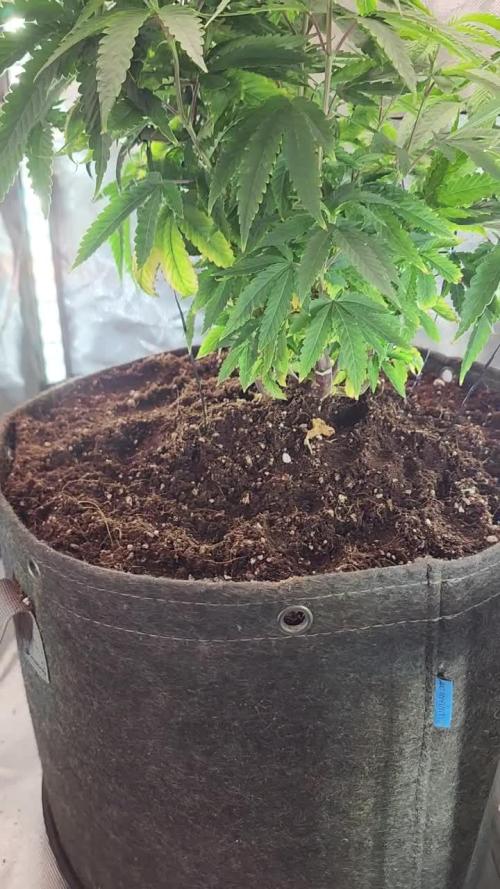
12/30 - Transplant will be completed by the end of the day - still running high humidity and high temps - Increased Myco/Silica/Nitro feeds - Heavy LST coming week . 😎😎😎😎😎😎😎😎
01/01 - First update of the year - if you are reading this, peace and prosperity to you and yours - Did not get a chance to transplant just yet, looking to transplant by the end of the week - So far this mother has been rocking out just fine - looking to pluck clones by mid Jan - Had a little PH burn on the tips - flushed for PH balance correction.
01/03 - Still have yet to transplant - working on increasing root mass volume before transplanting to minimize transplant shock - Myco and Nitrogen feeds have increased - She is being grown as a mother for cloning - slight leaf tip burn - minor flush to adjust burn - temps and humidity still running high - transplant will be completed by the end of the week.
01/04 - Transplant complete - dropped her into a 7 gallon pot - Running a scog net for even canopy distribution - medium is a coco/perlite/worm casting mix - added supps ( Myco, Microbes and Silica)

Likes
4
Share

@Leprechauns_Garden
Follow
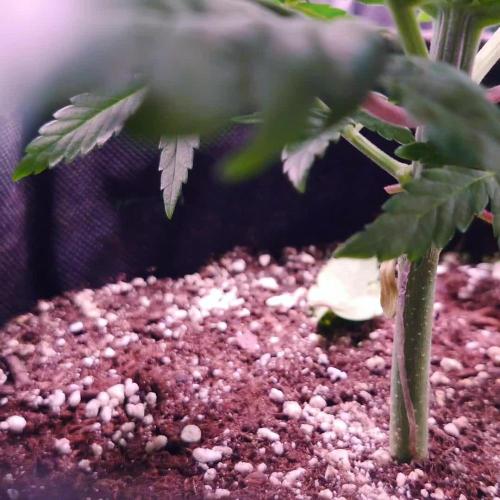
Alle Ladys super gesund und ordentlich am wachsen.
Keine neuen Informationen.
Nächste Woche werden sie getoppt und entlaubt.
Bis dahin haben sie aktuell 450 ppfd und ca 2 Liter Wasser alle 2 Tage.
Ab Woche 6 werde ich mit leichter Düngerzugabe beginnen.
Let IT grow 🌱🌿💚

Likes
7
Share


@HIAZ_urbanbudfarmer
Follow
Hi Gromie's, upped nutrients & turned light up to 75% (360w), wich has helped bring up temps to 22-24°c really good growth. DD#2 ,DD#3, DD#4 are 1 week younger than DD#1, had originally fimmed 2, 3,&4 but changed my mind & decided to top them & mainline them. I have topped DD#1 for a 2nd time & I am following nebula haze's (grow weed easy.com) method of mainlining keeping the first & 3rd node's to give me 4 cola's per side, 8 total. So till next time Gromie's, ☮️👍🤘


Likes
16
Share


@Hawkbo
Follow
The hulk is swelling up at a rapid clip I think she'll have some big buds on her. Started giving less grow down to 2 ml per gal and more bloom. Added in some TNB co2 as well which I usually only use on the autos. Instead of feeding on the previous feed I gave them the enhancer from green house feeding just humic acids and enzymes and they responded very well as I think there was beginning to be a build up. I'm happy with how they look right now.
Likes
39
Share


@MariRemediesLLC
Follow
Very rough week. I noticed discoloration of fan leaves which led to a lot of different deficiencies. Thought I was going to lose my plants.


Likes
4
Share

@DogDoctorOfficial
Follow
8×8 Adventure – Week 11
Blueberry Muffin – Pheno B
💚 The Little One Keeps Shining
Hello everyone, and welcome back to another chapter of the 8×8 Adventure! 🌱💚
And here she is again...
Our little Blueberry Muffin Pheno B.
If you've been following this diary from the beginning, you already know exactly what makes this girl special.
She's small.
She's slow.
She's compact.
She's beautifully green.
And somehow...
she keeps getting more beautiful every week.
😂💚
While some of the plants around her have been stretching, reaching and trying to occupy every possible centimetre of the room, Blueberry Muffin Pheno B has remained completely committed to her own philosophy.
Stay small.
Build flowers.
Look beautiful.
Take your time.
And honestly?
I respect it.
This week isn't about dramatic intervention.
It's about watching her continue to develop while we give her exactly what she needs.
Because at this stage of flowering...
sometimes the best thing a grower can do is simply let the plant finish her story.
────────────────────────
🌸 Week 11 – The Quiet Stage Of Flowering
We're now at that interesting point in the flowering cycle where the major structural work is already behind us.
The plant has her architecture.
The flowering sites are established.
The roots are established.
The irrigation system is running.
The nutrition is established.
The lighting is in place.
And now...
the flowers get to do the talking.
That's exactly where Pheno B is right now.
We're not constantly reaching into the canopy.
We're not trying to reshape her.
We're not trying to make her taller.
We're not trying to make her behave like another phenotype.
We're simply observing.
Watering.
Feeding.
Monitoring the environment.
Checking the flowers.
And making adjustments only where the plants actually ask for them.
Pheno B isn't asking for much.
She's just quietly getting on with the job.
────────────────────────
🌿 Small Doesn't Mean She's Not Working
This little girl continues proving one of my favourite points from the entire 8×8 Adventure:
Height isn't everything.
At around 75 cm, Blueberry Muffin Pheno B is still one of the smallest plants in the room.
But look at her.
She's lush.
She's green.
She's full of flowering sites.
She's compact.
She's developing density.
And she's filling her available space extremely well.
She's not wasting energy trying to become a giant.
She's simply using the architecture she has.
And that's what I love about phenotype hunting.
You don't always get what you expect.
Sometimes the plant gives you something completely different from the picture you had in your head.
And instead of fighting it...
you learn to appreciate it.
Pheno B has made her position very clear.
She's the little one.
And she's perfectly happy with that.
😂💚
────────────────────────
🌸 The Flowers Are Becoming The Story
At this stage, her height isn't really what I'm watching anymore.
I'm watching the flowers.
And they're looking beautiful.
The developing buds continue gaining structure and volume.
The plant is gradually becoming more dominated by flowering growth, and those compact branches are carrying increasingly substantial floral sites.
This is where the patience starts becoming rewarding.
Week after week, the difference may seem small when you're standing in front of the plant every day.
But compare photographs.
Suddenly...
you see it.
More flower.
More structure.
More density.
More maturity.
And that's what we're looking for now.
Not another giant burst of vegetative growth.
Not another training session.
Just development.
────────────────────────
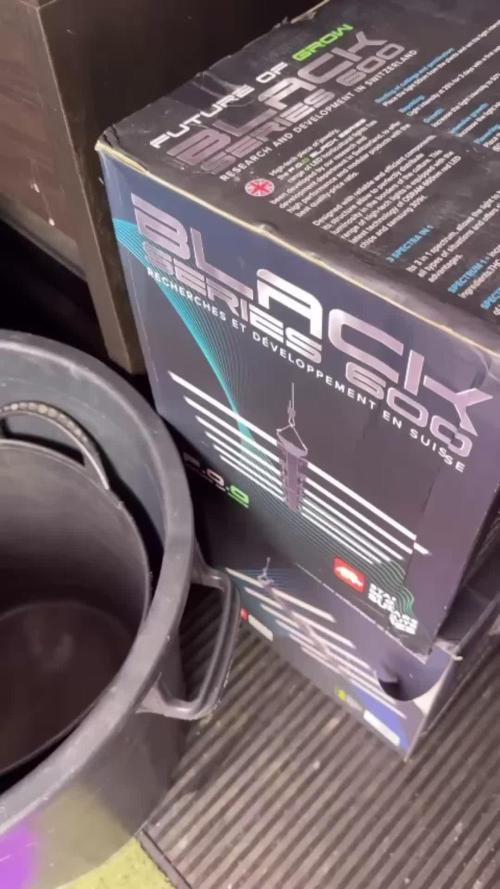
💡 Two More Future Of Grow Black Series 600W Fixtures
Now, although we're doing very little to the plant physically this week, there has been an important development above her.
Future of Grow provided us with two additional Black Series 600W fixtures for us to test as part of the 8×8 Adventure.
And that gave us a completely different lighting capability.
Once the additional fixtures were added, the available PPFD increased considerably.
Actually...
a little more than I wanted.
😂
So instead of simply running the fixtures at maximum power, we turned them down.
We're currently running at approximately 59% power from the plug.
At that setting, we're seeing approximately 1,500 PPFD across the upper canopy, with the intensity naturally decreasing lower down depending on plant height and canopy position.
And I'm very happy with that.
The important part isn't simply having 600W fixtures.
It's having control over them.
────────────────────────
🔌 More Light Doesn't Mean We Need More Power
This is something I really enjoy demonstrating in a real grow.
When you have powerful equipment, you don't necessarily need to run it flat out.
We increased the available lighting.
The PPFD went higher than I wanted.
So we reduced the power.
Simple.
😂
Now we're still providing an extremely strong light environment while using less electricity.
We're also avoiding unnecessary stress on the fixtures and the associated equipment.
And we're giving ourselves room to adjust later if the plants tell us they want something different.
That's one of the reasons I'm so happy with the additional Future of Grow fixtures.
They give us more capability.
More control.
And more room to experiment.
────────────────────────
☀️ Around 1,500 PPFD At The Top
The approximately 1,500 PPFD we're seeing is measured across the upper canopy.
Obviously, Blueberry Muffin Pheno B is not a perfectly flat surface.
She's a living plant.
Some flowers are higher.
Some are lower.
Some leaves face the fixtures directly.
Others sit at different angles.
So the light naturally changes throughout the structure.
And that's exactly what we expect.
The goal isn't to make every single square centimetre of the plant receive identical light.
The goal is to create a strong overall light environment and allow the plant to use those photons as efficiently as possible.
And with Pheno B's compact architecture, this is particularly interesting.
She has a relatively small vertical footprint, so we're able to provide a very strong upper-canopy environment without needing to chase a huge plant through the tent.
She's compact.
The light is strong.
And now...
we watch what she does with it.
────────────────────────
💚 Future Of Grow – A Big Thank You
I want to give Future of Grow a special shout-out this week.
Providing two additional Black Series 600W fixtures gives us the opportunity to explore how these plants respond when we substantially increase the available lighting capability.
And we're not just turning everything on and walking away.
We're testing.
We're adjusting.
We're measuring.
We're finding the level that makes sense.
That's exactly the kind of real-world testing I enjoy doing.
We increased the lighting.
We saw where the PPFD went.
We decided it was more than necessary.
We reduced the output.
And now we're sitting at a level I'm very comfortable with.
More capability.
Less unnecessary power consumption.
And plenty of light.
That's a pretty good combination.
────────────────────────
🌿 Pheno B Under The New Lighting
And what about our little Blueberry Muffin?
She's happy.
That's really the simplest way to describe it.
Her foliage remains lush.
Her colour remains beautiful.
Her flowering development continues.
And she isn't giving us any reason to suddenly start changing everything.
So we're not.
She's doing her thing.
We're doing ours.
The lights provide the photons.
The roots provide the foundation.
The irrigation provides the water and nutrients.
The environment provides the conditions.
And the plant decides how to put everything together.
That's the fun part.
────────────────────────
🥥 Nutrition – Another Small Step
There was also a small nutritional adjustment this week.
Nothing dramatic.
We're simply increasing Terra Bloom slightly from 2.2 ml/L to 2.3 ml/L.
The current recipe is:
• Terra Bloom — 2.3 ml/L
• Pure Zym — 1 ml/L
• Power Buds — 1 ml/L
• Sugar Royal — 1 ml/L
• pH Plus — 0.03 ml/L
• Lemon Kick — 0.03 ml/L
That small increase in Terra Bloom brought the EC up slightly.
We're now sitting around:
⚡ EC — 2.14 mS/cm
Again...
Nothing dramatic.
Just a small measured progression as flowering continues.
I don't believe in changing things simply because the calendar says another week has passed.
The plant tells us what she needs.
And Pheno B is telling us:
"I'm happy."
So we're making small adjustments rather than dramatic ones.
────────────────────────
💧 Irrigation – Keep The Roots Happy
The irrigation remains consistent as well.
We're currently around:
💧 1.45 L per plant / 24 hours
The current root-zone conditions remain stable, with the solution and substrate both around 25°C.
That's important.
Because while we can change the lighting strategy, adjust nutrition and make other decisions above the canopy...
The roots still need consistency.
Water.
Nutrition.
Oxygen.
A stable root environment.
And Pheno B is receiving exactly that.
Her slow growth isn't something we're trying to correct through excessive inputs.
That's simply her phenotype.
We're supporting her rather than trying to force her to become somebody else.
────────────────────────
🌡️ Week 11 – Current Conditions
This week's recorded conditions are:
• 🌡️ Day Temperature: 26.5°C
• 🌙 Night Temperature: 26°C
• 💧 Relative Humidity: 61%
• 🥥 Substrate Temperature: 25°C
• 💦 Nutrient Solution Temperature: 25°C
• ⚗️ pH: 6.02
• ⚡ EC: 2.14 mS/cm
• 💨 CO₂: approximately 693 ppm
• 💡 Light Schedule: 12/12
• 💧 Irrigation: approximately 1.45 L/plant/24h
• ? Pot Size: 15 L
• 📏 Plant Height: approximately 75 cm
The room continues to remain stable overall.
Summer can still create small fluctuations, of course, but we're keeping the variables we can control as consistent as possible.
And that's particularly important at this stage.
We're not looking for perfection every minute of every day.
We're looking for stability.
────────────────────────
🧠 Why We're Not Touching Her
I think this deserves its own section because it's an important part of the grow.
There is always a temptation to do something.
Remove a leaf.
Move a branch.
Change the feeding.
Change the light.
Adjust something.
But sometimes...
there is nothing that needs fixing.
Pheno B has a good structure.
Her flowers are developing.
Her foliage is healthy.
Her environment is stable.
Her irrigation is consistent.
Her nutrition is working.
So why would I disturb her?
We're watching her closely.
We're checking for problems.
We're monitoring development.
But we're not manufacturing problems just because we feel like we should be doing something.
This is the stage where patience becomes cultivation too.
────────────────────────
🌿 Compact Architecture – A Little Advantage
Her compact size is actually becoming quite enjoyable at this stage.
There isn't a huge vertical structure to manage.
There isn't an enormous stretch creating constant challenges.
She's simply sitting there...
building.
Her flowers are concentrated through a compact architecture, and that makes her a fascinating contrast to some of the taller plants in the 8×8.
Same room.
Same general philosophy.
Same lighting.
Same nutrition.
Same irrigation.
Different genetic expression.
That's the experiment.
And Pheno B continues giving us a very clear answer.
Small.
Compact.
Slow.
But beautiful.
────────────────────────
📸 The Photographs Tell The Truth
This is another reason I love keeping individual diaries.
If we only photographed the whole room, Pheno B could easily disappear into the bigger picture.
But when you isolate her...
You can appreciate her.
The lush foliage.
The compact structure.
The developing flowers.
The density.
The colour.
The progression.
She's not competing with anyone anymore.
She doesn't need to.
She's simply showing us what she can do.
And honestly...
I think she's doing a beautiful job.
────────────────────────
☀️ Photons, Plants & Patience
One of the things this stage reminds me of is that lighting is only one piece of the equation.
We're now giving these girls a very strong lighting environment.
Approximately 1,500 PPFD at the upper canopy.
That's a lot of photons.
But photons alone don't grow flowers.
The plant still needs:
Water.
Nutrition.
Healthy roots.
CO₂.
Temperature control.
Humidity control.
Healthy foliage.
And time.
Everything has to work together.
That's why we're not simply adding light and then expecting miracles.
We're giving the plants a complete environment and watching how they respond.
Pheno B is responding in her own way.
Slowly.
Quietly.
Beautifully.
────────────────────────
🔬 Same Genetics, Different Personality
This is probably one of the biggest reasons I enjoy having both Blueberry Muffin phenotypes documented separately.
They're related.
They're growing under the same general conditions.
But they don't express themselves exactly the same way.
Pheno B has consistently shown us that she's the smaller, slower phenotype.
And instead of treating that as something that needs correction...
I'm treating it as information.
This is what her genetics are expressing.
And that's valuable.
Because the purpose of a phenotype diary isn't to make every plant behave the same.
It's to discover how they behave.
And this little girl has been very clear.
😂💚
────────────────────────
🔮 Looking Ahead
From here...
We're keeping things simple.
We're going to continue monitoring the flowers.
Continue checking the foliage.
Continue watching the environmental conditions.
Continue providing consistent irrigation.
Continue with the flowering nutrition.
And continue testing the new lighting setup.
The two additional Future of Grow fixtures give us another exciting variable to observe.
We've already found a power level we're comfortable with.
Now we'll watch how the plants respond over the coming weeks.
And as for Pheno B?
She's going to keep doing what she does best.
Take her time.
Build quietly.
And look beautiful while doing it.
────────────────────────
💚 Final Thoughts – Let The Little One Finish
I think that's probably the biggest lesson this girl continues teaching me.
Not every plant needs to be big.
Not every plant needs to be fast.
Not every plant needs constant intervention.
And not every phenotype needs to be pushed toward the same result.
Sometimes...
the little one is exactly the one you want to watch.
Blueberry Muffin Pheno B is compact.
She's slow.
She's lush.
She's green.
She's flowering beautifully.
And she's becoming increasingly dense.
This week we haven't needed to do much physically to her.
And that's okay.
We've provided the light.
We've provided the nutrition.
We've provided the irrigation.
We've provided the environment.
And now...
we give her time.
That's the stage we're in.
The plant has done her part.
Now we watch the flowers finish the story.
And with the new Future of Grow lighting above her, a small increase in nutrition, a stable environment and a very happy-looking plant...
I'm really curious to see what this little Blueberry Muffin becomes by the end.
For now?
She's shining.
And that's enough.
💚🌸
────────────────────────
🙏 Thank You
A huge thank you to Zamnesia for giving us the opportunity to explore these Blueberry Muffin genetics and to follow this beautiful phenotype individually throughout the entire journey.
A heartfelt thank you to Plagron for the nutrition supporting these girls through flowering and helping us maintain such healthy, lush plants.
A massive thank you to Future of Grow for providing the Black Series lighting that has been powering this room and, especially this week, for providing two additional Black Series 600W fixtures for us to test.
Having more lighting capability and then being able to control the output to find the level that makes sense for the plants is exactly the kind of experiment I love documenting.
And thank you to Lumiflora for continuing to contribute additional light deeper into the canopy and helping us think about the plants as three-dimensional structures rather than simply flat canopies.
Thank you as well to everyone following the 8×8 Adventure here on GrowDiaries.
This project continues showing us something I never get tired of seeing:
Same room.
Same environment.
Same general cultivation philosophy.
Different genetics.
Different personalities.
Different stories.
Blueberry Muffin Pheno B may still be the little one.
She may still be the slow one.
But she's also one of the most charming plants in this room.
She's compact.
She's lush.
She's beautiful.
And she's quietly building something very interesting.
So this week, there isn't a dramatic intervention.
There doesn't need to be.
We're simply giving her what she needs...
and letting her finish.
Keep shining, little girl. 💚🌸
Until next week...
Growers Love, happy growing, and take care everyone! 🌱💚


Likes
24
Share

@BunnyBud
Follow
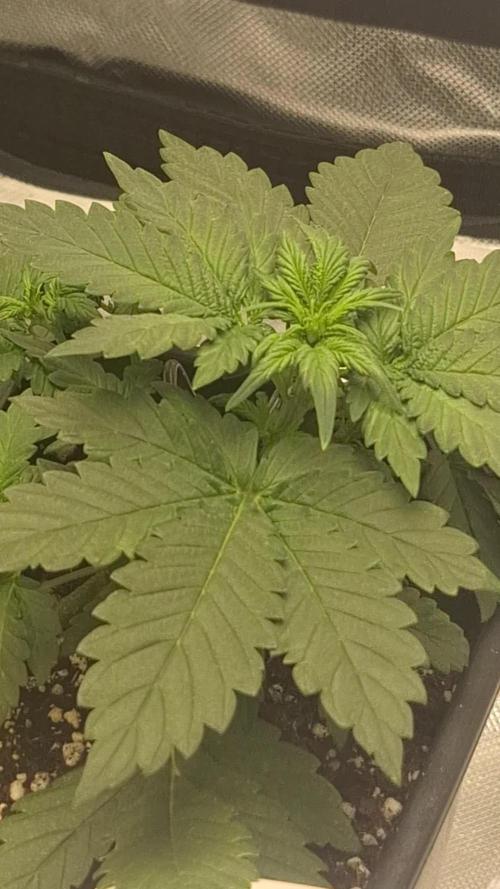
31 Aug. I start the third week of my autoflower. The plant is growing well, but I noticed small yellow spots on the leaf tips, which seem like a mild calcium deficiency. This is probably due to the fact that so far I have been giving water with a slightly low pH, around 6, while the ideal range would be 6.5–7.
At the beginning, to lower the ppm of the tap water (which was around 211 ppm), I mixed it with demineralized water. This brought the ppm down to about 109–140, making it harder for the plant to absorb the available calcium. Additionally, the soil I am using, Biobizz Light Mix, is lightly fertilized but does not contain enough calcium to correct this small initial deficiency.
For this week, I will not add any fertilizers. I simply want to raise the pH to 6.5 and use water with higher ppm, so the plant can better absorb the nutrients already present in the soil.
The lamp is positioned about 35–36 cm from the plant and so far there are no burn issues. Temperatures range between 25 and 30 °C depending on the day, while humidity in the room stays between 40–60%. The humidifier is always on because I keep the window open, but the dehumidifier is not being used, as it is not necessary at the moment.
I also have a new oscillating fan arriving to replace the current fixed one, and I’m waiting for a regulable extractor (90–145 m³/h), which will allow me to control the air perfectly during winter if needed.
This week my main goals are:
Increase the water ppm without overdoing it
Adjust the pH to 6.5
Keep observing the plant without adding any fertilizers
Everything else seems fine and growth is regular. With these corrections, I expect the new leaves to grow healthy and free of spots.
==UPDATE 31/08==
To control the calcium deficiency, I will administer an eggshell solution until I reach 300 ppm (I will boil some eggshells and administer the solution in tap water).
Likes
46
Share


@Dr_Rook
Follow
Encarando ya la recta final. Calculo que en una semana y unos pocos días más cómo mucho cortaré.
Al principio de semana di su última comida con Ec baja y a mitad de esta hice el lavado de raíces, drenando un agua con Ec ya aceptable, con lo que presagio que va a tener buen nivel de sabor.
Les estoy haciendo pasar ya bastante frío, buscando un extra de resina; con lo que se está llenando de colores. Estaba un tanto preocupado con los cogollos porque no los notaba demasiado apretados, pero en esta semana lo han hecho y mucho. Espero esta semana terminen de apretar como rocas.
Comienza la cuenta atrás, tic tac, tic tac…
