Likes
5
Share
When the lights are off I will post another video so the green is easy to see!
Processing
Likes
13
Share
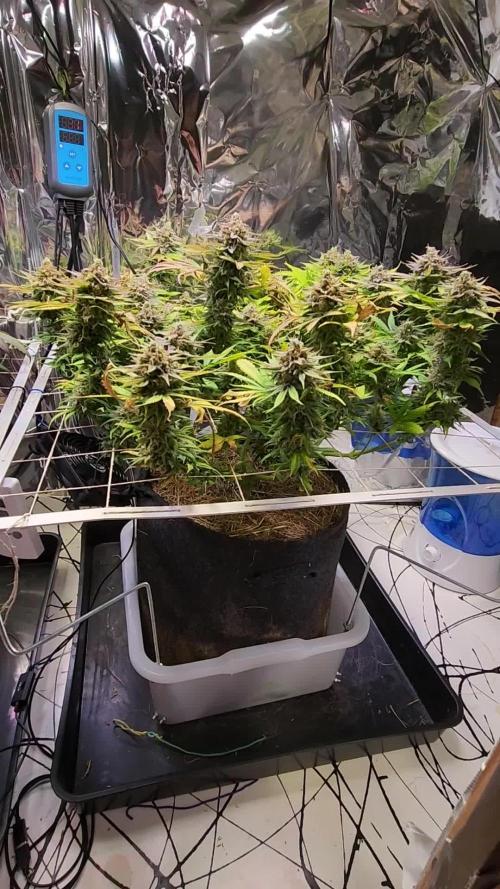
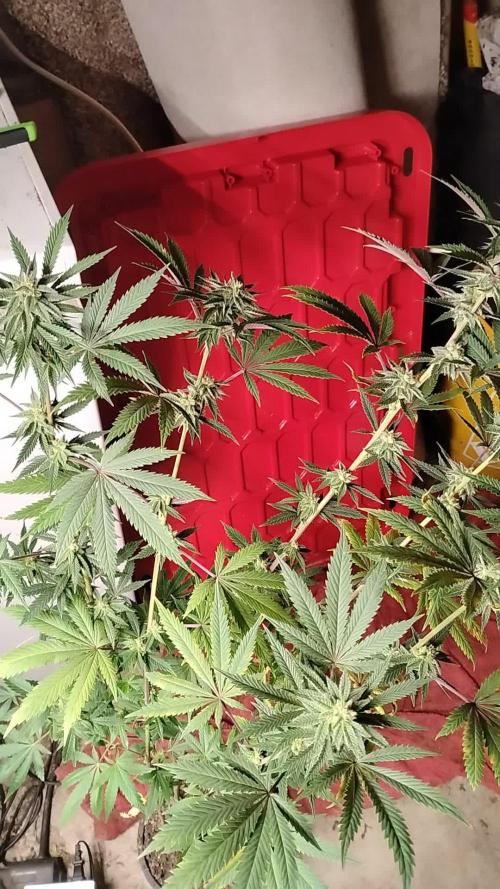
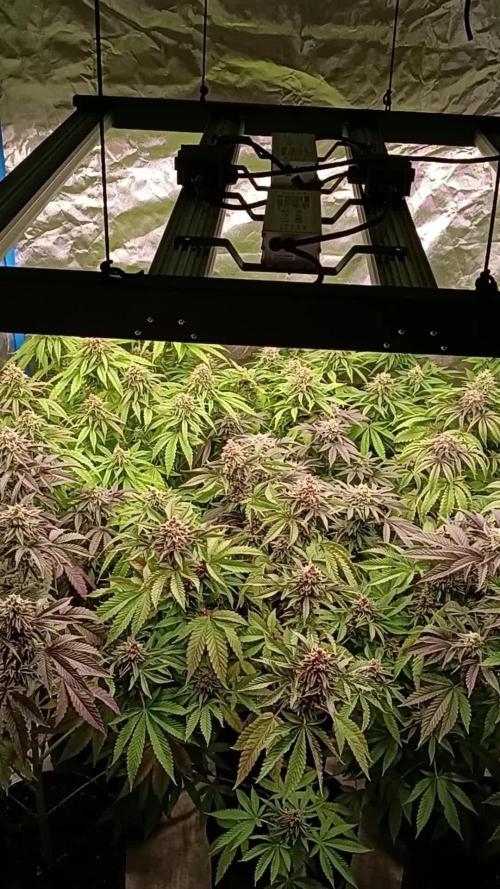
I'm wanting to replace all my miscellaneous lights with another quantum bar rig before my Fall grow this year. Anybody want to buy some gently used lighting gear this summer???😁😎 👉 2 x 100w Cree CXB3590 (3500k) with pin heatsinks - 3 grows usage 👉 1 x 100w Citizen Clu048 COB (3500k) with pin heatsink - 3 grows usage 👉 1 x 120w DIY quantum board (3000k) 256 x LM301b's - no heatsink - used for 2 grows 👉 1 x 60w Bridgelux COB (3500k) - Par38 style - used for 1 day (a back-up bulb) 👉 1 x Morsen 2000w (367w actual) blurple with a bank of 1/6 of the 200 LEDs not working - used 3 grows 👉 1 x Morsen 2000w (367w actual) blurple with only my current grow in use (the replacement) 👉 1 x HeroLight 1500w (285w actual) 5 x COB full spectrum (pinkish-white) - 2 veg stage uses 👉 4 x 36w Par38 type deep red (660nm) bulbs - 3 grows usage 👉 2 x 25w 225 LED panels (660nm) - 3 grows usage 👉 2 x 25w 225 LED panels (440nm) 4 veg stage uses 👉 2 x 25w 225 LED panels (440nm) 👉 1 x 50w 225 LED panel (6500k+440nm) 👉 1 x 20w Par38 style Cree COB (3000k) - (more like a 40w) - used for a week 👉 1 x 15w Sansi blurple Par38 type bulb - used 1 day only 👉 1 x 40w Sansi 4000k daylight Par38 type bulb - used during germination only 👉 4 x 12w MiracleLED red spectrum (4000k daylight + 700nm red) regular light bulb - used during flowering in 2 grows Just hit me up in chat if you are interested in anything- ============================================ SUNDAY 3/31: I did a little more tweaking on the timers and ventilation. I foliar fed her a few times and rotated her. MONDAY 4/1: I foliar fed her a few times and spun her around, then tweaked the timers a bit more...fingers crossed.. TUESDAY 4/2: I fed her about 1/2 gallon of all the good stuff, and started her on Open Sesame and Tiger Bloom. Increased Terpinator, Bud Candy, and Calimagic, and decreased Grow Big. She's got at least 10 good bud sites and I never even FIM'd her.👍 MONDAY: I spun her around and foliar fed her a few times TUESDAY: I fed her about 3/4 gallon and started her on Open Sesame and Tiger Bloom. Foliar fed a few times and tweaked the timers again.. WEDNESDAY: I foliar fed a few times and rotated her, then took some photos. She's starting to stretch now.👍 THURSDAY: I foliar fed her a few times and rotated her. FRIDAY: I watered her with about a half-gallon including boomerang, bud candy, terpinator, kelp me kelp you, calimagic, and armor si. I foliar fed her several times and rotated her 180 degrees.
Likes
12
Share
@Doofy
Follow
This plant loloks sooo cool!! I´m goin 2 top her again only on 1 side. Try a cewl shape 😎😎😎
Likes
9
Share
This lady is getting better every week All of her sisters are too Amazing genetics with amazing nutrients
Likes
32
Share
@WATP55
Follow
Day 83 Currently drying, will update before Robert Smith turns up.... Day 87 5 days in, all trimmed and back in to dry. Temp 18c RH 50% Will raise humidity to 62% for last 5 days and add fan. Day 92 Girls pruned to similar size buds and in jars to cure. Will wait a few days until the residual moisture dissipates then weigh for the final time. Lemony tones coming off her already. Pleased as was getting worried during drying. Think I'll try a dry trim on the two Lemon Kix I have in atm (see my other diary) Sampled some this afternoom and eveb before a cure its smooth enough to smoke, citrusy in profile and burns a nice clean white ash. Looking forward to seeing the flavour/texture evolve over next few weeks before smoke report. I'm not the most patient person, this part is extremely difficult. Day 97 Final weight dried and a week cured is 87.8g (3.1oz) Extremely pleased with the yield. Smoke report I've got to be honest, it's not the stinky monster I was expecting but its made up for it in other areas. Really smooth on the inhale, lemony forest taste, no horrible aftertaste. No coughing, which is a novelty! For my first run, I'm v happy. I feel the excessive heat may have microwaved some of the terps but we live and we learn. Not long until my Auto Lemon Kix are ready, hopefully got the temp under control in time for them.....
Likes
28
Share
Hasn't done much vertical growth, seems to be more horizontal growth now. I topped and defoliated every plant. I'm trying to form them into canna-bushes. Hopefully I'm doing the correct training procedures to make them all grow that way both indoors and out.
Likes
15
Share
@Brickie74
Follow
This week went well. The Jelly Rancher plant was getting big enough to move to a bigger pot (1 gallon fabric pot). It may have been able to stay in the Jiffy Pot a little longer but figured I'd get it done with a few others I was transplanting. The roots looked great, the plant seemed nice and strong.
Likes
38
Share
@Chucky324
Follow
Hello. This is the end of week 11 and the beginning of week 12 of veg. Wow, These plants have doubled in size since last week. I'm guessing the roots found the compost. I put in 2 gallons of compost in each pot this year and was worried the soil might be too hot for the plants. But they look good. No burnt or wilted leaves. Showed some yard flowers. After all this site is about the flowers, eh! 😄 Repotted the twins and the extra plant and I will flower them inside under the mars Hydro FC-4800 in the main grow room. They will be harvested before the plants in the greenhouse and I'll show it here. Haven't had a good berry strain in awhile. Looking forward to the taste. Showed how I use the plastic pots. I prefer the plastic pots to the cloth pots, but I still use some cloth. When the roots get into the landscapers cloth, I can bottom water better. It doesn't hold a lot of water, I don't have to worry about mold. and I get better air transfer to the roots. Ok. Be Great. Chuck.
Likes
69
Share
@nonick123
Follow
Día 30 (01/07) Riego con 250 ml H20 pH 6,5. Se muestran sedientas 6 días después del topping, las nuevas ramas se están formando rápidamente! Día 31 (02/07) Se muestran saludables y potentes! Día 32 (03/07) Riego con 500 ml H20 pH 6,5 Día 33 (04/07) Las plantas están creciendo muy rápido! Me planteo hacer supercropping o LST en algunas de ellas... Día 34 (05/07) Se muestran sedientas. Las macetas se le empiezan a quedar pequeñas Riego con 250 ml de H20 pH 6,5 Día 35 (06/07) Training session! Aplico LST a todas y supercropping a la OnionOG mutante con 4 colas por nodo Riego con 500 ml H20 pH 6,5 Día 36 (07/07) Riego con 500 ml de Té Vegetativo de Lurpe Solutions Aplico foliarmente Kelp hidrolizado a 0.25 ml/l Ajustes de LST. Están respondiendo estupendamente al entrenamiento! 😍💥 💦Nutrients by Lurpe Solutions - www.lurpenaturalsolutions.com 🌱Substrate PRO-MIX HP BACILLUS + MYCORRHIZAE - www.pthorticulture.com/en/products/pro-mix-hp-biostimulant-plus-mycorrhizae
Likes
29
Share
Hope you are well. Thanks for taking the time. Little main line defoliation to focus growth. A cell is a quantum measuring device for light’s frequency to make order from the chaos that light frequencies bring from our environment. A cell performs mechanical resonance, where its intrinsic structures vibrate at specific resonant frequencies when exposed to external mechanical stimulation. Cells possess the ability to sense and respond to mechanical cues from their environment, a process known as mechanosensing. This can involve the activation of signaling pathways and changes in gene expression. Cellular resonance is a component of mechanotransduction, the process by which cells convert mechanical force into a biochemical signal that triggers a cellular response. Plants perceive mechanosensory stimuli, such as vibration and touch, through structures like trichomes (hairs) and specialized ion channels embedded in their cell membranes. Plants are sensitive to frequencies ranging from ultrasound to lower sound waves, such as 250 Hz. The perception depends on various factors, including the stiffness of the underlying tissue, which can be tuned by the plant to perceive specific frequencies associated with environmental cues like insect herbivory. While the exact molecular mechanisms are still being explored, scientists have identified several potential pathways that may be affected by acoustic vibrations in this frequency range: 4000-5000 Hz. Enzyme activity: Sound waves can increase the activity of certain enzymes, such as amylase, and elevate the content of soluble sugars and proteins. Increased stomatal opening in response to specific frequencies can optimize photosynthesis by increasing the plant's absorption of water and CO2. In addition to enhancing drought tolerance, sound vibrations can strengthen plants' overall resistance to stress. Studies have shown that some genes related to stress response can be activated by sound stimulation. The Emerson effect is a phenomenon where the combination of red and far-red light increases the rate of photosynthesis beyond the sum of the two wavelengths used separately. This synergy is important for understanding Extended Photosynthetically Active Radiation (ePAR), which includes the far-red spectrum, because it means a more comprehensive measurement is needed to fully understand light's effect on plant growth. ePAR meters measure light up to 750 nm, which is necessary to capture the far-red light that participates in the Emerson effect. The human eye can detect more shades of green than any other color due to a combination of our cone cell sensitivity and evolutionary history. Our eyes are most sensitive to the yellow-green part of the spectrum, which is the peak of our visual sensitivity, and a large part of our ancestry was spent needing to distinguish subtle variations in greenery for survival. or our primate ancestors, being able to discern subtle differences in green was crucial for survival. It helped them identify edible plants and avoid poisonous ones, as well as detect predators hiding in foliage. This constant need to distinguish shades of green drove the evolution of our color perception to become most sensitive to it. S-cones: Detect short wavelengths, perceived as blues and violets. M-cones: Detect medium wavelengths, perceived as greens. L-cones: Detect long wavelengths, perceived as reds and yellows. The primary reason for our enhanced sensitivity to green is that the peak sensitivities of the M-cones and L-cones are very close together in the green-yellow region of the visible spectrum. This overlap means that green light stimulates both the M-cones and L-cones, creating a more robust and detailed signal for the brain to interpret. In contrast, the S-cones are more isolated and respond to a much narrower band of light, leading to less sensitivity for blues. The brain's visual processing pathways also play a role. Our visual system processes color differences through "opponent channels," which compare the signals from different types of cones. The opponent channel that processes red versus green has a more precise and intricate system than the blue versus yellow channel, leading to finer discrimination in the green part of the spectrum.
Likes
2
Share
@Naujas
Follow
14 days, the girl looks great, a little wrinkled due to the humidity which is only 40-45%, but I don't know if all this will soon resolve itself, I just need to water it more often :) this week I'm changing the light to mars sp150 which will stay until the end of growth :) I'm giving the girl 6.3 ph water with 2 ml of heaven :) good luck to everyone.
Likes
3
Share
📆 Semana 8 La Lemon Cherry Runtz entra en su fase final con un aspecto explosivo. Los cogollos se compactan al máximo y la resina sube otro nivel, dejando una capa pegajosa y brillante que parece azúcar glass. Los pistilos siguen oscureciendo y los cálices se hinchan, señal clara de que la maduración ya está en su punto. El aroma se vuelve aún más intenso: dulce, afrutado y con ese toque goloso tan característico que llena el cuarto nada más abrir la puerta. La estructura aguanta perfectamente el peso, sin caídas ni estrés, y el aireado natural de la planta hace que todo el conjunto respire y termine de engordar sin problemas. Todo está encajando para un final limpio y potente. 💧 Semana de lavado de raíz: agua pura, pH ajustado y dejar que termine de afinar sabor y aroma de forma natural. Seguimos creciendo fuerte 💪!
Likes
212
Share
Likes
1
Share
High humidity and high temperature variation can cause mold and mildew. Healthy plant and high ventilation prevent the problem!