

Likes
Comments
Share
Likes
5
Share
@Drtomb
Follow
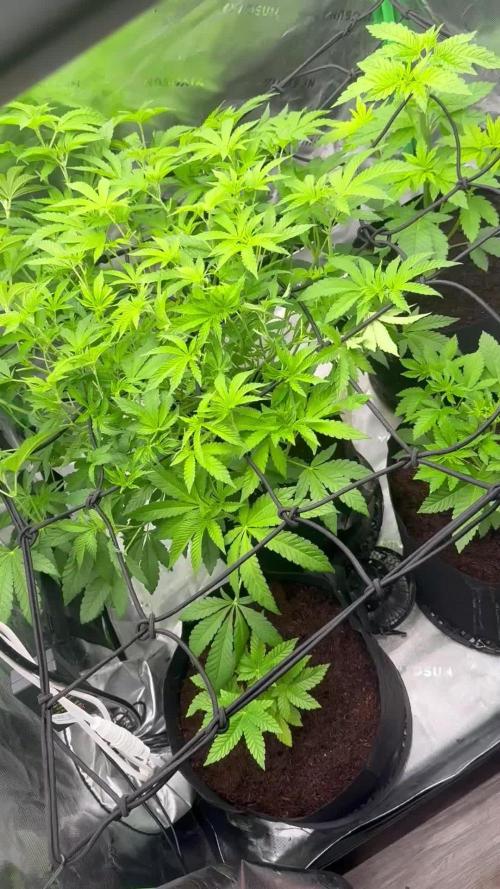
Just hit day 10 of flower this net has about 20% touching the 2nd trellis. And about 70% almost touching. The Saskatoon Berry plants are very close node spacing. The bud formations are already prevalent.
Likes
6
Share
@For2itous
Follow
Just some lst bending of leaves and stuff rn. Wow has this plant exploded with vigor so far 😎 growing quicker than the guava next to her. Can't wait to see how big it actually gets since my light setup is subpar lol. Happy growing 🌴
Likes
5
Share
Out of water for 3 days and when I arrive she looks with all her leads facing down. As soon I put her water she refused but after few hours she becomes very healthy. I had to cut few yellow leeds
Likes
3
Share
Esta semana hicimos poda de bajos a podas las puntas y una poda de bajos a todas las ramas , se recupera muy bien de las podas la Jack está semana ya arrancamos de a poco con los fertilizantes de flora , así hacemos el último trasplante a 10 litros para pasar a flora , yo creo q ta esta más que bien para entrar en floración ya , pero quiero hacer el último trasplante antes , vamos a ir viendo como vienen las siguientes semanas
Likes
2
Share
@burnout
Follow
Shortest pheno has purple stigmas. Defoliating every couple days. The pheno in the front middle didn't grow as many shoots, plant structure looks different than the other 4. Has a musky smell.
Processing
Likes
5
Share
Day 7 Plant sprouted :) Day 11 - 21/01/20 this one is going fine. not sure how it will be affected as the light is 110cm/44 inches away. This is because I currently have a sativa in the tent - Pineapple express! Im using RQS easy boost organic nutes so il not be adding any chemicals for this grow. just pure phed water. im assuming the bud will taste way better when cured as im not pumping the plant full of chemicals. might see a slightly smaller yield but if its primo weed then who cares? lol. Il update later in the week or at the start of next week if im really busy. Happy growing :)
Likes
16
Share
🌸 BlueBerry – Week 5 Flower Report Grower’s Journal | Zamnesia BlueBerry ⸻ 🌱 The Girls in Full Bloom Both BlueBerry #1 and #2 are absolutely stunning this week: • Size: Towering beauties, full presence in the room. • Bud Formation: Large, well-stacked flowers building from bottom to top, showing the real effect of the ICL 300 inner canopy lights. • Pheno Difference: • Pheno #1 is forming a dominant central cola, reaching tall and thick — a real spear. • Pheno #2 is slightly more balanced across branches, but still bulking fast. • Hairs (Pistils): Beautiful white pistils everywhere — vibrant, strong, and reaching out like nature’s way of saying, “I’m ready to bloom.” This early hair explosion is a promise of dense, resinous flowers soon to come. ⸻ 💡 ICL 300 – Fruits of the Light The inner canopy lights are proving their worth: • Buds aren’t just forming at the top, but all the way down the structure. • No wasted shadow zones, no underdeveloped sites. • It feels like the plant is blooming in 360°, thanks to the way the ICL spreads light deep into the canopy. The difference between a regular top light and this combination is day and night, and now it’s visible in every flower forming. ⸻ Nutrition Update – Bringing Back All-In-One Liquid This week we reintroduced the Aptus All-In-One Liquid into the feeding mix. Why? • To give the plants a broad-spectrum nutritional push right at mid-flower. • Ensures no deficiency or slowdown during this critical bud development stage. • Works hand in hand with Top Booster and CalMag to support cell expansion and flower density. At this stage, the girls are hungry and hard at work, so it’s the right time to fuel them properly. ⸻ 🔄 Quick Recap of the Journey So Far • Cannakan germination → soil prep with Aptus amendments → steady veg → training + defoliation → flower induction. • Week 4 brought early frost and strong stacking. • Week 5 now brings real bulk, pistil fireworks, and inner canopy buds rising. This has been a textbook BlueBerry journey so far — stable, strong, beautiful. ⸻ 🔮 What to Expect Next (Week 6 and Beyond) • More Bud Bulk: Flowers will gain weight and density quickly from here. • Pistil Transition: Some of those white hairs will start to orange and curl as new sets keep pushing. • Trichome Explosion: Frost will build across leaves and flowers, giving that snowy BlueBerry look. • Terpenes Rising: Expect the first real waves of that nostalgic, sweet-fruity BlueBerry scent. What not to expect: major height gain. The stretch is over, from here, all energy goes into flower expansion and resin production. ⸻ 💬 Final Thoughts Week 5 is the moment where the BlueBerry girls are no longer just “plants” — they are flowering powerhouses. Frost, pistils, bulk, and balance. With the ICL 300 feeding the canopy from the inside and the All-In-One Liquid giving them the push they need, these ladies are on track to become legends in their own right. BlueBerry #1’s towering cola and BlueBerry #2’s even structure are both testaments to genetic quality and environmental harmony. It’s a pleasure to watch them evolve — and even more to share their journey 🌸✨. 📲 Don’t forget to Subscribe and follow me on Instagram and YouTube @DogDoctorOfficial for exclusive content, real-time updates, and behind-the-scenes magic. We’ve got so much more coming, including transplanting and all the amazing techniques that go along with it. You won’t want to miss it. • GrowDiaries Journal: https://growdiaries.com/grower/dogdoctorofficial • Instagram: https://www.instagram.com/dogdoctorofficial/ • YouTube: https://www.youtube.com/@dogdoctorofficial ⸻ Explore the Gear that Powers My Grow If you’re curious about the tech I’m using, check out these links: • Genetics, gear, nutrients, and more – Zamnesia: https://www.zamnesia.com/ • Environmental control & automation – TrolMaster: https://www.trolmaster.eu/ • Advanced LED lighting – Future of Grow: https://www.futureofgrow.com/ • Root and growth nutrition – Aptus Holland: https://aptus-holland.com/ • Nutrient systems & boosters – Plagron: https://plagron.com/en/ • Soil & substrate excellence – PRO-MIX BX: https://www.pthorticulture.com/en-us/products/pro-mix-bx-mycorrhizae • Curing and storage – Grove Bags: https://grovebags.com/ ⸻ We’ve got much more coming as we move through the grow cycles. Trust me, you won’t want to miss the next steps, let’s push the boundaries of indoor horticulture together! As always, this is shared for educational purposes, aiming to spread understanding and appreciation for this plant. Let’s celebrate it responsibly and continue to learn and grow together. With true love comes happiness. Always believe in yourself, and always do things expecting nothing and with an open heart. Be a giver, and the universe will give back in ways you could never imagine. 💚 Growers love to all 💚
Likes
25
Share
ANTHOCYANIN production is primarily controlled by the Cryptochrome (CR1) Photoreceptor ( !! UV and Blue Spectrums are primary drivers in the production of the pigment that replaces chlorophyll, isn't that awesome! 1. Diverse photoreceptors in plants Many civilizations, including the sun god of ancient Egypt, thought that the blessings of sunlight were the source of life. In fact, the survival of all life, including humans, is supported by the photosynthesis of plants that capture solar energy. Plants that perform photosynthesis have no means of transportation except for some algae. Therefore, it is necessary to monitor various changes in the external environment and respond appropriately to the place to survive. Among various environmental information, light is especially important information for plants that perform photosynthesis. In the process of evolution, plants acquired phytochrome, which mainly receives light in the red light region, and multiple blue light receptors, including his hytropin and phototropin, in order to sense the light environment. .. In addition to these, an ultraviolet light receptor named UVR8 was recently discovered. The latest image of the molecular structure and function of these various plant photoreceptors (Fig. 1), focusing on phytochrome and phototropin. Figure 1 Ultraviolet-visible absorption spectra of phytochrome, cryptochrome, phototropin, and UVR8. The dashed line represents each bioactive absorption spectrum. 2. Phytochrome; red-far red photoreversible molecular switch What is phytochrome? Phytochrome is a photochromic photoreceptor, and has two absorption types, a red light absorption type Pr (absorption maximum wavelength of about 665 nm) and a far-red light absorption type Pfr (730 nm). Reversible light conversion between the two by red light and far-red light, respectively(Fig. 1A, solid line and broken line). In general, Pfr is the active form that causes a physiological response. With some exceptions, phytochrome can be said to function as a photoreversible molecular switch. The background of the discovery is as follows. There are some types of plants that require light for germination (light seed germination). From that study, it was found that germination was induced by red light, the effect was inhibited by subsequent far-red light irradiation, and this could be repeated, and the existence of photoreceptors that reversibly photoconvert was predicted. In 1959, its existence was confirmed by the absorption spectrum measurement of the yellow sprout tissue, and it was named phytochrome. Why does the plant have a sensor to distinguish between such red light and far-red light? There is no big difference between the red and far-red light regions in the open-field spectrum of sunlight, but the proportion of red light is greatly reduced due to the absorption of chloroplasts in the shade of plants. Similar changes in light quality occur in the evening sunlight. Plants perceive this difference in light quality as the ratio of Pr and Pfr, recognize the light environment, and respond to it. Subsequent studies have revealed that it is responsible for various photomorphogenic reactions such as photoperiodic flowering induction, shade repellent, and deyellowing (greening). Furthermore, with the introduction of the model plant Arabidopsis thaliana (At) and the development of molecular biological analysis methods, research has progressed dramatically, and his five types of phytochromes (phyA-E) are present in Arabidopsis thaliana. all right. With the progress of the genome project, Fi’s tochrome-like photoreceptors were found in cyanobacteria, a photosynthetic prokaryotes other than plants. Furthermore, in non-photosynthetic bacteria, a homologue molecule called bacteriophytochrome photoreceptor (BphP) was found in Pseudomonas aeruginosa (Pa) and radiation-resistant bacteria (Deinococcus radiodurans, Dr). Domain structure of phytochrome molecule Phytochrome molecule can be roughly divided into N-terminal side and C-terminal side region. PAS (Per / Arndt / Sim: blue), GAF (cGMP phosphodiesterase / adenylyl cyclase / FhlA: green), PHY (phyto-chrome: purple) 3 in the N-terminal region of plant phytochrome (Fig. 2A) There are two domains and an N-terminal extension region (NTE: dark blue), and phytochromobilin (PΦB), which is one of the ring-opening tetrapyrroles, is thioether-bonded to the system stored in GAF as a chromophore. ing. PAS is a domain involved in the interaction between signal transduction-related proteins, and PHY is a phytochrome-specific domain. There are two PASs and her histidine kinase-related (HKR) domain (red) in the C-terminal region, but the histidine essential for kinase activity is not conserved. 3. Phototropin; photosynthetic efficiency optimized blue light receptor What is phototropin? Charles Darwin, who is famous for his theory of evolution, wrote in his book “The power of move-ment in plants” published in 1882 that plants bend toward blue light. Approximately 100 years later, the protein nph1 (nonphoto-tropic hypocotyl 1) encoded by one of the causative genes of Arabidopsis mutants causing phototropic abnormalities was identified as a blue photoreceptor. Later, another isotype npl1 was found and renamed phototropin 1 (phot1) and 2 (phot2), respectively. In addition to phototropism, phototropin is damaged by chloroplast photolocalization (chloroplasts move through the epidermal cells of the leaves and gather on the cell surface under appropriate light intensity for photosynthesis. As a photoreceptor for reactions such as escaping to the side of cells under dangerous strong light) and stomata (reactions that open stomata to optimize the uptake of carbon dioxide, which is the rate-determining process of photosynthetic reactions). It became clear that it worked. In this way, phototropin can be said to be a blue light receptor responsible for optimizing photosynthetic efficiency. Domain structure and LOV photoreaction of phototropin molecule Phototropin molecule has two photoreceptive domains (LOV1 and LOV2) called LOV (Light-Oxygen-Voltage sensing) on the N-terminal side, and serine / on the C-terminal side. It is a protein kinase that forms threonine kinase (STK) (Fig. 4Aa) and whose activity is regulated by light. LOV is one molecule as a chromophore, he binds FMN (flavin mononucleotide) non-covalently. The LOV forms an α/βfold, and the FMN is located on a β-sheet consisting of five antiparallel β-strands (Fig. 4B). The FMN in the ground state LOV shows the absorption spectrum of a typical oxidized flavin protein with a triplet oscillation structure and an absorption maximum wavelength of 450 nm, and is called D450 (Fig. 1C and Fig. 4E). After being excited to the singlet excited state by blue light, the FMN shifts to the triplet excited state (L660t *) due to intersystem crossing, and then the C4 (Fig. 4C) of the isoaroxazine ring of the FMN is conserved in the vicinity. It forms a transient accretionary prism with the tain (red part in Fig. 4B Eα) (S390I). When this cysteine is replaced with alanine (C / A substitution), the addition reaction does not occur. The effect of adduct formation propagates to the protein moiety, causing kinase activation (S390II). After that, the formed cysteine-flavin adduct spontaneously dissociates and returns to the original D450 (Fig. 4E, dark regression reaction). Phototropin kinase activity control mechanism by LOV2 Why does phototropin have two LOVs? Atphot1 was found as a protein that is rapidly autophosphorylated when irradiated with blue light. The effect of the above C / A substitution on this self-phosphorylation reaction and phototropism was investigated, and LOV2 is the main photomolecular switch in both self-phosphorylation and phototropism. It turns out that it functions as. After that, from experiments using artificial substrates, STK has a constitutive activity, LOV2 functions as an inhibitory domain of this activity, and the inhibition is eliminated by photoreaction, while LOV1 is kinase light. It was shown to modify the photosensitivity of the activation reaction. In addition to this, LOV1 was found to act as a dimerization site from the crystal structure and his SAXS. What kind of molecular mechanism does LOV2 use to photoregulate kinase activity? The following two modules play important roles in this intramolecular signal transduction. Figure 4 (A) Domain structure of LOV photoreceptors. a: Phototropin b: Neochrome c: FKF1 family protein d: Aureochrome (B) Crystal structure of auto barley phot1 LOV2. (C) Structure of FMN isoaroxazine ring. (D) Schematic diagram of the functional domain and module of Arabidopsis thaliana phot1. L, A’α, and Jα represent linker, A’α helix, and Jα helix, respectively. (E) LOV photoreaction. (F) Molecular structure model (mesh) of the LOV2-STK sample (black line) containing A’α of phot2 obtained based on SAXS under dark (top) and under bright (bottom). The yellow, red, and green space-filled models represent the crystal structures of LOV2-Jα, protein kinase A N-lobe, and C-robe, respectively, and black represents FMN. See the text for details. 1) Jα. LOV2 C of oat phot1-to α immediately after the terminus Rix (Jα) is present (Fig. 4D), which interacts with the β-sheet (Fig. 4B) that forms the FMN-bound scaffold of LOV2 in the dark, but unfolds and dissociates from the β-sheet with photoreaction. It was shown by NMR that it does. According to the crystal structure of LOV2-Jα, this Jα is located on the back surface of the β sheet and mainly has a hydrophobic interaction. The formation of S390II causes twisting of the isoaroxazine ring and protonation of N5 (Fig. 4C). As a result, the glutamine side chain present on his Iβ strand (Fig. 4B) in the β-sheet rotates to form a hydrogen bond with this protonated N5. Jα interacts with this his Iβ strand, and these changes are thought to cause the unfold-ing of Jα and dissociation from the β-sheet described above. Experiments such as amino acid substitution of Iβ strands revealed that kinases exhibit constitutive activity when this interaction is eliminated, and that Jα plays an important role in photoactivation of kinases. 2) A’α / Aβ gap. Recently, several results have been reported showing the involvement of amino acids near the A’α helix (Fig. 4D) located upstream of the N-terminal of LOV2 in kinase photoactivation. Therefore, he investigated the role of this A’α and its neighboring amino acids in kinase photoactivation, photoreaction, and Jα structural change for Atphot1. The LOV2-STK polypeptide (Fig. 4D, underlined in black) was used as a photocontrollable kinase for kinase activity analysis. As a result, it was found that the photoactivation of the kinase was abolished when amino acid substitution was introduced into the A’α / Aβ gap between A’α and Aβ of the LOV2 core. Interestingly, he had no effect on the structural changes in Jα examined on the peptide map due to the photoreaction of LOV2 or trypsin degradation. Therefore, the A’α / Aβ gap is considered to play an important role in intramolecular signal transduction after Jα. Structural changes detected by SAXS Structural changes of Jα have been detected by various biophysical methods other than NMR, but structural information on samples including up to STK is reported only by his results to his SAXS. Not. The SAXS measurement of the Atphot2 LOV2-STK polypeptide showed that the radius of inertia increased from 32.4 Å to 34.8 Å, and the molecular model (Fig. 4F) obtained by the ab initio modeling software GASBOR is that of LOV2 and STK. It was shown that the N lobes and C lobes lined up in tandem, and the relative position of LOV2 with respect to STK shifted by about 13 Å under light irradiation. The difference in the molecular model between the two is considered to reflect the structural changes that occur in the Jα and A’α / Aβ gaps mentioned above. Two phototropins with different photosensitivity In the phototropic reaction of Arabidopsis Arabidopsis, Arabidopsis responds to a very wide range of light intensities from 10–4 to 102 μmol photon / sec / m2. At that time, phot1 functions as an optical sensor in a wide range from low light to strong light, while phot2 reacts with light stronger than 1 μmol photon / sec / m2. What is the origin of these differences? As is well known, animal photoreceptors have a high photosensitivity due to the abundance of rhodopsin and the presence of biochemical amplification mechanisms. The exact abundance of phot1 and phot2 in vivo is unknown, but interesting results have been obtained in terms of amplification. The light intensity dependence of the photoactivation of the LOV2-STK polypeptide used in the above kinase analysis was investigated. It was found that phot1 was about 10 times more photosensitive than phot2. On the other hand, when the photochemical reactions of both were examined, it was found that the rate of the dark return reaction of phot1 was about 10 times slower than that of phot2. This result indicates that the longer the lifetime of S390II, which is in the kinase-activated state, the higher the photosensitivity of kinase activation. This correlation was further confirmed by extending the lifespan of her S390II with amino acid substitutions. This alone cannot explain the widespread differences in photosensitivity between phot1 and phot2, but it may explain some of them. Furthermore, it is necessary to investigate in detail protein modifications such as phosphorylation and the effects of phot interacting factors on photosensitivity. Other LOV photoreceptors Among fern plants and green algae, phytochrome ɾphotosensory module (PSM) on the N-terminal side and chimera photoreceptor with full-length phototropin on the C-terminal side, neochrome (Fig. There are types with 4Ab). It has been reported that some neochromes play a role in chloroplast photolocalization as a red light receiver. It is considered that fern plants have such a chimera photoreceptor in order to survive in a habitat such as undergrowth in a jungle where only red light reaches. In addition to this, plants have only one LOV domain, and three proteins involved in the degradation of photomorphogenesis-related proteins, FKF1 (Flavin-binding, Kelch repeat, F-box 1, ZTL (ZEITLUPE)), LKP2 ( There are LOV Kelch Protein2) (Fig. 4Ac) and aureochrome (Fig. 4Ad), which has a bZip domain on the N-terminal side of LOV and functions as a gene transcription factor. 4. Cryptochrome and UVR8 Cryptochrome is one of the blue photoreceptors and forms a superfamily with the DNA photoreceptor photolyase. It has FAD (flavin adenine dinucle-otide) as a chromophore and tetrahydrofolic acid, which is a condensing pigment. The ground state of FAD is considered to be the oxidized type, and the radical type (broken line in Fig. 1B) generated by blue light irradiation is considered to be the signaling state. The radical type also absorbs in the green to orange light region, and may widen the wavelength region of the plant morphogenesis reaction spectrum. Cryptochrome uses blue light to control physiological functions similar to phytochrome. It was identified as a photoreceptor from one of the causative genes of UVR8 Arabidopsis thaliana, and the chromophore is absorbed in the UVB region by a Trp triad consisting of three tryptophans (Fig. 1D). It is involved in the biosynthesis of flavonoids and anthocyanins that function as UV scavengers in plants. Conclusion It is thought that plants have acquired various photoreceptors necessary for their survival during a long evolutionary process. The photoreceptors that cover the existing far-red light to UVB mentioned here are considered to be some of them. More and more diverse photoreceptor genes are conserved in cyanobacteria and marine plankton. By examining these, it is thought that the understanding of plant photoreceptors will be further deepened.
Likes
25
Share
Easy to grow . Fun to grow smells so fucking dank. Like peeling back fresh grapes tbh. I was able to make some cannabutter for my wife birthday V day weekend bash. Also was able score some fire ass trim and pressed it with my new 20ton press. I'll post more photos later but the hash rosin from just the trim smells so fucking good. Ethos did a great job on these autos so happy I was able to grow them. Straight out my multipass box easier said then done. Thank you again to everyone who followed me growing these beauty's.
Likes
29
Share
Smooth sailing at this point... I have just a few key things to discuss going forward this week. No more nitrogen being fed to these plants at this point. My PK booster has no nitrogen, and I plan on using it once or twice more. The majority of nutrition at this point is coming from the rooted leaf Cal-Mag fuel which is an organic source of food. I've also been using the Golden Tree 0-0-2 but unfortunately I ran out this week. To replace it, I'll be using an organic black strap molasses. My temperatures have also dropped at night. By by about 7° c. My daytime temperatures are down two or three degrees Celsius. CO2 dosage is set to 800 parts per million
Likes
11
Share
Gießen - 💦 Week 6: P-K 7-5 Boost! 1,0 Liter je Lady / Tag Düngen 1x pro Woche gem. angegebenen Schema. Die letzte Düngung 🌺🍁 anschließend lediglich Osmosewasser PH 6,5 mit 1,2 ml/l Calmag. Sanlight Evo 3-60 100% (1000-1200 PPFD) Temperatur: 23-25 grad Celsius r.Lf.: 50-55%
Likes
7
Share
Die Pink Poochie hat sich super erholt vom Mainlining Stress. Ein Trieb hängt noch ein wenig nach, aber der wird sicher noch aufholen. Ansonsten wurde umgetopft in große 20l Airpots.
Processing
Likes
20
Share
Since I am in DWC and the fertilizers are organic, I take care to add them slowly.. Como estoy en DWC y los fertilizantes son orgánicos, me ocupo de añadirlos lentamente... Por el momento no controlo la atmósfera, sólo tengo un extractor ajustado a 400m3/h para los 2 lumatek al 75%. Planeo controlar la atmósfera a partir de la inyección de CO2 en la semana 2 o 3 para ver más. Mientras tanto tengo algunos picos de temperatura por encima de los 28 pero son realmente específicos. Estoy tratando de mantener la humedad lo suficientemente alta para tener un buen VPD. For the moment I don't control the atmosphere, I just have an extractor set at 400m3/h for the 2 lumatek at 75%. I plan to control the atmosphere from the CO2 injection in week 2 or 3 to be seen again. In the meantime I have a few temperature peaks over 28 but they are really specific. I am trying to keep the humidity high enough to have a good VPD. Subí un poco la ec este fin de semana 4 de 0.9 a 1 I turned up the ec a bit this weekend 4 from 0.9 to 1
Likes
7
Share
Diese Woche präsentiert sich die Blue Lobster von Cipher Genetics als richtig dicker, fetter Busch und zeigt eine beeindruckende Vitalität. Die Erholungsphase nach den intensiven Trainingsmaßnahmen verläuft optimal, und die Pflanze nutzt die verbleibende Vegetationszeit, um ordentlich Biomasse aufzubauen. Man sieht deutlich, wie dicht die Triebstruktur inzwischen ist und wie kraftvoll die Lady die neuen Segel nach oben schiebt. Bevor es in ein bis zwei Wochen in die lang ersehnte Blütephase geht, steht noch eine finale Entlaubungsaktion untenrum an, um die Energie gezielt in die Top-Buds zu lenken. Die Basis für eine fette Performance ist definitiv gelegt.
Likes
7
Share
La altura de las plantas oscilan entre 35 y 50cm. La semana proxima se realizara una defoliacion del conjunto. Como se observa la cobertura de la zona de cultivo es total. Se prosigue con riego lunes, miercoles y sabados.
Likes
8
Share
Finally we cut this plant 13 weeks plant, it isn't a 8 weeks plant this is my main complaint about it, the bank should change the information because most of the people select this strains because are "faster".