


Likes
Comments
Share

@DogDoctorOfficial
Follow
Week 15 From Seed | Lemon Cherry Gelato 🍋🍒 | Drying, Trimming & Curing Begins
Well…
Here we are again 😄
Another chapter of this Lemon Cherry Gelato run officially closes, and honestly, this update feels like the moment where the entire grow finally becomes “real medicine.”
First of all, once again, apologies for dividing the harvest into multiple reports lately. I know the updates have been stretched across several weeks, but honestly… with the amount of documentation, photos, macros, videos, trimming sessions, resin collection, curing observations, and extraction experiments we have been doing lately, trying to compress everything into a single update would almost feel disrespectful to the process itself.
And this run deserves the proper attention.
So for everyone arriving now, quick recap:
These Lemon Cherry Gelato girls were grown entirely under 12/12 from seed.
No traditional vegetative phase.
No massive training sessions.
No giant bush shaping.
Just letting the genetics express themselves naturally while documenting the process from beginning to end.
And what these girls became honestly surprised me.
Compact plants.
Thick trunks.
Heavy branches.
Dense stacking.
Ridiculous resin production.
And some seriously loud terpene expression.
The previous report reflected harvest itself:
- the fade,
- the structure,
- broken branches,
- resin-covered fingers,
- hanging flowers,
- drying environment,
- and all the beautiful chaos surrounding harvest week.
This report becomes the next important stage:
Drying.
Trimming.
Finger hash.
Final flower preparation.
And the beginning of cure.
The girls dried for roughly 10 days under controlled conditions:
- around 18–20°C,
- roughly 60% RH,
- with the first couple of days slightly lower around 45% to help surface moisture leave the flowers safely before stabilizing the room again.
And honestly… the dry came out beautifully.
Dense flowers like these always make growers slightly nervous during drying because chunky buds can trap moisture surprisingly easily. But breaking the plants into branches instead of hanging full plants ended up being absolutely the right decision here.
The branches slowly reached that perfect moment growers wait for:
not snapping aggressively…
not bending softly…
…but that beautiful little “click.”
That tiny sound telling you:
“Okay. It’s time.”
So naturally…
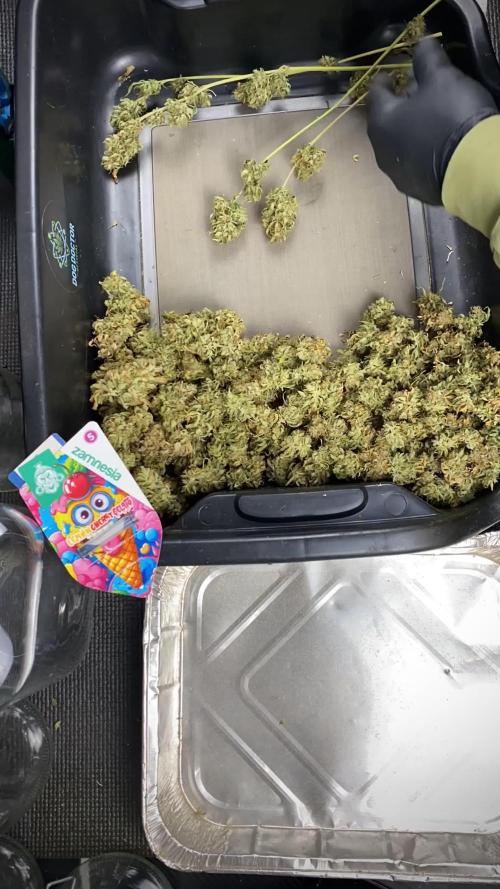
Mr. Baggy joined the trimming session 😄
Studio lights on.
Trim bin ready.
Scissors ready.
Music playing.
Gloves on.
And branch by branch, these girls slowly transformed into jars full of finished medicine.
And honestly?
These plants were absurdly sticky.
Not just frosty visually.
Actually greasy.
The kind of resin that keeps building layer after layer on the gloves until eventually you stop trimming for a moment and realize you accidentally created little hash sculptures on your fingertips again 😄
Which brings us to one of the best parts of this report:
Finger hash.
Or more specifically in this stage:
classic trimming resin collected during dry manicure.
Every session slowly left behind beautiful sticky resin on the gloves and fingers, and instead of wasting it, everything got collected carefully with patience and love.
And wow…
These girls made AMAZING finger hash.
Soft.
Oily.
Extremely workable.
Instantly greasy with just body heat alone.
No aggressive heat needed.
No real pressure needed.
Just the warmth from the hands was enough to start transforming the resin into beautiful little temple balls almost immediately.
That alone already says a lot about resin quality.
We even documented the full process:
- trim collection,
- kief separation,
- resin handling,
- pressing,
- shaping,
- and the final little temple balls.
And honestly, seeing the transformation from loose resin into a perfectly smooth little sphere never gets old. There’s something deeply satisfying and strangely ancient about it.
The final dry numbers honestly made me extremely happy too:
Plant 1:
304.5 grams dry trimmed flower.
Plant 2:
163.5 grams dry trimmed flower.
Total:
468 grams of dry cured manicured medicine.
And for a 12/12-from-seed run?
That’s honestly fantastic.
Especially considering how compact these plants actually were physically.
Small-ish structure…
massive output.
Exactly the kind of run that keeps teaching you not to judge plants purely by height.
The flowers themselves turned out gorgeous:
- dense,
- compact,
- extremely resinous,
- loud aroma,
- beautiful coloration,
- swollen calyxes,
- and surprisingly heavy for their size.
The terpene profile already started evolving beautifully during trimming too.
That loud fresh-harvest sharpness slowly began softening into something deeper and sweeter:
- creamy citrus,
- candy-like fruit,
- gas,
- soft cherry sweetness,
- earthy backend notes,
- and occasional creamy dessert-like moments depending on the jar.
And this is where curing now becomes incredibly important.
Because harvest is not the finish line.
Curing is where flowers slowly begin becoming complete.
For storage and cure, we decided to use both:
- traditional glass jars,
- and Grove Bags.
And honestly, both have their strengths.
Glass jars remain timeless:
simple,
effective,
reliable,
beautiful for long-term observation and burping routines.
Meanwhile Grove Bags bring modern humidity-control technology into the process and honestly make maintaining stable curing conditions dramatically easier when used properly.
The idea is not “one replacing the other.”
It’s more about understanding different tools and seeing how each behaves over time.
And speaking of beautiful details…
Huge thank you to Zamnesia for the gorgeous storage jars with the engraved lid design because honestly… they look incredible 😄
Little details matter.
Especially during cure.
Because curing becomes ritualistic in a strange way:
opening jars,
checking aromas,
observing moisture,
feeling texture changes,
watching flowers slowly mature week after week.
The medicine almost feels alive during this phase.
We also included:
- trimming timelapses,
- resin handling,
- branch breakdowns,
- finger hash photos,
- hanging flower shots,
- studio trimming moments,
- and a bunch of closeups because honestly these girls deserved proper documentation until the very end.
And next week…
Next week becomes the final chapter.
Smoke review.
Full cure review.
Flavor translation from smell to smoke.
Effect profile.
Breakdown texture.
Ash quality.
Terpene evolution.
Final impressions.
And the real question:
How did this Lemon Cherry Gelato actually become as medicine after all this time?
Because now the grow part is mostly over.
What remains is experience.
And honestly…
that’s the most important part.
Huge thank you once again:
- Zamnesia,
- Plagron,
- the LEDs,
- all the gear involved,
- GrowDiaries,
- the community,
- the old followers,
- the silent supporters,
- the curious new visitors,
- and everyone spending even a few minutes following these updates.
And of course…
Thank you Mr. Baggy 😄💙
He survived another trimming session somehow.
See you all in the final chapter 🌱

Likes
46
Share


@Chubbs
Follow
420 Fastbuds Week10
Gorilla Punch Auto
These beauties are about as done as I think they're going to get. Definitely will be chopping them in the upcoming week. They smell super strong so can't wait to see how they'll finish and dry. Being sticky would be an understatement for sure. Both did get a little crispy on a few of the leafs but I think thats do to lowering the lights in the tent. All in all Happy Growing.

Likes
4
Share


@ElQueso
Follow
Humidity to high but the circulation of air seems to be enough
Let's hope everything go's to plan


Likes
12
Share


@Skunkiest_bender39
Follow
The fimming does what I wished. The single headbud, „twin‘ed“ into 3 headbuds. The fimming also stops the vegetation, but most times luckily only the node of the headbud! Then does the twinheadbuds build a roof-crown with the other nodes.

Likes
15
Share


@Kurow
Follow
Here’s to fruitful buds! Alrighty been feeding every two days and did some decent defoliation on them today. Last weeks please be easy. 🙏🏾

Likes
8
Share


@4leksz
Follow
Diese Woche habe ich mir etwas einfallen lassen damit ich nicht nur Photos hinterlasse sondern auch etwas über mein System erklären kann.
Letzte Woche Sonntag habe ich einige Plants getoppt und sie schauen soweit ganz gut aus. Ich hatte leider letzte Woche he ein Problem mit dem Root Juice von Advanced Nutrients die Nährlösung in den Tanks ist gekippt. Ich habe es erst am zweiten Tag gesehen und habe sofort alles geputzt und Wasser gewächselt. Danach wieder alles eingestellt und läuft.
Ph: 5.7
Ec : 0.9
Ich habe auch jeweils 20g Mineral Magic in die Nährlösung hinzugefügt und 1 Teelöffel davon um den Stil der Plants gemacht.
In meinen 2 Videos findet ihr mehr dazu.
Happy Growing :)


Likes
2
Share


@StonerJesus
Follow
It was at this week I realized I’m not going to have the space!!
Had to set the tent in on its side and will top and lst these for the last half of veg.
My dumb ass bit off a bit too much; 6 plants ; 2 autos, 2 Fem’d Seeds and the two documented here.
Dropped the new carbon filter in as things are getting stanky. 6x24 Phat Carbon with cloud line line to make the tent closed except for watering only.
Next week and moving forward I’ll get photos in natural light!
Likes
10
Share


@Medgrow93
Follow
The Wonder Pie were showing signs of deficiencies so I added 2ml/L of liquid worm castings to see if it helps, also top-dressed diatomaceous earth to help get rid of the fungus gnats. Will top dress the powdered nutrients again in 1-2 weeks. Also foliar sprayed them with Sugar Candy Syrup to help with the deficiencies. I'll go with bigger plants next time because I think I won't get much from these smaller plants. Other than that, just waiting for them to do their thing and hopefully harvest in 5 weeks or so.

Processing
Likes
14
Share


@Thckaos
Follow
25-10-20 Se cambia la solución y se realiza un lavado de raíces. Para bajar la conductividad de las raíces de 2.05 a 0.2 ms para que la solución nueva sea más efectiva. Se corrige el PH de 7.8 a 5.6. La solución tiene 2.6 ms y 5.6 PH. Se añade una pastilla de CO2.
25-10-20 (2 horas más tarde) Se corrige el PH 6 a 5.6 Conductividad 1.9 ms con los nutrientes ya.
26-10-20 Se corrige el PH 5.8 a 5.6 Conductividad 1.95 ms.
27-10-20 Se corrige el PH 5.9 a 5.6 Conductividad 2.00 ms.
28-10-20 Se corrige el PH 6.00 a 5.6 Conductividad 2.03 ms.
29-10-20 Se corrige el PH 6.00 a 5.6 Conductividad 2.10 ms.
30-10-20 Se corrige el PH 6.00 a 5.6 Conductividad 2.14 ms.
31-10-20 Se corrige el PH 6.00 a 5.6 Conductividad 2.20 ms.
Likes
14
Share


@MasterKush714
Follow
Yooo update gang!!!! Let's Get It!!!!
Sooo it's a new week, super important week, taking clones Saturday morning got my Grodan 1.5 inch cubes washed and soaked in 5.8 Ph water and light feed solution with Cropsalt S/O! Fire nutrients!!! Gunna then plug them with Clonex and set them in the tray will start the next diary for that monday!!! ALSO flipping light schedule to 12/12 on Monday to Flower!!! Also I upped the nutrients as I will be switching to flower and I will continue as directed for 21 days and then introduce flowering nutrients other then that she is steady growing and stretching serious praying leaves up top stay tuned gang! Thank you for stopping by and stay brackin fam!!!! LFG!!!
****************************************
Update!!! 👹👹👹
Cloned her...that failed lol miserably had alot to do with the dome and me leaving it off at one point just all bad lol restarting the clone process lol

Likes
11
Share


@MrGoonai
Follow
12/12/24 Short Facts:
Watered: 1 x 2.4L, 1 x 2.5L, 1 x 2.5L — Total: 7.4L
VPD @ 1.4
Light @ 70% (~700 to 950 PPFD)
Stopped watering with fertilizers, only water, CalMag and Silicia Force
---------------------------------------------------------------------------------
I’ve stopped watering with fertilizer because I’m planning to harvest her in the coming days.
You can already see that she’s slowly dying. I hope she’ll put all her remaining energy into her flowers in these final days.
I’m going to dry her, but only because there’s a new method I want to try. You can now place the harvested buds into a special plastic bag immediately after harvest. These bags are designed to let water out while preserving the terpenes almost completely intact. One of the German grow shops selling these bags tested different samples in a lab, and the results seem to support their claims.
If it works, great! If not and the harvest ends up molding, I don’t mind. 98% of the harvest will already have to be trashed due to the legal limit.

Processing
Likes
13
Share


@MG2009
Follow
The mystery cookie males have been topped,and I will reveg them, mom is all alone, and able to stretch out a bit with more light.
Temps and humidity is stable.
05/16/2018
5weeks into flowering MYSTERY COOKIE males are removed, Captains cake heavily fertilized by the twins. Mom's last day in sunlight look at her colors
05/21/2018
End of week 5 flowering, getting more outdoor pics natural daylight, very sparkly hope my camera picks them up!


Likes
13
Share

@MrGrowDiarie
Follow
Day 42
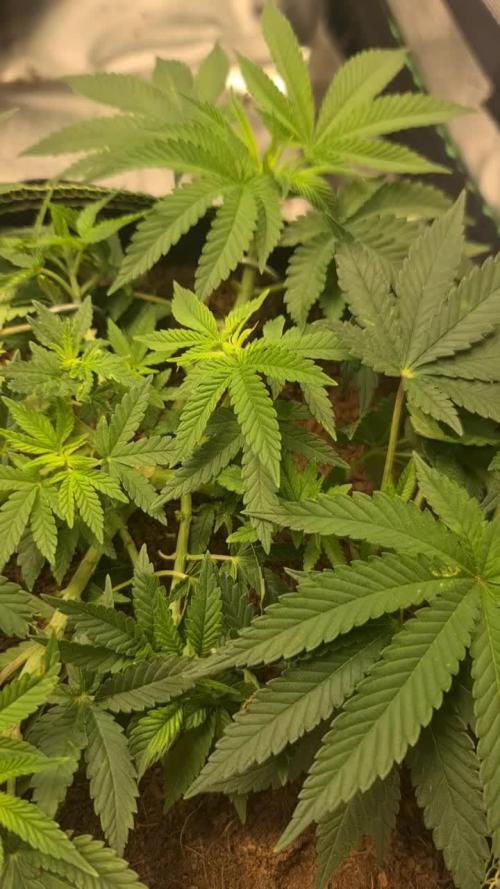
This girl is looking fantastic! The canopy is nice and full, with multiple strong tops forming evenly across the plant. The internodal spacing is tight, creating a bushy and compact structure that’s perfect for future bud development. Leaves are a rich, healthy green with no signs of stress, and side branches are stretching out nicely after training. Overall, she’s thriving and building a strong base for the flowering stage!


Likes
59
Share


@JeyGanesha
Follow
Un altra settimana è passata e tutto procede bene.per fortuna non ho più trovato nessun nanners 🙏✌️💪..belle piantine mie, continuate così che farete delle belle pannocchie....
30/8/24 gente ho combinato una bella cazzata.pur avendo esperienza, mannaggia a me,mi sono portato a casa dentro il box, il cazzo di ragnetto rosso... fanculo...
Ho già iniziato a ripulire tutto, box e piante con Neem...li sterminerò tutti 😂..
Likes
35
Share


@XperencdGmanXG
Follow
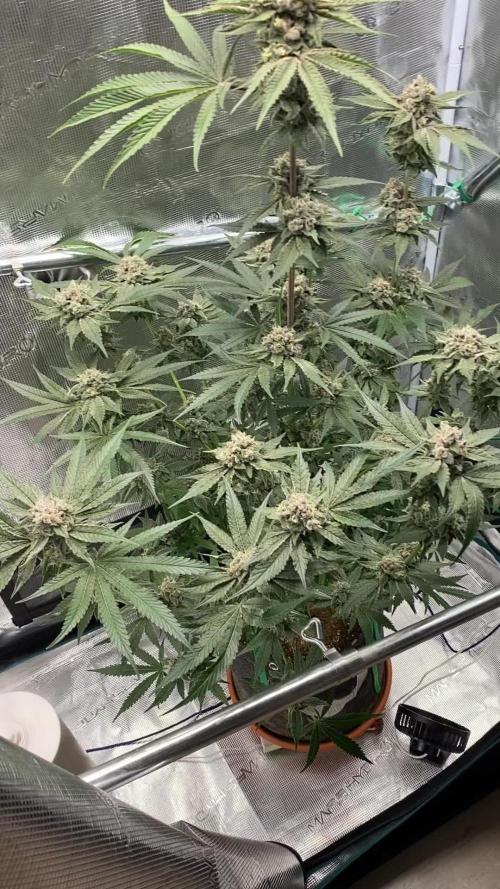
went to the lift & co. convention all weekend so I really couldnt update my grow diary. Things are going well and the plant is doing so well i think im going to put it outside this year.

Likes
36
Share


@pifflestikkz
Follow
Day 172
21/10/24 Monday
I had 1.5 Litres of feed left, and she was top dry this morning so she finished that off today.
Picture update 😎💚
I'll get one later with lights off 🙌
Day 174
23/10/24 Wednesday
De-chlorinated tap water pH 6 only today.
Finally update pictures and videos 📸 💚
She is developing awsome colours, and buds are now starting to stack weight 💪🙌
Day 177
26/10/24 Saturday
De-chlorinated tap water pH 6 only today, noticed a few tips burning.
She is stacking !! This week she has developed a really floral aroma is sweet and tantalising like a perfume almost.
She is glistening with trichomes, and buds are taking the dark 🌑 colour with purple/pink calyx tips.
Super duper sticky!!
Likes
9
Share


@DeepRootsGrowTrees
Follow
KICKASS AUTO by KANNABIA
Week #5 Apr 30th- May 7th
This week was the last week of veg as she started to pre-flower towards the end of the week she's 16 inches and so growing she has side branches that are also growing at a good rate she going to be a shorter busy lady. She looking 👍 nice and green no issues this week. She's loving being outside!! Stay Growing!!
KANNABIA.COM KICKASS AUTO
