Likes
Comments
Share
@Mrdub
Follow
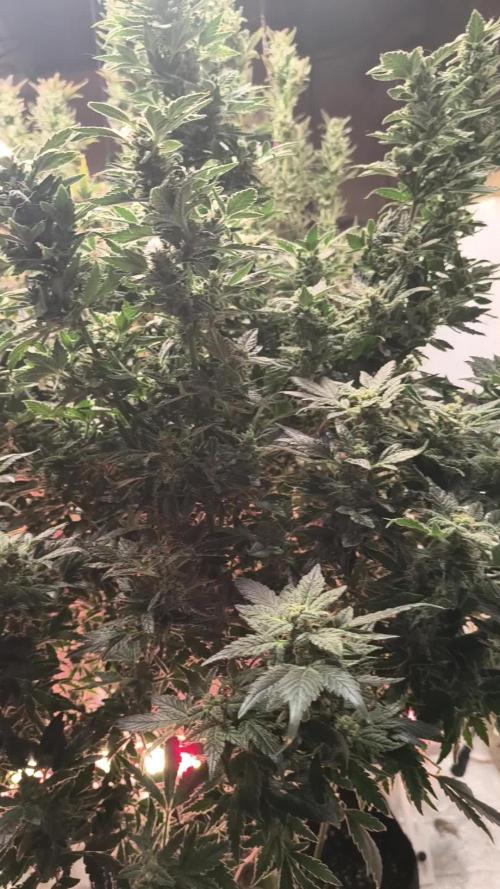
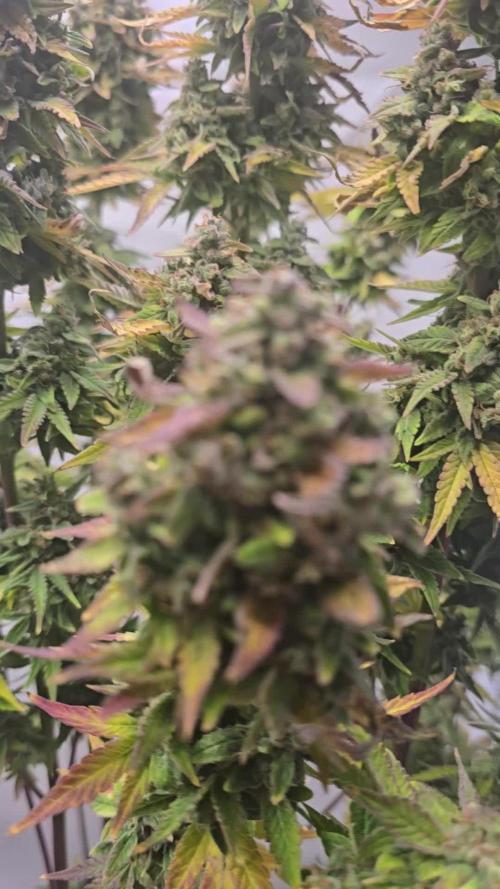
This girl is booming along colas starting to swell even more trichome coverage starting to reeks of rotten fruit kinda burns my nose a bit lol looks like she only has a few weeks left still waiting for the fade to start setting in loving these purple tips I'm going to get these branches spread out to get more light to inner colas she's so bushy don't look like I defoliated her but I did the added calmag had really helped I haven't seen any calmag spots so far running 6.2 ph lights at 100 percent give her a gallon of water every couple days now that I'm in late flowering I run one 24 hr cycle then let her rest for 8 hrs stopped using recharge jus feeding her heavy now starting to taper off so I can strating hitting her with the carbo flush and getting her ready for harvest so here's to another week of growing lfg

Likes
8
Share
Servus Moin! Die Pinapple Slush XL hat sich wohl erstmal erholt. Diese Woche ist super Wetter und das nutze ich, sie gleich draußen hinzustellen.
Likes
37
Share
Hello growers and tokers! 👋 👩‍🌾 🧑‍🌾.🔥💨 Settled great after last week's transplant. Start giving her grow nutrients this week and she got a nice stretch. I also topped her at the beginning of the week. These photos are from when I topped I couldn't get any pictures done at the end of the week. She took the topping nice and is growing fast. Unfortunately this is her last week in veg, next week I flip to 12/12 because all the other ladies are ready. Stay tuned for updates on this little one. If you like what you see check out the other strains sharing the tent. Have a great Cannafam!
Likes
97
Share
@Natrona
Follow
Divine Seeds Auto V.2 Contest 👉Sponsored Grow👈 Big Demon Auto W11F6 8/10-16 Watered at the end of last week and have not watered yet this week. I have been foliar feeding at least once a day with the following blend. Calmag 15ml Plant Juice 60ml GH bloom 5ml Green Sensation 4ml Feed was ph 6.37, ppm 784 at 65f. I ph’d the water down to 6.25 with brought the runoff down to a range of 6.7-7.42 on the plants in the tent. I think it should be lower, but in the meantime, I hope this helps my tent family recover from lockout. Big Demon is starting to show some lavenders in her buds as they slowly develop. Thank you all for your continued support and encouragement. Your likes and comments motivate me to keep sharing my journey. Let’s continue to learn to grow together! Stay green, growers love 💚🌿 💫Natrona💫
Likes
25
Share
Elle grandit bien mais j’ai de la difficulté à m’ajuster avec se qu’elle demande en Nutriments et en eau Légère brûlure de lumière à quelques endroits.
Likes
6
Share
@Headies
Follow
They started growing strong this week!
Likes
24
Share
@nonick123
Follow
Día 101 (09/09) Riego con 500 / 1000 ml H2O pH 6,5 Parece que se ha parado un poco el amarilleamiento que subía tan rápidamente por las plantas! Día 102 (10/09) Riego con 500 / 1000 ml H2O pH 6,5 Excepto LemonPaya, todas las plantas empiezan a llenarse de tricomas! 😍 Día 103 (11/09) Riego con 500 / 1000 ml H2O pH 6,5 Estoy emparanoiado con que la floración va lenta... Día 104 (12/09) Los cogollos no se están formado correctamente... Algo pasa... Los pistilos tienen un extraño color verde y no engordan... OnionOG #1 es la única que tiene un ritmo normal... Riego con 250 / 500 ml porque las temperaturas empiezan a bajar a 25 ºC diurnos / 22 ºC nocturnos y está bajando el consumo de agua... Día 105 (13/09) La deficiencia empeora... Solo se salvan OnionOG #1 y KS1 #2... Día 106 (14/09) La deficiencia sigue empeorando... Solo se salvan OnionOG #1 y KS1 #2... Día 107 (15/09) La floración se ha ido al traste! (Excepto OnionOG #1 y KS1 #2) Tras preguntar a Lurpe, GD e IG concluyo que el super soil tiene un bloqueo de nutrientes Debido al bloqueo, se ha detenido la floración en 4 de las 6 plantas Siguiendo las recomendaciones de Lurpe, hago flush hasta que el agua de escorrentía tiene una EC 2,5 (1250 PPMs) A ver si les da tiempo a recuperarse... 💦Nutrients by Lurpe Solutions - www.lurpenaturalsolutions.com 🌱Substrate PRO-MIX HP BACILLUS + MYCORRHIZAE - www.pthorticulture.com/en/products/pro-mix-hp-biostimulant-plus-mycorrhizae
Likes
10
Share
Likes
19
Share
@Haoss
Follow
I have to dry the buds in the dark at 20 degrees in 50% humidity 💯
Likes
6
Share
The plant is still going strong, but I noticed that the colors have faded a bit. Not necessarily a bad thing, though—I realized the temperature difference between day and night was a bit too extreme, which probably caused unnecessary stress. It did look absolutely stunning with those colorful leaves, but stability is more important now.🌱 Other than that, everything is going great! The buds are getting thicker, stinkier, and completely covered in frost.😍 The dominant smell is still pink pepper, which is really interesting. Sometimes I get a hint of something sweet, but I’m not sure yet if it will develop more over time.💚
Likes
29
Share
***Note that I started to count the days when I placed the seeds between paper towels. The seeds were planted 3 days later and sprouted from the ground 2 days after being planted. D80 (13/05/2021): I'm looking at the trichomes every other days. Glue Gelato is starting to show amber on top buds. No amber for Banana Kush and Gelato. This time I will chop them all at the same time so the one I will rely on is the Glue Gelato. As soon as she is ready, I will harvest them all. Banana Kush and Gelato would probably need more, but in term of logistic, I need to harvest all my plants at the same time. D83 (16/05/2021): Not ready yet. I'm checking trichomes closely! 😬 - Light: the lights are at 100% and at 12 inch form the plants. - Temperature: during the day: 24-25C ; during the night: 20C. - Humidity: the humidity is maintain around 46-48% all the time. - Air circulation: There is an oscillating fan on the ground, one fixed fan pointing on top of the canopy and one fixed fan to help cool the lights. - Water: I gave water every other day or when the ground feel dry or the pots feels light. - ***IPM: I never mention it but I'm using nematodes pouch as an integrated pest management. I had trouble with pest in my first grow and I learned from it. That's the only thing I do for pest and of course watching closely and regularly at my plants 😊
Likes
11
Share
This lovely lady is on the mend from a little bit of light burn. Adjusted the light with my digital watt meter (easily picked up off Amazon for 20$ ) and she is bouncing back. RH has been steady at 65% this week with temps hitting 78-79 degrees before my in-line fan takes care of it. Increased watering amount to about 350 ml per feed, while also adding 1 more ml of the Sensi cal mag to the mix. Happy Gardening 🇨🇦👊❤️
Likes
84
Share
Friday, Feb. 19th. Today Iam going to make a Grow just for me I bought in November the 25 Years Anniversary Box from T.H. -Seeds Today ive chosen the Bubblegum Its just because ive grown it once and only had 1 Plant ( clone) and it was soooo delicious We will see if i can repeat that Taste with the " Legendary Bubblegum" from T.H.-Seeds As I have a bigger Growspace, these Girls are going to start under 12/12 Lightschedule Starting in 3l Airpots and then transplanting into 11l Amended Soilmix ( RQS Easy Boost Organic Nutrient) I took 3 Seeds, they were looking quite lightgreen--------and put them into a Glass of lukewarm Water for a few Hours Tomorrow i am going to make Further Germination under a wet Kitchensponge Saturday Feb. 27th. Those seeds took longer to Germinate than the other Strains But on saturday Roots were long enough to Plant them Monday Plants show barely up... still in Shell... one looking like wilted yeah we will see in the next 2 days who made it Girls are growing under 12/12 in the Big Tent. its quite dry here ( RH 40 or less) and they have to fight more, than in the other Tents But in the End.... Cannabis grows under nearly every Condition... its just the Question how good so stay tuned for the next update.... in week 1 Stay Tuned Saturday Feb.20th After a few Hours sokaing into Water, they moved under a wet Kitchensponge for further Germination Then they are covered and placed on a warm Spot. Breeders Information: Bubblegum is one of the first strain in T.H. Seeds collection. It was created in 1993. Today Bubblegum is an outstanding and famous cannabis variety with a big amount of awards. The plant demonstrates a good stabillity. It has a quite short size and reaches to 120-160 cm tall. The harvest comes after 55-60 days of the flowering and produces yields of 350-500 gr/m2. The smoke provides an intense fruity flavor and a mostly indica effect.
Likes
2
Share
We become aware at such times of man's wonderful ability to bring seemingly unrelated elements into harmonic balance, and receive a glimpse into a world where everything exists in conscious sympathetic attunement to everything else. When we listen to a piece of music that seems to strike a beautiful chord somewhere inside us, or view a painting that simply glows with harmonic awareness well executed, we probably do not spare much time to contemplate the wonderfully intricate combination of vibrations that our sensors make it possible for us to perceive. We tend to appreciate the relationship between the parts of something by an awareness of the harmony or dissonance of the whole. This ability enables us to say "what a beautiful house!" instead of "analysis has proven that this collection of building materials exhibits certain elements of harmonic proportion." While this ability to instinctively appreciate the beauty of true harmony has an important role to play in evolution, a more analytical understanding of the laws involved can be most useful. This is especially so if we wish to create works of art where each part exists in true harmony, not only with the other part of that particular whole, but with the universe within which the creator and the created exist. Everything vibrates. From the most dense matter to the most subtle cosmic rays, everything which our senses allow our thoughts to become aware of, can be specified in terms of wavelength or frequency of vibration. These two terms define the same thing, but from different points of view. The following are the approximate wavelengths of various energy carriers: Cosmic rays 0.000,000,001 mm Gamma rays 0.000,000,1 mm X rays 0.000,500 mm Ultraviolet rays 0.003 mm Visible light 0.006 mm Infrared 0.01 mm Sound waves 1 meter Radio waves 300 meters Violet light 400 nm to 450 nm Blue light 450 nm to 500 nm Green light 500 nm to 570 nm Yellow light 570 nm to 590 nm Orange light 590 nm to 610 nm Red light 610 to 700 nm 1 nanometer (nm) = 0.000,000,1 cm = 1/10,000,000 cm If a guitar string is plucked and we hear a sound, it is not too difficult for the human mind to associate this sound with the vibration of the guitar string. With color it is quite different. It is difficult for us to conceive that the color of a substance is not an inherent property of the substance itself, but an indication picked up by our senses of that substance's ability to absorb or reflect the light which happens to be shining on it at that moment. Neither the matter nor the light is colored. What happens is that the brain learns to differentiate between the frequencies reflected or transmitted by the substance the eyes are focused on. The same thing happens with sound. When we say "Oh! Listen, they're playing my favorite song," what we really mean is: "My brain has stored within it a particular pattern of frequencies. I have compared the new information being received with this stored pattern and have deduced the answer that the two patterns are similar within certain specified tolerances." The 'pleasure' involved could have something to do with our running the pre-recorded pattern at the same time, in 'sympathy' with the new pattern as it is received. The word sympathy describes very well our ability to appreciate color and sound. It also describes the reason behind certain elements of harmony. For instance, if a substance vibrating at 100 cycles per second (tone 1) is in the proximity of another substance vibrating at 200 cycles per second (tone 2), we could perceive, if we had the right equipment, a certain sympathetic relationship between the two. We will see from this that there is a uniform doubling of the first tone seen in the second. At various points along the waves, the two are the same in amplitude. At other points, they are at opposite poles to each other. This doubled frequency has more points of similarity to the original than any other frequency except the original itself. If the equipment we had available for measuring these two frequencies was a soundboard amplifier and a pair of ears, then we would hear what would sound to us like one tone. If we had the opportunity to hear one at a time, we would hear that although they sound the same, one is higher in pitch than the other. This characteristic of 'the same but different in pitch', musicians have called the octave. Any two tones produced where one has exactly doubled the frequency of the other is called an octave. Speaking in ratios, an octave would appear then as the ratio 2:1 or 1:2, depending on whether we are talking of an octave up or down. A single note produced by almost any instrument will contain more than one wavelength or frequency. It will have a dominant frequency, the wavelength of which we would call the note's 'fundamental' or 1st harmonic. It will also have a varying number of upper harmonics, gradually fading in intensity into infinity or silence. Natural harmonics always have the same pattern of intervals between them. The interval between the 1st and 2nd harmonic is a perfect octave; between the 2nd and 3rd a perfect fifth; between the 3rd and 4th a perfect 4th; and so on, the intervals becoming smaller and smaller until they lose any relationship with the western 12 tone scale as it exists at the moment. Just as an octave has certain elements of sympathy with its fundamental, so some intervals have been noted to be more perfectly in sympathy with the fundamental than others. The ratio of the 'perfect 5th' or interval of 7 semitones, as it occurs in the harmonic series, is 3:2 or 2:3, while that of the 'perfect fourth" is 4:3 or 3:4. All the tones in the western 12 tone scale can be expressed in terms of the ratio between the upper tone and its fundamental. This would seem to be an ideal way of generating a scale from any given fundamental and several attempts have been made to do this, the Pythagorean system being probably the most well known. Although when working with a single tone instrument playing on its own, the Pythagorean formula works wonderfully well, if we had several instruments tuned this way together and asked them to play almost any western music, we would find that at times they sounded quite out of tune to each other. The lack of flexibility of the various scale systems based on the harmonic series has led to what is known as the 'tempered' scale. This uses as its primary unit of interval the ratio of the octave or 2:1. It then proceeds to divide the interval between any fundamental and its upper octave into 12 smaller intervals by applying the ratio: two to the one-twelfth power, to one (21/12:1). This equals 1.059463094, so by multiplying any frequency by this number, we will obtain the tempered semitone next up from our fundamental. We will also find that any tone twelve semitones up from any other tone, in a scale generated in this way, will have exactly double the frequency. If we took the note middle C on a piano and halved the wavelength, we would have the note C one octave above. If we halved this, we would have the C above, and so on. However, within about 6 octaves, we would find that although a 'sound' was being produced, no human ear could perceive it. If we kept on going, halving and producing upper octaves of our fundamental C, we would proceed through the infrared band, into the visible light spectrum. If we happened to be outside during the day, we would, for one octave only, see the note C with our eyes. The next octave above would already be in the ultraviolet band, and outside the eye's sensitivity range. If we can think of color as being an indication of a substance's vibratory rate or wavelength, we may begin to see a relationship that could exist between the color and sound spectrums. The logical extension of what has so far been said is that there exists a scale in the color spectrum that corresponds exactly to the scale in the sound spectrum, each color tone being an octave of the equivalent note in the sound range. This is not the end of the story but only the beginning. If we can for the moment accept that any wavelength in one band has upper and lower octave stretching out to infinity, then the next question is 'fine, but what shall we use as our fundamental? A particular color? A particular sound frequency?' The musicians among us will probably say 'A 440'. This means that the note A should vibrate at 440 Hertz, or 440 times per second. They would tell us that this is standard pitch has been adopted by most orchestras around the world; pianos are tuned to it, instruments are constructed to formulas based on it, and so to them it would probably seem the most appropriate place to begin. Some of these musicians may know of the battle that is still raging with regards to this being the standard, but few would know why A = 440 Hz was chosen except that it worked when it was set to be a suitable compromise between the many different pitches in use at the time. 432 Hz is said to be mathematically consistent with the patterns of the universe. Studies reveal that 432 Hz tuning vibrates with the universe’s golden mean PHI and unifies the properties of light, time, space, matter, gravity, and magnetism with biology, the DNA code, and consciousness. When our atoms and DNA start to resonate in harmony with the spiraling pattern of nature, our sense of connection to nature is said to be magnified. Another interesting factor to consider is that the A=432 Hz tuning correlates with the color spectrum, while the A=440 Hz is off. Audiophiles have also stated that A = 432 Hz music seems to be non-local and can fill an entire room, whereas A=440 Hz can be perceived as directional or linear in sound propagation. Once you adopt the idea that sound (or vibration in general) can have an equalizing and harmonizing effect (as well as a disturbing effect), the science of harmony can be applied to bring greater harmony into one's life or tune to specific energies. There is a form of absolute and relative harmony. Absolute harmony can, for example, be determined by the tuning of an instrument. The ancients tuned their instruments at an A of 432 Hz instead of 440 Hz - and for a good reason. There are plenty of music examples on the internet that you can listen to in order to establish the difference for yourself. Attuning the instrument to 432 Hz results in a more relaxing sound, while 440 Hz slightly tenses up the body. This is because 440 Hz is out of tune with both macro and micro cosmos. On the contrary, 432 Hz is in tune. To give an example of how this is manifested microcosmically: our breath (0,3 Hz) and our pulse (1,2 Hz) relate to the frequency of the lower octave of an A of 432 Hz (108 Hz) as 1:360 and 1:90. It is interesting to note that 432 Hz was the standard pitch of many old instruments and that it was only recently (19th and 20th century) the standard pitch was increased. This was done in order to be able to play for bigger audiences. Bigger audiences (more bodies) absorb more of the lower frequencies, so the higher pitch was more likely to “cut through”. One of the oldest instruments of the world is the bell ensemble of Yi Zeng (dated 423 BC), tuned to a standard F4 of 345 Hz, which gives an A= 432 Hz. The frequency of 345 Hz is that of the platonic year! Similarly, many old organs are tuned in A=432 as well; for example, St. Peter’s Capella Gregoriana, St. Peter’s Capella Giulia, S. Maria Maggiore in Rome. Maria Renold’s book “Intervals Scales Tones and the Concert Pitch C=128 Hz” claims conclusive evidence that 440 Hz and raising concert pitch above scientific “C” Prime=128 Hz (Concert A=432 Hz) disassociates the connection of consciousness to the body and creates anti-social conditions in humanity. The difference between concert pitch A=440 Hz and Concert A=432 Hz is only 8 cycles per second, but it is a perceptible difference of awareness in the human consciousness experience of the dream we share called existence.
Likes
14
Share
I am very happy with the results of this growth cycle. I have improved my techniques for growing plants (LST and topping) and methods for stopping mite infestation. I didn't get a great harvest(not too much big flowers), but I like the result, nice compact and very good smelling buds.I make a wet trimming process and after this I tried for the first time to wash the buds before the drying process, because I use the foliar products to defeat the mites and the result is excellent (the ganja tastes good when I smoke it). Next time I will try to grow bigger and denser flowers to get a bigger harvest💪💪😊. An excellent plant that I would recommend to beginners, who want to experiment without risking too much.
Likes
5
Share
My baby girls is looking much more stronger now that the nematodes are doing their magic and are eliminating little by little those horrible gnats. I'm using straw to cover the medium so I can avoid the direct light for the beneficial bacteria in this case a nematode called steinernema feltiae excellent to get rid of the freaking gnats! I just cannot wait to see this wonderful amnesia pro im full flower!
Likes
7
Share
Stressing them out let’s see what they got
Likes
14
Share
Posting the phenos when I do them
Likes
46
Share
Welcome to week 4 📅 Day 22 6/28/2021 I started the sog 2 days ago and it is coming along great and they look very good with no signs of trouble. happy growing and ill see you again on Thursday I would like to say a few words about Mars Hydro. the TS 1000 is a great light and I love the fact that the power supply is capable of being separated from the light and located outside of the tent to keep the heat down. I also like the fact that you can control the light intensity and daisy chain with another light witch is what I plan on doing.
Likes
2
Share
Defoliated 3 of the 4 2x Royal Critical and 1x F1 Orion. The zombie has started to grow will be a couple of weeks behind the rest. But its ALIVE its ALIVE 😂. They are soaking up the water and will add nutrients from next week 6