


Likes
Comments
Share

@squalino
Follow
🌿 Journal de Culture : Mac 1 – "Spirit" (Plante #2) – Floraison Initiale
Date du jour : 20/05/2026
Âge de la plante :
J+46 (Semaine 7)
Taille actuelle :
94 cm (avec LST + SCROG)
Évolution :
+32 cm depuis la dernière mesure (Malgré le tricotage sous le filet !)
Grand déménagement réussi ! La Permanent White Marker ayant libéré l'espace, j'ai enfin pu installer Spirit et sa sœur dans leur nouvelle tente. Et le moins que l'on puisse dire, c'est qu'elle a explosé.
📊 État de Santé & Évolution de la Structure
Un monstre de vigueur :
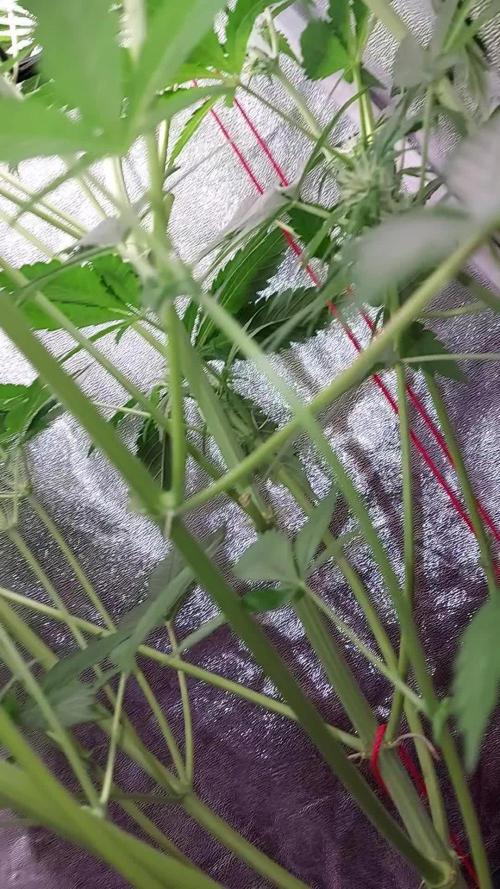
Spirit affiche une structure tout simplement monstrueuse. Même si sa sœur prend énormément de place en largeur dans la tente, Spirit a décidé de s'exprimer en hauteur. Malgré le LST intensif et l'installation du filet de SCROG pour essayer de la contenir, elle dépasse largement sa sœur jumelle.
Stade de Floraison :
La transition est bien confirmée, nous sommes en plein début de floraison. Les premiers pompons se forment et sont recouverts de magnifiques pistils bien blancs et vigoureux.
Le défi de la hauteur :
C’est la grosse bataille du moment ! Avec le pot surélevé, le haut de la plante culmine désormais à 1m35 du sol. Mon plafond étant bas, la marge de manœuvre devient critique : il ne me reste plus que 20 cm de battement maximum avant de toucher le haut de la tente.
⚙️ Paramètres Environnementaux & Culture
Lumière :
Toujours à 75% d'intensité. En raison de sa poussée verticale incontrôlable, la canopée ne se trouve plus qu'à 37 cm de la lampe.
Je surveille de très près pour éviter tout stress lumineux ou thermique.
Climat :
Températures maintenues à 24°C le jour et 21°C la nuit.
Humidité en hausse :
L'hygrométrie est montée à 60%, ce qui est un peu haut pour ce stade. C'est sûrement lié à la présence des Autopots et du réservoir principal dans la même pièce. Pour redresser la barre et sécuriser la floraison, j'ai mis en route le déshumidificateur.
Arrosage & Nutrition :
J'ai coupé l'arrivée d'eau du système Autopot hier. L'objectif est de laisser le substrat s'assécher légèrement afin de pouvoir lui administrer manuellement son premier boost de floraison : le Bio PK 5-8 de Biotabs.
le 21/05
Apport de 0,75 cl d'eau avec 4 ml de PK 5-8 biotabs PH 6,3
📝 Résumé de la situation
Le phénotype de Spirit est impressionnant de puissance, mais il va falloir continuer à tricoter fermement les branches les plus hautes sous le filet de SCROG si le stretch ne s'arrête pas rapidement. Les signaux sont au vert : les pistils sortent massivement et la plante déborde d'énergie. Le passage au PK 5-8 va venir nourrir cette structure massive pour maximiser la formation des têtes.
Pour éviter toute confusion dans mes prochains suivis, sa figurine fétiche veillera sur le pot jusqu'au cut !
🙏 Remerciements
Un immense merci à @mia_biotabs et à Mrs_Larimar pour votre accompagnement et vos précieux conseils qui me permettent de dompter ce monstre vert, ainsi qu'à tous les passionnés qui partagent cette aventure avec moi depuis le premier jour.
Suivez l'évolution de Spirit, la suite s'annonce chargée en résine ! ❤️❤️❤️❤️❤️

Likes
11
Share


@Nutrient_gro
Follow
Just been adding water when dry. Adding some pure worm castings top dresses. Will be adding Gaia green all purpose in a week or 2 when needed.

Likes
8
Share


@s99mrgreen
Follow
I added more pictures of Super silver haze, she's baby and only 3 weeks to veg. Just showing

Likes
68
Share


@715creeks
Follow
I'm not sure what to do with this plant now, it seems to be more leaf than bud and there doesn't seem to be any coming.
it's probably time to cut my losses with this one?

Likes
Comments
Share

@Bread_n_Buds
Follow
Sativa Fiesta – Zamnesia Seeds | Germination & Early Growth
The start with these two Sativa Fiesta seeds has been very straightforward so far.
Both seeds cracked in less than 24 hours after being placed in water, showing a quick and healthy start. After being transferred into soil, they took around two days to break through the surface. Germination and emergence were both smooth, with no issues or signs of stress along the way.
The seedlings are currently looking healthy and vigorous, with good color and steady development. They are already a little taller than some of the other plants in the grow, which could be expected considering the 70% Sativa genetics. Sativa Fiesta is part of Zamnesia’s Experimental line, with strains going through a selection and testing process before being released commercially. According to Zamnesia, Sativa Fiesta successfully made it through that process.
The genetics are listed as Mexican × Pakistani Hash Plant × Durban, resulting in a predominantly Sativa profile. The reported terpene profile includes caryophyllene and myrcene, with sweet, earthy, spicy and herbal notes.
For this grow, I’m using Zamnesia Vegan Grow as the nutrient, together with the Zamnesia Ecosystem grow box, equipped with its ventilation system. Lighting is provided by the Zamnesia Phytonaut LED 480W.
At this stage, the main observation is simply how easy the start has been: fast germination, quick emergence and healthy-looking seedlings from both seeds. The slightly taller structure is something I’ll keep an eye on as vegetative growth develops.
**Strain:** Sativa Fiesta
**Breeder:** Zamnesia Seeds
**Line:** Zamnesia Experimental
**Genetics:** Mexican × Pakistani Hash Plant × Durban
**Genotype:** 70% Sativa / 30% Indica
**Type:** Feminized, photoperiod
**Terpenes:** Caryophyllene, Myrcene
**Flowering time:** 9–10 weeks
**Indoor height:** up to 150 cm
**Outdoor height:** up to 300 cm
**Reported THC:** up to 25%
**Reported CBD:** 0–1%
**Aroma:** Sweet, earthy, spicy, herbal
Grow setup:
🌱 Zamnesia Ecosystem Grow Box
💡 Zamnesia Phytonaut LED – 480W
💨 Integrated ventilation system
Zamnesia Vegan Grow
All the products used in this grow are available at
www.zamnesia.com

Likes
12
Share


@Herbz_Unkraut
Follow
Defoiled alot of leaves underneath and some of the leaves that put shade on budsites
Also defoiled for reducing RH and increasing airflow
Likes
14
Share


@BudBrewerz
Follow
The sherbet is looking healthy and strong , nice green leafs. I still did not pot her out into a bigger pot, I had planned on doing this the week that passed, but it didn't happen just yet. I did some pulling on some of the toppen branches though to get them a little more even in height. I will get her into the new bigger pot very soon. And spots are opening up in the blooming closet, so as soon as I get this Tent-X controller online , she will probably be moving out to the blooming closet
Likes
33
Share


@STAYINGONMYMAINCBATORUNTWO
Follow
I am officially in flush now! I love how far I have come with these girls! They have started to plump up nearly the size of 2 clipper lighters in width! The smell is so sweet and after the touch you can smell the caramel all through it! I can’t wait to taste!


Processing
Likes
4
Share


@Strife957
Follow
This week was hottt.
I have been out sic l8ly sorry 4 no updates.
The girls r still growing strong. With very little maintenance.
I gave them each 5 gallons of water with nutrients on Sat, (early morning since it was a heat wave)
I defoliated (the lower branches became shaded out) and now the little bushes are taking upon a more tree like appearance.
They are all just under the 7 ft roof, with training.
They were hitting the roof and getting wet (morning dew), so i put more fans inside, (also the 90+ outside temps).
No problems with heat.
I will start making preparations 2 switch them 2 flower at the end of this month :)

Likes
7
Share


@Rompilator
Follow
The strawnana hybrid is getting super frosty and its not stopping 😄. Sweeter kush smell but its gassy and and puts off great aromas. I finally finished drying the pink candy hybrid and its phenomenal! Super funky smell that has a slight sweet Gassyness to it. Smell totally changed after drying and it is super potent as well. Considering getting it tested. I'll never see this strain again
Likes
5
Share

@PapaTerps
Follow
ZodaZa - Umami Seed Co.
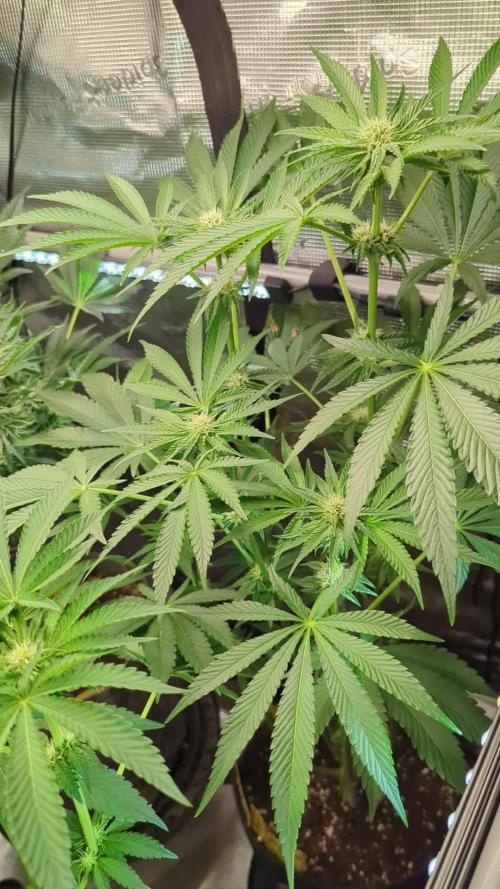
Day 66 - watered with 2L of RO tap water with nutrients mixed individually in order and then pH'd to 6.3. She's has finished her stretch phase and is now focusing on developing her bud sites! I've lollipopped her to about four nodes from the canopy, as the lower nodes would never receive enough light to develop in time, it will also give the canopy all that extra energy 🙏🏻 Her aroma is just about to come through, but it's a little too early to fully decipher it. She's had a good amount of stress now, so I'm going to leave her alone for the next couple weeks and just allow her to grow 💪🏻


Likes
199
Share


@Teamdirtbag2
Follow
The autos are flowering and just loving the sun. They are drinking daily. What a difference the sun makes.
The others are moving soon. Gorilla is ready.
Slurricane is ready to be cloned. So I must find time to set up the cloner. Maybe I'll go old school with it. Once I top her she will start branching. This is what we need more clones.
I've been having trouble with seeds, got some more coming. I just dont have the time or energy to take care of them. That is obviously the problem here. The fluctuating humidity from 10% to 99% doesn't help.

Blue Gelato 41 · Barney's Farm
Gorilla Zkittlez · Barney's Farm
ShiskaBerry · Barney's Farm
CBD Lemon Potion Auto · Barney's Farm
Pineapple Express Auto · Barney's Farm

Cream Mandarine Auto® · Sweet Seeds

Foul Mouth · Dungeons Vault Genetics

Fire OG · Custom Breeder & Strain

Slurricane · In House Genetics

Moon Walker Kush · Spliff Seeds
Strawberry Lemonade · Barney's Farm
Purple Berry Kush · Spliff Seeds

Diesel Fire OG · Relentless Genetics
Spliffs Strawberry · Spliff Seeds
CBD Spliff Berry · Spliff Seeds
Citrus Farmer · Dungeons Vault Genetics
Tahoe Kush · In House Genetics
Likes
6
Share


@pzwags420
Follow
On week 2 she is putting out much more preflowers. She is stretching for sure but still maintaining excellent node spacing. the average ppfd is 850.

Likes
4
Share


@Elpatron152
Follow
Hello everyone, Everything is smooth just i put the scrog to late the delivery was late, but everything good will see how is going

Likes
11
Share


@TgOgFaRms
Follow
I'm thrilled to provide you with the latest update on my flourishing journey. We have now entered week 2 of the flowering phase, and I must say it has been an exceptionally productive period. The plants have undergone a significant stretch, showcasing robust growth and a remarkable level of health. 🌿🌸💪🌱
Despite the positive progress, I can't help but feel a hint of apprehension due to an unfortunate incident experienced by a fellow grower. One of their plants unexpectedly hermaphroditized during the same stage we are currently in. 😬🚫⚡️
Our collective venture involves four individuals, and at present, two of us, including myself, are in the initial week of flower. The other two participants are at week 5 and 6. Fortunately, the fourth member seems to be experiencing smooth sailing with their plants. 🌿👥💚🚢
Stay tuned for further updates as we navigate through this critical phase of cultivation. Let's remain vigilant and provide the utmost care to ensure a successful and abundant harvest. 🌿🌸🌱🌾
Happy growing! 🌿💚🌱

Likes
8
Share


@Kindbudz
Follow
This was the most beautiful grow I have done to date. There were a few mistakes I made along the way, like not defoliating enough and some over topping but I still highly impressed with the results. Looking forward to growing this again.

Likes
2
Share


@TheOtherSide
Follow
4/22/24 - 4/28/24
-----------------------------------
4/2 - Seed popped
-----------------------------------
3 Gallon Fabric Pot
50% Cana-Coco
25% Vermiculite
25% Perlite
-------------------------
Tent:
2’x4’x5’ GA Tent 600D
1 Gal Humidifier
1x 6” Clip Fan
1x 28” Oscillating Fan
1x 4” Carbon Filter with 2x 200 CFM
-------------------------------------------
3 Gallon Tall Fabric Pots
Spider Farmer SF1000 LED - Spider-Farmer
Optic 1 54W 3500k - opticledgrowlights
Optic 1 XL 100W 3500k – opticledgrowlights
Optic 1 XL 100W 3500k (Dimming) – opticledgrowlights
Cana COCO - Coco Brick
Perlite - Sta-Green
Vermiculite – Sta-Green
Filtered Water – Everest Machine
Botanicare Cal-MAG Plus
General Hydroponic – Flora Series
General Hydroponic – pH Up, pH Down
Great White - Root Magic Mycorrhizae+
Real Growers – Recharge
Fish Head Farms – Fish Shit
Brer Rabbit – Blackstrap Molasses
Likes
21
Share


@OGTrauma
Follow
Ill write from pc but as im trying to add a new nutrient i need to see if bulk ups without od
The update, and some source of knowledge - sadly the product is not registered .
https://www.growbaratochile.cl/thc-fertilizantes/sales-de-epson.html
https://www.royalqueenseeds.com/blog-epsom-salts-a-natural-hack-to-grow-healthy-cannabis-plants-n837
Thus: big gas leaks homies have nice halloween, the reason i'd flooded with photo this week was i needed to record any negative reaction caused by the incorporation of epson salts on the watering as i understand this shit also adds sulphur and be spreaded on soil for slow release, fixing too light or weakened soils , something i can't do with cal mag from bac, but that product has other sceneario where i can both water or spray on veg until early flowering so i wanted to try it but i didn't know the ratio, and the purposed spoon i used it on 1.5lt of water on 9 x 11lt Killer Kush that were soft to mild on specific carencies , additionaly, of using a very demanding food schema by boosters can accentuate the lack of specific nutrients like Calcium and Magnesium , so this add thick kick of Mg prevention as it pretty neat it's understanding, except on instructing the dosage and application. I did some barrier as is the last week i can do foliar spray as these bastards but furthermore is really a red flag as u can create the conditions for contract some fungi.
By a lot of having still figuring out the perfection of both illumination & thermals , still trying to enhance the light spectrum , and doing the first interaction with uv exposition to check that plants dont stress or physically burn, as i want to do the uv shit for late flowering as i expect by genetics this shit SHOULD BE A QUICK FLOWERING so, im entering to late flowering and do it for entire 4 weeks and then consider if plants show that are ripe enough, considering there is a quick underdeveloped automatic at bottom on a 12/12 scenario, and thus that motherfucker will not be forgiven by it unstability of this batch. 👻
Also i noticed i had slight fox-tailing that was quite provoked by messed up outside weather, so i still may need to ellaborate on lights to prevent excess of generated heat as well, as can incur in some penalty . I have a faint idea how to deal with as HEAT HERE WILL BE HELL.
Likes
10
Share


@Stanp
Follow
Both Growing amazing.
Did a full defoliation on all big leaves on the fruit spirit.
The 3 G looks dangerous!!