




Likes
9
Share


@TiRobotProds
Follow
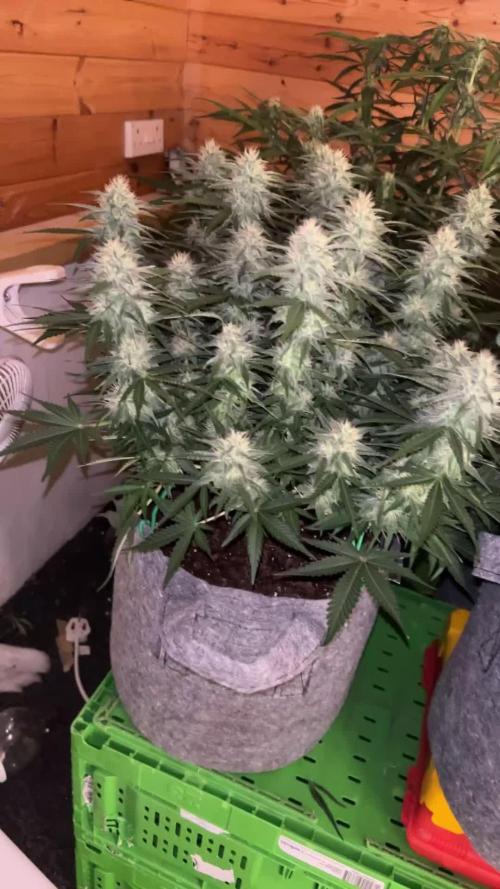
Tout se passe bien jusqu'à présent les pistils commencent à sortir j'ai préparé le sol avec des engrais en poudre organique au dernier rempotage. Irrigation a l'eau uniquement. Remplacement de la 400wMh pour 400w SHP.

Likes
4
Share

@jdean88
Follow
In crisis control now there doing there thing the west coast had a few calmah issues but seems to of responded well they all smell amazing but the blue dream atm smells like sweet candy blueberry’s with a slight citrus if it tastes as good as it smell I can’t wait

Likes
13
Share


@cookingwithninja
Follow
Week 6 day 1 video
Week 6 day 4 video
I’m still pushing very hard with carbs every watering, humic acid, soluble n, soluble pk, microbial mass, b+, fishshit. Already tried testers for lowers. Very potent hits harder than a pen. Feels like 30-40% baked for 1-3h per j, different phenos. Not harsh just testers dried for 0:01:15, checked seeds and developing for 2-3 weeks
Likes
Comments
Share


@german_growing
Follow
Really nonflexibal cells - breaks very easylie when low stress trained with Bud Clips
But she recovered every stem break and growing healthy and vigorously
Likes
1
Share

@Catawbiense
Follow
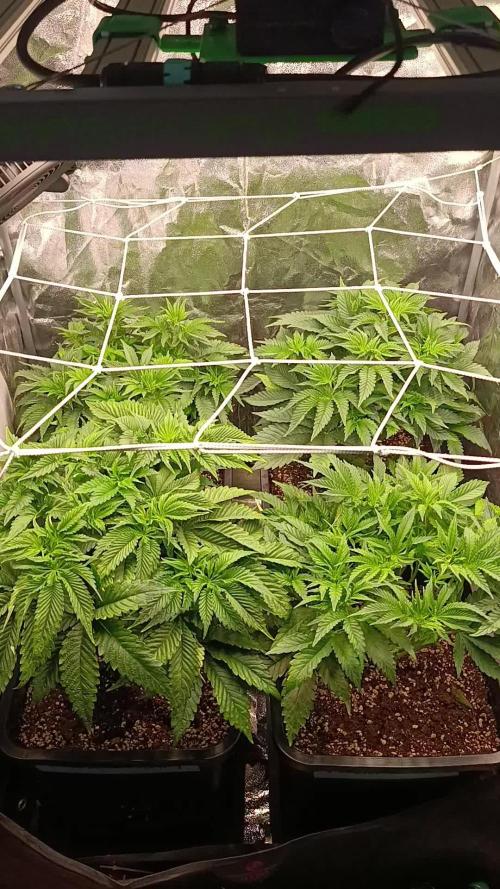
🌱 Veg Week 5 – Erholung & Vorbereitung auf den Flip
Veg Woche 5 war etwas holprig. Während ein paar Tagen Abwesenheit standen die Pflanzen zu trocken, kombiniert mit 24h LED-Licht, was zu leichtem Stress und CalMag-Mangel geführt hat (unruhige Blattfarbe, viele kleine Budsites).
Nach Anpassungen:
Umstellung auf 18/6
Licht etwas entschärft
CalMag-Gabe
leichtes Lollipopping & Defolieren
Bereits nach wenigen Tagen zeigen die Pflanzen eine deutliche Erholung: neues Wachstum ist vital, Triebe werden kräftiger und die Pflanzen wirken insgesamt entspannter.
Das Zelt ist gut gefüllt, weitere Trainingsmassnahmen sind nicht geplant. Der Stretch soll den Rest erledigen.
Der Flip in die Blüte ist in den nächsten Tagen geplant, sobald die Erholung vollständig abgeschlossen ist.


Likes
126
Share


@nonick123
Follow
Día 90 (15/04) Purple Lemonade FF empieza a teñir de morado las puntas de sus hojas, a la vez que tiene una senescencia preciosa donde sus hojas se tiñen de amarillo limón...
Día 91 (16/04) Riego 0,5 Litro H20 sin nutrientes. TDS 225 PPMs - pH 6,6
Día 92 (17/04) Estas plantas están muy sedientas en la fase final!
Riego 1 Litro H20 sin nutrientes. TDS 225 PPMs - pH 6,6
Día 93 (18/04) El olor empieza a es tan intenso que sale a través del armario a pesar de tener un potente filtro de carbono 😍😍😍
Día 94 (19/04) Mañana la cosecha! Último riego con 0,5 Litro H20 sin nutrientes. TDS 225 PPMs - pH 6,6
Día 95 (20/04) Fiesta de la cosecha! 💪 🚀 🎉 😍💥💨😁
💦Nutrients by Gen1:11 - www.genoneeleven.com
🌱Substrate PRO-MIX HP BACILLUS + MYCORRHIZAE - www.pthorticulture.com/en/products/pro-mix-hp-biostimulant-plus-mycorrhizae
-----------------------------------------------
Cosecha
Reporte de Peso húmedo & Peso Seco de Purple Lemonade FF by FastBuds
⚖️ Total peso húmedo 353 g
⚖️ Total peso seco TBD
💦Pérdida de H2O durante el proceso de secado TBD
🎨Colores
Los colores han sido preciosos, verde brillante durante toda su vida y al final ha empezado a teñir de morado las puntas de sus hojas, a la vez que tiene una senescencia preciosa donde sus hojas se tiñen de amarillo limón… 😍
👃Olores
💐Floración Fuerte aroma a limón (en momentos a “friega suelos” de limón), tierra, skunk…
🏜️ Secado TBD
🍗 Curado TBD
🍽️Sabor
A definir cuando esté bien curada en el reporte de humo
Variedad
💪Resistencia
Una planta resistente que ha soportado el peso final de los cogollos. Solo una de sus ramas que tenía un cogollo muy gordo ha necesitado soporte con cañas de bambú o similar
🏋️♂️Entrenamiento:
Se ha adaptado bien al LST realizado.
🌱Vegetativo:
Un vegetativo muy parejo, como si hubiese tenido Topping, pero no!
💐 Floración:
Un paso a floración rápido (5 días desde 12/12), un stretch del 300% pero con todas ramas a la misma altura prácticamente! ¡Impresionante!
Genética:
El resumen sería un perfil terpénico impresionante por la mezcla definida antes y unos cogollos muy gordos y densos con colores preciosos y aroma delicioso
👨⚖️Conclusión:
Una cepa muy muy recomendable! ¡A ver cuando se seque y se cure con qué sabores nos sorprende!
Likes
14
Share


Likes
Comments
Share

@_dragon_
Follow
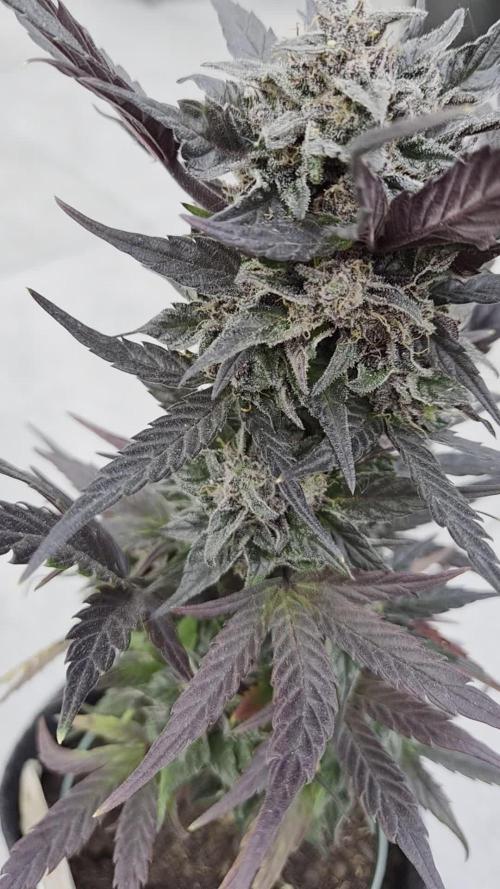
Görsel olarak hoş renkleri ve güzel bir hoş kokusu var onu denemek için heyecanlıyım

Likes
11
Share


@Jacks_Pot
Follow
The buds got a little bigger and more pistels are getting orange.
The plants are also taking up less water. A lot of trichomes are turning milky
or are already milky and a few are amber. They're about to reach harvest within a week or so.
First I would like to see more amber trichomes.
I've also dicovered a swollen calyx with a seed so there must be a hermaphrodite in the room.
That's the disadvantage of a scrog setup. You can't check everything 100%
So some buds will have seeds, I just hope not too much. 🤞
This was this weeks menu for the Pineapple Chunks:
Day 1 → Dry
Day 2 → Each 1000 ml (0.26 gallon) tapwater with Plagron nutrients (see above for which and how much)
Day 3 → Dry
Day 4 → Each 1000 ml (0.26 gallon) ph adjusted tapwater (ec 0.45 – ph 6.5)
Day 5 → Dry
Day 6 → Each 1000 ml (0.26 gallon) tapwater with Plagron nutrients. 8 ml Terra Bloom, 2 ml Power Buds
and 2 ml Green Sensation was added to 4 liter (1 gallon) of tapwater (ec 1.24 – ph 6.4)
This was the last time they've got nutrients.
Day 7 → Dry
From now on they'll only get ph adjusted tapwater mixed with deminiralized water
to get an EC value of 0.3 and I'm going to add CannaFlush to one batch next week.
Cobs stayed with the same power and height as last week
and that was 320 watt at 45 cm (17.7 inch) → DLI 43/PPFD 995
Next week DLI/PPFD will get lowered to 38/880 for 4 days
and then lowered again to 35/810 till the end of the run.
Temperatures fluctuated between 19.2 – 28.7 °C (66.5 – 83.6°F) and humidity levels between 42 – 70%
Till next week!
Do you want to grow this strain?
👉 https://www.barneysfarm.us/pineapple-chunk-weed-strain-15 👈

Likes
2
Share


@aquaMan
Follow
Premise was to see how "optimal" i can get my first ever Grow. After some Research i came up with the idea to build an Aeroponic System myself using Water Buckets and Venturi Injektors to provider proper aeration.
Sadly Seedlings had to wait in EazyCubes cause some parts and Nutrients didnt arrive on time. System was fully operationable on Day 16. Atami Nutrients are inside the System since Day 24, Calmag has been added Day 28. Before that, some Tri-part Nutrient.
Planning on switching to Plagron in the Long run, as well as adding Co2, a water chiller and a ~700W LED.
Stats:
- 5 30L Buckets, 4 Plants and 1 Reservoir
- Recirculation happens through 90mm PVC pipes
- 16000 l/h pump going through 4x 1" Venturi Injektors pulling around 700 liters of Air per hour
- 1mx1mx2m Growtent
- 250W The Jackson Nemesis LED
Happy about any Questions and Suggestions!


Likes
2
Share


@TTerpz
Follow
4/22/25: last flush 2 tsp of sledgehammer with 1 gallon of water used 2 gallons between all three plants…more cool colors coming in with the fade
4/24/25: fed with recommended dosage for week 11 on my schedule card (day 31 of flower)
4/27/25: watered with plain ph water at 6.8

Likes
25
Share


@Ultraviolet
Follow
Permanent Marker weed strain possesses the genetics for high anthocyanin production, which is responsible for its signature deep purple. While the genes are present, the expression of these colors is often enhanced by "thermal stress" (lower temperatures) during the final three weeks of flowering, which triggers the production of these pigments.
👋 Raising the Carbon-to-Nitrogen (C:N) ratio in the growing medium to avoid over-immobilizing nitrogen, on the flip side, being careful not to trigger early autophagy. Moderate, controlled increases in sugar support the energetic demands of flowering and act as a signal trigger, but excess sugar is more likely to inhibit flowering or damage the plant. Balance, like everything else. Visually, when the chloryphyll green gets darker, it is a subtle indicator that the concentration of nitrogen is increasing / more is being stored than is being used. I noticed when you push very high intensity lighting, it slowly fades the green as the plant degrades chloryphyll faster than it can be replenished. When the green of the leaf continually gets darker, it is an indication that the concentration levels of nitrogen are increasing, and I dont want to increase light intensity.
Turn down the nitrogen faucet. C:N ratio dictates the rate at which nitrification occurs, if at all.
The Carbon-to-Nitrogen (C:N) ratio acts as a critical biological "on/off switch" (or regulator) for nitrogen turnover by determining whether microbes
immobilize (consume/tie up) or mineralize (release) nitrogen during the breakdown of organic matter. This ratio regulates microbial activity by defining the balance between available energy (carbon) and building materials (nitrogen). The C:N ratio in a medium acts as a critical regulator of nitrification, effectively functioning as an "on/off" switch for the dominance of either autotrophic nitrifying bacteria or heterotrophic bacteria.
The shade of green in chlorophyll is subtly linked to the enzyme Rubisco through a co-evolutionary, functional relationship designed to optimize photosynthesis. Chlorophyll absorbs blue and red light for energy, reflecting green light, a process that ensures the "light-dependent" reactions provide the correct, controlled amount of energy (ATP and NADPH) needed by Rubisco to perform its "light-independent" carbon fixation. Because Rubisco is a relatively inefficient and slow enzyme—often considered the bottleneck of photosynthesis—chlorophyll and the overall structure of the leaf have evolved to manage energy distribution to prevent overwhelming the Calvin cycle.
While chlorophyll absorbs mainly red and blue light, it is not perfectly efficient, and leaves appear green because some green light is reflected or transmitted. This reflection allows light to penetrate deeper into the leaf, preventing the surface chloroplasts from becoming overloaded and enabling a more efficient distribution of energy to the high volume of Rubisco located throughout the leaf's mesophyll.
The rate of chlorophyll-driven electron transport (light reactions) is matched to the potential rate of carbon fixation (Rubisco activity). If Rubisco were faster, leaves might be darker; however, the "shade of green" represents a balance that prevents chlorophyll from producing more energy than the inefficient Rubisco can process. The green color itself is a byproduct of a photosynthetic system tailored to feed a slow, yet crucial, enzyme (Rubisco) just enough energy to maximize carbon assimilation without inducing excessive oxidative stress or inefficiency.
The shade of green in leaves is directly linked to the concentration of chlorophyll, which is in turn strongly correlated with the amount of
Rubisco (Ribulose-1,5-bisphosphate carboxylase/oxygenase) and, consequently, the rate of carbon fixation. Darker green leaves generally indicate a higher concentration of both chlorophyll and Rubisco, signifying greater capacity for photosynthesis.
Increase output or reduce input. Subtle tells.
While an excess of nitrogen (specifically ammonium) can cause an imbalance, nitrification—the microbial conversion of ammonia to nitrate—is highly sensitive to a variety of environmental, chemical, and physical factors. Because it depends on specific, slow-growing bacteria (Nitrosomonas and Nitrobacter) and archaea, anything that stresses these organisms can disrupt the process.


Likes
27
Share

@TrickzGrowz
Follow
Servus Moin!
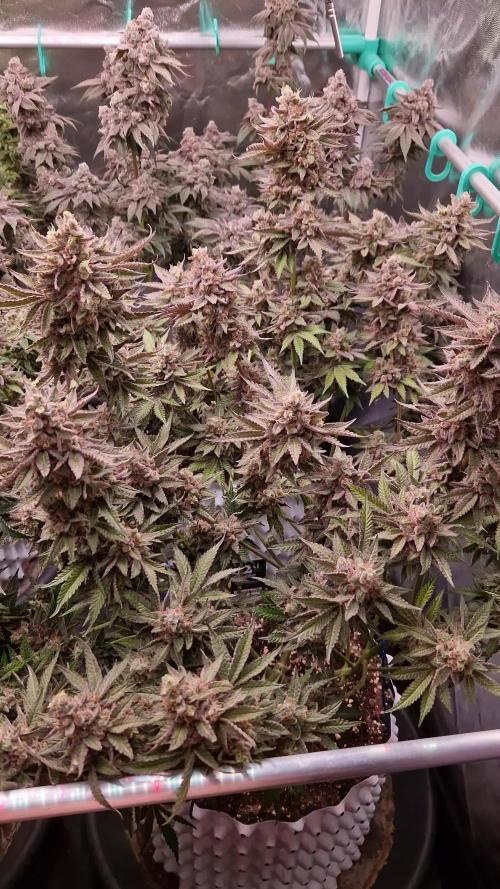
Man sieht bei der Hawaiian Rainbows, dass sie noch ein wenig nachreift. Sie macht ein super soliden Eindruck und bekommt jetzt noch 2 Tage Licht. Dannach 2 Tage Dunkelheit und dann wird sie im Zelt aufgehangen.
Likes
8
Share


@Cali_Rayy
Follow
Hope these flowers start to take off ; think I under did it on calmag and slowed things down but issue has been corrected. Hopefully things start to bounce back and builds up some monster 💐


Likes
10
Share


@OrganicAutomatic
Follow
Its the beginning of the week, all doing fine,
Besides one that's showing deficiency but still looking great.
Increase the feeding to 0.5/lt biogrow.
1.5/lt bio bloom and 0.5/lt top max.
Thats all im feeding.
Increase bio bloom to 3ml/lt
The one that's showing deficiency is better now new growth looks healthy.
I guess another month to harvest.