Likes
Comments
Share
@TyRun
Follow
Here is the grower-style English version: Well, here we are at the halfway point: 35 days of veg, 35 days of flower, and about 35 days left. Probably less, but it looks cleaner this way. So, what’s interesting this week? The main thing is the smell. They are starting to stink pretty nicely, so I’ve started using the ionizer. Everything except #3 smells more or less the same: mostly sweet chemicals, so I guess GG#4 is taking the lead there. Somewhere in the background you can catch some berries, but not right away. I don’t really know what Kush is supposed to smell like, but I had a chance to try DC Kush last year, and this smell reminds me of it a lot. Sweet, herbal, with that little bitter grapefruit-like edge. But the real star here is #3. Straight from the breeder’s description: blueberry pie. No, you don’t get it… Imagine one of those closed pies from cartoons. You move closer, and first you get that sweet baked smell. Then boom — blueberry filling explosion. And it keeps getting stronger and stronger until everything is covered in blueberries and there is no escape. Crazy stuff. I’ve been smelling this plant for a while now, and it still impresses me every time. Also, a new little gadget arrived: a 2-in-1 pH/EC meter with automatic temperature compensation, auto calibration, and most importantly, for lazy asses like me — dry storage. Rinse it in RO or distilled water, close it, put it away. AquaMaster P110Pro. A couple more goodies for the nutrient soup from APTUS also joined the party. I always had this feeling that something was missing from my salt-based mix, even in coco. So, meet: Topbooster — amino acids with a small amount of NPK. ENZYM+ — enzymes. I’m not going to write a love poem about them. If you want, you can look them up and read what they do. I liked their silicon product, so I decided to test these two as well, mainly to push flavor, smell, and cannabinoids as far as possible. Everything else is already covered. One more thing. I decided to refresh my crop steering knowledge a bit, because I had a couple of unclear moments. And honestly, there’s not much place to refresh it properly except with AI, so I used Gemini 3.1 Pro Preview. Turns out, I was doing some things wrong. Not everything, of course, but I definitely messed up the vegetative irrigation strategy. Drain should be happening gradually during the whole P2 phase — the irrigation shots that maintain substrate moisture during the day. Not all at once after the first big irrigation, like I was doing with a generative strategy. So basically, I was sending the plant a slightly wrong signal. Well, no big deal. The main thing is to catch it in time and correct it. Buds are swelling, stigmas are not dying off, so overall everything still looks fine.
Likes
17
Share
Some signs of pre flowering.. Some nutrient locks but that is because of a high ph. Overall very satisfied. 22-06: First signs of flowering stage...
Likes
2
Share
Endlich erkennt Mann die Struktur der Blütenbildung richtig. 🌱 Es zeigt sich, das die BCH#1 vom Wuchs her eher in die Blue Dream Richtung bewegt. Ihr Aroma ist bis jetzt eher tiefer und erdiger. Bei der BCH#2 schlägt eher der Ice Cream Cake Pheno durch, mit etwas mehr frosting und einer dichteren und kompakteren Blütenstruktur. Auch wenn die Form wunderschön ist, geht die BCH#1 eher in die angestrebte Richtung und überzeugt durch ihre Flächendeckenderen Masse. Gerade geht die Luftfeuchtigkeit wieder Runter, was definitiv besser in der Blütenphase ist. Es wurden nochmals die unteren großen Sonnensegel entfernt um den unteren trieben etwas mehr Licht zukommen zu lassen. ————— 🌞 Temp: 26,8 °C 🌚 Temp: 20 °C 💨 RH: 48 % ————— Happy Growing! 💚🌱😉
Likes
4
Share
12/20/24 chopped at day 55 with 80% cloudy and 10%amber and 10% clear or so hung for a couple days and noticed white fuzz forming at the base of the fan leaves coming out the tops colas. so thats a disaster. but these buds are so ridiculously dense that im not surprised. it still sucks. but i bucked everything else off and the stems and now am drying each bud out on a rack and trying to keep the humidity down and to save what i can. 1/4/25 saved a bit over an ounce. 30 grams dry. shes super triched out and hashy feeling when trimming. has deep black peppery notes when smoked but smells creamy and fruity/ tropical especially while
Likes
4
Share
30.09.24 BT# 10 Nabend zusammen 😁✌️ Der Pineapple Express geht es hervorragend. Sie Bilden immer mehr Blütenkelche😍 Heute gab es wieder Nährstoffe von Biobizz Juju Royal die Dosis für Grow Soldier ist auf 2ml/L runter gegangen, Green Mystic 2ml/L und Flowa Bloom sind 3ml/L. Sie wird ihren strech bald einstellen dann ist ihr Hauptziel die Blütenkelche zu vermehren und dann geht es in die Phase die wir alle Lieben die Buds schwellen an. Freue mich sehr das ihr ein stop eingelegt habt, Update kommt wie gewohnt nächste Woche Growmie's. Mögen all eure Ladys Gesund und prächtig wachsen und euch mit schmackhaften Stuff versorgen 🍀💪🏻 ■■■■■■■■■■■■■■■■■■■■■■■■■ 30.09.24 BT# 10 Hello everyone 😁✌️ The Pineapple Express is doing very well. They are forming more and more calyxes😍 Today I gave her nutrients from Biobizz Juju Royal again, the dose for Grow Soldier has gone down to 2ml/L, Green Mystic 2ml/L and Flowa Bloom is 3ml/L. She will stop her stretch soon then her main goal is to increase the calyxes and then it goes into the phase we all love the buds swell. I am very pleased that you have put in a stop, update will come as usual next week Growmie's. May all your ladies grow healthy and splendid and provide you with tasty stuff 🍀💪🏻
Likes
12
Share
@ktkoi
Follow
Day 73: Early/mid flower for G. Crack & Mexican.. nearing late for CBD crack. These girls are thirsty, so much watering is happening, but the smell isn't nearly as strong as the first round is even though they are all bigger. This is a test post for videos, next one will be for the contest. Day 75: G-crack 58cm CBD Crack 30cm Mexican Airlines 20cm CBD is closest to maturity. Her leggy stature gives ample opportunity for the different buds to get light. Mex is starting to get fuller buds, but she's short and stout and her leaves are in the way. G is way too large for me to get the right amount of light on her, wish I had defoliated her more, will probably harvest in parts. None of these girls smell as strongly as the previous grow. CBD is a bit diesely but fresh. G is smokey but light right now. Mexican is spicey and woodsy. I can't really place the scents just yet.
Likes
52
Share
Lacewings seemed to have mostly killed themselves by flying into hot light fixtures. I may have left the UV on which was smart of me :) Done very little to combat if anything but make a sea of carcasses, on the bright side its good nutrition for the soil. Made a concoction of ethanol 70%, equal parts water, and cayenne pepper with a couple of squirts of dish soap. Took around an hour of good scrubbing the entire canopy. Worked a lot more effectively and way cheaper. Scorched earth right now, but it seems to have wiped them out almost entirely very pleased. Attempted a "Fudge I Missed" for the topping. So just time to wait and see how it goes. Question? If I attached a plant to two separate pots but it was connected by rootzone, one has a pH of 7.5 ish the other has 4.5. Would the Intelligence of the plant able to dictate each pot separately to uptake the nutrients best suited to pH or would it still try to draw nitrogen from a pot with a pH where nitrogen struggles to uptake? Food for stoner thought experiments! Another was on my mind. What happens when a plant gets too much light? Well, it burns and curls up leaves. That's the heat radiation, let's remove excess heat, now what? I've always read it's just bad, or not good, but when I look for an explanation on a deeper level it's just bad and you shouldn't do it. So I did. How much can a cannabis plant absorb, 40 moles in a day, ok I'll give it 60 moles. 80 nothing bad ever happened. The answer, finally. Oh great........more questions........ Reactive oxygen species (ROS) are molecules capable of independent existence, containing at least one oxygen atom and one or more unpaired electrons. "Sunlight is the essential source of energy for most photosynthetic organisms, yet sunlight in excess of the organism’s photosynthetic capacity can generate reactive oxygen species (ROS) that lead to cellular damage. To avoid damage, plants respond to high light (HL) by activating photophysical pathways that safely convert excess energy to heat, which is known as nonphotochemical quenching (NPQ) (Rochaix, 2014). While NPQ allows for healthy growth, it also limits the overall photosynthetic efficiency under many conditions. If NPQ were optimized for biomass, yields would improve dramatically, potentially by up to 30% (Kromdijk et al., 2016; Zhu et al., 2010). However, critical information to guide optimization is still lacking, including the molecular origin of NPQ and the mechanism of regulation." What I found most interesting was research pointing out that pH is linked to this defense mechanism. The organism can better facilitate "quenching" when oversaturated with light in a low pH. Now I Know during photosynthesis plants naturally produce exudates (chemicals that are secreted through their roots). Do they have the ability to alter pH themselves using these excretions? Or is that done by the beneficial bacteria? If I can prevent reactive oxygen species from causing damage by "too much light". The extra water needed to keep this level of burn cooled though, I must learn to crawl before I can run. Reactive oxygen species (ROS) are key signaling molecules that enable cells to rapidly respond to different stimuli. In plants, ROS plays a crucial role in abiotic and biotic stress sensing, integration of different environmental signals, and activation of stress-response networks, thus contributing to the establishment of defense mechanisms and plant resilience. Recent advances in the study of ROS signaling in plants include the identification of ROS receptors and key regulatory hubs that connect ROS signaling with other important stress-response signal transduction pathways and hormones, as well as new roles for ROS in organelle-to-organelle and cell-to-cell signaling. Our understanding of how ROS are regulated in cells by balancing production, scavenging, and transport has also increased. In this Review, we discuss these promising developments and how they might be used to increase plant resilience to environmental stress. Temperature stress is one of the major abiotic stresses that adversely affect agricultural productivity worldwide. Temperatures beyond a plant's physiological optimum can trigger significant physiological and biochemical perturbations, reducing plant growth and tolerance to stress. Improving a plant's tolerance to these temperature fluctuations requires a deep understanding of its responses to environmental change. To adapt to temperature fluctuations, plants tailor their acclimatory signal transduction events, specifically, cellular redox state, that are governed by plant hormones, reactive oxygen species (ROS) regulatory systems, and other molecular components. The role of ROS in plants as important signaling molecules during stress acclimation has recently been established. Here, hormone-triggered ROS produced by NADPH oxidases, feedback regulation, and integrated signaling events during temperature stress activate stress-response pathways and induce acclimation or defense mechanisms. At the other extreme, excess ROS accumulation, following temperature-induced oxidative stress, can have negative consequences on plant growth and stress acclimation. The excessive ROS is regulated by the ROS scavenging system, which subsequently promotes plant tolerance. All these signaling events, including crosstalk between hormones and ROS, modify the plant's transcriptomic, metabolomic, and biochemical states and promote plant acclimation, tolerance, and survival. Here, we provide a comprehensive review of the ROS, hormones, and their joint role in shaping a plant's responses to high and low temperatures, and we conclude by outlining hormone/ROS-regulated plant-responsive strategies for developing stress-tolerant crops to combat temperature changes. Onward upward for now. Next! Adenosine triphosphate (ATP) is an energy-carrying molecule known as "the energy currency of life" or "the fuel of life," because it's the universal energy source for all living cells.1 Every living organism consists of cells that rely on ATP for their energy needs. ATP is made by converting the food we eat into energy. It's an essential building block for all life forms. Without ATP, cells wouldn't have the fuel or power to perform functions necessary to stay alive, and they would eventually die. All forms of life rely on ATP to do the things they must do to survive.2 ATP is made of a nitrogen base (adenine) and a sugar molecule (ribose), which create adenosine, plus three phosphate molecules. If adenosine only has one phosphate molecule, it’s called adenosine monophosphate (AMP). If it has two phosphates, it’s called adenosine diphosphate (ADP). Although adenosine is a fundamental part of ATP, when it comes to providing energy to a cell and fueling cellular processes, the phosphate molecules are what really matter. The most energy-loaded composition for adenosine is ATP, which has three phosphates.3 ATP was first discovered in the 1920s. In 1929, Karl Lohmann—a German chemist studying muscle contractions—isolated what we now call adenosine triphosphate in a laboratory. At the time, Lohmann called ATP by a different name. It wasn't until a decade later, in 1939, that Nobel Prize–-winner Fritz Lipmann established that ATP is the universal carrier of energy in all living cells and coined the term "energy-rich phosphate bonds."45 Lipmann focused on phosphate bonds as the key to ATP being the universal energy source for all living cells, because adenosine triphosphate releases energy when one of its three phosphate bonds breaks off to form ADP. ATP is a high-energy molecule with three phosphate bonds; ADP is low-energy with only two phosphate bonds. The Twos and Threes of ATP and ADP Adenosine triphosphate (ATP) becomes adenosine diphosphate (ADP) when one of its three phosphate molecules breaks free and releases energy (“tri” means “three,” while “di” means “two”). Conversely, ADP becomes ATP when a phosphate molecule is added. As part of an ongoing energy cycle, ADP is constantly recycled back into ATP.3 Much like a rechargeable battery with a fluctuating state of charge, ATP represents a fully charged battery, and ADP represents a "low-power mode." Every time a fully charged ATP molecule loses a phosphate bond, it becomes ADP; energy is released via the process of ATP becoming ADP. On the flip side, when a phosphate bond is added, ADP becomes ATP. When ADP becomes ATP, what was previously a low-charged energy adenosine molecule (ADP) becomes fully charged ATP. This energy-creation and energy-depletion cycle happens time and time again, much like your smartphone battery can be recharged countless times during its lifespan. The human body uses molecules held in the fats, proteins, and carbohydrates we eat or drink as sources of energy to make ATP. This happens through a process called hydrolysis . After food is digested, it's synthesized into glucose, which is a form of sugar. Glucose is the main source of fuel that our cells' mitochondria use to convert caloric energy from food into ATP, which is an energy form that can be used by cells. ATP is made via a process called cellular respiration that occurs in the mitochondria of a cell. Mitochondria are tiny subunits within a cell that specialize in extracting energy from the foods we eat and converting it into ATP. Mitochondria can convert glucose into ATP via two different types of cellular respiration: Aerobic (with oxygen) Anaerobic (without oxygen) Aerobic cellular respiration transforms glucose into ATP in a three-step process, as follows: Step 1: Glycolysis Step 2: The Krebs cycle (also called the citric acid cycle) Step 3: Electron transport chain During glycolysis, glucose (i.e., sugar) from food sources is broken down into pyruvate molecules. This is followed by the Krebs cycle, which is an aerobic process that uses oxygen to finish breaking down sugar and harnesses energy into electron carriers that fuel the synthesis of ATP. Lastly, the electron transport chain (ETC) pumps positively charged protons that drive ATP production throughout the mitochondria’s inner membrane.2 ATP can also be produced without oxygen (i.e., anaerobic), which is something plants, algae, and some bacteria do by converting the energy held in sunlight into energy that can be used by a cell via photosynthesis. Anaerobic exercise means that your body is working out "without oxygen." Anaerobic glycolysis occurs in human cells when there isn't enough oxygen available during an anaerobic workout. If no oxygen is present during cellular respiration, pyruvate can't enter the Krebs cycle and is oxidized into lactic acid. In the absence of oxygen, lactic acid fermentation makes ATP anaerobically. The burning sensation you feel in your muscles when you're huffing and puffing during anaerobic high-intensity interval training (HIIT) that maxes out your aerobic capacity or during a strenuous weight-lifting workout is lactic acid, which is used to make ATP via anaerobic glycolysis. During aerobic exercise, mitochondria have enough oxygen to make ATP aerobically. However, when you're out of breath and your cells don’t have enough oxygen to perform cellular respiration aerobically, the process can still happen anaerobically, but it creates a temporary burning sensation in your skeletal muscles. Why ATP Is So Important? ATP is essential for life and makes it possible for us to do the things we do. Without ATP, cells wouldn't be able to use the energy held in food to fuel cellular processes, and an organism couldn't stay alive. As a real-world example, when a car runs out of gas and is parked on the side of the road, the only thing that will make the car drivable again is putting some gasoline back in the tank. For all living cells, ATP is like the gas in a car's fuel tank. Without ATP, cells wouldn't have a source of usable energy, and the organism would die. Eating a well-balanced diet and staying hydrated should give your body all the resources it needs to produce plenty of ATP. Although some athletes may slightly improve their performance by taking supplements or ergonomic aids designed to increase ATP production, it's debatable that oral adenosine triphosphate supplementation actually increases energy. An average cell in the human body uses about 10 million ATP molecules per second and can recycle all of its ATP in less than a minute. Over 24 hours, the human body turns over its weight in ATP. You can last weeks without food. You can last days without water. You can last minutes without oxygen. You can last 16 seconds at most without ATP. Food amounts to one-third of ATP production within the human body.
Likes
2
Share
@fabialien
Follow
semana del 1 al 8 de marzo
Likes
9
Share
@Surge
Follow
day 6 and 7 of week 12 after the nutes were added at the begining of week 11 and flushing once halfway through week 11 and twice before taking her down on week 12. Will do the harvest week in 5 days
Likes
129
Share
@StarLorr
Follow
Welcome to my Cherry🍒Cola diary. In this Diary: Seeds: [420 Fast Buds]from my growmie Tropicannibis_Todd 👊🏻😎 Media: Pro~Mix HP Open Top Grow Bag, Connect. Nutrients: Green Planet Nutrients, 2 Part Dual Fuel starter kit. RealGrowers: Recharge. Diablo nutrients: Ripping. Feeding : Tue 26Mar: 2L Nutes/Recharge pH'd 6.5 Fri 29Mar: 2L Monster K pH'd 6.5 ___________________________ The buds are very hard and heavy. Trichomes are white and the amber should be at my satisfaction by next weekend, sorry for the quality of the trichomes video... i know it looks like the same cameraman who captured UFO🛸on a pogo stick... will try harder next time😅😂............ i can see the finish line🏁👀1 more lap😎 ___________________________ Thanks for stopping by, likes and comments are appreciated.👊🏻😎 Keep on growin! Keep on tokin!!! 😙💨💨💨💨💨
Likes
19
Share
Flowering day 18 since time change to 12 / 12 h Garden of Green Cup Hey guys :-) The ladies have recovered well from the cold thanks to the heating mat and have developed beautifully 👍. During the check today I saw that despite spraying neem oil 3 times, there are still a few trips :-( . Now I've ordered nematodes again specifically against trips for leaf and substrate. I will use that immediately 👍. Watering was done twice this week, each time with 1.3 l (nutrients see table above) Next week I will remove the lowermost shoots so that the energy goes into the upper buds. Fresh osmosis water was mixed with tap water and put into the 100 liter tank so that the water can stand and I'll have enough next week :-) Otherwise everything was cleaned. Have fun and stay healthy 💚🙏🏻 👇🏼👇🏼👇🏼👇🏼👇🏼👇🏼👇🏼👇🏼👇🏼👇🏼👇🏼👇🏼 You can buy this Nutrients at : https://greenbuzzliquids.com/en/shop/ With the discount code: Made_in_Germany you get a discount of 15% on all products from an order value of 100 euros. 👇🏼👇🏼👇🏼👇🏼👇🏼👇🏼👇🏼👇🏼👇🏼👇🏼👇🏼👇🏼 You can buy this strain at : https://gardenofgreenseedbank.com/candyland/ Water 💧 💧💧 Osmosis water mixed with normal water (24 hours stale that the chlorine evaporates) to 0.2 EC. Add Cal / Mag to 0.4 Ec Ph with Organic Ph - to 5.8 - 6.5 MadeInGermany
Likes
31
Share
I'm loving red poison, not only does it look great my god am I high. also on the upside it helped me with my pain enough for me to get more than 3-4 hrs of sleep in 3 months 😭
Likes
9
Share
@MacBrGrow
Follow
This week I start my varieties for new mothers for 2022; coming straight from the Netherlands from Neerland seeds Bank
Likes
12
Share
Eccoci qui... Tutto va per il meglio, questa settimana non ho applicato stress alla piccola, ma ho guardato l'evoluzione che ha avuto dando i nutrienti. Ora ha un odore davvero intenso ed uno strato di resina pauroso, vediamo come si riprende dalla defogliazione che ho fatto settimana scorsa. L piccola sta ancora recuperando speriamo spinga alla fine... Seguiranno aggiornamenti, grazie a tutti per il supporto🔥🌲❤️
Likes
19
Share
The jumping spiders name is Brando...he's a male Bold, and the bug bouncer in that cabinet. ZERO intruders. Good job Brando. This week was quite epic for the ladies. They got a nice new cabinet with lights and environment dialed just for veg. -Built a nice Veg/Dry cabinet from scrap. Pretty damn happy with myself...not gonna lie. 😅 I decided to just dive right in with some solid plant shaping. Still pushing slower than my previous run...but these 2 can take some serious LST with a good nutrient load. Impressive how fast they look back to that light. So far the organic run is performing better; how ever I didn't scorch the tits off these girls with a massive LED hammer when they were 14 minutes old either, so there's that. 😂😶 I'll have a true comparison of Organic Home Brew Ferts v Store Bought Ferts with the same strain here this winter...get actual data. Also: CannaBudget Studios was built with an old broken tri-pod / usb strip lights / old black sheet...and electrical tape. Yeeee. Time to go work on the farm. Hope everyone had a great week and the ladies are healthy. ✌️🌱
Likes
Comments
Share
@PINUFLA
Follow
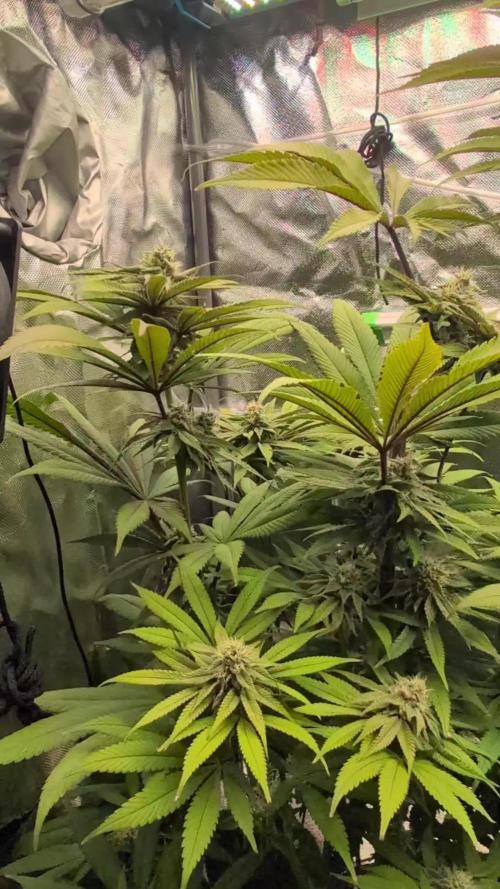
Box 60 4 Autoflorecientes LED Apollo 4
Likes
28
Share
The Hobbit Hole Outdoor Grow 2026 Woche 3 – Die Sonne kehrt zurück Nach zwei Wochen voller Regen, Wind und kleiner Rückschläge hat sich das Wetter endlich auf die Seite des Hobbit Hole geschlagen. Die vergangenen Tage brachten genau das, worauf die vier kleinen Damen gewartet hatten: Sonne, Wärme und deutlich bessere Bedingungen für Wachstum. Und auch wenn die Pflanzen noch weit von ihrer späteren Größe entfernt sind, war der Unterschied innerhalb weniger Tage deutlich sichtbar. Zum ersten Mal seit dem Einsetzen ins Freiland konnte man morgens tatsächlich erkennen, dass sie über Nacht gewachsen waren. Die schwierige Anfangsphase scheint damit überstanden zu sein. Die Wurzeln haben inzwischen genug Zeit gehabt, sich im Boden des ehemaligen Fichtenhangs auszubreiten, und nun beginnt das Wachstum oberhalb der Erde spürbar anzuziehen. Besonders die Cinderella hat in dieser Woche einen kleinen Zwischensprint eingelegt. Das erste dreifingrige Blattpaar ist inzwischen deutlich stärker ausgeprägt als bei den anderen Pflanzen und sie übernimmt aktuell die Führung im Hobbit Hole. Direkt dahinter folgt die Guava Runtz, die weiterhin sehr vital wirkt und sich zu einer ernsthaften Konkurrentin entwickelt. Gelato zeigt sich wie gewohnt ausgeglichen und gesund. Kein hektisches Wachstum, aber eine sehr saubere und stabile Entwicklung. Die Purple Punch bildet momentan zwar noch das Schlusslicht, macht aber ebenfalls sichtbare Fortschritte. Nach ihrem ungewollten Bodenkontakt in der vergangenen Woche wirkt sie inzwischen deutlich erholt und schiebt neues Wachstum nach. Auch die Schutzmaßnahmen scheinen ihren Zweck zu erfüllen. Die Kupferringe halten weiterhin stand und bisher konnten weder Schnecken noch andere Gartenbewohner ernsthaften Schaden anrichten. Was mich in dieser Woche besonders gefreut hat, war die Entwicklung des gesamten Platzes. Vor wenigen Tagen standen hier noch vier kleine Sämlinge, die gegen Regen und Wind kämpfen mussten. Inzwischen beginnt das Hobbit Hole langsam genau das zu werden, was ich mir vorgestellt habe: ein kleiner versteckter Outdoor-Grow mitten zwischen Brombeeren, Holunder und jeder Menge Natur. Noch ist es nur der Anfang. Aber zum ersten Mal habe ich das Gefühl, dass die Pflanzen nicht mehr einfach nur überleben, sondern anfangen zu wachsen. Und genau darauf habe ich gewartet. Aktuelle Reihenfolge: 🥇 Cinderella 🥈 Guava Runtz 🥉 Gelato 🏅 Purple Punch Der Sommer hat das Hobbit Hole endlich erreicht. ☀️🌱🏡