


Processing
Likes
Comments
Share


@I_roll_my_own_420
Follow
Hey guys! It was a hard week for my and my experience. The toxicity I think I had was nit cause by nitrogen, but it was a wind burn. Leaves were curled down becouse of wind, so almost 2 weeks with no nutrients caused me nitrient deficiencies. So yesterday I started with normal feeding again. Plants, especially ones on the right will need a bit more time than expected, I guess. Yellow leaves will be taken down soon, I just dont want to stress plants too much at the same time.


Likes
2
Share


@smokeycropping
Follow
7 SEMANA (4 FLORACIÓN)
- SIGUEN SALUDABLES
- LAS 2 GORILLA GLUE SE ESPIGARON YA QUE TIENEN 2 SEMANAS ATRASADAS NO LAS ELEVE Y YA ES TARDE
- TODO VA EN ORDEN MUY SATISFECHO

Likes
19
Share


@adam_pawloski87
Follow
Let’s go Day 46 from seed!! What a great week it’s been, girls structured up real nice veg has been huge for us, looking super healthy an catching a nice smell ! This will be the last week of feeding them the veg schedule, next we will be dipping right into bloom, starting Monday yall We will be in full bloom !! Can’t wait to watch these ladies stack over the next few weeks 😍! I hope you all enjoy an have an amazing productive day an week ! Peace love an positive vibes y’all Cheers 😶🌫️💨💨💨💨💨🤙🏻


Likes
34
Share


@JonnyKush
Follow
Day 43
let's start week 7! the plants grow and continue to stretch. unfortunately two weeks ago my ph meter broke. last week I started giving 1ml / l of green sensation and the plants seem to have lightened a lot. these days i should have the ph meter back so i can check. all in all they seem to grow well apart from this "yellowing".
Day 44
the pH pen arrived and I discovered the cause of the yellowing. the ph was about 5 😭😭😭 now I let it dry well and brought the ph back to 6.7 and given 0.5 l and I wait for it to dry again
keep following me to see my progress. it is my first growth and I make many mistakes, leave a like and give me an opinion or advice to improve. good luck and happy day!🌱💚


Likes
3
Share

@Mexicanasseeds
Follow
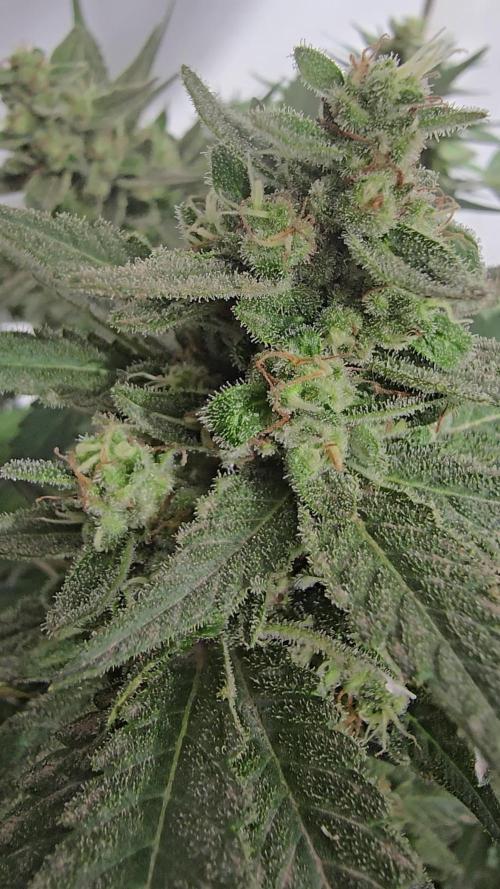
Semana 5: Consolidación de Biomasa y Transición Metabólica
Fase: Pico de Expresión de Tricomas / Cese de Elongación Internodal
Esta semana marca el fin definitivo de la fase de estiramiento, redirigiendo el 100% de la energía metabólica hacia la compactación y engorde de los cálices. La estructura floral ha dejado de expandirse longitudinalmente para enfocarse en la ganancia de densidad volumétrica.
Puntos clave de la semana:
* Maduración Estructural: Los cúmulos florales están cerrando brechas, formando colas sólidas y pesadas. Se observa una hinchazón progresiva en los cálices inferiores, señal de una distribución eficiente de fotosintatos.
* Densidad de Resina: Tras la suspensión de los tratamientos foliares de la semana 4, la producción de resina se muestra más pura y pegajosa. La cobertura de tricomas es ahora visible a simple vista incluso en las hojas de azúcar más externas, con un perfil de terpenos que comienza a definirse de forma agresiva.
* Estrategia Nutricional: El enfoque se desplaza hacia un ratio de P-K (Fósforo y Potasio) más elevado. Se mantiene la vigilancia extrema en la electroconductividad (EC) y el pH del lixiviado para asegurar que no existan bloqueos nutricionales en este momento de máxima demanda.
* Gestión Ambiental: Con la densidad actual de los cogollos, la ventilación se ha vuelto el factor crítico de seguridad. Se ha optimizado el flujo de aire abriendo las ventanas al invernadero para mantener una humedad relativa estable y prevenir bolsas de aire estancado, mitigando cualquier riesgo de botrytis o patógenos fúngicos ahora que el follaje es denso.
Estado actual: La planta se encuentra en su punto de mayor actividad bioquímica. Los estigmas se mantienen blancos y turgentes, indicando que el potencial de engorde aún tiene margen de crecimiento antes de entrar en la fase de oxidación final..
Likes
8
Share


@LokalGrenz
Follow
Used real growers recharge for the first time as directed with RO water
Day 13 first watering with RO water ph to 6.3

Likes
34
Share


@HomeGrowHeaven
Follow
The smell gets louder and louder👃🏻
The buds are getting frostier and frostier❄️
I love Pheno #4 shes so frosty, sticky and smells delicious💚🌺😍

Likes
7
Share


@Lazuli
Follow
I topped her like a maniac and just fed 1 nutrient, best budz ever haha i could throw it at a window and it would crack

Likes
45
Share


@Ultraviolet
Follow
My homework.
Rubisco regeneration is intrinsically linked to nitrogen supply because Rubisco is a major sink for nitrogen in plants, typically accounting for 15% to over 25% of total leaf nitrogen. The regeneration phase itself consumes nitrogen through the synthesis of the Rubisco enzyme and associated proteins (like Rubisco activase), and overall nitrogen status heavily influences the efficiency of RuBP regeneration.Structural Component: Nitrogen is an essential building block for all proteins, and the sheer abundance of the Rubisco protein makes it the single largest storage of nitrogen in the leaf.
Synthesis and Activity: Adequate nitrogen supply is crucial for the synthesis and maintenance of sufficient Rubisco enzyme and Rubisco activase (Rca), the regulatory protein responsible for maintaining Rubisco's active state. Nitrogen deficiency leads to a decrease in the content and activity of both Rubisco and Rca, which in turn limits the maximum carboxylation rate, Vmax, and the rate of RuBP regeneration Jmax, thus reducing overall photosynthetic capacity.
Nitrogen Storage and Remobilization: Rubisco can act as a temporary nitrogen storage protein, which is degraded to remobilize nitrogen to other growing parts of the plant, especially under conditions of nitrogen deficiency or senescence.
Nitrogen Use Efficiency (NUE): The allocation of nitrogen to Rubisco is a key determinant of a plant's photosynthetic nitrogen use efficiency (PNUE). In high-nitrogen conditions, plants may accumulate a surplus of Rubisco, which may not be fully activated, leading to a lower PNUE. Optimizing the amount and activity of Rubisco relative to nitrogen availability is a target for improving crop NUE.
Photorespiration and Nitrogen Metabolism: Nitrogen metabolism is also linked to the photorespiration pathway (which competes with carboxylation at the Rubisco active site), particularly in the reassimilation of ammonia released during the process.
To increase RuBisCO regeneration, which refers to the process of forming the CO2 acceptor molecule Ribulose-1,5-bisphosphate (RuBP) during photosynthesis, the primary methods involve optimizing the levels and activity of Rubisco activase (Rca) and enhancing the performance of other Calvin-Benson-Bassham (CBB) cycle enzymes.
Biochemical and Environmental Approaches:
Optimize Rubisco Activase (Rca) activity: Rca is a crucial chaperone protein that removes inhibitory sugar phosphates, such as CA1P (2-carboxy-D-arabinitol 1-phosphate), from the Rubisco active site, thus maintaining its catalytic competence.
•Ensure optimal light conditions: Rca is light-activated via the chloroplast's redox status. Adequate light intensity ensures Rca can effectively maintain Rubisco in its active, carbamylated state.
•Maintain optimal temperature: Rca is highly temperature-sensitive and can become unstable at moderately high temperatures (e.g., above 35°C/95F° in many C3 plants), which decreases its ability to activate Rubisco. Maintaining temperatures within the optimal range for a specific plant species is important.
•Optimize Mg2+ concentration: Mg2+ is a key cofactor for both Rubisco carbamylation and Rca activity. In the light, Mg2+ concentration in the chloroplast stroma increases, promoting activation.
•Manage ATP/ADP ratio: Rca activity depends on ATP hydrolysis and is inhibited by ADP. Conditions that maintain a high ATP/ADP ratio in the chloroplast stroma favor Rca activity.
Enhance Calvin-Benson-Bassham (CBB) cycle enzyme activity: The overall rate of RuBP regeneration can be limited by other enzymes in the cycle.
•Increase SBPase activity: Sedoheptulose-1,7-bisphosphatase (SBPase) is a key regulatory enzyme in the regeneration pathway, and increasing its activity can enhance RuBP regeneration and overall photosynthesis.
•Optimize other enzymes: Overexpression of other CBB cycle enzymes such as fructose-1,6-bisphosphate aldolase (FBA) and triose phosphate isomerase (TPI) can also help to balance the metabolic flux and improve RuBP regeneration capacity.
Magnesium ions, Mg2+, are specifically required for Rubisco activation because the cation plays a critical structural and chemical role in forming the active site: A specific lysine residue in the active site must be carbamylated by a CO2 molecule to activate the enzyme. The resulting negatively charged carbamyl group then facilitates the binding of the positively charged Mg2+ion. While other divalent metal ions like Mn2+ can bind to Rubisco, they alter the enzyme's substrate specificity and lead to dramatically lower activity or a higher rate of the non-productive oxygenation reaction compared to Mg2+, making them biologically unfavorable in the context of efficient carbon fixation. The concentration of Mg2+ in the chloroplast stroma naturally increases in the light due to ion potential balancing during ATP synthesis, providing a physiological mechanism to ensure the enzyme is activated when photosynthesis is possible. At the center of the porphyrin ring, nestled within its nitrogen atoms, is a Magnesium ion (Mg2+). This magnesium ion is crucial for the function of chlorophyll, and without it, the pigment cannot effectively capture and transfer light energy.
Mg acts as a cofactor: Mg2+ binds to Rubisco after an activator CO2 molecule, forming a catalytically competent complex (Enzyme-CO2-Mg2+). High light + CO2) increases demand: Under high light (60 DLI is a very high intensity, potentially saturating) and high CO2, the plant's capacity for photosynthesis is high, and thus the demand for activated Rubisco and the necessary Mg2+ cofactor increases. Mg deficiency becomes limiting: If Mg2+ is deficient under these conditions, the higher levels of Rubisco and Rubisco activase produced cannot be fully activated, leading to lower photosynthetic rates and potential photo-oxidative damage.
Optimal range: Studies show that adequate Mg2+ application can enhance Rubisco activation and stabilize net photosynthetic rates under stress conditions, but the required concentration is specific to the experimental setup.
Monitoring is key: The most effective approach in a controlled environment is to monitor the plant's physiological responses e.g., leaf Mg2+ concentration, photosynthetic rate, Rubisco activation state, and adjust the nutrient solution/fertilizer to maintain adequate levels, rather than supplementing a fixed "extra" amount.
In practice, this means ensuring that Mg2+ is not a limiting factor in the plant's standard nutrient solution when pushing the limits with high light and CO2.
Applying Mg2+ through foliar spray is beneficial to Rubisco regeneration, particularly in alleviating the negative effects of magnesium (Mg) deficiency and high-temperature stress (HTS). While Mg can be leached from soil, within the plant it is considered a mobile nutrient, particularly in the phloem. Foliar-applied Mg is quickly absorbed by the leaves and can be translocate to other plant parts, including new growth and sink organs.
Foliar application of: NATURES VERY OWN MgSO4 @ 15.0g L-1 in a spray bottle.
Foliar sprays are often recommended as a rapid rescue measure for existing deficiencies or as a supplement during critical growth stages, when demand for Mg is high. Application in the early morning or late evening can improve absorption and prevent leaf burn.
The starting point [of creativity] is curiosity: pondering why the default exists in the first place. We’re driven to question defaults when we experience vuja de, the opposite of déjà vu. Déjà vu occurs when we encounter something new, but it feels as if we’ve seen it before. Vuja de is the reverse—we face something familiar, but we see it with a fresh perspective that enables us to gain new insights into old problems.
Likes
16
Share


@GRow_M8s
Follow
Week 4 Topped all 6 plants on the 4th nod. Stopped feeding voodoo juice and increased dose of bio-grow to 2ml/L plus added Alg-A-mic 2ml/L.

Likes
5
Share


@Jankky
Follow
Threw a shade cloth over the top to help with a week of 90's into the 100's. Due too some time limitations and dry room space restrictions, two of the furthest along girls will be harvested in the next 7-10 days. Then 7-10 days after that the last two will need to be harvested, hoping they get far enough along :).


Likes
10
Share


@Hashy
Follow
10/5/19 Day 43. Removed a few fan leaves and lowered the height of the lamp to flowering distance. The plant is just starting to show pistals.
No feed today. Think all is good.
11/5/19 Day 44. Fed 1.5L. 3.0ml/L coco A and 3.0ml coco B, 1.0ml silicon, 0.5ml cal mag, 1.5ml boost. Ph 6.0 Ec2.1
run off 0.4L ph 6.4 ec 2.3
So far so good really, if anyone thinks I'm doing anything wrong then give me a shout.
12/5/19 Fed 2L. 3.5ml/L coco A and 3.5ml coco B, 1ml silicon, 0.5ml cal mag, 1.5ml boost. Ph5.9 Ec2.5
run off 1.5L Ph 6.3 Ec2.3
13/5/19 Day 46 fed 1L. 3.0ml/L coco a and b, 1ml silicon, 0.5ml cal mag, 1.5ml boost. Ph6.0 Ec2.3.
run off 0.5L Ph6.4 Ec 2.5
Going to start reducing Coco a and b, then adding Pk9/18 soon.
14/5/19 Day 47. No feed today, just did a little more LST and leaf tucking. Think that's it for the LST. May release all the clamps in next few days and drop my net on it.
15/5/19 Day 48. Decided to release the plant from the LST, I have managed to get the hole canopy level with a cig box, so with it hopefully flower any day now it can stretch evenly (touch wood). Also removes a load of fan leaves.
Fed 2L. 2.5ml/L coco A&B, 1ml silicon, 1ml cal mag, 1.5ml boost. Ph6.0 Ec2.1
Run off 0.7L Ph6.4 Ec2.9. yikes that's a big jump for my run off on the Ec.
So fed again but 1L and changed A&B from 2.5ml/L to 2.0ml/L. Final Ph6.0 Ec1.9
Run off 0.6L Ph 6.3 Ec2.5
Going to try and get the run off down a bit more 2mo. Looks like I might have to feed once a day from this point onwards.
16/5/19 Day 49. Week hasn't gone as expected, I thought pistils would be showing by now. I am going to leave it released from the LST for a while and apply when it starts to get uneven again. I do think I have got the canopy quite even.
Fed 2L. 2ml/L coco A&B, 1ml silicon, 0.25ml cal mag, 1.5ml boost. Ph 5.9 Ec 1.6
Run off 1.4 L Ph 6.3 Ec 2.6.
This is quite high which I think is caused by my boosting agent. I might ditch sumo boost and try something else.
Likes
10
Share


@StoneJackson
Follow
The outdoors are going great at the moment other than a few yellowing lower leaves. I corrected with a nitrogen booster (mainly blood and bone meal I think) and also hit them with some rock phosphate, manure, compost, earth worm castings, bio-char, and epsom salts for a magnesium kick, the yellowing should fade in the next week and I’m thinking they’ll have everything they need for flower.
I mixed all that, top dressed the ground around the bottom of the pots (they’re well and truly rooted in the ground) and topped up the pots with the rest.
Looking forward to a good yield out there it has been raining lately, humidity is up but I’m sure the week of sunshine coming up will correct any issues trouble is they’ve gotten so think at the top it’s hard to splay everything out in an optimal way, I’m slowly working through the branches bringing heads down and airing the more bushy sections out.
Other than that I’m a little concerned about insects I’m seeing lots of fungus gnats but i have been using eco-neem so I’ll continue to foliar spray thoroughly, soil drench and hope for the best 🤞🏽
Likes
13
Share


@KinoBudz74
Follow
Buds fattening up🤟I think in about 3-4 for more weeks will be harvest time 🔥
Likes
16
Share


@CityFarmer
Follow
Hello everyone,
Well its getting kinda packed in the greenhouse so all i have for you guys is a little video,
See you guys next week... 🤘🤘🤙🤙


Likes
26
Share


@Targona
Follow
18/09/2022 - 42 days since my little girl sprouted from seeds🌱
Second week of flowering my Bruce 🍋⛽🌻
Nutrients:
Jungle Indabox - the girl responded well to the nutrient change, so I continue to feed the same as last week, when I set the nutrients for flowering
Jungle Environ X - bud stimulators 🌼
I am giving Advanced Nutrients - bud stimulators, Bud Ignitor for the last time this week
Atami - ATA Calmag - it is recommended to use Calmag when growing under LED lights
Training:
LST: just a slight LST, I attached some small twigs with string so that more light shines on them 💡💡
Defoliation: I did a bigger defoliation in the middle of the week so that the girl could breathe well and the big leaves wouldn't shade the twigs 🍃🍃
Light: Mars Hydro TS1000, the girls are doing amazing under this great light, I can see a big difference compared to my past results 💡💡💓
The girl is slowly turning into a big lady, her stems are strong, regularly grown, so that massive buds can form on them 🌸👩🌲
You can see white tufts of pistils on the stems, in this week of flowering they are just right and look like a blanket of snow ❄️❄️
She is already a strong lady revealing her beauty. 🌲💓
The box emits a soft scent that reminds of fruit and earth, but it's a gentle whiff 🍇🌍
Thanks for the likes and you can follow me on Twitter 🐦: @ Targona666
See you soon 😍

Likes
5
Share


@HighOhioAn
Follow
Testers are stealing my heart day by day loving the structure of these plants. Fast buds is really out done themselves. Cannot wait to see who makes the cut.🔥