Check the winners The Grow Awards 2026 🏆 












Likes
Comments
Share
@squalino
Follow
Journal de Culture : Frost 1 (Semaine 5)
Génétique : Frostbanger (F2 Perso) | Système : Autopot 20L
📣 Remerciements
Un immense merci à toutes les personnes qui suivent ce journal depuis le début ! Un merci tout particulier à @MIA_BIOTABS et à Mrs_Larimar pour leurs précieux conseils qui m'aident à mener cette session au mieux. Merci à tous pour votre soutien constant !
🛠️ Configuration Technique
Éclairage : Lumatek ATS 300W Pro (réglé à 75%)
Distance lampe/canopée : 55 cm
Climat : Jour : 25°C / Nuit : 21°C
Humidité (HR) : 50%
Tente : 1m80 de hauteur
📅 Évolution & Floraison : La phase sérieuse commence !
État de la plante :
jour +35
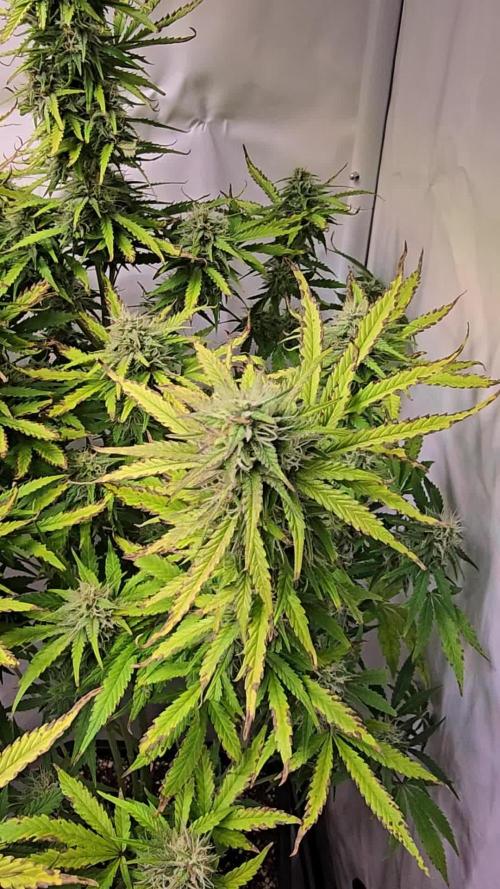
La structure est maintenant bien établie. La phase de stretch semble se stabiliser, laissant place au développement des sites de floraison.
Hauteur actuelle : 68 cm (+22 cm)
Stade : Floraison confirmée. Les pompons commencent à se former et la plante change d'allure pour se concentrer sur la production.
Travail sur la plante :
Entretien :
Je n'ai pas touché à la plante depuis une semaine. Après le travail d'aération et de palissage précédent, j'ai choisi de la laisser tranquille pour ne pas la stresser lors de son passage en floraison. Elle s'épanouit d'elle-même.
Structure :
Le palissage à la ficelle fait toujours son office, maintenant une canopée ouverte où l'air circule parfaitement.
Gestion du système Autopot :
le 12/05 Nutrition :
Fidèle à la méthode Biotabs, la plante n'a reçu que de l'eau claire via le système Autopot. Sa couleur vert foncé et sa vigueur prouvent que le substrat est parfaitement équilibré pour cette phase de transition.
le 14/05
apport de 50 cl de tea compost
preparation tea compost :
LE MELANGE :
15 grammes tea compost avec 5 ml d'orgatrex pour 1 litre d'eau ( 4 plantes donc ×2. 50cl par plante ) .
mélanger le tous dans un sceaux.
LA PREPARATION
materiel :
1 sceau
1 pompe à air pour aquarium. ( 15 euro ).
je vais utiliser pour 18h00 la pompe de mon aire dôme de l'autopots. j'ai acheté aussi 2 petit diffuseur d'air à 4 euros . ustensil utiles pour aérer le tea compost .
mettre les diffuseur dedans allumé la pompe et laisser pendant 18h00.
normalement le température idéal pour que les micro-organismes se développent est entre 18 degrés et 22 degrés.
pour ma part le mélange était dans ma salle de culture à enciron 24 , 25 degrés.
voir video et photos ajouter
18h00 après
filtrer le mélange pour éviter touts dépôts susceptible de moisir et ramener des champignons.
donner au plante 50 centilitres .
Le tea compost se garde mal donné dans l'heure qui suis le stop de l'aération
Résumé :
On arrive à un moment charnière. Avec 68 cm de hauteur, elle occupe l'espace de manière idéale. Les fleurs commencent à se dessiner nettement sur chaque sommet dégagé lors du dernier LST. La plante est sereine, le cultivateur aussi !
À bientôt pour la suite de la floraison !


Likes
47
Share
@Staple_1
Follow
The plants got a big defoliation of a lot of the lower growth in lolipop style fashion, either flipping to flower next week or waiting two weeks. I’ve had to start using neem oil because it seems some little critters are eating my plant leaves. It’s very minimal and small just better to be safe than sorry, currently at day 40 of the Grow. Just moved the light up a few more inches compared to the plants canopy. Seems as if they’re getting a little light stress since I turned the light all the way up to the full 1,000 blast. Same feeding schedule. Let me know if y’all have any tips! Always appreciated


Likes
8
Share
@Fuzzel
Follow
The get finally get going.
Only water this week.
Topping #1 and #2 over 5th node on day 33.
I guess I was kinda curious and ate the cut tops after giving them a rinse. They tasted great, kinda sweet&sour, reminded me of grapes that are not fully ripened and green. Also a bit parsly.
Likes
28
Share
@ThatoneAKguy
Follow
Holy stretch Batman! DD#1 put on almost two feet and while I’m not super stoked about the node spacing right now I’m also not stressing about it. Like quite a few autos one stops short and creeps ahead in the bloom. That’s what #2 did. But she’s the Christmas tree type and the first that I’ve never left alone. I also know why I top them early usually or at least do some LST. These were behind their room mates and unreachable after week 3. I never expected them to be this tall so my expectations are met and exceeded thus far.


Likes
12
Share
@Seymour_buds
Follow
girls are growing well. changed water change out cycle to replacing 1/3 of entire resevoir every 3 days. The theory is that i will be able to transition changes to nutrients slowly to identify any changes to the girls.
one girl showing sign of what i believe to be calcium deficiency.(picture attached)

Likes
4
Share
@efectocanario
Follow
comenzamos la primera semana de floracion, y junto con el formamos el primer super cropping en las fotos principales podemos apreciar el momento en que hacemos el super cropping y podemos comparar con la siguiente foto es al otro dia cuando sale el sol y vemos como las hojas enseguida se posicionan para absorver todo los rayos solares posibles! tambien comenzamos con las bases de floracion y durante las 2 primeras semanas de flora agregamos voodo juice y bud ignitor


Likes
11
Share
@Fullmeltalchemist
Follow
11.8 - D50/F2 - Things with these two are swell. The massive leaf duo are on 12/12 now and separated into different tents on 11.8. I kept the smaller of the two in the 5x4 with ten other 5 gallon plants. Hoping this doesn’t lead to too much crowding, but have started to set 14” support rings to help with training. The larger one is in the 3x3 with four 3 gallon plants, including two autos that should finish well before the 9lb becomes unmanageable
I mulched with Organic Maine Enriched Mulch so hopefully lose less water to evaporation, then dosed with a new product by NLS as an amendment to boost flowering. The ingredient list on this pack is amaze and you can’t even begin to imagine how it smells haha. As I’ve said before, their products “stank so good”.
11.10 - D52/F4 - All defoliated and stretching!

Likes
21
Share
@Ultraviolet
Follow
Heyókȟa
I desire to study nature, and to know better the mind of God, the creator, Holy art thou, O Father.
12x12=144, A dodecahedron is a polyhedron with 12 faces, and in coordination chemistry, it refers to a geometry where ligands surround a central metal atom (in this case, Magnesium) in a specific, 8-coordinate arrangement. Dodecahedrane is a hydrocarbon, meaning it's composed solely of carbon and hydrogen atoms. The carbon atoms are arranged at the corners of a dodecahedron, a 3D shape with 12 pentagonal faces. The water molecules in the dodecahedron form hydrogen bonds that are individually slightly weaker than in either the dimer or the tetramer. However, because three-quarters of the O -H groups in the dodecahedron form hydrogen bonds, it has a more negative energy per molecule than has either the dimer or the tetramer. Magnesium (Mg2+) is the essential, central metal ion in the chlorophyll molecule, crucial for photosynthesis by enabling light absorption and energy transfer. It is chelated by four nitrogen atoms within the porphyrin (or chlorin) ring structure. Chlorophyll appears green because it reflects light in the green region of the visible spectrum, specifically between 490 and 570 nm. The main resonance electronic frequency of a neutral Magnesium (Mg) atom corresponds to the transition from the ground state to the first excited state. Resonance Line Wavelength of Mg2+: 285.1nm (UVB light). The central atom of the chlorophyll molecule is Magnesium (Mg2+), which is coordinated within a porphyrin ring. The electronic "resonance frequency" of this central atom—meaning the frequency at which its electrons absorb energy—is primarily driven by the electronic transitions (ETR) of the surrounding conjugated chlorin ring structure, rather than a discrete atomic transition of the Magnesium atom itself. The resonant electronic frequencies of the chlorophyll porphyrin (technically, a chlorin) ring are determined by the energy required to promote π-electrons within its conjugated system, primarily appearing in the blue and red regions of the visible spectrum.
In standard physics, Chloryphyll b has peak absorption at 460nm (Blue). If we take the peak wavelength 460nm and a UV-B, UVR8 peak absorption wavelength 285nm Tryptophan-285 (W285) Sensing protein. 460/285=1.618 Φ, "natural harmony" and the "structure of light". The cryptochrome photoreceptor (CRY) is a UV-A/blue light receptor that shares this dual sensitivity with several other biological structures and functions, including significant sequence similarity and a common evolutionary ancestor with DNA photolyase enzymes. These are light-activated enzymes that use blue/UV-A light to repair DNA damage caused by UV-B radiation in plants.
Dodecahedrane (C20H20) is a hydrocarbon with a cage-like structure where carbon atoms form 12 pentagonal faces (a regular dodecahedron). It is highly symmetric (icosahedral), contains no delocalized electrons (no aromaticity), and has minimal angle strain, but significant torsional strain. Water Dodecahedron (H2O) forms hydrogen-bonded cages. While individual hydrogen bonds in this structure are weaker than in the linear dimer or tetramer, it has a more negative total energy per molecule. This is because three-quarters (75%) of the groups are involved in hydrogen bonding, creating a very stable, closed-shell configuration. a 3D carbon hydrocarbon (C20H20) to stable water clusters in hydrate, while the Magnesium ion acts as the central activator within a conjugated ring in biological systems, with its electronic absorption dominated by the ring, not the atom itself.
Effective quantum efficiency of photosystem II, often denoted as ΦPSII
In horticultural lighting, adding 730 nm (far-red) LEDs alongside standard red/blue lights has been shown to increase canopy photosynthesis by 20–30% in several crops by acting synergistically with shorter wavelengths. However, the limitation is that excessive, pure IR/Far-red light (without accompanying red light) can trigger the "shade avoidance response," causing plants to grow tall, weak, and spindly rather than robust. Knowing is half the battle however, engineering or utilizing infrared light (specifically the 700-750 nm far-red range) is a viable method to boost photosynthetic efficiency. It acts as a bridge to allow PSII to utilize a broader spectrum of light, breaking the traditional 700 nm barrier.
Extend, then multiply.
UVR8-mediated signaling (often in conjunction with CRY proteins) triggers protective mechanisms that maintain the stability of the photosynthetic apparatus (including LHCII and reaction center proteins), thus ensuring that the efficiency of Photosystem II remains higher in UV-B-exposed plants compared to plants lacking this receptor. ΦPSII indictates the rate of electron transfer from water to plastoquinone, which drives the production of ATP and NADPH. There is a close link between ΦPSII and the true rate of CO2 fixation (Φ*co2), particularly in C4 plants.
Effective quantum efficiency of photosystem II, often denoted as ΦPSII, represents the proportion of light absorbed by Photosystem II (ΦPSII) that is actually used in photosynthetic electron transport. It is a key indicator of how efficiently a plant is using light for photosynthesis, as opposed to losing it as heat or fluorescence. ΦPSII (effective quantum yield of photosystem II) functions primarily as a "multiplier" (a coefficient of efficiency) rather than an additive factor when estimating the overall photosynthetic electron transport rate (ETR). Multipliers are considered far more beneficial than additions because they generate exponential growth, leverage existing resources to their full potential, and create sustainable, self-multiplying capacity, rather than just incremental, linear increases.
Humans, and most other mammals, rely on other mechanisms, such as nucleotide excision repair, to manage and repair UV-induced DNA damage. As such, humans do not have the direct, light-driven repair mechanism that photolyase offers in plants.

Likes
52
Share
@Ultraviolet
Follow
Flattened canopy a little by bending and gently cropping stems over several days. Dropped hours of light to 16 and switched to a spectrum more suited to flowers. Will give her one more week to prepare and develop.
INFINITY
Dodecahedron is the only platonic solids that has infinite numerical pathways. The Aether.
Saturday I switched to 12, I forgot for a second this strain is 100% Sativa, I thought she wouldn't stretch much because the PPFD was high. Never noticed such an obvious change in temperament from a plant overnight, it has been a sleepy, lazy leaf veg cycle for the most part, there are no signs of flowers yet ofc, but just the way she exploded into a more satellite disciplined formation, ITS TIME, so it begins, no turning back now....... my poor electricity bill.


Likes
24
Share
@JUNGLE_B4RNS
Follow
Week 5 of flowering
It’s growing 😂
There’s not much to do, keeping an eye on the leaves helps me to tell if it still needs some nutrients or just water.
I’ve been able to readjust the lack of Cal on 2 plants (Strawberry Kush) unfortunately 2 others plants (1 Super Skunk and 1 Banana Kush) were too deficient to catch back.
I wish the Super Skunks were a bit more Indica. They are typically Sativa phenotypes, at 80% I would say, second time it happens in 3 years with this batch (ART. 1520007 , B19).
Normally they’re perfectly balanced and produce plenty of massive colas in a very short period.
1 of the White Gorilla Haze is making proper dark purple flowers, it’s a very nice pheno.
I will add more bud porn on next week 😊
(I’m looking for a job in the Cannabis industry as Master Grower, Mineralogist, Quality Control)

Likes
3
Share
@jaydee702
Follow
The girls are hardening up and glazing over with tricombs its looking like all of nine weeks mabe ten before ripe for smoking since she stretched 2 weeks longer than ever before with this strain .finally forming some really nice nugs starting to stink a little has a flower garden sweetness that stinks so good.cant wait yum yum.
Found some male parts in popcorn below canopy I got rid of everything below the canopy to keep her female only new pics are 8 weeks and 5 days in flower stil needs to rippen its in full Bloom now so im flushing till she is ready next week or so


Likes
124
Share
@Legendaryseedthumb
Follow
Day 1 drying: Really nice strain! Easy to grow, medium dosage of nutrients.
Smells amazing, I’m really curious how they will end up after the drying. Let’s see in some days.
Drying day 7: finished and damn the terps are amazing! Smells and taste amazing. It reminds me of amnesia but in a mix with mimosa. Super special. I do really recommend trying this one out. But I would recommend using living soil over coco!
Likes
10
Share
@Archieballs
Follow
All looking good. Banana #1 is starting to put on more weight. #2 and Haze nodes are coming closer together. The smell is intense. All 3 got ph water as needed about 4.5 liters until runoff.

Likes
14
Share
@ThatsmyGrow
Follow
She need maybe more time, but i need space for my new Projekt, but it is what it is.

Likes
29
Share
@Wrongholn519
Follow
These girls are busting out the seams.
Giving them heroic doses of Calmag and molasses to finish the job off.
I just did a Trichome check and we're at 5-10% amber so they are ready to be pulled. These photoperiod plants are ready in under 100 days.
The smell is wildly pungent .. thankfully I have my exhaust venting outside for the whole world to enjoy ☮️🇨🇦
