





@Mannirumpel420
Volgen
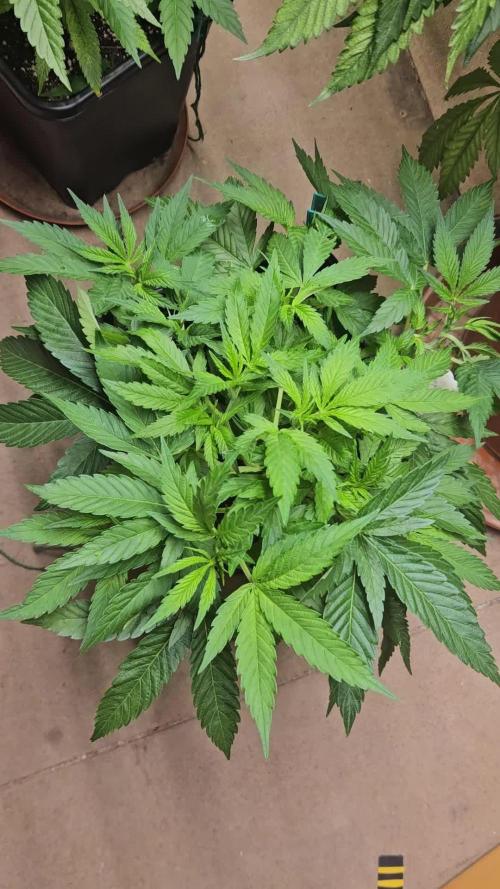
Ab heute bekommen sie 12h Licht.Es wird eine Herausforderung ihre ganzen Triebe zu trainieren.Höchstwahrscheinlich müssen viele Blätter weg,damit mehr Luft und Licht durch kommt. Ihr Wachstum spricht micht sehr an und ich werde wahrscheinlich einen steckling dieser Sorte behalten,da sie zusätzlich einfach unfassbar gut riecht.




@Hashy
Volgen
********************************************
Week 11 Mid flower (week 7 flower)
********************************************
Light cycle=12/12
Light Power=140w 59%
Extractor controller settings (during lights on).
High temp= 26c
Temp step=0c
High Rh= 48%
Rh step=0%
Speed max=10
Speed min=3
Extractor controller settings (during lights off).
High temp= 20c
Temp step=0c
High Rh= 53%
Rh step=0%
Speed max=10
Speed min=3
Smart controller settings (during lights on).
Lights on=9.00am
Radiator on= -19.0c
Radiator off=+19.5c
Smart controller settings (during lights off).
Lights off=9.00pm
Radiator on=-18.0c
Radiator off=+18.5c
VPD aim=1.0-1.5
DLI aim=40-45
EC aim=1.0-1.8
PH aim=6.0-6.5
💧💧💧💧💧💧💧💧💧💧💧💧💧💧💧💧
NPK= 8-17-26
Method= Automatic
Feed=Flower nutes
Neutralise=0.1ml/L
Plagron bloom=4ml/L
Plagron Power buds=1ml/L
Green Sensation=1ml/L
Easy Ph down=0ml/L
(1ml=24 drops, 1 drop=0.04ml)
Easy Ph Up=0.021ml/L
(1ml=24 drops, each drop is 0.04ml)
Ec=1.55 PH=6.2/6.0
Runs=8
Run times=3mins (0.75L/0.375L each)
Gap times= 17mins
Total runtime=24mins(6.0L/3.0L each)
Total flowrate= 0.25L/min(0.125L/min each)
Auto start time=10.00am
Auto stop time=12.23pm
💧💧💧💧💧💧💧💧💧💧💧💧💧💧💧💧
********************************************
********************************************
📅19/4/25 Saturday(Day 71)
💧
Manual Flower nutes
Ec=1.5 PH=6.3/6.0
Volume=7L
Volume left=1L
Volume used=6.0L
Volume each=3.L
Runoff.
Total runoff=0.7L
Ec=3.4 PH=6.5/6.3
💧
📅20/4/25 Sunday(Day 72)
📋H=91cm D=19cm Dli=43.8 PPFD=1010
📅21/4/25 Monday(Day 73)
📋
📅22/4/25 Tuesday(Day 74)
📋
💧
Automatic water
Ec=0.14 PH=6.9/6.4
Volume=8.0L
Volume left=2L
Volume used=6L
Volume each=3L
Runoff.
Total runoff=0L
Manually 1L each
Volume each=4L
Total runoff=0.7L
Ec=2.6 PH=6.5/6.3
💧
📅23/4/25 Wednesday(Day 75)
📋
📅24/4/25 Thursday(Day 76)
📋H=91cm D=19cm Dli=47.0 PPFD=1090
Lowered light power to 130w
H=91cm D=19cm Dli=44.0 PPFD=1020
📅25/4/25 Friday(Day 77)
📋H=91cm D=19cm Dli=44.0 PPFD=1020
********************************************
Weekly roundup.
📋 What can I say, this is producing some chunky flowers, stunning plant, has suffered a little on the main cola through the light being close, but I'll be reducing light intensity from this point.
Back soon.
Take it easy.
********************************************


@Krautbauern
Volgen
Gradually, Gorilla Cookies begins to extract the nutrients from the leaves. it is impressive how much resin it produces. Hopefully she will do well in the last few weeks.


@Exotic_Grower
Volgen
Week 6 starts good so far
Two plants looks a little burn on the leaves
The hole thent smells strong of citrus and the terp profile is increadible. The hole side branches and the leave branches are full with terps
Edit on day 63: one plant (the one in the middle) startet to get a wired burn on the leaves. They getting Brown and Fall down on the edges. I dont know what she is Missing😬


@Mr_Dior21
Volgen
Loved growing this beauty she smelled amazing the whole way through. I wish I got more off her but hey I’ll get em next time. This strain isn’t too potent but you feel a nice calming relaxing wave and a gentle soothing high after your first hit. I feel as if there might be a higher amount of CBD in this girl because of that. At the end of the day it get my lady and I high and I’m all good with y’all thank you again for checking on my grows hope y’all stay around 👏



@Bud_vista
Volgen
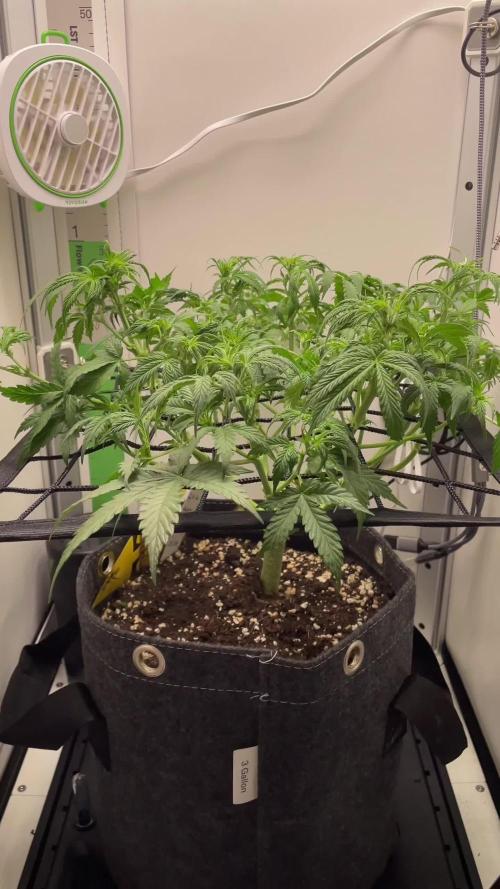
We are starting week 5!
It’s incredible how strong she’s growing since entering the pre flowering stage.
One week after entering preflower she’s stretching nicely and nearly covered the whole space.
After 7days from pre flowering I did another defoliation to improve airflow and focusing on forming potential buds.
Week 5 went smoothly and I’m still happy with the results and growing in coco.
Looking forward to week 6!


@medicalcannabelfast
Volgen
CBD 20-1 has been an easy grow :) she likes full strength feeds
And guzzles water like there’s no tomorrow .
Her colas are short but they are fat and packed with resin and trichome’s
She smells fruity and fresh and I can’t wait to make meds with them :)


@Grower_Of_Persia
Volgen
week intel:
every thing is amazing girls are ripening , we can now cause more e.c stress than before because:
1-plants are very mature now and can handle stress
2- at this week its the only stress that is helpful for increasing plant resins
stresses :
E.C stress around 1.6 and 1.7 3 times a week
feeding:
i replaced B-52 with Bloom Base Nutrient
i feed them 3 times this week with this order :
day 1 : i feed them high with base nutrients(calcium & micros (half dose) + Bloom) about 850 ppm - 1.7 e.c to cause a little stress.
day 3 : i feed them high dose of Top-Max + Bloom Base Nutrient around 877 ppm - 1.7 e.c to cause stress .
day 5 : i feed them high dose of Feeding Booster around 850 ppm - 1.7 e.c to cause e.c stress again
guide of the week :
last weeks are time of ripening , and the only helpful stress is e.c stress at this moment





@La_VecinaCannabica
Volgen
El armario se empieza a llenar, es el primer dia en floración de las Pink truffle con el HPS. No os perdáis los próximos días 🤜🏻🤛🏻💚


@Lazuli
Volgen
Light defoliation on both of them,
They are both in full flower now, the autopot seems to go a bit quicker
shorts_status_processing


@Bigkeenedickheadfr
Volgen
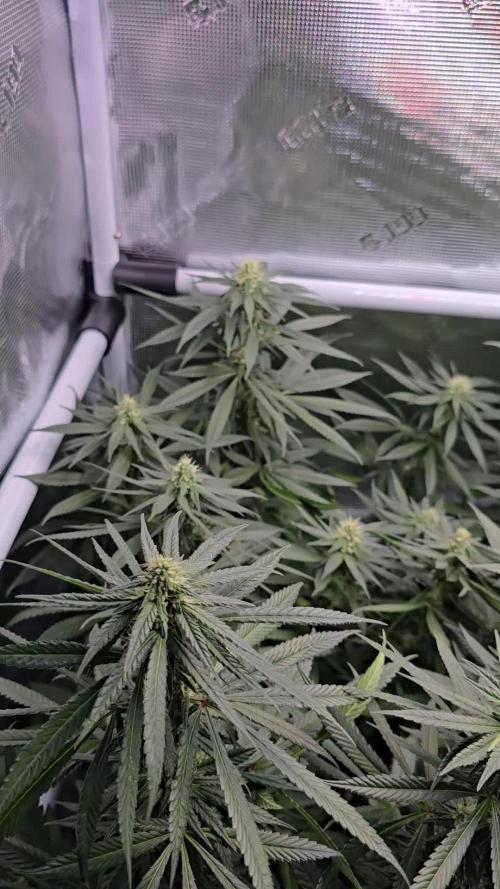
Not sure if I recorded the wrong height as week, but she shrunk 4 inches. 🤣. No issues, chugging along in flower.

@leithsffs
Volgen
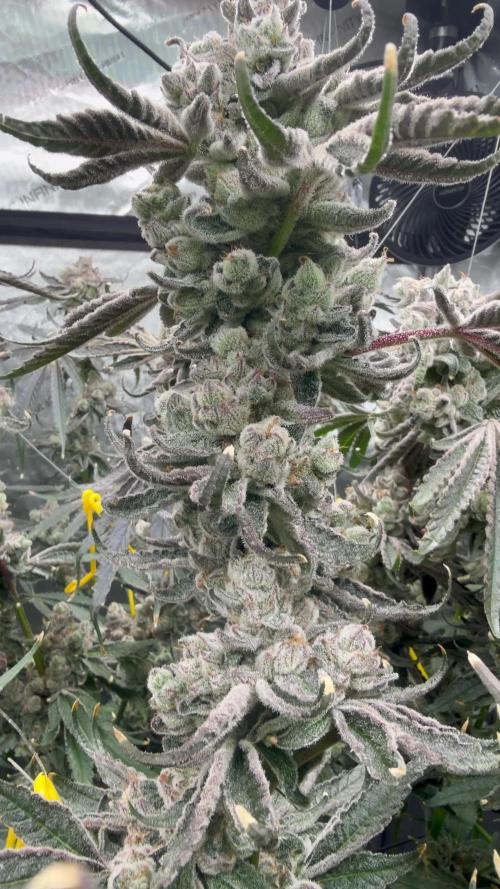
I defoliated a lot of the under canopy today so I could move the scrog net upwards. These girls just had to stretch and stretch their legs. And, yes, the smell on my fingers after handling them was intensely citrus.
I only gave them a little water this week as the air has been very moist and the soil has been damp enough.

@BabyBilly
Volgen
I lowered the ppms of fade and PK and it made a significant difference. Everything is back normal and stable again. Lowering light intensity and temp in general to induce maturation. I’m sitting at 10% amber roughly. I’m going to check this weekend and it might be chop chop.




@Ultraviolet_
Volgen
Remember that, however you are played, or by whom, your soul is in your keeping alone. Even though those who presume to play you be kings or men of power, when you stand before God, you cannot say, 'But I was told by others to do thus,' or that virtue was not convenient at the time. This will not suffice. Remember that.
Day:18
84°F and 65% RH (VPD) for the vegetative stage. Approximately 1.15kPa(assuming leaf temperature is about 2°F cooler than the air), which falls right into the ideal vegetative sweet spot (0.8kPa to 1.2kPa). At 1.15kPa, plants can draw water and nutrients efficiently without risking stress or wilting. It keeps the leaf pores (stomata) open, allowing for ideal carbon dioxide intake and maximizing vegetative growth. VPD is determined by the leaf's temperature, not just the ambient air. Because leaves usually run 1° to 3°F cooler than room air under bright grow lights, my actual VPD will be slightly lower, closer to the 1.0kPa mark. As she transitions from vegetative growth to flowering, one can gradually lower the humidity (to around 45–60%) and drop temperatures slightly to prevent disease from settling inside dense buds when they appear.
Night:6
At 70°F and 60% relative humidity, Vapor Pressure Deficit (VPD) is 0.86 kPa. This is right on the cusp of whats optimal for the vegetative stage. During the nighttime, plants generally close their stomata and undergo cellular respiration rather than photosynthesis. Transpiration slows to a near stop, making VPD less critical at night than during the day. However, maintaining a nighttime VPD between 0.8 and 1.0 kPa is highly beneficial in that it ensures the air is dry enough to prevent powdery mildew or bud rot, but moist enough to keep the plant from undergoing unnecessary stress. This range keeps the environment comfortable for cellular processes and prevents large atmospheric swings. Keeping it all flowing.
(Not pushing them yet, these are photoperiods)
The optimal soil (root zone) temperature for cellular root respiration and nutrient uptake in cannabis is between 68F & 72F This narrow range balances biological energy production (cellular respiration) with the dissolved oxygen levels in the soil, maximizing plant growth and health. Warmer soils hold significantly less dissolved oxygen. When soil temperature exceeds 74F oxygen depletion occurs, inhibiting cellular respiration almost entirely, At 68-72F root cells generate optimal adenosine triphosphate (ATP) via respiration to power root-tip elongation and the active transport of water and nutrients.
Too Hot (Above 78F) Root respiration increases, demanding more oxygen, while the water's oxygen-carrying capacity drops. This creates a prime environment for anaerobic pathogens and Pythium (root rot).
Too Cold (Below 60F) Root metabolism and cellular respiration slow to a crawl. This severely impairs nutrient and water absorption, leading to yellowing, wilting, and phosphorus deficiencies.
A lot depends on whether it's automatic or photoperiod; with photoperiod, there is not as much of a need to push "hard" as the real countdown only begins once the flower is initiated. Automatics, on the other hand, the chronological "clock" begins ticking the moment the seed germinates. It is of critical importance that the seedling growth gets off to the races, understanding that early growth is like compound interest, which will pay off come harvest. This reality is why getting autoflowers "off to the races" early on yields such exponential benefits. The "compound interest" is directly related to the surface area of the leaves. Larger, faster-growing seedlings process more light and build bigger root networks early on, which translates into an explosion of vertical and lateral growth during their short vegetative window.
The margins for error are so thin with autoflowers; this early-stage momentum depends on several critical practices. Seedlings exposed to increased atmospheric CO2 levels early in life will develop at an increased rate. To effectively "extend" or optimize the capacity of Photosystem II (PSII) for increased photosynthetic efficiency. In standard oxygenic photosynthesis, Photosystem II (PSII) is naturally limited to the red-light spectrum, peaking at 680nm. Extending its light-harvesting capacity past 700nm into the far-red region requires bypassing the natural limits of standard chlorophyll a. Adding 730 nm (far-red) LEDs alongside standard red/blue lights has been shown to increase canopy photosynthesis by 20–30% in several crops by acting synergistically with shorter wavelengths. However, the limitation is that excessive, pure IR/Far-red light (without accompanying red light) can trigger the "shade avoidance response," causing plants to grow tall, weak, and spindly rather than robust. Utilizing infrared light (specifically the 700-750 nm far-red range) is a viable method to boost photosynthetic efficiency. It acts as a bridge to allow PSII to utilize a broader spectrum of light, breaking the traditional 700 nm barrier. UVR8-mediated signaling (often in conjunction with CRY proteins) triggers protective mechanisms that maintain the stability of the photosynthetic apparatus (including LHCII and reaction center proteins), thus ensuring that the efficiency of Photosystem II remains higher in UV-B-exposed plants compared to plants lacking this receptor. ΦPSII indictates the rate of electron transfer from water to plastoquinone, which drives the production of ATP and NADPH. There is a close link between ΦPSII and the true rate of CO2 fixation (Φ*co2).
ETR stands for Electron Transport Rate. It measures the speed at which electrons are moved through the thylakoid membranes in a plant's chloroplasts during the light-dependent reactions of photosynthesis. Infrared light (particularly Near-Infrared or NIR) improves cellular energy by interacting directly with the electron transport chain (ETC) in mitochondria. This process boosts adenosine triphosphate production, which acts as a metabolic coefficient multiplier by accelerating enzyme activity dramatically.
Extend then multiply.
Far-Red photons interact with plant photoreceptors to accelerate the plant’s biological "clock" or trigger a shade-avoidance response. Autoflowers don't use the plant's biological clock, although the IR will initiate a shade avoidance and make them stretchy. You can just add equal measures of 660nm-680nm to negate the shade avoidance effect. Replacing nights' "darkness" with a combination of IR+ and 660nm. Because autoflowers don't require a dark period to flower, many growers just blast them with light. 18/6 24/0. However, this ignores the plant's metabolic rhythms, where daytime photosynthesis (light reactions) must be perfectly balanced with nighttime carbon fixation and assimilation (Calvin cycle) to avoid bottlenecking plant development. Cellular respiration is a 24/7 process, but it can only function while the plant has the free oxidative capacity to do so. A 100% photosynthetically active leaf cannot perform cellular respiration. The viral trend of defoliation of every leaf that isn't "getting enough light" is of great detriment overall, putting 100% of the cellular respiratory "workload" and responsibility on the 0/4/6 hours of darkness in sub-optimal conditions for enzymatic activity. Photosynthesis captures nearly 100% of the initial energy as carbon, while cellular respiration is the process that unlocks 90% of that captured energy into usable ATP so the plant can use it. Respiration is considered only roughly 30% to 40% efficient. It captures enough of the potential energy in glucose to synthesize around 30 to 38 ATP molecules per glucose molecule. The remaining 60% to 70% of the energy in the sugar is not captured in ATP; instead, it naturally escapes into the environment as heat, which helps regulate plant temperature. In plants, the primary enzymes of the Electron Transport Chain (ETC) and the ATP synthase complexes are typically adapted to function optimally in warmer temperatures (roughly 77°F to 95°F, depending on the specific plant strain). As temperatures rise within this physiological range, molecular collisions increase, speeding up respiration and ATP production. The cannabis plant has a branched respiratory pathway. During heat or cold stress, plants activate Alternative Oxidase (AOX). AOX burns sugars to dissipate energy as heat rather than coupling it to ATP production. This pathway actually functions optimally at elevated temperatures to help protect the cell from the damaging build-up of Reactive Oxygen Species (ROS) during heat stress. Enzyme activity generally scales with heat; there is a strict biological limit. If canopy temperatures in a grow room exceed 104°F, the enzymes and their supporting lipid membranes lose stability. Not saying you need to go crazy, just optimize nights the same as we optimize days.
Phosphorus is the driving force behind early seedling development. It acts as the "energy hub" of the plant, directly driving cell division, robust root growth, and the creation of DNA. Without an adequate, easily accessible supply early on, the plant's overall growth potential and final yield can suffer permanently.



@Birdbirdman
Volgen
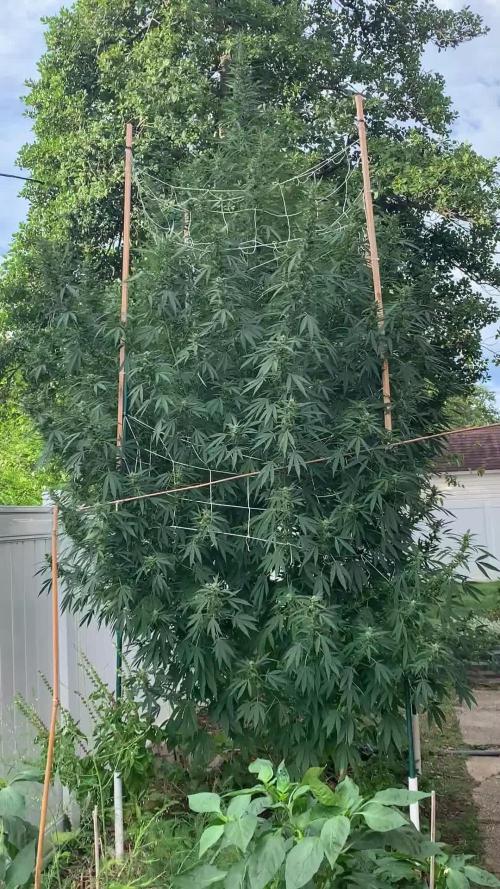
September 29 log (Week 18 / Flower Week 8): This absolute unit just survived a brutal front with 35 mph winds and heavy rain without a single broken branch.
Using the leaf blower every single morning to blast off excess moisture and keep the dense, frosty canopies completely safe from bud rot.
Flowers are filling out heavily with resin production kicking into overdrive as we head into the final weeks of late bloom.



@Krautis_IndoorFarm
Volgen
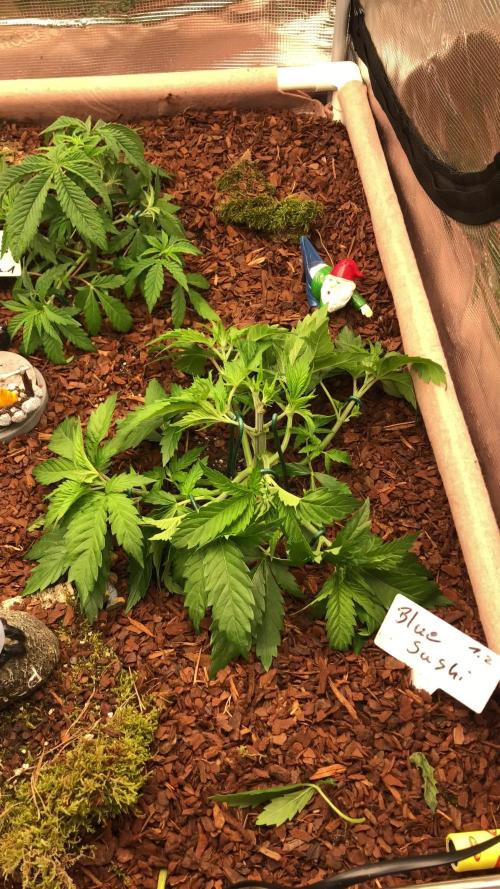
Heute hab es satte 20L Wasser für die gutenund davon waren 10l Komposttee. Bevor es ans LST ging und etwas entlauben ging


@sativa_thc
Volgen
como decia antes voy subir todo q tengo desde entones solo rege con agua nada mas. el resto lo dice la planta por si sola, todo fue una locura la humedad demasiado alta, las lluvias y el invierno q estaba ya encima complicaba las cosas. pero al final todo resulto con los resultados esperados


@Mrg7667
Volgen
Day 74 and there getting chopped today! I thought the harvest was going to be broken into two separate weeks considering the times on the Choco was listed about 7-10 days sooner then the DD (wich was listed at 70 days for flowering)
However looking at the tricombs on the Chocolate Marshmallow most pheno didnt start getting amber untill the DDs did as well! A couple DD pheno could have maybe gone a couple more days but we will see!
Going for reveg on all the pheno, since i didnt get to take any clones. We will see how it goes!
