


Likes
Comments
Share

@DogDoctorOfficial
Follow
Week 13 from seed. Week 9 of flower.
And this one matters.
Not because everything changed overnight — but because this is where the run starts showing its final intentions. One plant came down, one plant keeps going, and both are teaching something different.
This week marks the point where observation becomes more important than intervention. The work is mostly done now. What happens here is less about pushing, and more about reading. Watching. Letting the plant finish saying what it has to say.
From seed to now, this run has stayed simple on purpose.
12/12 from seed, steady environment, minimal overcorrection, and a consistent approach from start to finish. No chasing numbers, no dramatic swings, no last-minute magic tricks. Just stable inputs, careful observation, and letting the cultivar express itself without interruption.
And that is exactly what this week reflects.
One of the two plants was harvested this week — not because she was clearly ahead, and not because the other was behind, but because this stage offers a rare opportunity to compare expression across harvest timing. Same cultivar, same room, same feed, same environment — slightly different finish line. That is useful information, especially when the goal is not just yield, but understanding the medicine at different stages of maturity.
This is less about “ready” and more about reference.
One plant comes down now to show what this cultivar offers at this point in ripeness.
The second stays standing to show what another few days may add, remove, or transform.
That kind of side-by-side tells more than any chart ever will.
The room itself remains unchanged and stable. Conditions are still exactly where they have been: controlled, calm, and predictable. No changes to the environment, no major changes to irrigation, and no attempt to force a finish. At this stage, consistency is the strategy.
Feeding is now reduced to enzymes only.
No base nutrients, no boosters, no extras — just enzymes and water.
At this point, the plant is no longer building aggressively. She is finishing. Enzyme-only irrigation helps break down residual organic matter in the substrate, keeps the root zone active and clean, and allows the plant to continue consuming what it has already stored internally. This is not about “flushing” in the old dramatic sense. It is simply about removing excess input and allowing the plant to finish on what it already carries.
And she is using it beautifully.
This is where the fade begins to tell the truth.
The shifting leaf color isn’t decline — it is redistribution. Nitrogen is being pulled, chlorophyll is breaking down, stored resources are moving, and the plant is redirecting what remains into final reproductive output. That is why the greens soften. That is why purples begin to appear. That is why red tones start surfacing through senescence and cooler expression.
This is the plant using herself completely.
And visually, she is doing it with style.
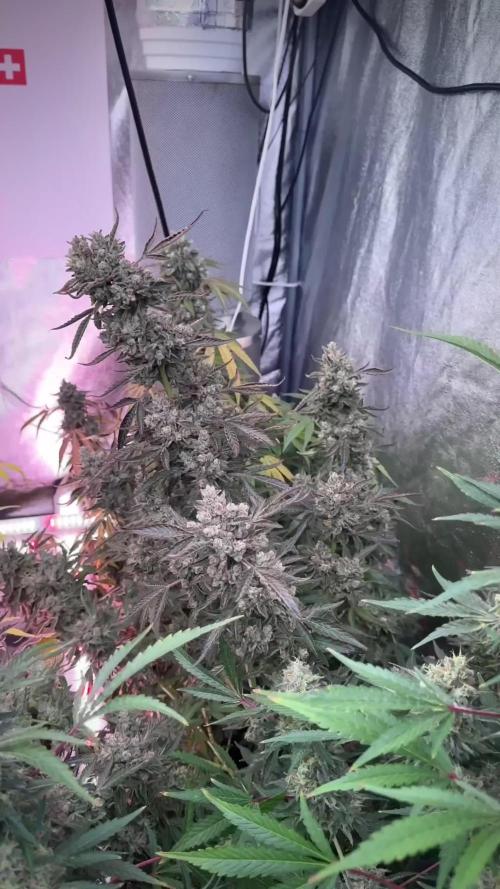
There is color now in every direction — softened greens, faded lime, muted reds, touches of purple, and that late-flower pale glow that only shows up when a plant is actually finishing instead of just aging. The flowers are dense, compact, and fully formed. Resin is heavy. Structure is holding. Light still catches everything.
The room is shining.
Both plants are carrying weight well. Dense tops, compact flowers, strong stacking, and resin coverage from crown to lower sites. No loose finish, no empty tops, no weak lower structure. Even now, late into flower, she still looks composed.
The harvested plant came down thick.
Big structure, strong frame, dense flower, and stems with enough development to show those hollow internal channels that often appear in vigorous, well-fed, fast-moving growth. Frost coverage is heavy, texture is compact, and she carried herself like a proper finisher from top to bottom.
She is now drying in a rack rather than hanging whole — not as a stylistic choice, just a practical one. Space dictates workflow sometimes, and good growing means adapting without romanticizing process. Same plant, same finish, different drying logistics. The important part is controlled handling from here.
And during harvest, she gave a little extra.
Fresh finger resin from harvest always deserves its own note.
What collects on the fingers during live harvest is not the same material as what comes later during dry trim. Similar in origin, different in state.
Fresh harvest resin is live expression — warm, volatile, aromatic, soft, and immediate. It is closer in spirit to charas in the traditional sense: resin gathered from living plant material by direct contact, long before modern processing tried to standardize everything. That matters, because what is collected in that moment still carries a different volatile profile than what comes later from dry trim.
Dry trim finger hash is still resin.
Fresh harvest finger resin is living resin.
They are related, but they are not the same conversation.
And for people who have never paid attention to that difference, this is one of those details worth learning once and never forgetting.
The second plant remains standing, and she is still earning her place.
Still dense. Still shining. Still building.
Not dramatically, not explosively — just quietly continuing.
And that is the point now.
Late flower is no longer about visible daily change. It is about subtle shifts. Trichome maturity. Water behavior. Leaf surrender. Aroma transition. Hidden risk. Final swelling. This is where “not doing much” becomes one of the most active parts of the entire cycle.
Because this is the stage where small mistakes matter most.
Now is when you watch for ripeness.
Now is when you watch for overstay.
Now is when you watch for mold that never comes.
Now is when you watch for trichomes instead of pistils.
Now is when restraint becomes part of the skillset.
She may come down next week.
She may ask for a little more.
That decision will not be made by calendar — it will be made by what the plant says next.
And that is where we leave her.
One harvested.
One still speaking.
Both worth listening to.
Big love to everyone following this run — old heads, new eyes, silent watchers, loud supporters, curious growers, skeptics, believers, and everyone who gave this diary even a second of attention.
To the GrowDiaries platform.
To the community.
To the people who watch closely.
To the ones who question everything.
To the ones who just came for pretty flowers and stayed for the process.
To Zamnesia for the genetics.
To Plagron for the feed.
To the gear keeping the room steady.
To the people behind the brands.
To the growers behind the screens.
And to both plants for doing exactly what they were supposed to do.
Week 13.
Week 9 flower.
One down. One still glowing.
📡 DELETED @ 1K Please stay tuned.we never quit https://www.youtube.com/@TheDogDoctorOfficial NEW 🙏 Thank you for your patience and continued support.
FOR DISCOUNT CODES AND MORE JUST FOLLOW THE LINK https://website.beacons.ai/dogdoctorofficial
📲 Don’t forget to Subscribe and follow me on Instagram and YouTube @DogDoctorOfficial for exclusive content, real-time updates, and behind-the-scenes magic. We’ve got so much more coming, including transplanting and all the amazing techniques that go along with it. You won’t want to miss it.
GrowDiaries Journal: https://growdiaries.com/grower/dogdoctorofficial
Instagram: https://www.instagram.com/dogdoctorofficial/
YouTube: https://www.youtube.com/@dogdoctorofficial Deleted by Youtube - https://www.youtube.com/@TheDogDoctorOfficial NEW
Vimeo : https://vimeo.com/dogdoctorofficial Under construction stay tuned
⸻
Explore the Gear that Powers My Grow
If you’re curious about the tech I’m using, check out these links:
🔆 Lighting & Environmental Control
• Future of Grow — Advanced LED lighting technology
https://www.futureofgrow.com/
DISCOUNT CODE: DOG20
• Lumiflora — Under-canopy LED lighting
https://lumiflorade.com/
• TrollMaster — Environmental controllers and automation gear (past collaboration)
⸻
Genetics
• Zamnesia Seeds — Genetics used in this project
https://www.zamnesia.com/
⸻
🌱 Soil, Substrates, Boosters & Root Support
• Plagron — Substrates, bio mixes, and supportive products
https://plagron.com/en/
⸻
🎒 Storage, Curing & Preservation
• Grove Bags — Curing and storage solutions
https://grovebags.com/
⸻
📸 Photography Equipment & Tools
(Not sponsors, but part of my creative toolkit)
• Sony A6700
• Sony full-frame macro lens + few more
• Stacking photography workflow - learning
• iPhone (for behind-the-scenes shots)
We’ve got much more coming as we move through the grow cycles. Trust me, you won’t want to miss the next steps, let’s push the boundaries of indoor horticulture together!
As always, this is shared for educational purposes, aiming to spread understanding and appreciation for this plant. Let’s celebrate it responsibly and continue to learn and grow together.
With true love comes happiness. Always believe in yourself, and always do things expecting nothing and with an open heart. Be a giver, and the universe will give back in ways you could never imagine.
💚 Growers love to all 💚
📸 P.S. – The Eye Behind the Lens
All photos in this diary (for now — except for the ones showing the camera, which I took with an iPhone) are taken with a Sony A6700 paired with a Sony full-frame macro lens and a few more.
Photography is part of the story — it’s how we share the fine textures, the glow, and the quiet details that words can’t always capture.
I’ve also started experimenting with photo stacking — a technique where multiple images, each taken at a slightly different focus point, are layered together to create one perfectly sharp image from front to back.
It’s not digital enhancement or AI; it’s pure photography — a way to reveal the plant’s beauty in microscopic depth, from trichome to petal.
You’ll even see a few shots of "ghost me" capturing the shots — camera, lens, setup — because every grow deserves not just to be cultivated, but documented like art.
FOR DISCOUNT CODES AND MORE JUST FOLLOW THE LINK https://website.beacons.ai/dogdoctorofficial
NEW DISCORD - Official Server Invite Link : https://discord.gg/ksjAkA5T74

Likes
3
Share


@Nvchods3
Follow
buenl gente esta semana cortare la chocolate haze qe tuvimos en exterior por problemas en el kndor (temp) , se nos quedo enanas pero se ven muuuy resinosas estas bellezas.

Likes
6
Share


@Headies
Follow
Upper growth slowed for about a week or two and root developed, but then the top started growing, and branches started forming. Leaves started getting bigger.
Processing
Likes
2
Share


@pendeja420
Follow
Wow!! It was sunny and hot all week! You can see that they almost doubled their size and are looking pretty much more healthy. That is also because I followed @MadeInGermany 's advice and decided to wait more until I had to water. They seem to have liked that, beacuse there is no more sign of Ca blocking in the leaves. And they grew very nicely, no need of everything. Also following his advice I will use Cal/Mag in the next watering. But, you know, I'm making it cheap... so I will use another home-made recipe: wood ash fertilizer, which include those nutrients and some that are needed in flowering stage -which seems to be starting, so next week will have the flowering label-. It also degrades the N in the soil that could be still causing a little overfeeding (leaves' tips are a bit burnt). However, I admit that my mistake was overwatering from the beggining. Lesson learned! No watering for the whole week and the plnat didn't seem to worry about it.
Man! If only it had been this sunny all the time! Plants look very healthier and are way bigger, with huge new leaves. A little amount of pistils showed up in the last days, so I guess it is the moment for stretching. Knowing that, I decided to do a little training on Sweet, as it is the one a bit behind. You can see in the last picture how I took a couple leaves that were blocking light from side branches-future bud sites- and taped them, so they didn't. If results are good I might do the same with Rebel, but I have a feeling that she'll do good without it.
Sadly, next week will be all rainy and cloudy... Nothing to do tho. Any commentary will be thanked, even if it is about how cheesy the videos are! 😂
Processing
Likes
3
Share


@Sunday_Grower
Follow
Really happy with the rate of growth. Both plants responded well to training and have bushed out pretty well. Going to let them stretch out from now on. God's Vagina has finally shown she is a female! Both plants are now growing at roughly the same speed.


Likes
25
Share


@MadeInGermany
Follow
Flowering Day 19
Since time chance
To 12 / 12 h .
Hey guys :-)
She grows great .
Today everything below was cleaned and defoliated :-) .
A lot was removed because this time it was quite cramped in the tent and you don't lose your energy in the lowest shoots :-) .
This week it was poured twice with 1.2 l each.
You flowers are developing beautifully 💚
Everything was checked and it looks like all trips are slowly but surely gone :-)
have fun and stay healthy 🙏🏻💚
👇🏼👇🏼👇🏼👇🏼👇🏼👇🏼👇🏼👇🏼👇🏼👇🏼👇🏼👇🏼
You can buy this Nutrients at :
https://greenbuzzliquids.com/en/shop/
With the discount code: Made_in_Germany you get a discount of 15% on all products from an order value of 100 euros.
👇🏼👇🏼👇🏼👇🏼👇🏼👇🏼👇🏼👇🏼👇🏼👇🏼👇🏼👇🏼
You can buy this strain at :
www.Zamnesia.com
Water 💧 💧💧
Osmosis water mixed with normal water (24 hours stale that the chlorine evaporates) to 0.2 EC. Add Cal / Mag to 0.4 Ec Ph with Organic Ph - to 5.8 - 6.4
MadeInGermany
Likes
8
Share


@Inceptionist
Follow
Mystery Made 2 got harvested 16/11 and I'm planning to let her dry for 14-21 days before trimming and put them in glass+boveda (58%) and grove bags for final cure.
Drying conditions are as follows:
16-18°C
55-60% RH


Likes
80
Share


@Hawkbo
Follow
I'm just gunna post videos until things get interesting, I'm not winning any awards anytime soon anyways on here but when it counts In the last few weeks I'll do the pics. Its day 31 here and everything looks pretty good.
Likes
80
Share


@Mrs_Larimar
Follow
April, 20th
Happy 4:20 to all People
The first Thinng when i open the Tent is smelling such lovely Scents, flowery spicy... whateveer
Then looking at those Peaks they Produce,.....😍 and I start aBIIIIIG Smile😁
Girls doing fine
Flowering and Flowering,,,
Feeding every other Day , I added Organic More PK, because they need it now
Watering often with all Beneficals they need now

Likes
51
Share


@eldruida_lamota
Follow
Que pasa fumetillas, ya estoy de vuelta y traigo la quinta semana de floración jaujas, que aromas que desprende esta variedad, y como tricoma 🔝, que más se puede pedir.
Bueno por pedir, que no se caigan del peso de las flores en semanas que salga cantidad pero que no caigan 🤣.
Buen porte andan también con buen color, y las flores están prietas prietas 💎
.
La humedad esta al 45% la temperatura está entre 21/25 grados , y como siempre el ph , ya que es de lo más importante,está en 5,8/6,0.
.
AgroBeta:
1 ml x L Flowering black line , vía radicular.
0,2 ml x L Beta shark, vía radicular.
0.5 gr x L mega PK , vía radicular.
0,8 ml x L Terminator, vía radicular.
0,5 gr x L Engordacogollos, vía radicular.
0,3 ml x L Tucán , vía radicular.
0,1 ml x L Betazyme, vía radicular.
0,3 ml x L Tricoma, vía radicular.
0,05 ml x L Gold Joker, vía radicular.
0,2 ml x L Silver, vía radicular.
.
Hasta aquí todo familia 🕸️ , un saludo y buenos humos fumetillas💨💨💨.
Processing
Likes
7
Share


@CityFarmer
Follow
Hello everyone,
Been busy this week working around the house so not much I can say. Heres a little video of there growing...
See you guys next week

Likes
3
Share

@Organic_G
Follow
Wachsen wirklich perfekt, keine Mängel, super fette Stämme, extrem vital und gut am Stacken die Ladys…
Die Automatics sind auf einem Rekordrun wenn es so weiter geh, für 2. Woche Flower sind die extrem robust geworden…

Likes
5
Share


@Cannibalgardens
Follow
Boy with the temperatures being so good in my basement I had a tough few weeks with this girl . She still faired better then her friend gelato41 , I had ph issues and temps fluctuating , and the lack of time as my kids and wife have been sick with the flu for a week and I'm full time Midnight's ...dam never thought growing could be such a challenge sometimes both physically and mentally... With things back on track in my home life and growing world I can't wait to see how my first few weeks of flowering goes wish us luck canna family cheers ...

Likes
2
Share

@Ninjabuds
Follow
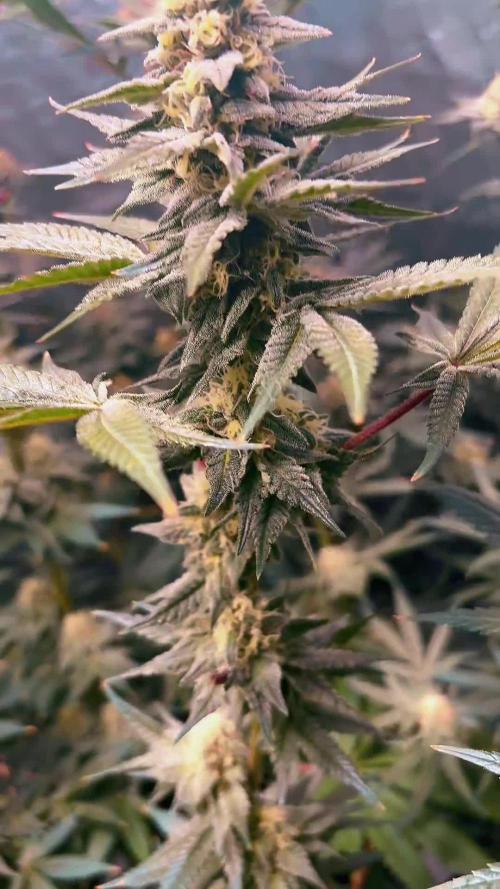
It’s day 43 of flower! All of the plants look great! I’m going to start dialing back the light intensity slowly over the next couple weeks. Harvest time is getting close

Processing
Likes
19
Share


@CannabisAprendiz
Follow
Esta es una genética de un olor muy fuerte y pesado se siente intenso desde la vegetación , es una variedad muy resinosa con unos colores morados hermosos , probando las flores cuando terminó el secado y ahora curando las flores se siente un sabor terroso , al principio no me gusto ya que nunca había probado este , pero después al seguir fumando se siente un sabor final muy agradable.
Esta genética se conservará para futuros cruces y experimentar algo nuevo.
muy conforme con la producción de cada clon

Likes
8
Share


@Die_Growbox
Follow
Nährstoffe bekomme ich nicht geregelt Blätter werden gelb von umtern nach oben gegossen wird nach gieß Plan von growers .ch mit Leitungswasser
Ph werde Erde 5,5-6,5
Da die Feuchtigkeit nicht gesenkt werden konnte sind jetzt nur noch 3 Pflanzen im Zelt


Likes
10
Share


@Itslegalnow
Follow
It’s still drying but i pulled a few nugs to start the cure. I still have one plant up, it’s seeded and working hard on seed production. Keeping alive as long as needed.

Likes
23
Share


@NorthernMonkeyzInc
Follow
1st week of flower, here is the blackberry moonrock by anesia seeds, moonwalker kush by spliff seeds and somango by seedsman seeds


Likes
72
Share


@Natrona
Follow
Hello Friends and followers and new visitors welcome to week 13. 7/30-8/5
Goddesses are doing well. I'm seeing new pistils on some buds throughout the plants.
7/30 pictures videos and ferigate day. Each received 2 liters. Tps1 made at 2 gallon formula. Tps1 22.5ml
Signal 9 ml
Ec 1.14, cm 1140, ppm 790, ph 5.94. Added 2.5 ml ph up. This raised ph to 7.02
7/31 it's been so hot here lately. I made a lemon icebox pie. Very easy 10 min prep time but a 7 hour wait for chilling. It is refreshing on a hot day.
Recipe in week 4 Of my recipe diary. It's infuseable if you make your own crust.
8 /1 took some close ups of the goddesses buds. I'm seeing lots of milky but no amber tricomes at 13 weeks
8/2 Fertilized the Goddesseswith 1 1/2 ltr fertilizer water.
8/3 flushed 1gallon followed by 1 liters fertilizer water.
8/4 no water or fertilizer. Opened tent to let in fresh air.
8/5 Busy today. The ladies in the Goddess tent went outside for their hair cuts. Lots of defoliation. I took off most 3 leaf feeder fans from both Gaia and Circe. Cleaned up cream caramel for the dry leaves. Interesting on Circe, every bud location had a single leaf feeder leaf of course with the three and 5 leaf sugar leaves as well Gaia did not have the single leaf feeder. Checked tricomes in top, middle and bottom buds. It looks like 90% milky. Ferigate 30ml Tps1, Signal 12, cal mag 20. Each lady received 3 ltrs.
So, as it goes, I'm still going through boxes of Moms papers. In week 1, I told you about my grandfather establishing a homestead in Wyoming in 1906. Saturday, I came across the original land rights document issued from the President of United States, Warren G Harding, in 1923 to my grandfather. Stipulations of the Homestead act required that the owner make improvements and live there a certain number of years. All of the conditions were met. Let me tell you. Wyoming is dry and windy like a desert but cold. Noone wants to live there even now.
The courage and fortitude required to uproot and establish a new life in an uncharted territory was passed on to my mother. Having attended several schools and colleges, she settled in Connecticut and went to Teachers College. After graduating, she signed up with the US State Department to teach overseas. Her first choice was Triest Italy, her second choice Tokyo Japan. We don't always get what we want: she got her second choice, Japan. And as the song says, you get what you need.
After Japan, my dad was assigned to Langley Air Force Base in Hampton. The family moved to the states. After a few years settling into life in the states, my mom continued teaching elementary children. In 1969 she received "Teacher of the Year." The school she taught at was located in a low-income area with many underprivileged children. many of the children had reading difficulties. During the 1970s she returned to college to pursue advanced degrees in education, specifically learning disabilities. She changed school districts and once she completed her master's degree, she worked between 2 schools as the reading specialist. She received teacher of the year award again two more times before she retired in the 80's. As I mentioned in an earlier week, she was a lifelong learner. In the 1980's her quest for spiritual enlightenment began. She began attending holistic seminars for meditation, yoga, chakras, crystal energy, spiritualism, healing and many other "New Age" ideologies. I followed this same spiritual pursuit in the '70s and still follow many of the same isms. When I emptied out her apartment when she died in 2020, I came across some of the exact books that I had purchased, and still have, in my quest for spiritual truths.
In 1866, Mucha witnessed the death and destruction of the from the Austrian-Prussian warwhen he was a child. After German invasion and occupation, a cholera epidemic broke out and the emaciated bodies were thrown in a mass grave outside of town. WWI broke out in 1914. 1915 Czechoslovakia took steps to become an independent nation. 1917 the russian revolution ended the tsarist regime to an end. 1919 WWI ends. Mucha witnessed first hand the loss and devistation wars bring. It was during the war, Mucha began his famous The Slav Epic. A series of paintings highlighting the trials and tribulations of the Slav nations for the fight for independence. These works of art were given to the City of Prague. After the war ended, Mucha designed Czech postage stamps as well as banknotes that were circulated in 1919-1931. 1933 Naziism is on the rise as Hitler's popularity increases. As the fear of war increases, he paints the "Light of hope". Soon WWII will break out.
When Mucha was in his mid 30's he met August Strindberg who introduced him to Occultism and mysticism which have a significant impact on his life and work. In 1894 he bought a 10x13 cm rectangular format camera. This too becomes essential in preparing his compositions, and as a support in its own right. I have shown in my posting the various family photographs dating back to the late 1800's. Everyone wanted to have the latest technology with respect to the arts. Remember the theater was in its heyday. Mucha was painting the posters for the prima donna Sarah Bernhardt's theatrical performances.
In 1922 , Mucha is elected Soverign Grand Commander of the Czech Supreme Council of Freemasons and wrote a book on Freemasonry in 1925. This was to mark the 333rd anniversary of the birth of Jan Amos Kaminsky 1592- 1670, consideredby many at that time to be yhe spiritual founder of Freemasonry. The mysticism books I have by Florence Scovel Shinn and Emmitt Fox were written in 1920s and 30s.
The universal pursuit of man's higher purpose and the universal spiritual truths are reflected in my family letters. The pervasive topics were the war and the international conflicts resulting from one nation's desire to oppress and control, and through spiritual pursuits, the dream for world peace.