Processing
Likes
Comments
Share
@
Follow
Likes
58
Share
Saturday, Feb. 20th. San fernando Valley Girls were transplanted, and moved into Bigger Tent, and under the Marshydro SP-3000 They are showing loooong Leaves, They are growing Vigor and they seem to behappy in their new Envoirement I did alittle defoiliation-means i cut the Bottom shoots Lights are running on 50 Percent If you want to buy the tent or the Lights, here are the Links: Light: http://bit.ly/marshydro-sp3000 Tent: http://bit.ly/marshydro-120x60tent
Likes
11
Share
Processing
Likes
24
Share
9/2 allowin showing colors finally, getting purple I some fanleaves, she's smelling super sweet like berries 9/4 she's getting so so frosty. Shes growing/budding like a typical sativa. Super Long slender nugs with ridiculous amounts of frost/crystals covering all surrounding sugar leaf. Yet still small and slender actual bud formation. I am very impressed by the resin production so far though. (Sativas always look Impressive(crystals) but lack actual bud structure) Watered and introduced beastie bloomz to the mix instead of open sesame. Hoping to pack on extra weight. On a side note: the clone from this plant is flowering as well. I have limited the addition of most nutrients besides what was already in the soil. Its cool to note that the clone that hasnt been fed flowering nutes like the mother plant has, is lacking in smell, color and resin production, in comparison between feeding with open sesame vs not feeding besides water as needed. Its not surprising but i love seeing the proof
Likes
2
Share
Same methods, same nutrients, cheap but very good options!
Likes
11
Share
Another week down look at that canopy 😍 I think the stretch has finished and there’s no need for the second net so it’s come down. Not a lot a work this week a bit of defo and top dressing. Yeah for the first time this grow no a lot to say I guess……. Till next week let get it 💪🏽
Likes
7
Share
@Meksi2790
Follow
first week in flower will defoliate week after all plants look real good lolipopped and cleaned
Likes
37
Share
@MrJones
Follow
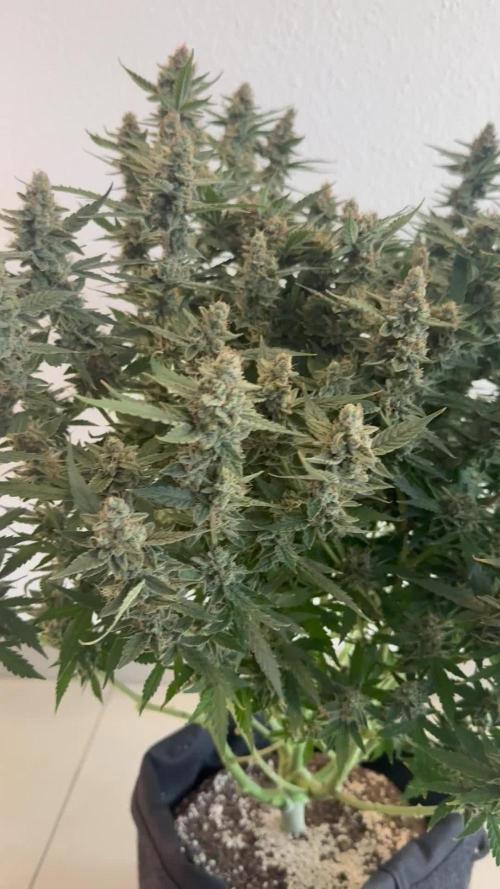
MrJones Pink Sugar Breath F2 by VMAN - ViparSpectra XS2000 240W Infrared Full Spectrum LED Grow Light ´🌿⊱╮🌿╰⊰🌿 WEEKLY GOALS 🌿╰⊰´🌿╰⊰´🌿 🏡Indoor - 3"x4"x8" Custom Built Grow Closet 🌞Environment - 80F and 55% Humidity 🌾This strain likes to stretch during flower, so a heavy training regiment will be needed. ⚱️3-Gallon 📊5.8 / 6.4 PH 💧 Feeding / Dry Amendments using Mr. B's Green Trees ORGANIC BLOOM 2-8-6 🌞ViparSpectra XS2000 240W x2 Infrared Full Spectrum LED Grow Light 🕷️ IPM - We will be using Green Cleaner" 1 OZ per Gallon, and CannControl from Mammoth alternating between products each month for Integrated Pest Management. 🌿╰⊰´🌿╰⊰´🌿 PLANT UPDATES 🌿╰⊰´🌿╰⊰´🌿 📝 Notes - A good friend of mine gave me some of his crosses to test, please read below for his amazing details, I am very excited to see what I can accomplish with these genetics and my cannabis gardening approach. ╰⊰´🌿 ╰⊰´🌿 ╰⊰´🌿 ╰⊰´🌿 ╰⊰´🌿 ╰⊰´🌿 ╰⊰´🌿 🗓️ Sunday 11/20/22 Had a small problem with Fungus Gnats, used some Mosquito Buts to fix it, made a soil drench and and issue resolved. The plants are in their final weeks, and all that is left is for them to ripen, continue to fatten up, I have 3 purple Phenotypes and they look amazing! 🗓️ Wednesday 11/23/22 Lowered the H2O PH to 5.8 / 6.2, over did the last top dressing, wrong time for a little Nute burn, but the ladies are doing great! 🗓️ Friday 11/25/22 - Watered the plants last night, and tonight took a few pictures of few of the buds, they are looking amazing, the smell in the closet is just intoxicating! ╰⊰´🌿 ╰⊰´🌿 ╰⊰´🌿 ╰⊰´🌿 ╰⊰´🌿 ╰⊰´🌿 ╰⊰´🌿 Breeders Notes by VMAN Pink Sugar Breath is a creation of Platinum Kush Breath x Pink Sugar cookies originally Bred by UFO Genetics. Pink Sugar Breath F2 is the second filial Generation that was hunted and creates by Visions. The vigorous cultivar takes 63 to 75 days to flower with various phenotypes. These phenotypes can express terpene profiles ranging from Bakery Dough, Sugar, Og Funk, Fruity, Gas, Dank, Chemical Floor Cleaners, and much more. Expect Purple and Pink Phenotypes to pop up fairly easily. Color starts to show within 7 to 8 days of flower for the purple and pink phenotypes. Green phenotypes have more of an OG Funk/Floor Cleaner presence ╰⊰´🌿 ╰⊰´🌿 ╰⊰´🌿 ╰⊰´🌿 ╰⊰´🌿 ╰⊰´🌿 ╰⊰´🌿
Likes
1
Share
Remember that, however you are played, or by whom, your soul is in your keeping alone. Even though those who presume to play you be kings or men of power, when you stand before God, you cannot say, 'But I was told by others to do thus,' or that virtue was not convenient at the time. This will not suffice. Remember that. Day:18 84°F and 65% RH (VPD) for the vegetative stage. Approximately 1.15kPa(assuming leaf temperature is about 2°F cooler than the air), which falls right into the ideal vegetative sweet spot (0.8kPa to 1.2kPa). At 1.15kPa, plants can draw water and nutrients efficiently without risking stress or wilting. It keeps the leaf pores (stomata) open, allowing for ideal carbon dioxide intake and maximizing vegetative growth. VPD is determined by the leaf's temperature, not just the ambient air. Because leaves usually run 1° to 3°F cooler than room air under bright grow lights, my actual VPD will be slightly lower, closer to the 1.0kPa mark. As she transitions from vegetative growth to flowering, one can gradually lower the humidity (to around 45–60%) and drop temperatures slightly to prevent disease from settling inside dense buds when they appear. Night:6 At 70°F and 60% relative humidity, Vapor Pressure Deficit (VPD) is 0.86 kPa. This is right on the cusp of whats optimal for the vegetative stage. During the nighttime, plants generally close their stomata and undergo cellular respiration rather than photosynthesis. Transpiration slows to a near stop, making VPD less critical at night than during the day. However, maintaining a nighttime VPD between 0.8 and 1.0 kPa is highly beneficial in that it ensures the air is dry enough to prevent powdery mildew or bud rot, but moist enough to keep the plant from undergoing unnecessary stress. This range keeps the environment comfortable for cellular processes and prevents large atmospheric swings. Keeping it all flowing. (Not pushing them yet, these are photoperiods) The optimal soil (root zone) temperature for cellular root respiration and nutrient uptake in cannabis is between 68F & 72F This narrow range balances biological energy production (cellular respiration) with the dissolved oxygen levels in the soil, maximizing plant growth and health. Warmer soils hold significantly less dissolved oxygen. When soil temperature exceeds 74F oxygen depletion occurs, inhibiting cellular respiration almost entirely, At 68-72F root cells generate optimal adenosine triphosphate (ATP) via respiration to power root-tip elongation and the active transport of water and nutrients. Too Hot (Above 78F) Root respiration increases, demanding more oxygen, while the water's oxygen-carrying capacity drops. This creates a prime environment for anaerobic pathogens and Pythium (root rot). Too Cold (Below 60F) Root metabolism and cellular respiration slow to a crawl. This severely impairs nutrient and water absorption, leading to yellowing, wilting, and phosphorus deficiencies. A lot depends on whether it's automatic or photoperiod; with photoperiod, there is not as much of a need to push "hard" as the real countdown only begins once the flower is initiated. Automatics, on the other hand, the chronological "clock" begins ticking the moment the seed germinates. It is of critical importance that the seedling growth gets off to the races, understanding that early growth is like compound interest, which will pay off come harvest. This reality is why getting autoflowers "off to the races" early on yields such exponential benefits. The "compound interest" is directly related to the surface area of the leaves. Larger, faster-growing seedlings process more light and build bigger root networks early on, which translates into an explosion of vertical and lateral growth during their short vegetative window. The margins for error are so thin with autoflowers; this early-stage momentum depends on several critical practices. Seedlings exposed to increased atmospheric CO2 levels early in life will develop at an increased rate. To effectively "extend" or optimize the capacity of Photosystem II (PSII) for increased photosynthetic efficiency. In standard oxygenic photosynthesis, Photosystem II (PSII) is naturally limited to the red-light spectrum, peaking at 680nm. Extending its light-harvesting capacity past 700nm into the far-red region requires bypassing the natural limits of standard chlorophyll a. Adding 730 nm (far-red) LEDs alongside standard red/blue lights has been shown to increase canopy photosynthesis by 20–30% in several crops by acting synergistically with shorter wavelengths. However, the limitation is that excessive, pure IR/Far-red light (without accompanying red light) can trigger the "shade avoidance response," causing plants to grow tall, weak, and spindly rather than robust. Utilizing infrared light (specifically the 700-750 nm far-red range) is a viable method to boost photosynthetic efficiency. It acts as a bridge to allow PSII to utilize a broader spectrum of light, breaking the traditional 700 nm barrier. UVR8-mediated signaling (often in conjunction with CRY proteins) triggers protective mechanisms that maintain the stability of the photosynthetic apparatus (including LHCII and reaction center proteins), thus ensuring that the efficiency of Photosystem II remains higher in UV-B-exposed plants compared to plants lacking this receptor. ΦPSII indictates the rate of electron transfer from water to plastoquinone, which drives the production of ATP and NADPH. There is a close link between ΦPSII and the true rate of CO2 fixation (Φ*co2). ETR stands for Electron Transport Rate. It measures the speed at which electrons are moved through the thylakoid membranes in a plant's chloroplasts during the light-dependent reactions of photosynthesis. Infrared light (particularly Near-Infrared or NIR) improves cellular energy by interacting directly with the electron transport chain (ETC) in mitochondria. This process boosts adenosine triphosphate production, which acts as a metabolic coefficient multiplier by accelerating enzyme activity dramatically. Extend then multiply. Far-Red photons interact with plant photoreceptors to accelerate the plant’s biological "clock" or trigger a shade-avoidance response. Autoflowers don't use the plant's biological clock, although the IR will initiate a shade avoidance and make them stretchy. You can just add equal measures of 660nm-680nm to negate the shade avoidance effect. Replacing nights' "darkness" with a combination of IR+ and 660nm. Because autoflowers don't require a dark period to flower, many growers just blast them with light. 18/6 24/0. However, this ignores the plant's metabolic rhythms, where daytime photosynthesis (light reactions) must be perfectly balanced with nighttime carbon fixation and assimilation (Calvin cycle) to avoid bottlenecking plant development. Cellular respiration is a 24/7 process, but it can only function while the plant has the free oxidative capacity to do so. A 100% photosynthetically active leaf cannot perform cellular respiration. The viral trend of defoliation of every leaf that isn't "getting enough light" is of great detriment overall, putting 100% of the cellular respiratory "workload" and responsibility on the 0/4/6 hours of darkness in sub-optimal conditions for enzymatic activity. Photosynthesis captures nearly 100% of the initial energy as carbon, while cellular respiration is the process that unlocks 90% of that captured energy into usable ATP so the plant can use it. Respiration is considered roughly 30% to 40% efficient. It captures enough of the potential energy in glucose to synthesize around 30 to 38 ATP molecules per glucose molecule. The remaining 60% to 70% of the energy in the sugar is not captured in ATP; instead, it naturally escapes into the environment as heat, which helps regulate plant temperature. In plants, the primary enzymes of the Electron Transport Chain (ETC) and the ATP synthase complexes are typically adapted to function optimally in warmer temperatures (roughly 25°C to 35°C depending on the specific plant strain). As temperatures rise within this physiological range, molecular collisions increase, speeding up respiration and ATP production. The cannabis plant has a branched respiratory pathway. During heat or cold stress, plants activate Alternative Oxidase (AOX). AOX burns sugars to dissipate energy as heat rather than coupling it to ATP production. This pathway actually functions optimally at elevated temperatures to help protect the cell from the damaging build-up of Reactive Oxygen Species (ROS) during heat stress. Enzyme activity generally scales with heat; there is a strict biological limit. If canopy temperatures in a grow room exceed 40°C, the enzymes and their supporting lipid membranes lose stability. Not saying you need to go crazy, just optimize nights the same as we optimize days. Phosphorus is the driving force behind early seedling development. It acts as the "energy hub" of the plant, directly driving cell division, robust root growth, and the creation of DNA. Without an adequate, easily accessible supply early on, the plant's overall growth potential and final yield can suffer permanently. E=MC2 looks like a simple multiplication problem; it describes a fundamental physical truth: mass and energy are the same thing. The equation doesn't just calculate a value; it reveals that mass is effectively "congealed" energy. Energy is just numbers. Energy isn't a physical "substance" you can hold or touch. It is essentially an abstract, calculated number that we assign to a system to predict how it will change, interact, or move. A numerical label we attach to matter to track how it behaves. Because the universe runs on laws of symmetry (specifically, that the laws of physics don't change over time), a single global number must be conserved. We call that number "energy". We don't grow; we facilitate energy conversion. How well a seedling grows is essentially down to how much knowledge one can acquire to increase the level of conversion to occur. Applying knowledge effectively requires intuition, which comes from hands-on experience. A seasoned stoner learns to read subtle signs—like a slight change in leaf turgor (stiffness), subtle color shifts, or the specific texture of the soil—before a textbook diagnosis can be made. Ultimately, growing is the application of botanical science blended with active observation. Knowledge dictates your potential, but adaptability and attentiveness to the plant's immediate environment determine your results. 1.618 nature mathematically optimizes quantum energy transfer and light absorption efficiency within the photosynthetic machinery, as it naturally dictates energy scaling hierarchies and resonance dynamics. External vibration or electromagnetic wave that perfectly matches a plant's natural frequency directly influences plant growth. Low-frequency sound waves and targeted electromagnetic fields stimulate cellular processes and boost photosynthetic efficiency Does it produce better yields? How long is a piece of string? As long as you cut it. But isssss the juice worth the squeeze? The quantum framework of the IVM seems to think so. Good enough for the quantum firmware, good enough for the DNA software. Genetics are not dictated; they are expressed; the rate of that expression is dictated by the environment in which growth occurs. Quantum Coherence in Photosynthesis occurs When a photon of sunlight strikes a leaf, the energy it carries must travel to a reaction center to be converted into chemical energy. This process operates at nearly 100% efficiency. If the energy moved in a traditional "bunching" or random hopping manner, a large portion of it would be lost as heat. Instead, plants utilize quantum superposition. The energy particle (exciton) doesn't just take one path; it exists in a wave state and explores multiple pathways simultaneously. It essentially "chooses" the most efficient route to the reaction center simultaneously. Research shows that molecular vibrations and the specific network arrangements of chlorophyll molecules (like the naturally evolved Chlorophyll A & B ratios) actively protect against energy overflow, optimizing light capture across different light intensities. Enzymes are the biological catalysts that speed up chemical reactions within a plant's cells, allowing them to grow, metabolize, and repair. Rather than relying solely on the classical kinetic energy of molecules colliding, plants use quantum tunneling. Subatomic particles like electrons and protons (hydrogen ions) can literally "teleport" through energy barriers that they normally wouldn’t have the energy to climb over. This makes vital metabolic reactions happen far faster than classical physics could ever explain. Chloryphyll b has peak absorption at 460nm (Blue) and at 647nm(Red). If we take the blue peak wavelength 460nm and a UV-B, UVR8 peak absorption wavelength 285nm, Tryptophan-285 (W285) Sensing protein. 460/285=1.618 Φ If we take chlorypyhll b's Red absorption peak 647nm and a UV-A of 400nm, we get 647/400=1.618 Φ. "Structure of light". The cryptochrome photoreceptor (CRY) is a UV-A/blue light receptor that shares this dual sensitivity with several other biological structures and functions, including significant sequence similarity and a common evolutionary ancestor with DNA photolyase enzymes. These are light-activated enzymes that use blue/UV-A light to repair DNA damage caused by UV-B radiation in plants. Synergistic. But Shhh, it's a secret. Effective quantum efficiency of photosystem II, often denoted as ΦPSII, represents the proportion of light absorbed by Photosystem II (ΦPSII) that is actually used in photosynthetic electron transport. It is a key indicator of how efficiently a plant is using light for photosynthesis, as opposed to losing it as heat or fluorescence. ΦPSII (effective quantum yield of photosystem II) functions primarily as a "multiplier" (a coefficient of efficiency) rather than an additive factor when estimating the overall photosynthetic electron transport rate (ETR). Multipliers are considered far more beneficial than additions because they generate exponential growth, leverage existing resources to their full potential, and create sustainable, self-multiplying capacity, rather than just incremental, linear increases. This fascinating observation is rooted in the intersection of subatomic geometry, fractal scaling, and quantum dynamics. In specific molecular arrangements—such as in conjugated polymer networks or biomolecular architectures—the Golden Ratio (PHI) naturally dictates energy scaling hierarchies and resonance dynamics. Mathematically tied to the fine-structure constant, which defines the strength of the electromagnetic interaction. The Golden Ratio can be mapped geometrically as the Golden Angle (137.5 degrees) in atomic structures, linking the charge of the electron to fundamental quantum constants like Planck's constant. Electromagnetic. The Golden Angle (137.5): This angle is derived from the Golden Ratio (1.618). It is the smaller of two angles created when a circle is divided such that the ratio of the arcs equals the Golden Ratio.
Likes
15
Share
@Trinidad
Follow
As a beginner, when you get mold on your bud like this, you know that you are doing something right. Only the biggest and best buds suffer from bud rot while drying, it shows how important it is to have dehumidifier when drying big buds. You can clearly see she is a high yeilder. Her final weight came in at 189 I had to tie the dehumidifier high up in the tent so that the heat coming from it would not dry out the buds like what happened in my 1st grow, Wurlz F1 by Zamnesia. She is very sticky. She has terps similar to that of king Louie...very musky and fragrant.. it's difficult to explain, however she is very delicious
Likes
20
Share
@TechDCo
Follow
23/10/2024 Lights On! I opened the tent this evening but it's her morning 🌄 however you like to picture it! Strong smell of gas that' smells bitter like lemons, when it hits the back ya sinuses. After a few minutes taking pictures, the undertones of the nutty earthy leaves prevails and lingers around the room it seems for much longer than the lemons. 24/10/2024 Lights On! 25/10/2024 Lights On! 26/10/2024 Lights On! Deffo smelling very sharp lemon 🍋 27/10/2024 Lights On! Yep, there deffo lemons I'm smelling its a Strong Lemon Toilet Fresher kinda' thing! I'm not saying 'Lemon Toilet Freshers' are my thang! But hey, its a sharp lemon smell! Reminds me of the smell of apple car Freshers but lemon instead! I do say; it's the kind of fresh sharp citrus smell when you open ya car door with fresh Freshers hanging! 😈 👿 Slite nute burn from the Holland nutes! "Note to self: next time time add 0.6ml/l instead of 1ml as a low dose! You'll get it perfect eventually 😌 I'm sure! "Not all fat hairy girls are dumb and smelly: some maybe the lazyones, but this time of year the crazy ones and lazyones have to go shopping, nowonder its bussy this time of year: cues cues cues, like Jesus Christ put a folk in it or two! 😉KFC should do trollies for a family pack! deffo at x-mas time because the halloween treats have vanished, the snow then falls, the prices go up the portions go down (more recycled junk) you gotta blame "global warming" on some fat b!tch taking up the space!. Jokes aside: Mrs.Clause like playing with Santa's snowballs! Sorry folks 😞 that's a backwards sexes Mrs.Santa joke 😃 .....Baha well biite mee for spreading laughs this time of year! - Like her egg yolks! 28/10/2024 Lights On! Sorry uploaded 😔 all the photos from today! Will sort them out later! Cba one of those dayz! I just wanted to get them off my phone! I felt like I was going to say "get them off my chest" reading that over again quickly! - Poor English when I'm not running everything through Ai 😕 or is this actually Ai prompted to make mistakes and appear normal! Aye! Makes you question my whole existence within these entries of folklore and mystic magical characters! Baha I think it's my eyes - I'm seeing purple 💜 👀 on her pistils! Blink twice though and the purple hues is definitely there! Oh boy, this is going to be awesome colour show! I reckon 10-11z give or take! Counting time ⏲️ is a forever losing battle! In ones mind it's a peaceful shuffle rattle! We are just in "Crusing Shuttles" the brain is a bubble 29/10/2024 Lights On! Had to supercrop some branches! Now drinking just over 8.5L/24h. 5L = Day 3.5L = Night The last 4 days i topped up only with water to balance the nutes out; i clearly forgot to mention this! She seems a lot more relaxed and the NPKs have leveled out! BG41 indica tent is doing okay she's drinking 4.5L/24h. "Time for a advocaat! I could be Dutch at heart! Well, I sure do speak it 😏 on the double!" "Reversed Black Joke to a WhiteWoman: She got smacked of a black guy and never went back 😅" You ever wonder why hospital lights frequencies make you feel sick! 😬 😫 deffo the street lamps 🔦 now! Too bright! The sun is more blue with its halos 😇
Likes
50
Share
Week 5: Transplant Time & Root Power! Oh man, this was one of those weeks! We transplanted all five phenos into bigger pots, and let me tell you, they’re thriving! (Check out the complete video episode for all the details 😉). The girls are looking amazing, all pretty much the same size for now, so I don’t have any favorites yet—but let’s see what the future holds! For photos, I used both my Nikon P900 and Sony A6000, with a bunch of lenses and filters to preserve the true colors—these LEDs are powerful! Current Setup & Conditions This week, they’re still chilling with their sisters in the big tent, but in about a week, they’ll be moving into the TrolMaster ecosystem for even better environmental control. Watering: pH 6.06, EC 0.96 Temperature: A bit cold , but it is what it is. We’re facing some freezing outdoor temps (as shown last week in the frosty veggie garden pics!), yet these Runtz are holding strong like true champions. 💪❄️ Nutrition: Still on the Aptus Clean Program, with: Regulator System Clean RO Water Conditioner All-in-One Liquid Root Development: The Real MVP! Let’s go deep on roots! The mycorrhizae in the Pro-Mix soil has been working its magic, and I’m still boosting them further with a touch of Aptus Holland Mycor Mix. The root development on this transplant was insane—super white, healthy, and ready to explode with growth. What Are Mycorrhizae? The word “mycorrhiza” comes from Greek: • Myco- meaning fungus • Rhiza- meaning root Mycorrhizae are a type of beneficial fungi that form a symbiotic (mutually beneficial) relationship with plant roots. These fungi extend far beyond the root zone, creating an underground network that helps plants absorb water, nutrients, and improve overall health. This is not a single species but rather a whole category of fungi, mainly divided into: 1. Ectomycorrhizae – Live on the outside of plant roots, forming a sheath around them. Common in trees like pines and oaks. 2. Endomycorrhizae (Arbuscular Mycorrhizae, AMF) – The most beneficial for most crops and cannabis. These penetrate root cells, forming structures inside the roots that exchange nutrients. Where Are Mycorrhizae Found in Nature? Mycorrhizae naturally occur in forests, grasslands, and undisturbed soils worldwide. They play a crucial role in maintaining ecosystem balance by helping plants access nutrients from the soil. In a natural environment, plants are constantly forming relationships with these fungi. However, in modern agriculture, excessive tilling, chemical fertilizers, and fungicides have reduced their populations, making supplementation necessary in many cases. How Do Mycorrhizae Work? Once mycorrhizae colonize a plant’s roots, they start forming an underground fungal network called the mycelium. This network extends the plant’s reach into the soil, acting as a second root system. Benefits of Mycorrhizae: ✅ Enhanced Nutrient Uptake – Mycorrhizae help plants absorb phosphorus, nitrogen, and micronutrients that would otherwise be unavailable. ✅ Improved Water Absorption – The fungal network can reach deeper into the soil than roots alone, helping plants survive drought conditions. ✅ Stronger, Healthier Roots – They promote thicker, more robust root systems, reducing transplant shock. ✅ Better Soil Structure – They produce glomalin, a protein that improves soil aggregation and helps retain moisture. ✅ Natural Pest & Disease Resistance – Healthy plants with strong mycorrhizal relationships tend to be more resistant to soil-borne pathogens. How Mycorrhizae Help in Cannabis & Gardening In controlled growing environments, using mycorrhizae is a game-changer. Since cannabis relies heavily on phosphorus, the enhanced nutrient uptake provided by mycorrhizae is especially beneficial. Best ways to apply mycorrhizae: • At transplant – Dust roots with mycorrhizae powder or mix into soil. • As a soil drench – Some liquid formulations allow fungi to colonize even after planting. • Mix into your growing medium – Using pre-amended soil like Pro-Mix HP Mycorrhizae ensures roots have early access. Pro Tip: Mycorrhizae need living roots to survive! Avoid using synthetic fungicides or excessive chemical fertilizers, as they can kill the fungi. Think of mycorrhizae as a natural root booster. They’ve been around for hundreds of millions of years, helping plants thrive in all conditions. By using them in cultivation, you’re mimicking nature, ensuring your plants grow stronger, healthier, and more resilient. When used correctly, mycorrhizae can increase yields, improve plant health, and reduce the need for synthetic inputs—making them a must-have for any serious grower! Can’t wait to see how they’ll look in the next transplant! I made a few changes to my improvised photo studio, including a pink background for now—because why not? Let’s keep things fun and full of color! 🌸📸 Massive gratitude to all our sponsors and of course, a special shoutout to Zamnesia, Plagron, and Grow Diaries for making this amazing cup happen. 🙌 And to the community—followers, supporters, lovers, haters—I love you all! ❤️ Let’s keep pushing forward, learning, and making this grow legendary! Stay Tuned for More! Next week, i may be moving them into bigger pots and getting them into their final environment. You won’t want to miss this next stage! See you all next week—stay tuned, keep growing, good luck to all and let’s make history together! 🚀🌱 Genetics - Runtz https://www.zamnesia.com/6000-zamnesia-seeds-runtz-feminized.html Nutrients - Plagron https://plagron.com/en/hobby - Aptus Holland https://aptus-holland.com/ Controls - Trol MAster https://www.trolmaster.eu/ LED - https://www.futureofgrow.com/en LED - https://www.thinkgrowled.com Soil - https://www.promixgardening.com/en Germination - Cannakan https://cannakan.com/?srsltid=AfmBOopXr-inLXajXu3QFgKXCXXos4F1oEvScjMKIB5MR5dk8-GJ-F49 DOGDOCTOR 15% off Smoking Papers - https://ziggioriginal.com/ Terpene saver - https://grovebags.com/ As always thank you all for stopping by, for the love and for it all , this journey of mine wold just not be the same without you guys, the love and support is very much appreciloved and i fell honored with you all in my life With true love comes happiness Always believe in your self and always do things expecting nothing and with an open heart , be a giver and the universe will give back to you in ways you could not even imagine so As always, this is shared for educational purposes, aiming to spread understanding and appreciation for this plant. The journey with nature is one of discovery, creativity, and respect. Let’s celebrate it responsibly and continue to learn and grow together! Growers Love To you All 💚 #EternityGrowCup #RuntzHunt #GrowersLove #CannabisCommunity #AptusHolland #ProMixSoil #TrolMaster #Zamnesia #Plagron #ZiggiPapers #Grovebags
Processing
Likes
5
Share
Likes
34
Share
@rhodes68
Follow
5/17 Week 8 ... and the state of the grow is unsettled This grow has fought us since germ and it is showing no signs of giving in. Just cannot seem to find their "happy place" environmentally or nuet wise. They doing ok-ish this is not a big yielding strain no matter the ad copy but havent had this much issue with it indoors before. Starting at baseline with the lighting HID 300w 16 inches above Baba LED moved towards front of tent. Both lights tilted very slightly towards each other hopefully giving better dispersal. Still showing nitrogen sensitivity so reducing Bloom to 8ml/gal while increasing PK to 6 so PK does not suffer, will watch for deficiencies Looking at going considerably over on these now, nothing coming up behind them so zero space issues, see what happens. Continue to leaf pluck when one needs to go Evening feed 5/17: They look better and some experimenting with the lights showed me the angle tilt needed increasing and HID increased to 450w giving a total of 600w in the tent. Should not cause too much heat issue. Still have 150w in reserve 5/18 PM Pic of lights - Seems to be working out managing to cover base of tent with both lights giving a 5000k and 3000k spectrum. Buds building faster now in particular on Baba, Hadnt gotten sick we would have thought of this weeks ago, aint that inspired. Man this Cov-19 stuff will cloud your thinking. Keeping HID at 450w Pics of plants - doing better Nuets - Running low on Soul Peak so gradually working in the KoolBloom to make it last. Seriously think the Soul Peak is better. 5/18 TAHTA TA TAHHHH! Baba found her happy place and is bulking very fast. See how long it continues Re-did the lights Had to drop wattage on HID due to heat even after a redesign of the extraction to eliminate drag on air movement. For 14 hours they will run at 450 watts but for 6 hours a day will drop to 300 watts. This should keep any problems from occurring. Just hard to run that Metal Halide at more than 300 watts in warm weather without AC which aint happening. HID to 300/450 watts, 13 inches above Baba at a 20 degree tilt to disperse light. LED at full 17 inches above Athena with a 20 degree tilt. Coincidentally that puts them at the same height. Added a 30 watt 2700K LED on Baba and Athena give them some more red. See how it works. Nuets as is 5/20 Pics After viewing tricones beginning to walk down the EC to flush in a couple days. Plan 10 day flush. That puts them finishing about the middle of week 11. Not perfect but nothing so far with this grow has been lol Adding the 30 watt 2700K LED in the bottom seems to be helping, lot of increased lower growth WHICH I WILL TAKE ... 😬 Seriously every bud counts lol 5/21 Buds continuing to build at a decent rate finally. Had to re-arrange the tent my wife's plant is getting big Holding nuets where they are till flush, plan to begin flush during week 9. Working on a tactic to harvest Sally ahead of Jane without hurting either After a talk with her and looking seriously at what we have here I am going to break up the feeds. Athena will need to go into flush first she is furthest along. So start it on week 9. Sally ... we are going to do something unusual for her and Jane. Since flushing Sally per normal would be just no good for the twin Jane we are going to flush but then put the plants on organic bloom. So big initial flush with agent to clean out the salts then shifting her to light organics to continue feeding the twin without having to revisit the flushing issue. No idea how long the twin may go Baba will just play by ear on her, continue the light Bloom feeding keeping her PK up until we see the go signal from her. Hoping she goes a week longer than the others. 5/22 Lights to full weather is cool today and time is short Holding nuets here till new week then begin flush on Athena Buds still building nicely on Baba Almost forgot the twin: Here is the plan we flush the pot same time as Athena but on the next feeding we introduce organic bloom nuets for Jane instead of a flush as normal. We dont smoke so not overly concerned with harshness just want the pot clean. The organics will belay any further need of flushing. Best we can do 5/23 Need to start flush now so Athena and Sally on water only till I introduce organics to Sally. No agents Baba staying on feed
Likes
35
Share
6th week of veg. Is finally in the books and all systems are go for the flower show. As they’re revegged clones, their branching structure is just ridiculous. Sucker branches everywhere pulling nutrient flow away from the winners. Right before we flipped and as per videos - we gutted every single plant and crushed it down to no more than about 7 tops max per plant. The whole goal is only to flower select, top shelf bud with every opportunity (and space) to grow to its fullest potential. So far, Druid nutrients has fit the bill for every one of em and they’re all extremely happy on this system👍. We also couldn’t resist and snipped another run of clones off each one but the Skywalker. Not sure if the boogie nights or blueberrys will make it but u never really know do you🤷. That said, the diy aerocloner has been a beast for us and minus an aphid issue last round - she puts out a 100% success rate😉. We’ll use the best of these as complimentary to reg. Run of some spicy bitch we’ve got coming up. Even if the pollen chuck is a failure - we won’t be losing any of the elite white widow or blueberry genetics🤞🤞🤞🤞. Other than that - it’s all wait’n on the buds now👍👌👍. Until next week. Background This ones tied to part 2 of the pollen chuck. They were supposed to be a clone run for pollination but the mothers all reveg’d due to a timer incident and high stupidity. These will be the inaugural flowering run of the revamped dutchy system. Growing made easy😉. Shit ton of finagling and setup but once she’s ready - sit back, relax and watch em grow😍😎. Thanks for take’n a look.
Likes
26
Share
@MedicaL
Follow
Cream Cookies Auto od Fast Buds je prostě stará klasika, na které je ale bohužel vidět její věk. V době svého vydání to mohl být solidní kousek, ale dnešní optikou už tahle genetika těžko konkuruje.Růst a struktura: Neurazí, ale ani nenadchne. Roste to tak nějak samospádem, jak člověk od staršího automatu čeká. Žádný extra stabilní fenotyp nebo explozivní růst se nekoná.Cukru taky moc nevydala.
Likes
8
Share
It’s almost time! This week both plants are getting flushed to prepare them for harvest. 🌱 After that, they’ll be cut down and hung up to dry. #2 has developed an absolutely massive main bud — honestly the biggest I've ever had so far! Meanwhile, #1 stands proud as the tallest plant in the tent, still giving off that amazing sweet, tropical aroma.🍍🍬 Both plants have shown a very fast flowering time, finishing up quicker than expected! Upon checking the trichomes, about 65% are milky, 30% amber, and 5% still clear — exactly where I want them for the effects I'm aiming for. Super excited to see the final results after the dry and cure💚
Likes
9
Share
@Plebsi710
Follow
Still 3 plant in the tent at the moment , 2 of them are harvested and drying right now :) another should be ready for harvest this week :) I do have a plant that seems to be late compared to the other , although she is now massive compared to her sisters
Likes
137
Share
@MrJones
Follow
mrjones - Slurricane #7 S1 🌱Slurricane #7 S1 @inhousegenetics_official 👨‍🌾🏽GD Grower: MrJones 🔹🔹🔹🔹🔹🔹GOALS🔹🔹🔹🔹🔹🔹 🌞Environment - 75/80℉ and 60% Humidity Good Old Mother Nature 💧 Feeding - The Green Sunshine Company - Earth Dust All-Natural Plant Nutrients ⚗️Soil - 35% ProMix MP / 25% Ocean Forest / 20% Tupur Royal Gold / 10% lobster Compost / 10% Additional Perlite 🍃Training / So this girl was 60 Inches and spread her out under a 5x5 Trellis 🕷️ IPM - Will be using Green Cleaner" 1 OZ per Gallon, and CannControl from Mammoth alternating between product each month 🔹🔹🔹🔹🔹🔹🔹🔹🔹🔹🔹🔹🔹🔹🔹 📜 Rambling - Week 16 / This lady was already 60 inches tall, built a 5x5 Trellis, and spread her out, with the whole summer to go she is going to Beast Mode On Me! Going to be top dressing with the Green Sunshine Company - Earth Dust All-Natural Plant Nutrients, Two-part Dry Amendment, Base, and Bloom, will be making compost teas each week, see recipes below, will be doing a vegetarian focus tea, and a flowering focused tea. 🔹🔹🔹🔹🔹🔹🔹🔹🔹🔹🔹🔹🔹🔹🔹 ▶️ Sunday - 05.23.21 / Watered today with Dechloranted H20 filtered through a Boogie Brew 40k Inline Filter ▶️ Monday - 05.24.21 / Started a compost tea today - see the recipe below. ▶️ Tuesday - 05.25.21 / Watered plants with the compost tea today, they drank it up! ▶️ Wednesday - 05.26.21/ Plants looking perky! Rain some today. ▶️ Thursday - 05.27.21 / Outside is going well, and a bit yesterday and today, no need to water :) The plant is just looking amazing, will be adding a clone from this one over a few days, this one will be all-natural! The Earth Dust is smoking! ▶️ Friday - 05.28.21 / ▶️ Saturday - 05.29.21 / 🔹🔹🔹🔹🔹🔹🔹🔹🔹🔹🔹🔹🔹🔹🔹 Earth Dust - DESCRIPTION 🔹Earth Dust is our all-natural plant nutrient designed for indoor and outdoor flowering plant growers. You can grow easily by “just adding water” to your soil for the entire growth cycle. It creates a “living soil” so your plants thrive from seedling all the way through flower and harvest. Earth Dust represents an organic dry amendment method of gardening, it’s made of a natural powder of ingredients. 🔹Because you only need to water your soil with Earth Dust, you can concentrate on caring for your plants and getting a healthy crop “on autopilot”. Now you can grow without spending hours of your life mixing chemical nutrients, and you can do it naturally. What’s more, is you will enjoy the cleanest, most aromatic, and flavorful harvest you’ve ever experienced when a plant grows in a rich, organic web of living soil. Product Highlights 🔹All-Natural Ingredients – Mostly plant-based – Safe around children and pets. 🔹Packaged in kraft paper bags that are recyclable and compostable. 🔹Easy to Use – Just mix the powder into the soil 3 separate times – then water only. 🔹Packed full of rich microbe food & contains billions of beneficial fungi and bacteria! Creates a resilient, living soil that defends against pests and diseases. 🔹Rich in trace minerals and nutrients for full plant expression. Sourced from rock dust, sea-farmed kelp, and land-grown crops. 🔹Soil Conditioners help balance pH and make nutrients more available in the soil. Achieved with ingredients like bat guano, worm castings, limestone, molasses, and humic acid. 🔹The correct balance of N-P-K nutrients for each stage of growth: 🔹Earth Dust Base (3-1-2) contains key nutrients for sustained vegetative growth. High nitrogen (N), Low Phosphorous (P), and Medium Potassium (K). 🔹Earth Dust Boost (2-3-6) contains accelerated-release nutrients for powerful flowering growth. Low nitrogen (N), Medium Phosphorous (P), and High Potassium (K). 🔹Re-use soil harvest after harvest by simply adding more Earth Dust Base to begin again. Create your own living soil that gets better every time it’s used. 🔹Go organic, save time, and get predictable, healthy harvests. 🔹🔹🔹🔹🔹🔹🔹🔹🔹🔹🔹🔹🔹🔹🔹 Compost Tea for Vegetative Stage Water 4 Gallons 3 Cups Composr (Your Favorite Worm) 4 TBL Molasses 4 TBL Seaweed Extract 4 TBL Fish Fertilizer Use air Stone o the tea for 24/3 hours 70/75F, use at full strength for establishing plants and a half strength for younger plants
Likes
2
Share
Mix packs and Gorilla Z were fed Dr. Earth w/worm castings and top dressed with compost. All plants received full strength Silica Boost foliar spray. Mix pack#2 showed 2 unopen pollen sacks (?) which were removed.