Likes
Comments
Share

@Wilstang
Follow
IPM
https://www.arbico-organics.com/product/mite-predator-phytoseiulus-persimilis-plus-sachets/mite-predators
https://www.arbico-organics.com/product/spidermite-destroyer-stethorus-punctillum-adults-larvae/pest-solver-guide-mites

Likes
4
Share


@smoking_hills9
Follow
Last final defoliation done, now buds are fully exposed to the lights and the best part, harvest trim will be easier. Still it took me around 8 h altogether to defoliate all of them. Tones of buds and frost , amazing smells. Won't rush will give it a bit more to swell.

Likes
11
Share


@BrigadeDesTerps
Follow
Jour 76
Et commence à développer leur pistils
Les plantes sont saine et prennent beaucoup de hauteur je dois en palisser quelques une
J’ai fais un thé de compost oxygéné pour les booster pour la floraison
Recette :
5g cendre coque de ricin
25g biochar
5 gr levure de bière
4gr pollen d’abeille
7gr ortie micronisé
5gr spiruline
10gr tourteau de karanga
8gr Kelp
20gr zéolithe chabasit
5gr de consoude
3gr hydrolysât de Kelp
5gr vers de farine
12,5gr bactérie soluble
5gr levure saccharomyces cerevisae souche myco 6420
12,5gr de prêle sauvage sécher
125gr lombricompost
2gr big foot mycorhize gold
Mycorrhizae (400 propagules per gram)
Endomycorrhiza
Glomus aggregatum -100 propagules/gram
Glomus etunicatum – 100 prop/gram
Glomus intraradices – 100 prop/gram
Glomus mosseae – 100 prop/gram
Bacillus subtilis – 350,000,000 cfu/gram
Bacillus licheniformis – 200,000,000 cfu/gram
Bacillus megaterium – 200,000,000 cfu/gram
Bacillus simplex – 200,000,000 cfu/gram


Likes
24
Share


@MaxMo8
Follow
I would like to thank all those in charge of this site. Also all those who supported me and followed me thanks to everyone
I will I will keep you update guys win while the flowers are drying 😍

Likes
Comments
Share


Likes
3
Share



Likes
64
Share


@Ju_Bps
Follow
Hello Growers!
All was good this week, girls are in steetch, they start to come big lol, all space are busy, that's good .
I've give 1 times water only1.5l and 1 times 1.5l water + rqs bloom 1 tablet for 6l + 1.5ml/l of sugar royal.
I think stretch is ending on this end week, we can see a start of fruits on the top.
Have a good week and see you next week my friends 🤪

Likes
7
Share


@mperkins37
Follow
LST, HST and defoliated second time, Fimmed main 1x, fimmed all tops 14 days later, fimmed all resulting tops 3 weeks later. well over 100 tops and counting, removed all tiny branches off the mains. pre loli.. lol Ill let em up in a few days. should be well beyond the 20" circumference of the 20 gal pots. Gonn a flower 2 in the space , and 2 in my newly acquired 48x48x80 tent. Shopping a few Flowering beasts to put in for the next phase. Love to get 2x https://opticledgrowlights.com/products/slim-720s-dimmable-led-grow-light-720w-triple-dimmer-3500k-uv-ir-lh351h-v2. Oh well, we will see. HAppy growing peeps!
Processing
Likes
11
Share


@TheVerdini
Follow
Coming along nicely. Large number of bud sites, starting to grow but still far from mature. Nice aroma every time I open the tent. Starting to become a bit frosty.

Likes
42
Share


@GanjaReaper
Follow
In this week i decided to only give them another startbooster which contains some rootstimulator. Some days after feeding with startbooster, i gave them some water.
There are still so many kinds of nutrients in the soil.
The plants look a little light green, i have been checking my run-off water and it should be fine( still higher EC then i used to have but i have already explained why it is that way).
I'm not overwatering so it's not a (N)itrogen problem which can most of the time results into light green leaves.
( when there is no nitrogen in the soil the roots will not or barely take any water(nutrients)
I had the same thing with other sativas in the past, behind the window before and in later stages it got solved. I still have to remind myself that it is a fun-outside-grow so i should'nt complain about
low humidity(40-45) which should be 85%, temperature 20-21 degrees which should be 26-27, being behind a glas window instead of better exposure to the sunlight or lamps, not having fans on it to get
better firm stems or closer lightsource so they don't stretch that much.
For now i start getting them used to the sunlight by carefully putting them in shade places or with a few hours sunlight. It went well but except for the bigger pot plant,
you can see on the highest leaf that it got a little bit curly but still not a big issue.
I might buy some Canna Cure this week. Canna cure is good against insects, molts and such. It also holds some nutrients. Very usefull for outside growing.
Since i don't want to overwater or overfeed my plants because i want them to root alot, this might be a solution to give them some extra nutrients, it also makes the leaves more green.
When the plants are getting bigger and more thick i want to start doing LTS, i order to do so i just have a little bit time left to bully them a bit with keeping them dry for rooting.
I don't want to do that while doing LTS.
Don't mind the temperature meter, its not 32 degrees outside. It was still inside behind the window between the curtains. It hotter there. ( might also be the reason for some stretch in the plants)


Processing
Likes
1
Share


Likes
82
Share


@Streptokok
Follow
Purple Buds are amazing.I could not be happier with their color, buds are chunky and frosty, the smell is indescribable. It reminds me a certain sweet from the childhood :) and I bet it will taste even better. Later, I will show some more pictures for Industrial CBD which is doing fine. I will move Purple Buds tomorrow out of my tent for two days in the darkness and then - harvest time :) CBD has got one more week to go I think. Happy growing to everyone.


Likes
11
Share


@CampExotic
Follow
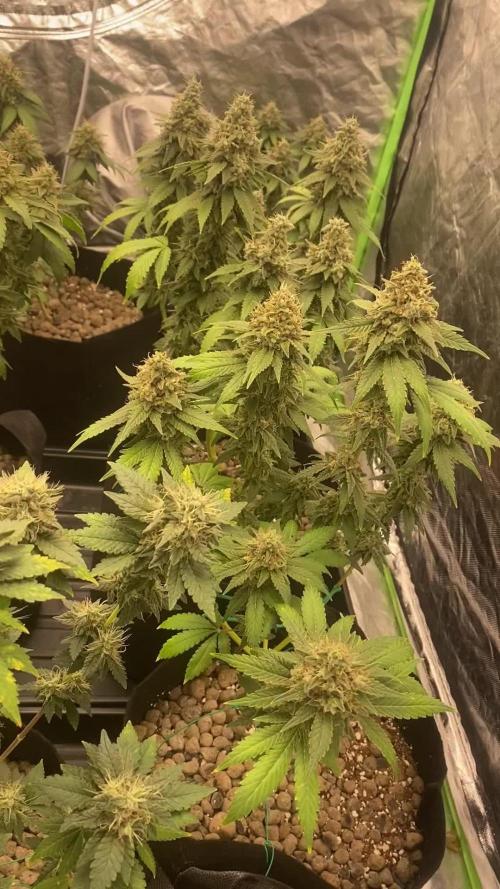
Starting week 2 and the bud sites have come outta nowhere. Got some LST hooks in but I’ll take them out soon. Gonna use more CalMag but besides that she looks cool!
Changed the nutes to flower nutes of course. Adding some new LST to see what happens.
So far the buds are growing and expanding. Went from one cola to many. Not sure if I’ll remove the hooks yet



Likes
42
Share


Likes
6
Share


@The710Garden
Follow
This is my Diploid Version of the Orange Bud 2.0 she got a really interesting Mutation wich I can Show yaal in a few days when Shes gettin her finally defo and lollipopping ! Never had it before she topped her on her own wich I Never recognised before and I have it direct in Both cultivars from the ice Cream Haze did it aswell and got 3 Main branches from Day 1
Processing
Likes
17
Share


@StoneyMelony
Follow
Overview of my grow:
Tent: Secret Jardin DS120 4 x 4 (120 cm by 120 cm)
Lights: 2 x 120 Watt CTlite c4 clusterled
Climat: Trotec Dehumidifyer 240 watt- 10L/24h
Filter: Prima Klima carbon filter PK2600
fan: 2 x Secret Jardin 20watt osc. fan
Pots: Gronest 4 x 11 liter airpots
Water : automated water system
PH: bluelab
Nutrients: Plagron cocos A + B
Plagron PK 13/14
ATA cal/mag
Epsom salt
Week 9 She is growing buds fast, she is so frosty now and she smells up the whole place.
Likes
12
Share


@2Stones1Bird
Follow
Checkout my Instagram @smallbudz to see the Small budget grow setup for indoor use, low watt, low heat, low noise, step by step.
30/11/2019 - Struggling with high humidity, change led strip color from red,green,blue to red and green.
1/12/2019 - Checked and adjusted the light distance.
2/12/2019 - Pot feels light and dry, gave her 1,5l PH 6.3 with a 1/4 of recommended Biobizz nuts, notice almost no run off.
3/12/2019 - Finally her first pistil appeared on the main stem I was starting to get worried.

Processing
Likes
41
Share


@Frosty_farm
Follow
Week 2 of flowers started, gave her a nutrients feeding. She's loving life. This plant is going to be much bigger than my first grow. I'm excited, I'm using half the amount of nutrients suggested on the bottles. I don't know if it's the breeder or the nutrients. But I'll continue doing what I'm doing. I'll post more pictures during the week. Why are the white hairs already starting to get brown?
Day44.....this plant keeps growing, I'm getting worried lol. She's actually 24inches tall and there are buds everywhere 😊. Day 46....seems like she eased up on the vertical growth. I guess it time to fatten up.
Day 47......thank God I didn't do 2 gsc plants. I would have definitely needed a dehumidifier. She's doing very well, I have no complains. I hope she will be ready to harvest in 3week because I will be going out of town for at least 4 days and she drinks at least a gallon in 2 days. Lat day of week 2 of flower day 48..... she's doing very well and keeps growing. Finished up this week with a nice fat feeding. Can't wait to see these buds swell up, I think I might end up having to support her buds.
Likes
7
Share

@xhibo
Follow
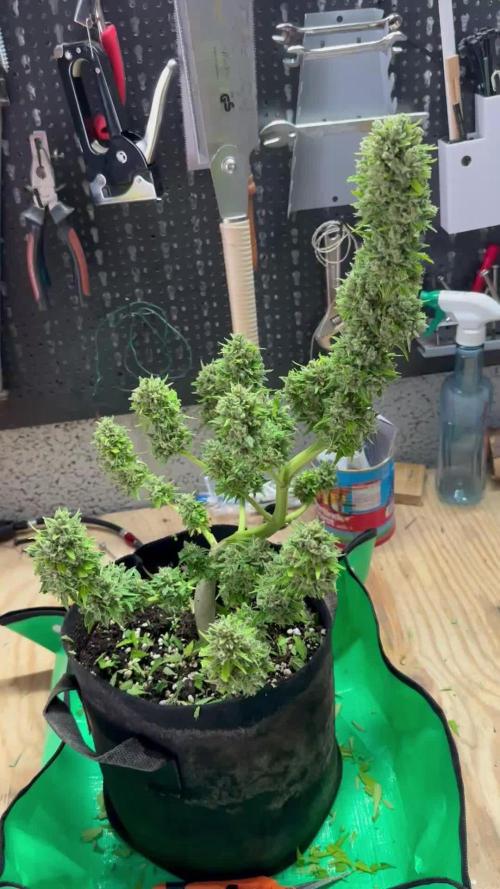
Tag 81: Es wurde geerntet, da die nächste Tage nur noch Regen angesagt ist und ich keine weitere Ertragssteigerung erwarte und die Schimmelgefahr da ist. Bisher habe ich grob wettrimmed und lasse sie nun 14 Tage in der Garagen trocknen.
Update 29g trocken