Processing
Likes
10
Share
@TrimQueen
Follow
So, guys.. This is her first month blooming. 4 complete weeks has passed. Here we are for 2 more. Gave Her a super powerful egg shell fert (all powdered - Phosforium Whelthy.) 07/10/20 - We are in the middle of week 5. Thats the way they look like. For me a good number of buds and they are as dense as I thought they would be by this time. I think everything is under control despite some foxtails cuz the heat. Loving the experience.
Likes
68
Share
@Aquemini
Follow
Ok so I'm really impressed with this autoflower. It's a monster in my opinion. I really pushed it hard for a day or two during a heat wave. Temps were 88F, I gave it a Full dose of PK booster ( LiquidKool Bloom ) and some Raw Citrus. Plant suck the bucket DOWN FAST. I thought alright its liking it. It did but it also burned it pretty badly. So I watered it down and got a cal-mag deficiency lol. Then during the heat wave I was being to brave and left to work for 12 hours with high temperatures and the plant tops at about 2 and a half feet when its recommended 3 feet. Totally my fault. But man oh man, she took all of it pretty well in my opinion. She's a little burnt but the FROST on the buds are insane outside the tent lights. It hasn't even had 1 night of sleep its entire life. 8/15 Checked ppm and pH, felt brave and added full dose PK. 8/16 Checked ppm and pH, pH remained steady at 5.9, ppm climbed to 1200. I let it run. 8/17 Checked ppm and pH, pH remained steady at 5.9, ppm climbed to 1400 and the bucket was empty. I knew I'd see burned tips soon. Added plain pH water, dropped to 800ppm. Left it to drink water. 8/18 Checked ppm and pH, tips showing burn but its definitely swelling, was it worth it? So far I'm thinking yes. Definitely yes. Ppm 950, pH 6.0 8/19 Checked ppm and pH, ppm at 1100, pH at 6.2 I watered it down with plain pH water to 700. I was feeling brave again, added more sweetener and PK booster. Ppm at 900. ( I made a mistake over the last 2 days and forgot to add cal-mag) 8/20 Checked ppm and pH, ppm went down to 800, pH at 6.2. Made no adjustments just added Cal-mag. I already had a slight deficiency going but not adding ANY to a plant that drinks 2 gallons a day was a huge mistake. It got a lot of brown patches and yellow but not everywhere. I also realized it was to close to the CMH. Plus a heat wave sent my temp to 88F while I was at work, not sure how long. I think I got a little bit of foxtail going on the very top tips. Adjusted temperature and raised light as high as I could. 8/21 Checked ppm and pH. This plant just eats and drinks to much. None of my other plants come close to this one. I have to check it everyday. My others can go up to 3 days untouched. This monster is impressive. I would reccomend this autoflower to anyone, but it says it's an intermediate grow level. It's been super easy for me. Really hope this monster finishes soon. All trichromes are clear. Still got awhile to go. 8/22 Checked ppm and pH 8/23 Checked ppm and pH 8/24 Checked ppm and pH 8/25 Checked ppm and pH 8/26 Checked ppm and pH 8/27 Checked ppm and pH
Likes
11
Share
@Zurbena
Follow
We moved on to the second week. The root has already reached the end of the pot. I am amazed by the root development. I did not expect such a big root and I think it could have been transplanted a little earlier. On the twelfth day, he moved to a 22.7 L pot.
Likes
52
Share
Lacewings seemed to have mostly killed themselves by flying into hot light fixtures. I may have left the UV on which was smart of me :) Done very little to combat if anything but make a sea of carcasses, on the bright side its good nutrition for the soil. Made a concoction of ethanol 70%, equal parts water, and cayenne pepper with a couple of squirts of dish soap. Took around an hour of good scrubbing the entire canopy. Worked a lot more effectively and way cheaper. Scorched earth right now, but it seems to have wiped them out almost entirely very pleased. Attempted a "Fudge I Missed" for the topping. So just time to wait and see how it goes. Question? If I attached a plant to two separate pots but it was connected by rootzone, one has a pH of 7.5 ish the other has 4.5. Would the Intelligence of the plant able to dictate each pot separately to uptake the nutrients best suited to pH or would it still try to draw nitrogen from a pot with a pH where nitrogen struggles to uptake? Food for stoner thought experiments! Another was on my mind. What happens when a plant gets too much light? Well, it burns and curls up leaves. That's the heat radiation, let's remove excess heat, now what? I've always read it's just bad, or not good, but when I look for an explanation on a deeper level it's just bad and you shouldn't do it. So I did. How much can a cannabis plant absorb, 40 moles in a day, ok I'll give it 60 moles. 80 nothing bad ever happened. The answer, finally. Oh great........more questions........ Reactive oxygen species (ROS) are molecules capable of independent existence, containing at least one oxygen atom and one or more unpaired electrons. "Sunlight is the essential source of energy for most photosynthetic organisms, yet sunlight in excess of the organism’s photosynthetic capacity can generate reactive oxygen species (ROS) that lead to cellular damage. To avoid damage, plants respond to high light (HL) by activating photophysical pathways that safely convert excess energy to heat, which is known as nonphotochemical quenching (NPQ) (Rochaix, 2014). While NPQ allows for healthy growth, it also limits the overall photosynthetic efficiency under many conditions. If NPQ were optimized for biomass, yields would improve dramatically, potentially by up to 30% (Kromdijk et al., 2016; Zhu et al., 2010). However, critical information to guide optimization is still lacking, including the molecular origin of NPQ and the mechanism of regulation." What I found most interesting was research pointing out that pH is linked to this defense mechanism. The organism can better facilitate "quenching" when oversaturated with light in a low pH. Now I Know during photosynthesis plants naturally produce exudates (chemicals that are secreted through their roots). Do they have the ability to alter pH themselves using these excretions? Or is that done by the beneficial bacteria? If I can prevent reactive oxygen species from causing damage by "too much light". The extra water needed to keep this level of burn cooled though, I must learn to crawl before I can run. Reactive oxygen species (ROS) are key signaling molecules that enable cells to rapidly respond to different stimuli. In plants, ROS plays a crucial role in abiotic and biotic stress sensing, integration of different environmental signals, and activation of stress-response networks, thus contributing to the establishment of defense mechanisms and plant resilience. Recent advances in the study of ROS signaling in plants include the identification of ROS receptors and key regulatory hubs that connect ROS signaling with other important stress-response signal transduction pathways and hormones, as well as new roles for ROS in organelle-to-organelle and cell-to-cell signaling. Our understanding of how ROS are regulated in cells by balancing production, scavenging, and transport has also increased. In this Review, we discuss these promising developments and how they might be used to increase plant resilience to environmental stress. Temperature stress is one of the major abiotic stresses that adversely affect agricultural productivity worldwide. Temperatures beyond a plant's physiological optimum can trigger significant physiological and biochemical perturbations, reducing plant growth and tolerance to stress. Improving a plant's tolerance to these temperature fluctuations requires a deep understanding of its responses to environmental change. To adapt to temperature fluctuations, plants tailor their acclimatory signal transduction events, specifically, cellular redox state, that are governed by plant hormones, reactive oxygen species (ROS) regulatory systems, and other molecular components. The role of ROS in plants as important signaling molecules during stress acclimation has recently been established. Here, hormone-triggered ROS produced by NADPH oxidases, feedback regulation, and integrated signaling events during temperature stress activate stress-response pathways and induce acclimation or defense mechanisms. At the other extreme, excess ROS accumulation, following temperature-induced oxidative stress, can have negative consequences on plant growth and stress acclimation. The excessive ROS is regulated by the ROS scavenging system, which subsequently promotes plant tolerance. All these signaling events, including crosstalk between hormones and ROS, modify the plant's transcriptomic, metabolomic, and biochemical states and promote plant acclimation, tolerance, and survival. Here, we provide a comprehensive review of the ROS, hormones, and their joint role in shaping a plant's responses to high and low temperatures, and we conclude by outlining hormone/ROS-regulated plant-responsive strategies for developing stress-tolerant crops to combat temperature changes. Onward upward for now. Next! Adenosine triphosphate (ATP) is an energy-carrying molecule known as "the energy currency of life" or "the fuel of life," because it's the universal energy source for all living cells.1 Every living organism consists of cells that rely on ATP for their energy needs. ATP is made by converting the food we eat into energy. It's an essential building block for all life forms. Without ATP, cells wouldn't have the fuel or power to perform functions necessary to stay alive, and they would eventually die. All forms of life rely on ATP to do the things they must do to survive.2 ATP is made of a nitrogen base (adenine) and a sugar molecule (ribose), which create adenosine, plus three phosphate molecules. If adenosine only has one phosphate molecule, it’s called adenosine monophosphate (AMP). If it has two phosphates, it’s called adenosine diphosphate (ADP). Although adenosine is a fundamental part of ATP, when it comes to providing energy to a cell and fueling cellular processes, the phosphate molecules are what really matter. The most energy-loaded composition for adenosine is ATP, which has three phosphates.3 ATP was first discovered in the 1920s. In 1929, Karl Lohmann—a German chemist studying muscle contractions—isolated what we now call adenosine triphosphate in a laboratory. At the time, Lohmann called ATP by a different name. It wasn't until a decade later, in 1939, that Nobel Prize–-winner Fritz Lipmann established that ATP is the universal carrier of energy in all living cells and coined the term "energy-rich phosphate bonds."45 Lipmann focused on phosphate bonds as the key to ATP being the universal energy source for all living cells, because adenosine triphosphate releases energy when one of its three phosphate bonds breaks off to form ADP. ATP is a high-energy molecule with three phosphate bonds; ADP is low-energy with only two phosphate bonds. The Twos and Threes of ATP and ADP Adenosine triphosphate (ATP) becomes adenosine diphosphate (ADP) when one of its three phosphate molecules breaks free and releases energy (“tri” means “three,” while “di” means “two”). Conversely, ADP becomes ATP when a phosphate molecule is added. As part of an ongoing energy cycle, ADP is constantly recycled back into ATP.3 Much like a rechargeable battery with a fluctuating state of charge, ATP represents a fully charged battery, and ADP represents a "low-power mode." Every time a fully charged ATP molecule loses a phosphate bond, it becomes ADP; energy is released via the process of ATP becoming ADP. On the flip side, when a phosphate bond is added, ADP becomes ATP. When ADP becomes ATP, what was previously a low-charged energy adenosine molecule (ADP) becomes fully charged ATP. This energy-creation and energy-depletion cycle happens time and time again, much like your smartphone battery can be recharged countless times during its lifespan. The human body uses molecules held in the fats, proteins, and carbohydrates we eat or drink as sources of energy to make ATP. This happens through a process called hydrolysis . After food is digested, it's synthesized into glucose, which is a form of sugar. Glucose is the main source of fuel that our cells' mitochondria use to convert caloric energy from food into ATP, which is an energy form that can be used by cells. ATP is made via a process called cellular respiration that occurs in the mitochondria of a cell. Mitochondria are tiny subunits within a cell that specialize in extracting energy from the foods we eat and converting it into ATP. Mitochondria can convert glucose into ATP via two different types of cellular respiration: Aerobic (with oxygen) Anaerobic (without oxygen) Aerobic cellular respiration transforms glucose into ATP in a three-step process, as follows: Step 1: Glycolysis Step 2: The Krebs cycle (also called the citric acid cycle) Step 3: Electron transport chain During glycolysis, glucose (i.e., sugar) from food sources is broken down into pyruvate molecules. This is followed by the Krebs cycle, which is an aerobic process that uses oxygen to finish breaking down sugar and harnesses energy into electron carriers that fuel the synthesis of ATP. Lastly, the electron transport chain (ETC) pumps positively charged protons that drive ATP production throughout the mitochondria’s inner membrane.2 ATP can also be produced without oxygen (i.e., anaerobic), which is something plants, algae, and some bacteria do by converting the energy held in sunlight into energy that can be used by a cell via photosynthesis. Anaerobic exercise means that your body is working out "without oxygen." Anaerobic glycolysis occurs in human cells when there isn't enough oxygen available during an anaerobic workout. If no oxygen is present during cellular respiration, pyruvate can't enter the Krebs cycle and is oxidized into lactic acid. In the absence of oxygen, lactic acid fermentation makes ATP anaerobically. The burning sensation you feel in your muscles when you're huffing and puffing during anaerobic high-intensity interval training (HIIT) that maxes out your aerobic capacity or during a strenuous weight-lifting workout is lactic acid, which is used to make ATP via anaerobic glycolysis. During aerobic exercise, mitochondria have enough oxygen to make ATP aerobically. However, when you're out of breath and your cells don’t have enough oxygen to perform cellular respiration aerobically, the process can still happen anaerobically, but it creates a temporary burning sensation in your skeletal muscles. Why ATP Is So Important? ATP is essential for life and makes it possible for us to do the things we do. Without ATP, cells wouldn't be able to use the energy held in food to fuel cellular processes, and an organism couldn't stay alive. As a real-world example, when a car runs out of gas and is parked on the side of the road, the only thing that will make the car drivable again is putting some gasoline back in the tank. For all living cells, ATP is like the gas in a car's fuel tank. Without ATP, cells wouldn't have a source of usable energy, and the organism would die. Eating a well-balanced diet and staying hydrated should give your body all the resources it needs to produce plenty of ATP. Although some athletes may slightly improve their performance by taking supplements or ergonomic aids designed to increase ATP production, it's debatable that oral adenosine triphosphate supplementation actually increases energy. An average cell in the human body uses about 10 million ATP molecules per second and can recycle all of its ATP in less than a minute. Over 24 hours, the human body turns over its weight in ATP. You can last weeks without food. You can last days without water. You can last minutes without oxygen. You can last 16 seconds at most without ATP. Food amounts to one-third of ATP production within the human body.
Likes
5
Share
All and all I popped 19 seeds lost one after it came above ground 5 of those I will be posting on here which are mandarin cookie crossed with zweet og they are regular photoperiod plants so I will have to sex them it is a small pheno hunt looking for something to keep as a mother plant didn’t use any nutes for the first week
Likes
12
Share
Eccoci qui... WOW!! Che colori che ha!!!! Finalmente stiamo ammirando come si stanno formando le cime ed è uno spettacolo, tutte queste sfumature di viola mi fanno venire l’acquolina in bocca!!! Grazie a @KhalifaGenetics e @xpertnutrients per la collab e a tutti per il supporto🔥🌲❤️
Likes
1
Share
@tigerbomb
Follow
da questa settimana ho smesso con i fert e comincio a dare solo acqua per poi fare un paio di flush non so se da questa o dalla prossima settimana -11/01 fatto il flush con una media di 25 litri a testa, da domani sarà la dodicesima e probabilmente ultima settimana -dovrò eseguire un ultimo flush prima del raccolto e devo programmare lo spacco del tronco
Processing
Likes
120
Share
2017-09-11. Kl 12.00. Week 4 starts. I have cleaned the whole room for the new week and gave the girls water and nutes. Added videos and pics. Girl is 21 cm high. ---------------------------------------------------------------------------------------------------- 2017-09-12. Kl 10.00. New pics and video. She has grown from 21 cm to 25 cm in 23 hours. ------------------------------------------------------------------------------------------------------------------------------------------------------- 2017-09-15. KL 10.00. New pics and video. The girl is 30 cm high and has grown 9 cm the last 4 days. ---------------------------------------------------------------------------------------------------------------------------------------------------- 2017-09-16. Kl 10.00. She is growing like crazy and needs to get defoliated every morning. I added 2 new videos and gave her 2 liters of water and nutes. ----------------------------------------------------------------------------------------------------------------------------------------------------------------------------------
Likes
59
Share
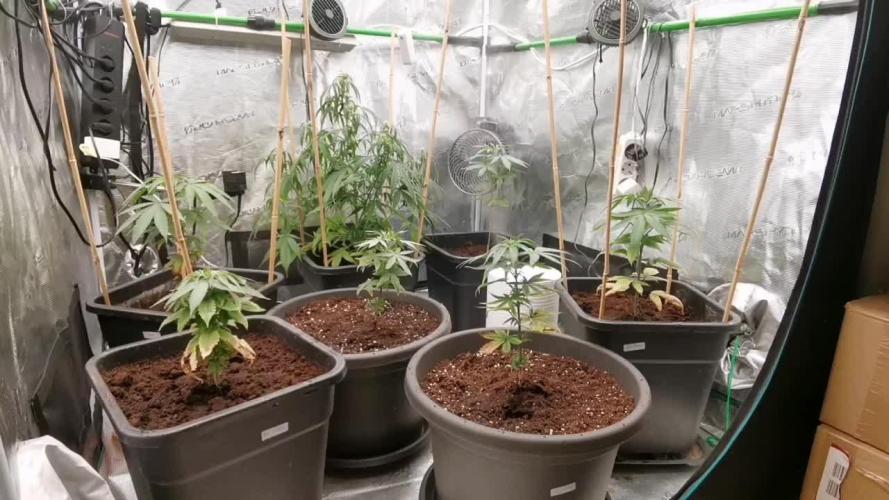
(11/04-11/10) First Week Notes & Observations: One week old, not much to report to report other than the first plant is smaller than the second at the start of the week. Removed the domes as the humidity in the tent is set pretty high and think it should be fine. RH this week was monitored for 80% Temps were monitored for 78F daytime and 68-70F overnight. Lights were adjusted to provide 280ppfd on plant 1 and 270ppfd plant 2 - that is also the max for this week. It's an increase from 150 last week. Feed & Monitor: Day 11 - both plants were fed about .80 gallons of 5.8ph de-chlorinated tap water for runoff. Both plants produced .25 gallons of 6.7ph and 1980/1950ppm runoff measured with 2 ph pens that were tested&calibrated first. Plant 1 top soil test after feed was avg 6.62 and plant 2 avg 6.85 both plants were tested 3 times on top soil. Made a video of plants.... not sure what is expected here, but think it will just be for fan movements and free music. Hope everyone enjoys the daily progressions of overhead and side profile (Organized Chaos). I will try to add Black back or cover pics by end of week every week.
Likes
27
Share
Day 91 The plants are progressing beautifully through the flowering stage. Buds are now forming dense clusters along the main stems and side branches, with plenty of healthy white pistils. The trichomes are starting to become more visible under the light, giving the buds a nice frosty appearance. Overall, the plants look strong and healthy — dark green leaves, good structure, and no major signs of stress. I did some light defoliation this week to improve airflow and light penetration, especially in the lower areas. This should help the buds develop more evenly. Humidity and temperature have been kept stable to avoid mold or mildew issues. Feeding has been consistent with bloom nutrients, and I’m keeping an eye on runoff to make sure everything stays balanced.
Likes
14
Share
Jeg har nu min nr 2outdoor ( den anden har stået ude i over 12dage :-) og er til gengæld forret med jord og 🍁! Jeg er virkelig overrasket 😮 over at det har kunnet lade sig gøre at spirer direkte i underlaget. Men jeg har også lagt tørret blade 🍁 på toppen om natten 💚☮️HELD OG LYKKE TIL ALLE SAMMEN DER UDE
Likes
3
Share
Another week closer. A couple things this week, 1st thing is after raising the PPMS last week got a little tip burn, so only raised the PPMS a little this week and keeping an eye on them, only 2 got tip burn barley noticeable, so we will slowly raise during the week and watch and see that they can take it...Thats the problem sometimes with Hydroponics you are at the mercy of the weakest plant..but it is what it is. Everything else looks really good and is dialed in perfect., OO YEA 2ND thing is I'm really amazed at how well this SPIDER-FARMER SF4000 is doing, I really am, I ran this light before side by side against a MH/HPS and it produced a little less than the MH/HPS..but now running it by itself and not getting any bleed over from the other lights, its running perfect and the production is amazing, Massive Veg and the Bloom started right away, can't wait to see the finished plants... Until next week, smoke a fatty, help out your fellow grower.
Likes
Comments
Share
Likes
16
Share
Processing
Likes
6
Share
Semana de progresso da engorda acontecendo!um pequenonover de nutrientes nas meninas e fiz uma lavagem das raizes e ela ja mostraram melhorias!aproveitei e deixei elas no ar livre para a limpeza da barraca com óleo de neen!uma delas esta com.poucas aranhas vermelhas e acho que posso ter algum problemas no futuro proximp da colheita!1 das 3 plantas ja esta quase no ponto mais uma semana e faca! As outras 2 so no final do mês!me sinto feliz por ter esse plantio em barraca pela primeira vez!
Likes
22
Share
Due to prolonged bad weather, I decided to harvest them to avoid mold and other damage. There were three of us, and it took around 6 hours to trim about 80% of both plants. I ended up with a yield of 205 grams dry per plant. I'm more than satisfied with the plants. For my first grow, I couldn't be happier.
Likes
79
Share
@Hou_Stone
Follow
This week i flush the roots with tap water ( PPM : 310 , PH : 7.5) after i add water with 0.7 grow powder and 0.1g of Booster PK+ to reach 720PPM and adjust PH to 5.8 ---------------------------------------------------- -Daytime temperature: 27°C -Night temperature: 23°C -Humidity: 45-65% -Lamp: Mars Hydro FC3000. intensity 80% at 40cm from the top leaves -Room: Mars Hydro 100x100x180cm -Extractor: Mars hydro 402 CFM Max. power 2/10 -Substrate : 70% coco, 25% perlite, 5% vermiculite. My instagram : https://www.instagram.com/p/CuMhQ_BsjRP/?utm_source=ig_web_copy_link&igshid=MzRlODBiNWFlZA==