


Likes
Comments
Share


@RockoCalenberg
Follow
Letzte Tage vor der Ernte
Auch hier in den letzten Tagen kaum noch Entwicklung.
Die Pflanze stand optisch fertig,
hat aber nicht mehr wirklich weitergereift.
Foxtailing lief weiter auf bereits entwickelten Buds,
ohne dass sich die Reife sichtbar nach vorne bewegt hat.
Der Chop erfolgte ebenfalls aus praktischen Gründen,
da ein weiteres Warten keinen klaren Mehrwert gezeigt hätte.
👉 Optisch fertig, aber ohne echten Abschluss.
Kurzfazit:
👉 Unruhiger Finish-Verlauf ohne klaren Reifepunkt.
Grow on 🌱
Last Days Before Harvest
Again, very little development in the final days.
The plant looked finished,
but did not continue ripening in a meaningful way.
Foxtailing continued on developed buds,
without real progress in maturity.
Chopped as well for practical reasons,
since waiting longer showed no clear benefit.
👉 Looks done, but never fully completed.
Quick summary:
👉 Unstable finish without a clearly defined ripening point.
Grow on 🌱

Likes
7
Share


@SouthernUKgrower
Follow
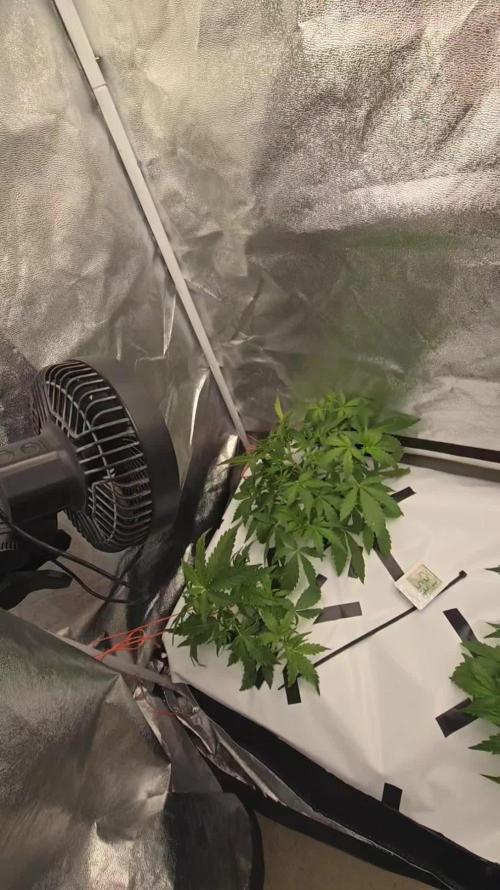
One of the girls had to be chopped as she was ready and extremely deficient. The others are maturing nicely and really starting to swell at the bud sites. The smells are a bit better but apart from the one pheno nothing too crazy. Should be easy to chop at some point next week.

Likes
Comments
Share


Processing
Likes
17
Share


@jamjam887766
Follow
On Tuesday last week I burned my plants, particularly #1. Everything was going very well so I thought I'd add a little more nutrients to get some bigger blooms. That was a mistake! I flushed them with just tap water and trimmed off the leaves that were badly burned. Yesterday the plants were looking much better and I introduced a fraction of the nutrients that I was feeding them before.
Plant #2 is starting to get covered in trichomes though there aren't any on #1. With a jeweler's magnifying glass and my phone I did my best to take pics of #2's trichomes. It's not so easy to see in the pictures but in person they all look clear. I'll wait until they're all cloudy and some are amber to chop it down.

Likes
27
Share


@DeepRootsGrowTrees
Follow
GELATO-K BY KANNABIA
WEEK #20 WEEK #9 Flower
Mar 22nd-29th
This week she it's starting to show she's almost done. Leaves are getting yellow and dry. She's also getting purple hues in her buds. She has some large buds covered in trichomes she's definitely a producing plant that can also be trained to your growing desires. She smells outstanding!! Thank you for taking a look!! Stay Growing!!

Processing
Likes
7
Share


@HylianGrass
Follow
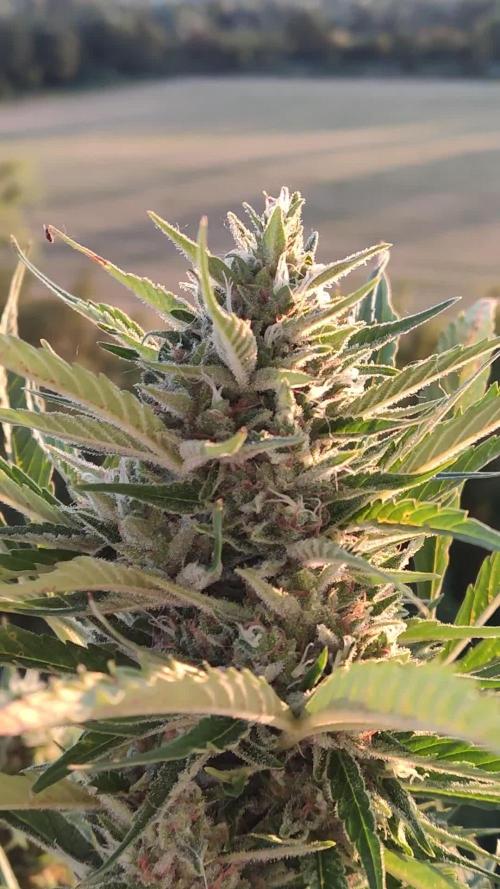
Starting week 3, this strain grows like crazy!! The conditions are looking good, i am now giving her full nutes since she took more than well the last half-dozed nutes. Very nice lush green with no signs of deficiencies! One the root found its way to the tank wich surprised me be how fast she broke through the bottom hole




Likes
12
Share


@H2Smith
Follow
📅 16.04-21 (Flower Day 50 since 12/12)
📜 Addition of 175ml total care. Trhichome analysis: everything is transparent.
⚗️ 2.06
💦 5.99
🌊 55L
📏
📅 17.04-21 ( Flower Day 51 since 12/12)
📜 Set PH 6.10. Removed 40l. Addition of 35l in the tank at 4 p.m. Addition of 45l at 7pm. 10% of the leaves turn black
⚗️ 1.93
💦 6.14
🌊 75L
📏
📅 18.04-21 (Flower Day 52 since 12/12)
📜 10l emptying of the system.
⚗️ 1.9
💦 6.10
🌊 55L
📏
📅 19.04-21 (Flower Day 53 since 12/12)
📜 10l emptying of the system. 30% of the leaves turn black
⚗️ 1.86
💦 6.14
🌊 70L
📏 cm
📅 20.04-21 (Flower Day 54 since 12/12)
📜 10l emptying of the system. 40% of the leaves turn black
⚗️ 1.85
💦 6.10
🌊 60L
📏 cm
📅 21.04-21 (Flower Day 55 since 12/12)
📜 theoretical start end of flo - analysis of trichomes: wait and see flushing within 1 - 2 days. Set ph a 6.2
⚗️ 1.85
💦 6.15
🌊 50L
📏 cm
📅 22.04-21 (Flower Day 56 since 12/12)
📜 👌 i fill 50 liter at 23h20
⚗️ 1.83
💦 6.20
🌊 50L
📏 cm
_____________________________________________________
📅 Day - 📜 Note - ⚗️ EC -💦 PH -🌊 Water -📏 Height
Equipment:
Idrolab 12 bucks
Chiller teco Hy500
weather controler with Co2 : PRO-LEAF BECC-B2
Bavagreen 720w
Bavagreen 720w
Bavagreen 240w
Bavagreen 240w
Nutrients and PH controller: PRO-LEAF PHEC-B2
Nutrients: Green House feeding - powder feeding hybrids | Powder feeding boost
Extractor: primaklima PK250-1 PK250-L1 x2
System and roots care: Idrolab Total care

Likes
168
Share


@Tropicannibis_Todd
Follow
💩Holy Crap Growmies , we are outdoors and in the Ground and there Doing Great💩
👉It's been another full week 63 days from seed and she's doing great , very nice Growth, considering shes been up against the wind and rain 👈
No problems 😊 so far so good 👍And she's now in full on flowering 😁👈 lots of sun and some nice weather 😎 The only one that hasn't had bud rot 👈
I GOT MULTIPLE DIARIES ON THE GO 😱 please check them out 😎
👉THANKS FOR TAKING THE TIME TO GO OVER MY DIARIES 👈
👉NutriNPK NUTRIENTS USED FOR FEEDING 👈rain water to be used entire growth👈
👉www.nutrinpk.com right now get 10% off using SPRING2022 as the coupon code👈

Likes
4
Share

@Nargileus
Follow
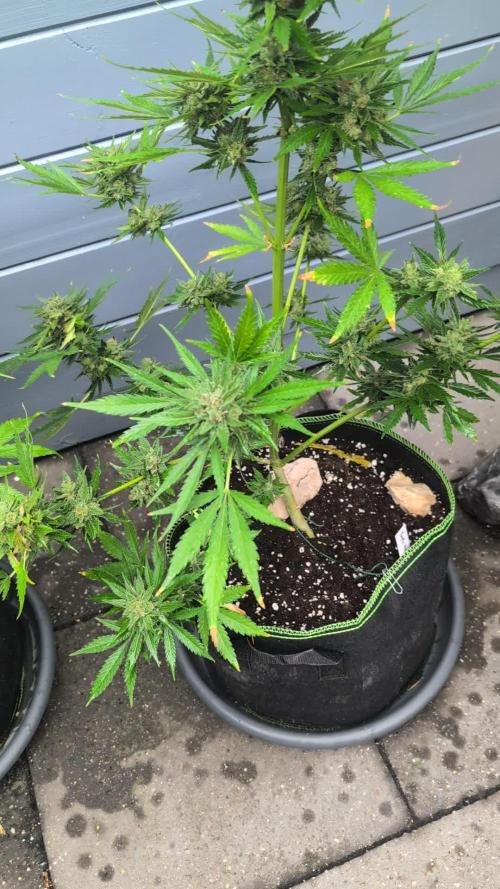
So langsam werden die Trichome immer reifer. Alles riecht wunderbar im Garten. Bei einer pflanze mußte ich einen Bud entfernen, da sich dazwischen ein bisschen Schimmel gebildet hatte.
Processing
Likes
12
Share


@jahredi
Follow
Day 21
After yesterday’s emergency bare root transplant out of biosolids, things are looking like there’s a glimmer of hope...
They got topped and pruned yesterday. a little earlier than I would have liked, but it made sense.
Day 23
Transplanted again down to 2 gallon pots to make room for another round I started. I decided to cut the fan leaves, too. These have been pruned and topped down to nothing but the emerging foilage from the 3rd and 4th nodes. My thinking is that the root system is so compromised that the less foliage they have to feed, the better. Fed some General Organics Bio Root 0-1-1 to promote root growth. Light mnist of pH’d water for foilar feeding.
Day 25
I think the Bio Root and the shade is doing them good 🤞Time will tell. If these come back strong, I’ll move them into 15 gallon living soil bags.


Likes
2
Share


@Dmon013
Follow
It's time to taste it. Sweet scent with a distinctive identity.
You guys have to try to touch her once, I hope so. :)💚🥦

Likes
Comments
Share

@DogDoctorOfficial
Follow
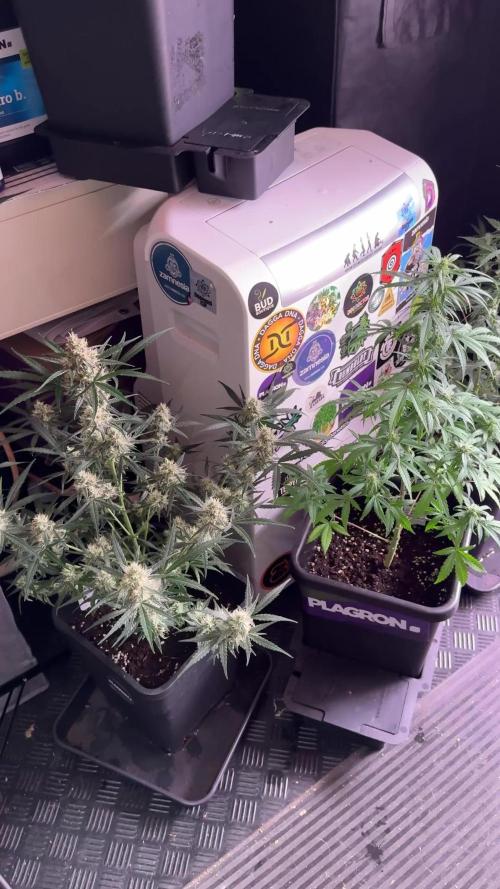
🌸 Pink Rosay Auto by Zamnesia | Pheno B | Week 8 (Flower Week 5) 🌱
The Tiny One That Refused To Give Up
If I were growing only two or three plants, I'm going to be completely honest...
I probably wouldn't have kept her.
Pink Rosay Pheno B is tiny.
Not small.
Not compact.
Tiny.
She's easily among the smallest plants I've ever grown.
And that's exactly what makes her so interesting.
Because this is the whole point of the 8×8 Adventure.
I'm growing twelve different genetics side by side, and instead of selecting only the plants that immediately impress me, I'm giving every phenotype the opportunity to tell me who she is.
And this little lady?
She's definitely telling us.
She isn't going to produce the biggest harvest in the tent.
She probably won't even come close.
But she's healthy.
She's flowering.
She's developing beautifully.
And she's still here.
Sometimes that's enough reason to keep watching.
🌸 Week 5 Flower – Tiny, But Still Building
The stretch is essentially behind her now, and her personality couldn't be clearer.
Pink Rosay Pheno B has remained incredibly compact throughout the entire grow.
Her nodes are tightly packed.
Her branches remain short.
Her entire structure feels almost miniature compared with the plants surrounding her.
But when you look closely...
There are flowers everywhere.
Those tiny branches are carrying developing buds, and the white pistils continue appearing across the flowering sites.
She's slowly turning this miniature framework into a miniature flowering plant.
And there's something strangely beautiful about that.
She isn't trying to become something she's not.
She's simply doing what her genetics told her to do.
✂️ Defoliation – Opening The Little Lady Up
Just like her sister, Pink Rosay Pheno B also received a selective defoliation this week.
Again, this wasn't because she was unhealthy.
Quite the opposite.
She's looking beautiful.
The reason was simply that her extremely compact architecture creates a very dense little package of foliage and flowers.
With so much plant compressed into such a small vertical space, selectively removing some unnecessary leaves helps open the structure.
The goal isn't to strip the plant.
It's not about removing healthy leaves just because we can.
And it's certainly not about making the plant look pretty for a photograph.
The idea is to create a little more space between foliage, flowers, light and moving air.
I removed leaves that were contributing to congestion and cleaned up portions of the lower and interior structure where development was unlikely to justify keeping excessive foliage.
But I didn't remove everything.
There are still flowers down there.
And I'm leaving some of them.
Because this is an experiment.
I want to see what this tiny phenotype can actually do.
💡 Let The Photons Move
With a plant this compact, light management becomes particularly interesting.
The Future of Grow Black Series provides the primary light from above, while the Lumiflora under-canopy system adds another source of illumination deeper in the room.
But there's an important distinction here.
Adding light doesn't automatically mean every flower needs to be exposed directly to it.
The plant still has its own architecture.
Leaves overlap.
Flowers sit underneath other leaves.
Some areas naturally receive less light.
By selectively opening the canopy, we're simply allowing more of the available photons to travel through the structure rather than being intercepted immediately by layers of foliage.
It's not about making the plant brighter.
It's about making the light distribution more useful.
And with a plant this tiny and dense, every little opening makes a difference to the way light and air move through her.
🌱 The Smallest Plant With A Big Lesson
This is probably the part of her story I appreciate most.
If you only looked at her height, you could easily conclude that something went wrong.
But nothing went wrong.
She simply expressed herself differently.
That's one of the reasons growing multiple phenotypes is so valuable.
Put two sisters next to each other and suddenly the differences become impossible to ignore.
One can stretch.
One can stay short.
One can develop large branches.
Another can produce a miniature architecture.
Same genetic family.
Completely different personalities.
And instead of asking:
"Why isn't she like her sister?"
I prefer asking:
"What can she show me if I let her finish?"
That's the experiment.
And that's why she's still here.
🌼 Flowers, Pistils & Personality
Despite her size, the flowering development is genuinely beautiful.
The flowers are becoming more defined, with fresh white pistils continuing to emerge from the developing calyxes.
The deep green foliage provides an incredible contrast against those bright white hairs.
And the more I look at her, the more I realise that her size is actually part of her charm.
She's almost like a miniature version of a full-sized flowering plant.
Everything is there.
Just compressed.
Tiny branches.
Tiny leaves.
Tiny flowers.
Tiny structure.
But the same biological process is happening.
She's still capturing light.
She's still producing energy.
She's still moving water and nutrients.
She's still building flowers.
And she's still telling us what her genetics are capable of.
❄️ She's Still Getting Frostier
Another thing that keeps this little plant interesting is the resin development.
She's beginning to show that frosted appearance across the flowers and surrounding sugar leaves, adding another layer to what is already an incredibly attractive little plant.
I don't expect her to suddenly turn into a giant producer.
But I do think she could produce something interesting in terms of flower quality.
And if the final amount ends up being very small?
That's okay too.
I've already been thinking that her eventual harvest may make more sense as a small personal extraction project rather than trying to treat her like a traditional high-yield plant.
Something like an ice-water wash could give those flowers another purpose.
But that's a decision for much later.
For now...
She's growing.
And that's what matters.
💧 Consistency Is Still The Strategy
The beauty of this phenotype is that she hasn't needed special treatment.
She's been receiving the same general cultivation philosophy as the rest of the room while being observed individually.
Hand watering gives me the opportunity to assess her every day and make sure her needs are being met without forcing her into a feeding strategy designed around a larger plant.
The important thing isn't trying to make her bigger at this point.
That chapter is over.
Now the objective is simply to allow her to finish as strongly and naturally as possible.
She's healthy.
She's flowering.
She's producing resin.
So we keep the environment stable and let her do the rest.
🌡️ Environment
The room continues providing a remarkably stable environment for all these different phenotypes.
Current conditions remain around:
Day temperature: 29°C
Night temperature: 25°C
Relative humidity: 60%
Solution temperature: 21°C
Root-zone temperature: 21°C
CO₂: approximately 639 ppm
This is one of the things I love most about this project.
Twelve different plants.
Twelve different personalities.
One environment.
And every phenotype gets to show us how she responds to the same cultivation philosophy.
👀 Looking Ahead – Let's See What She's Got
At this point, I'm not expecting miracles from Pink Rosay Pheno B.
And I don't mean that negatively.
I mean that realistically.
She's tiny.
Her total flower mass will naturally be limited by the amount of plant she's carrying.
But that's okay.
The goal now isn't to turn her into something she's not.
It's to see how beautifully she can finish as herself.
The flowers should continue swelling.
The pistils will eventually begin their transition toward maturity.
Resin production should continue increasing.
And that little compact canopy should slowly transform from a collection of tiny flowers into a finished miniature harvest.
Maybe she'll surprise me.
Maybe she won't.
Either way...
She's already taught me something.
❤️ Final Thoughts – The Little Lady That Stayed
Pink Rosay Pheno B is probably never going to win a competition for plant height.
She isn't going to dominate the canopy.
She isn't going to produce a mountain of flowers.
And honestly?
That's okay.
Because this project was never only about growing the biggest plant.
It's about observing genetics.
It's about giving different phenotypes the room to express themselves.
It's about learning that sometimes the plant you would have removed from the garden is the one that ends up teaching you something you wouldn't have learned otherwise.
If I had only been growing a couple of plants, I might have looked at this tiny Pink Rosay early in the grow and decided that her journey wasn't worth the space.
But I didn't.
I gave her a chance.
And now she's standing there, covered in flowers, getting frostier every week and quietly proving that she still has a story to tell.
She may be the smallest plant in the room.
She may produce the smallest harvest.
She may eventually become a tiny jar of flowers...
Or perhaps an even tinier ice-water experiment.
But before any of that happens, she deserves exactly what every other phenotype in this project receives:
Time.
Time to grow.
Time to flower.
Time to express herself.
And time to show us what she can do.
A huge thank you once again to Zamnesia for these wonderful genetics, Plagron for supporting the nutrition throughout this journey, Future of Grow for the incredible Black Series lighting, Lumiflora for bringing additional light beneath the canopy, TrolMaster for maintaining environmental control and everyone following this crazy 8×8 Adventure here on GrowDiaries.
Every plant doesn't need to be the biggest.
Every phenotype doesn't need to be a winner.
Sometimes...
the smallest ones simply need someone willing to let them finish their story.
And this little lady isn't finished yet. 🌸
Until next week...
Tiny plant. Big personality. Still here. Still shining. 🌱✨
Growers Love and happy growing! 💚

Likes
284
Share


@Roberts
Follow
Was a 26 and some change week grow. Was vegged under the Viparspectra P4000, and flowered under 2 Mars Hydro ts 1000's. Also flowered in a Mars Hydro 3x3x6 tent, with a 4 inch inline smart controller fan and filter combo. Worked really well together, and a ideal environment. She is super sticky, colorful and loaded with trichromes. Now gotta wait for her to dry and process it. Thank you PEV Seeds. Viparspectra, and Mars Hydro. 🤜🤛🌱 There is a harvest video om my YouTube channel. The link is on my main profile page.
Thank you grow diaries community for the likes, follows, comments, and subscriptions on my YouTube channel . Happy growing and happy holidays. 🌱🌱🌱🎄
https://youtube.com/channel/UCAhN7yRzWLpcaRHhMIQ7X4g

Processing
Likes
8
Share


@Elbuddha
Follow
Aumento las dosis de tripack bio bizz.
18-04-17 Primeras señales de floración

Likes
17
Share


@Island
Follow
Week 4
Broad Mite still making victim.
On this week I watered she with water + diatomaceous earth
Still waiting for better days, I hope hv succes 😐
Apparently the diatomaceous earth is working against broadmite 😅


Likes
27
Share


@valiotoro
Follow
Pheno 1 dark purple : On the nose, it reveals a sharp burst of fresh lemon, layered with a powerful eucalyptus aroma that’s both invigorating and camphorous. A truly refreshing and vibrant terpene profile😈🍋
Pheno 2 Green : this one is a real surprise! If I close my eyes, it’s like Nutella! It’s as if you’ve just walked into a kitchen where hazelnuts have been freshly roasted 🤤🌰
Pheno 3 light purple : It’s a mix of the first two with a hint of amarena cherry at the end🍒🍧
Likes
52
Share


@Ultraviolet
Follow
The cannabis strain Grape Guava can be a purple strain, depending on its specific phenotype and genetic makeup. While not all phenotypes of Grape Guava are purple, some variations, such as the Zatix Grape Guava, are noted for their striking purple appearance due to the genetic expression of anthocyanin pigments.
https://www.youtube.com/watch?v=cKdVmdoKJ5k
In a garden of green, Grape Guava gleams,
With its fruity aroma, enchanting dreams.
Clusters of grapes, guava's sweetness ignite,
A strain so divine, in purple and white.
Euphoria whispers, a lush fruity haze,
Grape Guava's embrace, a tranquil daze.
Off and away.@1400ppm. The increased CO2 allows plants to thrive at higher temperatures, which in turn necessitates higher humidity to maintain the ideal VPD for healthy growth and transpiration. 80F -5F = 75F LST with 70% RH = 0.72 kPa. Higher temperatures and humidity promote rapid growth, nutrient uptake, and photosynthesis while maintaining a lower stress level. Temperature influences the rate of enzymatic reactions involved in aerobic respiration. Enzymes, such as those involved in glycolysis, the Krebs cycle, and the electron transport chain, work most efficiently at an optimal temperature range. In low temperatures, enzymatic activity will slow down, thus reducing the rate of aerobic respiration. In high temperatures, enzymes can become denatured, thus impairing their function and stopping the process of aerobic respiration. Glucose is the primary fuel for aerobic respiration. The rate of aerobic respiration increases with the availability of glucose, as it is the starting point for glycolysis. If glucose levels are low, cells may rely on alternative energy sources such as fatty acids or amino acids , but these processes may yield less ATP or be less efficient. To determine this effect, carbon dioxide volume was measured (as carbon dioxide is an output of aerobic respiration)
18/6 with the 6 being IR. The near infrared (IR-a) borders around 700nm up to 1400nm @ photon par flux density of 1.8 instead of darkness, keeping temps overnight a neat 77F-80F.
Think of my tent as a lung. What goes in must come out. When the rate of air going out exceeds the amount of air coming in, it creates a negative pressure. Tent concaves (bends in). If set up correctly, your RH will begin to drop slowly to the desired level you set, and the extraction turns off when it reaches desired% RH. The plant, as it performs cellular respiration, will always be releasing more water into the air, so the RH% of the tent overnight will always increase, so long as oxidative phosphorylation is occurring. As soon as the RH% creeps back up to 55%, the extraction turns back on, over and over. This creates a strong pressure differential which will work wonders on your grow. Replicating high and low-pressure fronts in nature. Critical for oxygen diffusion at the critical time of peak cellular respiratory function..
Moisture will not transfer from a saturated atmosphere to another if that air is already at or above its saturation point, meaning the air can't hold any more water vapor. Once I understood that water is produced as a by product during cellular respiration, specifically at the very end of the electron transport chain (ETC) where electrons are finally transferred to molecular oxygen, the higher the RH of the air, the more resistance there is for more moisture to be added to that environment, and effects the ease with which it does so. But none of that water comes from the pot; it's pulled from the air. If you run high daytime RH, your medium/pot is 100% reliant on transpirational root pull to move water. ZERO evaporation happens across the atmosphere if the tent air has high RH%, the medium cannot release its water through evaporation. Once a canopy develops, light no longer slowly wicks and evaporates from the topsoil. The Soil-Plant-Atmosphere Continuum (SPAC) describes the continuous pathway and process of water movement, driven by a gradient in water potential, from the soil, through the plant's roots, stem, and leaves, and finally evaporating into the atmosphere through transpiration. There is evaporation, there is transpiration, and then there is evapotranspiration; Evapotranspiration (ET) is the combined total of two processes: evaporation (water lost directly from soil and surface water into the atmosphere) and transpiration (water released from plants to the atmosphere through their leaves). Evapotranspiration represents the total amount of water that moves from the medium into the air. There is no such thing as a medium with too much water, only a medium that retains too much for too long.
The water must always flow efficiently from one atmosphere(Medium) to another(Air) in a timely manner. Moisture is a critical factor for bacterial growth and decay. Dictating how long it's allowed to sit in any one location for any given period is a key preferred control. To ensure a net reduction in a bacterial population, the rate of removal (ET) must exceed the rate of bacterial growth (decay rate), which is often modeled as a growth rate for the specific bacterium under the given conditions. By optimizing daytime VPD, we also optimize conditions for bacterial growth to explode exponentially above 77°F.. If water is allowed to sit in a medium without an escape within a timeframe, nothing good will happen. IF High RH is maintained overnight as well as during the day, placing 100% of water movement at the behest of daytime transpiration, roots can only pull where they can reach, and if soil is compressed above a certain point, moisture will become trapped in a medium with no way of moving day or night. This will begin the countdown for decay to take hold. When water stagnates in a medium, it loses oxygen, creating anaerobic conditions that foster the growth of harmful microorganisms like bacteria and fungi, which can produce toxins and disease vectors.
Thigmomorphogenesis, the process by which plants respond to mechanical stimuli like touch by altering their growth and development, results in significant morphological changes to improve survival against mechanical perturbations. This complex response involves sensing touch and initiating physiological and genetic responses, leading to changes in form and structure over days or weeks. The process is triggered by physical forces such as wind, rain, or touch. Plants adapt to these stimuli by changing their shape and structure, which may include slower growth, thickened stems, or altered leaf development. Plants possess sophisticated mechanisms to detect even subtle mechanical stimuli and initiate responses. A variety of molecules, including calcium ions, jasmonates, ethylene, and nitric oxide, are involved in signaling these mechanical inputs. Touch can induce the expression of genes that encode proteins for calcium sensing, cell wall modification, and defense mechanisms. A plant exposed to constant wind may become shorter and sturdier. A plant that is touched frequently might grow more slowly to conserve energy and develop thicker cell walls. These changes increase a plant's resilience and ability to survive in harsh environments.
Let's get Thiggy with it.