


Likes
Comments
Share


@MissSolasolita
Follow
End of week 6 flower
Looking delicious
Flushing for the next week or two
depending how quick she yellows up
Though she looks ready


Likes
16
Share

@TrickzGrowz
Follow
Servus Moin!
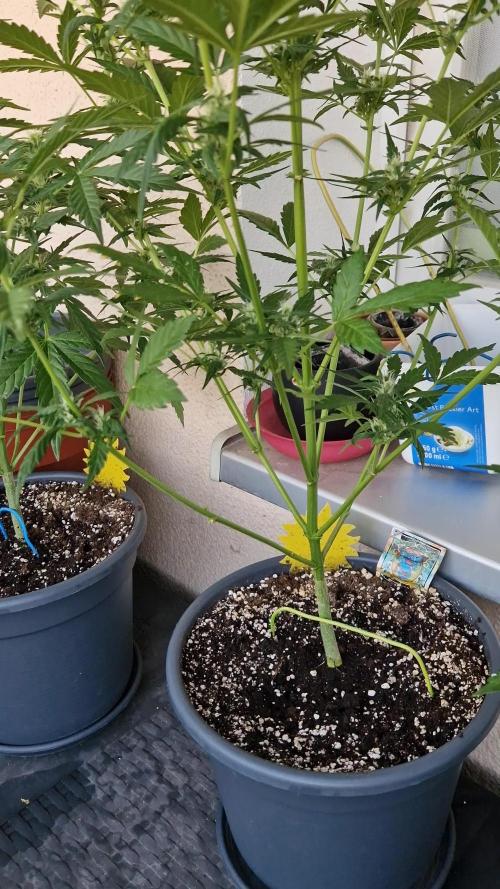
Die Pineapple Slush XL macht im Stretch ihren Namen alle Ehre. Ich habe das Gefühl, sie will gar nicht mehr aufhören in die Höhe zu wachsen. Langsam geht die Budentwicklung los. Bin gespannt wie sie mit den heißen Sommertenperaturen klar kommt.

Likes
Comments
Share


Likes
85
Share


@Tropicannibis_Todd
Follow
💩Holy Crap💩
That was so much fun , it's full on winter where I am and it kept me busy , and come on there's nothing like growing your own stuff. I had a blast as it's been at least over 10 years since my last indoor grow , and it was fun , I had used all of my old techniques and equipment and it worked out just fine , so I was glad I had a ruff idea of what to expect......
Final thoughts
Gonna be honest about that grow , it should me just how far Genetics have come, 10 plus years ago before I stopped growing indoors , all we had was like lowrider auto and greenomatic auto and maybe few others but they were horrible...... but this auto produced quite well as expected it should with the size of my medium and my soil base and very little nutrients, which is what I had hoped for from the start , cause I didn't really know where to start in terms of Genetics as I have been out the game for awhile but I'm super glad with the results and some gratitude needs to be sent to CanukSeeds , they came through as it always starts and ends with elite Genetics👌 ...........
I can't wait to start my next grow diary, so keep an eye out , there's gonna be more to come , I'm going to try some really interesting cultivars........
PS. Can anyone tell me this , back in the day like 2003-4-5-6 wasn't growdiaries.com just a private forum cause if memory serves me , I was among those lucky enough to find a community that did complete grow logs, fourm style, which is where I found my growmie and Mentor Franco Loga from Greenhouse seeds , RIP BUDDY 😃
CANT WAIT TO START MY NEXT GROW
👉I HAVE CREATED A PLACE FOR GROWMIES TO VISIT , SHOW OFF THERE GROWS , AND JUST HANG OUT .....👈
👉ALL YOU NEED IS TO JOIN THE GROWDIARIES DISCORD SERVER !!!!!!!!!!!👈
LINK IS 👉
https://discord.gg/zQmTHkbejs

Likes
68
Share

@Ultraviolet
Follow
Removed autoflower and put her in her own pot outside the tent.
Foliars applied in strong blue 430nm with 4000Hz tone. 20-minute dose prior to application.
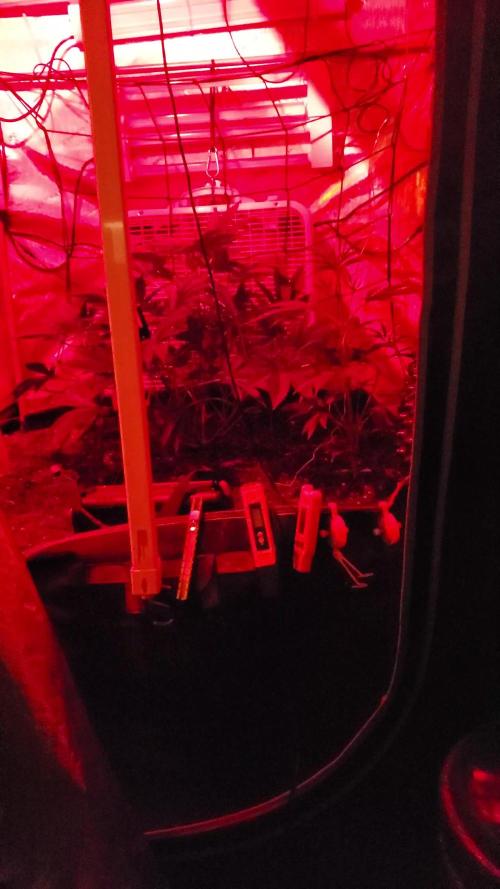
In essence, you're seeing a combination of the infrared light reflected by the plant, which the camera perceives as red, and any residual visible blue light the plant reflects, which results in a purple hue.
I was doing more stretching of the stems, adjusting weights, just a little too much, and it snapped almost clean. I got a little lucky in that it was still connected, wrapped her almost instantly while holding her in place with yoyo's. The core framework is now in place.
If your soil has a high pH, it's not ideal; you want a pH of 6.4, 6.5, or 6.6, which is ideal. If you are over a pH of 7, you have no hydrogen on the clay colloid. If you want your pH down, add Carbon. If you keep the pH below 7, you will unlock hydrogen, a whole host of new microbes become active and begin working, the plant will now be able to make more sugar because she has microbes giving off carbon dioxide, and the carbon you added hangs onto water. Everything has electricity in it. When you get the microbes eating carbon, breathing oxygen, giving off CO2, those aerobic soil microbes will carry about 0.5V of electricity that makes up the EC. The microorganisms will take a metal-based mineral and a non-metal-based mineral with about 1000 different combinations, and they will create an organic salt! That doesn't kill them, that the plant loves, that the plant enjoys. This creates an environment that is conducive to growing its own food.
Metal-based: Could include elements like iron, manganese, copper, or zinc, which are essential nutrients for plants but can exist in forms not readily accessible.
Non-metal-based: Examples like calcium carbonate, phosphate, or sulfur are also important for plant growth and potentially serve as building blocks for the organic salt.
Chelation in a plant medium is a chemical process where a chelating agent, a negatively charged organic compound, binds to positively charged metal ions, like iron, zinc, and manganese. This forms a stable, soluble complex that protects the micronutrient from becoming unavailable to the plant in the soil or solution. The chelate complex is then more easily absorbed by the plant's roots, preventing nutrient deficiency, improving nutrient uptake, and enhancing plant growth. Chelation is similar to how microorganisms create organic salts, as both involve using organic molecules to bind with metal ions, but chelation specifically forms ring-like structures, or chelates, while the "organic salts" of microorganisms primarily refer to metal-complexed low molecular weight organic acids like gluconic acid. Microorganisms use this process to solubilize soil phosphates by chelating cations such as iron (Fe) and calcium (Ca), increasing their availability.
Added sugars stimulate soil microbial activity, but directly applying sugar, especially in viscous form, can be tricky to dilute. Adding to the soil is generally not a beneficial practice for the plant itself and is not a substitute for fertilizer. While beneficial microbes can be encouraged by the sugar, harmful ones may also be stimulated, and the added sugar is a poor source of essential plant nutrients. Sugar in soil acts as a food source for microbes, but its effects on plants vary significantly with the sugar's form and concentration: simple sugars like glucose can quickly boost microbial activity and nutrient release. But scavenge A LOT of oxygen in the process, precious oxygen. Overly high concentrations of any sugar can attract pests, cause root rot by disrupting osmotic balance, and lead to detrimental fungal growth. If you are one who likes warm tropical high rh, dead already. Beneficial, absolutely, but only to those who don't run out of oxygen. Blackstrap is mostly glucose, iirc regular molasses is mostly sucrose. Sugars, especially sucrose, act as signaling molecules that interact with plant hormones and regulate gene expression, which are critical for triggering the floral transition. When sucrose is added to the growth medium significantly influences its effect on floral transition.
Probably wouldn't bother with blackstrap given its higher glucose content. Microbes in the soil consume the sugar and, in the process, draw nitrogen from the soil, which is the same nutrient the plant needs. Glucose is not an oxygen scavenger itself, but it acts as a substrate for the glucose oxidase (GOx) enzyme, effectively removing oxygen from a system. Regular molasses (powdered if you can), as soon as she flips to flower or a week before, the wrong form of sugar can delay flower, or worse. Wrong quantity, not great either. The timing of sucrose application is crucial. It was more complicated than I gave it credit for, that's for sure. When a medium's carbon-to-nitrogen (C:N) ratio reaches 24:1, it signifies an optimal balance for soil microbes to thrive, leading to efficient decomposition and nutrient cycling. At this ratio, soil microorganisms have enough nitrogen for their metabolic needs, allowing them to break down organic matter and release vital nutrients like phosphorus and zinc for plants. Exceeding this ratio results in slower decomposition and nitrogen immobilization, while a ratio below 24:1 leads to faster breakdown and excess nitrogen availability.
Carbon and nitrogen are two elements in soils and are required by most biology for energy. Carbon and nitrogen occur in the soil as both organic and inorganic forms. The inorganic carbon in the soil has minimal effect on soil biochemical activity, whereas the organic forms of carbon are essential for biological activity. Inorganic carbon in the soil is primarily present as carbonates, whereas organic carbon is present in many forms, including live and dead plant materials and microorganisms; some are more labile and therefore can be easily decomposed, such as sugars, amino acids, and root exudates, while others are more recalcitrant, such as lignin, humin, and humic acids. Soil nitrogen is mostly present in organic forms (usually more than 95 % of the total soil nitrogen), but also in inorganic forms, such as nitrate and ammonium. Soil biology prefers a certain ratio of carbon to nitrogen (C:N). Amino acids make up proteins and are one of the nitrogen-containing compounds in the soil that are essential for biological energy. The C:N ratio of soil microbes is about 10:1, whereas the preferred C:N ratio of their food is 24:1 (USDA Natural Resource Conservation Service 2011). Soil bacteria (3-10:1 C:N ratio) generally have a lower C:N ratio than soil fungi (4-18:1 C:N ratio) (Hoorman & Islam 2010; Zhang and Elser 2017). It is also important to mention that the ratio of carbon to other nutrients, such as sulfur (S) and phosphorous (P) also are relevant to determine net mineralization/immobilization. For example, plant material with C:S ratio smaller than 200:1 will promote mineralization of sulfate, while C:S ratio higher than 400:1 will promote immobilization (Scherer 2001).
In soil science and microbiology, the C:S ratio helps determine whether sulfur will be released (mineralized) or tied up (immobilized) by microorganisms.
A carbon-to-sulfur (C:S) ratio smaller than 200:1 promotes the mineralization of sulfate, when the C:S ratio is low, it indicates that the organic matter decomposing in the soil is rich in sulfur relative to carbon. Microorganisms require both carbon and sulfur for their metabolic processes. With an excess of sulfur, microbes take what they need and release the surplus sulfur into the soil as plant-available sulfate
A carbon-to-sulfur (C:S) ratio higher than 400:1 will promote the immobilization of sulfur from the soil. This occurs because when high-carbon, low-sulfur materials (like sawdust) are added to soil, microbes consume the carbon and pull sulfur from the soil to meet their nutritional needs, temporarily making it unavailable to plants.
200:1 C:S 400:1: In this range, both mineralization and immobilization can occur simultaneously, making the net availability of sulfur less predictable.
This dynamic is similar to how the carbon-to-nitrogen (C:N) ratio regulates the availability of nitrogen in soil. Just as microbes need a certain amount of nitrogen to process carbon, they also require a balanced amount of sulfur. Both mineralization and immobilization are driven by the metabolic needs of the soil's microbial population.
Sulfur is crucial for protein synthesis. A balanced ratio is particularly important in relation to nitrogen (N), as plants need adequate sulfur to efficiently use nitrogen. A severely imbalanced C:S ratio can hinder the efficient use of nitrogen, as seen in trials where adding nitrogen without balancing sulfur levels actually lowered crop yields.
Maintaining a balanced carbon-to-sulfur (C:S) ratio is highly beneficial for plant growth, but this happens indirectly by regulating soil microbial activity. Unlike the C:N ratio, which is widely discussed for its direct effect on nutrient availability, the C:S ratio determines whether sulfur in the soil's organic matter is released (mineralized) or temporarily locked up (immobilized).
Applied 3-day drought stress.
Glucose will hinder oxygenation more than sucrose in a solution because glucose is consumed faster and has a higher oxygen demand, leading to a more rapid decrease in oxygen levels. When cells respire, they use oxygen to break down glucose, and this process requires more oxygen for glucose than for sucrose because sucrose must first be broken down into glucose and fructose before it can be metabolized.
In a growth medium, glucose is a more immediate and universal signaling molecule for unicellular and multicellular organisms because it is directly used for energy and triggers a rapid gene expression response. In contrast, sucrose primarily acts as a signaling molecule in plants to regulate specific developmental processes by being transported or broken down, which can be a more complex and slower signaling process.
Critical stuff.
During wakefulness (DC electric current) life can not entangle electrons and protons. During the daytime, the light is sensed as multiple color frequencies in sunlight. Coherence requires monochromatic light. Therefore, at night, IR light dominates cell biology. This is another reason why the DC electric current disappears during the night. The coherence of water is maintained by using its density changes imparted by infrared light released from mitochondria in the absence of light. This density change can be examined by NMR analysis, and water is found to be in its icosahedral molecular form. This is the state that water should be in at night. This is when a light frequency is lowest and when the wave part of the photoelectric effect is in maximum use.
3600
Likes
5
Share


@blacknpearl
Follow
dec 20. megacrop 1.19gr/litre ph'ed at 6.38. about 500 ml
dec 22. megacrop 1.19gr/litre ph'ed at 6.39. about 500 ml
dec 24. megacrop 1.19gr/litre ph'ed at 6.39. about 500 ml
Likes
Comments
Share

@LegacyGrow
Follow
Englischversion below
Deutsch:
Tag 49 Veg:
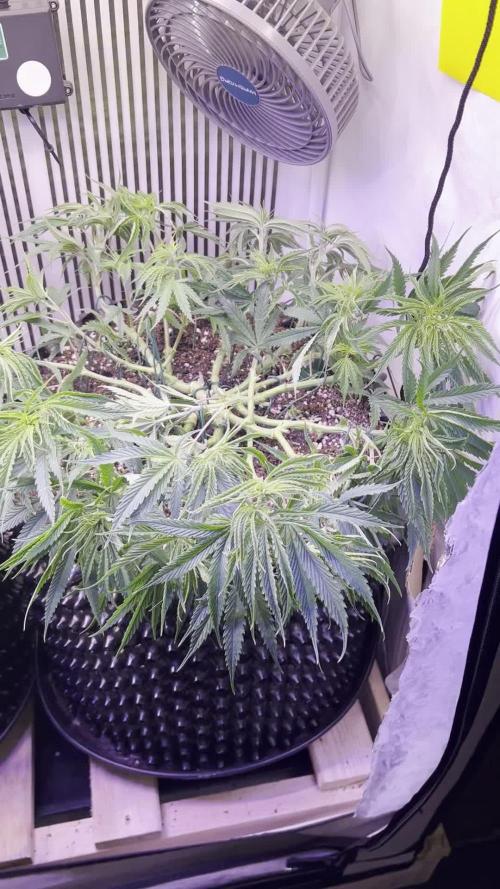
Alle Pflanzen haben das Ziel erreicht - den Rand des Topfes. Eine starke Entlaubung und Entfernung der kleineren Triebe stand an. Dadurch soll verhindert werden, dass die Pflanzen viel Energie in die Biomasse stecken, die später ohnehin beschnitten wird.
Ein Pulse-Zero und ein Bodenfeuchtigkeitsmesser ergänzen nun das Setup. Im angesicht der kommenden Blüte wird der VPD in Richtung 1-1,2 gepusht ( hauptsächlich durch ein geringeren RLF%).
Sobald sich die Ladies vom Stress erholt haben, wird die Blüte eingeleitet - im Streach wird dann wahrscheinlich das SCROG-Netz eingespannt.
--------------------------------------------------------------------------------------------------------------------------------------------
Day 49 – Vegetative Phase:
All plants have reached the target — the edge of the pot. A heavy defoliation and removal of smaller shoots were carried out. This is intended to prevent the plants from investing excessive energy into biomass that would later be pruned anyway.
A Pulse Zero and a soil moisture sensor have now been added to the setup. In preparation for the upcoming flowering phase, VPD is being increased toward a range of 1.0–1.2, primarily by lowering relative humidity.
Once the plants have recovered from the stress, flowering will be initiated. During the stretch phase, a SCROG net will likely be installed.

Likes
20
Share


@MMSC16
Follow
Day 84 - June 25
June 25 - 09.30AM Trichomes still not ready at 50/50 milky to cloudy. Soil is still moist. Will water either late this evening or tomorrow morning. I suspect this will be the second or last watering before chop.
June 25 - 09.00PM Removed a dead leaf - I want to remove some of the dying leaves on the colas, as underside of plant has a beautiful purple hue to the leaves.
June 26 - 08.45AM Trichomes are starting to turn milky, with 60/40 milky to cloudy ratio. Will water this evening as pot is getting lighter + soil isn't as moist.
June 26 - 01.20PM Purple is here. I think it's time to chop tomorrow as I'm seeing more ambers. I'm noticing some bright green growth which I hope isn't the start of nanners.
June 26 - 01.20PM Watered 3L. Chop tomorrow.
June 27 - 00.00AM CHOPPED (Day 86).
. June 27 - 00.00AM Inspected detached calyx with strange (I suspect pistil) growth. Many amber trichomes found. Strange, given colas I inspected were all cloudy with no amber, but this calyx (located at centre of plant) had plenty of amber trichomes. Perhaps this is due to recieving a higher than expected DLI at hotspot of light.
. June 27 - 00.00AM Underside of Buds are underdeveloped in comparison - easily due to light blockage. I aimed not to defoliate as she entered flower, but perhaps with better LST and leaf tucking I could've produced more even yield.
. June 27 - 00.00AM Trimmed Fan leaves and mostly necrotic foliage - want to avoid bud-rot at all costs, but I may have over-defoliated.
. June 27 - 00.00AM Drying hanging upside down with oscilating fan above (2/10) and one beneath driving air toward a wall of the tent. There's also an extraction fan at the top of the tent.
. June 27 - 00.00AM Humidity 60-62% & Temperature 64-66F.
. June 27 - 02.45PM Temperature is rising in the tent to 69F, inside a sealed bathroom room. Sealed Bathroom offers no light leakage, but I might need to open the door and allow light + cool air in.
. June 27 - 03.45PM Moved tent out of bathroom to get cooler air. Tent temperature was just under 70F. I've likely lost some flavour over a few hours - but now that it's in a cooler environment (with slight light leakage) - things should improve.
. June 27 - 03.45PM Temperature & Humidity are 66F and 60% respectively.
. June 27 - 04.00PM (16 hours since chop)
. June 27 - 04.05PM Added portable cooling unit to intake, this should drop temperature by a degree or two hopefully. Ensured Fans weren't directly in path of buds.
. June 27 - 04.30PM Humidity is 66%, I've increased oscilating fan speed to 5/10 to combat this.
. June 27 - 08.50PM Humidity is 60%. Temperature is 66F
. July 1 - 09.00PM Branches still bend - not snap. Will trim and start cure process tomorrow. Leaves shrivelled up.
. July 2 - 10.00AM Rough Trim, and placed into cure jars. 58% RH and 60% RH Probably should have harvested last night. Will maintain RH in jars via burping. Roughly 2oz (56g) of bud harvested.

Processing
Likes
12
Share


@PacoMendoza420
Follow
First day of week 4, the plants are grown big enough to top but they didn't develope enough side branches to start mainlining. I hope I can use this technique as soon as the plants recover from the topping.
On day 4 just the first of the three shows sign of complete recover while the side branches still don't want to grow up. I fed the plants with a tea full of microbes and good organic stuff.
End of week 4, the only thing needed for the lower branches to catch up was increase the height of the lamp. Now they are really happy looking forward to the second and last month of veg

Likes
6
Share


@CanadianFillmore
Follow
Start of week 7! Week 6 went really well. The Blue Dream has show the most signs of nute deficiency, but it hasn't gotten any worse. She's also very sticky, with dense buds that are starting to fatten up. This lady is on an 8 week schedule, removed big bud and added overdrive to the nute lineup.


Likes
41
Share


@PrairieFrostGrow
Follow
***Week 5 Flower - October 17 to 23, 2020, Days 29 to 35*********
New tent arrived this week. Finally getting into a 4 x 4......room for the girls. They were moved on day 33 to the new tent. Pulled the girls out and their stems are pretty strong so I am not going to stake these girls. Cut them out of the SCROG and will finish without the netting.
The girls look really good overall. Hoping for a swelling week and keeping them happy. The end is getting close and not many feedings left so will be working on getting the last nutrients in to them.
5 watering days this week, 3 were feed days. Microbes and enzymes again this week.
They are really frosty Sweet Seeds......hash making strain👍💪😃
Little more detail.........
Oct 17/20, Day 29
- 4L with Terpinator, Massive @ 3ml, Rezin, Sensi Bloom @ 2ml, B52 @ 1.5ml, CalMag, Liq. Wt @ 1ml
- 1165 ppm and 5.9pH.
- gave them a little Massive this feed to see if they will stretch a little more these last days.
Oct 18/20, Day 30
- 3L watering with Vitathrive and Rezin @ 2ml
- 65ppm and 6.0pH
- feeling like the girls are bit bigger today......could be phycological though as well.😀
- been battling pH issues so I am ignoring the runoff numbers and just giving them lots of water going in.
Oct 19/20, Day 31
- 3L with Enzymes Komplete and Microbial Mass both at 1ml/L
- 100ppm and 5.9pH going in.
- not going to flush them at this point so I am continuing to hit them with microbes.
Oct 20/20, Day 32
- 3L - Terpinator, Rezin, Sensi Bloom, Bid Bud @ 2ml, B52, Cal Mag, Liquid Wt. @ 1.5ml =
- 1000ppm and 5.7pH on this feed.
- full week 5 feed......base nutes upped to 2ml/l
Oct 22/20 -
- 3L - Sensi Bloom, Big Bud @ 2ml/L
- 445ppm and 5.4pH
- wanted to flush them today with a heavy amount of 4.5pH water but life didn't work that way.
Finished off the week at that. Will be watering again first day next week so didn't water that last day this week. They are looking very good.....darker but very good.
Likes
24
Share


@Caertner
Follow
Nun geht es los... "Rosi", "Claudia" und die etwas divenhafte "Franziska" konnten sich etwas stabilisieren.
Mal sehen, wann der Hydro-Boost anfängt... (*freu*). Claudia hatte Glück mit dem Netztopf und hat bereits anfang der Woche eine Wurzel im Wasser...
Tag 18: Rosi hat wohl Ärger mit dem Netztopf... Claudia legt schon los und Franziska will gepflegt werden. Ich denke ich mache aus ihr einen Bonsai ;)
Gesamt: Diesmal war das Umtopfen wohl sehr stressig... next time direkt die Keimlinge in den Blähton.

Likes
33
Share


@High_And_Hydro
Follow
She is feeling comfy now in her Joghurt-Becher Dr.Pepper DWC 😆
She looks a bit pale so next solution will be way stronger.
For a soda can she is doing ok i think.
Likes
11
Share


@SteffenX
Follow
week 27
18.10.2024
near harvest
19.10.2024
2nd partial harvest
20.10.2024
ca. 4g of dry buds

Likes
57
Share


@Silverback_Guerilla
Follow
11/24:
Both Black Jacks finally turned the corner and are looking like they'll produce for me.👍
The big Zkittlez just keeps on stretching and outpacing most of the other plants....looks like a supercropping is in her immediate future. Kinda sux, because she's got picture-perfect, textbook, conifer structure😑
11/25:
Had to raise the lights today about 5 inches to accommodate the big Zkittlez and a Sucrose Overdose..couldn't bring myself to ugly her up yet..maybe everybody else will catch up (ya right)
For now, I'm using platforms of various heights for the shorter plants, to keep the canopy level.
Likes
7
Share


@ChitownCannaChica
Follow
And she’s moving— just gave an ipm treatment and tip dress of kelp.
I take it slow the first 2 weeks of flower then slam them with nutes in the next few weeks. Look out!✌️🏻💚

Likes
31
Share


@Screwie
Follow
Today i changed the light from Mars Hydro300W classic to MH TS1000. Can tell straight away its much brighter and more like the sun. Hopefully it’ll be better and they grow strong!
Ive had the ladies in their 2 litre fibre pots and been watering a bit more now that they’re out of the propagator since 3 days ago. Actually i took them out late i suppose, and maybe the reason one of them has splotches is because of the high humidity of those couple of nights i thought it would be ok without the extraction fan for a few hours, however the ranges were going from like 90-70 or something. Anyway they’re big enough now to be outside on their own.
Might be a bit late to start nutrients but going to pick some up on the weekend and start them off on Biobizz standard nutrient.
Got to be watering more than i have as today noticed on 2 of them the leaves were drooping. Think they should be watered twice and around 75ml per plant but still getting used to these fibre pots that dry out quickly. Last thing i want is to screw it up early and lose any of these precious babies.
Going to ask a couple questions to clear up some queries i got.
Till next week...
