




Likes
14
Share

@DogDoctorOfficial
Follow
GMO Cookies Served with Extra Curiosity ?🍪
Drying & Trimming Report | Garlic, Gold & Preservation
And once again… yes 😄
We are dividing the reports.
At this point it almost became tradition.
But honestly, there is simply no realistic way to fit:
* harvest,
* drying,
* trimming,
* curing,
* smoke review,
* fresh frozen,
* washing,
* strain review,
* extraction plans,
* terpene analysis,
* and all the small details we love documenting…
into one single update without turning everything into chaos.
So first of all:
thank you for the patience.
Everything from seed until harvest was already documented in the previous reports, but for the people arriving only now, let’s quickly recap how we got here.
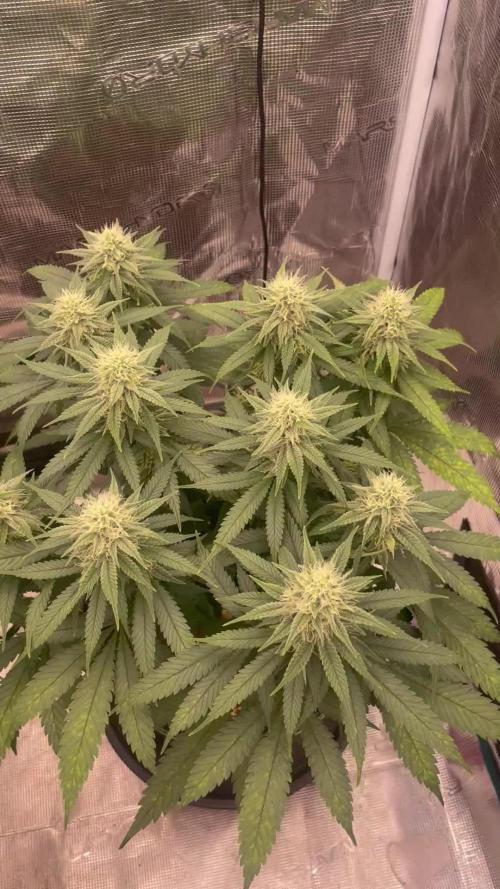
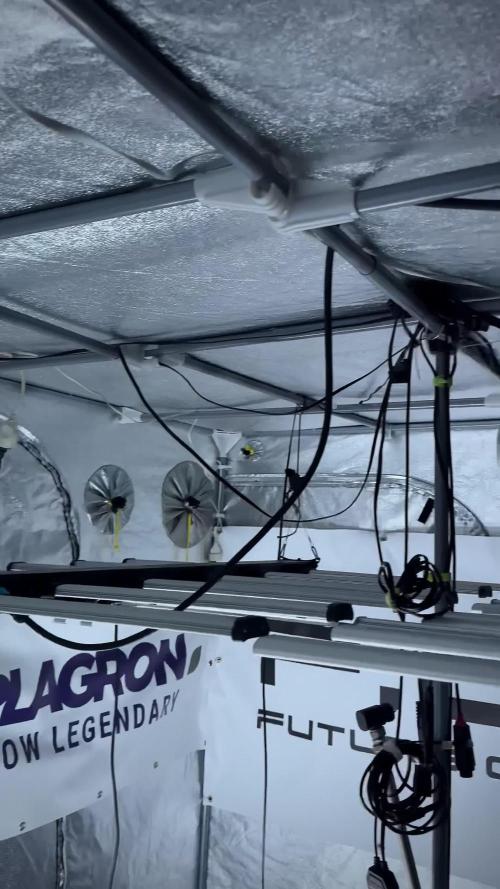
This GMO Cookies run was grown under a 12/12 from seed cycle using the F.O.G. LED setup, with environmental management focused on healthy plant development, airflow, structure, and resin production. Throughout flower the girls received selective defoliation, LST, continuous observation, and careful feeding while expressing one of the loudest terpene profiles we have had in the room in a while.
And now?
Now the plants have moved beyond harvest and entered one of the most important phases of all:
preservation.
Because growing beautiful flowers means very little if drying and trimming are rushed afterward.
So this report belongs to:
* drying,
* trimming,
* handling,
* preserving terpenes,
* collecting resin,
* and slowly preparing the medicine for cure.
The branches that were selected for drying spent approximately:
* 10 days drying,
* around 60% humidity,
* temperatures between 18–20°C,
with the first couple of days running slightly drier in order to help remove excess surface moisture before stabilizing the environment more carefully.
And honestly?
The aromas coming from these flowers during drying were absolutely ridiculous.
Now, to be completely honest and transparent:
these were not the densest flowers from the tent.
Visually they actually looked denser while still wet than they ended up feeling after drying.
But what they lacked slightly in density…
they completely compensated for in aroma, terpene expression, flavor potential, resin behavior, and overall personality.
And honestly, that trade-off is something many growers happily accept.
Because this GMO profile is LOUD.
Like…
walk-into-a-kitchen loud.
Real GMO lovers will understand this instantly.
Every trimming session felt like sitting next to a chef smashing fresh garlic cloves directly beside us.
Savory.
Greasy.
Funky.
Sharp.
Warm.
Almost oily-smelling.
And hidden underneath all that madness:
sweetness,
cookie notes,
earthiness,
and weird creamy undertones slowly revealing themselves as the flowers cured further.
This is not a shy cultivar.
Not even close.
Once the drying process finished, it was finally time to trim.
So:
gloves on.
Trim station ready.
Trim bin prepared.
Scissors cleaned.
Glass jars nearby.
Grove Bags prepared.
And of course…
little self-medication beforehand 😄
Because trimming sessions and cannabis culture somehow always belonged together naturally.
The branches were broken down carefully by hand, one by one, and every flower was trimmed individually with patience instead of speed.
As always, we used pointed curved trimming scissors.
And honestly, they are fantastic for this type of flower structure.
Especially with fluffier or more open flowers, curved pointed scissors allow you to:
* enter tighter spaces,
* remove excess leaf material precisely,
* preserve flower structure,
* avoid crushing calyxes,
* and maintain a more natural-looking final product.
Straight scissors work perfectly fine too of course, but for this type of trimming, curved points genuinely feel more comfortable and surgical.
And with GMO?
You quickly realize precision matters.
Because these flowers become sticky almost immediately.
The scissors start collecting resin.
The gloves become greasy.
Finger hash starts forming naturally.
And suddenly trimming stops being just “work” and starts becoming part of the experience itself.
The first dried branches gave us:
137.1 grams.
After trimming and weighing, the flowers were carefully transferred into Grove Bags, with smaller amounts also resting inside glass jars for comparison and monitoring during cure.
Then we moved onto the flowers dried on the drying rack.
Again:
not the densest plant from the tent.
And honestly, we believe temperatures played a role there.
This cultivar appeared slightly more sensitive to higher temperatures than some of the others around her. Our personal feeling is that she continued pulling significant water during flower development, which likely contributed to the final structure remaining slightly more open once dry weight settled.
But despite that?
The quality remained absolutely beautiful.
Sometimes growers become overly obsessed with density alone.
But density is not everything.
Aromatic expression,
resin quality,
effect,
smoothness,
flavor,
and terpene complexity matter just as much — sometimes even more.
And this GMO absolutely shines there.
The second drying batch landed at:
224.2 grams.
Again carefully bagged for preservation.
And speaking of preservation:
we decided to use Grove Bags for most of the flower storage.
Why?
Because preserving terpenes matters deeply to us.
Especially with a cultivar this expressive.
The idea behind Grove Bags is maintaining stable curing conditions while reducing the constant need to burp jars manually. They help regulate humidity exchange while still allowing the flowers to continue stabilizing naturally over time.
Of course, glass jars still remain legendary and we still use them too.
Honestly?
Both methods have their place.
And later during cure and smoke review, we will probably compare the differences more deeply.
But for now, the priority is simple:
protect the terpenes.
Protect the medicine.
Protect the work.
Now let’s talk about something we personally love a lot:
the “gold.”
Or what many people simply call:
kief.
During trimming, tiny trichome heads naturally separated and fell through the trim bin screen.
And honestly… watching that happen never gets old.
At one point we jokingly started “playing the drums” Moroccan style across the trim bin while working, moving material gently across the screen and collecting the resin heads gathering underneath.
And the result?
Beautiful golden powder.
Tiny greasy trichome heads.
Pure aromatic dust from the plant itself.
Eventually we pressed part of it together gently using finger warmth and pressure, creating a tiny mini temple ball.
Small.
Dark.
Sticky.
Greasy.
Beautiful.
The type of resin that already tells you:
“This plant is going to wash beautifully later.”
And yes…
that curiosity is still alive and stronger than ever.
Because despite everything already documented here, we still have:
more than 700 grams of fresh frozen flower material waiting patiently inside the freezer.
That future report is still coming.
And honestly?
We are incredibly excited for it.
But there is no rush.
That material is preserved safely and waiting for the right moment to become:
* ice water hash,
* solventless resin,
* or whatever expression this GMO decides to offer us later.
For now, this chapter belongs to drying, trimming, preservation, and preparation.
Before ending this report, one more important thing:
cleaning.
Once trimming was finished and the room slowly emptied, it was time to clean everything thoroughly and prepare the environment for future runs.
And honestly, this part matters far more than many growers realize.
Between runs we strongly believe in:
* deep cleaning,
* sanitizing surfaces,
* cleaning fans,
* sterilizing tools,
* removing plant residue,
* using UVC if available,
* using ionizers or environmental tools carefully,
* and resetting the room properly.
Because prevention is always easier than fighting problems later.
A clean room protects future harvests.
And after a run like this?
The room deserved a respectful reset.
Now next week?
Next week we finally move deeper into:
* curing,
* smoke review,
* terpene evolution,
* flavor,
* effects,
* smoothness,
* strain review,
* and our true thoughts about GMO Cookies after spending months with this cultivar from seed until cure.
And honestly…
we cannot wait.
Before ending, as always:
Thank you.
To Zamnesia.
To F.O.G.
To Plagron.
To Lumiflora.
To Grove Bags.
To the platform.
To the community.
To the growers sharing knowledge.
To the hash makers.
To the flower lovers.
To the silent supporters.
To the curious people following this strange garlic-filled adventure 😄
To everyone spending even a few moments here with us.
This GMO Cookies run truly was served with extra curiosity.
And honestly?
That curiosity still hasn’t disappeared yet. 🌱
📲 Don’t forget to Subscribe and follow me on Instagram and YouTube @DogDoctorOfficial for exclusive content, real-time updates, and behind-the-scenes magic.
GrowDiaries Journal: https://growdiaries.com/grower/dogdoctorofficial
Instagram: https://www.instagram.com/dogdoctorofficial/
YouTube: https://www.youtube.com/@dogdoctorofficial Deleted by Youtube - https://www.youtube.com/@TheDogDoctorOfficial NEW
Vimeo : https://vimeo.com/dogdoctorofficial Under construction stay tuned ⸻
Explore the Gear that Powers My Grow
If you’re curious about the tech I’m using, check out these links:
🔆 Lighting & Environmental Control
• Future of Grow — Advanced LED lighting technology
https://www.futureofgrow.com/
DISCOUNT CODE: DOG20
• Lumiflora — Under-canopy LED lighting
https://lumiflorade.com/
• TrollMaster — Environmental controllers and automation gear (past collaboration)
⸻
Genetics
• Zamnesia Seeds — Genetics used in this project
https://www.zamnesia.com/
⸻
🌱 Soil, Substrates, Boosters & Root Support
• Plagron — Substrates, bio mixes, and supportive products
https://plagron.com/en/
⸻
🎒 Storage, Curing & Preservation
• Grove Bags — Curing and storage solutions
https://grovebags.com/
⸻
📸 Photography Equipment & Tools
(Not sponsors, but part of my creative toolkit)
• Sony A6700
• Sony full-frame macro lens + few more
• Stacking photography workflow - learning
• iPhone (for behind-the-scenes shots)
As always, this is shared for educational purposes, aiming to spread understanding and appreciation for this plant. Let’s celebrate it responsibly and continue to learn and grow together.
With true love comes happiness. Always believe in yourself, and always do things expecting nothing and with an open heart. Be a giver, and the universe will give back in ways you could never imagine.
💚 Growers love to all 💚
📸 P.S. – The Eye Behind the Lens
All photos in this diary (for now — except for the ones showing the camera, which I took with an iPhone) are taken with a Sony A6700 paired with a Sony full-frame macro lens and a few more.
Photography is part of the story — it’s how we share the fine textures, the glow, and the quiet details that words can’t always capture.
I’ve also started experimenting with photo stacking — a technique where multiple images, each taken at a slightly different focus point, are layered together to create one perfectly sharp image from front to back.
It’s not digital enhancement or AI; it’s pure photography — a way to reveal the plant’s beauty in microscopic depth, from trichome to petal.
You’ll even see a few shots of "ghost me" capturing the shots — camera, lens, setup — because every grow deserves not just to be cultivated, but documented like art.
FOR DISCOUNT CODES AND MORE JUST FOLLOW THE LINK https://website.beacons.ai/dogdoctorofficial
NEW DISCORD - Official Server Invite Link : https://discord.gg/ksjAkA5T74

Likes
24
Share


@Grnhead
Follow
The smell is really starting to come in. Bought 2 sets of 80 mm internal fans to increase the airflow through the plant and in the box. Many of the lower leaves are curling down and I think it was a mixture of the high morning humidity and the lack of air flow. Now there are 5 internal fans and a large external fan, and it should be more than enough air flow. Growth is starting to slow finally, the height is perfect right now but I have a feeling it’s going to keep getting taller. I keep tying her down as best as I can.

Likes
26
Share


@GuerillaGorilla
Follow
17 sept.
Please let there be sunshine,
Mould had been spotted mainly in the northern part of the plant. Rain had been pouring down for nearly a week and air humidity was around 80-90 %
Plants are way to far in their flower cycle for these kind of showers and you can see it has taken its toll.
Pistils are turning brown and buds need to be checked every other day to stop mold from spreading.
She still needs a week more maybe 2 if weather allows it, but she will be chopped before the next rainy days.
I will lose a part of the harvest to mould weekly but for me the maturation of the harvest is more important than the quantitity. As you can see there are plenty of buds left that still have chance of maturing. Harvesting now would be a shame.
Simply hoping for some dry warm days for her to swell and put on some weight.

Likes
6
Share


@MisterFlavonoid
Follow
This one was Baked in Paris by PerfectTreeSeeds, grown with AptusPlantTech only! Check the other weeks to see the ones with GreenPlanetNutrients!
Great gassy notes, awesome structure, beautiful colours. I know this one came out a little too early, but I was having problems with humidity and also with smell so I decided to take 'em all out at the same time.
Forgot to take pictures of her on the drying screen, will update soon (:

Likes
23
Share

@GoodTimesOrganics
Follow
Hi liebe Community and Welcome Back! 💚
Woche 15 (Tag 115) im Vergleichsgrow!
Bio Tabs NL. vs. Weedefix (Stuttgart/ Germany)
Blütetag: 63 (BW9)
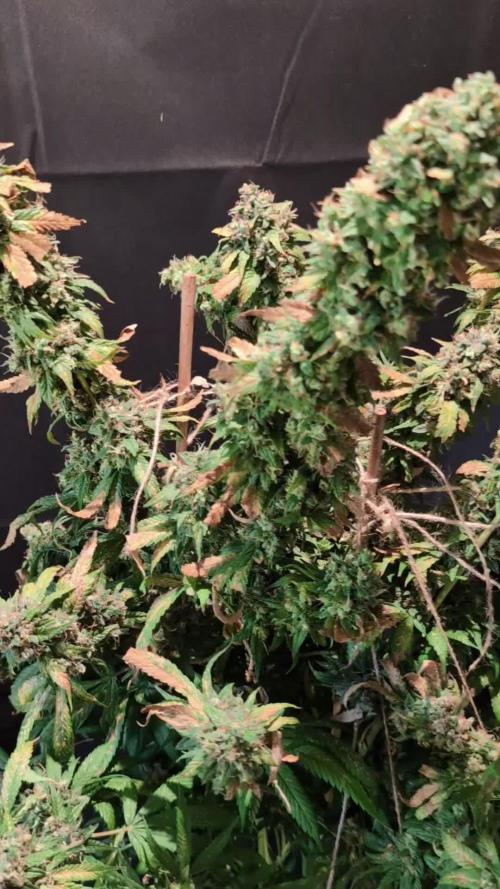
Heute war Erntetag! Und die Ergebnisse sind trotz Phosphor überschuss super zufrieden stellend!
Wir haben eine super gewachsene Pflanze mit ordentlich Loadup und einem Aroma, welches auch sehr für sich spricht.
Nun zum eigentlichen Vergleich: Ich muss sagen, ich messe weder Drain noch PH da ich rein Ökologisch mit Bio Tabs bei dieser Pflanze gearbeitet habe.
Und dennoch war es wohl zuviel des guten. Nach der Zugabe des Komposttee und des zwei Wochen zuvor angewandten PK Boosters ist der Bodenhaushalt etwas gekippt.
Daher auch die verwelkenden (verbrannten) Blätter.
Ich denke dass nicht beide Komponenten in der Blüte angewendet werden sollten.
Weniger ist wohl doch insgesamt mehr.
Ich habe die Pflanzen die letzten 48 Stunden im dunklen stehen lassen um nochmal einen kleinen Stressboost hinein zu bringen.
Die Bedingungen im Growzelt waren bis zuletztin Top!
—————
🌞 Temp: 26
🌚 Temp: 18°C bis 19°C
💨 RH: 54%
VPD: 1,71 kPa
💡ppfd: 830 mpm
—————

Likes
8
Share

@ebone4206
Follow
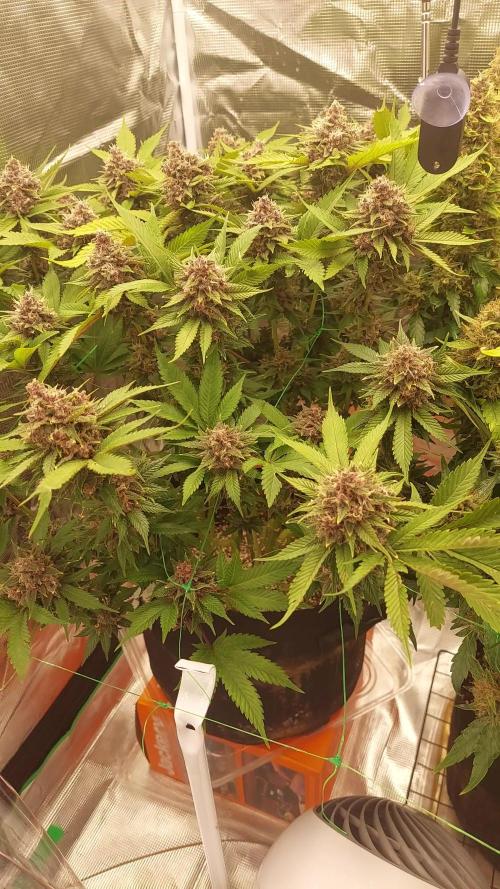
I'm lowering her nutes slowly and picking up thus past week. I'm down to 200 -300 ppm going in and I still got over 1000 ppm runoff. I'm going to just give her PhD water and get the runoff to 400.
Only 1 leaf faded 2 or 3 weeks ago but nothing else major. The leafs are looking like they are trying to fade but nothing noticeable and most are still green. Her tricomes are less clear now but it has seemed like this will be a reg photo. Could be what I did on my end for it to be almost week 9 or 10.
I want the leafs to fade more before I pull and see some amber tricomes.
We did chop a branch and let it dry in the tent above the light. Someone, not me was anxious to try lol. It dried in 3 or 4 days lol. will say it was not harse one bit. Smoke was white. I felt a little something but nothing to be like whoa. I felt it for like 5 mins in my head. The smell was amazing. Not as potent because of thr way it was dried. It broke down nice. The smell stood out more when I broke it down. I broke it down with my hands. I did a dry hit and taste nice and hit of sweetness. I rolled a wrap and smoked that first. I put the rest in my vape and had the same outcome. It was very dense. Didn't take pix of weigh it sorry. Forgot to add we cut a small piece off as in the pixels. We smoked the big nut and thr small ones in the vape. Nice clean hit.
That makes me question the flushing aspect but this is my first grow so will see when I do a proper dry.
I can't wait to cut these bad girls.
i need a break 😩.
I started lowering the feed last week slowly but found out my runoff is not really changing. 🙃
It had been hard to keep the humidity down when lights are off. I have a big dehumidifier on my ac but it doesn't work like I want, it likes to shut off constantly and the ac only works keeping it down but if it's to cold the humidity goes up. If it get to cold in the lung room the ac blows out humid air and that goes straight into the tent. Also where I live one day the humidity could be over 90% and that night or next day be in the 30%. And it summer it's like low 20 or 30s and rises at night. Our nights usually cool down to the 60s in the summer.
So a little worried about drying. I was thinking of getting a small portable dehumidifier inside the tent.
Other than that she's looking like she's almost ready.

Likes
14
Share


@LK_Smoka
Follow
No more nutrients since early last week just water I think another week.

Likes
92
Share


@DogDoctorOfficial
Follow
🌱 Week 1: The Journey Begins! 🌟
Hey Grow Fam! 🙌 We’re off to an epic start with our TrolMaster adventure, and I’m already feeling the love for the setup, the seeds, and the growth happening in the room! So, let’s dive right in and get into the details of this exciting week!
🌿 Germination Update:
Our first Gorilla Melon seed from Fast Buds didn’t sprout, but no worries—round two was a success! 🦍🍈 The second seed has germinated and is looking full of potential. I’m throwing in a Sweet Seeds Papaya Zoap into the germination station too, so we’re keeping this exciting lineup going strong! Germination is such a key part of the journey, and having a healthy start is what it’s all about.
🔧 Room Build & TrolMaster Setup:
The build is coming along beautifully, and I gotta say, the TrolMaster system is blowing my mind! Everything’s under control like magic 🎩✨, and the TM+ app? Wow, just wow. I mean, I can literally be in the bathroom and still keep an eye on the plants—check all the metrics, adjust settings, and fine-tune what I need, all from my phone! 😂💧 This level of control is next level. I’m loving how smooth and seamless it makes managing the room. The gear is just unreal, and seeing it all come together is truly something special.
🌱 Nutrition Talk:
As for feeding, we’re starting light but smart! I’ve begun with 0.15ml of Regulator and 0.25ml of Startbooster per liter for now. I always believe in starting easy and ramping up as the plants develop. These early stages are crucial—balance is everything. For the time being, I feel this is more than enough to keep the babies happy and healthy. 🌿💧 The Regulator is working wonders in maintaining plant structure and health, while the Startbooster is fueling the early root and vegetative growth, laying down a solid foundation for the weeks to come. It’s about getting it right from the start—too much too early can be a killer. Keeping it steady with precision, that’s the goal!
Big Shout-Outs:
To the amazing team at @TrolMaster, @Fast_Buds, @Sweet_Seeds, @AptusHolland, and all the incredible sponsors—I’m beyond grateful for the support! 💚 And to my GrowDiaries fam and followers, you guys make this journey what it is—thank you for the love, and I’m so honored to have you along for this ride. 🙏
We’re just getting started, and I can’t wait to show you what’s next. Stay tuned for more updates, epic builds, gear reviews, and plenty of insight. Don’t forget to follow me on GrowDiaries, YouTube, and IG for exclusive content, and let’s make this grow the best one yet! 🌿🔥
Growers Love to All 💚💚💚
P.S.- A deep dive into the Full Spectrum Quantum Sensor (MBS-PAR):
The Full Spectrum Quantum Sensor (MBS-PAR) is an essential tool for any serious grower looking to optimize their light environment. This sensor measures photosynthetically active radiation (PAR), which refers to the spectrum of light that plants actually use for photosynthesis—typically between 400 and 700 nanometers and more depending .
What makes the MBS-PAR sensor special is its full spectrum capability, meaning it accurately detects not just visible light but also far-red and UV light—which are crucial for maximizing plant growth, development, and flowering. With this tool, I can monitor the exact intensity of light my plants are receiving, making sure they’re getting the optimal levels for every stage of growth.
By using this sensor in my grow room, I’ll be able to ensure that the light distribution is uniform across the canopy. Plus, it allows me to fine-tune the light output from my ThinkGrow LED setup, ensuring my plants are thriving under the best conditions. Whether it’s increasing light during the vegetative phase or fine-tuning it for flowering, the MBS-PAR sensor helps me keep everything on point. And the best part? I can monitor it all through the TrolMaster app, ensuring I can make adjustments whenever needed—even if I’m not in the grow room!
This level of precision means healthier plants, better yields, and maximum efficiency. It’s a game-changer for taking the guesswork out of lighting and getting closer to growing perfection! 🌱💡
Growers Love to All 💚💚💚


Likes
13
Share


@Andres
Follow
she has 103 days and I'm going to leave 120 days to knock her out. she still enjoys the sun and the outdoors and she s feeding every 10 days with red bird guano... 80%ambar



Likes
14
Share


@Johnny_Depoca
Follow
This week I keep cheking the ripening by shooting supermacros and analysing thricomes and pistils. Watermelom is the most compact yet the first ripen, denser and stickier with healthy leaves with no yellowing at all. Dosidos is bigger and well spread after the training but despite many buds (kinda violetish) they are really not as beautiful as Watermelon's. Mimosa is going on as it has always been late...I decided to try to speed up by reducing the hours of light (from 20 to 17) and the intensity mimicking autumn. As trichomes are getting milky soon I plan to harvest Watermelon and Dosidos next week. See ya 🙏 happy growing buddies!!
Likes
145
Share


@Kynareth
Follow
Plants keep growing good, without excess or nutrient fault. So happy
They have doubled the size. +17 cm. As i commented before i'm struggling with the height of the tent, I hope they stop but I don't think so I have switch ON the flowering leds to invite them to start flowering.
Also is the first auto strain that vegs for 34 days and there aren't signs of preflowering. The vendor states that the complete life is between 70 and 80 days... I don't care about time but yes about space. Thinking in setup a scrog mess, but i don't know.
day 36 - I see some preflowering signs at one plant. Ads you can see in the pictures the higher was nearly touching the leds and I dind't had margin to move it upper, so i have lowered the base around 10-15 cm and now they have some space to go bigger at flowering.
I have taken advantage of the occasion to take out all the plants and take some photos out of the closet, hope you like it.
In 2 days more i will do a root cleaning with specific solution and will change all the water for preflowering doses
Also the smaller one was damaged during this process, i hope she recover fast. I will apply some wound paste on that to avoid more stress; you can see too that the smaller one is not straight due to bigger one blocking the light.
With lowering the basethere is a humidity reduction of around 10%

Likes
13
Share

@TrickzGrowz
Follow
Servus Moin!
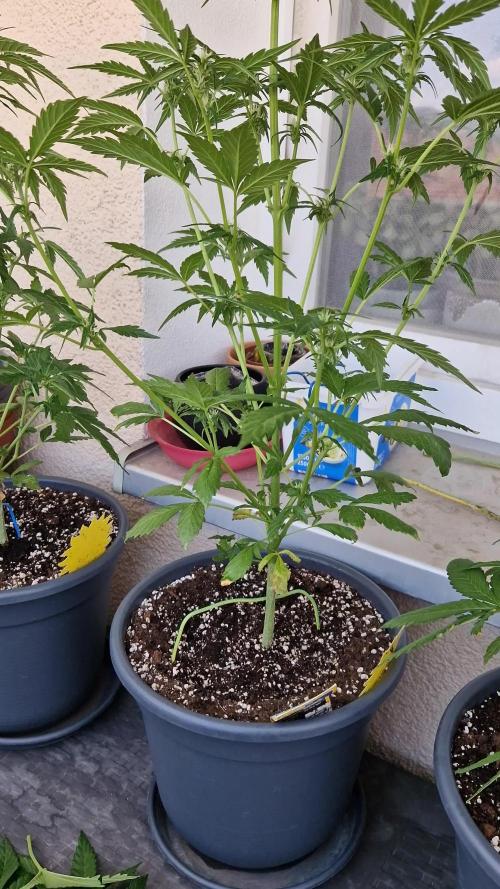
Die Pineapple Slush XL ist einfach wirklich nur ein Monster. Sie ist echt riesig geworden, ich hoffe sie wächst nicht noch mehr in die Höhe.
Likes
90
Share


@CRiSPrGrow
Follow
these came down at 10 weeks and 4 days 509 wet after a wet trim expecting close to 300 finally let's see 🚀 all in all pretty stoked to try that chem ! trying on paper bags then it's jars, check back in later 😱 😱 😱 😱


Likes
361
Share


@Ju_Bps
Follow
Hello my friendly growmies 👩🌾👨🌾🌲🌲,
This Fat Banana 🍌😋 continue to grow really fast this week 😱😱
The first pistils start to coming, and the first ball too...
I've found 4 balls on 2 nodes (the 2 first) on the #2, I've removed them.
I'll see if I can keep under control, I'm not really surprised. They got lot of stress the 2nd/3rd week..
The other nodes look good.
And #1 really sweet 😍
I've decided to don't touch the plants to don't give more stress.
💦I give water each 2 or 3 days and more and more/plant
400 ml Water + RQS Grow Tab (1/2 for 2.2l )
450 ml Water + cannazym
500 ml Water + RQS Grow Tab + Boost
@PH6
Tips💡
For the rqs tabs, to don't waste,
I cut the tabs and use a 1/2 /tabs for 2 or 2.5l Water.
I'll continue the grow tabs one week more and starting bloom tabs in 1 week.
Lamp @60%
I've moved the plant this end week in my new tent 120x60x150.
Under the FC3000💡💡
Thanks community for follow, likes, comments, always a pleasure 👩🌾👨🌾❤️🌲
Mars Hydro - TS1000 💡💡
https://www.mars-hydro.com/ts-1000-led-grow-light
Mars Hydro - FC3000 💡💡
https://www.mars-hydro.com/fc-3000-samsung-lm301b-led-grow-light
RQS - Fat Banana Auto 🍌🍌🌲🌲
https://www.royalqueenseeds.com/autoflowering-cannabis-seeds/487-fat-banana-automatic.html
Likes
4
Share

@MrLahey
Follow
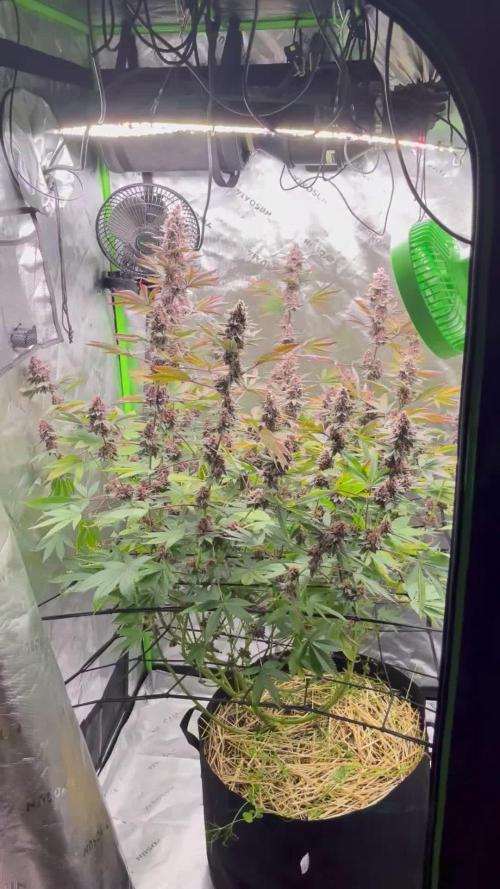
Day 59 of flower. Probably gonna chop her this weekend. She looks and smells great! Such an improvement over the first time I grew this (which was my first grow).



Likes
18
Share


@VI_Cannabis
Follow
June 7 - We ordered some new lights last week, they are 240w kingbrite samsung lm310h with uv/ir, 3000k, and meanwell drivers.
We setup the new room and moved the girls into there. After a bit of LST and a watering (with nutrients) at roughly 7ph, they were ready to go under the 2 new lights and the same SF-1000 we have been using in this grow.
The new room is a 12 ft enclosed trailer. I moved everything from the small tent into this. I put clear poly on the walls, floor and ceiling. I put poly on the shelf I am going to be keeping in there as well. I bought 50ft of 6mm mylar and lined the floors, roof and sides with it. I plan to get some reflective tape to seal everything and to cover the wood. I did not get much of a chance to watch temp's today as they it was later in the evening after all was said and done. The inline fan blowing in air from outside.
June 8 -
9 AM i checked the plants, they were at 25.2 and 50% RH. Late through the day I had checked and we had gotten up to around 32 degrees. So I moved the inline fan to the closer vent, hooked up to that, and had the air blowing out of the trailer with the inline fan sucking it from above the lights.
I then added oscillating fan and had it blowing air on the left side of the room so it would somewhat circulate once I closed the doors. I then checked at about 9pm and we were at 22 degrees. Definitely noticed a decent amount of growth already. I have the lights on a 22/2 cycle as I was worried about the heat at night time.
June 9 -
Some great growth from the girls, still having problems controlling the temps in the afternoon. I decided to prop the door open a bit to have a constant breeze throughout the day while I am at work. Decided to do some more LST and also a bit of defoliation. I took about 25% of the leaf's that were blocking the new growth as it was getting a bit bunched up. I was then told the leaf's are almost solar panels for them. So from now on I will be trying to just do some tucking unless needed. The leaf's I removed were most of the damaged leaf's, I am not to sure if that makes much of a difference. I gave them a watering with only water as there is a potential I am getting a bit of a nutrient buildup along with the PH problem. Or potentially the reason for the ph problem is nutrient buildup. After watering with A PH of 7 I got some run off and tested it. The smaller plant gave me a PH of about 5.5 where the bigger one is around 5.0.
June 10 -
Plants are looking happy and showing tons of growth. Seems to be trying to stretch outwards. Not a ton of sign of PH issues showing so potentially getting it under control. Still a bit of damage to previous leaf's but it is what it is! The last few days I have been leaving the door open a bit in order to keep the temps down. I decided to test something and turn the lights off (automatically) at 11AM and back on at 5PM so light schedule has now changed to 18/6 and it seems I may have figured out the issue. We haven't had lots of sun the last couple days so it hasn't been to hard and I have yet to know if it truly fixed the heat issue for now. (I will be looking into a ac unit as well since it typically gets to around 30-35 around here.
June 11 - Pulled some of the branches back down and added a few more LST spots. Seems we have a good amount of growth from the smaller plant out of the 2 topped spots. Unfortunately it looks like I fucked up on the bigger plant and only one of the nodes seems to have new growth. I will continue to monitor that but I think I cut the node to low and also to soon. Other then that, the girls are doing great. They seem to be absolutely loving these new lights. I gave them some nutrient water today as well. roughly 3L each. They seem to be A hell of A lot more thirsty under these new lights.
June 12 - The girls are doing great , they are still just doing growing away. Lots of progress everyday. I am going to be getting a go-pro so I can set-up a time-lapse for the rest of this grow. I received my new inline fan, I got A ac infinity CLOUDLINE T4 with the temperature humidity controller. I am going to be having one fan pushing fresh air in and one fan pulling out the hot air. I will be doing that tomorrow since I have to work today.
June 13 - I ordered another 50ft of mylar and that showed up today. I have decided to remove the shelf and add another 3+ feet to the grow space. So today I installed more poly, mylar, the ac infinity fan. I have it set-up to pump in air if it gets to warm. I am thinking of switching it to the output that way if it gets to hot or to humid I can have that air pulled out of the trailer. Right now my other inline fan is the outtake and I just have it set on full. Overall I think everything is set-up a bit better and more accessible. I will be putting my 2x2 tent in there at the left of the doors so I can have a veg room when these 2 are in flower. I plan to have 4 in veg and 4 in flower for the next grow. Still waiting on JOTI seeds, ordered 3 weeks ago and still have not been shipped. I will be getting those going the moment they arrive.
The girls seem to be happy still, did a bit more LST to try to keep everything even, mainly I'm just pulling down on the spots I already have tie wire on.
Likes
3
Share

@PapaTerps
Follow
Holy Snow - Greenhouse Seed Co.
Day 52
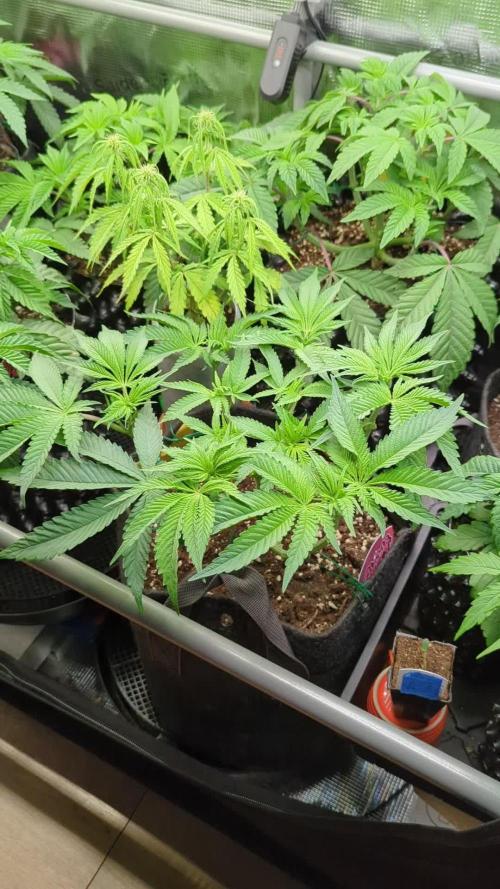
🚿 watered twice this week, with 2L of RO tap water, mixed with the defined nutrients, individually, in order and pH'd to 6.3. I've upped her nutrients again, increasing the Grow to promote growth, as well as the BioHeaven and Acti-Vera to help with the plants metabolism and overall health 👌🏻
✂️ She's had a good amount of work performed this week, from a second round of topping, lollipoping and Defoliation as well as this, Ive also altered her low stress training a bit, pulling the outer stems down so the canopy was more even 💪🏻
🌸 This will more than likely be her last week in veg, when space becomes available in the flower tent, she will be moved over to there and will then be on a 12-12 schedule 🙏🏻
