




Likes
1
Share
@Trinidad
Follow
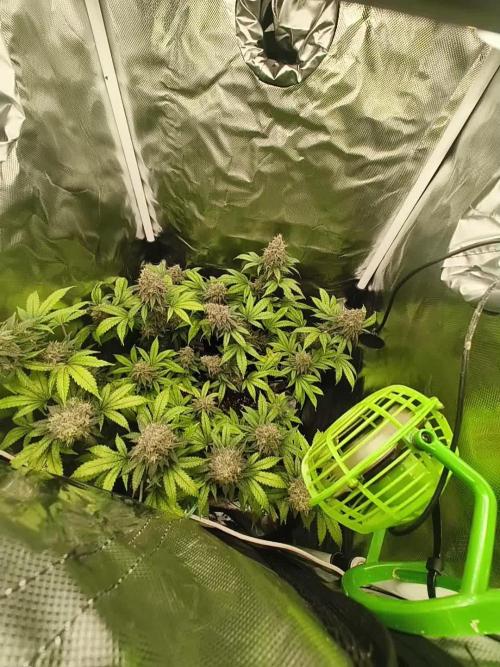
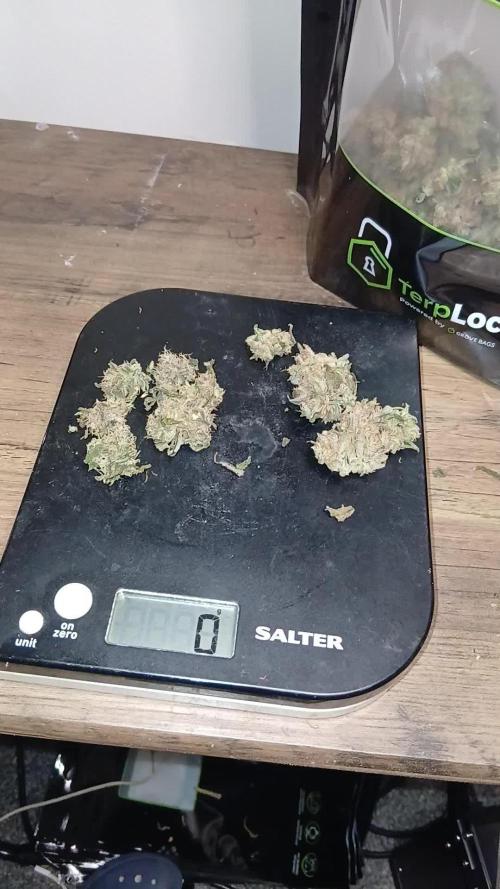
2 different Frostbangers plants. Same grow. 1 came in at 52g and the other at 6. Easy grow and easy trim


Likes
17
Share


@MasterKush714
Follow
Was a great experience hopefully my fruits of labor haven't gotten destroyed by bud rot so scary for real lol


Likes
145
Share


@Salokin
Follow
Hello Growmies,
The final chapter of this incredible journey has unfolded, and it's time to share the bountiful harvest and reflections on the entire cultivation process. Trimming the plant was a joy, and with gentle fingers, I removed all the large fan leaves. The precision in this process revealed the true beauty of the buds, setting the stage for a smooth harvest. With care and gratitude, the plant was chopped, and the buds were hung to dry. The anticipation for what lies ahead only adds to the sense of accomplishment. The wet weight, excluding fan leaves, stands at an impressive 782 grams. The buds are massive, a testament to the efficacy of the nutrients used, particularly the Power Buds. The name seems apt, as the result is a collection of sticky, dense buds with subtle lemon notes and sweet pungent undertones. In the final moments, the plant unveiled some delightful purple hues. While I wish I could have allowed them to intensify further, it's a reminder that each grow is a learning experience. In hindsight, a slightly longer fading period would have accentuated those beautiful colors. We live and learn, and that's the essence of this journey.
A heartfelt thank you to Plagron and Zamnesia for hosting this amazing contest. The quality of the products and the support throughout the journey have been invaluable.
As this chapter concludes, I'm left with a sense of fulfillment and gratitude for the collective experience we've shared. The plant's growth, from seed to harvest, has been a testament to the art and science of cultivation.
Feel free to check out my other adventures in my bigger environments, until then...happy growing!
Stay Lifted
Salokin


Likes
54
Share


@GarciasGarden
Follow
DAY 7 SINCE PLANTING: Everything is still going great I really like to baby these girls making sure they are always at the right temp and humidity and never dying for a drink .. you can definitely already tell a difference in how much water uptake each strain differs by... like the washing machine by ripper seeds was the first to take off and definitely sucking up water the fastest. Kosher Kush is super healthy as well along with the free BLUEBERRY seeds from “ Seedsman. I’m planning on moving them into my tent here in the next 10-14 days under my 1000 watt MH (dimmed to 600 watts) and 2 other mars hydro 150 watt leds(at half power) if you guys could help me out with your opinions ,thoughts, critiques Anything would be appreciated like how far away should I keep the lights after moving them into the 5x5?



Likes
6
Share


@bubatz420
Follow
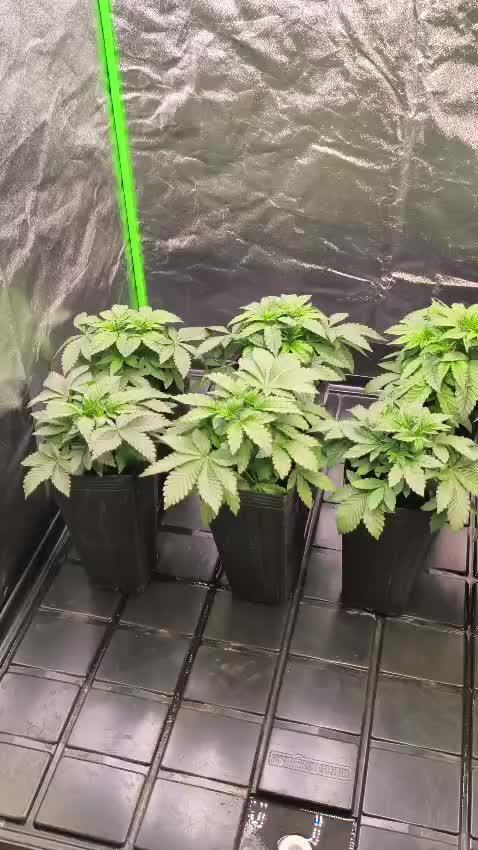
Im Zelt stehen noch die 3 Lemon Cherry Gelato und die 1 Strawberry Lemonade
hab jetzt heute die Blüte eingeleitet :)


Likes
19
Share


@candiedamberfarms
Follow
Completing their first week of bloom. They’ll be measured again on Sunday but going into flower they sat at 42”. There was a runt and I was able to hoist up the xxl autopot to even out the canopy before flipping. I did a heavy defoliation but you’d never know. I’ll wait until stretch is over and really get in there to open up the airflow. Super healthy and very vibrant. Constantly praying and up taking Lotus extremely well. I expect a 10-11 week bloom. Happy growing y’all.

Likes
56
Share


@nonick123
Follow
Día 43 (02/12) CBD Auto 20:1 #1 no para con el stretch! 🚀😍 Le elimino algunas hojas de abanico que tapan la luz a los cogollos inferiores
Está empezando a pedir más agua cada día, pero no me extraña con lo grande que es!
CBD Auto 20:1 #2 está empezando a engordar y engordar los cogollos 💥😁
OG Kush Auto tiene unos erizos preciosos!
Día 44 (03/12) CBD Auto 20:1 #1 sigue imparable. Elimino algunas hojas de abanico
OG Kush Auto se empieza a mostrar más sedienta en la formación de cogollos!
Día 45 (04/12) CBD Auto 20:1 #1 sigue imparable. Elimino algunas hojas de abanico más!
OG Kush Auto también le elimino algunas hojas de abanico
Día 46 (05/12) CBD Auto 20:1 #1 Schwazzing / defoliación intensiva
OG Kush Auto Defoliación!
Día 47 (06/12) CBD Auto 20:1 #1 repetimos Schwazzing / defoliación intensiva debido a que la planta no para!
Es increíble lo que crece esta planta!
Día 48 (07/12) OG Kush Auto ha empezado a aumentar el consumo de H2O, y se muestra sedienta en esta fase. Mañana aumentaré el volumen de riego de 750 ml a 1.000 ml
Debido a que se acerca una ola de frio, hago una mejora sustancial en la tienda
Coloco un radiador de aceite + un termostato digital Wifi (controlador de temperatura) para poder controlar el radiador
Me encanta porque desde la App puedo programar eventos en función de cualquier parámetro, de modo que puedo controlar la histéresis del radiador 😁
Tras un par de días de pruebas, consigo una temperatura estable de 22 - 24 ºC con luces ON! 😁
Día 49 (08/12) CBD Auto 20:1 #1 ha crecido increiblemente esta semana comparandola con la semana anterior! Un monster pheno!
CBD Auto 20:1 #2 hago riego con 750 ml H2O RO + BIO PK 5-8 10 ml/l. ¡Un empujón para la recta final de floración!
Tiene unos colores preciosos en los cogollos! Con tonos rosas y morados en los apices! 😍
LSD-25 Auto hago riego con 750 ml H2O RO + BIO PK 5-8 10 ml/l. ¡Un empujón para la recta final de floración!
Está preciosa con ese morado casi negro que presenta en cogollos y hojas, unido a los pistilos de color naranja fuego conforme van madurando
OG Kush Auto tiene una formación de cogollos impresionante, y ha empezado a cubrir de tricomas todas las hojas que salen de los cogollos 😍
Lo unico preocupante es que ha empezado a mostrar algunas manchas marrones en las hojas de los cogollos...
Riego con 1 litro de H2O RO + 1 g/L de BACTREX para ver si le ayuda con la gestión de este exceso / deficiencia
💦Nutrients by Bio Tabs - www.biotabs.nl/en/
🌱Substrate PRO-MIX HP BACILLUS + MYCORRHIZAE - www.pthorticulture.com/en-us/products/pro-mix-hp-biofungicide-plus-mycorrhizae
"GDBT420" 15% DISCOUNT code for the BIOTABS Webshop https://biotabs.nl/en/shop/
Likes
9
Share


@russrahl
Follow
First week of flowering went good, plants are not really starting to stretch to much yet, screen is pretty much full already so I will probably just fill the last few squares on each side then I’ll add the second screen and let them grow up into it. I did a heavy defoliation at the end of week 1 as the screen was way to crowded. I’m going to wait till the end of week 2 and clear everything under the first screen then. Plants were also showing a little bit of nutrient burn on some of the leaf tips so I added about 3 gal of fresh water to my reservoir to dilute the mixture a bit. Overall it’s a very robust and leafy plant so far, lots of shouts coming up into the screen, should be a pack tent anyway. I’ll add more pictures throughout the week as well. Cheers 💨

Likes
21
Share


@Ultraviolet
Follow
Heyókȟa
I desire naught but the study of nature, to find my way back home.
12x12=144, A dodecahedron is a polyhedron with 12 faces, and in coordination chemistry, it refers to a geometry where ligands surround a central metal atom (in this case, Magnesium) in a specific, 8-coordinate arrangement. Dodecahedrane is a hydrocarbon, meaning it's composed solely of carbon and hydrogen atoms. The carbon atoms are arranged at the corners of a dodecahedron, a 3D shape with 12 pentagonal faces. The water molecules in the dodecahedron form hydrogen bonds that are individually slightly weaker than in either the dimer or the tetramer. However, because three-quarters of the O -H groups in the dodecahedron form hydrogen bonds, it has a more negative energy per molecule than has either the dimer or the tetramer. Magnesium (Mg2+) is the essential, central metal ion in the chlorophyll molecule, crucial for photosynthesis by enabling light absorption and energy transfer. It is chelated by four nitrogen atoms within the porphyrin (or chlorin) ring structure. Chlorophyll appears green because it reflects light in the green region of the visible spectrum, specifically between 490 and 570 nm. The main resonance electronic frequency of a neutral Magnesium (Mg) atom corresponds to the transition from the ground state to the first excited state. Resonance Line Wavelength of Mg2+: 285.1nm (UVB light). The central atom of the chlorophyll molecule is Magnesium (Mg2+), which is coordinated within a porphyrin ring. The electronic "resonance frequency" of this central atom—meaning the frequency at which its electrons absorb energy—is primarily driven by the electronic transitions (ETR) of the surrounding conjugated chlorin ring structure, rather than a discrete atomic transition of the Magnesium atom itself. The resonant electronic frequencies of the chlorophyll porphyrin (technically, a chlorin) ring are determined by the energy required to promote π-electrons within its conjugated system, primarily appearing in the blue and red regions of the visible spectrum.
In standard physics, Chloryphyll b has peak absorption at 460nm (Blue). If we take the peak wavelength 460nm and a UV-B, UVR8 peak absorption wavelength 285nm Tryptophan-285 (W285) Sensing protein. 460/285=1.618 Φ, "natural harmony" and the "structure of light". The cryptochrome photoreceptor (CRY) is a UV-A/blue light receptor that shares this dual sensitivity with several other biological structures and functions, including significant sequence similarity and a common evolutionary ancestor with DNA photolyase enzymes. These are light-activated enzymes that use blue/UV-A light to repair DNA damage caused by UV-B radiation in plants.
Dodecahedrane (C20H20) is a hydrocarbon with a cage-like structure where carbon atoms form 12 pentagonal faces (a regular dodecahedron). It is highly symmetric (icosahedral), contains no delocalized electrons (no aromaticity), and has minimal angle strain, but significant torsional strain. Water Dodecahedron (H2O) forms hydrogen-bonded cages. While individual hydrogen bonds in this structure are weaker than in the linear dimer or tetramer, it has a more negative total energy per molecule. This is because three-quarters (75%) of the groups are involved in hydrogen bonding, creating a very stable, closed-shell configuration. a 3D carbon hydrocarbon (C20H20) to stable water clusters in hydrate, while the Magnesium ion acts as the central activator within a conjugated ring in biological systems, with its electronic absorption dominated by the ring, not the atom itself.
Effective quantum efficiency of photosystem II, often denoted as ΦPSII
In horticultural lighting, adding 730 nm (far-red) LEDs alongside standard red/blue lights has been shown to increase canopy photosynthesis by 20–30% in several crops by acting synergistically with shorter wavelengths. However, the limitation is that excessive, pure IR/Far-red light (without accompanying red light) can trigger the "shade avoidance response," causing plants to grow tall, weak, and spindly rather than robust. Knowing is half the battle however, engineering or utilizing infrared light (specifically the 700-750 nm far-red range) is a viable method to boost photosynthetic efficiency. It acts as a bridge to allow PSII to utilize a broader spectrum of light, breaking the traditional 700 nm barrier.
Extend, then multiply.
UVR8-mediated signaling (often in conjunction with CRY proteins) triggers protective mechanisms that maintain the stability of the photosynthetic apparatus (including LHCII and reaction center proteins), thus ensuring that the efficiency of Photosystem II remains higher in UV-B-exposed plants compared to plants lacking this receptor. ΦPSII indictates the rate of electron transfer from water to plastoquinone, which drives the production of ATP and NADPH. There is a close link between ΦPSII and the true rate of CO2 fixation (Φ*co2), particularly in C4 plants.
Effective quantum efficiency of photosystem II, often denoted as ΦPSII, represents the proportion of light absorbed by Photosystem II (ΦPSII) that is actually used in photosynthetic electron transport. It is a key indicator of how efficiently a plant is using light for photosynthesis, as opposed to losing it as heat or fluorescence. ΦPSII (effective quantum yield of photosystem II) functions primarily as a "multiplier" (a coefficient of efficiency) rather than an additive factor when estimating the overall photosynthetic electron transport rate (ETR). Multipliers are considered far more beneficial than additions because they generate exponential growth, leverage existing resources to their full potential, and create sustainable, self-multiplying capacity, rather than just incremental, linear increases.
Humans, and most other mammals, rely on other mechanisms, such as nucleotide excision repair, to manage and repair UV-induced DNA damage. As such, humans do not have the direct, light-driven repair mechanism that photolyase offers in plants.

Likes
51
Share


@randyjustice
Follow
Overall, I am really impressed with the quality of this grow. Impressed by Barney Farms and the quality of this seed! Overall it was pretty easy to grow, with great yield, and great tasting buds!

Likes
5
Share


@cookingwithninja
Follow
Plants are currently drying
2+ months later. And next project au79

Likes
16
Share


@GRow_M8s
Follow
- Day 62 and the 4 of the mephs are with some amber crystals already ( Stomper#1,#2 & GWK#1,#2),
- Stomper #3 (D62) and SODK (D57) are a few weeks behind.
- Stomper and GWK produced a light>medium bud structure (tap water only🚿) with full of crystals 💎 (pretty cool for an auto with little effort), not yielders (soil organic) thought but with buds to make diamond rings.
- SODK looking more like a yielder from these 3 strains with more compact buds and indica structure.
- Humidity a little higher than the optimum this week, except Stomper#3 & SODK we didn't water the plants too much and we had some dry periods in the medium.
- Made a final defoliation before harvest (4), we will dry the buds in a dry machine (as the Root66 dairy 👀) and make the rest trimming before curing.
🔕 Smells were super stealth until now, no problem at all and the buds looking and smelling dense when touching and checking them.
⚠️ Next update --> next week with the first part of the meph harvest 🤯.

Likes
30
Share


@Roberts
Follow
Watermelon auto is hurting this week. The neem oil spray is always so harsh on my plants. I am trying a different a way of spraying them,
spray, wait a half hour, and rinse off. But leave on the under side of leaves. Since they like to hide there. Hopefully it will help. I have not seen new ones on this plant. They were on another. It has been a horrible year for issues in my grows. Thank you RQS, Gen1:1, and Medic grow.. 🤜🏻🤛🏻🌱🌱🌱
Thank you grow diaries community for the 👇likes👇, follows, comments, and subscriptions on my YouTube channel👇. ❄️🌱🍻
Happy Growing 🌱🌱🌱
https://youtube.com/channel/UCAhN7yRzWLpcaRHhMIQ7X4g
Thank you grow diaries community for the 👇likes👇, follows, comments, and subscriptions on my YouTube channel👇. ❄️🌱🍻
Happy Growing 🌱🌱🌱
https://youtube.com/channel/UCAhN7yRzWLpcaRHhMIQ7X4g

Likes
23
Share


@MistaOC
Follow
*******************************************
11.02. Day 16
*******************************************
13.02. Day 18
*******************************************
16.02. Day 21
*******************************************