


Likes
Comments
Share

@zazazilla
Follow
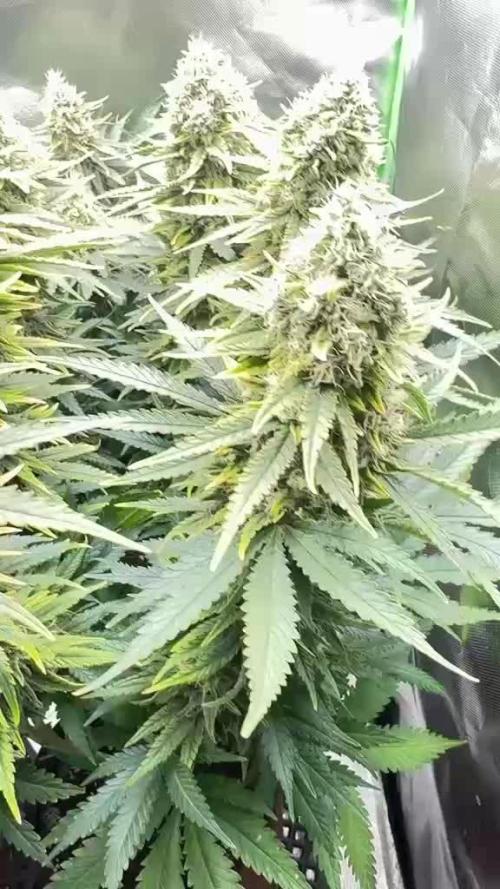
Den 69. Den 42. květu. Tento týden holky ještě pěkně dorostly, ale poslední tři dny už je vidět, že se růst postupně zastavuje a rostliny se soustředí hlavně na zrání a nabírání objemu palic.
Malý a velký Critical Orange Punch vypadají jako dvě úplně odlišné kytky, a to nejen vzhledem, ale i výnosem a vůní. Menší má krásně zbarvené oranžové pestíky a příjemnou sladší vůni. U toho většího jsem musel svázat korunu dohromady, aby se pod tíhou palic nelámaly větve. Manipulace už je docela o nervy, protože ty palice jsou opravdu těžké.
Frozen Biscotti má taky velmi pěkný výnos a palice začínají přecházet do fialových odstínů. Vůně se od minulého týdne zase posunula, cítím v tom zázvor a sladký podtón, připomíná mi to jemné zázvorky. Opravdu zajímavý profil a těším se na výsledek.
Trichomy se začínají pěkně kalit, zatím bych řekl půl na půl mléčné a čiré, jantarové jsem zatím moc nezaznamenal spíš jen na listech.
Na rostlinách je vidět lehké přehnojení, hlavně na sugar leaves, ale zároveň palice krásně nabobtnaly, takže už do toho nebudu nijak zasahovat a nechám to v klidu dojet. Teď už nemá smysl dělat větší změny.
Aktuálně se soustředím hlavně na stabilní podmínky, hlídám teplotu a vlhkost, aby všechno doběhlo bez problémů až do sklizně.

Likes
2
Share


@PapasGrow
Follow
CBD Compassion Lime Auto 🏥🍋
Your passion, Our Passion, Dutch Passion... 😸
Growing in Mars Hydro tent (3x3) ⛺
with Mars Hydro FC 3000 🚀
She is unfortunately flowering on 12/12 light cycle with photoperiod plants, but despite that she is doing fantastic. Smells like sweet citrus.
Moved out of tent for final few weeks.
Week 11 ✅

Processing
Likes
3
Share


@macrocefalo
Follow
Eight weeks of flowering I raised the PH to 6.3 and the plants that showed phosphorus deficiency no longer presented the problem, the absorption must have improved since the fertilization was the same. But as not everything is wonderful in this life in the last week here in the city where I live we had a great cold front 10º C. Inside the grow the temperature varied at least 13.5ºC during the night and light off and 20º during the day with the light on, the cold always stops growth but the formation of buds is going well apparently. Definitely plant # B3 is either photoperiod or locked, it has white pistils on the stem indicating pre-flowering but even before entering the flowering period I don't know what to do lol.
Likes
26
Share


@ButterfliesLittleFarm
Follow
Hello Diary.
The third week of flowering and a total of six weeks is behind us. 💪
Hulkberries grow nicely, the flowers get bigger and bigger, full of trichomes. Hulkberry # 1 is more branched than the others and it seems to me that it also has more flowers so it will definitely give a higher yield. 😋
Even though I did a little defoliation last week there is still a big jungle on my little farm.
Their roommate Green Gelato is in the middle between them and seems small compared to the Hulkberries, which definitely dominate in size. The Hulkberry # 2 has reached a height of 115cm and it is just above the maximum that my farm can allow given the height. It doesn’t look like it’s going to grow any more which is a big relief. That's why I had to adjust the light to them so that the Gelato is further away from the light than it should be. But unfortunately I can’t do otherwise, I hope it doesn’t affect him too much.
What is a little worrying is the humidity in the air which is higher than I would like, I put two circular fans and a large exhaust fan I put on maximum, but the humidity doesn’t drop. The temperature is also high in the box, hovering around 28 degrees but sometimes rising to 29 degrees or even more, but the plants are genetically predisposed to a warmer climate so hopefully by the end everything will be fine.
Although I have already mentioned this, my farm is in a small room in the apartment, and the weather conditions outside also affect the conditions in that small room. Given this hot summer and heavy rains, it’s no wonder the climate in the box.
Let’s take a look at what this week looked like.
24/07/2020 - Day 36.
Watering. This time I only added CalMag from GHE, I didn’t add BioBizz harn. I still regulated the water at p.H 6.5 with Plagron’s, Lemon Kick. Each time I prepare 7 lit. water and with that I water all three plants evenly.
28/07/2020 - Day 40.
Watering. In 7 lit. water I added BioBizz and adjusted p.H to 6.5.
As for BioBizz, I’ve added the full palette scheduled for Week 6.
30/07/2020 - Day 42.
Photography and Watering. Given the height, it’s hard for me now to take the plants out of the box to take satisfying photos, so I didn’t paint them on a black background this week. After the photo shoot, I watered the plants with the addition of BioBizz.
Hulkberry Auto # 1 - Day 35. - 99cm
Hulkberry Auto # 2 - Day 35. - 115cm
That's all for this week. See you soon.

Likes
34
Share


@AbroCadabro
Follow
I just added weeks 5 and 6 into one week because I didn't really have time to post last week.
There seems to be a problem with my plants that I can't quite figure out. The only commonality that I changed with both plants since the last grow is the microbe Inoculant that I bought from NPK. The Black Afghan that I harvested back in November didn't have these microbes added to the soil and it grew into a monster. I am beginning to wonder if these microbes are stealing food from my plant. Even though these microbes are sold as "flowering" microbes. I'm beginning to think they are starving my plants.
Also, I am technically 7 weeks from the flip to 12/12. So I may just be at the end of the flower period for these plants. I checked the Tricomes and they are mostly cloudy with about 5-10% amber. Normally at this point I would be cutting out the nutrients and letting her consume her leaves. However, she has already started to so that and now I don't know what to do. I just don't know. So... lesson learned. Stick to the basic nutes and stop trying to make this job harder than it needs to be. KISS

Likes
55
Share


@Ultraviolet
Follow
What's in the soil? What's not in the soil would be an easier question to answer. 16-18 DLI @ the minute. +++ as she grows.
Probably not recommended, but to get to where it needs to be, I need to start now.
Vegetative @1400ppm 0.8–1.2 kPa 80–86°F (26.7–30°C) 65–75%, LST Day 10, Fim'd Day 11
CEC (Cation Exchange Capacity):
This is a measure of a soil's ability to hold and exchange positively charged nutrients, like calcium, magnesium, and potassium. Soils with high CEC (more clay and organic matter) have more negative charges that attract and hold these essential nutrients, preventing them from leaching away.
Biochar is highly efficient at increasing cation exchange capacity (CEC) compared to many other amendments. Biochar's high CEC potential stems from its negatively charged functional groups, and studies show it can increase CEC by over 90%. Amendments like compost also increase CEC but are often more prone to rapid biodegradation, which can make biochar's effect more long-lasting. biochar acts as a long-lasting Cation Exchange Capacity (CEC) enhancer because its porous, carbon-rich structure provides sites for nutrients to bind to, effectively improving nutrient retention in soil without relying on the short-term benefits of fresh organic matter like compost or manure. Biochar's stability means these benefits last much longer than those from traditional organic amendments, making it a sustainable way to improve soil fertility, water retention, and structure over time. Needs to be charged first, similar to Coco, or it will immobilize cations, but at a much higher ratio.
a high cation exchange capacity (CEC) results in a high buffer protection, meaning the soil can better resist changes in pH and nutrient availability. This is because a high CEC soil has more negatively charged sites to hold onto essential positively charged nutrients, like calcium and magnesium, and to buffer against acid ions, such as hydrogen.
EC (Electrical Conductivity):
This measures the amount of soluble salts in the soil. High EC levels indicate a high concentration of dissolved salts and can be a sign of potential salinity issues that can harm plants.
The stored cations associated with a medium's cation exchange capacity (CEC) do not directly contribute to a real-time electrical conductivity (EC) reading. A real-time EC measurement reflects only the concentration of free, dissolved salt ions in the water solution within the medium.
98% of a plants nutrients comes directly from the water solution.
2% come directly from soil particles.
CEC is a mediums storage capacity for cations. These stored cations do not contribute to a mediums EC directly.
Electrical Conductivity (EC) does not measure salt ions adsorbed (stored) onto a Cation Exchange Capacity (CEC) site, as EC measures the conductivity of ions in solution within a soil or water sample, not those held on soil particles.
A medium releases stored cations to water by ion exchange, where a new, more desirable ion from the water solution temporarily displaces the stored cation from the medium's surface, a process also seen in plants absorbing nutrients via mass flow. For example, in water softeners, sodium ions are released from resin beads to bond with the medium's surface, displacing calcium and magnesium ions which then enter the water. This same principle applies when plants take up nutrients from the soil solution: the cations are released from the soil particles into the water in response to a concentration equilibrium, and then moved to the root surface via mass flow.
An example of ion exchange within the context of Cation Exchange Capacity (CEC) is a soil particle with a negative charge attracting and holding positively charged nutrient ions, like potassium (K+) or calcium (Ca2+), and then exchanging them for other positive ions present in the soil solution. For instance, a negatively charged clay particle in soil can hold a K+ ion and later release it to a plant's roots when a different cation, such as calcium (Ca2+), is abundant and replaces the potassium. This process of holding and swapping positively charged ions is fundamental to soil fertility, as it provides plants with essential nutrients.
Negative charges on soil particles: Soil particles, particularly clay and organic matter, have negatively charged surfaces due to their chemical structure.
Attraction of cations: These negative charges attract and hold positively charged ions, or cations, such as:
Potassium (K+)
Calcium (Ca2+)
Magnesium (Mg2+)
Sodium (Na+)
Ammonium (NH4+)
Plant roots excrete hydrogen ions (H+) through the action of proton pumps embedded in the root cell membranes, which use ATP (energy) to actively transport H+ ions from inside the root cell into the surrounding soil. This process lowers the pH of the soil, which helps to make certain mineral nutrients, such as iron, more available for uptake by the plant.
Mechanism of H+ Excretion
Proton Pumps: Root cells contain specialized proteins called proton pumps (H+-ATPases) in their cell membranes.
Active Transport: These proton pumps use energy from ATP to actively move H+ ions from the cytoplasm of the root cell into the soil, against their concentration gradient.
Role in pH Regulation: This active excretion of H+ is a major way plants regulate their internal cytoplasmic pH.
Nutrient Availability: The resulting decrease in soil pH makes certain essential mineral nutrients, like iron, more soluble and available for the root cells to absorb.
Ion Exchange: The H+ ions also displace positively charged mineral cations from the soil particles, making them available for uptake.
Iron Uptake: In response to iron deficiency stress, plants enhance H+ excretion and reductant release to lower the pH and convert Fe3+ to the more available form Fe2+. The altered pH can influence the activity and composition of beneficial microbes in the soil. The H+ gradient created by the proton pumps can also be used for other vital cell functions, such as ATP synthesis and the transport of other solutes. The hydrogen ions (H+) excreted during photosynthesis come from the splitting of water molecules. This splitting, called photolysis, occurs in Photosystem II to replace the electrons used in the light-dependent reactions. The released hydrogen ions are then pumped into the thylakoid lumen, creating a proton gradient that drives ATP synthesis.
Plants release hydrogen ions (H+) from their roots into the soil, a process that occurs in conjunction with nutrient uptake and photosynthesis. These H+ ions compete with mineral cations for the negatively charged sites on soil particles, a phenomenon known as cation exchange. By displacing beneficial mineral cations, the excreted H+ ions make these nutrients available for the plant to absorb, which can also lower the soil pH and indirectly affect its Cation Exchange Capacity (CEC) by altering the pool of exchangeable cations in the soil solution.
Plants use proton (H+) exudation, driven by the H+-ATPase enzyme, to release H+ ions into the soil, creating a more acidic rhizosphere, which enhances nutrient availability and influences nutrient cycling processes. This acidification mobilizes insoluble nutrients like iron (Fe) by breaking them down, while also facilitating the activity of beneficial microbes involved in the nutrient cycle. Therefore, H+ exudation is a critical plant strategy for nutrient acquisition and management, allowing plants to improve their access to essential elements from the soil.
A lack of water splitting during photosynthesis can affect iron uptake because the resulting energy imbalance disrupts the plant's ability to produce ATP and NADPH, which are crucial for overall photosynthetic energy conversion and can trigger a deficiency in iron homeostasis pathways. While photosynthesis uses hydrogen ions produced from water splitting for the Calvin cycle, not to create a hydrogen gas deficiency, the overall process is sensitive to nutrient availability, and iron is essential for chloroplast function.
In photosynthesis, water is split to provide electrons to replace those lost in Photosystem II, which is triggered by light absorption. These electrons then travel along a transport chain to generate ATP (energy currency) and NADPH (reducing power). Carbon Fixation: The generated ATP and NADPH are then used to convert carbon dioxide into carbohydrates in the Calvin cycle. Impaired water splitting (via water in or out) breaks the chain reaction of photosynthesis. This leads to an imbalance in ATP and NADPH levels, which disrupts the Calvin cycle and overall energy production in the plant. Plants require a sufficient supply of essential mineral elements like iron for photosynthesis. Iron is vital for chlorophyll formation and plays a crucial role in electron transport within the chloroplasts. The complex relationship between nutrient status and photosynthesis is evident when iron deficiency can be reverted by depleting other micronutrients like manganese. This highlights how nutrient homeostasis influences photosynthetic function. A lack of adequate energy and reducing power from photosynthesis, which is directly linked to water splitting, can trigger complex adaptive responses in the plant's iron uptake and distribution systems.
Plants possess receptors called transceptors that can directly detect specific nutrient concentrations in the soil or within the plant's tissues. These receptors trigger signaling pathways, sometimes involving calcium influx or changes in protein complex activity, that then influence nutrient uptake by the roots. Plants use this information to make long-term adjustments, such as Increasing root biomass to explore more soil for nutrients. Modifying metabolic pathways to make better use of available resources. Adjusting the rate of nutrient transport into the roots. That's why I keep a high EC. Abundance resonates Abundance.
Likes
19
Share


@Sublyme_ness
Follow
this plant has a tendancy to throw out lime green leaves which throws you off a bit.. its quite a sensitive plant to ph im thinking. make sure you get the soil right. given the sheer density of buds it wants to grow on the colas i would suggest that its best to use a big light on this plant and if you are going to scrog properly space the budsites otherwise it just forms one big clump of buds in small plants.. hard to get light to everywhere.. genetics wise though damn! very quick vigorous growth, chunky looking white pistils, and looooooots of leaf production. thanks california and fastbuds


Likes
52
Share


@Krisis
Follow
04/14/25. Start of week 7 flower.
Love. That’s all I have this update.
Okay.. that and I think this lady is really close to being done. Going to check trichs today.
Meanwhile my guess is just water from here on.
Likes
4
Share


@Crusty_Juggler
Follow
60x60 cm tent in a 1920's peek-in-closet
Oversized vent for silence
High power DIY LED
True SoG 12/12 from seed with 15 plants in 2L pots
Watering all plants in bottom tray with 30% of total pot size (10L)
WEEK 1
DAY 1 - Germinated in paper towel
DAY 3 - Planted into pots + Lights ON at 125w
DAY 5 - All plants have broken soil
DAY 7 - Slight stretch - Light at 185w
WEEK 2
Two of the Iced Out are lagging behind, others are on point - I'm trying to push light and nutes to the max.
Extraction fan (AC infinity Cloudline T6) on level 2.
DAY 13 - First full watering (10L) with 20 ml Canna Terra Vega
DAY 14 - Circulation fan turned on (low) during lights on
WEEK 3
Good growth, two Iced Out still lagging
DAY 18 - Light at 225w, Extraction fan on level 3 during lights on
DAY 20 - 2nd watering, 8L with 30ml Vega + Light at 250w
DAY 21 - On point, mostly :) Could've pushed nutes a bit more from the go
WEEK 4
DAY 24 - So far this week I'm just kicking back and watching them do their thing. The two lagging Iced Outs are trying to catch up.
DAY 26 - Watering 10L with 50 ml Vega (one day too late...) + light on 300w (max)
DAY 28 - 4 weeks from popping the seeds, looking good except for the two Iced Outs, one of them is trying to get with the program, the other... Well, some plants are just pricks.
WEEK 5
I think this is the week we'll see them take off :)
DAY 29 - Plants are starting to show sex, removed 2 Urkle Mints males, the other two are females, the rest are fems so we're down to 13 female plants total with only a single weakling
DAY 29 - Watering 8L with 50ml Vega (shouldn't have been later than today!)
DAY 33 - plants exploded over the last 4 days and most are stretching and starting to flower
DAY 33 - Watering 10L with 60ml Vega (feeding Vega once or twice more then we switch to Flora)
DAY 35 - Just cruisin' 😎



Likes
3
Share

@Gympaddy
Follow
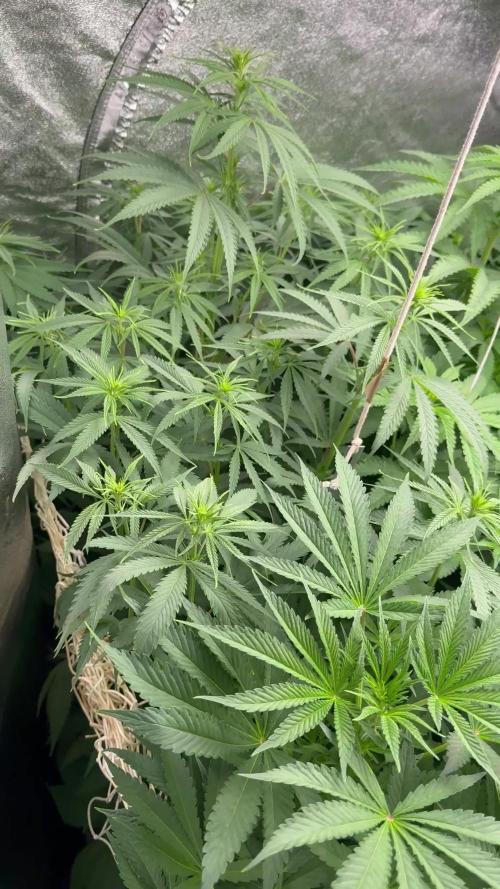
The ladies are growing like crazy... I don't mind, but it's time I tidied up a bit next week... I think quite a bit of foliage will have to go.


Likes
19
Share


@Naturalist
Follow
Just fed AgroThrive Organic Fertilizer - Fruiting & Flowering on Chemdawg on day 88, straight water on the rest PPMs are still high at 2914 average with acid run offs of 5 but plants look pretty good the CD looked hungry so fed it the PPM on it prior was the lowest of the 6.
I ordered a High CFM Kit so I can get some of my space back, as is my 5x5 is more of a 4x4 & I could use the space right now.


Likes
17
Share


@olli0420
Follow
The roots look super healthy. I'm happy because I didn't use quality soil for germination 😬 I guess it worked because I used like 90% perlite and 10% poor quality soil which worked great for new little roots. So much so that they wanted to be repotted after 2 weeks😁
after the repot they looked very much happy 💚 I repotted with biobizz light mix soil and a lot of perlite,as much perlite as soil cause I'm afraid of root rot and it just works for me🖤 also I still haven't given any nutrients cause they don't seem to want them yet.

Likes
12
Share


@MadeInGermany
Follow
Hey guys :-)
This week the lady was watered 3 times with 1 l each time. ( Nutrients see table above )
It is developing well and will soon be in bloom 😃.
Apart from that, everything was cleaned in a controlled manner and osmosis water was treated.
Stay healthy 💚🙏🏻
👇🏼👇🏼👇🏼👇🏼👇🏼👇🏼👇🏼👇🏼👇🏼👇🏼👇🏼👇🏼
You can buy this Nutrients at :
https://greenbuzzliquids.com/en/shop/
With the discount code: Made_in_Germany you get a discount of 15% on all products from an order value of 100 euros.
👇🏼👇🏼👇🏼👇🏼👇🏼👇🏼👇🏼👇🏼👇🏼👇🏼👇🏼👇🏼
Water 💧 💧💧
Osmosis water mixed with normal water (24 hours stale that the chlorine evaporates) to 0.2 EC. Add Cal / Mag to 0.4 Ec Ph with Organic Ph - to 5.8 - 6.4
MadeInGermany

Processing
Likes
14
Share


@kevgrow
Follow
Hey friends, end of week 4 from seed :)
- I had to transplant plant #2 from a 2 gallon pot to a 5 gallon fabric pot because roots were coming out from the 2 gallon pot, I began noticing some change in the color on leaves so I immediately decided to make the change.
- Plant #2 still hasn't revealed its gender to me, I can't figure it out because I see small pistils all around the leafs but there is just one area on the main stem with to very small round balls. I am hoping pistils come out from these balls as it did on other parts of the plant.
- Thinking of purchasing a bigger tent, I feel this one will fall short once this plant matures. I might leave it another 1-2 weeks in vegetative stage.
- Trimmed some leaves
- Performed some LST on plant #2
Likes
4
Share


@Weedhi_75
Follow
Voy a tener que cortar para tener aireación, apareció hongo, 30%de la planta se va de ✂️ Se ve tricomas dorados en las hojas de los cogollos 🍻

Likes
4
Share


@Big0zGrower420
Follow
Day 35 today. Still pushing forward and enjoying the process. Lowered the humidity in the tent, gotta have the AC on full blast though. Nutrients have been a challenge but getting things worked out and staying positive.

Likes
8
Share


@ZanderZone777
Follow
It's week 9 of flower and she's been fed her last bit of nutrients. I'll start flushing with BushDoctor's SledgeHammer 2 tsp a gallon. Then just straight water until the chop :)
Likes
5
Share


@eldruida_lamota
Follow
Que pasa familia, vamos con la cuarta semana de floración de estas Papaya Zoap F1 de Sweetseeds.
Vamos al lío, me quede con 3 por espacio, siempre pongo alguna semilla de más por si no abriese alguna por no perder ese hueco del indoor.
También se trasplantaron a su maceta definitiva, en este caso de 7 litros.
Y también superaron el shock por el trasplante se recuperaron 100%.
El ph se controla en 6.2 , la temperatura la tenemos entre 20/22 grados y la humedad ronda el 50%.
El fotoperiodo esta a 12/12 para floración. Las jodidas estiraron bastante, y es algo que no me gusta de todas las F1, que cultive hasta ahora.
Hasta aquí todo, Buenos humos 💨💨💨