Likes
Comments
Share
@Wilstang
Follow
IPM https://www.arbico-organics.com/product/mite-predator-phytoseiulus-persimilis-plus-sachets/mite-predators https://www.arbico-organics.com/product/spidermite-destroyer-stethorus-punctillum-adults-larvae/pest-solver-guide-mites
Likes
5
Share
Chopped on day 62, danky, earthy, slight gassy smells. Rock solid buds.
Likes
87
Share
@ClubRiot
Follow
Zkittlez Feminized by Club Riot Seeds ( www.clubriotseeds.com ) Week 1 0.5L Pot LED: MIGRO 200 (210W) for Veg. Stage Canna COCO Seeds are put at germinated in wet paper towels for 72 hours Name: Zkittlez Feminized Genetic: Grape Ape x Grapefruit Type: Feminized ( Indica Strain ) Indoor Yield: 80 ~ 140 grams/plant ( 15L Pot ) with LST growth technique. Indoor Height: 70 ~ 110 cm THC: Very High CBD: Low Flavour: Grape , Sweet , Berry . Effect: Relaxed , Happy and Euphoric.
Processing
Likes
10
Share
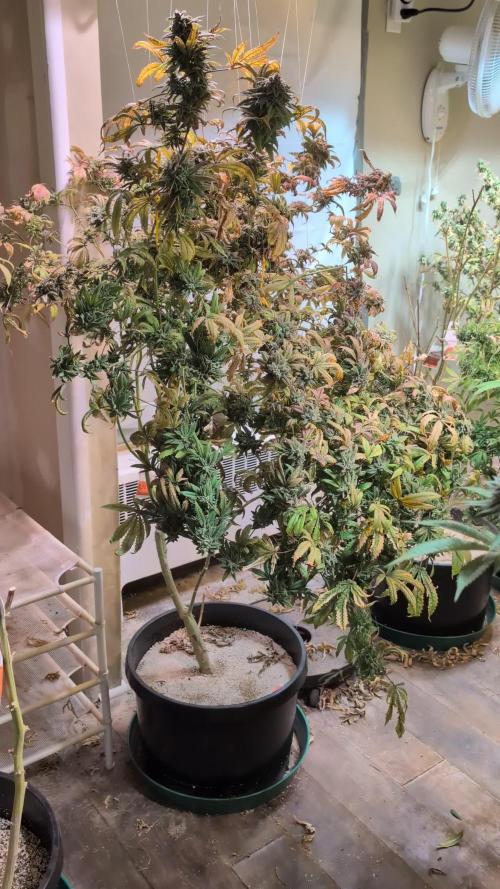
The mephisto is has bounced back and pushing hard. All the plants still have a high runoff but has been pushing hard this last week or so. Ph run off has been around 7.6 from around 8.4ph😬😬 I kinda gave up on the freeze berry but I started checking it out and I didnt notice how well the branching is on that plant and how frosty it is. the freeze berry has been getting set up nicely hoping it fills out nicely because the branching and spacing on that one is not too shabby I'm not sure wth is going on with the big bomb that one decided to just grow like a bush real fast and has soo many bud sites but is flowering super slow.. I started all the seeds at the same time except the mephisto is about a week or two younger than the rest. The crystal meth is about ready I'm going to start flushing that here sometime this week when I get my new ph pen.
Processing
Likes
28
Share
@Salgeezi
Follow
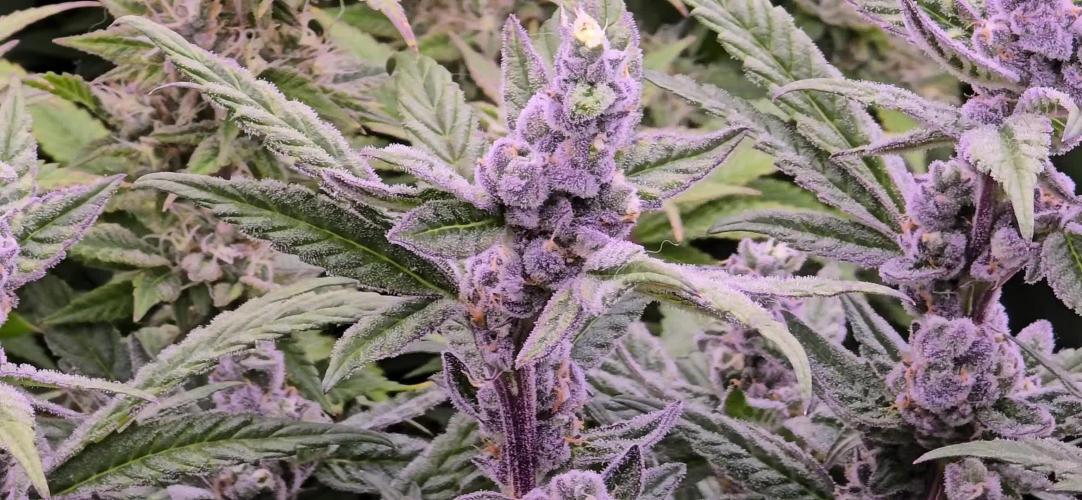
Kinda worried the buds are showing lots of cloudy trichromes and on sugar leaves I am seeing amber. Bud Structure and the way they are still taking their feedings are telling me otherwise. So Im guna keep on trucking. My grows flowering times are never what breeder says too, always longer. Forgot to mention at the start of week 5 I added full tilt by floraflex aswell. Also started watering 8x a day with lights on. One time at lights off. At about 160ml each feeding with about 40-50ml runoff. These small pots are all roots and I feel the high frequency waterings are necessary to keep the runoff EC levels down Wattage 170 EC 700 Humidity 58 Temp 78
Likes
16
Share
@Mrg7667
Follow
Day 15 of flower! Kinda goofed this week i gave the babies week two nutes after the last post wich was like day 10 and i noticed a little bit of nitrogen over dose. I think the Powersi is also helping nutrients absorption! So i actually did this week a little different then i planned just cut the bio bloom in half because i didnt realize the powersi npk ratio inceases p and k Havent seen anymore aphids might do another couple sprays to be safe. Grow safe allows full spray through flower
Likes
29
Share
@Grey_Wolf
Follow
Testing for Connoisseur genetics Outback haze #1 7th March 2022 Welcome to week 23 😀 Both of these ladies are looking fantastic as they progress into the blooming stage 💪 Absolute monster on the left is my favourite of the two but the other isn't too bad either . Neither have needed any feeds with the soil providing plenty of nutrition at this stage. 100% sativa's or in this case haze are fairly low maintenence when it comes to feeding . chuck in some manure or something ( I am using guano ) and they will happily grow along nicely . Did you know that Connoisseur genetics are looking for new testers for their newest strains?? to be considered you just need to have had a few diaries with harvests Thanks once again for stopping by 👍 *****Major Update 10th March ***** Plant two developed ball sacks along with her pistils so unfortunately I had to pull her out and destroy the plant. I know some people might think I could have tried removing the sacs and giving the plant a chance . But I am trying to make myself some F1 hybrids and do not want any Hermies anywhere near my females . Now because this strain has Thai genetics there is always that chance they throw "nanners" but usually later in flower so for this one to show itself right on the start of flowering is enough for me to pull it , burn it with fire . Or in this case I'm gonna let the sun solarise it and then it'll be mulched with other plant materials from my garden.
Likes
13
Share
Harvesting in a few days! She’s ready! Purple Punch is more like pinesol! Very earthy piney aroma—- guess it’s perfect for Christmas! Considering this is a solo grow, I’m very happy with the bud quality! Must be that dynomyco! ✌️💚🌿💨
Likes
22
Share
@ZinosBest
Follow
So the second week started and I start with grow technique and try to bend down the main line to give more light for the lower sights may increase the yield and potency. Definetly try to make several main colas and If it will be necessary I will use some ScrOG method too. I will update the second week in the second part of the week with more photos about how they reacting the start of the LST. After the natural grow style this is definetly more work and care but I really enjoy to make work with her. UPDATE #1: Start to give more nutrients. Enchanced root developers, high dose, vitamins, hormones, everything. Bend down her allday-everyday, like every 4-6 hours. I updated some pictures and videos before the week II second part. This next weeks crucial about the LST, so try to maximize the observation and acting fast if it is neccessary. Even cutted down 1-1 fan leaves because they blocked the light way so I think this will also maximize the reach of the light. Definetly exicting.
Likes
26
Share
Day 17 17/07/24 Wednesday De-chlorinated tap water pH 6 with calmag 5ml -5L. Very humid week, noticed a green turning colour on top of soils where the humidity has been far to high. I have installed door netting and recently left open all day and night now so they can condition over night in colder temps. All are doing well, one overdose slightly behind and looking ABIT swifted. But she'll come around 💪💚 Day 19 19/07/24 Friday Lite Feed today, 250ml each pot small run off. Seeing excellent start to these babies. Let's get it 👌💚 Day 21 21/07/24 Sunday De-chlorinated tap water pH 6 with calmag 5ml to 5L. Watering in 1L each day from now. Updated video
Likes
107
Share
This lady got a good lust for life🌲, I've topped her earlier this week and she keeps shooting out new ones like it's nothing. I made a little peak to see how I handle this lady💚👨‍🌾. Still only water and sometimes adding some Aptus 🌊💦
Likes
2
Share
Got back from 2 weeks holiday and immediately lollipopped and defoliated all 4 plants heavly. Will wait a few days for them to recover from the battering I gave them before flipping to 12/12. This plant is at the back of the 4 in the timelapse.
Likes
19
Share
@Hashy
Follow
******************************************** Week 10 mid flower (week 6 flower) ******************************************** Light cycle=12/12 Light Power=140w 59% Extractor controller settings (during lights on). High temp= 26c Temp step=0c High Rh= 48% Rh step=0% Speed max=10 Speed min=3 Extractor controller settings (during lights off). High temp= 20c Temp step=0c High Rh= 53% Rh step=0% Speed max=10 Speed min=3 Smart controller settings (during lights on). Lights on=9.00am Radiator on= -19.0c Radiator off=+19.5c Smart controller settings (during lights off). Lights off=9.00pm Radiator on=-18.0c Radiator off=+18.5c VPD aim=0.9-1.4 DLI aim=35-40 EC aim=0.8-1.6 PH aim=6.0-6.5 💧💧💧💧💧💧💧💧💧💧💧💧💧💧💧💧 NPK= 8-17-26 Method= Automatic Feed=Flower nutes Neutralise=0.1ml/L Plagron bloom=4ml/L Plagron Power buds=1ml/L Green Sensation=1ml/L Easy Ph down=0ml/L (1ml=24 drops, 1 drop=0.04ml) Easy Ph Up=0.021ml/L (1ml=24 drops, each drop is 0.04ml) Ec=1.55 PH=6.2/6.0 Runs=8 Run times=3mins (0.75L/0.375L each) Gap times= 17mins Total runtime=24mins(6.0L/3.0L each) Total flowrate= 0.25L/min(0.125L/min each) Auto start time=10.00am Auto stop time=12.23pm 💧💧💧💧💧💧💧💧💧💧💧💧💧💧💧💧 ******************************************** ******************************************** 📅12/4/25 Saturday(Day 64) 📋 Away 📅13/4/25 Sunday(Day 65) 📋 Away 💧 Automatic Flower nutes Ec=1.5 PH=6.3/6.0 Volume=20L Volume left=14L (est) Volume used=6.0L(0.25L/min) Volume each=3.L(0.125L/min) Runoff. Total runoff=L Ec= PH=/ 💧 📅14/4/25 Monday(Day 66) 📋 Away 📅15/4/25 Tuesday(Day 67) 📋 Away 📅16/4/25 Wednesday(Day 68) 📋 Away 📅17/4/25 Thursday(Day 69) 📋 Away 💧 Automatic Flower nutes Ec=1.5 PH=6.3/6.0 Volume=14L (est) Volume left=8L (est) Volume used=6.0L(0.25L/min) Volume each=3.L(0.125L/min) Runoff. Total runoff=L Ec= PH=/ 💧 📅18/4/25 Friday(Day 70) 📋H=70cm D=41cm Dli=28.2 PPFD=653 Arrived home before lights out. ******************************************** Weekly roundup. 📋 I came home sooner then I thought, the autofeed used slight more then I calculated. 💧 Data for when I was away. Volume left=7L Volume used when away=13L(0.27L/min) Volume each=6.5L(0.135L/min) Runoff. Total runoff=L Ec= PH=/ 💧 Considering she's been autopilot all week she looks fine. Pumping out pistils. Back soon. Take it easy. ********************************************
Likes
6
Share
@EKWCR
Follow
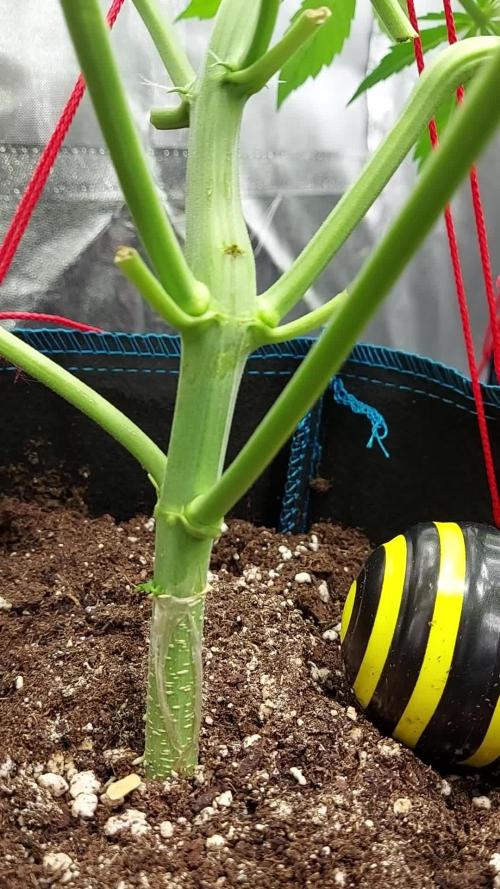
I attempt to do an early SCROG but the plants are already too rigid for that, so i will train the branches and the trunk slowly to soften the tissues. My objectif is to do a U SCROG.
Likes
20
Share
@VnknowN
Follow
Not a verry good grow at all. I will try to use a scrog net in the Future…:/
Likes
31
Share
@TacoKart
Follow
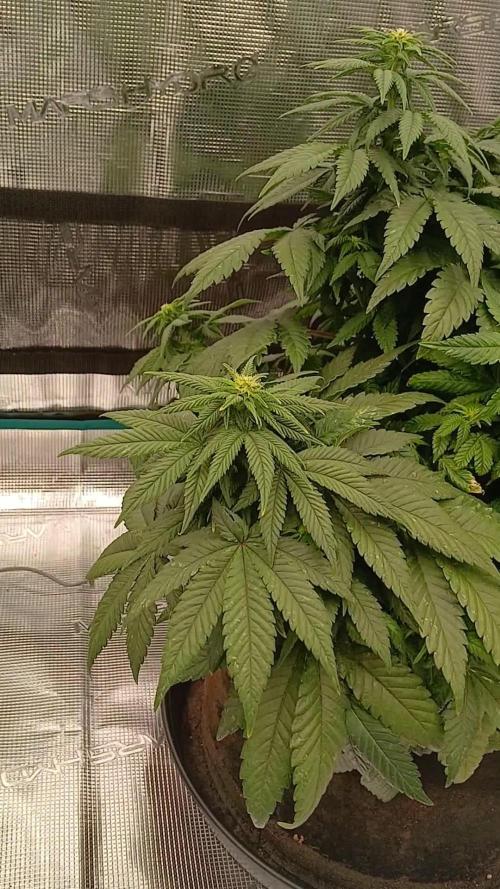
They were started all around the same time but the zkittlez seems to be the runts of the grow. Can't get them to bush out as good as the sour grape kush. Going to be adding a second light so its more even coverage. They are leaning more than Id like to the middle. Id rather train them in the directions I want so even light coverage coming the from top with a new light should help. Noticed spotting caused by calcium deficiency and supplemented water with calmag and it seems to helping, Also did first top on one of the sour grape kush plants.
Likes
2
Share
67 days since April 16th, 2026 We become aware at such times of man's wonderful ability to bring seemingly unrelated elements into harmonic balance, and receive a glimpse into a world where everything exists in conscious sympathetic attunement to everything else. When we listen to a piece of music that seems to strike a beautiful chord somewhere inside us, or view a painting that simply glows with harmonic awareness well executed, we probably do not spare much time to contemplate the wonderfully intricate combination of vibrations that our sensors make it possible for us to perceive. We tend to appreciate the relationship between the parts of something by an awareness of the harmony or dissonance of the whole. This ability enables us to say "what a beautiful house!" instead of "analysis has proven that this collection of building materials exhibits certain elements of harmonic proportion." While this ability to instinctively appreciate the beauty of true harmony has an important role to play in evolution, a more analytical understanding of the laws involved can be most useful. This is especially so if we wish to create works of art where each part exists in true harmony, not only with the other part of that particular whole, but with the universe within which the creator and the created exist. Everything vibrates. From the most dense matter to the most subtle cosmic rays, everything which our senses allow our thoughts to become aware of, can be specified in terms of wavelength or frequency of vibration. These two terms define the same thing, but from different points of view. The following are the approximate wavelengths of various energy carriers: Cosmic rays 0.000,000,001 mm Gamma rays 0.000,000,1 mm X rays 0.000,500 mm Ultraviolet rays 0.003 mm Visible light 0.006 mm Infrared 0.01 mm Sound waves 1 meter Radio waves 300 meters Violet light 400 nm to 450 nm Blue light 450 nm to 500 nm Green light 500 nm to 570 nm Yellow light 570 nm to 590 nm Orange light 590 nm to 610 nm Red light 610 to 700 nm 1 nanometer (nm) = 0.000,000,1 cm = 1/10,000,000 cm If a guitar string is plucked and we hear a sound, it is not too difficult for the human mind to associate this sound with the vibration of the guitar string. With color it is quite different. It is difficult for us to conceive that the color of a substance is not an inherent property of the substance itself, but an indication picked up by our senses of that substance's ability to absorb or reflect the light which happens to be shining on it at that moment. Neither the matter nor the light is colored. What happens is that the brain learns to differentiate between the frequencies reflected or transmitted by the substance the eyes are focused on. The same thing happens with sound. When we say "Oh! Listen, they're playing my favorite song," what we really mean is: "My brain has stored within it a particular pattern of frequencies. I have compared the new information being received with this stored pattern and have deduced the answer that the two patterns are similar within certain specified tolerances." The 'pleasure' involved could have something to do with our running the pre-recorded pattern at the same time, in 'sympathy' with the new pattern as it is received. The word sympathy describes very well our ability to appreciate color and sound. It also describes the reason behind certain elements of harmony. For instance, if a substance vibrating at 100 cycles per second (tone 1) is in the proximity of another substance vibrating at 200 cycles per second (tone 2), we could perceive, if we had the right equipment, a certain sympathetic relationship between the two. We will see from this that there is a uniform doubling of the first tone seen in the second. At various points along the waves, the two are the same in amplitude. At other points, they are at opposite poles to each other. This doubled frequency has more points of similarity to the original than any other frequency except the original itself. If the equipment we had available for measuring these two frequencies was a soundboard amplifier and a pair of ears, then we would hear what would sound to us like one tone. If we had the opportunity to hear one at a time, we would hear that although they sound the same, one is higher in pitch than the other. This characteristic of 'the same but different in pitch', musicians have called the octave. Any two tones produced where one has exactly doubled the frequency of the other is called an octave. Speaking in ratios, an octave would appear then as the ratio 2:1 or 1:2, depending on whether we are talking of an octave up or down. A single note produced by almost any instrument will contain more than one wavelength or frequency. It will have a dominant frequency, the wavelength of which we would call the note's 'fundamental' or 1st harmonic. It will also have a varying number of upper harmonics, gradually fading in intensity into infinity or silence. Natural harmonics always have the same pattern of intervals between them. The interval between the 1st and 2nd harmonic is a perfect octave; between the 2nd and 3rd a perfect fifth; between the 3rd and 4th a perfect 4th; and so on, the intervals becoming smaller and smaller until they lose any relationship with the western 12 tone scale as it exists at the moment. Just as an octave has certain elements of sympathy with its fundamental, so some intervals have been noted to be more perfectly in sympathy with the fundamental than others. The ratio of the 'perfect 5th' or interval of 7 semitones, as it occurs in the harmonic series, is 3:2 or 2:3, while that of the 'perfect fourth" is 4:3 or 3:4. All the tones in the western 12 tone scale can be expressed in terms of the ratio between the upper tone and its fundamental. This would seem to be an ideal way of generating a scale from any given fundamental and several attempts have been made to do this, the Pythagorean system being probably the most well known. Although when working with a single tone instrument playing on its own, the Pythagorean formula works wonderfully well, if we had several instruments tuned this way together and asked them to play almost any western music, we would find that at times they sounded quite out of tune to each other. The lack of flexibility of the various scale systems based on the harmonic series has led to what is known as the 'tempered' scale. This uses as its primary unit of interval the ratio of the octave or 2:1. It then proceeds to divide the interval between any fundamental and its upper octave into 12 smaller intervals by applying the ratio: two to the one-twelfth power, to one (21/12:1). This equals 1.059463094, so by multiplying any frequency by this number, we will obtain the tempered semitone next up from our fundamental. We will also find that any tone twelve semitones up from any other tone, in a scale generated in this way, will have exactly double the frequency. If we took the note middle C on a piano and halved the wavelength, we would have the note C one octave above. If we halved this, we would have the C above, and so on. However, within about 6 octaves, we would find that although a 'sound' was being produced, no human ear could perceive it. If we kept on going, halving and producing upper octaves of our fundamental C, we would proceed through the infrared band, into the visible light spectrum. If we happened to be outside during the day, we would, for one octave only, see the note C with our eyes. The next octave above would already be in the ultraviolet band, and outside the eye's sensitivity range. If we can think of color as being an indication of a substance's vibratory rate or wavelength, we may begin to see a relationship that could exist between the color and sound spectrums. The logical extension of what has so far been said is that there exists a scale in the color spectrum that corresponds exactly to the scale in the sound spectrum, each color tone being an octave of the equivalent note in the sound range. This is not the end of the story but only the beginning. If we can for the moment accept that any wavelength in one band has upper and lower octave stretching out to infinity, then the next question is 'fine, but what shall we use as our fundamental? A particular color? A particular sound frequency?' The musicians among us will probably say 'A 440'. This means that the note A should vibrate at 440 Hertz, or 440 times per second. They would tell us that this is standard pitch has been adopted by most orchestras around the world; pianos are tuned to it, instruments are constructed to formulas based on it, and so to them it would probably seem the most appropriate place to begin. Some of these musicians may know of the battle that is still raging with regards to this being the standard, but few would know why A = 440 Hz was chosen except that it worked when it was set to be a suitable compromise between the many different pitches in use at the time. 432 Hz is said to be mathematically consistent with the patterns of the universe. Studies reveal that 432 Hz tuning vibrates with the universe’s golden mean PHI and unifies the properties of light, time, space, matter, gravity, and magnetism with biology, the DNA code, and consciousness. When our atoms and DNA start to resonate in harmony with the spiraling pattern of nature, our sense of connection to nature is said to be magnified. Another interesting factor to consider is that the A=432 Hz tuning correlates with the color spectrum, while the A=440 Hz is off. Audiophiles have also stated that A = 432 Hz music seems to be non-local and can fill an entire room, whereas A=440 Hz can be perceived as directional or linear in sound propagation. Once you adopt the idea that sound (or vibration in general) can have an equalizing and harmonizing effect (as well as a disturbing effect), the science of harmony can be applied to bring greater harmony into one's life or tune to specific energies. There is a form of absolute and relative harmony. Absolute harmony can, for example, be determined by the tuning of an instrument. The ancients tuned their instruments at an A of 432 Hz instead of 440 Hz - and for a good reason. There are plenty of music examples on the internet that you can listen to in order to establish the difference for yourself. Attuning the instrument to 432 Hz results in a more relaxing sound, while 440 Hz slightly tenses up the body. This is because 440 Hz is out of tune with both macro and micro cosmos. On the contrary, 432 Hz is in tune. To give an example of how this is manifested microcosmically: our breath (0,3 Hz) and our pulse (1,2 Hz) relate to the frequency of the lower octave of an A of 432 Hz (108 Hz) as 1:360 and 1:90. It is interesting to note that 432 Hz was the standard pitch of many old instruments and that it was only recently (19th and 20th century) the standard pitch was increased. This was done in order to be able to play for bigger audiences. Bigger audiences (more bodies) absorb more of the lower frequencies, so the higher pitch was more likely to “cut through”. One of the oldest instruments of the world is the bell ensemble of Yi Zeng (dated 423 BC), tuned to a standard F4 of 345 Hz, which gives an A= 432 Hz. The frequency of 345 Hz is that of the platonic year! Similarly, many old organs are tuned in A=432 as well; for example, St. Peter’s Capella Gregoriana, St. Peter’s Capella Giulia, S. Maria Maggiore in Rome. Maria Renold’s book “Intervals Scales Tones and the Concert Pitch C=128 Hz” claims conclusive evidence that 440 Hz and raising concert pitch above scientific “C” Prime=128 Hz (Concert A=432 Hz) disassociates the connection of consciousness to the body and creates anti-social conditions in humanity. The difference between concert pitch A=440 Hz and Concert A=432 Hz is only 8 cycles per second, but it is a perceptible difference of awareness in the human consciousness experience of the dream we share called existence.
Likes
7
Share
Welcome to Veg Week 3 of Kannabia Apple Fritter BioBoost Edition Need a Fail-Safe Germination and Express Flowering?Kannabia Makes It Easy with BioBoost, Sproutly and Its Fast Genetics . More informations to find at The Kannabia Blog on GrowDiaries. Check out Kannabia Seeds with my link [https://www.kannabia.com/de?ref=61966] and grab the germination device or the strains I used . Trust me – it’s worth it for sure ! Get another 20% Discount at all products using the code [GGD] at the checkout. little Holiday Present to the Community btw ☃️ For this Project , I’ve chosen the Feminized Photo Strain Apple Fritter BioBoost : Here’s what I’m working with: • 🌱 Tent: 120x60x80 • 🧑‍🌾 Breeder Company: Kannabia Seeds • 💧 Humidity Range: 60 • ⏳ Flowering Time: 63 Days • Strain Info: 24%THC • 🌡️ Temperature: 26 • 🍵 Pot Size: 0.1 • Nutrient Brand: Hy-Pro • ⚡ Lights : 600W x 2 A huge thank you to Kannabia Seeds for allowing me to try my Best with this amazing collection from Photo Strains they managed to Sponsore . Big thanks for supporting the grower community worldwide! Your genetics and passion speak for themselves! Let’s grow together – and don’t forget to stop by again to see the latest updates! Happy growing! Stay lifted and stay curious! Peace & Buds!
Likes
Comments
Share