


Likes
Comments
Share

@Puff_TM_Dragon
Follow
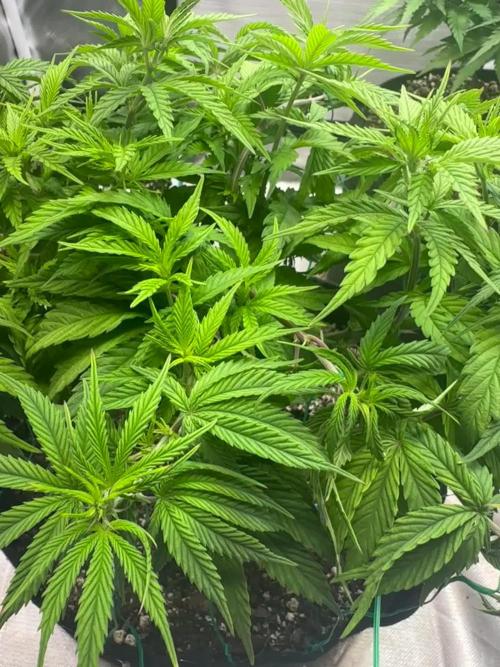
Gave a nutrient boost and set to 12 hr.
Still doing LST but I will probably unleash once it actually starts flowering. Been a bit lazy with defoliation but that can wait until flowering as well. I think it will be due for cal mag and some flower nutes in the near future.

Likes
5
Share


@beer420
Follow
Were getting there!
Plants looking beautiful and swelling up.
Two questions below!
Thanks for reading and happy growing.

Likes
13
Share


@rhajaed
Follow
1800 ppms going in second week of flower.. these girls are huge so they have been handling high ppms very well.

Likes
1
Share


@Spaceperle93
Follow
LST an Tag 23
Erde aufgefüllt da Boden abgesackt.
Tag 23 nochmal mit terra grow gedüngt.
Ab jetzt Weitergabe mit biobizz da kein ph gerät vorhanden
Likes
53
Share


@cheetah844
Follow
Dirty Aquarium Water:
6.43 pH
381 PPM
73.4⁰F
They've gotten both bushier & taller, I needed to create more room in the tent for the clones that I will make seeds from, so I moved the extra clones I'm uncertain of what I'm going to do with it into a makeshift grow area.
I'm waiting for temperatures to stay consistently warm outside so I can get these soon to be forced female outdoors to start making feminized seeds.

Likes
4
Share


@Erich2025
Follow
I did some trimming this week. The plant grows well and healthy. I didn‘t use any nutrients because of the slight burn last week.
Next week I am going to transplant the plants in their final pot and prepare them for flower at week 6.
🌴🍪


Likes
18
Share


@Hashy
Follow
Week 16
Light cycle=12/12
Light Power=120w
Extractor controller settings
High temp= 25c
Low temp= c
Temp step=0c
High Rh= 40%
Low Rh= %
Rh step=0%
Speed max=10
Speed min=1
Smart controller settings (during lights on).
Lights on=10.01-21.59
Radiator on= below 20.0c
Radiator off= above 21.0c
Dehumidifier on= above 55% RH
Dehumidifier off= below 50% RH or above 24c
Smart controller settings (during lights off).
Lights off=22.00-10.00
Radiator on= below 16.5c
Radiator off= above 17.5c
Dehumidifier on= not in use
Dehumidifier off= not in use
Fri 5/4/24
💧💧💧💧💧💧💧💧💧💧💧💧💧💧💧💧
Method= automatic
Feed=water 3&4
Ec=0.2 PH=6.8/7.0
Total volume made=8L
Total volume left=2.5L
Total volume used=5.5L
Volume per plant=2.75L
Runoff.
Total runoff=2.5L
Ec=1.2 PH=/ Runoff ph pen broken.
💧💧💧💧💧💧💧💧💧💧💧💧💧💧💧💧
#3 (Day 106)(Day 68 flower)
📋
Sat 6/4/24
#3 (Day 107)(Day 69 flower)
📋
Sun 7/4/24
#3 (Day 108)(Day 70 flower)
📋
Mon 8/4/24
💧💧💧💧💧💧💧💧💧💧💧💧💧💧💧💧
Method= automatic
Feed=water 3&4
Ec=0.2 PH=6.8/7.0
Total volume made=9L
Total volume left=3.75L
Total volume used=5.25L
Volume per plant=2.6L
Runoff.
Total runoff=2.25L
Ec=0.9 PH=/ Runoff ph pen broken.
💧💧💧💧💧💧💧💧💧💧💧💧💧💧💧💧
#3 (Day 109)(Day 71 flower)
📋
Tue 9/4/24
#3 (Day 110)(Day 72 flower)
📋
Wed 10/4/24
#3 (Day 111)(Day 73 flower)
📋 she ain't going to bulk up anymore, trichomes are ready. May harvest soon.
Thur 11/4/24
💧💧💧💧💧💧💧💧💧💧💧💧💧💧💧💧
Method= manual
Feed=water 3&4
Ec=0.2 PH=6.8/7.0
Total volume made=5L
Total volume left=1L
Total volume used=4L
Volume per plant=2.L
Runoff.
Total runoff=0.5L
Ec=0.8 PH=/ Runoff ph pen broken.
💧💧💧💧💧💧💧💧💧💧💧💧💧💧💧💧
#3 (Day 112)(Day 74 flower)
📋 This is the last weekly update for this one. She should be getting chopped tomorrow.
Back soon.
Take it easy.
Likes
15
Share


@Professor_Daank
Follow
Cruise control. Boomin'. Colorful. Stanky., Sticky. Daanky.
Everything is going well and I'm keeping them alive.
The Blue Dream is literally 7 inches from the light and LOVING it. Stacks on stacks on stacks.
The next two weeks will explode.

Processing
Likes
18
Share


@eldruida_lamota
Follow
Esa familia, actualizamos las northern light xL, hay una de las 3 que destaca del resto por tamaño y flores, pintan muy bien, se ve buen color y bastante vigorosas, tutelamos 1.
Bajamos humedad y temperatura, a estas alturas estamos pensando en el siguiente proyecto con varias geneticas de zambezaseeds.

Likes
6
Share

@Zeven_Xero_Fyve
Follow
.
End of Week 6:
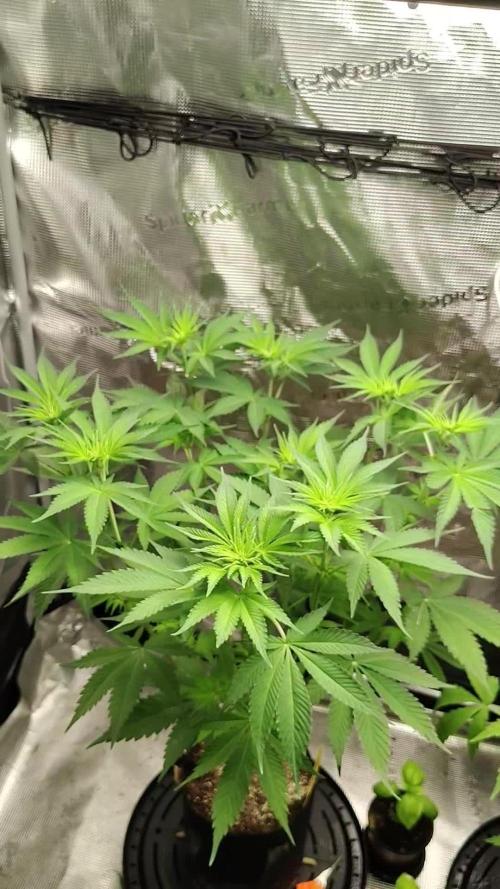
She's really stretching at an alarming rate, but at the same time incredibly sturdy shoots that aren't bending anytime soon. Given that she's not even showing pom-poms yet, I wonder just how tall she'll get before I need to do some super-cropping. I've only got another 1.5-2 feet left to play around with before she's chewing on the light. We'll see 😬
A few days after topping her last week I had to remove one of the shoots as it had fused with the leaf, leaving the other shoot to continue by itself. Regardless, the rest of the shoots are all even in height and forming a nice even canopy. Not every day you see that.
There's also a 12-finger leaf near the top of one of the shoots, which is cool to see. It's not the result of any leaves fusing together, just an extra 3 fingers. 💪 I snipped it off to get a shot of it with my phone, as it was in an awkward spot.

Likes
60
Share


@GuerrillaNo_4
Follow
UPDATE:
- Day/Night temperature differential is starting to bring out the purple colors.
- Trichomes are mostly cloudy, just waiting on some ambers to harvest.
- Did some defoliation to allow light at the lower growths in its last week
GENETICS:
-Free seeds from MSNL. Being used to test my system.
CLIMATE:
- Ambient Air Temp = 27/28'C ~ 26/27'C LST ~ Leaf to air temp variance of between 1-2'C
- Night Temp = 21/22'C ~ Day/Night temp differential 6-7'C
- Under Canopy Temp: 26'C (Day) ~ 21'C (Night)
- Relative Humidity = 55-65%RH (Avg. 60%RH)
- VPD = 1.30kPa (Avg.)
- Co2 ranges from 900ppm to 1500ppm (Avg. 1200ppm)
AIR PRESSURE:
- Ambient Air Pressure (outside tent) = 1015 mbars (101.5 Kilopascals)
- Actual Air Pressure (inside tent) = 980-1005 mbars (980-100.5 Kilopascals)
- Air Pressure Differential = ranging from -10 to -35 mbars (-1 to -3.5 Kilopascals)
LIGHT:
- 2x full spectrum CREE COBs
- At plant canopy = PPFD 900-1000umols/s/m2 ~ Lux 40,000-50,000 ~ Daily Light Integral 55-65
NUTRIENTS:
- Mostly Advanced Nutrients (For base nutrients and most additives, as only company I could find scientific data on)
- Canna (For Calmag Agent and Cannazym)
- Plant Success (Great White Mycorrhizae)
ADDITIONAL GROW TECHNIQUES:
- Mostly getting out of the plants way and letting nature take its course.
- Some LST. (i.e. tying down branches and tucking large leaves away)
- No HST.
INFECTION PREVENTION & CONTROL:
Infection control practices i.e
-PPE, Alcohol Hand wash
-Gray room outside tent,
-Carbon filter
-HEPA filter
-Plasma Ionizer
-Inline UV-C germicidal bulb
- Also using an additional higher powered COOSPIDER (UVC) 253nm & 187nm bulb, to disinfect the gray room outside of the tent once a week for 30 mins.
- Ozone (o3) gas that is produced using the COOSPIDER, is then directed into the tent to further control any unwanted pathogens.
- Ed Rosenthal (Zero Tolerance organic pesticide), sprayed once a week as preventative measure. On hand for heavier use (Once every 3 days before lights out for 15 days) in the case of an outbreak
(No outbreaks yet, due to aforementioned preventative measures)
Likes
52
Share


@Santica_Garden
Follow
Everything is going really well, very happy with how these ladies are doing, even with the summer heat they are doing really well at high temperatures! 👍🏾🌱💚


Likes
8
Share


@I_Identify_As_A_Dan
Follow
Week 13 for Ztrawberry by Greenhouseseedco
Shes really doing quite nicely😇 Going to get her last heavy defoliation at the end of this week plus a feed of BioBloom little top up of 7.5g
Likes
10
Share


@Dendegrow
Follow
Week 4 – Blue Sunset Sherbert
The plants are thriving in week 4 of flowering! 🌱 I added a layer of Greenhouse Feeding and Allmix on top to ensure they have enough nutrients until harvest. 🌿 The buds are swelling nicely, and resin production is clearly ramping up. ✨ The scent is also getting stronger, with noticeable citrus notes coming through 🍋. I slightly adjusted the light distance to optimize their development. 💡 Excited to see how they progress—stay tuned for more updates! 😎
---
Woche 4 – Blue Sunset Sherbert
Die Pflanzen gedeihen prächtig in der vierten Blütewoche! 🌱 Ich habe eine Schicht Greenhouse Feeding und Allmix oben drauf gegeben, damit sie bis zur Ernte optimal versorgt sind. 🌿 Die Buds nehmen ordentlich an Größe zu, und die Harzproduktion wird immer intensiver. ✨ Auch der Geruch wird stärker – die Zitrusnoten sind schon deutlich wahrnehmbar 🍋. Ich habe die Lampenhöhe leicht angepasst, um das Wachstum weiter zu optimieren. 💡 Bin gespannt, wie es weitergeht—bleibt dran für mehr Updates! 😎
Likes
10
Share


@valiotoro
Follow
Photoperiod buds 🤩
The smell is absolutely divine very fruity,sweet & tropical🍋🍊🍉🍌
Solid like a diamond 💎
Bay harbor butcher’s trim to show the density
Likes
18
Share

@eldruida_lamota
Follow
Hola familia, decidimos esperar y curar unas semanas antes de probarla.
19% de thc y es que esta cepa con predominancia indica no deja de sorprendernos a cualquier cultivador, es una cepa no muy complicada para cultivar pero tampoco fácil.
60/65 días de floración cruzada entre northern light x afghani .
Buenos céntrales y buenos satélites.
Hasta aquí el final del principio.
Likes
7
Share


@bro8006
Follow
Hello guys, today both ladies complete 30 days in the jungle. Só notice The LST one is about 30 cm maybe, and The onther im letting it grow and Just doing some defo ever 3 weeks or só..
Notice how tall is it. And possible tô Notice The buds a starting to form, also. Possible tô Notice that The trained one is not in the same level of flowering as The other one. O guess its still recovering from the lst and catching up speed.. But Who knkws we Will see next week..
Peace yall.
Processing
Likes
15
Share


@Siriuz
Follow
Alright guys, I'm back
First I thought she wasn't going to make it but then she started developing even better so we've got her already blooming guys!
We started adding floranova bloom but we keep adding floranova grow for the veggie stage, we will increase bloom nutes soon
We continue applying LST plus some watering every so often to keep her moist and wet but never super wet just chill
Depending on your lights wattage you could need more or less water you will have to figure it out yourself but for me is 600ml per 24 hrs morning and night time usually I keep the very well hydrated and they have been showing off for good!!!
