


Likes
Comments
Share



Likes
29
Share


@Reaper
Follow
ph meter is broken. i use ghe liquid to read ph lol
ph goes down every night. 650ppm is still too high for this strain, drinks a liter everyday
i need a bluelab ph/ec meter
2 Februari:
the buds start to appear on the hydro plant with thc everywhere lol

Likes
14
Share


@ao_grows1978
Follow
Week 7 of flower in the books and the Kush is in the home stretch. Pistils are all turning orange and buds are getting thick and resinous. She's got a nice citrusy smell and the colas are all swaying in the breeze. Shout out to Seedsman for these stable genetics. No deficiencies or issues that I had to fix along the way. Really happy I still have a couple more seeds left over.

Likes
7
Share


@NevermoreX0
Follow
Just that color. Wow! It is so nice. I love it, My personal favorite 😍. Looks happy :) so I am happy.
Likes
6
Share


@XanHalen
Follow
Dec 12:
Growth has been good, leafs started yellowing as I tried a regular watering as opposed to a feed, and they did not take well to it. I’ve read that it’s good to incorporate waterings between feeds, but 24hr later noticed a bit of yellowing on the lower section, 48hr post watering even more yellowing.
Dec 18:
Going with feed only and yellowing has halted, stretching has officially begun. No adverse effects from the short term nitrogen deficiency (that’s what I narrowed it down to). Playing with budsites to maintain an even canopy, and as soon as I see stretching halt, and fattening begin, I will up the bloom nutes.
Dec 20:

Likes
28
Share


@MindFlowers68
Follow
She still drinking a good amount of water but able to extent the waterings to 3 days apart before she gets thirsty again. Stopped feeding except one watering was with molasses and the other ph'ed filtered tap water to 6.5 and bubbled a few hours before use.
Upward bud growth is stopping and the buds are starting to plump up more and becoming more dense. Sill a good amount of white hairs but most are brown now. Terps are starting to get much stronger this week. Very frosty and shiny buds are sweet and pungent. Plants are holding them self up nice despite all the weight. No signs of leaves fading color yet. Temps and humidity gave been in much more favorable range and starting to get a nice
Day-night temp differential. I think the colors will start to ahow this week.


Processing
Likes
4
Share


@kevb84
Follow
first flower feeding week 1.added a vid.and a vid of next gen of clons.

Likes
1
Share


@TerpTurtle
Follow
Up on Melancholy Hill
There's a plastic tree
Are you here with me?
Just looking out on the day
Of another dream
Well you can't get what you want
But you can get me
So let's set out to sea, love
'Cause you are my medicine
When you're close to me
🍊


Likes
179
Share


@StarLorr
Follow
Welcome to my Øpium diary.
In this diary:
Seeds: sponsored by Ðivine Șeeds
Media: Promix HP
Nutrients: Advanced Nutrients, Diablo Nutrients.
Light and Weather: Şun☀️and Mother Earth.🌎
___________________________
Feeding:
Sat 22Jun: 4L water not pH'd
Tue 25Jun: 5L water not pH'd
Wed 26Jun: 5L nutrients pH'd 6.5
Thu 27Jun: 5L water not pH'd
Fri 28Jun: 4L water not pH'd
Sun 30Jun: 6L water not pH'd
Mon 01Jul: 4L water not pH'd
___________________________
Weather hasn't been that bad, a cloudy day, a fresh day and night then warm, rain Friday afternoon thru Sunday morning then Sunday afternoon 55 KPH wind gusts 💨
Anti-tilting device seem to hold them down for now😄
___________________________
Thanks for stopping by, likes and comments are appreciated!👊🏻😎
Keep on growin!
Keep on tokin!!!
😙💨💨💨💨💨
Likes
52
Share


@Any_Zenin
Follow
Tag 92: Blütetag 56, man sieht bereits die ersten Bernsteinfarbenen Trichome ich bin gespannt wenn die Pflanzen erntereif sind. Lichtintensität 90%.
Tag 93: Alle Pflanzen gegossen 15% Topfvolumen = 2,7L NL. Wasser PH 6.5 + 1.2ml/L CalMag + 0.25gr/L Bittersalz.
Tag 94: Die letzten Tage waren die Temperaturen leider sehr hoch aber ab morgen soll es zum Glück ein bisschen kühler werden. Heute habe ich alle Pflanzen kurz kontrolliert und sonst nur in ruhe gelassen. Lichtintensität 80%.
Tag 95: Alle Pflanzen in ruhe gelassen.
Tag 96: Ich lasse die Töpfe austrocknen und gieße nicht mehr bis ich Ernte, Lichtintensität 70%.
Tag 97: Die Pflanzen sehen gut aus und es werden immer mehr Trichome Bernsteinfarben, die nächsten Tage werde ich intensiver beobachten wie weit die Pflanzen gereift sind.
Tag 98: Heute habe ich meine beiden Cannatrol, TrimBins, Arbeitsfläche und Scheren für die Ernte vorbereitet.

Likes
10
Share


@Naturalist
Follow
Reducing Bloom & raising ratio of Foliage-Pro to address burn & faded LSD foliage.
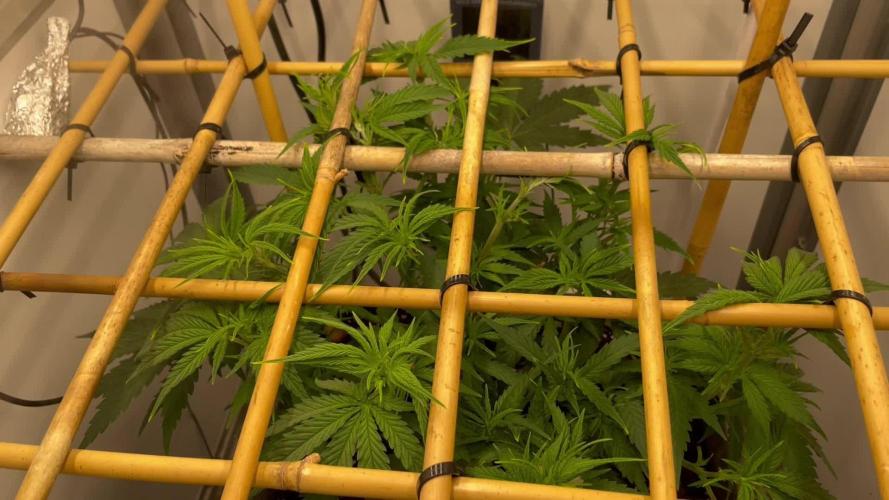
Buds are getting heavy will need to add bamboo support ASAP.

Likes
4
Share


@Greenbum
Follow
This was a solid week but my PH keeps dropping. PPM dropped from 780ish to 560 so I know she's eating. Buds are forming nice and compact for their first week of actually forming. Other than the PH problem that I'm correcting daily until my fresh res change, my tallest stalk in the back grew into the light so hopefully those buds don't bleach!
Open to constructive criticism btw!


Processing
Likes
15
Share


@greenflipcali89
Follow
Finishing out week 5 of flower and continuing my daily treatment for PM. Using Athena Mildew Control, an organic reactive treatment spray that you can use on the entire plant up to harvest. Realizing PM is systemic and is like herpes...it never goes away! All you can do is spot treat on a daily basis, the outward symptom of PM, which is the white patches/spots. Treating primarily Mimosa, but also parts of the Bling as well.
Napali Pink - As usual, is impervious to this type of PM and is thriving, with huge fat buds that still continue to get fatter and tighter by the day. They haven't even fully swollen up yet either. If the smoke is great, which I am sure it will be, this is a strain that I highly recommend growing. It has excellent branching structure with upward growth with very little help. Takes nutrients well and not too fussy or needy with any of variations of NPK or micros. I would say based on the looks of the buds and trichs, she will be a last to finish, but well worth the wait, as I have so. Many. Fat. Ass. Buds!!
Mimosa - such an amazing daytime strain that I would loove to always keep on hand, as this strain is on of my All Time Favorites! However, with such prized buds and terp profile, she is vulnerable to PM. She has had it the worst, and always continue to spot treat it daily. She is gaining this cool hue of purple along the outer edges of the leaves, as well as what I thought was PM, but surprisingly turned out to be a shit ton of trichs! Buds are fattening up nicely and think she will be the 2nd to finish out of the bunch. If I could grow her again, I will, but will be sure and do a preventative treatment for PM during her entire life cycle.
The Bling - she has been a trip growing, as she is very viney and lanky, but her branches firm up nice and strong. Practiced some Kushman Chiropractic on some of the stems with success. Had to spot spray, but not as bad as Mimosa's PM. Since I defoliated all leaves covering bud sites, along with huge fans, the buds have actually grown in height and girth! This one never ceases to amaze as she has come back from a bad HST. She is so heavy with trichs, it looks like it snowed on the buds. I am hoping to get a good yield but between the three ladies, she will come in last for that.
Used bamboo stakes to secure all branches/bud heads; used zip tie and paracord to secure to bamboo. Now every single bud gets light! Also testing out a Diminishing Light Schedule and now down to 11 hrs of daylight this week. Will continue to reduce by 1/2 hr each week until I hit 9 hrs of daylight. I will hold at that. Otherwise, patiently waiting for harvest!

Likes
105
Share


@Coopmc
Follow
Great after the mold issue during clone. Recovered good and nice yeild
4.4 Oz tops and mids 3.8 g of rosin and a few Oz of trim to process but man is this stuff good

Likes
62
Share


@Santica_Garden
Follow
3 out of the 4 Cheese plants have been put up to dry, I have uploaded a video for you guys with all the information, any questions just ask 👍🏾🌱💚
