





@Hempface86
Volgen
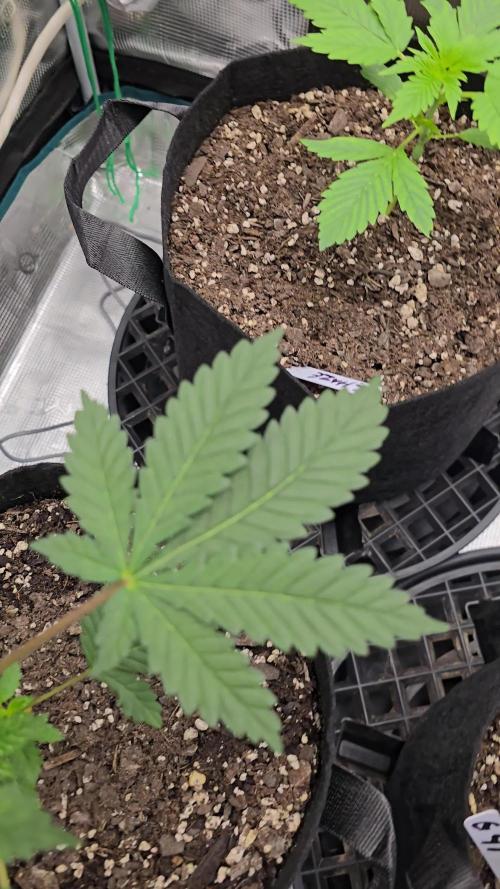
Very happy and healthy plant.. i look forward to flipping her to flower with the other two I have going in the next couple weeks.. I like variety.. I'm excited for this one Atlas seeds has not let me down yet..Happy Easter to everyone God bless and happy growing 🙏


@Ultraviolet
Volgen
Once again she passes my expectations, late to the show with trichome production. I'm surprised there is purple on the bud, maybe Purpinator does work. I thought I could see hints under the grow lights and thought my eyes were deceiving me, I was just being hopeful. But nah 2 of the 3(under the UV) have developed a beautiful tone of purple. I was never going to bother with a deep freeze but maybe the whole bud will change given conditions, that would be something, fingers crossed. 🤔 was a little skeptical that reducing temps humidity would change density, but it does, buds are solid something I've not been able to achieve before.
Rule of thumb is never to surpass 60% RH in the flowering phase and try to progressively reduce it down to 40% in the last 2–3 weeks before harvest. The plant will react as it seeks to protect its flowers, responding by producing denser buds and a higher concentration of resin. Cannabis plants are sensitive to sudden temperature changes, especially in the flowering stage. Extreme heat or cold can impact bud density and overall yields. In nature as a defense mechanism from cold, the plant sensing sudden dips in temperature will attempt to remove the pockets of air within the bud, it achieves this by compacting itself in doing so to better protect itself from cold snaps which are normally indicators in nature that worse weather is on the way.
Terpene levels are the highest just before the sun comes out. Ideally, you want as many terpenes present in your plants as possible when you harvest. Cannabis plants soak up the sun during the day and produce resin and other goodies at night. The plant is at its emptiest from "harvest undesirables" so to speak right before the lights on. Boiling cannabis roots during harvesting slows down the drying process. When you boil cannabis roots, it shocks the plant, closing the stomata on the leaves. This prevents massive moisture loss through the leaves, leaving only the floral clusters actively losing moisture at a reduced pace. I've always run a strict 60/60 and it took almost twice as long to dry to a snap than previous grows where I didn't boil for what it's worth.
Chlorophyll is good for the plant but not for you. When you harvest the buds, even after you flush them, if you flush them, they’re still filled with chlorophyll. Freshly cut buds are greener than dried buds because they still contain loads of chlorophyll. However, when rushed through the drying process, the buds dry but retain some chlorophyll, and when you smoke it, you will taste it. Chlorophyll-filled buds are smokable, but they aren’t clean. Slow drying gives the buds enough time and favorable conditions to lose the chlorophyll and sugars, giving you a smoother smoke. How the plant disposes of the chlorophyll and sugars by a process of chemically breaking them down and attaching the decomposed matter once small enough to water molecules which then evaporate back into the ether. Time must be given to the process to break down the chlorophyll and sugars. Think of it like optimizing the environment for decay.
All the nutrients it could ever need are in abundance, it eats nutrients based on its demand for growth, which is dictated primarily by available light.
Plant growth and geographic distribution (where the plant can grow) are greatly affected by the environment. If any environmental factor is less than ideal, it limits a plant's growth and/or distribution. For example, only plants adapted to limited amounts of water can live in deserts. Either directly or indirectly, most plant problems are caused by environmental stress. In some cases, poor environmental conditions (e.g., too little water) damage a plant directly. In other cases, environmental stress weakens a plant and makes it more susceptible to disease or insect attack. Environmental factors that affect plant growth include light, temperature, water, humidity, and nutrition. It's important to understand how these factors affect plant growth and development. With a basic understanding of these factors, you may be able to manipulate plants to meet your needs, whether for increased leaf, flower, or fruit production. By recognizing the roles of these factors, you'll also be better able to diagnose plant problems caused by environmental stress.
Water and humidity
*Most growing plants contain about 90 percent water. Water plays many roles in plants. It is:*
A primary component in photosynthesis and respiration
Responsible for turgor pressure in cells (Like the air in an inflated balloon, water is responsible for the fullness and firmness of plant tissue. Turgor is needed to maintain cell shape and ensure cell growth.)
A solvent for minerals and carbohydrates moving through the plant
Responsible for cooling leaves as it evaporates from leaf tissue during transpiration
A regulator of stomatal opening and closing, thus controlling transpiration and, to some degree, photosynthesis
The source of pressure to move roots through the soil
The medium in which most biochemical reactions take place
Relative humidity is the ratio of water vapor in the air to the amount of water the air could hold at the current temperature and pressure. Warm air can hold more water vapor than cold air. Relative humidity (RH) is expressed by the following equation:
RH = water in air ÷ water air could hold (at constant temperature and pressure)
The relative humidity is given as a percent. For example, if a pound of air at 75°F could hold 4 grams of water vapor, and there are only 3 grams of water in the air, then the relative humidity (RH) is:
3 ÷ 4 = 0.75 = 75%
Water vapor moves from an area of high relative humidity to one of low relative humidity. The greater the difference in humidity, the faster water moves. This factor is important because the rate of water movement directly affects a plant's transpiration rate.
The relative humidity in the air spaces between leaf cells approaches 100 percent. When a stoma opens, water vapor inside the leaf rushes out into the surrounding air (Figure 2), and a bubble of high humidity forms around the stoma. By saturating this small area of air, the bubble reduces the difference in relative humidity between the air spaces within the leaf and the air adjacent to the leaf. As a result, transpiration slows down.
If the wind blows the humidity bubble away, however, transpiration increases. Thus, transpiration usually is at its peak on hot, dry, windy days. On the other hand, transpiration generally is quite slow when temperatures are cool, humidity is high, and there is no wind.
Hot, dry conditions generally occur during the summer, which partially explains why plants wilt quickly in the summer. If a constant supply of water is not available to be absorbed by the roots and moved to the leaves, turgor pressure is lost and leaves go limp.
Plant Nutrition
Plant nutrition often is confused with fertilization. Plant nutrition refers to a plant's need for and use of basic chemical elements. Fertilization is the term used when these materials are added to the environment around a plant. A lot must happen before a chemical element in a fertilizer can be used by a plant.
Plants need 17 elements for normal growth. Three of them--carbon, hydrogen, and oxygen--are found in air and water. The rest are found in the soil.
Six soil elements are called macronutrients because they are used in relatively large amounts by plants. They are nitrogen, potassium, magnesium, calcium, phosphorus, and sulfur.
Eight other soil elements are used in much smaller amounts and are called micronutrients or trace elements. They are iron, zinc, molybdenum, manganese, boron, copper, cobalt, and chlorine. They make up less than 1% of total but are none the less vital.
Most of the nutrients a plant needs are dissolved in water and then absorbed by its roots. In fact, 98 percent are absorbed from the soil-water solution, and only about 2 percent are actually extracted from soil particles.
Fertilizers
Fertilizers are materials containing plant nutrients that are added to the environment around a plant. Generally, they are added to the water or soil, but some can be sprayed on leaves. This method is called foliar fertilization. It should be done carefully with a dilute solution because a high fertilizer concentration can injure leaf cells. The nutrient, however, does need to pass through the thin layer of wax (cutin) on the leaf surface.
It is to be noted applying a immobile nutrient via foliar application it will remain immobile within the leaf it was absorbed through.
Fertilizers are not plant food! Plants produce their own food from water, carbon dioxide, and solar energy through photosynthesis. This food (sugars and carbohydrates) is combined with plant nutrients to produce proteins, enzymes, vitamins, and other elements essential to growth.
Nutrient absorption
Anything that reduces or stops sugar production in leaves can lower nutrient absorption. Thus, if a plant is under stress because of low light or extreme temperatures, nutrient deficiency may develop.
A plant's developmental stage or rate of growth also may affect the amount of nutrients absorbed. Many plants have a rest (dormant) period during part of the year. During this time, few nutrients are absorbed. Plants also may absorb different nutrients as flower buds begin to develop than they do during periods of rapid vegetative growth.
432 Hz is said to be mathematically consistent with the patterns of the universe. Studies reveal that 432 Hz tuning vibrates with the universe’s golden mean PHI and unifies the properties of light, time, space, matter, gravity and magnetism with biology, the DNA code and consciousness. When our atoms and DNA start to resonate in harmony with the spiraling pattern of nature, our sense of connection to nature is said to be magnified.
Another interesting factor to consider is that the A=432 Hz tuning correlates with the color spectrum while the A=440 Hz is off.
Audiophiles have also stated that A = 432 Hz music seems to be non-local and can fill an entire room, whereas A=440 Hz can be perceived as directional or linear in sound propagation.
Once you adopt the idea that sound (or vibration in general) can have an equalizing and harmonizing effect (as well as a disturbing effect), the science of harmony can be applied to bring greater harmony into ones life or a tune to specific energies. There is a form of absolute and of relative harmony. Absolute harmony can for example be determined by the tuning of an instrument. The ancients tuned their instruments at an A of 432 Hz instead of 440 Hz - and for a good reason. There are plenty of music examples on the internet that you can listen to in order to establish the difference for yourself. Attuning the instrument to 432 Hz results in a more relaxing sound, while 440 Hz slightly tenses up to body. This is because 440 Hz is out of tune with both macro and micro cosmos. On the contrary, 432 Hz is in tune. To give an example of how this is manifested micro cosmically: our breath (0,3 Hz) and our pulse (1,2 Hz) relate to the frequency of the lower octave of an A of 432 Hz (108 Hz) as 1:360 and 1:90.
It is interesting to note that 432 Hz was the standard pitch of many old instruments, and that it was only recently (19th and 20th century) the standard pitch was increased. This was done in order to be able to play for bigger audiences. Bigger audiences (more bodies) absorb more of the lower frequencies, so the higher pitch was more likely to “cut through”. One of the oldest instruments of the world is the bell ensemble of Yi Zeng (dated 423 BC), tuned to a standard F4 of 345 Hz which gives an A= 432 Hz. The frequency of 345 Hz is that of the platonic year! Similarly many old organs are tuned in an A=432 as well; for example: St. Peter’s Capella Gregoriana, St. Peter’s Capella Giulia, S. Maria Maggiore in Rome.
Maria Renold’s book “Intervals Scales Tones and the Concert Pitch C=128 Hz” claims conclusive evidence that 440 Hz and raising concert pitch above scientific “C” Prime=128 Hz (Concert A=432 Hz) disassociates the connection of consciousness to the body and creates anti-social conditions in humanity.
The difference between concert pitch A=440 Hz and Concert A=432 Hz is only 8 cycles per second, but it is a perceptible difference of awareness in the human consciousness experience of the dream we share called existence.

shorts_status_processing


@FolloMiSensi
Volgen
Week 9 plant - vertical growth slowed down, packing on the buds quite nice. smelling great, quick counted 11 colas
Week 8 plant - stretched quite a bit this past week. hairs everywhere, bud growth is starting to come in. quick counted 12 colas.
Just added water to the res, ph went up a bit so dropped in 1ml of ph down to bring it back to 5.6, around 790-800 ppm.
Did a light defoliation on the bottom of the plants, pulling off weak/dying older fan leaves mostly.
Minor tucking of fan leaves on the top to expose more colas to the light. Adjusted the light to 18" from the tallest cola.

@Growmie95
Volgen
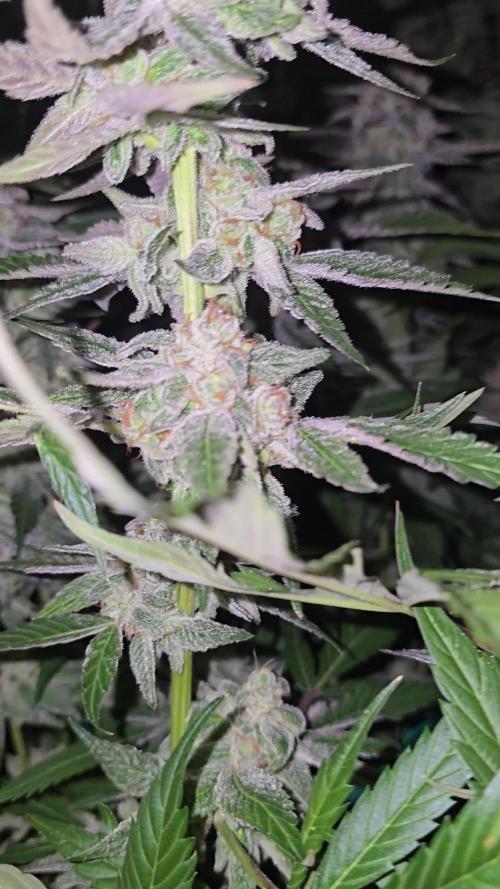
Flowers are maturing. Left pheno seems to .need some more time the others look quite ripe but trichomes are not quite there yet.


@eldruida_lamota
Volgen
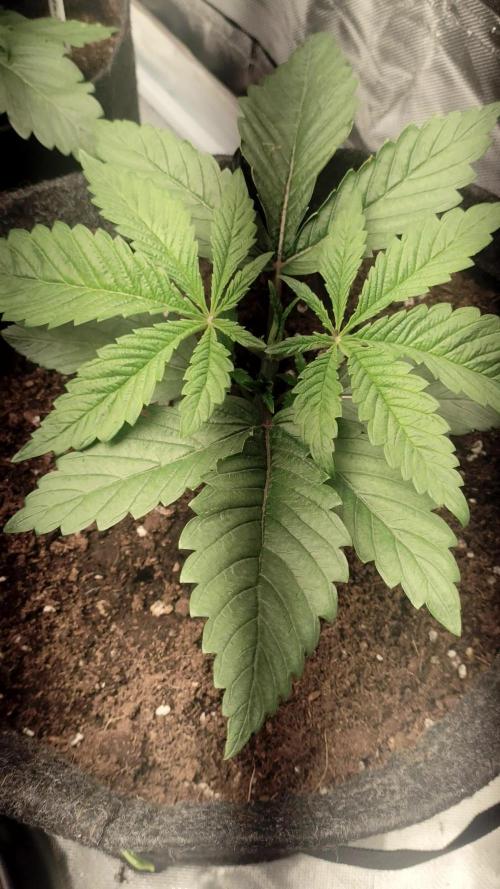
Vamos familia que ya actualizamos la cosecha de estas zkittelz de Mafia seeds.
Vaya flores que se han marcado repletas de tricomas, parecen escarcha y las flores se marcan aromas bien dulces.
Es una variedad bastante fácil de cultivar pero al tener un periodo de floración algo más largo, hay que estar pendiente de alimentarlas bien, gracias Agrobeta en mi sala es posible.
Temperaturas máximas en 24 y mínimas en 20 y una humedad estable en torno al 36%.
Las mantuve 10 semanas, ya las vi bien maduras y ya tenía tricomas ambar así que les di matarile.
Agrobeta:
https://www.agrobeta.com/agrobetatiendaonline/36-abonos-canamo
Mars hydro:
Code discount: EL420
https://www.mars-hydro.com/
Espero que disfruteis este diario, buenos humos 💨💨💨.



@AppleFritterGarden
Volgen
Esta semana hice otro "topping". Ya veo muchas mejoras también gracias al nutri spray y al aumento del pH. Ya estamos empezando a ver algunas mejoras.


@Captensmokey
Volgen
They are now growing faster than fast... They are getting ready for flowering. I will soon switch to hesi nutrition... 🙌👍


@Growin_it
Volgen
Low maintenance. Just watered this week with cal-mag'd water.
Trichomes still nice and cloudy.
Harvest is close.


@BudHaks
Volgen
Hey, there peeps!
Apologies for not updating my diary as I have been quite busy balancing non-plant responsibilities -.-!
Anyway, we are now on day 75 since I ordered my equipment and started germinating my seed and day 71 since I placed my seedling in her first Coco pot! She is now a staggering 4 foot 2 - which was overwhelming considering this is my first grow and orginally only cleared out 2/3 of my cuboard but now it uses the whole space but she's coming along so well! I have also added a LED Grow Light Full Spectrum 50W Red COB as I wanted some extra light for the bottom half nuggests.
She is very healthy (I assume from the strong healthy roots) and hasnt shown any major defects other then the initial defects i encountered in week 2-3 and slight light burn on the top cola in week 7 which was from the plant growing so quickly and touching the light, but I did then adjust the light within 2-3 hours.
What do you guys think and how did she get so tall consdiering she is an auto-flower and the strain is meant to be indica domiant?


@Guerrilla_grower777
Volgen
06/08/2025 20:15
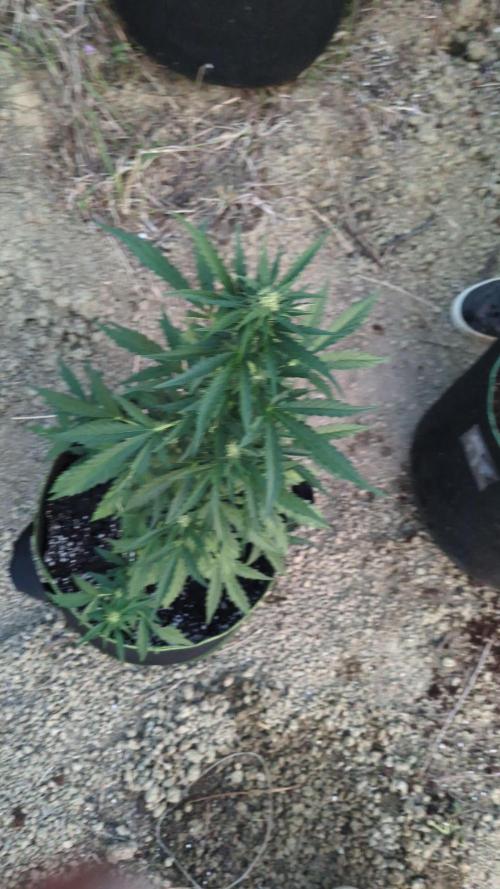
Good climate but one day in the middle of the week had 2h of heavy Rain with some hail(FUCK) that damaged one branch of the frostbanger
Gorilla z bumping and frosting all good
Frostbanger unbelievable how frost It can be on her very first days of flower,this Will be frost and a banger😂
Apricot auto and Coco milk now transplanted ,had some problems bringing them here that's why they look sad
Fucking boars this place Is so dangerous right now




@little_Boncannasai
Volgen
🌱 Dulræntgosas kleines großes Reiseabenteuer 🌱
Hallo ihr feurigen Abenteurer.
Vielleicht hat der ein oder andere gedacht, "Dass wird sie niemals schaffen!" Nun, was soll ich sagen, mir geht es den Umständen entsprechend eigentlich ganz gut. 😁
Ja es ist noch eine Herausforderung und es strengt auch sehr an. Aber meine Wasserspenderin kümmert sich rührend um mich.
Der besondere Zaubertrank für meine Wurzeln und die andere Zutat fürs Wachsen, sind sooooo lecker.
Und das lässt sich wirklich sehen. Wie ein wilder Drache sprieße ich langsam in die Höhe. Meine Wurzeln bahnen sich sichtbar ihren Weg durch die Erde. Groß und stark, kann ich meinen Schatz bewachen.
Und seit heute, bin ich wild!
Ja, ihr habt richtig gelesen. Mit meinen zarten 17 Tagen, stehe ich nun endlich unter der grellen brennenden Scheibe am Himmel. Die Zeiten in meiner Drachenhöhle sind vorbei.
Ich bin frei, wild und mutig für das neue Abenteuer!
Monstergeschichten machen mir keine Angst. Im Gegenteil, sie fordern mich gerade zu heraus. Sollen sie kommen, die Fraßlinge aus den dunklen Schatten, in der Nacht. Denn meine Wasserspenderin wird sich was einfallen lassen!
Viel mehr gibt es zur Zeit noch nicht zu erzählen. Aber bleibt gespannt, das Abenteuer wird mit Sicherheit noch aufregend werden.
Liebe Grüße eure Dulræntgosa
"die Drachen-Lady"


@HylianGrass
Volgen
Week 3 was all about shaping the canopy using lst. Being an autoflowering strain time is always off the essence . If you stress her too much you will drastically reduce your yield. Like my past grow , this strain takes lst like a baws, bouncing back real fast



@BostonEraWeed
Volgen
Vasi destra e sinistra hanno una 10 di gg dí differenza… irrigò con 500 ml dose minima per piantina
Ppfd 180 parte alta
Sulle piantine più piccole 140 ppfd .. il sensore calcola sopra quelle grandi .




@DogDoctorOfficial
Volgen
🌱 Godfather OG (Zamnesia) | Pheno A | Week 4
The adventure continues…
Every week this project reminds me why I love growing from seed. Even when plants share the same room, the same nutrients, the same lighting and exactly the same environment, each phenotype writes its own story. That’s exactly what this diary is about.
This is Godfather OG – Pheno A from Zamnesia, grown as part of my 8×8 Adventure, where twelve different genetics are all being cultivated using the 12/12 from seed method. The goal isn’t to chase massive vegetative plants, but to discover each cultivar’s natural expression while keeping everything under identical conditions.
Week 4 has been all about building structure. The roots are now well established, the branches are strengthening, and the plant is beginning to reveal the architecture that will support the coming stretch. Every day she becomes a little easier to read, and so far she’s telling a very promising story.
⸻
🌿 Plant Development
This phenotype has developed into a beautiful, compact plant with excellent vigor. The overall colour is rich and healthy, while the newest growth shows that vibrant lime-green tone typical of fast, actively dividing tissue.
One thing that immediately catches my attention is how symmetrical she is becoming. The internodal spacing remains tight, producing a dense canopy filled with potential flowering sites.
The stem is noticeably thick and sturdy, which is always something I like to see before entering the real flowering stretch. Strong foundations usually lead to strong harvests.
Large fan leaves are doing an incredible job powering photosynthesis while shading portions of the canopy that aren’t yet ready for full exposure.
Overall, she looks calm, healthy and completely comfortable in her environment.
⸻
🌱 Low Stress Training & Leaf Tucking
Training this week remained focused on Low Stress Training (LST).
Instead of removing leaves, I’m continuing to gently reposition branches and tuck larger fan leaves underneath developing shoots. This simple technique allows more light to reach secondary growth without sacrificing valuable solar panels.
The beauty of leaf tucking is that nothing is permanently removed. The plant keeps all of its energy-producing leaves while the lower branches receive enough light to begin competing for canopy space.
Every day the branches become a little more flexible and easier to position. As they continue to harden, they’ll naturally hold their new shape, creating a wider and more even canopy.
It’s a slow process, but one that consistently pays off later in flower.
⸻
💧 Feeding Program
The nutrition remains simple and consistent.
Current feeding:
• Terra Grow — 1.8 ml/L
• Power Roots — 1 ml/L
• Pure Zym — 1 ml/L
• Sugar Royal — 1 ml/L
Solution adjustments:
* pH: 6.1
* EC: 1.35 mS/cm
Nothing dramatic has changed because there simply isn’t any need to fix something that is already working. The plant is responding beautifully, producing vigorous new growth without any signs of nutrient excess or deficiency.
The root zone appears very healthy, allowing the canopy to expand steadily every day.
⸻
🌡️ Environment
The room continues to perform exceptionally well despite the warm weather.
Environmental conditions
• Day temperature: 33°C
• Night temperature: 25°C
• Relative humidity: 63%
• CO₂: 639 ppm
• Solution temperature: 26°C
• Substrate temperature: 21°C
While daytime temperatures are certainly on the higher side, maintaining stable humidity, good airflow and constant irrigation allows the plants to continue growing without showing signs of heat stress.
Healthy roots make an enormous difference during warmer periods, and so far this room is handling those conditions remarkably well.
⸻
👀 Looking Ahead
Over the next week I expect to continue guiding the canopy through gentle LST while allowing the secondary branches to catch up with the main leaders.
If she continues developing at this pace, she should enter the flowering stretch with an even canopy, excellent branch distribution and plenty of future bud sites already exposed to light.
For now, patience remains the best training technique.
⸻
🚀 The 12/12 From Seed Adventure
Growing directly under a 12/12 light schedule from seed continues to be one of the most fascinating experiments I’ve ever undertaken.
Every phenotype responds differently. Some stretch early, others remain compact, while others completely surprise me halfway through the cycle. That’s exactly why I enjoy documenting every single plant individually.
Watching each phenotype express its unique personality under identical conditions teaches me far more than simply chasing yield. Every week brings another lesson, and every diary becomes another chapter in that learning process.
⸻
🙏 Thank You
A huge thank you to everyone following this journey, whether you’ve been here since day one or you’ve just discovered the diary.
Thank you to those who leave kind comments, ask thoughtful questions, share knowledge, and even to the critics who encourage me to keep improving. Every interaction helps make this community stronger.
A special thank you goes to GrowDiaries for providing a platform where growers from around the world can document, compare and learn from one another.
And of course, endless gratitude to the incredible companies helping make this project possible:
🌱 Zamnesia — for the amazing Godfather OG genetics.
💜 Plagron — for providing the nutrition that keeps this garden thriving.
💡 Future of Grow — for delivering the light that powers every day of growth.
Finally, thank you for taking the time to follow this 8×8 adventure. I hope these weekly updates inspire you to keep growing, keep learning, and most importantly, enjoy every step of the journey.
Until next week…
Growers Love and Happy growing! 🌱💚


@Cocogrow1234
Volgen
Week 8 flower : still flushing with ph water everyday the run off ec is 0.5 gonna keep flushing for another week . Finishing on 9 weeks
The blue cheese I have 2 different phenos . 1 is very blue and weird shaped leaves and is nearly ready gonna give it till end of the week and do 48hrs on dark before harvest
The other blue cheese is more green but has grown a lot bigger the colas are amazing it definitely needs another 7-10 days .
Sunset sherbet this will be flushed for a few more days and left in dark for 48 hrs
This is the first time using led lights and all the bad stuff I heard about mars hydro . I have to say I’m very impressed with what it’s done .


@blackcald
Volgen
One more nice week. Defoliating and trimming by cat 🤣. About nutrients in comments, its my first time and plagron do fine i think, i have zero problems.


@Cr4zyElite
Volgen
Sixth Week / 13.06.24 - 19.06.24
Week 6 continued with smooth growth and development! 🌿 Focused on optimizing light exposure to each bud site using the SCROG technique, ensuring all buds are getting the attention they need. ☀️
The pistils are looking healthy and vibrant, showing promising signs of robust flowering. 🌼
Excitingly, Apollo F1 is already starting to develop its first trichomes, a sign that things are progressing well. ✨
Everything is on track, and the plants are thriving in their environment. 🚀

shorts_status_processing


