









@Mr_BFL
Volgen
Moby dick
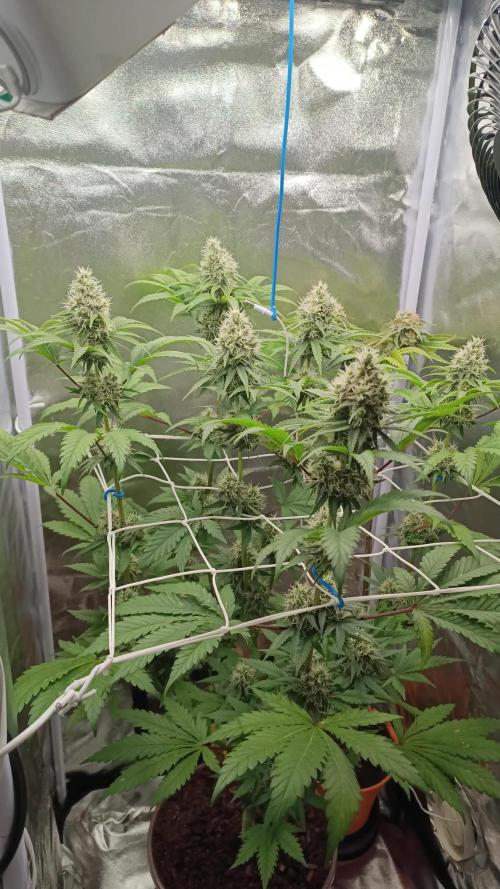
Problems with the strong light presses him to the ground. The internodes are very short, which gives me a lot of trouble.
----
Super Lemon Haze - Visually everything is OK
----
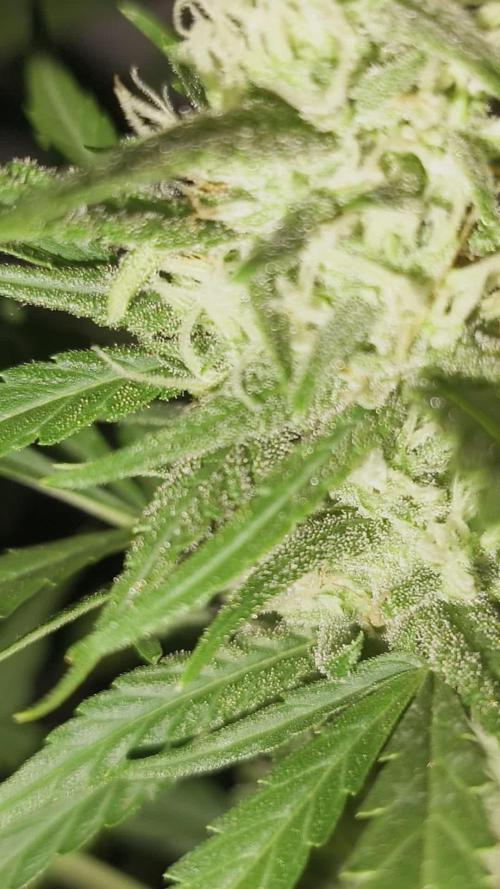
Y griega
Visually everything is OK, but I see an overdose of something that causes dullness, too green color and fragility


@Stickygreens420
Volgen
4/10/2023 - Day 43: just watered yesterday so nothing really new to report. They are really starting to smell now. Hits you right in the nose when I open the tent. Seeing more purple on the Grand Prix and some pistol browning on all the plants. Only minor problem I've had is the heat. It was almost 100° today, but my three fans and the exhaust have kept the temp under control for the most part. Had to turn on the AC for the assist, but kept temps at 80° in the tent.
4/13/2023 - Day 46 Flower: Not much has changed and I haven't had to do anything, so I haven't provided an update in a few days. Had to water again today. Added 4 gallons mixed with the same things I've been using. Jay Plantspeaker Quillaja as a wetting agent, Rootwise Bio-Phos and Bio-Catalyst, BuildASoil Big 6 Micro Nutrients and BuildABloom, Fermented Peach Extract, and Coconut Powder.
4/15/2023 - Day 48: I think the warmer weather has caused the girls to drink more. Watered another 4 gallons today, but just plane water with Jay Plantspeaker Quillaja. Seeing more purple on the two Grand Prix. Seeing a lot more orange pistols as well. The Grand Prix #2 has like a citrus gas smell, and the Frozen White Runtz is like a sweeter gas. The Ice Bath is earthy, and the Grand Prix #3 does not have a strong scent, but the bud structure is my favorite of all four.


@burnout
Volgen
Swelling and getting plump
Getting very stinky , wife upset her coworker could smell it on her jacket. I'm using a new AC Infinity refillable carbon filter, I don't think it's large enough for the room. Going to get another big Phresh filter, that seemed to work better.


@Fabii
Volgen
I pretty much stopped All Nutrients only giving small doses of A&B once every other watering soon i will only pour regular Water (not ph) just a couple of videos this time not to many because they haven’t gained size .
Pure Videos today of both Mazari & Strawberry OG.


@eldruida_lamota
Volgen
Que hay familia ya traigo la última semana de floración de estas Lava Cake de Zamnesia.
Vaya color que se marcan todavía, están bastante sanas , los tricomas están pegajosos , tiene unos aromas espectaculares, me tiene enamorado.Están ya a punto de caramelo.
Temperaturas máximas en 28 y mínimas en 25 y una humedad estable en torno al 36%.
Os comento que tengo un descuento y para que compréis en la web de Zamnesia de un 20%, el código es ZAMMIGD2023
The discount 20% and the code is ZAMMIGD2023
https://www.zamnesia.com/
Agrobeta:
https://www.agrobeta.com/agrobetatiendaonline/36-abonos-canamo
Mars hydro:
Code discount: EL420
https://www.mars-hydro.com/
Espero que lo disfrutéis, buenos humos 💨💨.


@HowtoBubatz
Volgen
The plants are now putting all their energy into bud production, and it’s really starting to show!🌱
Both are developing bigger and bigger buds, and the smell is becoming more intense every day.
#2 has an insanely large main bud, completely covered in trichomes.
The aroma is very hazy, deep, and complex. it’s going to be interesting to see how it develops in the coming weeks.
#1, on the other hand, continues to impress with its tropical, sweet, and pineapple-like scent, and its buds are also swelling up beautifully!
Everything is going exactly as it should—excited to see how much more they’ll bulk up in the next weeks!💚



@Schnabeldino
Volgen
📅 Week 5 | 🗓️ Days 29–35 – Low, wide, and locked-in
🔸 Growth & structure: Biscotti Gelato is loving life this week. She’s sitting low and proud with a tidy, pancake-flat canopy—tops marching in perfect formation. The main stem is chunky with neat training “knuckles,” and the undercarriage is clean so light and air glide right through. Leaves are a deep, happy green and holding that cute “hands-up” pray—no burns, no drama.
🔸 Training: Kept the LST/manifold rhythm going. Tie-downs are doing their job and everything stays level. I plucked a few interior fans—just enough to let the center breathe and give those fresh tips some runway
🔸 Looking to Week 6: Keep the table-top shape. Only snip leaves that clearly throw shade, and give the ties a gentle retighten so all leaders stay shoulder-to-shoulder. Once the footprint is nicely packed, we’re ready to flip—time to trade squats for stretch. 🌸
📈 Current Conditions:
🌡️ Day: 26 °C
🌡️ Night: 19 °C
💨 Humidity: 60%
🔦 PPFD: 400–500 µmol (18/6 light cycle)
🛠️ Setup:
💡 Spider-Farmer 100 W
⛺ Tent: 120 × 120 × 180 cm
🍯 Pots: 18 L plastic pots
🌱 Medium: Bio-Bizz Light Mix
💊 Nutrients: Advanced Nutrients
💧 Water: Tap water (0.5 EC)




@kevxyn
Volgen
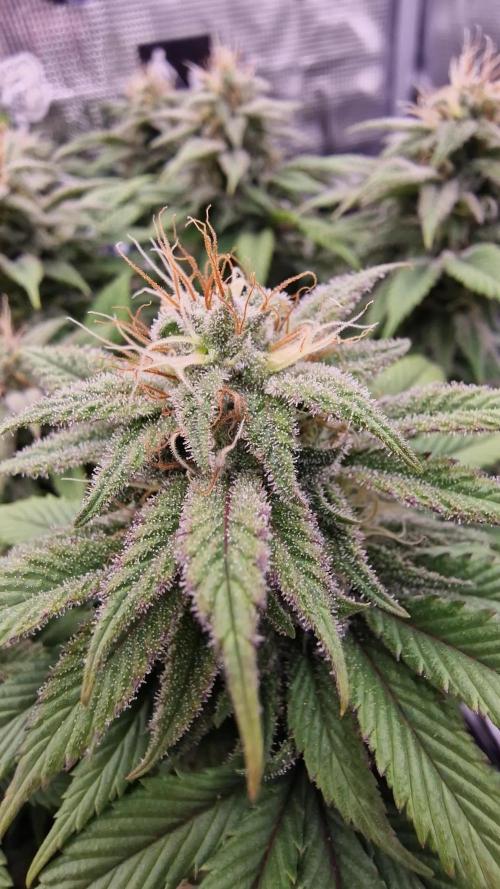
Der Geruch ist mittlerweile der Hammer süß-fruchtig aber gleichzeitig auch stechend-gasig 😍💚
shorts_status_processing


@StickyFruits
Volgen
7day - One of the bushes turned out to be a hermaphrodite, removed it away. Planty began to drink a lot, watering every other day for 1.7-1.8 liters
8day - added PK 13/14 atami 0.7ml/l +Canna bio flower 2ml/l +Bud ignitor 2ml/l -900ppm 1.8 litres and made defoliation
10day -added PK 13/14 atami 1ml/l +Canna bio flower 3ml/l +Bud ignitor 2ml/l +Rhino skin 1ml/l -950ppm 1.8 litres
12 day added PK 13/14 atami 1.1ml/l +Canna bio flower 3ml/l +Bud ignitor 2ml/l +Rhino skin 1ml/l -1000ppm 1.8 litres
14 day - pure water . 6.8PH 200ppm
2 litres/plant





@Ultraviolet_
Volgen
We become aware at such times of man's wonderful ability to bring seemingly unrelated elements into harmonic balance, and receive a glimpse into a world where everything exists in conscious sympathetic attunement to everything else. When we listen to a piece of music that seems to strike a beautiful chord somewhere inside us, or view a painting that simply glows with harmonic awareness well executed, we probably do not spare much time to contemplate the wonderfully intricate combination of vibrations that our sensors make it possible for us to perceive. We tend to appreciate the relationship between the parts of something by an awareness of the harmony or dissonance of the whole. This ability enables us to say "what a beautiful house!" instead of "analysis has proven that this collection of building materials exhibits certain elements of harmonic proportion." While this ability to instinctively appreciate the beauty of true harmony has an important role to play in evolution, a more analytical understanding of the laws involved can be most useful. This is especially so if we wish to create works of art where each part exists in true harmony, not only with the other part of that particular whole, but with the universe within which the creator and the created exist.
Everything vibrates. From the most dense matter to the most subtle cosmic rays, everything which our senses allow our thoughts to become aware of, can be specified in terms of wavelength or frequency of vibration. These two terms define the same thing, but from different points of view.
The following are the approximate wavelengths of various energy carriers:
Cosmic rays 0.000,000,001 mm
Gamma rays 0.000,000,1 mm
X rays 0.000,500 mm
Ultraviolet rays 0.003 mm
Visible light 0.006 mm
Infrared 0.01 mm
Sound waves 1 meter
Radio waves 300 meters
Violet light 400 nm to 450 nm
Blue light 450 nm to 500 nm
Green light 500 nm to 570 nm
Yellow light 570 nm to 590 nm
Orange light 590 nm to 610 nm
Red light 610 to 700 nm
1 nanometer (nm) = 0.000,000,1 cm = 1/10,000,000 cm
If a guitar string is plucked and we hear a sound, it is not too difficult for the human mind to associate this sound with the vibration of the guitar string. With color it is quite different. It is difficult for us to conceive that the color of a substance is not an inherent property of the substance itself, but an indication picked up by our senses of that substance's ability to absorb or reflect the light which happens to be shining on it at that moment. Neither the matter nor the light is colored. What happens is that the brain learns to differentiate between the frequencies reflected or transmitted by the substance the eyes are focused on. The same thing happens with sound. When we say "Oh! Listen, they're playing my favorite song," what we really mean is: "My brain has stored within it a particular pattern of frequencies. I have compared the new information being received with this stored pattern and have deduced the answer that the two patterns are similar within certain specified tolerances." The 'pleasure' involved could have something to do with our running the pre-recorded pattern at the same time, in 'sympathy' with the new pattern as it is received.
The word sympathy describes very well our ability to appreciate color and sound. It also describes the reason behind certain elements of harmony. For instance, if a substance vibrating at 100 cycles per second (tone 1) is in the proximity of another substance vibrating at 200 cycles per second (tone 2), we could perceive, if we had the right equipment, a certain sympathetic relationship between the two.
We will see from this that there is a uniform doubling of the first tone seen in the second. At various points along the waves, the two are the same in amplitude. At other points, they are at opposite poles to each other. This doubled frequency has more points of similarity to the original than any other frequency except the original itself. If the equipment we had available for measuring these two frequencies was a soundboard amplifier and a pair of ears, then we would hear what would sound to us like one tone. If we had the opportunity to hear one at a time, we would hear that although they sound the same, one is higher in pitch than the other. This characteristic of 'the same but different in pitch', musicians have called the octave. Any two tones produced where one has exactly doubled the frequency of the other is called an octave. Speaking in ratios, an octave would appear then as the ratio 2:1 or 1:2, depending on whether we are talking of an octave up or down.
A single note produced by almost any instrument will contain more than one wavelength or frequency. It will have a dominant frequency, the wavelength of which we would call the note's 'fundamental' or 1st harmonic. It will also have a varying number of upper harmonics, gradually fading in intensity into infinity or silence.
Natural harmonics always have the same pattern of intervals between them. The interval between the 1st and 2nd harmonic is a perfect octave; between the 2nd and 3rd a perfect fifth; between the 3rd and 4th a perfect 4th; and so on, the intervals becoming smaller and smaller until they lose any relationship with the western 12 tone scale as it exists at the moment. Just as an octave has certain elements of sympathy with its fundamental, so some intervals have been noted to be more perfectly in sympathy with the fundamental than others. The ratio of the 'perfect 5th' or interval of 7 semitones, as it occurs in the harmonic series, is 3:2 or 2:3, while that of the 'perfect fourth" is 4:3 or 3:4. All the tones in the western 12 tone scale can be expressed in terms of the ratio between the upper tone and its fundamental. This would seem to be an ideal way of generating a scale from any given fundamental and several attempts have been made to do this, the Pythagorean system being probably the most well known. Although when working with a single tone instrument playing on its own, the Pythagorean formula works wonderfully well, if we had several instruments tuned this way together and asked them to play almost any western music, we would find that at times they sounded quite out of tune to each other.
The lack of flexibility of the various scale systems based on the harmonic series has led to what is known as the 'tempered' scale. This uses as its primary unit of interval the ratio of the octave or 2:1. It then proceeds to divide the interval between any fundamental and its upper octave into 12 smaller intervals by applying the ratio: two to the one-twelfth power, to one (21/12:1). This equals 1.059463094, so by multiplying any frequency by this number, we will obtain the tempered semitone next up from our fundamental. We will also find that any tone twelve semitones up from any other tone, in a scale generated in this way, will have exactly double the frequency.
If we took the note middle C on a piano and halved the wavelength, we would have the note C one octave above. If we halved this, we would have the C above, and so on. However, within about 6 octaves, we would find that although a 'sound' was being produced, no human ear could perceive it. If we kept on going, halving and producing upper octaves of our fundamental C, we would proceed through the infrared band, into the visible light spectrum. If we happened to be outside during the day, we would, for one octave only, see the note C with our eyes. The next octave above would already be in the ultraviolet band, and outside the eye's sensitivity range. If we can think of color as being an indication of a substance's vibratory rate or wavelength, we may begin to see a relationship that could exist between the color and sound spectrums.
The logical extension of what has so far been said is that there exists a scale in the color spectrum that corresponds exactly to the scale in the sound spectrum, each color tone being an octave of the equivalent note in the sound range.
This is not the end of the story but only the beginning. If we can for the moment accept that any wavelength in one band has upper and lower octave stretching out to infinity, then the next question is 'fine, but what shall we use as our fundamental? A particular color? A particular sound frequency?' The musicians among us will probably say 'A 440'. This means that the note A should vibrate at 440 Hertz, or 440 times per second. They would tell us that this is standard pitch has been adopted by most orchestras around the world; pianos are tuned to it, instruments are constructed to formulas based on it, and so to them it would probably seem the most appropriate place to begin. Some of these musicians may know of the battle that is still raging with regards to this being the standard, but few would know why A = 440 Hz was chosen except that it worked when it was set to be a suitable compromise between the many different pitches in use at the time.
432 Hz is said to be mathematically consistent with the patterns of the universe. Studies reveal that 432 Hz tuning vibrates with the universe’s golden mean PHI and unifies the properties of light, time, space, matter, gravity, and magnetism with biology, the DNA code, and consciousness. When our atoms and DNA start to resonate in harmony with the spiraling pattern of nature, our sense of connection to nature is said to be magnified.
Another interesting factor to consider is that the A=432 Hz tuning correlates with the color spectrum, while the A=440 Hz is off. Audiophiles have also stated that A = 432 Hz music seems to be non-local and can fill an entire room, whereas A=440 Hz can be perceived as directional or linear in sound propagation.
Once you adopt the idea that sound (or vibration in general) can have an equalizing and harmonizing effect (as well as a disturbing effect), the science of harmony can be applied to bring greater harmony into one's life or tune to specific energies. There is a form of absolute and relative harmony. Absolute harmony can, for example, be determined by the tuning of an instrument. The ancients tuned their instruments at an A of 432 Hz instead of 440 Hz - and for a good reason. There are plenty of music examples on the internet that you can listen to in order to establish the difference for yourself.
Attuning the instrument to 432 Hz results in a more relaxing sound, while 440 Hz slightly tenses up the body. This is because 440 Hz is out of tune with both macro and micro cosmos. On the contrary, 432 Hz is in tune. To give an example of how this is manifested microcosmically: our breath (0,3 Hz) and our pulse (1,2 Hz) relate to the frequency of the lower octave of an A of 432 Hz (108 Hz) as 1:360 and 1:90.
It is interesting to note that 432 Hz was the standard pitch of many old instruments and that it was only recently (19th and 20th century) the standard pitch was increased. This was done in order to be able to play for bigger audiences. Bigger audiences (more bodies) absorb more of the lower frequencies, so the higher pitch was more likely to “cut through”. One of the oldest instruments of the world is the bell ensemble of Yi Zeng (dated 423 BC), tuned to a standard F4 of 345 Hz, which gives an A= 432 Hz. The frequency of 345 Hz is that of the platonic year! Similarly, many old organs are tuned in A=432 as well; for example, St. Peter’s Capella Gregoriana, St. Peter’s Capella Giulia, S. Maria Maggiore in Rome.
Maria Renold’s book “Intervals Scales Tones and the Concert Pitch C=128 Hz” claims conclusive evidence that 440 Hz and raising concert pitch above scientific “C” Prime=128 Hz (Concert A=432 Hz) disassociates the connection of consciousness to the body and creates anti-social conditions in humanity.
The difference between concert pitch A=440 Hz and Concert A=432 Hz is only 8 cycles per second, but it is a perceptible difference of awareness in the human consciousness experience of the dream we share called existence.


@GrowGuy97
Volgen
I am honestly blown away with how amazing all 3 plants done! I didn’t really have any deficiencies or issues with any of them the entire grow & it really shows in the quality & weight these ladies put off! Bud smells almost like licorice & has a very sweet taste when smoking! If you havnt already make sure to go check out New420Guyseeds, he has extremely fast shipping, great prices and quality genetics! Thanks for following & happy growing friends!🙏🏼✌️🏼🌱


@Dude147
Volgen
Last day of week 10
Plant is doing well, had some brown spots but nothing special.
Today defoliated few leaves to improve air movement, since I only use extractor fan, I thought it was necessary.
This week I also added Bud Factor X and CalMag to her feeding schedule.
I think I'm gonna feed her once again after 4 days and then start flushing for 2 weeks.
Nothing more to say, I really like how she develops and can't wait to taste her buds.
Happy growing to you all.



@CalGonJim
Volgen
How RQS Compares to Your Standouts
Brothers Grimm (your "otherworldly" stars: Montel Iced Tea, Body Count, Bubbles Blueberry F4, Ricky’s Hash Plant, Black Tangi Tea)
These are landrace-influenced, heirloom-style genetics with exceptional resin, unique flavors, and structure.
They outperform RQS in quality, potency, and "wow" factor in your tents. RQS tends to be more commercial/hybridized for ease and yield, while Brothers Grimm prioritizes distinctive traits and consistency in experienced hands.
Humboldt Seed Company autos (your top autos for resin, especially OG Triploid)
Humboldt focuses on West Coast legacy genetics with heavy resin production.
Clearly superior to RQS autos in trichome density and overall quality. RQS autos are faster and easier for beginners but often lack the resin "frost" and depth you get from Humboldt.
Fast Buds (fast, flavorful, reliable autos — you like them a lot)
Excellent speed and flavor profiles.
You noted they're in a "different class" — fair point. Fast Buds emphasizes quick cycles and modern hybrids with nice terps, while RQS autos can feel more generic or require more coaxing.
Quick Thoughts on Your Observations
Brothers Grimm (Montel Iced Tea, Bubbles Blueberry F4, etc.): These are clearly the stars in your current setup. The strong smell, unique leaf morphology, and overall vigor in small pots show they're expressing well under your conditions.
They reward careful growing with quality that feels special — resin, flavor complexity, and effects that fit your low-dose, functional style better than most commercial lines.
Your homemade cross (Gelato 44 × Bubbles Blueberry F4 pollen = "Blueberry Knockout"): Nice work on your first intentional cross-pollination!
Getting viable seeds and decent plants from a garage-level cross is a real win. It’s not "pretend breeding" — it’s exactly how many great lines started. The fact that it turned out "pretty nice" is encouraging.
However, as you noted, combining a Royal Queen Seeds Gelato 44 (solid but commercial) with Brothers Grimm Bubbles Blueberry F4 (higher-quality, more unique genetics) creates a hybrid that can show the best of both, but also some inconsistency. If the RQS side brings easier growth but less depth, while the Brothers Grimm side brings the special traits, the offspring can be hit-or-miss depending on which phenos you kept.
RQS Gelato 44 / Mike Tyson 2.0 vs. Brothers Grimm: Your experience matches what many growers report. RQS lines are generally more "user-friendly" and higher-yielding for beginners or volume grows, but they often lack the resin density, terpene complexity, and unique expressions you get from Brothers Grimm. The Tyson 2.0 collaboration added hype, but in your tents it landed at 7/10 while Brothers Grimm hit "otherworldly." That gap in quality is why you're leaning toward sticking with the professional, boutique genetics going forward.
3/30 11:17PM Gelato 44 & Punch Pie were nice right off the tree the little buds put me right to sleep last night!! The Autos are 7-10 but the Photos are 8/10


@XG_Jack
Volgen
Jack Herer outdoor organic grow is another week towards the harvest. Been a lot of fun watching this grow from seed. Getting close to chop, and expect some good weight off both my seedsman grows. They really showed up for me this grow. Thanks for checking it out!


@BodyByVio
Volgen
Just got done with trimming the 4x4 @greenhouseseedco Super Silver Haze / @blimburnseeds Silver Surfer Haze tent.
The final yield is exactly 1000g plus some (kind of a lot)that I smoke in the last 2 weeks 😃
Also got 6, gallon size ziploc bags filled with good quality trim for concentrate.
To be honest I was expecting a little more but keeping in mind that this grow I did not supplemented with bottled CO2 I think I’m good with the results.
Definitely I enjoyed a lot this grow and I’ve learned even more.


