
Processing
Likes
Comments
Share
@
Follow
Likes
3
Share
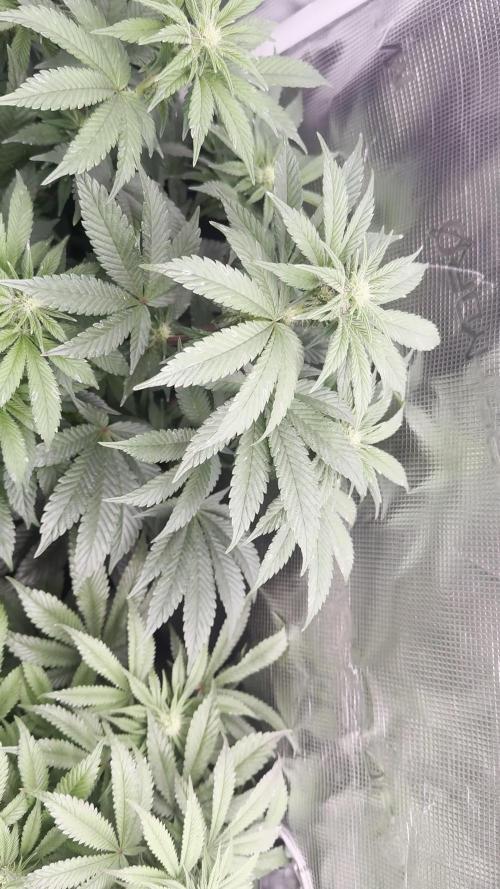
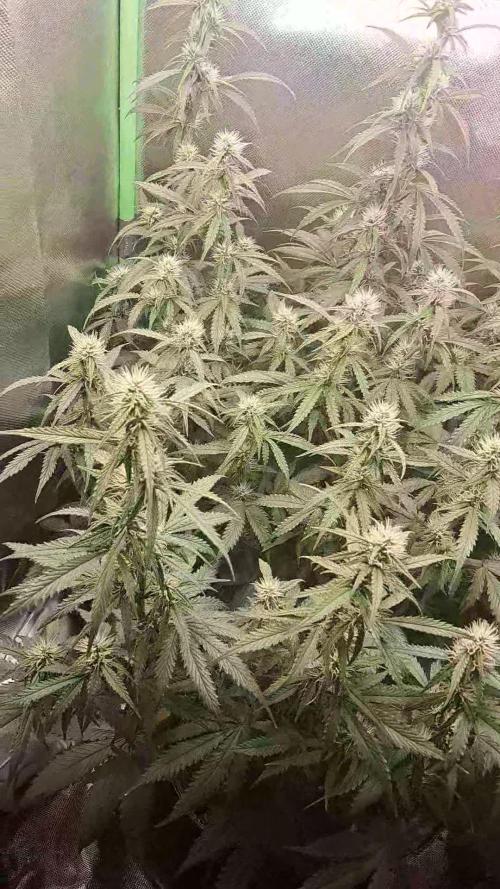
Sehr schöner gleichmäßiger Wuchs. Ich habe die Pflanze durch Supercropping auf ein relative homogenes Level gebracht und ich muss sagen. Es funktioniert einwandfrei. Außerdem habe ich die Haupttriebe mit Kunststoffbögen fixiert um weiteres abknicken zu verhindern.
Likes
4
Share
@Reisi
Follow
Bilder von Blütetag 28. An manchen Tagen trinkt sie jetzt 4 Liter Wasser. Wunderschöne Pflanzen 😍
Likes
28
Share
* ************** Week 7 - May 23 to 29, 2020 - Days 43 to 49 from germination **************** * This week she started to take more shape and came out of her ball form and standing up now. Side branches are still growing strong and reaching for the top of the canopy. Increased light intensity also as she is getting bigger and bushy with leaves now. She has increased her feed amounts this week and eating more now. She is happiest when her pot is dry and her leaves are up and praying. Heavy leaf strip and removed some lower nodes mid week. Letting her focus on growing the top nodes by removing lower points. Opened up the middle nice now and she is looking like a cannabis plant😀 Keep an eye on nitrogen though as she is green. She was getting choked out on the lower growth so removing some and letting the light in, the rest of the of sites should help her fatten up. Little more detail....... May 23/20, Day 43 - 3L feed - VeloKelp & Rezin & L.Wt & Sensyzime @ 1.5ml = 150ppm and 6.1pH - she is setting her buds but her leaves still look dark. - keeping ppm lower at 150. - main top reaching up more today. - Flower light switch turned on and raised the lights to increase intensity now. May 24/20 - Day 44 - Dry out day - Only two girls in the tent today so she should react well. - (GSC plants not flipping and moved to veg tent so made room in flower tent.) May 25/20 - Day 45 - fed twice today - 7:30am feed: 2L Sensyzime, Piranha, Rhino Skin, Rezin @ 1.5ml/L = 335ppm and 5.9 pH. - 8:30pm feed: Vitathrive & Velokelp @ 1.5ml/L = 350ppm and 5.8pH - heavy leaf strip today. May 26/20 - Day 46 - dry out day. - keep an eye on the girl because the last time the girl dried out she reacted well - noticed the inner growth is slightly brown around the edges. Buds/pistols are not very tall. Light should help with this. - still only two girls in the tent. May 27/20 - Day 47 - 3L feed: Mass&Terp @ 3ml/L, Rezin&LWt&Vita @ 1.5ml/L, CalMag&Rhino&Piran&D.F. @ 1ml/L = 1250ppm & 6.0pH - added more water to reduce ppm to 1080.........1250 a little high right now. - she was ready to be fed.....eating a little more now. - Her hairs are getting longer and reaching out more now......light helps😀 May 28/20 - Day 48 - 2L feed: Mass @ 4ml/L, Vita & Sensyzime @ 2ml/L, Dual Fuel @ 1.5ml/L = 1350ppm - little high so added water reduce ppm 1100 - She is taller and today and really looking nice. - She definitely likes it when her pot dries out. May 29/20 - Day 49 - dry out day - letting her be....she is happy😀 That wraps up another week. It has been great because she is really taking shape now and looking like the little girl I had in my mind👌
Likes
7
Share
@Hommero75
Follow
End of week 4 for the Purple Lemonade. She just got fed with Goldleaf feterlizer and cal-mag. So far no new changes. She keep growing slow, no signs of pre- flower. She's been a hand full. Leave are still getting the brown spots and dying even with cal-mag added to the feeding. Let's see how week 5 goes.
Likes
76
Share
Greetings, fellow cultivators! Week two in the flowering phase of the Pink Rozay expedition, and oh, what a captivating chapter it has been. Our queen is unfolding her floral tapestry with grace, filling up the space like a true botanical maestro. It's time to dive into the enchanting details of this week's developments. The mass defoliation that marked the transition into flowering has proven to be a strategic masterpiece. The Pink Rozay is now flourishing, and her majestic presence is felt throughout the room. The Scrog net, once a mere framework, is now a living canvas, painted with the vibrant hues of blooming potential. As I stroll through the green haven, I'm greeted by a sight that warms the heart – the Pink Rozay revealing her first signs of flower sites. It's a moment of pure botanical poetry, a promise of the visual symphony that is yet to unfold. The LED's spectrum, courtesy of Future Of Grow, continues to be the guiding light, coaxing out the innate beauty of each bud and leaf. Aptus Holland's NutriSpray, the botanical spa treatment, has been a ritual of care. The Pink Rozay, adorned with the organic surfactants and microelements like Manganese, Sulphur, Zinc, and Iron, is thriving in an atmosphere of nourishment and vitality. It's a dance of elements, a harmonious exchange between plant and nutrients. In the nutrient realm, the Pink Rozay is now enjoying the benefits of Aptus Holland's P-Boost. This phosphorus booster, 100% soluble in water, is the orchestrator of blooming processes. Enriched with organic acids, it not only stimulates protein, hormone, and vitamin production but also acts as a pH harmonizer. It's a delicate balance, and P-Boost is the maestro ensuring every note is in tune. And then, there's the switch from Startbooster to the entrancing Topbooster. This organic blend of bloom and maturation stimulation is the secret ingredient to enhancing the Pink Rozay's natural rhythms. Larger fruits with more fibres, resins, and sugars are on the horizon, promising a harvest that's not just abundant but a sensory delight. The Pink Rozay saga continues to unfold, and I'm thrilled to witness the dance of petals and fragrances reaching new heights. As always, immense gratitude to Aptus Holland for their nutrient mastery and to Future Of Grow for providing the illuminating backdrop to this botanical spectacle. Stay tuned, fellow growers, as we venture deeper into the floral enchantment. The Pink Rozay is flourishing, and I'm grateful to have you all on this radiant journey. Genetics -Pink Rozay @zamnesiaseeds https://www.zamnesia.com/7646-zamnesia-seeds-pink-rozay.html Nutrition - @aptusholland https://aptus-holland.com/ Led Power @ F.O.G. Future Of Grow https://www.thefuturofgrow.com/en/online-store/BLACK-SERIES-600-p489093171 As always thank you all for stopping by, for the love and for it all , this journey of mine wold just not be the same without you guys, the love and support is very much appreciated and i fell honored and blessed with you all in my life With true love comes happiness Always believe in your self and always do things expecting nothing and with an open heart , be a giver and the universe will give back to you in ways you could not even imagine so
Likes
2
Share
@blaze_fpv
Follow
Mid week 5 | the plant grows insane | looking extremely healthy | some really fat nugs start to form | way better than last time | I bought 2 full spectrum led panels for 15€ | now I have about 20W under canopy light 26 deg C 55% rlf 1200 ppm co2 about 750ppfd ---------------------------------------------------------------------------- Night time pics are all end of week 5 flower | under canopy light is going really strong| plants look really healthy | they evaporate a hell lot of water at the moment | buds are seriously swelling up | sugar starts to form rapidly | currently giving a really strong bubble gum candy scent 27 deg 50% 1200ppm co 2 ppfd didnt measure 😂 (light is set to 90%)
Likes
11
Share
Welcome to Week 8 of flower...... The plants have developed a more sour lemon scent. Which is pretty lovely to the nose. Both plants have really nice dense thick buds. Plant 1 is starting to show signs of fall colours. She has always had are lime green colour to her upper leaves. Now a beautiful red colour is appearing on the edges of leaves. Plant 2 the main colas have become so heavy that they are all leaning over. I've started introducing a bit of drought stress. Holding back between waterings. I'm hoping by doing this it will help to kick the girls into overdrive and start using stored sugars. It's seems to be working on plant 1 as the leaves are starting to yellow.
Likes
7
Share
@darb35
Follow
The runtz are about 45cm start of this week and the tall LCC is 75cm. She is also further into flower, but did not spread out so much in the tent. RAK seems to be very good with high PPFD, for the LCC they need a bit less I can feel.
Likes
5
Share
She's looking very very healthy and still trying to give her a perfect shape before I hit flower or before I changed the light cycle if you would. So let's see how this lady performs!
Likes
15
Share
@Chucky324
Follow
Hello. These is the last pics before harvest. I'll start harvesting tomorrow. Back in a couple of weeks with the harvest report and smoke report and total grams. OK. Keep Growing Straight. Chuck.
Likes
9
Share
- Plants are all looking very nice at this stage. - Flowering is well under way and the buds are developing nicely throughout this week. - Have not started LSTing 5th seed and it is growing very well - Last week of the MH Light. Switch to HPS for flowering stage
Likes
4
Share
Everything is doing good despite me not having ac at the moment! House has been staying at 85 degrees so the plants are happy at least. Plan on solving the ac issue by next week to start possibly flowering soon 🤞🤞. No health issues to report, just added another fx3 to the 3x3 to have 2 different phenos!
Likes
15
Share
Day 8 15-11-23 Change the pot to 1 Gallons ( Peatmoss + Soil + Vermiculite + Perlite) / Water PH 6.4 + B-Start Vitamin B-1 + Chemrich Cal - Mag + SV Bio Trichoderma (450ppm) Day 11 18-11-23 Water PH 6.4 + Chemrich Hydroponic A + Chemrich Hydroponic B + Honey Chome + Emerald Goddess + B-Start Vitamin B-1 (560ppm) Day 12 19-11-23 Water PH 6.4 + Chemrich Silica (280ppm) Day 13 20-11-23 Water PH 6.4 + Chemrich Humic (290ppm) Day 14 21-11-23 Water PH 6.4 + Chemrich Amino Acid (370ppm)
Likes
12
Share
day 38 stopped giving PK, carbs. only humic, folvic fishsh!t in watering. lifted terps video sticky icky video day 39 just humic and folvic into water. day42 bridal party gained a lot of weight, started to lean over blackberry. I feel like I could chop today.. slight chance might meet remo :)
Likes
17
Share
Animal Mints — Legends of the Frozen North ☃️ Part 1 — The Harvest Begins Before we begin this harvest report properly, we once again want to apologize for dividing this journey into multiple parts. Just like we did with the Legends of the 12/12 Galaxy series, the harvest, drying, trimming, curing, smoke review, and final strain analysis will happen across different weeks and different reports. But honestly… this is the only way we can truly document everything properly. We do not want to simply show the final dry buds and disappear. We want to show the process. The details. The decisions. The mistakes, the observations, the science, the emotions, the beauty, and the philosophy behind the work. Educational growing deserves time and space, and these girls absolutely earned it. So today marks the beginning of the final chapter for our Animal Mints — Legends of the Frozen North. And what a chapter this is. ⸻ From seed to harvest, these girls proved once again why 12/12 from seed continues to fascinate us so much. The morphology is incredibly efficient. Plants stay relatively compact compared to traditional long-vegetative runs, but what they lose in height, they repay with density, structure, resin production, and flower efficiency. The result? Compact giants. Dense towers of medicine. Heavy branches unable to support themselves anymore. Massive flowers held up by yo-yos because gravity simply started winning the battle. And honestly… this room became absolutely beautiful near the end. The senescence was fully setting in. The fade was impossible to ignore. During daytime photos and nighttime photos alike, the room transformed into a palette of autumn colors: * bright yellows, * faded lime greens, * soft oranges, * reddish and brownish tones, * curled leaves, * dry fans, * exhausted but fulfilled plants reaching the end of their biological cycle. And this is important to explain. A lot of growers panic when they see plants fading late in flower, but in many cases, especially near harvest, this is completely natural senescence. The plant understands its lifecycle is ending. Nutrients stored inside the leaves are being mobilized and redirected. Chlorophyll breaks down. Colors emerge. The plant slowly consumes itself while finishing resin and flower production. To us, this is one of the most beautiful moments in cultivation. Not death. Completion. ⸻ As always, we also harvest in darkness. Once the lights go off for the final night… they do not turn back on again. The plants remain in their night cycle until harvest. We personally prefer this approach because the plant is already in its resting metabolic state. The environment is cooler, calmer, and less stressful, and we avoid “waking the plant back up” only to cut it down shortly after. Before harvest, we also stop watering completely. We allow the substrate and the plant itself to dry naturally during the final stage. This helps reduce excess moisture inside the flowers and assists with the beginning of the drying process after harvest. ⸻ And speaking of flowers… These buds are enormous. Absolutely stacked. Rock solid. Frost-covered. Dense from top to bottom. The yo-yos became mandatory near the end because several branches simply could not support their own weight anymore. Every cola looked like it was carrying the entire weight of winter on its shoulders. Animal Mints truly lived up to its name. Frozen flowers. Heavy resin. Cold-looking trichome coverage everywhere. And despite the density, airflow management remained extremely important during the entire run. Defoliation timing, environmental control, humidity balance, and branch spacing all played a major role in making sure these flowers could mature safely without issues. ⸻ Of course, while removing dead leaves and cleaning the plants before hanging them whole for drying… something magical happened once again. Charas. That beautiful living resin slowly started building up on the fingers. And for those unfamiliar: Charas is one of the oldest forms of hashish production in the world. Traditionally associated with India and regions like Malana, charas is made by gently rubbing living cannabis flowers with the hands until the resin accumulates on the skin, later rolled into small resin balls by hand pressure alone. Unlike dry sift or modern extraction methods, charas is made from living plants. The resin is still alive, fresh, fragrant, warm, and incredibly aromatic. In places like Malana, ancient traditions surrounding charas still survive to this day. Entire generations preserved these techniques for centuries, often connected spiritually to Lord Shiva himself, who in Hindu mythology is deeply associated with cannabis. So every time we feel that resin slowly coating the gloves and fingers while handling living plants, it feels less like waste… and more like participating in something ancient. Something human. Something sacred. ⸻ The girls are now hanging whole. Full plants. Slow drying, exactly the way we prefer. For the first couple of days, humidity stays around 45% to help pull initial excess moisture away safely. After that, the environment stabilizes around: * 60% RH * 18–20°C And now begins one of the most important parts of the journey: patience. Over the next 7–10 days, chlorophyll will continue breaking down slowly, moisture will redistribute through the flowers, aromas will evolve, and the entire profile of the medicine will begin transforming. This is where harvest stops… and curing truly begins. ⸻ But this is far from the end. The next reports will focus deeply on: * drying observations, * trimming, * resin collection, * finger hash, * curing methods, * storage, * aromas, * textures, * smoke reports, * and the final strain review itself. And honestly… we still do not know how many parts this journey will require. Maybe two more. Maybe three. Maybe even four. But these girls deserve every detail. ⸻ As always, thank you to everyone following this journey and helping make these projects possible. Thank you to: * Zamnesia for the genetics, * Plagron for the nutrients and support, * F.O.G. for the lighting, * and everybody supporting this educational approach to cultivation. And of course… thank you to every grower, every reader, every silent observer, and every curious mind still exploring this incredible plant with respect, patience, and love. The Frozen North still has more stories to tell. As always, this is shared for educational purposes, aiming to spread understanding and appreciation for this plant. Let’s celebrate it responsibly and continue to learn and grow together. With true love comes happiness. Always believe in yourself, and always do things expecting nothing and with an open heart. Be a giver, and the universe will give back in ways you could never imagine. 💚 Growers love to all 💚
Likes
2
Share
67 days since April 16th, 2026 We become aware at such times of man's wonderful ability to bring seemingly unrelated elements into harmonic balance, and receive a glimpse into a world where everything exists in conscious sympathetic attunement to everything else. When we listen to a piece of music that seems to strike a beautiful chord somewhere inside us, or view a painting that simply glows with harmonic awareness well executed, we probably do not spare much time to contemplate the wonderfully intricate combination of vibrations that our sensors make it possible for us to perceive. We tend to appreciate the relationship between the parts of something by an awareness of the harmony or dissonance of the whole. This ability enables us to say "what a beautiful house!" instead of "analysis has proven that this collection of building materials exhibits certain elements of harmonic proportion." While this ability to instinctively appreciate the beauty of true harmony has an important role to play in evolution, a more analytical understanding of the laws involved can be most useful. This is especially so if we wish to create works of art where each part exists in true harmony, not only with the other part of that particular whole, but with the universe within which the creator and the created exist. Everything vibrates. From the most dense matter to the most subtle cosmic rays, everything which our senses allow our thoughts to become aware of, can be specified in terms of wavelength or frequency of vibration. These two terms define the same thing, but from different points of view. The following are the approximate wavelengths of various energy carriers: Cosmic rays 0.000,000,001 mm Gamma rays 0.000,000,1 mm X rays 0.000,500 mm Ultraviolet rays 0.003 mm Visible light 0.006 mm Infrared 0.01 mm Sound waves 1 meter Radio waves 300 meters Violet light 400 nm to 450 nm Blue light 450 nm to 500 nm Green light 500 nm to 570 nm Yellow light 570 nm to 590 nm Orange light 590 nm to 610 nm Red light 610 to 700 nm 1 nanometer (nm) = 0.000,000,1 cm = 1/10,000,000 cm If a guitar string is plucked and we hear a sound, it is not too difficult for the human mind to associate this sound with the vibration of the guitar string. With color it is quite different. It is difficult for us to conceive that the color of a substance is not an inherent property of the substance itself, but an indication picked up by our senses of that substance's ability to absorb or reflect the light which happens to be shining on it at that moment. Neither the matter nor the light is colored. What happens is that the brain learns to differentiate between the frequencies reflected or transmitted by the substance the eyes are focused on. The same thing happens with sound. When we say "Oh! Listen, they're playing my favorite song," what we really mean is: "My brain has stored within it a particular pattern of frequencies. I have compared the new information being received with this stored pattern and have deduced the answer that the two patterns are similar within certain specified tolerances." The 'pleasure' involved could have something to do with our running the pre-recorded pattern at the same time, in 'sympathy' with the new pattern as it is received. The word sympathy describes very well our ability to appreciate color and sound. It also describes the reason behind certain elements of harmony. For instance, if a substance vibrating at 100 cycles per second (tone 1) is in the proximity of another substance vibrating at 200 cycles per second (tone 2), we could perceive, if we had the right equipment, a certain sympathetic relationship between the two. We will see from this that there is a uniform doubling of the first tone seen in the second. At various points along the waves, the two are the same in amplitude. At other points, they are at opposite poles to each other. This doubled frequency has more points of similarity to the original than any other frequency except the original itself. If the equipment we had available for measuring these two frequencies was a soundboard amplifier and a pair of ears, then we would hear what would sound to us like one tone. If we had the opportunity to hear one at a time, we would hear that although they sound the same, one is higher in pitch than the other. This characteristic of 'the same but different in pitch', musicians have called the octave. Any two tones produced where one has exactly doubled the frequency of the other is called an octave. Speaking in ratios, an octave would appear then as the ratio 2:1 or 1:2, depending on whether we are talking of an octave up or down. A single note produced by almost any instrument will contain more than one wavelength or frequency. It will have a dominant frequency, the wavelength of which we would call the note's 'fundamental' or 1st harmonic. It will also have a varying number of upper harmonics, gradually fading in intensity into infinity or silence. Natural harmonics always have the same pattern of intervals between them. The interval between the 1st and 2nd harmonic is a perfect octave; between the 2nd and 3rd a perfect fifth; between the 3rd and 4th a perfect 4th; and so on, the intervals becoming smaller and smaller until they lose any relationship with the western 12 tone scale as it exists at the moment. Just as an octave has certain elements of sympathy with its fundamental, so some intervals have been noted to be more perfectly in sympathy with the fundamental than others. The ratio of the 'perfect 5th' or interval of 7 semitones, as it occurs in the harmonic series, is 3:2 or 2:3, while that of the 'perfect fourth" is 4:3 or 3:4. All the tones in the western 12 tone scale can be expressed in terms of the ratio between the upper tone and its fundamental. This would seem to be an ideal way of generating a scale from any given fundamental and several attempts have been made to do this, the Pythagorean system being probably the most well known. Although when working with a single tone instrument playing on its own, the Pythagorean formula works wonderfully well, if we had several instruments tuned this way together and asked them to play almost any western music, we would find that at times they sounded quite out of tune to each other. The lack of flexibility of the various scale systems based on the harmonic series has led to what is known as the 'tempered' scale. This uses as its primary unit of interval the ratio of the octave or 2:1. It then proceeds to divide the interval between any fundamental and its upper octave into 12 smaller intervals by applying the ratio: two to the one-twelfth power, to one (21/12:1). This equals 1.059463094, so by multiplying any frequency by this number, we will obtain the tempered semitone next up from our fundamental. We will also find that any tone twelve semitones up from any other tone, in a scale generated in this way, will have exactly double the frequency. If we took the note middle C on a piano and halved the wavelength, we would have the note C one octave above. If we halved this, we would have the C above, and so on. However, within about 6 octaves, we would find that although a 'sound' was being produced, no human ear could perceive it. If we kept on going, halving and producing upper octaves of our fundamental C, we would proceed through the infrared band, into the visible light spectrum. If we happened to be outside during the day, we would, for one octave only, see the note C with our eyes. The next octave above would already be in the ultraviolet band, and outside the eye's sensitivity range. If we can think of color as being an indication of a substance's vibratory rate or wavelength, we may begin to see a relationship that could exist between the color and sound spectrums. The logical extension of what has so far been said is that there exists a scale in the color spectrum that corresponds exactly to the scale in the sound spectrum, each color tone being an octave of the equivalent note in the sound range. This is not the end of the story but only the beginning. If we can for the moment accept that any wavelength in one band has upper and lower octave stretching out to infinity, then the next question is 'fine, but what shall we use as our fundamental? A particular color? A particular sound frequency?' The musicians among us will probably say 'A 440'. This means that the note A should vibrate at 440 Hertz, or 440 times per second. They would tell us that this is standard pitch has been adopted by most orchestras around the world; pianos are tuned to it, instruments are constructed to formulas based on it, and so to them it would probably seem the most appropriate place to begin. Some of these musicians may know of the battle that is still raging with regards to this being the standard, but few would know why A = 440 Hz was chosen except that it worked when it was set to be a suitable compromise between the many different pitches in use at the time. 432 Hz is said to be mathematically consistent with the patterns of the universe. Studies reveal that 432 Hz tuning vibrates with the universe’s golden mean PHI and unifies the properties of light, time, space, matter, gravity, and magnetism with biology, the DNA code, and consciousness. When our atoms and DNA start to resonate in harmony with the spiraling pattern of nature, our sense of connection to nature is said to be magnified. Another interesting factor to consider is that the A=432 Hz tuning correlates with the color spectrum, while the A=440 Hz is off. Audiophiles have also stated that A = 432 Hz music seems to be non-local and can fill an entire room, whereas A=440 Hz can be perceived as directional or linear in sound propagation. Once you adopt the idea that sound (or vibration in general) can have an equalizing and harmonizing effect (as well as a disturbing effect), the science of harmony can be applied to bring greater harmony into one's life or tune to specific energies. There is a form of absolute and relative harmony. Absolute harmony can, for example, be determined by the tuning of an instrument. The ancients tuned their instruments at an A of 432 Hz instead of 440 Hz - and for a good reason. There are plenty of music examples on the internet that you can listen to in order to establish the difference for yourself. Attuning the instrument to 432 Hz results in a more relaxing sound, while 440 Hz slightly tenses up the body. This is because 440 Hz is out of tune with both macro and micro cosmos. On the contrary, 432 Hz is in tune. To give an example of how this is manifested microcosmically: our breath (0,3 Hz) and our pulse (1,2 Hz) relate to the frequency of the lower octave of an A of 432 Hz (108 Hz) as 1:360 and 1:90. It is interesting to note that 432 Hz was the standard pitch of many old instruments and that it was only recently (19th and 20th century) the standard pitch was increased. This was done in order to be able to play for bigger audiences. Bigger audiences (more bodies) absorb more of the lower frequencies, so the higher pitch was more likely to “cut through”. One of the oldest instruments of the world is the bell ensemble of Yi Zeng (dated 423 BC), tuned to a standard F4 of 345 Hz, which gives an A= 432 Hz. The frequency of 345 Hz is that of the platonic year! Similarly, many old organs are tuned in A=432 as well; for example, St. Peter’s Capella Gregoriana, St. Peter’s Capella Giulia, S. Maria Maggiore in Rome. Maria Renold’s book “Intervals Scales Tones and the Concert Pitch C=128 Hz” claims conclusive evidence that 440 Hz and raising concert pitch above scientific “C” Prime=128 Hz (Concert A=432 Hz) disassociates the connection of consciousness to the body and creates anti-social conditions in humanity. The difference between concert pitch A=440 Hz and Concert A=432 Hz is only 8 cycles per second, but it is a perceptible difference of awareness in the human consciousness experience of the dream we share called existence.