


Likes
Comments
Share

@PEAKYPLANTERS
Follow
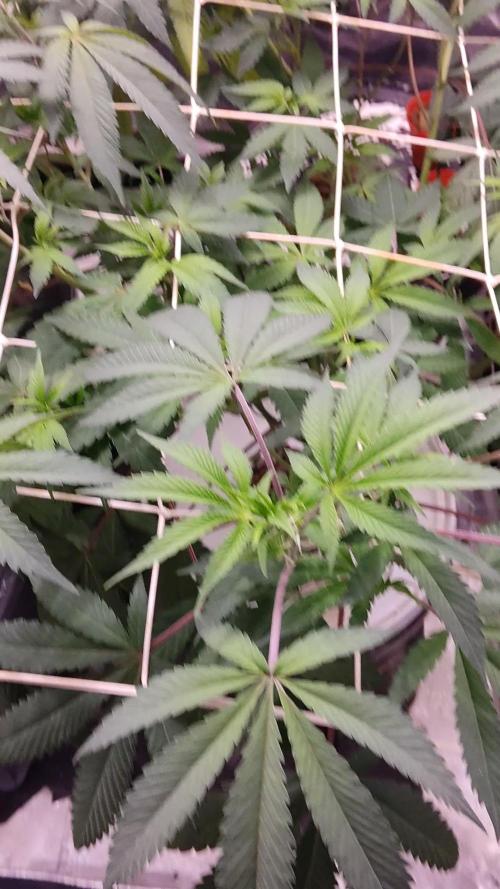
Guys, good evening...I've got it into my head now...I have to raise a fucking beast ! I'm still stretching this girl so we can make sure that when the tent is clear she will become the absolute queen.... It's not easy at all to run a dwc like this, but I'll try my best.

Likes
5
Share


@GrowDr
Follow
Day 16 : trichomes are starting to really show on newer leaves
Day 18 : starting to smell really good & stretch is continuing. Cultivar might stretch more then average.
Day 20 : Still stretching, nodal spacing is ok.

Likes
55
Share


@hawkeye_diesel66
Follow
So plan is now to water her one last time and then when she is mostly amber or a good 60/40 she'll be placed in a closet for 48 hours of darkness before the harvest so maybe another week or so. I want her to have the most amber trichomes I've tried to harvest at. I usually harvest once amber begins to appear, but I would like her to be more amber then the other gm I harvested to compare the outcomes.


Likes
22
Share


@MasterKush714
Follow
_ ___ _👹YOOOO WHAT UP GANG👹!!!!! SOOO 2ND WEEK OF VEGETATION BEGINS!!!! ____________________ _______________ ____ ___ __ _ _
********************************************************************************************************************************************
..............................................................................................................................................................................................................................................................................
SOOO GUYS HERES THE UPDATE WE ARE NOW AT DAY 14 FROM GERMINATION START DATE, SO FAR SHE TOOK A HIT INITIALLY FORMING
LEAF STRUCTURE BUT SHE IS RECOVERING LIKE A CHAMP, ALSO I TRANSFERED HER INTO THE LARGE FABRIC BUCKET (TECHNICALLY I SAID
I WOULD TRANSFER AT WEEK 3 BUT I DECIDED PHUCK IT AND TRANSFERED, NOW WAITING FOR HER TO RECOVER THIS WEEK WITH CONSTANT
DAILY WATERING BUT NOT HEAVY VERY LIGHT UNTIL SHE STRETCHES A BIT MORE, THEN GOING TO BE ADDING MORE NUTRIENTS INTO THE SYSTEM WITH FOOP NUTRIENT LINE THIS WEEK THANKS! 😎_______-----_____------___------____________________________________--------------------_______________________-----______-----_-_____
++++++++++++++++++++++++++++++++++++++++++++++++++++++++++++++++++++++++++++++++++++++++++++++++++++++++++
09/22/2023 UPDATE GUYSS!!!!!!!!!!!!!!!!!!!!!!!!!!!!!!!!
SOOOOOO SHE IS REALLY REALLY PROGRESSING AND COMING OUT OF HER SHELL * PUN INTENDED HAHA*😆
STARTED HER ON THE FIRST FEEDING OF NUTE'S WITH FOOP!!!!!!!!!! ( DO NOT SLEEP ON THEM!!!!!!!!!!!)))))
SHE IS REALLY TAKING OFF SO YEA OTHER THEN THAT GOING TO SWITCH TO THE MIGRO ARAY 2 + RED IN ABOUT A WEEK AND GO FROM THERE!!!!!!!!!!!!!!! THANKS!!!!
AS ALWAYS THANKS FOR STOPPING BY ALL THE ADVICE AND HELP IS TRULY TRULY APPRECIATED I WANNA WISH YALL A GREAT RED EYED WEEKEND LFG!!!!!!!!!!!!!!!!!!!!👹
++++++++++++++++++++++++++++++++++++++++++++++++++++++++++++++++++++++++++++++++++++++++++++++++++++++++++++++
________________________________________________________________------------------------------__________________________------------------------___________________________---------

Likes
23
Share


@Horseluisweed
Follow
Esta semana más de lo mismo aunque aún no ha terminado...jeje, le tuve que quitar el poso de café xq se le puso una pelusilla un tanto sospechosa(y mejor prevenir que curar ☝️)voy a hacerle un té de hummus, al volver el último fin de semana la he visto con los colores ligeramente más claros en algunas hojas(no sé si falta de nitrógeno o si es un problema de Ph)🤔, estoy planteandome poner mas luz y poner ventilación,🧐 al final de esta semana además quizá empiece a oler a ortiga en la habitación (ojalá 🎃☝️🕺)
🙌👌Quiero que crezca como la levadura!!!!🌵😋

Likes
55
Share


@deFharo
Follow
Bienvenidos cultivadores de marihuana clandestinos, y también, a los que tienen la fortuna de no serlo!🖐️👨🌾
PROBLEMAS: ayer detecté alrededor y dentro de la cáscara de la semilla ácaros, sólo en esta maceta, espolvoreé tierra de diatomeas, pero reconocí los síntomas, hoy había más bichos comiéndose el brote y ya lo habían desprendido del minúsculo tallo, me ha ocurrido otras veces y no me gusta, es un síntoma claro de semillas viejas o mal almacenadas. He quitado la semilla y el sustrato alrededor, he revisado con lupa el sustrato superior y he puesto otra semilla a germinar, he actualizado la fecha de germinación, ya veremos que pasa.
ROYAL PURPLE KUSH, sativa dominante de altura corta y puede que aporte algún color a la temporada. El crecimiento vegetativo es vigoroso y permite una infraestructura abundante, lo que da como resultado múltiples colas "castillo" grandes, fragantes e incrustadas de THC.
El distintivo sabor dulce de la madre Black Afghani se ve realzado por los sabores picantes y frutales del padre Bubba Kush Kush, lo que le da a Royal Purple Kush un sabor complejo y de otro mundo que debe experimentarse. El subidón es bien equilibrado, a la vez enérgico y sereno... viva sativa!!
=====================================================================
Comienzo la temporada de cultivos de primavera/verano, con la mismas ganas y emoción de siempre, muchas sativas dominantes para aprovechar el fantástico sol de primavera durante toda la etapa de crecimiento vegetativo, cultivaré en modo mixto interior/exterior hasta la floración, procuraré que las plantas tengan la mayor cantidad de horas de luz posible y como voy a tener que mover mucho las macetas del interior al exterior, voy a cultivar en macetas de 10L para no partirme la espalda.
También voy a estrenar tres nuevos Bio Fermentados Solubles basados en Microorganismos de Montaña (MM) y Pasto Fermentado para crecimiento vegetativo y otros dos para floración y que están en fermentación anaeróbica desde el 18/06/22, también otros hidrolizados enzimáticos de aminoácidos e hidrolizados potásicos complejos de ácidos húmicos y fúlvicos con minerales, conforme los vaya abriendo hablaré sobre ellos... pero aviso, esta temporada voy a muerte, sin piedad, quiero experimentar hasta donde puedo llegar con alimentación forzada en macetas, no busco amigos, busco cultivos descomunales para llenar mi saco de marihuana...
He preparado un sustrato ligero, bien aireado, con perlita, fibra de coco, bocashi de algas, Biochar con MM y humus de lombriz; lo puse en macetas de tela de 0.45L (7x12cm) porque quiero trasplantar cuanto antes a la maceta definitiva.
Hice una mezcla de riego para humedecer todo el sustrato: Agua de manantial de montaña con miel natural de brezo (azúcares, enzimas, minerales, vitaminas...), auxinas caseras de frijol negro (hormonas, enraizante) y 1% de mi Bio Mix para crecimiento vegetativo con Microorganismos Eficientes (EM), minerales y nutrientes básicos, con esta mezcla comienzo la inoculación de microbiología al sustrato, la miel es un excelente enraizante y aporta energía a los Microorganismos para que se propaguen... a continuación elegí la semilla más bonita y la enterré en el sustrato y se dejó ver a los 9 días, las bajas temperaturas retrasaron la germinación de todas las semillas de esta temporada, pero todas han germinado!
Al principio, encapsulo las macetas para mantener la humedad muy alta en la maceta y favorecer así la germinación, mantengo el encapsulado hasta que la plántula se ha desprendido totalmente de la cáscara de la semilla.
Después de 24h he comenzado a exponerla a la luz, durante la noche bajo la luz de la lampara Vipar P1000 al 20% de potencia (20w) y a unos 15cm de las macetas, por el día cerca de una ventana, evitando el sol directo... todo por la causa! 🖐️👨🌾😁
Hasta la próxima...
SALUDOS A TODOS!!
=================================
Info de la cepa ROYAL PURPLE KUSH: https://en.seedfinder.eu/strain-info/Royal_Purple_Kush/Emerald_Triangle/
"múltiples colas "castillo" grandes, fragantes e incrustadas de THC..." Emeral Triangle Seeds
- Genética: Black Afghani x Bubba Kush
- Dominancia sativa: 85% Sativa 15% Índica
- Tiempo de Floración: 8-9 semanas
- Rendimiento: 600-650gr/m2
- THC: Alto
==============

Likes
23
Share

@foxbberg
Follow
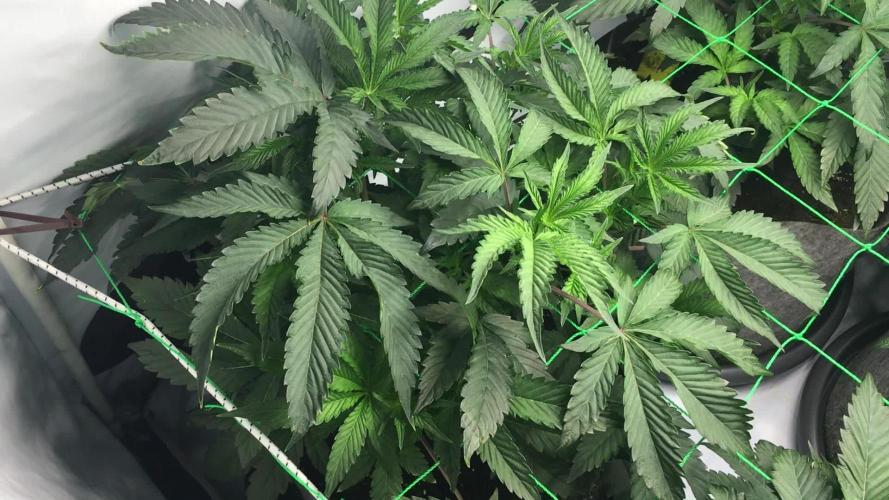
Day 29:
Low VPD due to shitty weather....... about 0.8 kPa at 23C.
Girls happy - nothin' to bend or weave today. Still dark green - no signs of overfeeding in new foliage.
Drain (average): pH 5.9; EC 2.7
Roots keep pentrating the pots.
👍
Day 30:
Girls happy - nothin' to bend or weave today. Still dark green - no signs of overfeeding in new foliage.
Drain (average): pH 5.8; EC 2.7
Roots keep pentrating the pots.
👍
Day 31:
Girls happy - nothin' to bend or weave today. Still dark green - no signs of overfeeding in new foliage.
Drain (average): pH 5.9; EC 2.7
Roots keep pentrating the pots.
👍
Day 32:
Did a little defoliation - just cut a few odd lookin' fanleafs and some smaller foliage at the bottom of the stem. 65g total.
Further i keep opening the canopy by moving some shoots to the next square of the net
Still watering daily. Plant 3 is way thirstier and bigger than the others. Plant 2 spills out the largest amounts of drain...... but she's not far behind them other girls.
Had to crank up the vent to get humidity out..... i'll keep defoliating carefully - that'll help it ;-)
Day 33 & 34:
Now they really wanna get tall...... since they so bushy, it's a bit tricky to feed them to the 'right' next square in the net....... LST-wise i have to admit, it would have been better to 'open' the canopy by binding the shoots down, instead of just flatten it out, by supercropping. Though it produces a lot of growth, it's kind of a chaos - hard to organize and almost impossible to open up for more light. Huge fanleafs pushing out everywhere. Plenty of foliage in the lower canopy - it's a mess somehow😶
Numbers in the drain are fine now (about 6.5; 1.2) so i'll start feeding nutrients again.
Day 35:
Fed nutrients - PH 6.4; EC 1.1
Drain (avg.): pH 6.3; EC 1.8
i'm taking out some leafs of different sizes - just a few at a day...... so there will be a bit more light and air over time......
Plans for week 6:
- Organize canopy/scrog
- carefully take leafs out
- keep checking for nutrient levels
Likes
11
Share


@AGrowerNotAShower
Follow
Man! I am definitely hooked on my new hobby. Harvested 96 grams of smokable bud and 93 grams of bud/leaves that I will be using to make dry ice hash. Took a third of that second weight (31 grams) to account for pure bud (which is more on the low end) and added to my 96 grams of good flower to get the 127 grams total. Made plenty of mistakes that I’m sure dropped my yield, the biggest being the lighting situation. Plants grew right into my light and even got bleached. The height of the plants made the outer colas grow past the high light areas, which made the buds very airy. But overall it was an amazing experience. I learned a lot of things, some that I have already incorporated on my second grow. And even with my drop in yield, I still ended up with more than enough flower to last me to my next harvest, so this was a great grow for me. Thanks to everyone who followed, liked, and commented. Your words were helpful and meaningful.
Likes
79
Share


@Salokin
Follow
Hi Growmies,
As the Epic Buzz family embarks upon week 14, a delicate ballet of color transformation pirouettes through the canopy. We are privileged to witness an entrancing fade, as the leaves segue into a tapestry of autumnal hues, signaling maturity and readiness. This aesthetic evolution is both a testament to genetic prowess and our vigilant care.
Epic Buzz #1: Towering with pride, #1 now exhibits a more seasoned character. Its colas, drenched in trichomes, are towers of potential, each a beacon of quality and potency. The plant's olfactory signature is potent; opening the tent unleashes a pungent fragrance so profound it dances through the air, reaching beyond the garden's confines.
Epic Buzz #2: A spectacle of resinous glory, #2 flaunts a frost-like coating that dazzles under the lights. Its buds, thick and lush, are a grower's dream, crafted by time and nature. The thick aroma that #2 exudes is nothing short of bewitching, wrapping the senses in an embrace that lingers.
Epic Buzz #3: With a verdant vibrance, #3 stands as a testament to the delicate interplay of nurture and nature. The fading of its foliage, from deep green to subtle amber and purple, speaks to the nearing end of a cycle. Each bud is a dense constellation of trichomes, forecasting a harvest rich in flavor and effect.
The environment within the tent is fine-tuned to near perfection, a balanced biosphere where each breath of air and beam of light is calibrated for cultivation excellence. The attentive dance of airflow from the fans, the precise hydration, and nutrient delivery—all converge to sustain this thriving microcosm.
As week 14 folds into the annals of this grow, we stand on the precipice of harvest, basking in the culmination of our Epic Buzz saga. The impending harvest is not just a collection of buds but a bouquet of experiences, a narrative of growth and a testament to the gardener's craft.
With hearts full and scissors ready, we prepare to transition from guardians of growth to shepherds of harvest.
Stay Lifted,
Salokin

Likes
24
Share


@Roberts
Follow
Melon Gum is doing great. I will likely be going to flowering next update. She is getting too big. She has not showen any maturity signs yet. Thanks again Pure Instinto, Spider Farmer, and Athena nutrition. 🤜🏻🤛🏻🌱🌱🌱
Thank you grow diaries community for the 👇likes👇, follows, comments, and subscriptions on my YouTube channel👇.
❄️🌱🍻 Happy Growing 🌱🌱🌱
https://youtube.com/channel/UCAhN7yRzWLpcaRHhMIQ7X4g.

Likes
5
Share


@70x70
Follow
Bisher lief fast alles problemlos und ich hab mich weiter am LST probiert.
Mir ist ein Ast komplett abgebrochen, aber ich konnte ihn wieder festmachen und er ist verwachsen. Allerdings ist der Ertrag sehr schlecht im Vergleich zu den anderen Ästen. (siehe Bild: Bruch)
Werde das nicht wieder versuchen.

Likes
15
Share


@World_Breeders
Follow
Pink Truffle is now fully established in week 4 of flowering, shifting from stretch into flower production. Bud sites are stacking consistently across the entire plant, with excellent spacing between nodes and a very open structure that maximizes light penetration and airflow.
The plant displays a classic spear-shaped architecture with multiple tops developing evenly. Flower formation is accelerating, pistil production is abundant, and the first signs of resin development are beginning to appear on the calyxes and surrounding sugar leaves.
Its elegant structure and uniform bud set suggest excellent potential for the coming weeks, where flower density, terpene production, and resin output will become the main focus.
Seeds by World Breeders
Cultivated by Piperoots 🇲🇦 🌱🔥
Likes
36
Share


@HAPPYWEEDS
Follow
La planta aguantó bastante bien todos mis fallos, finalmente no fue todo lo productiva que me habría gustado. Pero teniendo en cuenta todo lo que hice mal creo que puedo darme por satisfecho. Personalmente creo que debería haberla dejado crecer una semana más. Ya tengo todo preparado para mi segundo cultivo, en el cual incluiré muchas novedades (cepas, iluminación, nutrientes, etc). Esta vez detallaré mucho más todo el seguimiento del cultivo. Nos vemos pronto! 👽
Likes
33
Share


@BADKUSS
Follow
Hello everyone ,
Here is the phase of completed stretch, and the fertilizer fertilizer contribution are 100%, flowering starts very well and the appearance of the first pistil are visible everywhere.
For the height of the plants I find it reasonable and thus keeping all this world a good size the luminous penetration will be excellent ... until now hene no sign of problem for my plants I think that the flowering will follow its rhythm .. to see in the coming weeks ...
now place to photos ...

Likes
2
Share


@Ultraviolet_
Follow
We become aware at such times of man's wonderful ability to bring seemingly unrelated elements into harmonic balance, and receive a glimpse into a world where everything exists in conscious sympathetic attunement to everything else. When we listen to a piece of music that seems to strike a beautiful chord somewhere inside us, or view a painting that simply glows with harmonic awareness well executed, we probably do not spare much time to contemplate the wonderfully intricate combination of vibrations that our sensors make it possible for us to perceive. We tend to appreciate the relationship between the parts of something by an awareness of the harmony or dissonance of the whole. This ability enables us to say "what a beautiful house!" instead of "analysis has proven that this collection of building materials exhibits certain elements of harmonic proportion." While this ability to instinctively appreciate the beauty of true harmony has an important role to play in evolution, a more analytical understanding of the laws involved can be most useful. This is especially so if we wish to create works of art where each part exists in true harmony, not only with the other part of that particular whole, but with the universe within which the creator and the created exist.
Everything vibrates. From the most dense matter to the most subtle cosmic rays, everything which our senses allow our thoughts to become aware of, can be specified in terms of wavelength or frequency of vibration. These two terms define the same thing, but from different points of view.
The following are the approximate wavelengths of various energy carriers:
Cosmic rays 0.000,000,001 mm
Gamma rays 0.000,000,1 mm
X rays 0.000,500 mm
Ultraviolet rays 0.003 mm
Visible light 0.006 mm
Infrared 0.01 mm
Sound waves 1 meter
Radio waves 300 meters
Violet light 400 nm to 450 nm
Blue light 450 nm to 500 nm
Green light 500 nm to 570 nm
Yellow light 570 nm to 590 nm
Orange light 590 nm to 610 nm
Red light 610 to 700 nm
1 nanometer (nm) = 0.000,000,1 cm = 1/10,000,000 cm
If a guitar string is plucked and we hear a sound, it is not too difficult for the human mind to associate this sound with the vibration of the guitar string. With color it is quite different. It is difficult for us to conceive that the color of a substance is not an inherent property of the substance itself, but an indication picked up by our senses of that substance's ability to absorb or reflect the light which happens to be shining on it at that moment. Neither the matter nor the light is colored. What happens is that the brain learns to differentiate between the frequencies reflected or transmitted by the substance the eyes are focused on. The same thing happens with sound. When we say "Oh! Listen, they're playing my favorite song," what we really mean is: "My brain has stored within it a particular pattern of frequencies. I have compared the new information being received with this stored pattern and have deduced the answer that the two patterns are similar within certain specified tolerances." The 'pleasure' involved could have something to do with our running the pre-recorded pattern at the same time, in 'sympathy' with the new pattern as it is received.
The word sympathy describes very well our ability to appreciate color and sound. It also describes the reason behind certain elements of harmony. For instance, if a substance vibrating at 100 cycles per second (tone 1) is in the proximity of another substance vibrating at 200 cycles per second (tone 2), we could perceive, if we had the right equipment, a certain sympathetic relationship between the two.
We will see from this that there is a uniform doubling of the first tone seen in the second. At various points along the waves, the two are the same in amplitude. At other points, they are at opposite poles to each other. This doubled frequency has more points of similarity to the original than any other frequency except the original itself. If the equipment we had available for measuring these two frequencies was a soundboard amplifier and a pair of ears, then we would hear what would sound to us like one tone. If we had the opportunity to hear one at a time, we would hear that although they sound the same, one is higher in pitch than the other. This characteristic of 'the same but different in pitch', musicians have called the octave. Any two tones produced where one has exactly doubled the frequency of the other is called an octave. Speaking in ratios, an octave would appear then as the ratio 2:1 or 1:2, depending on whether we are talking of an octave up or down.
A single note produced by almost any instrument will contain more than one wavelength or frequency. It will have a dominant frequency, the wavelength of which we would call the note's 'fundamental' or 1st harmonic. It will also have a varying number of upper harmonics, gradually fading in intensity into infinity or silence.
Natural harmonics always have the same pattern of intervals between them. The interval between the 1st and 2nd harmonic is a perfect octave; between the 2nd and 3rd a perfect fifth; between the 3rd and 4th a perfect 4th; and so on, the intervals becoming smaller and smaller until they lose any relationship with the western 12 tone scale as it exists at the moment. Just as an octave has certain elements of sympathy with its fundamental, so some intervals have been noted to be more perfectly in sympathy with the fundamental than others. The ratio of the 'perfect 5th' or interval of 7 semitones, as it occurs in the harmonic series, is 3:2 or 2:3, while that of the 'perfect fourth" is 4:3 or 3:4. All the tones in the western 12 tone scale can be expressed in terms of the ratio between the upper tone and its fundamental. This would seem to be an ideal way of generating a scale from any given fundamental and several attempts have been made to do this, the Pythagorean system being probably the most well known. Although when working with a single tone instrument playing on its own, the Pythagorean formula works wonderfully well, if we had several instruments tuned this way together and asked them to play almost any western music, we would find that at times they sounded quite out of tune to each other.
The lack of flexibility of the various scale systems based on the harmonic series has led to what is known as the 'tempered' scale. This uses as its primary unit of interval the ratio of the octave or 2:1. It then proceeds to divide the interval between any fundamental and its upper octave into 12 smaller intervals by applying the ratio: two to the one-twelfth power, to one (21/12:1). This equals 1.059463094, so by multiplying any frequency by this number, we will obtain the tempered semitone next up from our fundamental. We will also find that any tone twelve semitones up from any other tone, in a scale generated in this way, will have exactly double the frequency.
If we took the note middle C on a piano and halved the wavelength, we would have the note C one octave above. If we halved this, we would have the C above, and so on. However, within about 6 octaves, we would find that although a 'sound' was being produced, no human ear could perceive it. If we kept on going, halving and producing upper octaves of our fundamental C, we would proceed through the infrared band, into the visible light spectrum. If we happened to be outside during the day, we would, for one octave only, see the note C with our eyes. The next octave above would already be in the ultraviolet band, and outside the eye's sensitivity range. If we can think of color as being an indication of a substance's vibratory rate or wavelength, we may begin to see a relationship that could exist between the color and sound spectrums.
The logical extension of what has so far been said is that there exists a scale in the color spectrum that corresponds exactly to the scale in the sound spectrum, each color tone being an octave of the equivalent note in the sound range.
This is not the end of the story but only the beginning. If we can for the moment accept that any wavelength in one band has upper and lower octave stretching out to infinity, then the next question is 'fine, but what shall we use as our fundamental? A particular color? A particular sound frequency?' The musicians among us will probably say 'A 440'. This means that the note A should vibrate at 440 Hertz, or 440 times per second. They would tell us that this is standard pitch has been adopted by most orchestras around the world; pianos are tuned to it, instruments are constructed to formulas based on it, and so to them it would probably seem the most appropriate place to begin. Some of these musicians may know of the battle that is still raging with regards to this being the standard, but few would know why A = 440 Hz was chosen except that it worked when it was set to be a suitable compromise between the many different pitches in use at the time.
432 Hz is said to be mathematically consistent with the patterns of the universe. Studies reveal that 432 Hz tuning vibrates with the universe’s golden mean PHI and unifies the properties of light, time, space, matter, gravity, and magnetism with biology, the DNA code, and consciousness. When our atoms and DNA start to resonate in harmony with the spiraling pattern of nature, our sense of connection to nature is said to be magnified.
Another interesting factor to consider is that the A=432 Hz tuning correlates with the color spectrum, while the A=440 Hz is off. Audiophiles have also stated that A = 432 Hz music seems to be non-local and can fill an entire room, whereas A=440 Hz can be perceived as directional or linear in sound propagation.
Once you adopt the idea that sound (or vibration in general) can have an equalizing and harmonizing effect (as well as a disturbing effect), the science of harmony can be applied to bring greater harmony into one's life or tune to specific energies. There is a form of absolute and relative harmony. Absolute harmony can, for example, be determined by the tuning of an instrument. The ancients tuned their instruments at an A of 432 Hz instead of 440 Hz - and for a good reason. There are plenty of music examples on the internet that you can listen to in order to establish the difference for yourself.
Attuning the instrument to 432 Hz results in a more relaxing sound, while 440 Hz slightly tenses up the body. This is because 440 Hz is out of tune with both macro and micro cosmos. On the contrary, 432 Hz is in tune. To give an example of how this is manifested microcosmically: our breath (0,3 Hz) and our pulse (1,2 Hz) relate to the frequency of the lower octave of an A of 432 Hz (108 Hz) as 1:360 and 1:90.
It is interesting to note that 432 Hz was the standard pitch of many old instruments and that it was only recently (19th and 20th century) the standard pitch was increased. This was done in order to be able to play for bigger audiences. Bigger audiences (more bodies) absorb more of the lower frequencies, so the higher pitch was more likely to “cut through”. One of the oldest instruments of the world is the bell ensemble of Yi Zeng (dated 423 BC), tuned to a standard F4 of 345 Hz, which gives an A= 432 Hz. The frequency of 345 Hz is that of the platonic year! Similarly, many old organs are tuned in A=432 as well; for example, St. Peter’s Capella Gregoriana, St. Peter’s Capella Giulia, S. Maria Maggiore in Rome.
Maria Renold’s book “Intervals Scales Tones and the Concert Pitch C=128 Hz” claims conclusive evidence that 440 Hz and raising concert pitch above scientific “C” Prime=128 Hz (Concert A=432 Hz) disassociates the connection of consciousness to the body and creates anti-social conditions in humanity.
The difference between concert pitch A=440 Hz and Concert A=432 Hz is only 8 cycles per second, but it is a perceptible difference of awareness in the human consciousness experience of the dream we share called existence.
Likes
24
Share


@TheGreenLeopard
Follow
sound week on the soil. this grow is really lovely. starting to see some promising bud sites. I think i might trim too much but i want the buds to get the light. topped them and they recovered very fast. still yet to see some purple. dont want to mess with pH just yet
