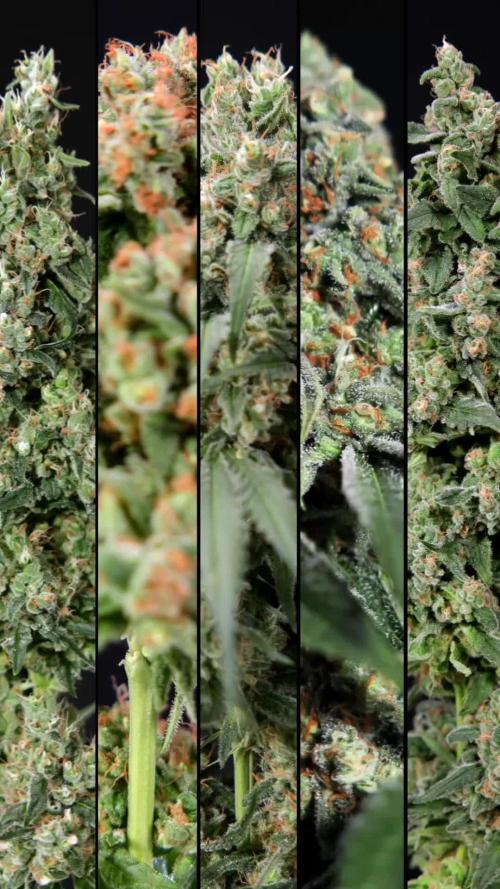
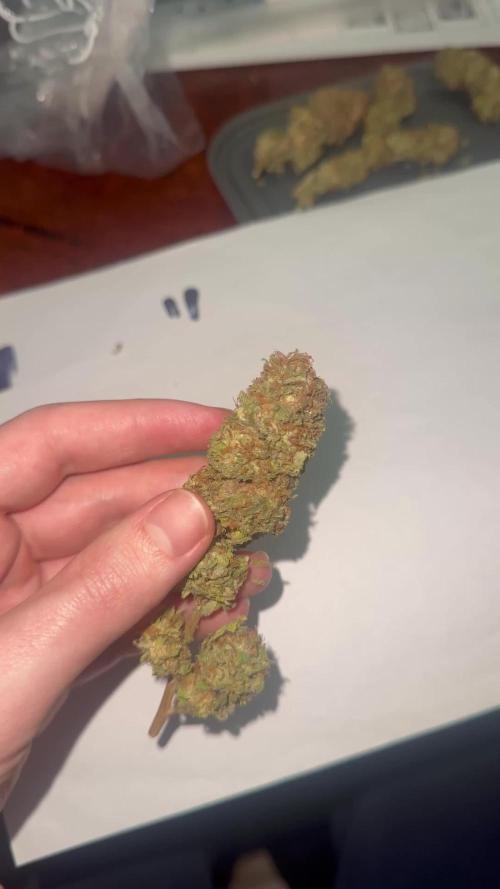
Check the winners The Grow Awards 2026 🏆
Likes
Comments
Share
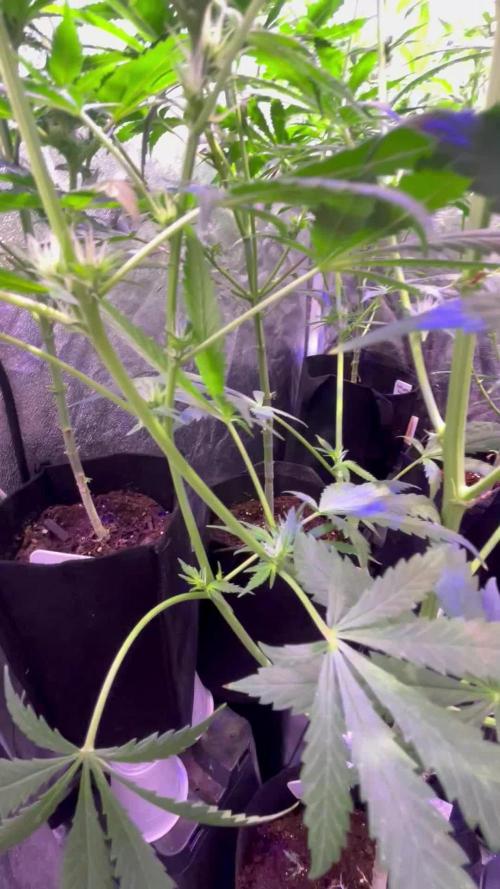
4th week of flower, things started to bulking up Delofiated a bit to even the canopies as much as I can These mf mimosa is still growing💀💀💀 cant do much about it, thinked about doing some super cropping to even the canopy but as i dont have an automatic watering system its not a good idea to put a scrog net, as im not gonna be able to water them at all
Likes
13
Share
@kakanero
Follow
I try Topping first time, I hope I've done everything right. The plant, its structure and color are still perfect :)
Likes
47
Share
2nd net is up. Early bud formations are promising. holding up to the extremes pretty well, some leaves taking minor damage, but overall, she is holding up, gave her 1 night at 50F see how she would react, stressful. Not advised as it messes with her metabolism, but I want to see if it triggers any anthocyanin response. Love to see her purp up but no signs yet. Remember, For every molecule of glucose produced during photosynthesis, a plant needs to split six molecules of water. This process provides the hydrogen needed for synthesizing glucose and other organic compounds, while oxygen is released as a byproduct. Homework. If Rubisco activity is impaired and it cannot properly function or regenerate its substrate, the plant's leaves are likely to turn a pale green or lime green, a condition known as chlorosis. Essentially, Rubisco activity is highly regulated and susceptible to various environmental and metabolic factors that can cause it to become inhibited, leading to an apparent failure in RuBP regeneration due to a lack of consumption. Rubisco regeneration is intrinsically linked to nitrogen supply because Rubisco is a major sink for nitrogen in plants, typically accounting for 15% to over 25% of total leaf nitrogen. The regeneration phase itself consumes nitrogen through the synthesis of the Rubisco enzyme and associated proteins (like Rubisco activase), and overall nitrogen status heavily influences the efficiency of RuBP regeneration. RuBisCO is a very large enzyme that constitutes a significant proportion (up to 50%) of leaf soluble protein and requires large investments in nitrogen. Insufficient nitrogen supply limits the plant's ability to produce adequate amounts of RuBisCO, thereby limiting the overall capacity for photosynthesis and carbon fixation. Maintaining the optimal, slightly alkaline pH is crucial for the proper function and regeneration of Rubisco. Deviations in either direction (too high or too low) disrupt the enzyme's structure, activation state, and interaction with its substrates, leading to decreased activity and impaired RuBP regeneration. (Lime/yellowing) Structural Component: Nitrogen is an essential building block for all proteins, and the sheer abundance of the Rubisco protein makes it the single largest storage of nitrogen in the leaf. Synthesis and Activity: Adequate nitrogen supply is crucial for the synthesis and maintenance of sufficient Rubisco enzyme and Rubisco activase (Rca), the regulatory protein responsible for maintaining Rubisco's active state. Nitrogen deficiency leads to a decrease in the content and activity of both Rubisco and Rca, which in turn limits the maximum carboxylation rate, Vmax, and the rate of RuBP regeneration Jmax, thus reducing overall photosynthetic capacity. Nitrogen Storage and Remobilization: Rubisco can act as a temporary nitrogen storage protein, which is degraded to remobilize nitrogen to other growing parts of the plant, especially under conditions of nitrogen deficiency or senescence. Nitrogen Use Efficiency (NUE): The allocation of nitrogen to Rubisco is a key determinant of a plant's photosynthetic nitrogen use efficiency (PNUE). In high-nitrogen conditions, plants may accumulate a surplus of Rubisco, which may not be fully activated, leading to a lower PNUE. Optimizing the amount and activity of Rubisco relative to nitrogen availability is a target for improving crop NUE. Photorespiration and Nitrogen Metabolism: Nitrogen metabolism is also linked to the photorespiration pathway (which competes with carboxylation at the Rubisco active site), particularly in the reassimilation of ammonia released during the process. To increase RuBisCO regeneration, which refers to the process of forming the CO2 acceptor molecule Ribulose-1,5-bisphosphate (RuBP) during photosynthesis, the primary methods involve optimizing the levels and activity of Rubisco activase (Rca) and enhancing the performance of other Calvin-Benson-Bassham (CBB) cycle enzymes. Biochemical and Environmental Approaches: Optimize Rubisco Activase (Rca) activity: Rca is a crucial chaperone protein that removes inhibitory sugar phosphates, such as CA1P (2-carboxy-D-arabinitol 1-phosphate), from the Rubisco active site, thus maintaining its catalytic competence. •Ensure optimal light conditions: Rca is light-activated via the chloroplast's redox status. Adequate light intensity ensures Rca can effectively maintain Rubisco in its active, carbamylated state. •Maintain optimal temperature: Rca is highly temperature-sensitive and can become unstable at moderately high temperatures (e.g., above 35°C/95F° in many C3 plants), which decreases its ability to activate Rubisco. Maintaining temperatures within the optimal range for a specific plant species is important. •Optimize Mg2+ concentration: Mg2+ is a key cofactor for both Rubisco carbamylation and Rca activity. In the light, Mg2+ concentration in the chloroplast stroma increases, promoting activation. •Manage ATP/ADP ratio: Rca activity depends on ATP hydrolysis and is inhibited by ADP. Conditions that maintain a high ATP/ADP ratio in the chloroplast stroma favor Rca activity. Enhance Calvin-Benson-Bassham (CBB) cycle enzyme activity: The overall rate of RuBP regeneration can be limited by other enzymes in the cycle. •Increase SBPase activity: Sedoheptulose-1,7-bisphosphatase (SBPase) is a key regulatory enzyme in the regeneration pathway, and increasing its activity can enhance RuBP regeneration and overall photosynthesis. •Optimize other enzymes: Overexpression of other CBB cycle enzymes such as fructose-1,6-bisphosphate aldolase (FBA) and triose phosphate isomerase (TPI) can also help to balance the metabolic flux and improve RuBP regeneration capacity. Magnesium ions, Mg2+, are specifically required for Rubisco activation because the cation plays a critical structural and chemical role in forming the active site: A specific lysine residue in the active site must be carbamylated by a CO2 molecule to activate the enzyme. The resulting negatively charged carbamyl group then facilitates the binding of the positively charged Mg2+ion. While other divalent metal ions like Mn2+ can bind to Rubisco, they alter the enzyme's substrate specificity and lead to dramatically lower activity or a higher rate of the non-productive oxygenation reaction compared to Mg2+, making them biologically unfavorable in the context of efficient carbon fixation. The concentration of Mg2+ in the chloroplast stroma naturally increases in the light due to ion potential balancing during ATP synthesis, providing a physiological mechanism to ensure the enzyme is activated when photosynthesis is possible. At the center of the porphyrin ring, nestled within its nitrogen atoms, is a Magnesium ion (Mg2+). This magnesium ion is crucial for the function of chlorophyll, and without it, the pigment cannot effectively capture and transfer light energy. Mg acts as a cofactor: Mg2+ binds to Rubisco after an activator CO2 molecule, forming a catalytically competent complex (Enzyme-CO2-Mg2+). High light + CO2) increases demand: Under high light (60 DLI is a very high intensity, potentially saturating) and high CO2, the plant's capacity for photosynthesis is high, and thus the demand for activated Rubisco and the necessary Mg2+ cofactor increases. Mg deficiency becomes limiting: If Mg2+ is deficient under these conditions, the higher levels of Rubisco and Rubisco activase produced cannot be fully activated, leading to lower photosynthetic rates and potential photo-oxidative damage. Optimal range: Studies show that adequate Mg2+ application can enhance Rubisco activation and stabilize net photosynthetic rates under stress conditions, but the required concentration is specific to the experimental setup. Monitoring is key: The most effective approach in a controlled environment is to monitor the plant's physiological responses e.g., leaf Mg2+ concentration, photosynthetic rate, Rubisco activation state, and adjust the nutrient solution/fertilizer to maintain adequate levels, rather than supplementing a fixed "extra" amount. In practice, this means ensuring that Mg2+ is not a limiting factor in the plant's standard nutrient solution when pushing the limits with high light and CO2. Applying Mg2+ through foliar spray is beneficial to Rubisco regeneration, particularly in alleviating the negative effects of magnesium (Mg) deficiency and high-temperature stress (HTS). While Mg can be leached from soil, within the plant it is considered a mobile nutrient, particularly in the phloem. Foliar-applied Mg is quickly absorbed by the leaves and can be translocate to other plant parts, including new growth and sink organs. Foliar application of: NATURES VERY OWN MgSO4 @ 15.0g L-1 in a spray bottle. For those high-intensity workouts when 1 meal a day is just not enough! Foliar sprays are often recommended as a rapid rescue measure for existing deficiencies or as a supplement during critical growth stages, when demand for Mg is high. Application in the early morning or late evening can improve absorption and prevent leaf burn. The plant was getting a little limey yellow in the centre. Shortly thereafter, she was back in business, green mostly regenerated. The starting point [of creativity] is curiosity: pondering why the default exists in the first place. We’re driven to question defaults when we experience vuja de, the opposite of déjà vu. Déjà vu occurs when we encounter something new, but it feels as if we’ve seen it before. Vuja de is the reverse—we face something familiar, but we see it with a fresh perspective that enables us to gain new insights into old problems. Confidence is evidence... nothing more. You are confident because you have driven 10,000 times, you are confident because you have spoken 10,000 times. People think confidence is a feeling, but it's not. If you want more confidence, then you need to create evidence, take more shots, collect more data, build more experiences, take more risks; fail, confidence doesn't come first; it is the reward you get for doing the work. no one else wants to do.
Likes
14
Share
D64/F12 - 11.18 - Been a really incredible week for these ladies. All of them are thriving with lovely prebuds <3 D67/F15 - 11.21 - Lovely progress. Even the least beautiful plant in the garden is reaching above the peony rings :) D70/F18 - 11.24 - Pretty aggressive defoliation on these ladies today. They responded great last round, so I expect to see the start to put a lot of weight on soon. The black sugars (second column of three from the left) we way more leafy than the fast white widows
Likes
66
Share
Welcome to my Dutch Passion Diaries Competition 2025 entry! For this competition, I’ve chosen the Indoor Feminized strain: Ice Cream Haze Media from Week 21 or Flower week 10 and Havest time Here’s what I’m working with for the Final Tent after Moving for the Flower time : • 🌱 Tent: 220x150x150 • 🧑‍🌾 Breeder Company: Dutch Passion • 💧 Humidity Range: 40 • ⏳ Flowering Time: 8W-10W • Strain Info: 20-25%THC, Sativa • 🌡️ Temperature: 26 • 🍵 Pot Size: 0.5l • Nutrient Brand: Narcos • ⚡ Lights : 720W x 2 Dimmed to 400w Each at the Moment. Because of Heatwave ⭐ A huge thank you to Dutch Passion for allowing me to be a part of this amazing competition and for supporting the grower community worldwide! Your genetics and passion speak for themselves! Curious to try these strains for yourself? You can check them out and support me at the same time through my personal link: https://dutch-passion.com/?a_aid=GGD I would truly appreciate every bit of feedback, help, questions, or discussions – and of course, your likes and interactions mean the world to me as I try to stand out in this exciting competition! Let’s grow together – and don’t forget to stop by again to see the latest updates! Happy growing! Stay lifted and stay curious! Peace & Buds!
Processing
Likes
5
Share
@Ensign420
Follow
Week 02 Introduction This week has been a bit of a struggle. Had my first experience dealing with slime and brown algae. But I think adding enzymes and increasing the beneficial bacteria helped to fix the issue. Also experienced nutrient burn for the first time. My nutrient solution strength got as high as 671 PPMs. So backed it down to about 430 PPMs during the end-of-week reservoir change. Also cut Hydroguard (expired?), CaliMagic, and Superthrive from this grow. Now she's still stunted, but is starting to recover. Hopefully... [START OF WEEK 02] Day 01 - Monday - 08/10/20 - Total Days: 008 ----------------------------------- - [0830]: Still looks a bit yellow. But getting larger! --- Solution strength was at 248 PPMs. --- Just topped off with a bit of distilled water --- PH went up to 6.1 so PH'd down to 5.8 --- Ran the top feed for a bit to wet the hydroton. - [2130]: She's looking even more yellow now. --- Even the new leaves are really yellow. --- Decided to add more base nutes. --- Added 4ml of Sensi A --- Added 4ml of Sensi B --- Now at about --- Solution Strength went up to 304 PPM. --- PH was at 6, --- Also raised the water level a bit more. --- I really hope it's a nutrient deficiency and not an over-watering issue. --- Please live! Day 02 - Tuesday - 08/11/20 - Total Days: 009 ----------------------------------- - [0830]: Looking less droopy. But still yellow. --- Decided to do a reservoir change. --- 4.5gal of distilled water --- 8ml of Sensi Grow A --- 8ml of Sensi Grow B --- 8ml of Voodoo Juice --- 4ml of B-52 --- 4ml of CaliMagic --- 4ml of Hydroguard --- 4 drops of Superthrive --- PH'd down to 5.8 --- Solution strength: 302 PPM --- Since I didn't want to risk over-watering the rockwool, I did not to do a top feed, may do one tonight after the sleep cycle (lights are still set to go off at 10am and back on at 4pm). --- As I was doing a reservoir change, I noticed that the tubes and bucket were a bit slimy. Didn't really stink or anything. Is this normal? Maybe due to the Hydroguard and Voodoo Juice? --- I hope she gets better soon! - [2215]: Getting larger! But still yellow. --- Also can see a root growing through the net pot! Tiny little thing but it's there! Will have to start dropping water once more appear. --- After looking over a few DWC diaries using AN nutes, seems like my solution strength is still too low. Most around this stage average around 500 PPMs with about 4ml per gallon. --- Top fed for a minute to wet the top of the hydroton. --- Solution strength went down to 263 PPM. --- Added 8ml more of Sensi A --- Added 8ml more of Sensi B --- Now base nutes are at 16ml for 4.5 gal of water. --- PPMs went up to 411. --- Still lower than 500 PPMs, but that's okay. --- PH was at 6. Not sure if I should adjust PH using AN nutes. So going to not ajdust unless PH goes above 6.1. Day 03 - Wednesday - 08/12/20 - Total Days: 010 ----------------------------------- - [0830]: Looks like more root growth! --- She still looks yellow. But leaves are perky. --- PH was at 6.2 so lowered down to 5.8. --- Solution strength was at 394 PPMs --- Since roots are still growing, I decide to lower the water level a bit. Now water level is a bit below the net pot. - [2200]: Root is getting longer! --- Slime is returning. Not sure why. --- Solution strength: 357 PPMs --- PH: 6.1 --- Decided to add an enzyme along with more beneficial bacteria to hopefully cure the slime. --- Added 16ml of Sensizym --- Added 5ml of Hydroguard --- Added 8ml of Voodoo Juice --- New solution strength: 430 PPMs --- New PH: 6.1 --- Top fed for a minute. --- This slimy residue is really freaking me out! I hope the added enzymes will help eliminate the slime. --- Going to do a full reservoir sterilization/nutrient change over the weekend. Please survive until then girl! Day 04 - Thursday - 08/13/20 - Total Days: 011 ----------------------------------- - [0930]: I think the enzymes worked! There is little to no slime now! --- Although I think the root was also dissolved in the process. It's now just a little stub sticking just below the net pot. The enzyme is also suppose to dissolved dead roots too but guess that root was too weak? Not sure what happened there. But I think the slime is cured! --- Solution strength went down to 395 PPMs. Decided to add more base nutrients. --- Added 8ml of Sensi A --- Added 8ml of Sensi B --- Added 4ml of B-52 --- Solution strength went up to 598 PPMs. --- PH was at 6.1 --- As long as the PH is between 5.5 and 6.3, I'm not going to use PH Up or Down. But still will monitor PH levels. - [1715]: Checked up on her after her nap and shes looking alive but stunted. But no slime! --- Decided to add some sugars to help maintain the enzymes and beneficial bacteria. --- Solution strength was at 587 PPMs. --- PH was at 6.2 --- Added 8ml of Bud Candy --- Solution strength went up to 671 PPMs. --- PH also went up to 6.3 --- Lowered water level a bit to hopefully promote more root growth. --- Top fed for a minute. --- She is getting bigger, but still looks yellow. Day 05 - Friday - 08/14/20 - Total Days: 012 ----------------------------------- - [0915]: Leaves look a little burnt on the tips. Still no slime. --- Going to back off on the PPMs to hopefully fix the nutrient toxicity. --- Solution strength was at 632 PPMs --- PH was at 6.3 --- Added/Removed water until PPMs were at 536. --- PH was still at 6.3 --- Raised water up a bit, then top fed for a minute. - [2200]: Looking better. Still yellow though. --- Solution strength: 514 PPMs --- PH: 6.5 --- Added PH down. --- New solution strength: 518 PPMs --- New PH: 5.2 --- PH was kind of high. So decided to PH down. Had to use quite a bit to bring it down. But eventually got it to drop down to 5.3. A little low, but so far, the PH has always gone up so wanted to start it really low. --- Ran the top feed for a minute to re-saturate the top of the hydroton. Day 06 - Saturday - 08/15/20 - Total Days: 013 ----------------------------------- - [0830]: She looks stunted. leaves are still yellow. --- Solution strength: 514 PPMs --- PH: 5.6 --- Top fed for a minute. --- Not sure what to do at this point. Going to do another reservoir change soon. Hoping she lives until then. - [2145]: Looking pretty much the same. --- A bit of slime has returned. Since I've been diluting the nutrient solution, the enzyme ratio has dropped. So I guess this is expected. --- Also noticed that slime build up was on the air-stones. Never really checked the stones so not sure how long that has been there. Looks brown too, which can't be good. --- Going to do an H202 sterilization of the system (minus the net pot) tomorrow so did not add anything. --- Lowered the water level to below the net pot. --- Then top fed for a minute. Day 07 - Sunday - 08/16/20 - Total Days: 014 ----------------------------------- - [0900]: STERILIZATION DAY! --- Decided to skip today's night cycle for a deep clean. --- I'm hoping that skipping a night cycle won't be too stressful. --- Temporarily moved her to a new bucket. --- Used about a half of gallon of straight distilled water to flush out the net pot. --- Drained the system and wiped up all the brown sludge. Also removed the air stones and cleaned up all the goo. --- Filled the system with 2 gallons of distilled water and at least 30ml of food grade hydrogen peroxide (35% strength). --- Yea its a lot, but since I'm not going to sterilize the system overnight, I went with a really high doseage. Basically I kept adding until I started to see little bubbles start to form. --- Then I ran the water pump. - [0915]: Boiled the air stones in tap water for about 10 min. Then reconnected them to the airlines. --- I let the air stones and hose soak in the sterilization solution for about 5 minutes so the peroxide can absorb into the stones. Then ran the air stone to help mix and agitate the solution. --- Occasionally, I'd repeat the process of turning the air pump off for a few minutes to let the stones soak. - [1000]: Covered the top two row of holes of the net pot with some aluminum tape. Hopefully this solves the light leaking in through the hydroton. - [1200]: Used an old toothbrush and scrubbed the pump clean. Then drained the system. --- Refilled with more distilled water and peroxide. Again added a lot. --- Ran system again to sterilize even more. - [1530]: Drained the system and refilled with distilled water to rinse. --- Ran the system for a few minutes, then drained and rinsed again. --- Did this a few more times over about an hour. - [1630]: Added 4 gallons of fresh distilled water. --- Added 15ml Sensi Grow A --- Added 15ml Sensi Grow B --- Added 12ml of B-52 --- Added 16ml of Voodoo Juice --- Added 16ml Sensizym --- Solution strength was at 430 PPMs --- PH was at 5.6 --- I was going to add Hydroguard, but I think the bottle is expired. Since 2017 or 2018!? I think Hydroguard is good for up to 2 years from the date on the bottle or 6 months after opening. So not going to use from now on. I wonder if this could have contributed to the slime build up. --- Also removed the CaliMagic and Superthrive too. Going to only use AN products to eliminate the chance of incompatible nutrients. --- Placed her back in the bucket and top fed for a minute. --- Here's hoping for the best. Going to let it ride until morning! Please feel better! [END OF WEEK 02]
Likes
12
Share
@most_dope
Follow
i was thinking about harvesting half and letting the bottom half finish but after chopping some of it i just ended up taking it all down. i knew i wouldnt get a crazy amount of weight from the early mess ups but im guessing it will be about 2 oz when dried. im happy with anything thats smokeable for a first time grower tho and i cant wait to get started on 2 more ladies :D im thinking maybe do the purple punch but this time use a 5 gallon pot so i can see her at her best ! the roots were sure cramped in this 2gallon lol. thanks for reading and following my journey :D
Likes
4
Share
Eccoci qui... Per problemi di lavoro ho tardato un pò la pubblicazione delle foto, la piccola purtroppo ha subito un forte stress durante le settimane precedenti e ad ora sta un pò meglio ma comunque ne ha risentito. E' la piccola con più resina e mi fa ben sperare nel risultato finale... Grazie a tutti per il supporto, NON VEDO L'ORA DI RACCOGLIERLA 🔥🌲❤️
Likes
32
Share
Processing
Likes
6
Share
Likes
31
Share
In Conclusion guys I just wished 2 out of the 3 ladies didn't stunt on me so I could have had more to harvest. But I am definitely getting alot better with my grows a definitely feel more confident in giving you guys reviews on my next strains that I have coming. Thanks for Watching & Happy Growing guys, any questions just ask 👍🏾
Likes
14
Share
Day 21. Looking good, been giving her general Hydroponics maxigro. Best all in one fertilizer on the market. Day 22. Lst and hst, removing 1 or 2 leafs per day to open her up. Day 27. Supercropped main cola. Looking good.
Likes
5
Share
@yerbatero
Follow
Como escribí anteriormente, no pensé en realizar un seguimiento, por lo tanto, no tengo fotos de todas las semanas. Desde esta semana sí llevaré un seguimiento. Estas fotos y videos son del día que inicia la semana 6. Desde el inicio de la floración, la planta ha multiplicado por tres aproximadamente su tamaño. El olor es riquísimo, como a frutas exóticas muy dulces. Fui demasiado ambicioso y le di demasiada vegetación considerando el pequeño espacio de la carpa. Como dispongo de muy poco espacio, quise aprovecharlo al máximo; todo el espacio está repleto de puntas, lo que no deja pasar mucha luz a los cogollos de abajo. Hay demasiada materia vegetal, por lo que, para evitar la aparición de hongos, tengo muy vigilada la humedad. La extracción de aire y la ventilación están encendidas casi todo el tiempo para evitar la botritis. Nos vemos la siguiente semana.
Likes
5
Share
Es wird jetzt in den Dryfembags getrocknet, aber es sind max 30g trocken
Likes
119
Share
Ahoy, green comrades and Power Buds enthusiasts! Gather 'round for the Week 5 Veg Report, where the saga of Jelousy continues to unfold in all its leafy glory. This week has been nothing short of spectacular, filled with growth, joy, and a touch of botanical magic. Now, brace yourselves for the root revelation – it was a week of root madness! Jelousy's roots decided to throw a green party of their own, growing with such vigor and enthusiasm that I couldn't resist but give her a grand ticket to her final pot. Yes, folks, the time has come for our green companion to settle into her permanent botanical abode. Let's talk about the grand ceremony – the transplantation. As always, I employed the mystical Aptus Holland Mycor Mix to accompany Jelousy on her journey. This mix isn't just a sprinkle of magic; it's a symphony of beneficial microorganisms, working in harmony with the plant. During transplanting, the mycorrhizal fungi in the mix establish a connection with Jelousy's roots, creating a dynamic partnership. They extend the root system, enhancing nutrient and water absorption, while Jelousy graciously provides them with sugars. It's like setting up a botanical support system, ensuring our green companion has everything she needs to flourish in her new and final home. Now, let's talk about a little gardening finesse – defoliation. As Jelousy reached for the skies, I decided to give her a little grooming session. Removing some of the older, lower leaves not only allows for better light penetration but also encourages the plant to focus its energy on the growing tips. It's like giving our green friend a botanical spa day, where she can channel her energy into the areas that truly matter. But wait, there's more! I couldn't resist taking a few clones. It's like preserving a piece of Jelousy's green magic for the future. Who knows, maybe we'll have a whole family of Jelousies thriving in the garden. And speaking of the garden, we've welcomed a new member – a little Buddha acting as the guardian of our growing oasis. He stands tall, radiating tranquility and showering blessings upon our flourishing green kingdom. He seems to be particularly fond of the tree growing beside him – our very own Jelousy. It's like having a silent guardian, watching over the botanical wonders unfolding. As we revel in the beauty of Week 5, let's extend our gratitude to Zamnesia and Plagron for guiding us through this enchanting journey. Their support is the wind beneath our leaves, propelling us toward horticultural greatness. A nod of appreciation to the vibrant Grow Diaries community – your shared passion and wisdom continue to enrich our collective knowledge. To my fellow contestants and growers, may your plants continue to thrive, and may the joy of cultivation accompany you through every green endeavor. Here's to a week of roots finding their home, leaves reaching for the heavens, and the garden flourishing under the watchful eye of our Buddha guardian. Stay green, stay inspired, and keep cultivating those dreams! As always, thank you all for stopping by, for the love and for it all. This journey of mine would just not be the same without you guys. The love and support are very much appreciated, and I feel honored and blessed with you all in my life !!! With true love comes happiness. Always believe in yourself and always do things expecting nothing in return, with an open heart. Be a giver, and the universe will respond in ways you can’t even dream of . Friendly reminder: all you see here is pure research and for educational purposes only. Genetics - Jelousy @Zamnesia Nutrients @Plagron Light - @viparspectra P2000 Room size - 3x3 - 0,9x0,9
Likes
86
Share
Greetings, fellow cultivators and enthusiasts of the green realm! Week 7 of our Apolo F1's botanical odyssey has unfolded with a sense of urgency, as she races towards harvest with astonishing speed. Join me as we delve into the world of autoflowers, where time bends and nature's clock reigns supreme. In the realm of autoflowers, time moves like a river, swift and unyielding. Our Apolo F1 is a testament to this enchanting phenomenon, progressing at a pace that defies expectations. With each passing day, she inches closer to her moment of glory, a testament to the genetic marvel that is the autoflower. The floral symphony reaches a crescendo as our green virtuoso enters the later stages of flowering. Buds swell and mature with remarkable speed, painting the canopy in hues of green and gold. It's a sight to behold, a testament to the accelerated growth and vitality inherent in autoflowers. Despite the rapid pace, we remain vigilant, knowing that nature's timing is the ultimate arbiter. While our Apolo F1 may be racing towards harvest, we must respect her journey and allow her to dictate the pace. The moon on harvest day beckons, but patience is the virtue that will ensure a truly celestial yield. As we marvel at the accelerated growth and breathtaking beauty of our Apolo F1, it's worth reflecting on the brilliance of autoflowers. These genetic marvels have revolutionized cultivation, offering a streamlined experience without sacrificing yield or quality. It's a testament to the ingenuity of nature and the boundless possibilities of genetic engineering. Amidst the whirlwind of growth, the nutrient-rich serenade persists. The transition from veg to flower mix continues to fuel our green companion's journey, ensuring she has all the nourishment needed to reach her full potential. The aqueous symphony plays on, a constant companion in this botanical adventure. A heartfelt thank you to Aptus Holland for crafting the nutrient symphony that fuels our green odyssey, and to Royal Queen Seeds for providing the genetic star of our celestial spectacle. The journey thus far has been nothing short of magical, and we continue to marvel at the wonders of nature's timekeeper. Join me in the next chapter of our Apolo F1 Mission Diary, where we'll witness the final sprint towards harvest and celebrate the culmination of this extraordinary journey. Until then, may your gardens flourish, and your green endeavors be ever blessed by the magic of autoflowers! Genetics -Apolo F1 @rqs_esp @royalqueenseedssp @rqsglobal Food - @aptusholland @aptus_world @aptus_es @aptus_portugal @aptusbrasil @aptusplanttechaus @aptus_thailand @aptusplanttechnz @aptususa_official LES @lumatekeu Controls - @trolmaster.eu @trolmaster.agro @trolmaster.support As always thank you all for stopping by, for the love and for it all , this journey of mine wold just not be the same without you guys, the love and support is very much appreciated and i fell honored and blessed with you all in my life With true love comes happiness .Always believe in your self and always do things expecting nothing and with an open heart , be a giver the universe will give back to you in ways you could not even imagine so #aptus #aptusplanttech #aptusgang #aptusfamily #aptustrueplantscience #inbalancewithnature #trueplantscience #rqs #ApoloMission #MoonHarvestAdventure #playwithlego #lego #legotime #legovideo #tothemoonandback More info and complete updates from all my adventures can be found - link in the profile description Friendly reminder all you see here is pure research and for educational purposes only Growers Love To you All 💚💚💚
Likes
3
Share
Still only giving her water, still in the solo cup for now. She's growing really nice with minimal effort 😎
Processing
Likes
3
Share
@Kushizlez
Follow
Day 19-26 (May 10th - May 17th) (Day 21) Stretch is almost over and the plants still look like they’re in veg. I’m seeing almost zero trichomes and when compared to my other room it’s laughable. At least the sites are starting to fill in a little. One plant is super leggy and stretchy. I’m guessing it’s Jack Herer but won’t know until late flower or harvest. The plant in the far left corner has great structure and thick pistil clumps. I’m guessing it’s either blueberry or the white og. Blueberry has a pretty distinct smell so differentiating all the strains won’t be that hard actually. (Day 24) I’ve been rearranging the plants once in a while just to get all sides exposed to some decent light. I never realized how much I value my LED until this run. The only way I would ever use another hps for flower is if it was one of those 1000w DE lights that all the commercial grows use. Sites are starting to fill in quite a bit now. Trichomes are still non existent though. Even on the archive genetics which is really surprising. (Day 25) Pots somewhat dried out finally. Tomorrow I’m going to leach everything with another 2 liters each and top dress with 15ml of nature’s pride bloom, 10ml of Destiny launch and 5ml of kelp meal. I’m starting to see minor N tox on some of the plants so I will probably give them a full gallon. This tent is largely experimental so I’m going to fuck with these plants pretty heavy to iron out some theories and try some new techniques. (Day 26) When I was watering today I noticed that slurricane, Puro loco and guava cake all hermed. The archives just got too stressed out in early veg I think. When I dug up both plants they were still being choked out by the sponge aerogarden plugs. Puro Loco was leading by far in the trichome department too. The guava cake was from a hermed bagseed so it’s not surprising at all but that kind of pisses me off about the “elite” Archive genetics, especially if you paid 200$ for a 10 pack. Then again, it was still my error and not their genetics. Luckily I didn’t pay a dime for them. Running those was a complete waste of time and space. With proper environment and no seedling stress I’m sure I could have grown some amazing looking stuff. All the European and Canadian genes look fine though. I’m sure they would have filled out a lot more if they weren’t being choked out by hermies. No signs of bananas anywhere else. Hopefully the 4 slurricanes I have outdoor this year will pull through without herming.
Processing
Likes
13
Share
@TheNug
Follow
plain water, dwc set up for green love potion seeds coming in. plants transplanted to final 5l pot. one seedling eaten by a rabid puppy