


Likes
Comments
Share


@TheGreenfulOne
Follow
Final stage approaching. Flush is underway. The plants look healthy and resinous, with a very strong, sweet mango aroma🤙


Processing
Likes
6
Share


@guspirinhes
Follow
ladies and gentelmans
I think we have overcome the stress of the cold nigths and, I think I also have the stress produced by the H2O in the flower pot.
Last week was stopping all (I think the roots are with a problem) but with the help of the microrizes we go for the good way,😜. but 2 days ago she wakeup with good energy
She show me that don't need wattering, yet ( i don't undertand, becouse the land is dry😳

Likes
9
Share


@dubmantiqeur
Follow
Week 5 28-35days was all smooth. Room is starting to smell alot more now


Likes
14
Share


@TheKydd
Follow
YEEEEEEAAAH BOOOOOI, my fabric pot arrived as i expected so i re-potted my baby about 8pm tonight, i used the same CANNA TERRA PRO Soil as before to fill the fabric pot (Soaked it in water then let to drain) and the transplant went smoothly. A video and photo have been uploaded showing it in its forever pot, and i also installed a proper oscillating fan. 14/09
Checked in on the baby this afternoon and looks like shes handled the re-potting just fine which is great news! Everything else is as per usual so will just throw some update photos on. 15/09
Today I checked in on the baby as usual and everything's looking great, she grew a noticeable difference although that's hard to tell in the photos. I gave her a good watering so the humidity came up to 70% for a short time but that's nothing to worry about. Temperature sat around 22 degrees Celsius all day. Photo's show the top and side views for reference. 16/09
Once again the LSD baby grew a nice amount over the day and is looking stout and healthy. The stem is already hardening off and very thick for its short size so i decided to begin to pull her over using LST as i will need to focus on keeping my plant growing low and across due to the space available in my cupboard. Everything went well during the LST so i have put photos up showing what i have done. Temp and humidity is usual. 17/09
Today after work i decided to finally get the mylar roll out and patch the ends of my cupboard as it was pretty rough with tinfoil. I cut out cardboard walls to shape of the existing ends and then lined the edges with carpet tape. I had someone help hold one side and we just placed it down swiftly flat onto the card. This mostly pulled it tight but its not perfect. Other than that, everything's going as per usual and i've uploaded some update photos 18/09
Nothing much to update today, everything's looking good. The weathers been pretty shit so the humidity is up but thats not a worry right now and summer coming up will eliminate that problem. Have updated a couple of photos, basically the plan is to train the plant along the cupboard as low as possible before tipping. This way i can utilize the short spaced cupboard. 19/09
Updated the photos! Everything's looking good, the temperature that is showing is the evening temperature 'which is affected slightly as the cupboard is in a garage. A little low but will only get better as spring comes in. 20/09
Likes
3
Share


@jaydee702
Follow
these 2 girls have had alot of stress more so than there hermi mother. They arent showing any sighns of hermi just female only in week three of 12/12. Their mother showed male parts by week 2 so its lookin very promising to be seedless this grow


Likes
58
Share


@MadeInGermany
Follow
Flowering day 44
since time change
to 12/12 h.
Hey everyone ☺️.
It gets more beautiful from week to week 😍👍.
As usual from this phenotype, everything is black / purple again on this beautiful Pheno 😊.
The buds are getting thicker and thicker and already smell extremely tasty 😍.
A little PK 13/14 was added, increasing the Ec to 1.4.
But that only remains for 1 week before it goes down again because plants are very small :-)
Like every 12-15 days, the water was completely replaced and all electronic devices checked for safety 👍.
The Ph / Ec measuring device was also recalibrated.
Otherwise there is nothing to report for this week and we'll see you again with the next update ☺️👍.
Stay healthy and let it grow 🍀
You can buy this Strain at :
www.Zamnesia.com
☝️🏼☝️🏼☝️🏼☝️🏼☝️🏼☝️🏼
Strain
Gelato clone from mother (Zamnesia )
☝️
Genetics: Wedding Cake x Gelato x Gelato 33
👍
Vega lamp: 2 x Todogrow LED CXB3590 COB 55 W
1 x Sanlight S2W 62 W
💡
Flower lamp : 2 x Todogrow LED CXB3590 COB 55 W
1 x Sanlight S2W 62 W
💡 ☝️
Grow Aero System : Growtool 0.8
☝️
Fertilizer:
Canna Aqua Vega A + B , Canna Aqua Flores A + B , Rizotonic, Cannazym, CANNA Boost, Pk 13/14, Canna Cal / Mag, Canna Ph - Grow, Canna Ph-Bloom
☝️🌱
Water:
Osmosis water mixed with normal water (24 hours stale that the chlorine evaporates) to 0.2 EG. Add Cal / Mag to 0.4 Ec Ph with ph- to 5.2 - 5.8
💦 💧


Likes
37
Share


@Wrongholn519
Follow
Edit: I came home from work after making my weekly log entry yesterday and I could smell my grow from my driveway... so I asked for help. THANK YOU OOZLEFINCH FOR THE HELP.. THIS IS WHY WE ASK FOR HELP...
I left a question on here stating that my new canister wasn't working and asked for generic advise. He left an answer that pointed out the fact that my exhaust fan might be set waaaay to high... and it was! It turns out there's a limit to the amount of air that filter fan 'scrub', and my exhaust fan goes way over that limit even on 6 or 7.. I turned it down to 3 and the smell got better immediately. ☮️
Still on auto pilot at this point... I'm really close to harvest.. and I'm not even on day 60 😲. I created videos this weeks, they capture the plants in ways that a still picture just won't.
My entire house stinks.. my neighbors are looking at my funny, and my wife thinks a family of skunks is hiding in our walls... I've never had this problem.. I even got a brand new carbon air scrubber and its not helping 🤣
Process/ Environment changes since last week:
- To help preserve the terpenes I've been trying to lower my temperature, which is hard without an AC unit I'm not plugging in an ac just to grow some plants. I'm at 24- 26 degrees C (75 - 82 F).
- I've been lowering my humidity accordingly to keep VPD in a good range
- I lowered my lights closer to my plants, turning them up would just add to the heat.
- I'm defoliating as much large fan leaves off as possible
- My watering pH is at around 6.7 to 6.8.. I will not be flushing these plants
- I rotate my plants every day to make sure I'm getting light to hit every node it can
This week I'm pulling out the digital scope and doing the first trichome checks for these babies. The cheese auto is going to get the chop by the end of next week.. I hope you like the video I added of it.. it's the easiest plant I've ever grown and she's going to be FIRE.
The blackberry auto is giving off a gas/berry smell and is very sticky to the touch. A beautiful triploid... my first and I hope to get many more.
The Forbidden Runtz smells just like a zkittles does, it's bang on. Very dense very sticky buds. I almost tossed her during the seedling stage too due to her mutation. I'm glad I reconsidered ☮️
Thank you Fastbuds


Likes
17
Share


@Herbz_Unkraut
Follow
Heat problems remain...
I upgraded the humidifier and installed a air hose from a cooler room...


Likes
17
Share


@Mr_nugs_lover_David
Follow
The strain is awesome, very happy about Ak420, it's my first time growing this strain, I'm growing 3 plants of ak420 this is the pheno #1 as you guys can see and smells just like her 2 sisters, very sweet and floral aromas I cannot stop smelling those flowers, I'm super happy about this strain, would love to keep working with her💚❤️🧡 stay tuned to see how this lady performs at the end of the process! 👨🌾

Likes
2
Share


@Ultraviolet_
Follow
We become aware at such times of man's wonderful ability to bring seemingly unrelated elements into harmonic balance, and receive a glimpse into a world where everything exists in conscious sympathetic attunement to everything else. When we listen to a piece of music that seems to strike a beautiful chord somewhere inside us, or view a painting that simply glows with harmonic awareness well executed, we probably do not spare much time to contemplate the wonderfully intricate combination of vibrations that our sensors make it possible for us to perceive. We tend to appreciate the relationship between the parts of something by an awareness of the harmony or dissonance of the whole. This ability enables us to say "what a beautiful house!" instead of "analysis has proven that this collection of building materials exhibits certain elements of harmonic proportion." While this ability to instinctively appreciate the beauty of true harmony has an important role to play in evolution, a more analytical understanding of the laws involved can be most useful. This is especially so if we wish to create works of art where each part exists in true harmony, not only with the other part of that particular whole, but with the universe within which the creator and the created exist.
Everything vibrates. From the most dense matter to the most subtle cosmic rays, everything which our senses allow our thoughts to become aware of, can be specified in terms of wavelength or frequency of vibration. These two terms define the same thing, but from different points of view.
The following are the approximate wavelengths of various energy carriers:
Cosmic rays 0.000,000,001 mm
Gamma rays 0.000,000,1 mm
X rays 0.000,500 mm
Ultraviolet rays 0.003 mm
Visible light 0.006 mm
Infrared 0.01 mm
Sound waves 1 meter
Radio waves 300 meters
Violet light 400 nm to 450 nm
Blue light 450 nm to 500 nm
Green light 500 nm to 570 nm
Yellow light 570 nm to 590 nm
Orange light 590 nm to 610 nm
Red light 610 to 700 nm
1 nanometer (nm) = 0.000,000,1 cm = 1/10,000,000 cm
If a guitar string is plucked and we hear a sound, it is not too difficult for the human mind to associate this sound with the vibration of the guitar string. With color it is quite different. It is difficult for us to conceive that the color of a substance is not an inherent property of the substance itself, but an indication picked up by our senses of that substance's ability to absorb or reflect the light which happens to be shining on it at that moment. Neither the matter nor the light is colored. What happens is that the brain learns to differentiate between the frequencies reflected or transmitted by the substance the eyes are focused on. The same thing happens with sound. When we say "Oh! Listen, they're playing my favorite song," what we really mean is: "My brain has stored within it a particular pattern of frequencies. I have compared the new information being received with this stored pattern and have deduced the answer that the two patterns are similar within certain specified tolerances." The 'pleasure' involved could have something to do with our running the pre-recorded pattern at the same time, in 'sympathy' with the new pattern as it is received.
The word sympathy describes very well our ability to appreciate color and sound. It also describes the reason behind certain elements of harmony. For instance, if a substance vibrating at 100 cycles per second (tone 1) is in the proximity of another substance vibrating at 200 cycles per second (tone 2), we could perceive, if we had the right equipment, a certain sympathetic relationship between the two.
We will see from this that there is a uniform doubling of the first tone seen in the second. At various points along the waves, the two are the same in amplitude. At other points, they are at opposite poles to each other. This doubled frequency has more points of similarity to the original than any other frequency except the original itself. If the equipment we had available for measuring these two frequencies was a soundboard amplifier and a pair of ears, then we would hear what would sound to us like one tone. If we had the opportunity to hear one at a time, we would hear that although they sound the same, one is higher in pitch than the other. This characteristic of 'the same but different in pitch', musicians have called the octave. Any two tones produced where one has exactly doubled the frequency of the other is called an octave. Speaking in ratios, an octave would appear then as the ratio 2:1 or 1:2, depending on whether we are talking of an octave up or down.
A single note produced by almost any instrument will contain more than one wavelength or frequency. It will have a dominant frequency, the wavelength of which we would call the note's 'fundamental' or 1st harmonic. It will also have a varying number of upper harmonics, gradually fading in intensity into infinity or silence.
Natural harmonics always have the same pattern of intervals between them. The interval between the 1st and 2nd harmonic is a perfect octave; between the 2nd and 3rd a perfect fifth; between the 3rd and 4th a perfect 4th; and so on, the intervals becoming smaller and smaller until they lose any relationship with the western 12 tone scale as it exists at the moment. Just as an octave has certain elements of sympathy with its fundamental, so some intervals have been noted to be more perfectly in sympathy with the fundamental than others. The ratio of the 'perfect 5th' or interval of 7 semitones, as it occurs in the harmonic series, is 3:2 or 2:3, while that of the 'perfect fourth" is 4:3 or 3:4. All the tones in the western 12 tone scale can be expressed in terms of the ratio between the upper tone and its fundamental. This would seem to be an ideal way of generating a scale from any given fundamental and several attempts have been made to do this, the Pythagorean system being probably the most well known. Although when working with a single tone instrument playing on its own, the Pythagorean formula works wonderfully well, if we had several instruments tuned this way together and asked them to play almost any western music, we would find that at times they sounded quite out of tune to each other.
The lack of flexibility of the various scale systems based on the harmonic series has led to what is known as the 'tempered' scale. This uses as its primary unit of interval the ratio of the octave or 2:1. It then proceeds to divide the interval between any fundamental and its upper octave into 12 smaller intervals by applying the ratio: two to the one-twelfth power, to one (21/12:1). This equals 1.059463094, so by multiplying any frequency by this number, we will obtain the tempered semitone next up from our fundamental. We will also find that any tone twelve semitones up from any other tone, in a scale generated in this way, will have exactly double the frequency.
If we took the note middle C on a piano and halved the wavelength, we would have the note C one octave above. If we halved this, we would have the C above, and so on. However, within about 6 octaves, we would find that although a 'sound' was being produced, no human ear could perceive it. If we kept on going, halving and producing upper octaves of our fundamental C, we would proceed through the infrared band, into the visible light spectrum. If we happened to be outside during the day, we would, for one octave only, see the note C with our eyes. The next octave above would already be in the ultraviolet band, and outside the eye's sensitivity range. If we can think of color as being an indication of a substance's vibratory rate or wavelength, we may begin to see a relationship that could exist between the color and sound spectrums.
The logical extension of what has so far been said is that there exists a scale in the color spectrum that corresponds exactly to the scale in the sound spectrum, each color tone being an octave of the equivalent note in the sound range.
This is not the end of the story but only the beginning. If we can for the moment accept that any wavelength in one band has upper and lower octave stretching out to infinity, then the next question is 'fine, but what shall we use as our fundamental? A particular color? A particular sound frequency?' The musicians among us will probably say 'A 440'. This means that the note A should vibrate at 440 Hertz, or 440 times per second. They would tell us that this is standard pitch has been adopted by most orchestras around the world; pianos are tuned to it, instruments are constructed to formulas based on it, and so to them it would probably seem the most appropriate place to begin. Some of these musicians may know of the battle that is still raging with regards to this being the standard, but few would know why A = 440 Hz was chosen except that it worked when it was set to be a suitable compromise between the many different pitches in use at the time.
432 Hz is said to be mathematically consistent with the patterns of the universe. Studies reveal that 432 Hz tuning vibrates with the universe’s golden mean PHI and unifies the properties of light, time, space, matter, gravity, and magnetism with biology, the DNA code, and consciousness. When our atoms and DNA start to resonate in harmony with the spiraling pattern of nature, our sense of connection to nature is said to be magnified.
Another interesting factor to consider is that the A=432 Hz tuning correlates with the color spectrum, while the A=440 Hz is off. Audiophiles have also stated that A = 432 Hz music seems to be non-local and can fill an entire room, whereas A=440 Hz can be perceived as directional or linear in sound propagation.
Once you adopt the idea that sound (or vibration in general) can have an equalizing and harmonizing effect (as well as a disturbing effect), the science of harmony can be applied to bring greater harmony into one's life or tune to specific energies. There is a form of absolute and relative harmony. Absolute harmony can, for example, be determined by the tuning of an instrument. The ancients tuned their instruments at an A of 432 Hz instead of 440 Hz - and for a good reason. There are plenty of music examples on the internet that you can listen to in order to establish the difference for yourself.
Attuning the instrument to 432 Hz results in a more relaxing sound, while 440 Hz slightly tenses up the body. This is because 440 Hz is out of tune with both macro and micro cosmos. On the contrary, 432 Hz is in tune. To give an example of how this is manifested microcosmically: our breath (0,3 Hz) and our pulse (1,2 Hz) relate to the frequency of the lower octave of an A of 432 Hz (108 Hz) as 1:360 and 1:90.
It is interesting to note that 432 Hz was the standard pitch of many old instruments and that it was only recently (19th and 20th century) the standard pitch was increased. This was done in order to be able to play for bigger audiences. Bigger audiences (more bodies) absorb more of the lower frequencies, so the higher pitch was more likely to “cut through”. One of the oldest instruments of the world is the bell ensemble of Yi Zeng (dated 423 BC), tuned to a standard F4 of 345 Hz, which gives an A= 432 Hz. The frequency of 345 Hz is that of the platonic year! Similarly, many old organs are tuned in A=432 as well; for example, St. Peter’s Capella Gregoriana, St. Peter’s Capella Giulia, S. Maria Maggiore in Rome.
Maria Renold’s book “Intervals Scales Tones and the Concert Pitch C=128 Hz” claims conclusive evidence that 440 Hz and raising concert pitch above scientific “C” Prime=128 Hz (Concert A=432 Hz) disassociates the connection of consciousness to the body and creates anti-social conditions in humanity.
The difference between concert pitch A=440 Hz and Concert A=432 Hz is only 8 cycles per second, but it is a perceptible difference of awareness in the human consciousness experience of the dream we share called existence.


Likes
25
Share


@FriendlyNeighbor
Follow
Day 59
Finally Fruit Spirit is going into 48 of darkness after 6 days of flushing....
She smells and looks just tasty cant wait to chop those girls in 2 days!!!!! 😬😁🙌
Likes
112
Share


@PEAKYPLANTERS
Follow
welcome back, fantastic friends of the weed
Welcome to Queen Peakyplanters Gardens
these splendid sweets have great vigor and are in great shape
Changing the light at the right time has made them much happier, and it seems that the relationship between light and plant is quite favorable
Soon we will also receive the automated dimmer for a more complete spectrum experience suitable for simulating sunset and sunrise😜
Kiss Kiss
Likes
Comments
Share

@HOME_GROWBOOK
Follow
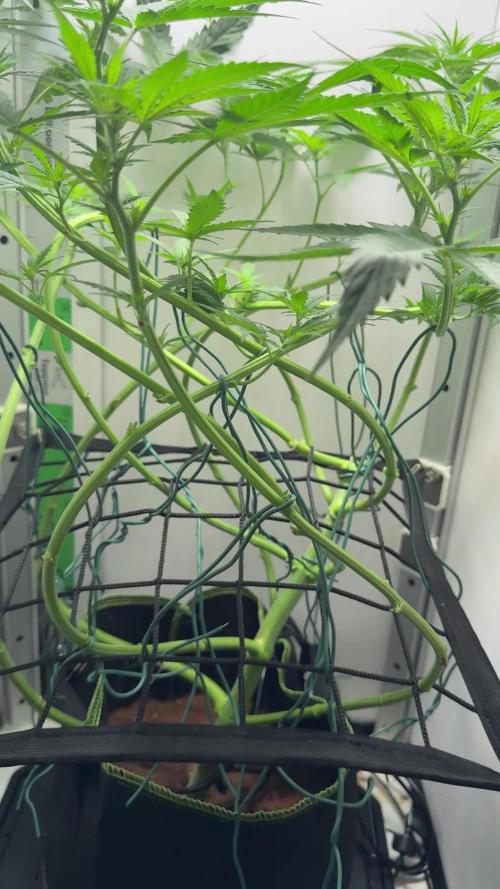
Die Pflanzen haben ihren Stretch voll eingesetzt – das Höhenwachstum ist deutlich sichtbar.
• Wuchs: Die Triebe sind stark nach oben geschossen und beginnen, die Blütepositionen zu bilden. Das Netz hilft dabei, die Struktur offen und gleichmäßig zu halten.
• Farbe: Leuchtend grünes, gesundes Laub ohne Anzeichen von Stress oder Mangel.
• Form & Struktur: Gleichmäßiger Aufbau mit stabilen Haupttrieben – ideale Vorbereitung auf die Blüte.
• Gesamtzustand: Vital, stark und optimal im Übergang zwischen Veg- und Flower-Phase.
Likes
2
Share


@eldruida_lamota
Follow
Que pasa familia, vamos con la quinta y última semana de crecimiento de estas Drizl Pickl feminizadas de Seedstockers.
Vamos al lío ,se trasplantaron en macetas de 7 litros definitivamente.
El ph se controla en 6.0 , la temperatura la tenemos entre 24/20 grados y la humedad ronda el 50%.
El ciclo de crecimiento puse 16h de luz, el foco está al 50% de potencia.
De momento van creciendo a buen ritmo y tienen un buen color, aplique de manera foliar el tetra 9 ahora cara a la floración.
Agradecer Agrobeta por el envío del kit gold series para esta temporada, son unos jefes 🙏
- os dejo por aquí un CÓDIGO: Eldruida
Descuento para la tienda de MARS HYDRO.
https://www.mars-hydro.com
Hasta aquí todo, Buenos humos 💨💨💨
Likes
9
Share


@Cestlaweed
Follow
Se pegaron gran estirón y la floracion ya es evidente en todas las plantas a excepcion de lsd 25.
El calor ya es altísimo debido al verano y se empieza a notar en las hojas superiores, sin embargo, todas las plantas tienen un aspecto sano.