Likes
Comments
Share
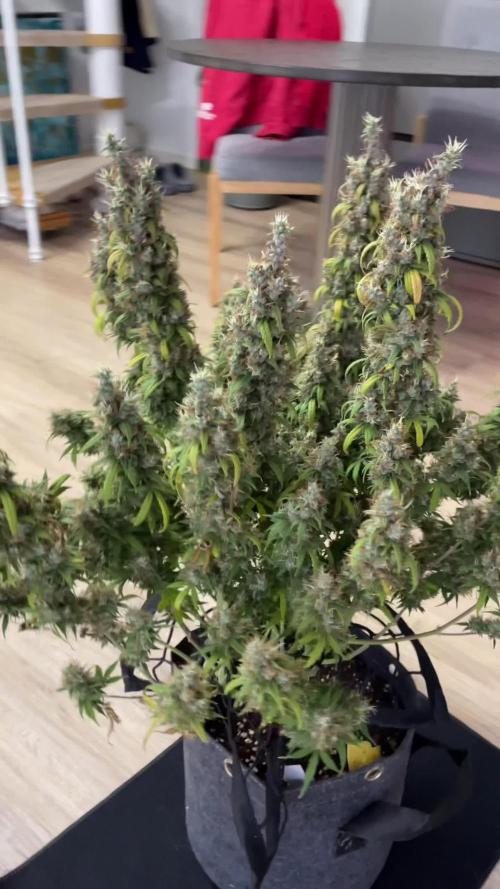
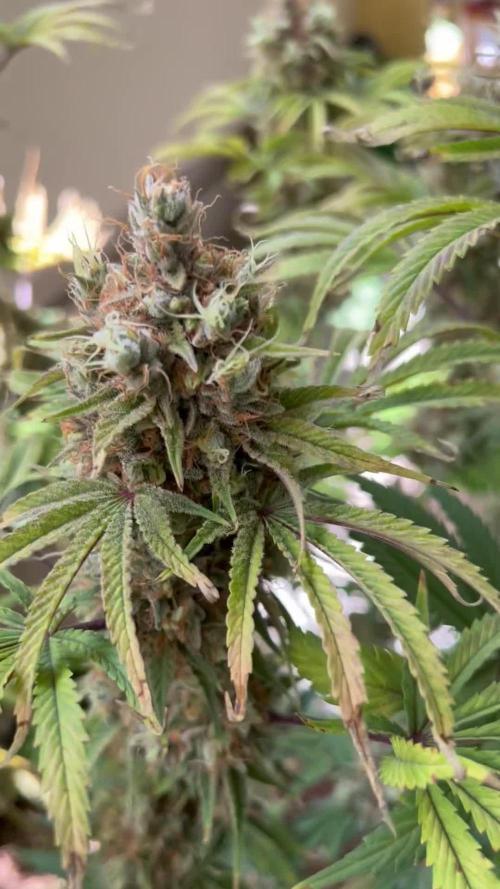
Forbidden Runtz Is A Great Addition To The Fast Buds Line Up. Very Colorful And A Treat To Watch Grow 👀
Likes
17
Share
📆 Semana 6 La Variegated Sour GPP está avanzando con personalidad propia. Aunque no ha mostrado variegación en esta ocasión, se está expresando de forma muy peculiar: los cogollos tienen una estructura apretada y densa, con una forma que recuerda a una pequeña coliflor —compacta, nudosa y muy distinta al resto del jardín. El plan nutricional sigue siendo el de XpertNutrients, que está funcionando sin pegas. Esta planta está comiendo bien y sin quejarse. El ritmo de riego lo mantengo ajustado a su consumo real, evitando saturaciones y permitiendo que respire entre riegos. Los Adlite siguen haciendo un trabajo excelente, y se nota sobre todo en cómo ha desarrollado las puntas: la iluminación pareja ha ayudado a que los cogollos se formen de manera simétrica y con buena producción de resina. A nivel climático, seguimos con temperaturas en torno a los 22-25°C y una humedad del 55% que, aunque no es ideal, no está generando problemas gracias a una buena ventilación y movimiento de aire constante. Los aromas comienzan a destacar con una mezcla ácida y ligeramente especiada, fiel al perfil Sour. Los tricomas se están volviendo lechosos, sin señales de ámbar todavía, así que aún queda margen para que siga cogiendo cuerpo. No tiene la variegación que esperábamos, pero sí una expresión floral única que la convierte en una candidata interesante para seguir observando. ¡Seguimos creciendo fuerte! 💪
Likes
4
Share
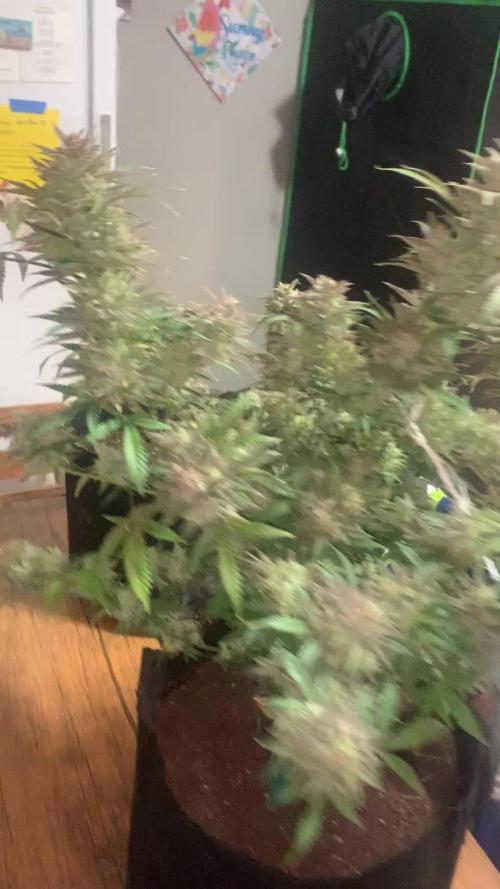
Did literally nothing. The rain did the watering for me. Just spraying some Neem to prevent damage from . These little bastards are my one and only problem at the time.
Likes
Comments
Share
Likes
78
Share
@Hou_Stone
Follow
My 4 plants are still there, with the banana as a smile 🍌😁 I continue the defoliation, I wonder if I'm not doing a little too much sometimes.. We will soon see the result 🌗Switching to flowering this week, I reduced the length of the day by 1 hour each day until reaching 12 hours night time / 12 hours daylight on the 33rd day!🌞 🌺On the 33rd day I apply a layer of organic nutrients mixed with a little soil that I add to the top of each pot. I added 35 grams of BioBloom to each of my pots🌺 (Pot of 7 Liters / 2 gallons) ------------------------------------------------------------ 💧Watering I water all my pots the same day but with more or less water. Simply by lifting them; A light pot is a dry pot and will need more water, A heavy pot is a wet pot and will need less water. On average I water each pot with: Day 29 : 0.5 L Day 33 : 1 L with 0.8 grams of bio enhancer/L I use tap water, adjust the ph to around 6 and water ------------------------------------------------------------ 🔥❄️Temperature of the week : Day : 19-23°C (Humidity : 65-80%) Night : 14-17°C (Humidity : 75-85%) Outside the tent it is around 16°C with 70% humidity The humidity is a little too high, I hope it will drop a little 🙏 ------------------------------------------------------------ 🚀Equipment of the week ⭐️ : Light FC3000 Mars hydro. power 95% at 50cm Extractor 6 inch Mars Hydro. power 1/10. ON 24/24h 2 fans to circulate the air inside the tent. Each on for 30 minutes then off for 1 hour. this rhythm repeats itself in a loop I'm removing my heat mat this week. ------------------------------------------------------------ 📜Links : 🌱Banana Krumble seeds : 👇 https://shop.greenhouseseeds.nl/feminised-cannabis-seeds/usa-genetics/banana-krumble/ Mars Hydro : 5% off with my discount code "houstone5" 💪 https://www.mars-hydro.com/?acc=hou-stone 👨‍🚀My Instagram❤️️: https://www.instagram.com/hou_stone420/ ------------------------------------------------------------ Thanks for your visit😀💚
Likes
14
Share
Endlich bereit für Blüte, stelle das Licht auf 12/12 Zyklus und lasse die Lampe nun mit voller Stärke auf 500watt laufen. Habe einen Mangel festgestellt, der wahrscheinlich auf das fehlen von CalMag zurück zuführen ist. Außerdem ist es Zeit die Pflanze großzügig zu entlauben.
Likes
10
Share
Day 28 after flip of zombie kush! Starting to focus on buds! We all ready can smell it not sweet more floral smell . See u next week growmies!
Likes
12
Share
@Chubbs
Follow
Weekly update on these ladies. They're still growing great but I've definitely stunted them messing up my ph. All in all they're progressing from week to week good, so it'll be cool to see how the flower stage goes. Getting two distinguished phenos I can see one more purple then the other more green one. Happy Growing
Likes
17
Share
The strain is awesome, very happy about Ak420, it's my first time growing this strain, I'm growing 3 plants of ak420 this is the pheno #1 as you guys can see and smells just like her 2 sisters, very sweet and floral aromas I cannot stop smelling those flowers, I'm super happy about this strain, would love to keep working with her💚❤️🧡 stay tuned to see how this lady performs at the end of the process! 👨‍🌾
Likes
55
Share
2nd net is up. Early bud formations are promising. holding up to the extremes pretty well, some leaves taking minor damage, but overall, she is holding up, gave her 1 night at 50F see how she would react, stressful. Not advised as it messes with her metabolism, but I want to see if it triggers any anthocyanin response. Love to see her purp up but no signs yet. Remember, For every molecule of glucose produced during photosynthesis, a plant needs to split six molecules of water. This process provides the hydrogen needed for synthesizing glucose and other organic compounds, while oxygen is released as a byproduct. Homework. If Rubisco activity is impaired and it cannot properly function or regenerate its substrate, the plant's leaves are likely to turn a pale green or lime green, a condition known as chlorosis. Essentially, Rubisco activity is highly regulated and susceptible to various environmental and metabolic factors that can cause it to become inhibited, leading to an apparent failure in RuBP regeneration due to a lack of consumption. Rubisco regeneration is intrinsically linked to nitrogen supply because Rubisco is a major sink for nitrogen in plants, typically accounting for 15% to over 25% of total leaf nitrogen. The regeneration phase itself consumes nitrogen through the synthesis of the Rubisco enzyme and associated proteins (like Rubisco activase), and overall nitrogen status heavily influences the efficiency of RuBP regeneration. RuBisCO is a very large enzyme that constitutes a significant proportion (up to 50%) of leaf soluble protein and requires large investments in nitrogen. Insufficient nitrogen supply limits the plant's ability to produce adequate amounts of RuBisCO, thereby limiting the overall capacity for photosynthesis and carbon fixation. Maintaining the optimal, slightly alkaline pH is crucial for the proper function and regeneration of Rubisco. Deviations in either direction (too high or too low) disrupt the enzyme's structure, activation state, and interaction with its substrates, leading to decreased activity and impaired RuBP regeneration. (Lime/yellowing) Structural Component: Nitrogen is an essential building block for all proteins, and the sheer abundance of the Rubisco protein makes it the single largest storage of nitrogen in the leaf. Synthesis and Activity: Adequate nitrogen supply is crucial for the synthesis and maintenance of sufficient Rubisco enzyme and Rubisco activase (Rca), the regulatory protein responsible for maintaining Rubisco's active state. Nitrogen deficiency leads to a decrease in the content and activity of both Rubisco and Rca, which in turn limits the maximum carboxylation rate, Vmax, and the rate of RuBP regeneration Jmax, thus reducing overall photosynthetic capacity. Nitrogen Storage and Remobilization: Rubisco can act as a temporary nitrogen storage protein, which is degraded to remobilize nitrogen to other growing parts of the plant, especially under conditions of nitrogen deficiency or senescence. Nitrogen Use Efficiency (NUE): The allocation of nitrogen to Rubisco is a key determinant of a plant's photosynthetic nitrogen use efficiency (PNUE). In high-nitrogen conditions, plants may accumulate a surplus of Rubisco, which may not be fully activated, leading to a lower PNUE. Optimizing the amount and activity of Rubisco relative to nitrogen availability is a target for improving crop NUE. Photorespiration and Nitrogen Metabolism: Nitrogen metabolism is also linked to the photorespiration pathway (which competes with carboxylation at the Rubisco active site), particularly in the reassimilation of ammonia released during the process. To increase RuBisCO regeneration, which refers to the process of forming the CO2 acceptor molecule Ribulose-1,5-bisphosphate (RuBP) during photosynthesis, the primary methods involve optimizing the levels and activity of Rubisco activase (Rca) and enhancing the performance of other Calvin-Benson-Bassham (CBB) cycle enzymes. Biochemical and Environmental Approaches: Optimize Rubisco Activase (Rca) activity: Rca is a crucial chaperone protein that removes inhibitory sugar phosphates, such as CA1P (2-carboxy-D-arabinitol 1-phosphate), from the Rubisco active site, thus maintaining its catalytic competence. •Ensure optimal light conditions: Rca is light-activated via the chloroplast's redox status. Adequate light intensity ensures Rca can effectively maintain Rubisco in its active, carbamylated state. •Maintain optimal temperature: Rca is highly temperature-sensitive and can become unstable at moderately high temperatures (e.g., above 35°C/95F° in many C3 plants), which decreases its ability to activate Rubisco. Maintaining temperatures within the optimal range for a specific plant species is important. •Optimize Mg2+ concentration: Mg2+ is a key cofactor for both Rubisco carbamylation and Rca activity. In the light, Mg2+ concentration in the chloroplast stroma increases, promoting activation. •Manage ATP/ADP ratio: Rca activity depends on ATP hydrolysis and is inhibited by ADP. Conditions that maintain a high ATP/ADP ratio in the chloroplast stroma favor Rca activity. Enhance Calvin-Benson-Bassham (CBB) cycle enzyme activity: The overall rate of RuBP regeneration can be limited by other enzymes in the cycle. •Increase SBPase activity: Sedoheptulose-1,7-bisphosphatase (SBPase) is a key regulatory enzyme in the regeneration pathway, and increasing its activity can enhance RuBP regeneration and overall photosynthesis. •Optimize other enzymes: Overexpression of other CBB cycle enzymes such as fructose-1,6-bisphosphate aldolase (FBA) and triose phosphate isomerase (TPI) can also help to balance the metabolic flux and improve RuBP regeneration capacity. Magnesium ions, Mg2+, are specifically required for Rubisco activation because the cation plays a critical structural and chemical role in forming the active site: A specific lysine residue in the active site must be carbamylated by a CO2 molecule to activate the enzyme. The resulting negatively charged carbamyl group then facilitates the binding of the positively charged Mg2+ion. While other divalent metal ions like Mn2+ can bind to Rubisco, they alter the enzyme's substrate specificity and lead to dramatically lower activity or a higher rate of the non-productive oxygenation reaction compared to Mg2+, making them biologically unfavorable in the context of efficient carbon fixation. The concentration of Mg2+ in the chloroplast stroma naturally increases in the light due to ion potential balancing during ATP synthesis, providing a physiological mechanism to ensure the enzyme is activated when photosynthesis is possible. At the center of the porphyrin ring, nestled within its nitrogen atoms, is a Magnesium ion (Mg2+). This magnesium ion is crucial for the function of chlorophyll, and without it, the pigment cannot effectively capture and transfer light energy. Mg acts as a cofactor: Mg2+ binds to Rubisco after an activator CO2 molecule, forming a catalytically competent complex (Enzyme-CO2-Mg2+). High light + CO2) increases demand: Under high light (60 DLI is a very high intensity, potentially saturating) and high CO2, the plant's capacity for photosynthesis is high, and thus the demand for activated Rubisco and the necessary Mg2+ cofactor increases. Mg deficiency becomes limiting: If Mg2+ is deficient under these conditions, the higher levels of Rubisco and Rubisco activase produced cannot be fully activated, leading to lower photosynthetic rates and potential photo-oxidative damage. Optimal range: Studies show that adequate Mg2+ application can enhance Rubisco activation and stabilize net photosynthetic rates under stress conditions, but the required concentration is specific to the experimental setup. Monitoring is key: The most effective approach in a controlled environment is to monitor the plant's physiological responses e.g., leaf Mg2+ concentration, photosynthetic rate, Rubisco activation state, and adjust the nutrient solution/fertilizer to maintain adequate levels, rather than supplementing a fixed "extra" amount. In practice, this means ensuring that Mg2+ is not a limiting factor in the plant's standard nutrient solution when pushing the limits with high light and CO2. Applying Mg2+ through foliar spray is beneficial to Rubisco regeneration, particularly in alleviating the negative effects of magnesium (Mg) deficiency and high-temperature stress (HTS). While Mg can be leached from soil, within the plant it is considered a mobile nutrient, particularly in the phloem. Foliar-applied Mg is quickly absorbed by the leaves and can be translocate to other plant parts, including new growth and sink organs. Foliar application of: NATURES VERY OWN MgSO4 @ 15.0g L-1 in a spray bottle. For those high-intensity workouts when 1 meal a day is just not enough! Foliar sprays are often recommended as a rapid rescue measure for existing deficiencies or as a supplement during critical growth stages, when demand for Mg is high. Application in the early morning or late evening can improve absorption and prevent leaf burn. The plant was getting a little limey yellow in the centre. Shortly thereafter, she was back in business, green mostly regenerated. The starting point [of creativity] is curiosity: pondering why the default exists in the first place. We’re driven to question defaults when we experience vuja de, the opposite of déjà vu. Déjà vu occurs when we encounter something new, but it feels as if we’ve seen it before. Vuja de is the reverse—we face something familiar, but we see it with a fresh perspective that enables us to gain new insights into old problems. Confidence is evidence... nothing more. You are confident because you have driven 10,000 times, you are confident because you have spoken 10,000 times. People think confidence is a feeling, but it's not. If you want more confidence, then you need to create evidence, take more shots, collect more data, build more experiences, take more risks; fail, confidence doesn't come first; it is the reward you get for doing the work. no one else wants to do.
Likes
2
Share
I cut them around 9.5 weeks.
Likes
52
Share
@MeaCulpa
Follow
We have been in bloom since around Feb. 29th/ Mar. 1st. Everything looks wonderful. I've read a lot that automatics don't like repotting and defoliating at all, but I listened to my "green thumb" and took away some big leaves and relined my ladies about 5-7cm. So they are a little higher. I carefully removed the soil to the clay balls and put some new soil between. I really hope they don't explode because of this. Either I set my filter about 30-40cm deeper. So I have a better control of the humidity. That's all that comes to my mind right now. I'm really excited to see what comes out of this.
Likes
5
Share
@DawgHaus
Follow
Day 1: A large root can be seen at the bottom of each cell pot. Filled 3x 3 gallon pots with coco perlite 60/40 mix and transplanted each seedlings into its forever home. Not messing with micro-bacteria and all this time round as the nutes have everything that’s needed, fresh coco and a good feed will be more than enough for these girls. Watered them each with 100ml of water mixed with with a small amount of Velokelp and stuck a bag over each to lock in the humidity. Once the transplanting was over I setup a little DIY drip irrigation system with a 10L reservoir. Feeding schedule will be at 1/4 strength of advise dose as recommend by FastBuds and Remo Nutrients. Set up the timer for the lights and drip irrigation system to kick in tomorrow. The lights will change to 18/6 and drip irrigation will kick in just after lights on. Day 2: Lights turned off for the first time after 24 hour light for the past few days. After 6 hours of darkness the seedling are looking healthy as fuck. The first true leaves are now developed and they’re all bright bright green. Drip irrigation timer did its thing for the first time today and I’m well happy with the result from my little DIY kit, hopefully all runs smoothly with it for the rest of the grow. Day 3: The cotyledons have started praying upwards towards the light. The bags over the top of the plants have a good amount of condensation on the inside so I’ve cut a couple small holes in the top of each bag to let a little air in. Turned drip system off for a couple days to avoid over watering. Day 4: Tiny second set of leaves can be seen in the centre of each plant. Made the air holes on bags bigger to get the ready for them to be removed. Drip system still turned off. Day 5: Drip irrigation system is working as it should and environments holding up so all is good. Plants are looking good and seem fairly well rooted. Removed the bags from the top of each pot and turned on the humidifier and set it to 60%. Only thing left to do on this setup up is get some trays under the pots so they’re not sitting in puddles during the feeds. Day 6: All of the plants first true leaves are praying up to the light and the second sets are starting to properly develop. Really happy with all the seedlings so far. When it comes to autos these seem like the business. Fans turned on today and drip irrigation set back on its timer. Found some old metal grilled shelves that have worked out perfect for trays for the irrigation. Day 7: Second set of leaves are beginning to rise up, another week I reckon and I’ll look into hanging the MH bulb so these girls can explode. Very happy with these seeds so far. Gave them their first foliar spray with a 5ml of Velokelp and 5ml of Magnifical mixed into 1L of water. Turned the oscillating fan up a notch too as I’ve got it set up a fair distance away and I didn’t feel the breeze was catching them enough. Mixed up a new stronger feed this evening so it’s read for the droppers coming in tomorrow.
Processing
Likes
12
Share
Buenas noches familia, sorpresa, jueves noche por aquí , actualizamos las power plant xL. Es la última semana antes de nuestra cosecha, el tiempo se nos echó encima y las Flores ya están echas, se preparó un lavado de raíces y tijeretazo,para sucesivamente colgarlas.( PRIMERA VEZ que se me echa el tiempo encima con la floración, jurao) Me habría gustado darles algo de estrés hídrico, pero lo veremos con las lemon kush y las northern light xL. -power plant xL es una cepa con predominancia sativa, con una corta floración,es un ejemplar fácil de cultivar, fuerte, y vigoroso. Estos ejemplares se cultivaron en 7L en sustrato light MIX de plagrOn, controlando en todo momento el PH de nuestras plantas, y dándoles de comer una gama advanced nutrients bastante básica. -PROS: facil cultivar, flores llenas de resina , flores compactas, ramas laterales largas. -CONTRAS: hay que tutorar por el peso de la flor, floración demasiado rápida a mi gusto (no te das ni cuenta). *Aquí ya me despido hasta la cosecha familia.
Likes
15
Share
They’re not the healthiest looking but they’re definitely way better than they were! Couldn’t wait any longer and needed to flip into flower because I was running out of height space
Likes
37
Share
@RFarm21
Follow
Foram regadas hoje ( 08/07/2021). Os nutrientes foram misturados num garrafao com 5L de água que usei para regar 3 plantas. Usei pouca quantidade porque foi a primeira vez que estão a levar com nutrientes, na próxima rega irei aumentar para um E.C de 0,5. A royal gorilla 2 como ainda está pouco desenvolvida, apenas reguei com 1L com pH 6.3 10/07/2021 - LST Ajudem-me com dicas para fazer o LST da melhor maneira, é a minha primeira vez. Obrigado e boa semana a todos!
Likes
2
Share
@LordNugz
Follow
Back from near death. The plants are doing well now. Hopefully a couple more weeks and I can move into flower
Likes
8
Share
Week 6 of flower is done and the 4x4 is progressing nicely! The buds are all starting to fatten up, I'm especially loving Hella Jelly #1, especially the candy terps she's giving off. The Vanilla Frosting is the other big player in the tent, with the second Hella Jelly a bit smaller than the other two. The Jelly Donutz will be the last to be harvested, as she is developing her flowers more slowly. This tent will be a staggered harvest when it comes to it. These plants have been so easy to grow this run. The Autopot Tray2Grow living soil bed bed has been solid throughout the run, and this past week I installed Blumat Blusoak tape for the 2x4 Grassroots bed, which, up until this point, I have been hand watering. It always amazes me how automatic watering eliminates like 90% of the tent work. It is such a game changer, and the plants love it even more than hand watering because they drink how much they want when they want it! Hella Jelly is supposed to be a fast finisher (45 days sometimes!), so after this next week I will begin checking trichomes. My guess is another 2-3 weeks at least. The trichomes will guide me! Happy growing, growmies! 😎
Processing
Likes
7
Share
@Kushizlez
Follow
(Days 21-28) (Day 23) I like the amount of stretch I’m seeing on practically all the plants. I'm going to lower the light at the end of the week to stop the stretch. The more stretch they get in veg the less I have to lollipop or prune down the road. Makes lst easier too. I’m going to try topping this week. Last time I topped at the 7-10th nodes and didn’t get the best horizontal growth. This round I’m ready to give everything 3 or more toppings, stay on top of training and defoliate much less. This soil looks insane. I should have added a thicker layer of oats because it’s starting to look proper. (Day 24) Got my stuff from the hydro store today and amended my soil again. Next visit I will be grabbing a P booster like bat guano before I enter flower. Today, I got the 2gal pots, some primo worm castings, 5-2-4 insect frass, 0-0-22 langbenite, 1-0-3 alfalfa meal and an exhale co2 bag. Guy at the store said it gets his 4x4 tent 1000ppm+. It takes a few weeks at least for it to start putting out any amount of co2. I got the room sealed and two fans bowing. I fed a compost tea with a little bit of each dry amendment, BSO dry compost, boogie brew base and worm castings aerated for 24h. I diluted it to about 850ppm which still might be a little high. (Day 25) Opened a bottle of EM1 that was improperly stored and it exploded all over me and part of the tent. I wiped off the plants but there is still specks here and there. Cleaned it off and sprayed with method1 pps. (Day 26) Topped 9/15 plants. Will do the rest next week once I see a little more growth. 5 of the bbb’s I started 6 days after everything else so they are still quite behind. I’m going to push the transplant another few days until they recover. Going to start lst after transplant. (Day 28) Transplanting into 1.6gal pots that I thought were 2gals tonight... Depending on how many females I get, they will be going into either 3, 7 or 10 gallon fabric pots. Growth is looking solid so far, zkittlez and the 3 WW’s are leading the pack in terms of growth speed and cotes are yellowing out. I’m pretty sure what I have is a zkittlez bagseed but there is also a strong chance it could have been from some shitty Canadian biker weed. I accidentally misplaced the seed so it’s possible it got mixed up and I germinated the wrong one. Judging by the rapid growth I’d say that’s a fair bet. Biker weed is notoriously fast growing. Either way it won’t be hard to tell once they’re in flower. The white widow is probably going to be a breeze. I’ve heard that’s why it’s so popular too. It’s just a hardy rookie strain with good resistance, decent quality and above average yield. A sure investment. The blackberries are lagging behind but I’m sure they will blow the others away in terms of quality. One of the tunas looks great and the other is a stubby runt. The stubby runt I currently have in flower is killing it right now so I’m not writing it off yet. Can’t wait to see if the tuna god produces some nostalgic smells. Tuna strains are still super popular on the Canadian black market. I plucked the first set of leaves that were starting to appear on each plant. These branches almost always turn to larf and they're so small I can't that stressing the plants out at all this early. If anything, the zkittlez and white widows need to slow down a bit anyway. I’ve been doing a shit ton of research over the past year into what causes weed and cigarettes to have black ashes/poor fire holding capacity. Smoking black weed drives me crazy because it’s all the legal and black market have nowadays. The cigar industry has numerous studies on the cause of ash color and burn rate and apparently it has to do with the ratio of mineral content in the soil/water. Soil/water that is high in phosphorus, magnesium, chlorine and other heavy metals will burn poorly and reduce to flaky black ashes. Whereas soil that has higher levels of potassium and calcium carbonate have thick uniform white ashes with no streaks. Calcium carbonate (wood ash, biochar) can also prevent heavy metals in the soil making them unavailable to the plant. I’m discontinuing my “Organic cal mag” as it is full of chlorine which I did not realize when buying it. I’m going to be pretty cheesed if that stuff ruined the burn of my current flowering crop. My dog also found and destroyed my Alaskan fish fertilizer so that’s being discontinued for now too.