


Likes
Comments
Share
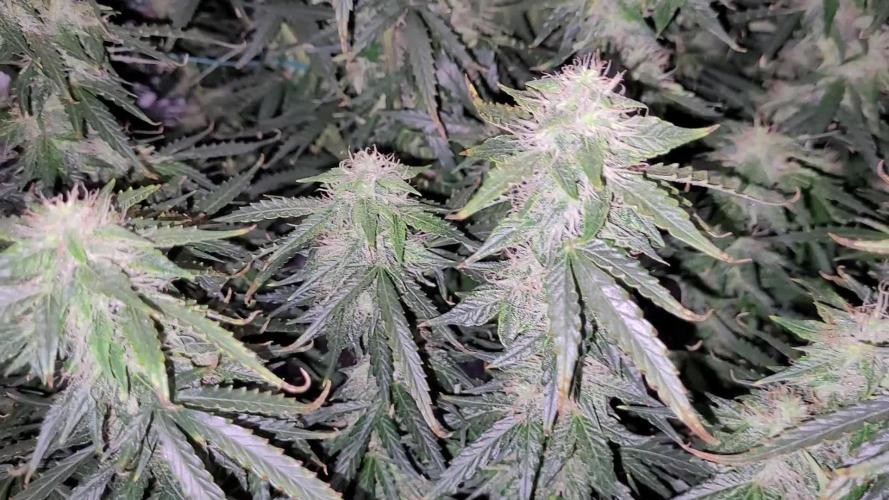

@StonedSteve
Follow
Today I am closing 6th week of blooming and starting 7th week
Day 83
I'm watering with 5 liters and I removed Bud Factor X and added Overdrive👌
Following HombreCZ advice, I reduced all nutrients for 50% except Vitamax. Děkuju😇

Likes
2
Share


@Shefman93
Follow
Transplanted from 15 gallons to 25 gallons at the start of the week. Changed amendment ratio to 50/50 of 444 & 284 as this is the last week of veg. Adjusted lst to have the canopy level and I will take clones before the flip to flower.

Likes
65
Share


@MadeInGermany
Follow
Flowering day 80
since clock
change to 12/12 H .
Hey guys :-)
the dr Blooms and blooms and there is still no end in sight 😂.
I'm curious how long it will take this time, but the wait is always worth it 👍.
She was watered 3 times with 1.2 l each (nutrients see table above)
Otherwise everything was cleaned.
Stay healthy 💚🙏🏻
👇🏼👇🏼👇🏼👇🏼👇🏼👇🏼👇🏼👇🏼👇🏼👇🏼👇🏼👇🏼
You can buy this Nutrients at :
https://greenbuzzliquids.com/en/shop/
With the discount code: Made_in_Germany you get a discount of 15% on all products from an order value of 100 euros.
👇🏼👇🏼👇🏼👇🏼👇🏼👇🏼👇🏼👇🏼👇🏼👇🏼👇🏼👇🏼
You can buy this strain at :
https://www.barneysfarm.com/dr-grinspoon-5
Water 💧 💧💧
Osmosis water mixed with normal water (24 hours stale that the chlorine evaporates) to 0.2 EC. Add Cal / Mag to 0.4 Ec Ph with Organic Ph - to 5.8 - 6.5
MadeInGermany

Likes
15
Share


@Sid93
Follow
Amazing smell sticky crystal I started giving Big Buds and hopefully in a few days they will be greasy and big 🔥🔥🔥

Likes
8
Share


@Ctrellis90
Follow
Wow!
That's what I find myself saying every time I look into this beautiful flower tent!
It's the end of week four bloom and dang am I happy lol. I'm absolutely in love with this plants strong indica structure. She looks so strong and sturdy, can't wait to see how she looks in full bloom, stacked up with flower... gorgeous plant.
We're running the insect Frass now, full strength and I also put down some hummus and compost as a top dressing just to be sure that these ladies have enough food. I'm sure that should be plenty until harvest.
Thanks for stopping by and be sure to check out Nupeddler and Growing Organic! Discount code CollinT

Likes
24
Share


@3lementa1
Follow
This is just a beautiful strain to grow. The leaves have a rich dark green appearance and the shape is a mix of fatter indica leaves and longer sativa leaves. It's tendency is a fairly manageable and predictable grow/stretch and it responds well to training and powerful lights. The leaves on one of them changed colour at the end of flush and went yellow with some purples and pinks but the buds themselves have almost a silver glow to them. The pistils come out in early flower in a very strong, spikey and symmetrical way that amplifies the cool glow given off by the trichomes. With the rich, dark, beautiful leaves, the whole appearance is really beautiful and otherworldly. One of the Wedding Cake plants self-pollenated and there are some seeds in the CBD Blue Shark, but they're few and far between. It's not a disaster like the Wedding Cake. Honestly I can't say enough good things about this strain. The plants were hardy, easy to work with and forgiving of mistakes and experiments. The flowers looked amazing through every stage of development, and the finished product smells great, tastes great, looks great, and makes you feel great. This is my favourite strain to grow so far.

Likes
10
Share


@Barzenegger
Follow
In this week, the Acapulco Gold, GMO, and Glookies successfully germinated and grew into little seedlings, while the first "anonymous" germination attempt failed.
Likes
21
Share


@Jimmy_JazzCabbage
Follow
Week 3 of flower complete and an interesting week to re-count. Let's jump right in....
Day 37 - I feel like I should be reporting more the fact is the Candy Kush is happy and very healthy and notch to do but keep the environment steady and stay out of her way. So that's what I did.
Day 38 - on this day I watered my lovely lady. She's adapted so well to the LST and just took off. She is the Candy of my eye. I was preparing to go to Vancouver for surgery so I gave a healthy top/bottom watering to cover for my time away.
Day 39 - This day was travel day so before we left I checked environment and raised my light to 20" to allow room to grow. She grows an inch to 1.5" a day during stretch. And we're off.
Day 40 - surgery day
Day 41 - travel day
Day 42 - after sleeping in my own bed I got up to water this morning. After 3 days she was just starting to drop her leaves. After watering she perked right back up again. I feel like my timing was good and suffered no issues. I also did some defoliation to clean up the bottom skirt.
Day 43 - Today all is good. Environment is spot on, and she's a happy girl. Took off a few LG fan leaves blocking sites that cannot be tucked.
So all in all a relatively easy week and a simple one for the Cabbage Farm. Thanks for checking in, I appreciate all your comments, likes, and feedback. Cheers 🌲🌬️ till next week.
Likes
16
Share


@Mrg7667
Follow
Dont know why i only have a video but Double Ds are just about hitting 23 with the tallest of the 6 and the DD is about 18 inches at the tallest of the 6
Knats seem to be 100% gone pkants are looking amazing definitely getting to the point of needing water everyday tho so transplant before next update is a must! Going into 2gal
Likes
18
Share


@BlueSmokeFarms
Follow
Bud sites are producing black/purple spot in leaves. Bud growth is producing as the days go by. Really excited with this being my first grow
Nitrogen boost really helped with the deficiencies. Plants are starting to look really heathy... Prunes lower colas that weren't stretching past the canopy and receiving energy so more energy can be used towards the top buds

Likes
17
Share


@JL420
Follow
los cogollos estan engordando y el olor ha aumentado tanto que me toco poner el filtro de carbon activo.
Hubo un pequeño exceso y regue un par de dias solo con agua de osmosis ec 0,17 y ph 6

Processing
Likes
2
Share


@Firepharmer
Follow
Day 43 ,
6 and a half weeks . She started to cloud up and has a few amber trichomes . Buds as starting to really full out now
Likes
4
Share


@S2993
Follow
Had a pooling problem in nft tanks so i think growth has been stunted a little?


Likes
2
Share


@Ultraviolet_
Follow
67 days since April 16th, 2026
We become aware at such times of man's wonderful ability to bring seemingly unrelated elements into harmonic balance, and receive a glimpse into a world where everything exists in conscious sympathetic attunement to everything else. When we listen to a piece of music that seems to strike a beautiful chord somewhere inside us, or view a painting that simply glows with harmonic awareness well executed, we probably do not spare much time to contemplate the wonderfully intricate combination of vibrations that our sensors make it possible for us to perceive. We tend to appreciate the relationship between the parts of something by an awareness of the harmony or dissonance of the whole. This ability enables us to say "what a beautiful house!" instead of "analysis has proven that this collection of building materials exhibits certain elements of harmonic proportion." While this ability to instinctively appreciate the beauty of true harmony has an important role to play in evolution, a more analytical understanding of the laws involved can be most useful. This is especially so if we wish to create works of art where each part exists in true harmony, not only with the other part of that particular whole, but with the universe within which the creator and the created exist.
Everything vibrates. From the most dense matter to the most subtle cosmic rays, everything which our senses allow our thoughts to become aware of, can be specified in terms of wavelength or frequency of vibration. These two terms define the same thing, but from different points of view.
The following are the approximate wavelengths of various energy carriers:
Cosmic rays 0.000,000,001 mm
Gamma rays 0.000,000,1 mm
X rays 0.000,500 mm
Ultraviolet rays 0.003 mm
Visible light 0.006 mm
Infrared 0.01 mm
Sound waves 1 meter
Radio waves 300 meters
Violet light 400 nm to 450 nm
Blue light 450 nm to 500 nm
Green light 500 nm to 570 nm
Yellow light 570 nm to 590 nm
Orange light 590 nm to 610 nm
Red light 610 to 700 nm
1 nanometer (nm) = 0.000,000,1 cm = 1/10,000,000 cm
If a guitar string is plucked and we hear a sound, it is not too difficult for the human mind to associate this sound with the vibration of the guitar string. With color it is quite different. It is difficult for us to conceive that the color of a substance is not an inherent property of the substance itself, but an indication picked up by our senses of that substance's ability to absorb or reflect the light which happens to be shining on it at that moment. Neither the matter nor the light is colored. What happens is that the brain learns to differentiate between the frequencies reflected or transmitted by the substance the eyes are focused on. The same thing happens with sound. When we say "Oh! Listen, they're playing my favorite song," what we really mean is: "My brain has stored within it a particular pattern of frequencies. I have compared the new information being received with this stored pattern and have deduced the answer that the two patterns are similar within certain specified tolerances." The 'pleasure' involved could have something to do with our running the pre-recorded pattern at the same time, in 'sympathy' with the new pattern as it is received.
The word sympathy describes very well our ability to appreciate color and sound. It also describes the reason behind certain elements of harmony. For instance, if a substance vibrating at 100 cycles per second (tone 1) is in the proximity of another substance vibrating at 200 cycles per second (tone 2), we could perceive, if we had the right equipment, a certain sympathetic relationship between the two.
We will see from this that there is a uniform doubling of the first tone seen in the second. At various points along the waves, the two are the same in amplitude. At other points, they are at opposite poles to each other. This doubled frequency has more points of similarity to the original than any other frequency except the original itself. If the equipment we had available for measuring these two frequencies was a soundboard amplifier and a pair of ears, then we would hear what would sound to us like one tone. If we had the opportunity to hear one at a time, we would hear that although they sound the same, one is higher in pitch than the other. This characteristic of 'the same but different in pitch', musicians have called the octave. Any two tones produced where one has exactly doubled the frequency of the other is called an octave. Speaking in ratios, an octave would appear then as the ratio 2:1 or 1:2, depending on whether we are talking of an octave up or down.
A single note produced by almost any instrument will contain more than one wavelength or frequency. It will have a dominant frequency, the wavelength of which we would call the note's 'fundamental' or 1st harmonic. It will also have a varying number of upper harmonics, gradually fading in intensity into infinity or silence.
Natural harmonics always have the same pattern of intervals between them. The interval between the 1st and 2nd harmonic is a perfect octave; between the 2nd and 3rd a perfect fifth; between the 3rd and 4th a perfect 4th; and so on, the intervals becoming smaller and smaller until they lose any relationship with the western 12 tone scale as it exists at the moment. Just as an octave has certain elements of sympathy with its fundamental, so some intervals have been noted to be more perfectly in sympathy with the fundamental than others. The ratio of the 'perfect 5th' or interval of 7 semitones, as it occurs in the harmonic series, is 3:2 or 2:3, while that of the 'perfect fourth" is 4:3 or 3:4. All the tones in the western 12 tone scale can be expressed in terms of the ratio between the upper tone and its fundamental. This would seem to be an ideal way of generating a scale from any given fundamental and several attempts have been made to do this, the Pythagorean system being probably the most well known. Although when working with a single tone instrument playing on its own, the Pythagorean formula works wonderfully well, if we had several instruments tuned this way together and asked them to play almost any western music, we would find that at times they sounded quite out of tune to each other.
The lack of flexibility of the various scale systems based on the harmonic series has led to what is known as the 'tempered' scale. This uses as its primary unit of interval the ratio of the octave or 2:1. It then proceeds to divide the interval between any fundamental and its upper octave into 12 smaller intervals by applying the ratio: two to the one-twelfth power, to one (21/12:1). This equals 1.059463094, so by multiplying any frequency by this number, we will obtain the tempered semitone next up from our fundamental. We will also find that any tone twelve semitones up from any other tone, in a scale generated in this way, will have exactly double the frequency.
If we took the note middle C on a piano and halved the wavelength, we would have the note C one octave above. If we halved this, we would have the C above, and so on. However, within about 6 octaves, we would find that although a 'sound' was being produced, no human ear could perceive it. If we kept on going, halving and producing upper octaves of our fundamental C, we would proceed through the infrared band, into the visible light spectrum. If we happened to be outside during the day, we would, for one octave only, see the note C with our eyes. The next octave above would already be in the ultraviolet band, and outside the eye's sensitivity range. If we can think of color as being an indication of a substance's vibratory rate or wavelength, we may begin to see a relationship that could exist between the color and sound spectrums.
The logical extension of what has so far been said is that there exists a scale in the color spectrum that corresponds exactly to the scale in the sound spectrum, each color tone being an octave of the equivalent note in the sound range.
This is not the end of the story but only the beginning. If we can for the moment accept that any wavelength in one band has upper and lower octave stretching out to infinity, then the next question is 'fine, but what shall we use as our fundamental? A particular color? A particular sound frequency?' The musicians among us will probably say 'A 440'. This means that the note A should vibrate at 440 Hertz, or 440 times per second. They would tell us that this is standard pitch has been adopted by most orchestras around the world; pianos are tuned to it, instruments are constructed to formulas based on it, and so to them it would probably seem the most appropriate place to begin. Some of these musicians may know of the battle that is still raging with regards to this being the standard, but few would know why A = 440 Hz was chosen except that it worked when it was set to be a suitable compromise between the many different pitches in use at the time.
432 Hz is said to be mathematically consistent with the patterns of the universe. Studies reveal that 432 Hz tuning vibrates with the universe’s golden mean PHI and unifies the properties of light, time, space, matter, gravity, and magnetism with biology, the DNA code, and consciousness. When our atoms and DNA start to resonate in harmony with the spiraling pattern of nature, our sense of connection to nature is said to be magnified.
Another interesting factor to consider is that the A=432 Hz tuning correlates with the color spectrum, while the A=440 Hz is off. Audiophiles have also stated that A = 432 Hz music seems to be non-local and can fill an entire room, whereas A=440 Hz can be perceived as directional or linear in sound propagation.
Once you adopt the idea that sound (or vibration in general) can have an equalizing and harmonizing effect (as well as a disturbing effect), the science of harmony can be applied to bring greater harmony into one's life or tune to specific energies. There is a form of absolute and relative harmony. Absolute harmony can, for example, be determined by the tuning of an instrument. The ancients tuned their instruments at an A of 432 Hz instead of 440 Hz - and for a good reason. There are plenty of music examples on the internet that you can listen to in order to establish the difference for yourself.
Attuning the instrument to 432 Hz results in a more relaxing sound, while 440 Hz slightly tenses up the body. This is because 440 Hz is out of tune with both macro and micro cosmos. On the contrary, 432 Hz is in tune. To give an example of how this is manifested microcosmically: our breath (0,3 Hz) and our pulse (1,2 Hz) relate to the frequency of the lower octave of an A of 432 Hz (108 Hz) as 1:360 and 1:90.
It is interesting to note that 432 Hz was the standard pitch of many old instruments and that it was only recently (19th and 20th century) the standard pitch was increased. This was done in order to be able to play for bigger audiences. Bigger audiences (more bodies) absorb more of the lower frequencies, so the higher pitch was more likely to “cut through”. One of the oldest instruments of the world is the bell ensemble of Yi Zeng (dated 423 BC), tuned to a standard F4 of 345 Hz, which gives an A= 432 Hz. The frequency of 345 Hz is that of the platonic year! Similarly, many old organs are tuned in A=432 as well; for example, St. Peter’s Capella Gregoriana, St. Peter’s Capella Giulia, S. Maria Maggiore in Rome.
Maria Renold’s book “Intervals Scales Tones and the Concert Pitch C=128 Hz” claims conclusive evidence that 440 Hz and raising concert pitch above scientific “C” Prime=128 Hz (Concert A=432 Hz) disassociates the connection of consciousness to the body and creates anti-social conditions in humanity.
The difference between concert pitch A=440 Hz and Concert A=432 Hz is only 8 cycles per second, but it is a perceptible difference of awareness in the human consciousness experience of the dream we share called existence.
Likes
6
Share


Likes
7
Share


@Canna055
Follow
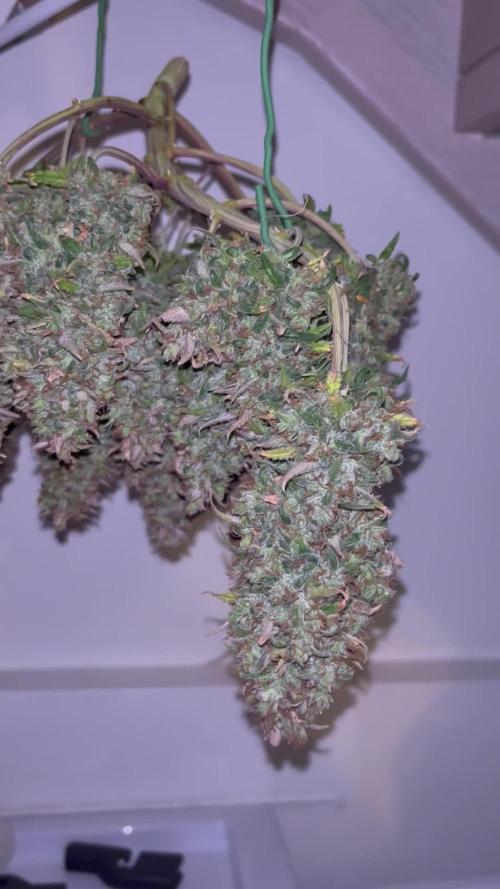
Flower day 15, Ladys doing good
Started to lollipop
The HerzOG seems to bounce back after last week cal/mag def.
50-60%Rl
20-27*C
Light is set to 80% ~ 560W


Likes
4
Share

@tsf_homegrow
Follow
🇩🇪
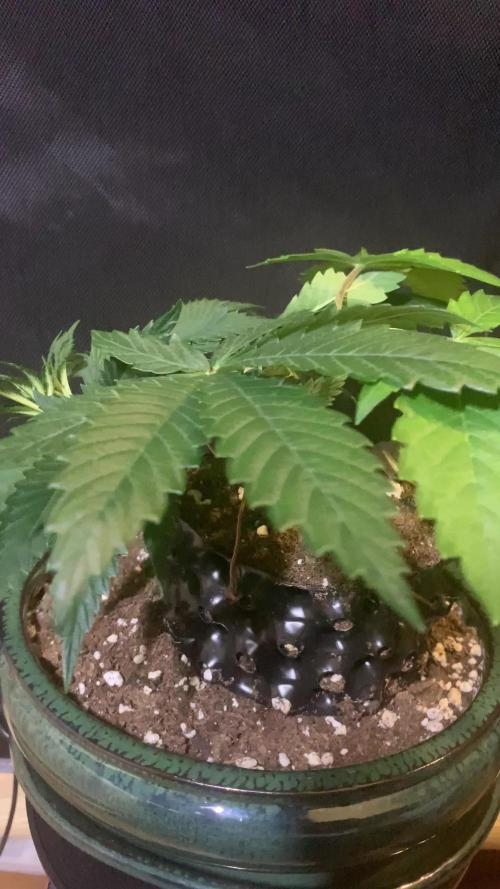
14.12. neue Woche neues Aussehen :) zwei Sonnensegel die nach oben zeigten entfernt, damit die inzwischen 4 seitentriebe etwas licht bekommen. die Drähte die letzten Tage über immer mal wieder neu justiert. Und vor ein paar Tagen zwei „Anker“ an den Stamm gesetzt damit die Pflanze bleibt wo sie ist. Durch den zug auf der anderen Seite hat sie angefangen sich dort mehr rüberzubiegen. Ansonsten macht sie sich ganz gut es läuft mehr oder weniger nach Plan.
Happy Growing💛✌️
🇬🇧
12.14. New week, new look :) I removed two upward-facing fan leaves so the four side shoots could get some light. I've been readjusting the wires a few times over the last couple of days. And a few days ago, I added two "anchors" to the stem to keep the plant in place. The tension on the other side had caused it to start bending more. Otherwise, it's doing quite well; things are more or less going according to plan.
Happy Growing💛✌️
Likes
38
Share


@Chucky324
Follow
Hello This is the end of week 5 and the beginning of week 6 of flowering.
Went to post on Tues. but found no pictures in any of my diaries. WTF...
1/2 way there. Still got 5 weeks to go, I'm planning to harvest around Aug 15 unless I get some pests or mold.
The inside plants seem to have gotten a little yellow. I'll give some extra nitrogen next watering.
Ok. Short Comment. Have Fun.
Chuck.
Some how the nutrients got messed up. I look at it later.???

Likes
11
Share


@RoyColt
Follow
Day52 21/01
3 lt ro water
6ml sensi calmag extra
Total 300 ppm pH6,1
Drain 500 ml 850 ppm
Day55 24/01
3lt ro water
8ml growA
8ml growB
Total 1050 ppm ph6,1
No Drain.
Day56 continue Def and LST.
Day57 26/01
2.5 lt ro water
8ml growA
8ml growB
Tortal 750 ppm ph6,1
Drain 250 ml 1600 ppm.


Likes
15
Share


@thegropro420
Follow
Sorry its been so long but ive decided to just focus on the pineapple express. She is doing great gonna start flushing her soon and started using final stage bloom nutes. The whole room has a heavy citrus terps smell and literally smells like juicy fruit gum. The frost is starting to come in thicker and thicker and im anxious to finally smoke her