Likes
Comments
Share
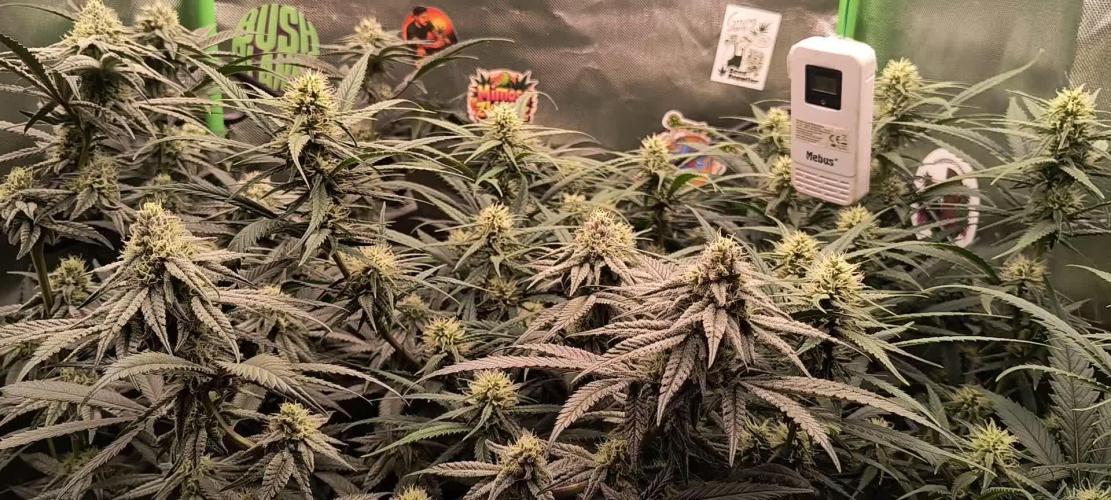
Soweit so gut 👍🏻 Aber, Trauermücken haben sich breit gemacht 😢😱😡 Sofortmaßnahmen... Mit Nematoden gegossen, feinen Sand als topping oben drauf. Und ein paar Gelbtafeln aufgestellt.. Einen Tag später nichts mehr zu sehen was rum fliegt.. Klar, in der Erde werden bestimmt ein paar Eier sein, aber die Nematoden werden ihren Job machen... Sonst keine Probleme 🔥

Likes
13
Share
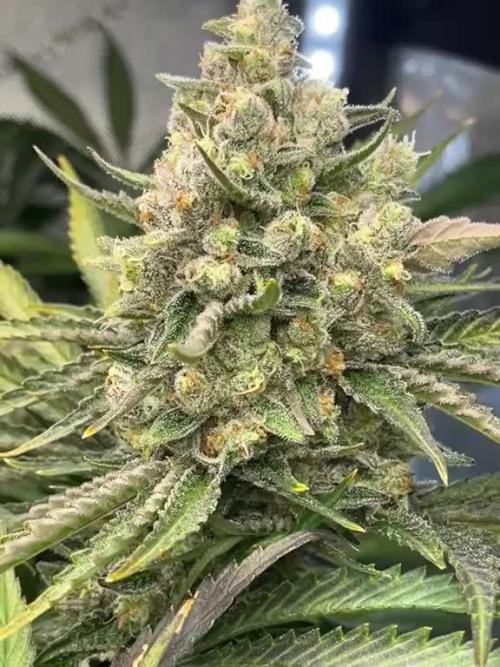
Regando solo con agua ya 2 semanas, sin necesidad de lavado el cultivo probiotico me lo permite las flores ya están maduran y se nota una densidad enorme en las special queen y en las green gelato de royal queen seeds
Processing
Likes
12
Share
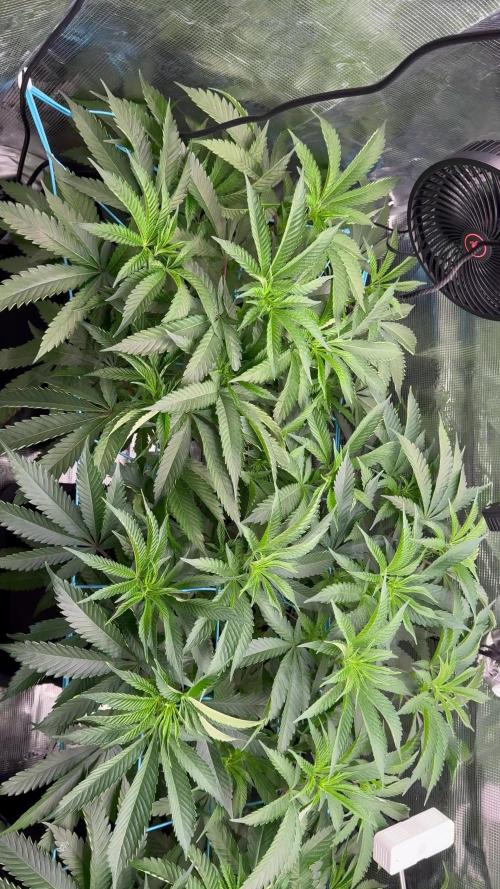
Checkout my Instagram @smallbudz to see the Small budget grow setup for indoor use, low watt, low heat, low noise, step by step. 07/12/2019 - Fed her 2l of 6.5PH water with 0,5ml of each Grow, Bloom, Max and Alga-mic, and 1ml of each Heaven and Vera,noticed about 10% run off, also added a green filter to the camera lens. Adjusted the light distance to 55cm again it was toooo close about 32cm. 10/12/2019 - Decided to go back and check the basics, removed led strip to give a proper 'night' time, changing light cycle to 20/4h no more 'exotic' 22/2h, re-checked the light distance every 2 to 3 days to ensure 60-45cm and I can tell all ready she is loving it. Also added home made Co2 made with 1 tsp of yeast, 3/4 tsp of sugar 700ml of warm water in a 1l bottle with a tiny pin hole on the cap. 11/12/2019 - Fed her 1.5l of 6.5PH water with 0,5ml of each Grow, Bloom, Max and Alga-mic, and 1ml of each Heaven and Vera,noticed about 10% run off. 12/12/2019 - 8 weeks have passed and no flowers I guess I'm flipping to 1212h to see if she reacts.
Likes
21
Share
Welcome growfessors to another episode of growfessor theatre 👽💚 Week 6F begins for the ladies of the 4x4, Green Crack, LSD and Mandarin dreams are rocking! Buds a bulking up, getting sticky, frosty and stanky!! Do-si-dos is a bit behind the other ladies as this strain will take an extra week to finish, but she's also packing on size, frost and stickyness. The Mars-Hydro TSW2000 light is rocking the grow, lighting up the 4x4 really well! Thanks for stopping by growfessors, stay tuned for another episode! 👽🌳💚
Likes
12
Share
@BB_UK
Follow
Can’t wait to see how this girl turns out she’s still in pre stretch like her sister #mimosacake and #forbiddenruntz they were the last 3 fastbuds to come into flower! 😊 going to be a great yield can already see it. Fastbuds WW always above and beyond with your genetics
Likes
4
Share
( Week 10) 30/6/2025 Well thats it guys we are at the end of my 2nd grow she hay came leaps and bounds since I started iv flushed for the last cupple of days and there is discolouration in the leafs and iv in the dark period for the next 32 hours and then ill chop and hang for another 7 days and then we are good to cure ill keep you posted on the out come
Likes
6
Share
Never quite made it in time for the competition, but ah well guess she’ll just have to be judged on how she looks now. Smells absolutely amazing a really sweet candy smelling srtain. A week or two left to go I think, looking foward to the harvest.
Likes
56
Share
Bonjour à tous les padawans et maîtres jedis Jour77 arrosage avec 2 litres d'eau ph6.3 Day80 j'ajoute en griffant la terre 3 grammes de feeding biobloom et arrosage avec 2 litres d'eau ph6.3 Ce sera mon dernier engraissage je commence mon rinçage la semaine prochaine Jour82 arrosage avec 3 litres d'eau ph6.3
Likes
4
Share
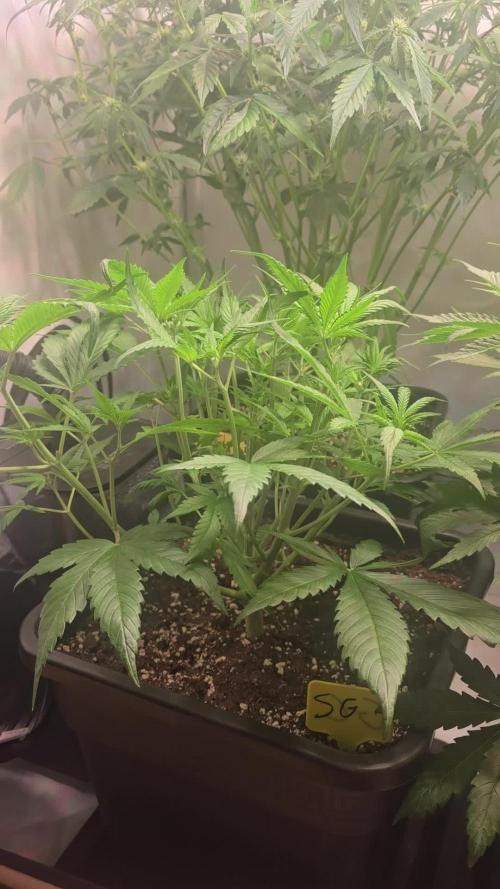
Neuen Topf bekommen und ins Blüte Zelt eingezogen ist Platz frei geworden.
Likes
17
Share
So this week it was time for the girls to get a hair cut. (Defoliation) Took all bottom leaves and lower stems off. At the end of this week it time to put them in 24hr of darkness then for the flip to flower stage 🙌 Throughout my veg stage I have had no problems or deficiencies With the plant at this moment in time green house feed is working wonders, they may have converted me to there range of feed but only time will tell. 9L per plant of water with enhancer 27G
Likes
2
Share
67 days since April 16th, 2026 We become aware at such times of man's wonderful ability to bring seemingly unrelated elements into harmonic balance, and receive a glimpse into a world where everything exists in conscious sympathetic attunement to everything else. When we listen to a piece of music that seems to strike a beautiful chord somewhere inside us, or view a painting that simply glows with harmonic awareness well executed, we probably do not spare much time to contemplate the wonderfully intricate combination of vibrations that our sensors make it possible for us to perceive. We tend to appreciate the relationship between the parts of something by an awareness of the harmony or dissonance of the whole. This ability enables us to say "what a beautiful house!" instead of "analysis has proven that this collection of building materials exhibits certain elements of harmonic proportion." While this ability to instinctively appreciate the beauty of true harmony has an important role to play in evolution, a more analytical understanding of the laws involved can be most useful. This is especially so if we wish to create works of art where each part exists in true harmony, not only with the other part of that particular whole, but with the universe within which the creator and the created exist. Everything vibrates. From the most dense matter to the most subtle cosmic rays, everything which our senses allow our thoughts to become aware of, can be specified in terms of wavelength or frequency of vibration. These two terms define the same thing, but from different points of view. The following are the approximate wavelengths of various energy carriers: Cosmic rays 0.000,000,001 mm Gamma rays 0.000,000,1 mm X rays 0.000,500 mm Ultraviolet rays 0.003 mm Visible light 0.006 mm Infrared 0.01 mm Sound waves 1 meter Radio waves 300 meters Violet light 400 nm to 450 nm Blue light 450 nm to 500 nm Green light 500 nm to 570 nm Yellow light 570 nm to 590 nm Orange light 590 nm to 610 nm Red light 610 to 700 nm 1 nanometer (nm) = 0.000,000,1 cm = 1/10,000,000 cm If a guitar string is plucked and we hear a sound, it is not too difficult for the human mind to associate this sound with the vibration of the guitar string. With color it is quite different. It is difficult for us to conceive that the color of a substance is not an inherent property of the substance itself, but an indication picked up by our senses of that substance's ability to absorb or reflect the light which happens to be shining on it at that moment. Neither the matter nor the light is colored. What happens is that the brain learns to differentiate between the frequencies reflected or transmitted by the substance the eyes are focused on. The same thing happens with sound. When we say "Oh! Listen, they're playing my favorite song," what we really mean is: "My brain has stored within it a particular pattern of frequencies. I have compared the new information being received with this stored pattern and have deduced the answer that the two patterns are similar within certain specified tolerances." The 'pleasure' involved could have something to do with our running the pre-recorded pattern at the same time, in 'sympathy' with the new pattern as it is received. The word sympathy describes very well our ability to appreciate color and sound. It also describes the reason behind certain elements of harmony. For instance, if a substance vibrating at 100 cycles per second (tone 1) is in the proximity of another substance vibrating at 200 cycles per second (tone 2), we could perceive, if we had the right equipment, a certain sympathetic relationship between the two. We will see from this that there is a uniform doubling of the first tone seen in the second. At various points along the waves, the two are the same in amplitude. At other points, they are at opposite poles to each other. This doubled frequency has more points of similarity to the original than any other frequency except the original itself. If the equipment we had available for measuring these two frequencies was a soundboard amplifier and a pair of ears, then we would hear what would sound to us like one tone. If we had the opportunity to hear one at a time, we would hear that although they sound the same, one is higher in pitch than the other. This characteristic of 'the same but different in pitch', musicians have called the octave. Any two tones produced where one has exactly doubled the frequency of the other is called an octave. Speaking in ratios, an octave would appear then as the ratio 2:1 or 1:2, depending on whether we are talking of an octave up or down. A single note produced by almost any instrument will contain more than one wavelength or frequency. It will have a dominant frequency, the wavelength of which we would call the note's 'fundamental' or 1st harmonic. It will also have a varying number of upper harmonics, gradually fading in intensity into infinity or silence. Natural harmonics always have the same pattern of intervals between them. The interval between the 1st and 2nd harmonic is a perfect octave; between the 2nd and 3rd a perfect fifth; between the 3rd and 4th a perfect 4th; and so on, the intervals becoming smaller and smaller until they lose any relationship with the western 12 tone scale as it exists at the moment. Just as an octave has certain elements of sympathy with its fundamental, so some intervals have been noted to be more perfectly in sympathy with the fundamental than others. The ratio of the 'perfect 5th' or interval of 7 semitones, as it occurs in the harmonic series, is 3:2 or 2:3, while that of the 'perfect fourth" is 4:3 or 3:4. All the tones in the western 12 tone scale can be expressed in terms of the ratio between the upper tone and its fundamental. This would seem to be an ideal way of generating a scale from any given fundamental and several attempts have been made to do this, the Pythagorean system being probably the most well known. Although when working with a single tone instrument playing on its own, the Pythagorean formula works wonderfully well, if we had several instruments tuned this way together and asked them to play almost any western music, we would find that at times they sounded quite out of tune to each other. The lack of flexibility of the various scale systems based on the harmonic series has led to what is known as the 'tempered' scale. This uses as its primary unit of interval the ratio of the octave or 2:1. It then proceeds to divide the interval between any fundamental and its upper octave into 12 smaller intervals by applying the ratio: two to the one-twelfth power, to one (21/12:1). This equals 1.059463094, so by multiplying any frequency by this number, we will obtain the tempered semitone next up from our fundamental. We will also find that any tone twelve semitones up from any other tone, in a scale generated in this way, will have exactly double the frequency. If we took the note middle C on a piano and halved the wavelength, we would have the note C one octave above. If we halved this, we would have the C above, and so on. However, within about 6 octaves, we would find that although a 'sound' was being produced, no human ear could perceive it. If we kept on going, halving and producing upper octaves of our fundamental C, we would proceed through the infrared band, into the visible light spectrum. If we happened to be outside during the day, we would, for one octave only, see the note C with our eyes. The next octave above would already be in the ultraviolet band, and outside the eye's sensitivity range. If we can think of color as being an indication of a substance's vibratory rate or wavelength, we may begin to see a relationship that could exist between the color and sound spectrums. The logical extension of what has so far been said is that there exists a scale in the color spectrum that corresponds exactly to the scale in the sound spectrum, each color tone being an octave of the equivalent note in the sound range. This is not the end of the story but only the beginning. If we can for the moment accept that any wavelength in one band has upper and lower octave stretching out to infinity, then the next question is 'fine, but what shall we use as our fundamental? A particular color? A particular sound frequency?' The musicians among us will probably say 'A 440'. This means that the note A should vibrate at 440 Hertz, or 440 times per second. They would tell us that this is standard pitch has been adopted by most orchestras around the world; pianos are tuned to it, instruments are constructed to formulas based on it, and so to them it would probably seem the most appropriate place to begin. Some of these musicians may know of the battle that is still raging with regards to this being the standard, but few would know why A = 440 Hz was chosen except that it worked when it was set to be a suitable compromise between the many different pitches in use at the time. 432 Hz is said to be mathematically consistent with the patterns of the universe. Studies reveal that 432 Hz tuning vibrates with the universe’s golden mean PHI and unifies the properties of light, time, space, matter, gravity, and magnetism with biology, the DNA code, and consciousness. When our atoms and DNA start to resonate in harmony with the spiraling pattern of nature, our sense of connection to nature is said to be magnified. Another interesting factor to consider is that the A=432 Hz tuning correlates with the color spectrum, while the A=440 Hz is off. Audiophiles have also stated that A = 432 Hz music seems to be non-local and can fill an entire room, whereas A=440 Hz can be perceived as directional or linear in sound propagation. Once you adopt the idea that sound (or vibration in general) can have an equalizing and harmonizing effect (as well as a disturbing effect), the science of harmony can be applied to bring greater harmony into one's life or tune to specific energies. There is a form of absolute and relative harmony. Absolute harmony can, for example, be determined by the tuning of an instrument. The ancients tuned their instruments at an A of 432 Hz instead of 440 Hz - and for a good reason. There are plenty of music examples on the internet that you can listen to in order to establish the difference for yourself. Attuning the instrument to 432 Hz results in a more relaxing sound, while 440 Hz slightly tenses up the body. This is because 440 Hz is out of tune with both macro and micro cosmos. On the contrary, 432 Hz is in tune. To give an example of how this is manifested microcosmically: our breath (0,3 Hz) and our pulse (1,2 Hz) relate to the frequency of the lower octave of an A of 432 Hz (108 Hz) as 1:360 and 1:90. It is interesting to note that 432 Hz was the standard pitch of many old instruments and that it was only recently (19th and 20th century) the standard pitch was increased. This was done in order to be able to play for bigger audiences. Bigger audiences (more bodies) absorb more of the lower frequencies, so the higher pitch was more likely to “cut through”. One of the oldest instruments of the world is the bell ensemble of Yi Zeng (dated 423 BC), tuned to a standard F4 of 345 Hz, which gives an A= 432 Hz. The frequency of 345 Hz is that of the platonic year! Similarly, many old organs are tuned in A=432 as well; for example, St. Peter’s Capella Gregoriana, St. Peter’s Capella Giulia, S. Maria Maggiore in Rome. Maria Renold’s book “Intervals Scales Tones and the Concert Pitch C=128 Hz” claims conclusive evidence that 440 Hz and raising concert pitch above scientific “C” Prime=128 Hz (Concert A=432 Hz) disassociates the connection of consciousness to the body and creates anti-social conditions in humanity. The difference between concert pitch A=440 Hz and Concert A=432 Hz is only 8 cycles per second, but it is a perceptible difference of awareness in the human consciousness experience of the dream we share called existence.
Likes
11
Share
Likes
21
Share
@Dunk_Junk
Follow
She's growing well. Maybe 1 more week in this pot then I intend to repot into a 20L airpot.
Likes
6
Share
🌱 Folder #1 — Lemon Cherry Gelato Week 3 Veg — 12/12 From Seed This run continues to surprise me in the best possible way. This plant is an autoflower, grown 12/12 from seed, and honestly… it’s performing well beyond expectations. This is my first time ever running autoflowers under a strict 12/12 cycle from day one, and I didn’t know what to expect going in. What I’m seeing now is clear, confident growth — calm, structured, and healthy. We are currently moving into the third pair of leaves, and what’s interesting is how balanced the behavior feels. At moments it almost feels like: • the autoflowers are behaving like photoperiods • or the photoperiods are behaving like autos Either way, the plant is responding beautifully. ⸻ 🌿 Growth & Structure • Stage: Week 3 veg • Light cycle: 12/12 from seed • Height: ~10 cm • Nodes: Third pair of leaves forming • Overall vigor: Strong, steady, controlled The leaves are lush, vibrant green, with excellent posture and spacing. Growth is compact but not stalled — exactly what I want to see at this stage, especially under 12/12. ⸻ 🎨 Leaf Expression & Personality We’re starting to see a bit of personality show up — nothing problematic at all. There is some light discoloration / pigmentation variation on the leaves, creating a subtle, almost camouflage-like pattern. Important to note: • No signs of deficiency • No stress signals • No structural issues Just natural expression, and honestly, it looks beautiful and unique. This is one of those moments where observation matters more than reaction. I’m loving it, and I’m very curious to see how this expression evolves as the plant matures. ⸻ 🌡️ Environment & Feeding All parameters remain identical to the previous report, keeping consistency across the room: • Same temperatures • Same humidity • Same solution • Same EC & pH • Same airflow philosophy Nothing changed — and that’s exactly the point. The plant is responding positively within the system. ⸻ 🧠 Observations So Far What stands out most is how comfortable these autoflowers seem under 12/12. There’s no rush, no panic, no weird stretch — just calm, confident development with a strong focus on structure and roots. This run is already teaching me something, and we’re only in week three. FOR DISCOUNT CODES AND MORE JUST FOLLOW THE LINK https://website.beacons.ai/dogdoctorofficial 📲 Don’t forget to Subscribe and follow me on Instagram and YouTube @DogDoctorOfficial for exclusive content, real-time updates, and behind-the-scenes magic. We’ve got so much more coming, including transplanting and all the amazing techniques that go along with it. You won’t want to miss it. GrowDiaries Journal: https://growdiaries.com/grower/dogdoctorofficial Instagram: https://www.instagram.com/dogdoctorofficial/ YouTube: https://www.youtube.com/@dogdoctorofficial ⸻ Explore the Gear that Powers My Grow If you’re curious about the tech I’m using, check out these links: 🔆 Lighting & Environmental Control • Future of Grow — Advanced LED lighting technology https://www.futureofgrow.com/ DISCOUNT CODE: DOG20 • Lumiflora — Under-canopy LED lighting https://lumiflorade.com/ • TrollMaster — Environmental controllers and automation gear (past collaboration) ⸻ Genetics • Zamnesia Seeds — Genetics used in this project https://www.zamnesia.com/ ⸻ 🌱 Soil, Substrates, Boosters & Root Support • Plagron — Substrates, bio mixes, and supportive products https://plagron.com/en/ ⸻ 🎒 Storage, Curing & Preservation • Grove Bags — Curing and storage solutions https://grovebags.com/ ⸻ 📸 Photography Equipment & Tools (Not sponsors, but part of my creative toolkit) • Sony A6700 • Sony full-frame macro lens + few more • Stacking photography workflow - learning • iPhone (for behind-the-scenes shots) We’ve got much more coming as we move through the grow cycles. Trust me, you won’t want to miss the next steps, let’s push the boundaries of indoor horticulture together! As always, this is shared for educational purposes, aiming to spread understanding and appreciation for this plant. Let’s celebrate it responsibly and continue to learn and grow together. With true love comes happiness. Always believe in yourself, and always do things expecting nothing and with an open heart. Be a giver, and the universe will give back in ways you could never imagine. 💚 Growers love to all 💚 📸 P.S. – The Eye Behind the Lens All photos in this diary (for now — except for the ones showing the camera, which I took with an iPhone) are taken with a Sony A6700 paired with a Sony full-frame macro lens and a few more. Photography is part of the story — it’s how we share the fine textures, the glow, and the quiet details that words can’t always capture. I’ve also started experimenting with photo stacking — a technique where multiple images, each taken at a slightly different focus point, are layered together to create one perfectly sharp image from front to back. It’s not digital enhancement or AI; it’s pure photography — a way to reveal the plant’s beauty in microscopic depth, from trichome to petal. You’ll even see a few shots of "ghost me" capturing the shots — camera, lens, setup — because every grow deserves not just to be cultivated, but documented like art. FOR DISCOUNT CODES AND MORE JUST FOLLOW THE LINK https://website.beacons.ai/dogdoctorofficial NEW DISCORD - Official Server Invite Link : https://discord.gg/ksjAkA5T74
Likes
21
Share
@Bncgrower
Follow
We've reached the end of this journey, the result was good, a very good strain to cultivate, a little sensitive at first, but then it reacted very well. The buds had a very good aroma, dense and resinous, now just wait for the drying and curing process to complete the cycle.. ✌️✌️✌️
Likes
3
Share
@MotasKush
Follow
Sunset Sherbet x Purple Punch from Ripper seeds. 👑🔥Low stress training 🙌😁, happy healthy plants... . Grow Your Own! 💚🍁💚 Love Cali strains, purple buds And trichomcity. 💜🤩😍
Likes
12
Share
hello plant lovers this week as I already expected there was a bomb growth. its full flowering has just started, I inverted the lights by placing the 300w further down the grow, gaining more space for the 100w module that I placed in front of it, the plants held water well even though now I have 30watt input plus 15w under the mokum tulip in last week's defoliation tidied up the grow room and now the stems are struggling to get their light I'm still at 18 out of 24 but I think I'll increase every few days and give full power to 24 hours I'll wait another four days before turning up the lights these little girls are still hungry to grow and the main led satisfies placed higher up is satisfying everyone today I removed a few leaves the space has now become a real jungle but whatever happens I'm happy of the LST results the smell is still very low I hope they don't explode but I already know that something will happen this week in this case I will be ready to tie the tips to the structure of the grow. good continue a kiss
Likes
4
Share
I'm having a hard time judging an approximate finish time with this plant. Its definitely in its final push though. Starting to yellow off quite a bit. I've never grown a plant that has stayed this small. Makes me wonder if I did something wrong along the way. I'll honestly be very happy once this thing is out of my tent. No issues to report this week. Happy growing everyone!!
Likes
14
Share
The OG Kush made it through her final week of flower...56 days in total. Super sticky and smells like a mix of limonene and pinene and a hint of sweetness on the back end. I'm definitely happy I have a couple more of these beans. Super smooth run, chunky resinous buds. Thank you to everyone that visited to check my first Grow Diary out. You made it a really cool experience ✌️☺️. https://www.instagram.com/ao.grows?igsh=MXR1dWZxMWhlNnF6bA== Check out my Instagram for clips I made for this grow.
Likes
99
Share
@Growbody
Follow
Meine lieben Freunde und Freundinnen, Brüder und Schwestern im Geistigen und Tatkräftigen, herzlich Willkommen zum Greenhouse Summer Outdoor Grow 2026. Der erste Strain des Outdoor Grows den ich Euch vorstellen werde ist die Purple Lemonade FF von 2Fast4Buds, eine 60% Sativa die laut FastBuds etwas nebulös als eine Kreuzung aus purple und citrus Cali Genetik beschrieben wird. Egal, sie soll sehr fruchtig und zitronig schmecken und könnte schöne Farben bekommen. Außerdem soll Sie eine kurze Blütezeit haben. Hier ist die URL: https://2fast4buds.com/de/seeds/purple-lemonade-fast-flowering#description Der zweite Strain der im Set mit dabei ist, ist die Mimosa x Orange Punch fem. von Barney's Farm, die ihre Genetik und den Taste bereits im Namen trägt, eine 65% Indica, die laut Barney's "ein wirklich sensationelles, zitrusähnliches und mandarinenartig-süßes Aroma" haben soll. Auch sie könnte interessante Farben bekommen. Hier die URL: https://www.barneysfarm.de/mimosa-x-orange-punch-552 Last but not least, der dritte Strain ist die Chocolate Sherbet fem. von Grower's Choice, eine 70% Sativa, deren Eltern Chocolope x Sunset Sherbet sind. Auf den Geschmack bin ich schon jetzt gespannt, cremiges Haschisch. Mit bis zu 240cm könnte sie die größte im Greenhouse werden und würde dann bis zur Decke wachsen. Hier ist die URL: https://www.growerschoice.nl/de/chocolate-sherbet.html#description EDIT: Nachdem die oben aufgeführten Pflänzchen nicht so recht loslegen wollten, habe ich mich entschlossen, fertige Stecklinge von Hanfgarten aus Österreich dazuzubestellen. Die Stecklinge kommen in die Mörtelwannen, die selbst gezogenen kommen in die bereits bewährten 15 und 20 Liter ROOTiES. So kann ich die auch mal direkt in die Sonne stellen. Der erste Steckling ist die Blueberry von Hanfgarten, eine 80% Indica, einer Kreuzung aus Afghan Indica x (Thai Sativa x Mexican Oaxacan Sativa), die nach 8 Wochen Blüte Mitte Oktober fertig sein soll. Außerdem soll sie fruchtig, beerig und süß schmecken. Auch hier gibt es eine URL: https://www.hanfgartenshop.de/blueberry.html Der zweite Steckling ist die Runtz, ebenfalls von Hanfgarten, ein Hybrid aus Zkittlez × Gelato, die auch nur 8-9 Wochen Blüte hat, mal sehen. Wenn sie ein ähnliches Aroma hat wie die Wurlz bin ich happy. Die URL: https://www.hanfgartenshop.de/runtz.html Der dritte Steckling ist die Super Lemon Haze, eine 80% Sativa von Greenhouse Seeds, deren Genetik von Lemon Skunk x Super Silver Haze stammt. Mit 9-10 Wochen Blüte steht sie wohl mit am längsten im Greenhouse. I💖Haze und hier sind die URL's: https://www.hanfgartenshop.de/super-lemon-haze.html https://shop.greenhouseseeds.nl/feminised-cannabis-seeds/1-seed-pack/super-lemon-haze/?variation_id=604 Auch dieses Jahr gibt es wieder etwas Neues: Mir ist vor einigen Wochen im Baumarkt ein Foliengewächshäuschen begegnet. Die Aussicht, meine Schätzchen immer im Trockenen zu Wissen, lies mich sofort (also sofort nach einem Recall mit meiner Liebsten) zuschlagen. Danach war nur noch ein teilweiser Umbau unseres Gartens nötig, einen kleinen Weg anders verlegen, ein Fundament ausheben, Bordsteine zersägen, 2 Zentner Beton verbuddeln, Löcher bohren, verdübeln und verschrauben ohne das der Beton ausplatzt, einen haufen Astwerk vom Wein opfern und viel Rasen neu anlegen, das war's schon fast. Neu: Sind auch die zwei 90 Liter Maurerbottiche, in denen sich meine Pflanzen wohlfühlen dürfen, 4x soviel Platz wie im letzten Summer Outdoor Grow. Zur Drainage habe ich Rheinkiesel 9-18 verwendet. Da drauf kam mein altes Erdmischungsrezept mit frischem Kompost von Piluweris, Lehm, den die Wühlmäuse ständig in unserem Rasen aufwerfen und Sand aus'm Kieswerk mit gaaanz viel Staub drinne, praktisch Gesteinsmehl. Auch hier gab's was Neues: Hornmehl zusätzlich, hatich früher schon verwendet und ganz vergessen. Der erste Sack Sonnenerde Hanferde wurde mit der oberen Schicht meiner Mischung vermischt. Der zweite Sack kam dann blank obendrauf. Neu: Für mich ist auch die angewendete Keimmethode noch neu, die Samen zuerst in einem Marmeladenglas mit temperiertem Wasser mit Zusatz von Wasserstoffperoxyd keimen zu lassen. Neu: In die Wannen kommen zusätzlich Gäste als da wären erprobte und neue sowie überwinterte Chilisorten, verschiedene Basiliken oder -kums, Weiße Melisse, Roter Klee, paar Blumen und so. Tag 126: Letzte Nacht hat es endlich mal wieder 4 Liter geregnet. Heute ist es leicht bewölkt mit viel Sonne und 28°C, im Greenhouse sind es 33°C bei 46%. Ein Weidenschwärmer verschläft den Tag im Trockenen. Wenn ich mein Handy immer bei mir hätte, gäbe es noch Fotos von Blindschleichen, Zauneidechsen, Schwalbenschwänzchen (Ich liebe sie, sie fliegen wie Kolibris) und Schmetterlingen, von denen ich die wenigsten kenne. Tag 128: Es hat draussen etwas abgekühlt. Die Temperaturen im Greenhouse sind heute 29°C bei 38%, nachts 12°C bei 89%. Tag 129: Heute ist der "kühlste" Tag der Woche mit nur 24°C, im Greenhouse sind es 28°C bei 41%, nachts 12°C bei 98% mit 12,5 Liter Regen. Tag 130: Die Temperaturen steigen ganz leicht auf Tags 25°C bei 67% mit leicht bewölktem Himmel und wenig Wind, nachts milde 14°C bei 96%. Heute hat die Super Lemon Haze Hanfgarten/Greenhousseeds mit der Blüte begonnen 💮 Die Blueberry von Hanfgarten blüht jetzt die 2. Woche, bekommt wunderschöne Herbstfarben und ist diese Woche noch auf 170 cm gewachsen. Die Runtz von Hanfgarten blüht knapp 2 Wochen und wächst weiter auf 142 cm. Die Super Lemon Haze Hanfgarten/Greenhousseeds ist nochmal richtig auf 193 cm geschossen, hat nochmal 20 cm zugelegt. Draussen geht es weiter mit der Minosa x Orange Punch, auch knapp 2 Wochen in der Blüte mit den ersten gelb werdenden Blättern, ist jetzt auf 182 cm. Die Chocolate Sherbet von Grower's Choice, die Größte von allen, kommt auf 228 cm. Sie Blüht immer noch nicht. Die Purple Lemonade FF von 2Fast4Buds dagegen blüht jetzt seit 4 Wochen, bekommt auch schön gefärbte Blätter, hat schon richtig dicke Blüten und hat mit ihren 173 cm nochmal bisle zugelegt. Wegen der sehr kurzen Regenphasen in diesem Jahr bleiben die drei Grazien an Ihrem Platz, sie trocknen schnell ab. Zur Zeit bekommen die drei Grazien draussen 2x am Tag ~3 Liter, die Stecklinge drinnen 2x 10 Liter Brunnenwasser. Tag 132: Tags 29°C bei 43%, nachts 14°C bei 90%. Eins kann ich versprechen: It will take a very, very long time 😃 Schön das du es bist, der mich begleitet 👍😎