


Likes
Comments
Share


@blasterw32
Follow
Buds and sugar leaves started to get more and more trichomes. Some pistils are turning amber/brown, mostly in the tallest colas. I'm slightly worried about the distance between lights / flowers (~16-17"), but so far they don't present any symptoms of light burning. There's no vertical room left to bring the lights up, so I really can't do anything in that matter, just hope they have stopped growing lol.
I'm also about a bit worried about the amount of leaves. Not sure if I should do some prunning or leave as it is.


Likes
68
Share

@Ultraviolet
Follow
Removed autoflower and put her in her own pot outside the tent.
Foliars applied in strong blue 430nm with 4000Hz tone. 20-minute dose prior to application.
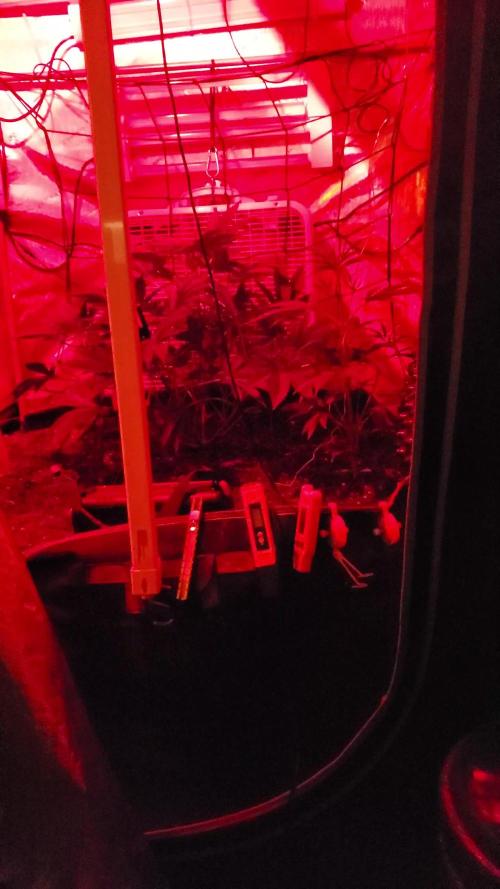
In essence, you're seeing a combination of the infrared light reflected by the plant, which the camera perceives as red, and any residual visible blue light the plant reflects, which results in a purple hue.
I was doing more stretching of the stems, adjusting weights, just a little too much, and it snapped almost clean. I got a little lucky in that it was still connected, wrapped her almost instantly while holding her in place with yoyo's. The core framework is now in place.
If your soil has a high pH, it's not ideal; you want a pH of 6.4, 6.5, or 6.6, which is ideal. If you are over a pH of 7, you have no hydrogen on the clay colloid. If you want your pH down, add Carbon. If you keep the pH below 7, you will unlock hydrogen, a whole host of new microbes become active and begin working, the plant will now be able to make more sugar because she has microbes giving off carbon dioxide, and the carbon you added hangs onto water. Everything has electricity in it. When you get the microbes eating carbon, breathing oxygen, giving off CO2, those aerobic soil microbes will carry about 0.5V of electricity that makes up the EC. The microorganisms will take a metal-based mineral and a non-metal-based mineral with about 1000 different combinations, and they will create an organic salt! That doesn't kill them, that the plant loves, that the plant enjoys. This creates an environment that is conducive to growing its own food.
Metal-based: Could include elements like iron, manganese, copper, or zinc, which are essential nutrients for plants but can exist in forms not readily accessible.
Non-metal-based: Examples like calcium carbonate, phosphate, or sulfur are also important for plant growth and potentially serve as building blocks for the organic salt.
Chelation in a plant medium is a chemical process where a chelating agent, a negatively charged organic compound, binds to positively charged metal ions, like iron, zinc, and manganese. This forms a stable, soluble complex that protects the micronutrient from becoming unavailable to the plant in the soil or solution. The chelate complex is then more easily absorbed by the plant's roots, preventing nutrient deficiency, improving nutrient uptake, and enhancing plant growth. Chelation is similar to how microorganisms create organic salts, as both involve using organic molecules to bind with metal ions, but chelation specifically forms ring-like structures, or chelates, while the "organic salts" of microorganisms primarily refer to metal-complexed low molecular weight organic acids like gluconic acid. Microorganisms use this process to solubilize soil phosphates by chelating cations such as iron (Fe) and calcium (Ca), increasing their availability.
Added sugars stimulate soil microbial activity, but directly applying sugar, especially in viscous form, can be tricky to dilute. Adding to the soil is generally not a beneficial practice for the plant itself and is not a substitute for fertilizer. While beneficial microbes can be encouraged by the sugar, harmful ones may also be stimulated, and the added sugar is a poor source of essential plant nutrients. Sugar in soil acts as a food source for microbes, but its effects on plants vary significantly with the sugar's form and concentration: simple sugars like glucose can quickly boost microbial activity and nutrient release. But scavenge A LOT of oxygen in the process, precious oxygen. Overly high concentrations of any sugar can attract pests, cause root rot by disrupting osmotic balance, and lead to detrimental fungal growth. If you are one who likes warm tropical high rh, dead already. Beneficial, absolutely, but only to those who don't run out of oxygen. Blackstrap is mostly glucose, iirc regular molasses is mostly sucrose. Sugars, especially sucrose, act as signaling molecules that interact with plant hormones and regulate gene expression, which are critical for triggering the floral transition. When sucrose is added to the growth medium significantly influences its effect on floral transition.
Probably wouldn't bother with blackstrap given its higher glucose content. Microbes in the soil consume the sugar and, in the process, draw nitrogen from the soil, which is the same nutrient the plant needs. Glucose is not an oxygen scavenger itself, but it acts as a substrate for the glucose oxidase (GOx) enzyme, effectively removing oxygen from a system. Regular molasses (powdered if you can), as soon as she flips to flower or a week before, the wrong form of sugar can delay flower, or worse. Wrong quantity, not great either. The timing of sucrose application is crucial. It was more complicated than I gave it credit for, that's for sure. When a medium's carbon-to-nitrogen (C:N) ratio reaches 24:1, it signifies an optimal balance for soil microbes to thrive, leading to efficient decomposition and nutrient cycling. At this ratio, soil microorganisms have enough nitrogen for their metabolic needs, allowing them to break down organic matter and release vital nutrients like phosphorus and zinc for plants. Exceeding this ratio results in slower decomposition and nitrogen immobilization, while a ratio below 24:1 leads to faster breakdown and excess nitrogen availability.
Carbon and nitrogen are two elements in soils and are required by most biology for energy. Carbon and nitrogen occur in the soil as both organic and inorganic forms. The inorganic carbon in the soil has minimal effect on soil biochemical activity, whereas the organic forms of carbon are essential for biological activity. Inorganic carbon in the soil is primarily present as carbonates, whereas organic carbon is present in many forms, including live and dead plant materials and microorganisms; some are more labile and therefore can be easily decomposed, such as sugars, amino acids, and root exudates, while others are more recalcitrant, such as lignin, humin, and humic acids. Soil nitrogen is mostly present in organic forms (usually more than 95 % of the total soil nitrogen), but also in inorganic forms, such as nitrate and ammonium. Soil biology prefers a certain ratio of carbon to nitrogen (C:N). Amino acids make up proteins and are one of the nitrogen-containing compounds in the soil that are essential for biological energy. The C:N ratio of soil microbes is about 10:1, whereas the preferred C:N ratio of their food is 24:1 (USDA Natural Resource Conservation Service 2011). Soil bacteria (3-10:1 C:N ratio) generally have a lower C:N ratio than soil fungi (4-18:1 C:N ratio) (Hoorman & Islam 2010; Zhang and Elser 2017). It is also important to mention that the ratio of carbon to other nutrients, such as sulfur (S) and phosphorous (P) also are relevant to determine net mineralization/immobilization. For example, plant material with C:S ratio smaller than 200:1 will promote mineralization of sulfate, while C:S ratio higher than 400:1 will promote immobilization (Scherer 2001).
In soil science and microbiology, the C:S ratio helps determine whether sulfur will be released (mineralized) or tied up (immobilized) by microorganisms.
A carbon-to-sulfur (C:S) ratio smaller than 200:1 promotes the mineralization of sulfate, when the C:S ratio is low, it indicates that the organic matter decomposing in the soil is rich in sulfur relative to carbon. Microorganisms require both carbon and sulfur for their metabolic processes. With an excess of sulfur, microbes take what they need and release the surplus sulfur into the soil as plant-available sulfate
A carbon-to-sulfur (C:S) ratio higher than 400:1 will promote the immobilization of sulfur from the soil. This occurs because when high-carbon, low-sulfur materials (like sawdust) are added to soil, microbes consume the carbon and pull sulfur from the soil to meet their nutritional needs, temporarily making it unavailable to plants.
200:1 C:S 400:1: In this range, both mineralization and immobilization can occur simultaneously, making the net availability of sulfur less predictable.
This dynamic is similar to how the carbon-to-nitrogen (C:N) ratio regulates the availability of nitrogen in soil. Just as microbes need a certain amount of nitrogen to process carbon, they also require a balanced amount of sulfur. Both mineralization and immobilization are driven by the metabolic needs of the soil's microbial population.
Sulfur is crucial for protein synthesis. A balanced ratio is particularly important in relation to nitrogen (N), as plants need adequate sulfur to efficiently use nitrogen. A severely imbalanced C:S ratio can hinder the efficient use of nitrogen, as seen in trials where adding nitrogen without balancing sulfur levels actually lowered crop yields.
Maintaining a balanced carbon-to-sulfur (C:S) ratio is highly beneficial for plant growth, but this happens indirectly by regulating soil microbial activity. Unlike the C:N ratio, which is widely discussed for its direct effect on nutrient availability, the C:S ratio determines whether sulfur in the soil's organic matter is released (mineralized) or temporarily locked up (immobilized).
Applied 3-day drought stress.
Glucose will hinder oxygenation more than sucrose in a solution because glucose is consumed faster and has a higher oxygen demand, leading to a more rapid decrease in oxygen levels. When cells respire, they use oxygen to break down glucose, and this process requires more oxygen for glucose than for sucrose because sucrose must first be broken down into glucose and fructose before it can be metabolized.
In a growth medium, glucose is a more immediate and universal signaling molecule for unicellular and multicellular organisms because it is directly used for energy and triggers a rapid gene expression response. In contrast, sucrose primarily acts as a signaling molecule in plants to regulate specific developmental processes by being transported or broken down, which can be a more complex and slower signaling process.
Critical stuff.
During wakefulness (DC electric current) life can not entangle electrons and protons. During the daytime, the light is sensed as multiple color frequencies in sunlight. Coherence requires monochromatic light. Therefore, at night, IR light dominates cell biology. This is another reason why the DC electric current disappears during the night. The coherence of water is maintained by using its density changes imparted by infrared light released from mitochondria in the absence of light. This density change can be examined by NMR analysis, and water is found to be in its icosahedral molecular form. This is the state that water should be in at night. This is when a light frequency is lowest and when the wave part of the photoelectric effect is in maximum use.
3600
Processing
Likes
5
Share


@Hexus
Follow
Days 78-84 - Been lax in updates, but I still log every week to completion. Back injury in addition to The Nineteen, Rona Style, has been a bit of a pain in the posterior. (That means ass) Plants are gigantic and sassy. Had Dangergirl come out and defoliate/lollipop the bottoms out of the girls, saving me painful labor and increasing my yields, so yay for her! Plants are happy, pompoms are getting thick, and everything looks good. Switched FF01 to flower on day 84.


Likes
13
Share


@Fonzi
Follow
Sehr gute Sorte. Sie Bss#1 hat ein etwas organisches leicht limoniges Aroma und die bss#2 riecht sehr stark nach Eukalyptus. Mir gefallen beide aber ganz gut. Vorallem ist die Wirkung ist sehr gut.


Likes
5
Share


@deepsheeba
Follow
!! A genetic mutation appears! flower tip look odd and the stem is flat but no weird sprout on it. Only one stem is affected.
Some other LST done.
CO2 decreased to 1000 for saving some co2. I don't think I have enough power to use all of that CO2.
Plant is growing really well. There's only a small concern about some worms at the bottom of the pot. I need to check it further. To be sure anyway I have planned an irrigation with neem Oil just for precaution.


Processing
Likes
55
Share


@Njaak
Follow
Most of the week was spent setting up the hydro grow. Needed to build a DIY chiller since air temp in our grow room is hot, and water needs to be a good deal colder. Fridge from kijiji, garden hose, fittings, and submersible pump all in were under $100 but knowing what I know now I'd likely go with a thermoelectric chiller (DIY, with power supply and temp controller) next time around. Looking forward to tracking metrics and seeing how it goes :). Seems there's a lot of contradiction in terms of level of nutrients recommended, max water temperature, using H2O2 to boost water temp that can keep algae and rot at bay, etc. Got my hands on some Hydroguard via Amazon... despite local shops saying you can't get it in Canada... so I'm going to go with that instead of H2O2 to start, despite water temp getting up above 21 C (70 f) during the day. Fingers crossed.
Update - keeping water reservoir tank under 20 C now by using reflective bubble wrap insulation on the reservoir itself and pipe insulation as well. It's a 10 C difference from the room temp, so I'm SUPER pleased with that.

Likes
34
Share


@crystal_garden_0
Follow
Great week, soft transplant done just fine. 4.5 inch pots to 5 gallon pots. Plants seem happy, lights and genetics are really nice. Hopefully all goes well. Thanks everyone
Likes
67
Share


@Dunk_Junk
Follow
Only a few days till I start staggered harvest. Whatever buds look ready I will cut off her.
Short video this week, sorry guys, technical problems 😑
Likes
Comments
Share


Likes
6
Share


@Cultivandomedicinanatural
Follow
En esta ocasión tenemos algunas plantas más grandes que otras, tenemos las red hot cookies miden 17 y 20 cm. Las tropicanas 15 y 20 cm y la purple punch og 16 cm.
Vamos a hacer una agua con concentración de 1.35 para las grandes y de 1.2 para las que son un poco más pequeñas.
Seguimos con un ph de 5.8 y se va notando ya la corrección de las carencias iniciales.

Likes
47
Share


@terpproducer
Follow
👇 This week:
---
Watered again as usual with the standard Plagron scheme + Calmag (last feeding with Alga Grow) (PLEASE CHECK YOUR WATER BEFORE USING CALMAG)
Phosphorus foliar spray - red stems pretty much gone now
PPFD at canopy height approximately 350-400, VPD ~1
Performed a major defoliation again
Ordered more Autopots 😂
---
Happy growing and thanks for checking out my report! I really appreciate you! 😁💪🙏

Likes
10
Share


@HideAndFly420
Follow
Day 57 this little lady last weekend showed up with some burning on the leaves but I’m. Not really sure it was an excess of nutrient, signals of a deficiency of K and P are also visible. So I just gave oh controlled water with regulator and enzym+ and some calmag, now everything looks fine and i ‘ m sure I t will be great this week.
Tomorrow, feeding day!
Day 59 lady si farting up every day, I’ve been feeding her the last two days. The yellow on the leaves is just because of a water deficiency from the last week, I wanted my lady to absorb everything I gave. On day 57 I gave 1 lt but it was too dry, so on day 58 I gave her another lt and she took it all with PH 6,2 and PPM 1000z
I think I’ve got 20/25 day max left so this will be the last week of fertilising from
Day 70 I’ll start mi flush.
Day 62 today feeding day I finally get my p-boost and k-boost from aptus. She drunk 1 lt with
ph 6,1 and ppm 1090
Let’s see🌱🌱🌱🔥🔥
Likes
2
Share



Likes
90
Share


@MrCOCO
Follow
Hi... Everything goes very fast ... I used the pinching method to increase my yield and the quality of buds also... 🍃🍃🍃now I keep my fingers crossed for the girls ...🍃🍃🍃 I think maybe a week and I will switch to flowering... 🍃🍃🍃
Happy growing 🍃🍃🍃
Likes
Comments
Share


@CannabisStrainReview
Follow
Here is the grow report of the Blue Dream. It was a pleasure to grow. I used high-frequency fertigation.


Likes
25
Share


@Luna91
Follow
Hello guys!
This week was amazing for my girls & Me! :D
4 of them are showing a great sign of flowering! After I defoliated all and tried main Lining for the first time! I didn’t expect such a great results! They are already healing and I should say: I’m falling in love with growing!!
It’s like my thing! After hours and hours reading and searching! When i see them happy like this, feels like all of my efforts are paying off.
I just wish they weren’t autos!
A newbe grower totally can handle an original femmenized seed! I don’t know why everyone said go for autos for tour firat grow!!
I’m practicing most of the trainings suitable for autos till i get real stuff!! Soon!
I also got that powerful AC, i was hesitating to buy!! it’s pretty amazing! Now I can grow my pineapple Express at thr best temp 25 degrees with 2200w!
I just hope i dont get too suprise when i see the Bill😅
Likes
10
Share


@BR1CK_SANCHEZ
Follow
Eventful week for the girls... threw in another 95w LED to finish out flower and to grow an extra plant or two next run. Checked the trics on the leftmost plant and they were almost all cloudy and even starting to turn amber in a couple spots, so I decided it was time to chop her. Probably gonna take the other smaller plant down soon as well. The tallest plant is still looking larfy as hell but I'm hoping she'll thicken up a little over the next week or two.
Likes
4
Share


@Ferenc
Follow
Yeah I have already written a review about it in my previous diary. It is really strong not a day time smoke... It makes you really high. The plant is very very stinky when you cut so close all the doors and windows!!!!!! Last 2 pictures in the jar was aken after 4 days of the harvest. The harvest day it was 171g and after 4 days 80g. It needs to be cured. After 6 days its weight 51g. The last 6 pictures show the flower after 3 weeks of curing. The best thing in this smoke that it doesn't have that strong smell at all almost nothing but the effect is in :) All the plants grow at least 40-50 cm but it can grow over 100cm as well if you let it.
4 weeks later : I decided to make some cannabutter. Update: Fucking hell I have never tried brownie or tea like this and also I have never been so high. I put one tsp into my tea and felt nothing so decided to repeat with 3 tsp. I went to take a nap and when I woke up I couldn't see I was so fucking high for several hours. Uhhh was great tho.😂✌️✌️ Last 10 pictures: This is what left after almost 3 months of harvest I smoked and cooked it.
