


Likes
Comments
Share

@Bncgrower
Follow
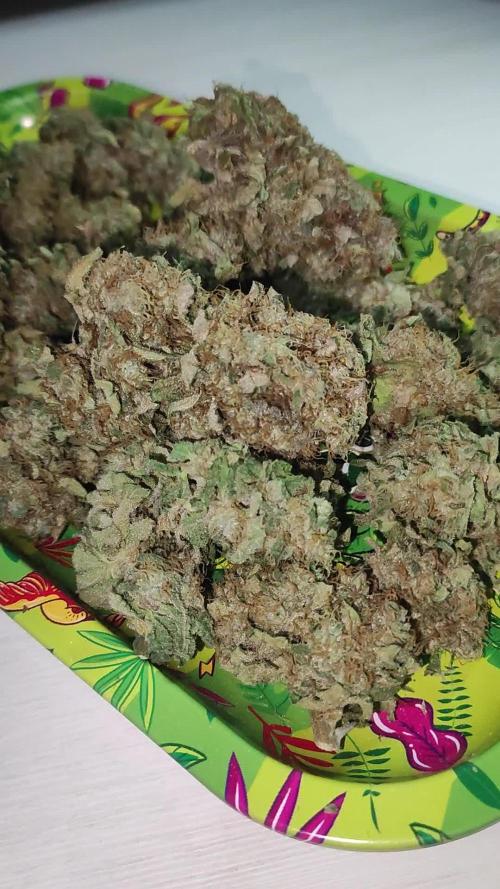
Harvested last night, truly strong smell, cultivation was absolutely perfect from start to finish. Very happy with the result, anxious for the drying and curing process! Thank you for following along.. 🤜🤛🌱🌿🌲
Likes
5
Share


@nd-grower
Follow
Water was 5.9ph gave some grow big and honey today.. raised lights up as well .
11-27-25 not showing signs of pH issue like the cookies but I did top her this morning so she's not gonna get any water for a few days which is ok with me
11-29+25: growing good 1st signs of flowering 2 days ago..
Water used was pH of 6.1

Likes
Comments
Share


@Robom069
Follow
very big buds
not so dense but still very good i guess
left side acid dough
right side black domina




Likes
15
Share


@FishTankGrow
Follow
Everything going strong.
Baby Yoda spreading his ears.
One leaf started to curl a bit. Maybe too much water?
Starting nutes tomorrow.
The more leaves. Wanted to start nutes but soil is too moist.
Will hold off for another day. Just misting the surface.
Started with Fox Farm at 1/3 dosage as my soil had organic nutes in it already. Starting slowly.
Saw a gnat running around. Stopped water and misting. Put some packing tape in. Should be ok. 😁
Temperature is creeping up as I add more light. Maybe increase distance soon.
Increased the light distance. Leaves were looking a little baked. Maybe too hot as well.

Processing
Likes
6
Share


@MulzinMo
Follow
4/20
Still having trouble getting seeds to grow! 4 out of 6 seeds from the initial pop have died, so I've popped one more Chemdogging and one more Sour Diesel. Placed the popped seeds directly in the pot they'll stay in for the whole grow per suggestions. Built a 30"x36" trellis out of 3/4" PVC pipe, will install a double trellis netting on it once I set up the Blumat watering system. Also added in a smart power strip that now has built-in timers I can control from my phone. Organized all my extra grow equipment and cleaned up the room! The little pots in the photos are some random seeds I'm starting off in here to give to some friends to grow outdoors.
4/25 - sour diesel popped up today!
5/2
Still no luck getting the Chemdogging to sprout, currently waiting on C-dog and a Blackberry auto to sprout in my other two pots. Set up some random plants from seeds I found in a bag of Black Lime and Cookies, put them in a separate room to flower so I can find out if they're female.

Likes
6
Share


@Cannabis_Sativa
Follow
The wonder woman from Barney farm fuck marvel/dc this is real wonder woman 😈

Likes
17
Share


@Mastr
Follow
Hi all grower auto orange bud week 13 she had long veg pase due transplant shock but now she get very big and bushy u feed her 1ml bio grow 4ml bloom 2ml big bud
Half ml cal mag with 5 litre water ph every other day
The bud top leaf start getting purple so beautiful plant definitely grow her again

Processing
Likes
19
Share


@MrSweetLeaf
Follow
First week of flowering going well still got a few leaves here and there that look a bit sad but overall they look healthy and are growing like crazy. Upped the nutrients to 900ppm. Still watering every third day. Got some 13” risers and 18” saucers that work incredibly well with these cloth 5gals.


Likes
4
Share


@DogDoctorOfficial
Follow
💙 8×8 Adventure – Week 14 🌿
Blueberry Muffin – Pheno B
🌸 A Little Further Ahead, Still in No Hurry — The Compact Girl Follows Her Own Clock
Welcome back to another chapter of the 8×8 Adventure! 🌱💚
And here we are again...
Blueberry Muffin Pheno B.
😂💙
Still compact.
Still taking her time.
Still looking at the rest of the room as if everybody else is running around for absolutely no reason.
And honestly?
I think she might have a point.
😂🌿
She's moving forward, she's developing beautifully, and she's actually a little further along than her sister.
But let's not get carried away.
We're not talking about a sudden transformation into the fastest girl in the room.
Nope.
She's still taking the scenic route.
She's simply a little further down that road than Pheno A.
And when I look at her now, I really like what I'm seeing.
The flowers have their own character.
The structure is beautiful.
She's continuing to evolve.
And despite her slower pace compared with much of the room, she's giving us plenty of reasons to keep watching.
💙🌸✨
So this week, we're keeping things simple.
No dramatic changes.
No new environmental strategy.
No attempt to force her to catch up with her neighbours.
We're letting her continue at her own pace while we observe the differences between these two sisters.
Because if the 8×8 Adventure has taught me anything, it's that the plants don't always follow the schedule we imagine for them.
And Blueberry Muffin Pheno B?
She's following hers.
Let's give this little lady her spotlight!
────────────────────────
🌱 THE 8×8 ADVENTURE — ONE ROOM, MANY DIFFERENT CLOCKS
For anyone discovering this diary for the first time, welcome to the 8×8 Adventure!
The idea behind this project is simple.
We're observing different genetics and phenotypes sharing the same general growing environment.
Same room.
Same lighting ecosystem.
Same 12/12 schedule.
Same general nutritional approach.
Same grower.
But very different plants.
Some stretch.
Some stay compact.
Some develop quickly.
Others take their time.
Some become giants.
Others seem perfectly happy keeping their feet on the ground.
😂🌿
And then there are plants like our Blueberry Muffin sisters.
Both compact.
Both progressing more slowly than much of the room.
Both beautiful.
But still following their own individual timelines.
That's what makes this experiment interesting.
We're not trying to make every plant behave identically.
We're watching what happens when different genetic expressions share the same general conditions.
And Pheno B is giving us another little piece of that puzzle.
💙🌱
────────────────────────
💙 STILL COMPACT — BUT A LITTLE FURTHER ALONG
Let's talk about the difference between the sisters.
Pheno B is a little more advanced than Pheno A at the moment.
Not dramatically.
Not enough to make us forget that both girls are progressing more slowly than many of their neighbours.
But it's noticeable.
And I like documenting those little differences.
Because when you look at the cultivar name alone, it's easy to imagine that both plants should behave in roughly the same way.
But plants aren't copies of one another.
Even when two plants share the same genetic background, individual phenotypes can express themselves differently.
They can have different structures.
Different growth patterns.
Different rates of development.
And different finishing timelines.
Here, Pheno B is just a little further along.
She's still compact.
Still taking her time.
But she's showing us her own version of Blueberry Muffin.
And that's exactly what we want to document.
💙🌸
────────────────────────
🐢 NO HURRY, NO PANIC, NO RACE
I swear these girls have their own calendars.
😂💙
The rest of the room keeps moving, and these two Blueberry Muffins seem perfectly comfortable doing things at their own speed.
And you know what?
That's fine.
We're not running a race.
We're not handing out prizes for the fastest plant to reach the next stage.
And we're certainly not going to assume that every difference in timing means something needs to be changed.
Pheno B is developing.
She's progressing.
She's looking beautiful.
She's simply taking longer than many of the other girls.
That's the observation.
And that's what we'll continue to document.
The important thing is to distinguish between a plant that is progressing slowly and a plant that is showing signs of a problem.
Those aren't automatically the same thing.
So rather than making assumptions based on the calendar alone, we're watching the actual plant and how she develops.
No unnecessary drama.
No imaginary deadlines.
Just Blueberry Muffin doing her thing.
😂💙🌿
────────────────────────
🌸 THE FLOWERS DESERVE THE ATTENTION
Now, let's leave the calendar aside for a moment.
Because I don't want this report to become entirely about how slowly she's moving.
There's much more to this girl than her timeline.
She's developing beautiful flowers, and her structure is worth appreciating on its own.
When I look at her, I don't just see a plant that's behind the others.
I see a plant with her own expression.
Her own structure.
Her own visual character.
And that is what makes photographing individual phenotypes so rewarding.
The whole-room view tells us one story.
Getting closer tells us another.
And when we compare those observations over several weeks, we begin to appreciate the small changes that might otherwise go unnoticed.
That's why we're here.
Not simply to count weeks.
Not simply to compare heights.
But to document what each individual plant actually does.
And Blueberry Muffin Pheno B?
She's still giving us something beautiful to look at.
💙📸✨
────────────────────────
🌿 TWO SISTERS, TWO INDIVIDUAL JOURNEYS
I know we're going to cover some of the same subjects in Pheno A's diary.
And that's completely fine.
Both reports need to make sense on their own, because someone might be following only one of these plants.
But the interesting part is how the same general story expresses itself differently in each diary.
Pheno A is moving at her own pace.
Pheno B is a little further along.
Both are compact.
Both are slower than much of the room.
And both are beautiful.
The differences aren't necessarily dramatic.
Sometimes they're small distinctions in timing or development.
But those distinctions are exactly what makes following individual phenotypes worthwhile.
We're giving each girl her own record rather than treating them as one generic plant.
And when the run is complete, we'll have two individual stories to look back on.
Same family.
Same room.
Different clocks.
💙🌸🌱
────────────────────────
💡 SAME ARTIFICIAL SUN — SAME PHOTONS
The lighting setup remains unchanged this week.
Our Future of Grow Black Series LEDs continue providing the main lighting, with the two additional Black Series 600W fixtures remaining part of the upgraded room setup.
After introducing the extra fixtures, we reduced the output to approximately 59% from the plug rather than simply running everything at maximum.
Our working reference remains around:
☀️ Approximately 1,500 PPFD across the upper canopy.
Actual intensity varies according to plant height and position, so that figure is a reference for the upper canopy rather than a claim that every flower receives exactly the same amount.
And Pheno B?
She's sharing the same lighting environment as the rest of the room.
Same artificial sun.
Same general lighting strategy.
Different genetic expression.
Some plants respond by building large structures.
Some stretch.
Some remain compact.
And some take their time developing their flowers.
The photons are available, but each plant has its own biology and its own way of responding to the environment.
That's one of the things that keeps this experiment interesting.
💡🌿💙
A huge thank you to Future of Grow for supplying the additional fixtures and allowing us to expand the lighting capability of the room.
────────────────────────
❤️ A LITTLE RED LIGHT BEFORE THE NIGHT
We're also continuing with our 15-minute red-light period after the main lighting period.
This is an additional part of the lighting routine we're exploring, and it's worth explaining what we mean by it.
Plants respond to different wavelengths of light through several photoreceptors.
Red and far-red light are particularly relevant to phytochrome signalling, which helps plants interpret changes in their light environment.
However, red light and far-red light are not interchangeable terms.
Their wavelengths differ, and the effects depend on the spectrum, intensity, duration, timing, and the plant's physiological response.
So, for our setup, the extra 15 minutes of red light is something we're documenting as part of the lighting routine.
We're not assuming that it automatically improves flowering, increases yield, or guarantees a better transition into the dark period.
We want to understand the science behind what we're doing rather than simply repeat claims we've heard.
❤️💡🌱
────────────────────────
🔬 QUICK SCIENCE BREAK — THE EMERSON EFFECT
Since we're talking about light, let's take a moment to revisit the Emerson effect.
The Emerson effect is a real phenomenon discovered through research into photosynthesis.
In simplified terms, photosynthetic activity can increase when certain wavelengths of red light and far-red light are provided together, beyond what would be expected from their separate effects under the conditions studied.
This helped scientists understand that photosynthesis involves two cooperating photosystems:
🌿 Photosystem II (PSII)
🌿 Photosystem I (PSI)
These systems work together in the photosynthetic electron transport chain.
Different wavelengths can contribute differently to their activity, and under suitable conditions, their combined contribution can enhance photosynthetic performance.
That's the fascinating part.
But here's the important distinction.
The Emerson effect is not simply another name for giving a plant a short red-light treatment after the main lights switch off.
The classic effect concerns photosynthetic responses under particular illumination conditions. An end-of-day lighting treatment is a different situation.
We therefore shouldn't assume that our 15-minute red-light period automatically triggers the Emerson effect or guarantees an improvement in plant performance.
The actual spectrum and conditions matter.
And that's why I prefer to keep the explanation honest.
We can explore lighting.
We can test ideas.
We can learn from the science.
But we shouldn't promise results that we haven't established.
🔬💡🌱
────────────────────────
🌙 THE DARK PERIOD STILL MATTERS
Our main lighting schedule remains 12/12.
The additional red-light period is a separate part of the lighting routine, and it doesn't mean plant responses to darkness can be reduced to a simple on/off switch.
Plants have internal rhythms and respond to changes in their light environment.
Photoreceptors, signalling pathways, and the timing of the light-dark cycle all play roles in how plants respond.
So we're keeping the distinction clear.
We're documenting the lighting treatment we're using.
We're keeping the rest of the room consistent.
And we're observing the plants rather than assuming that one small adjustment will explain every aspect of their development.
That's the approach I prefer.
Curiosity, observation, and a little bit of science.
💚🔬
────────────────────────
🌱 NUTRITION — NO CHANGES THIS WEEK
On the nutritional side, we're keeping the same general program as the rest of the room.
No new recipe for Pheno B.
No attempt to force her to catch up.
No changes simply because she's developing more slowly than some of the other plants.
The current recipe remains:
🌱 Plagron Pure Zym — 1 ml/L
⚗️ Plagron pH Plus — 0.03 ml/L
🍋 Plagron Lemon Kick — 0.03 ml/L
🌸 Plagron Terra Bloom — 2 ml/L
🌱 Plagron Power Buds — 1 ml/L
🍯 Plagron Sugar Royal — 1 ml/L
🌿 Plagron Green Sensation — 1 ml/L
Current solution readings are approximately:
⚗️ pH — 6.04
⚡ EC — ~2.05 mS/cm
The general nutritional approach remains unchanged.
We're keeping things consistent and observing the individual plants rather than assuming that slower development automatically calls for a different feeding program.
Pheno B is progressing.
She's a little further along than her sister.
And we're continuing to let her show us how her own story develops.
────────────────────────
🌡️ WEEK 14 — ROOM OVERVIEW
🌸 Flowering: Week 14
💡 Main lighting schedule: 12/12
❤️ Additional end-of-day red-light period: 15 minutes
💡 Lighting system: Future of Grow Black Series LEDs
🔌 Approximate fixture output: 59% from the plug after adjustment
☀️ Upper-canopy PPFD reference: approximately 1,500
🌱 Pot size: 15 L
The general room setup remains unchanged.
We're keeping the environment and overall approach consistent while observing the differences between the plants.
────────────────────────
✂️ THE BEST THING WE CAN DO IS NOT INVENT WORK
At this stage, we're not trying to create tasks just because we feel we should be doing something.
😂🌱
The plants have established their structures.
The flowers are developing.
And the room continues along the same general path.
So we're observing, documenting, and making changes only when there's a genuine reason to do so.
Pheno B doesn't need us constantly interfering with her just because she's moving more slowly than some of the other girls.
She needs us to pay attention to what she's actually doing.
And that's exactly what we're doing.
Sometimes growing involves plenty of hands-on work.
Sometimes it involves stepping back and allowing the plant to continue.
Right now, this girl is giving us plenty to observe.
So we're letting her get on with it.
💙🌿
────────────────────────
📸 THE VALUE OF KEEPING INDIVIDUAL RECORDS
This is where the separate phenotype diaries really come into their own.
When we document Pheno A and Pheno B individually, we can look back and compare their development rather than relying on memory.
We can see which plant was a little further along.
We can compare their structures.
We can follow their individual timelines.
And we can appreciate how two plants sharing the same general environment can still express themselves differently.
That's useful information for the diary, and it's part of what makes this project enjoyable.
Not every observation has to be dramatic.
Sometimes it's simply:
"She's still moving slowly, but she's a little further along than her sister."
And that's a perfectly worthwhile observation.
Because this isn't about inventing differences.
It's about documenting the ones we actually see.
💙📸🌱
────────────────────────
😂 BLUEBERRY MUFFIN IS NOT CHECKING THE CALENDAR
If this girl could talk, I suspect the conversation would go something like this:
Me: "You know the rest of the room is moving a little faster, right?"
Blueberry Muffin Pheno B: "And?"
Me: "Nothing. Just checking."
Blueberry Muffin Pheno B: "Good. Now leave me alone."
😂💙🌸
And honestly, fair enough.
She's not here to satisfy my curiosity on a schedule.
She's here, she's developing, and she's doing things at her own pace.
The job is to observe her actual progress rather than decide in advance where she should be.
So, little lady...
take your time.
Just don't be surprised when I come back with the camera again.
😂📸
────────────────────────
💙 FINAL THOUGHTS — A LITTLE AHEAD, STILL COMPLETELY HERSELF
Week 14.
Blueberry Muffin Pheno B.
Still compact.
Still slower than much of the room.
Still taking her time.
But a little further along than her sister, and still looking beautiful.
💙🌸✨
We're not changing the general setup this week.
The lighting remains the same.
The nutritional approach remains the same.
The room continues along its established path.
And we're keeping the additional 15-minute red-light period as part of the lighting routine we're documenting.
We've also taken a moment to discuss red and far-red light, along with the Emerson effect, because understanding the science behind our equipment and routines matters.
The Emerson effect is fascinating, but it shouldn't be confused with a guaranteed benefit from a short end-of-day red-light treatment.
We'll keep the explanation grounded, keep observing the plants, and let the evidence guide what we conclude.
And as for Blueberry Muffin Pheno B?
She's doing her thing.
She's a little further along than Pheno A.
She's still taking the scenic route compared with much of the room.
And she's continuing to show us her own expression.
That's what I want to celebrate this week.
Not a race.
Not a competition.
Not an arbitrary deadline.
Just another chapter in the life of this beautiful little plant.
So let's give her the spotlight.
Let's appreciate her flowers.
Let's appreciate her structure.
Let's appreciate the differences between the sisters.
And let's remember why we started documenting these individual phenotypes in the first place.
Same room.
Same general conditions.
Different plants.
Different personalities.
Different timelines.
And a whole lot to learn along the way.
💙🌱🌸
Keep doing your thing, Blueberry Muffin Pheno B.
You're a little further along than your sister, but you're still in no hurry to join the fast lane.
😂💙
And that's fine.
We're watching.
We're documenting.
And we're letting you write your own story.
────────────────────────
🙏 THANK YOU
A huge thank you to Zamnesia for the Blueberry Muffin genetics and for giving us the opportunity to discover these individual phenotypes. 💙🌸
Thank you to Plagron for supporting the nutritional side of the 8×8 Adventure. 🌱
A massive thank you to Future of Grow for the Black Series lighting and especially for supplying the additional Black Series 600W fixtures that have expanded the lighting capability of this room. 💡🙏
Thank you to LumiFlora for helping illuminate the deeper parts of the canopy.
Thank you to TrolMaster for helping maintain the environment behind the scenes.
And, of course, thank you to everyone following along on GrowDiaries.
Every comment.
Every question.
Every observation.
Every photograph.
Every week spent following these different plants and their individual journeys.
It all becomes part of the story.
And Blueberry Muffin Pheno B?
She's still here.
Still compact.
Still beautiful.
Still progressing.
And still doing things at her own pace.
💙🌸✨
I'm looking forward to seeing how her story continues to unfold alongside her sister and the rest of the room.
Until then, keep growing, little lady.
Keep developing.
Keep shining.
And keep reminding us that not every plant needs to follow the same clock.
Growers Love, my friends, and happy growing! 🌱💚💙
See you next week in the 8×8 jungle...
where the faster girls keep moving,
the Blueberry Muffin sisters continue taking the scenic route,
the photons keep flying,
and we're still learning something new from every plant.
Let's grow, observe, and let every phenotype tell her own story. 💙🌱✨
Processing
Likes
10
Share


@UrbanFog
Follow
Plants continued to mature this week and all the buds are getting fat they will have there last nutrient feed this week in prep for flushing and harvest next week.
The Lemon Zkittles looks and smells amazing looks amazing. Nearly all the plants look and smell the small, good genetics and breading.
The Cxx is again a very stable genetics and flowered and smells exactly as the last grow did. Good genetics.
The Peyote Cookies and Shishkaberry also grew well and similar, good genetics.
Afghan Kush amazing buds and very earthy smell.classic
The gorilla cookies had a rather large variation in pheno types but all look amazing and each will be a pleasure to smoke.


Likes
7
Share


@Hommero75
Follow
I'm excited for the Purple Lemonade FF she is stretching and growing nicely.
Today she was fed a good serving of Goldleaf feterlizer, IBex Catapult to boost the development and cal-mag to help with any issue.
Likes
3
Share


@PhinolaGreen
Follow
6. Woche
Das letzte Topping ist ein paar Tage her, denke diese Woche macht sie noch Veg und wechselt in ner Woche in den Stretch. Gab gerade nochmal bisschen Dünger. Ich habe den Green Sensation von Plagron erstmal wieder rausgenommen, da der ja speziell für die Bloom ist und ich nicht will, dass der jetzt irgendwas im Wachstum blockiert 😊

Likes
17
Share


@Sativa763
Follow
Day 70 after switch.
its going to end soon I think.
65 - 70 days recomended by breeder.
Maybe I will just not water again and let her slowly die 😱
she looks good - beatutifull almost - although I inspected a problem at one of the buds... more in my question that I will create.
bigger leafs are getting soaked out of nutritions and start to get yellow.
probably the last time you see her alive.
I try to recap a little bit of the veg. phase in the upcoming week to get the diary a more "complete" look 😎
Also I will update you as soon as I got this in the glasses.
thanks for your participation on my way with ralph wigum from root riot seeds (almicanna)👌
Likes
13
Share


@FlavoursUk
Follow
Welcome back to another week, finally decided to flip to flower as these girls do grow pretty quickly in DWC. Aiming for some nice quality buds bit also a decent yield of at least 1 gram per watt of light.
Nutrient solution has not been changing to complete flower schedule yet but I will be sure to switch it over in a few days. The crucial part now is keeping the EC and pH in a good range to avoid any deficiencies or Nutrient lock out.
Let's see what the stretch brings the first few weeks. Stay tuned, and I'll be back for the by the end of the week to report some video feedback.
End of the week has ending with a heavy defoliation session. Plants were getting bushy and covering potential tops so that needed to be addressed. For now, it will be selective defoliation once they have recovered, which should be in 2/3 days.
Let's watch them bounce back. Stay tuned for week 2.
Check out my YouTube and Instagram channel for a closer look. (Link on profile)

Likes
12
Share


@GYOweed
Follow
This one adds weight smell and stickiness at the end it seems.
Smells nice licorice fruity sweet kush. Dense buds. Not much for size.
I think this is the last week.
Glad i gave it nutes to the end alternating.

Likes
8
Share


@Alejangrow
Follow
Giving Ph balanced tap water to start flushing.
Will add a flushing agent halfway through the week & will do 2 days of darkness prior to harvest. 😎👍🏼🌿

Likes
3
Share


@HowtoBubatz
Follow
This week has been a mixed bag for my two plants. #1 is really taking off now, showing strong growth and picking up speed!🌱
It’s looking healthy and vigorous, which is great to see. Towards the end of the week, I also noticed the first signs of flowering—exciting!
Unfortunately, #2 is still struggling.😩
It has barely grown and remains very small compared to #1.
If it doesn’t start making progress soon, I might consider replacing it with another plant.
I’ll give it a little more time, but let’s see how things develop in the next week. Fingers crossed!🤞


Likes
3
Share


@PoshGrow
Follow
Welcome to GhostGrow Chapter One by PoshGrow!
🌳 Week #6
3rd week of flowering. Somehow didnt documented alot of this week and next one in vids or pics... Need to smoke less i guess 🤦♂️😆
Scrog works perfect, abit lose, but manageable.
If you wonder about my home made scrog net, its made from 18mm hot water pvc tube, some screws and rope 😅
Watering when needed, every other watering I used Fox Farm Big Bloom, Grow Big & Tiger Bloom.
Likes
21
Share


@CampaCavallo
Follow
Il raccolto è stato abbastanza veloce e semplice viste le dimensioni ridotte della ragazza 💚 il profumo è gradevole 🐒🍇
Mettiamola ad essicare ed aspettiamo che i fiori maturino per bene 👍🏻😘😋