


Likes
Comments
Share

@LegacyGrow
Follow
Deutsch:
Tag 56 Grow
Tag 2 Blüte:
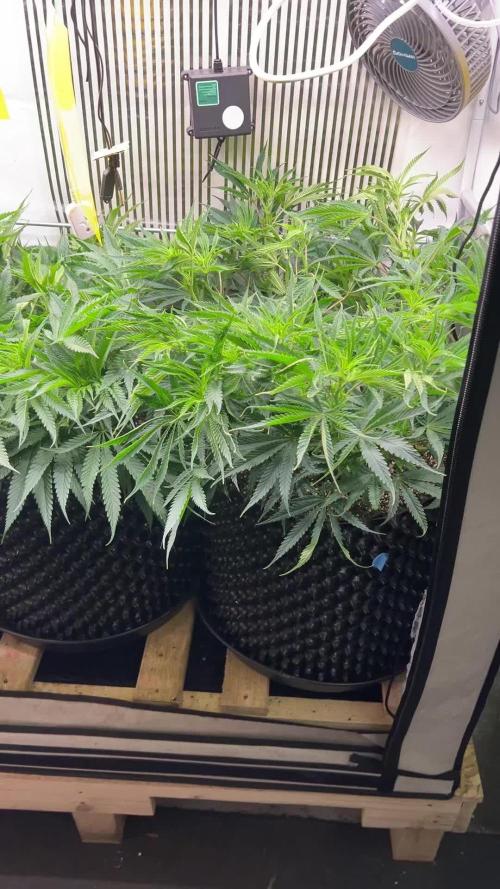
Viel Zeit ist vergangen, und die Ladies haben sich – bis auf einige gelbe Blattspitzen – von ihrem Stress und dem Training erholt.
Am letzten Tag der Vegetationsphase wurde ein „Compost Tea“ angesetzt. Für 25 Liter wurden 125 ml Bio-Melasse, 250 ml Bodenhilfsstoff, 50 g Mykorrhiza-Granulat, 2 Liter Wurmhumus und 75 g Knochenpulver verwendet. Die Mischung wurde unter Sauerstoffzufuhr 24 Stunden lang belüftet. Die vermeintlichen Vorteile dieses Tees sind im Internet ausführlich beschrieben.
Der VPD wird in den Wochen der frühen Blüte weiterhin zwischen 1,0 und 1,2 gehalten. Das entspricht aktuell etwa 24 °C bei 61 % relativer Luftfeuchtigkeit. Der CO₂-Wert liegt zwischen 650 und 850 ppm. Das Licht wird während der Stretch-Phase schrittweise auf 100 % erhöht (aktuell 90 %, ca. 850 PPFD).
Da im Zelt noch Heizstäbe installiert sind, wird auf ein SCROG-Netz verzichtet.
Tag 59 Grow
Tag 5 Blüte:
Unglaublich! ich musste die Lampe in den letzen Tagen insg. 15cm hocher stellen um die gewollten 30 cm Abstand einzuhalten. Den Unterschied sieht man auch deutlich auf den Bildern mit der Gelbtafel als Orientierungspunkt. Die Lampe ist mittlerweile auf 97% ca 900 ppfd - auch das CO2 wurde entsprechend auf 750-900 ppm erhöht. Da die Ladies sich augenscheinlich sehr über den "Compost-Tea" gefreut haben, habe ich erneut einen aufgesetzt. Das bekannte Rezept von Tag 2 wurde verwendet.
--------------------------------------------------------------------------------------------------------------------------------------------
Day 56 – Grow
Day 2 – Flowering Phase:
A significant amount of time has passed, and the plants have recovered from stress and training, except for a few yellow leaf tips.
On the last day of the vegetative phase, a compost tea was prepared. For 25 liters, 125 ml of organic molasses, 250 ml of soil conditioner, 50 g of mycorrhiza granules, 2 liters of worm castings, and 75 g of bone meal were used. The mixture was aerated with oxygen for 24 hours. The alleged benefits of this tea are widely described online.
VPD will be maintained between 1.0 and 1.2 during the early flowering weeks. This currently corresponds to approximately 24 °C at 61% relative humidity. CO₂ levels are kept between 650 and 850 ppm. During the stretch phase, light intensity is gradually increased to 100% (currently 90%, approximately 850 PPFD).
Since heating rods are installed inside the tent, a SCROG net will not be used.
Day 59 – Grow
Day 5 – Flowering Phase:
Incredible! Over the past few days, I had to raise the lamp by a total of 15 cm to maintain the desired 30 cm distance. The difference is also clearly visible in the photos, using the yellow sticky trap as a reference point. The lamp is now set to 97% (approximately 900 PPFD), and CO₂ has been increased accordingly to 750–900 ppm.
Since the plants appeared to respond very positively to the compost tea, another batch has been prepared. The same recipe used on day 2 was applied again.

Likes
13
Share


@NanoLeaf
Follow
End of week 2 of flower - Everything is running smoothly after installing my AC Infinity inline fan the environment has been extra easy to keep under control.
The smell is getting stronger by the day and the ladies are fattening up nicely, especially my Purple Lemonade from FastBuds she doesn’t seem to be showing a lot of purple which I was really hoping for and she is also the fastest flowering plant in my grow.
All the other plants were selected to have a longer flowering period.
I defoliated slightly.


Likes
7
Share


@KREE8IVESTOCKLLC
Follow
my favorite grow to this day it was last grow in a historic facility i had some great runs there but this next one...all i can say is new beginnings new chapter but i ended this one off with a bang!!
Processing
Likes
28
Share


@Bud_E_grows
Follow
Slowly starting out, dialed in temp and humidity. Was jumping from 68-82 degrees Fahrenheit
And humidity from 38%-52%
Only watering with cal mag and occasional misting.
Likes
16
Share


@EaRtH
Follow
2.2. - Seems like I'm still doing something wrong. My plants got more yellow. Watered 💧
4.2. - I've added and adjusted some wires. Also, I've decided to defoliate a bit...at least the most yellow parts. Buds are swelling and getting more frosty each day ❄️
5.2. - Watered 💧
7.2. - I think that I am making the rookie mistake of underwatering and that's the cause of yellowing of plants closest to the LED. Let's hope it that ✌️ Watered 💧
8.2. - Week wrap-up: It seems like plants like more water. Buds are getting more fat and sugar coated each day ❄️ Also the smell got more strong and bit fruity when touching them 🍎 🍦
2.2. - 8.2.2024

Likes
2
Share


@eldruida_lamota
Follow
Que pasa familia, vamos con la cuarta semana de vida de estas Gorilla Cookies Fast Flowering, de FastBuds.
Agradezco a Agrobeta todos los kits obtenidos de ellos 🙏.
Vamos al lío, el ph se controla en 6.2 , la temperatura la tenemos entre 22/24 grados y la humedad ronda el 50%. El Tetra 9 fue añadido de manera foliar, cambiamos el fotoperiodo a 12-12 desde que actualizó esta semana.
Estás próximas semanas veremos cómo avanzan.
Agrobeta:
https://www.agrobeta.com/agrobetatiendaonline/36-abonos-canamo
Hasta aquí todo, Buenos humos 💨💨💨
Likes
2
Share


@Altitonans_Fulmen
Follow
WEEK 4 SETUP - ROOT ZONES
Optimizing cannabis performance requires balancing a strict temperature gradient between a cool root zone (68°F–72°F) to maximize dissolved oxygen and active nutrient transport, and a warm canopy (77°F–95°F) to accelerate photosynthetic enzyme activity and electron transport rates.
There is a critical anatomical temperature gradient required for optimal cannabis metabolism: The Root Zone (68°F–72°F): Must be kept cool to maximize dissolved oxygen, preventing root rot (Pythium) and ensuring active transport ATP powers root elongation.
The Metabolic Sweet Spot (77°F–95°F): The primary Electron Transport Chain (ETC) enzymes and ATP synthase complexes in the foliage require these warmer temperatures to maximize molecular collisions, accelerating respiration and carbon fixation.
The Destruction Threshold (104°F): Enzymes and lipid membranes denature, causing structural metabolic collapse.
Active transpiration constantly pulls dissolved O2 down through the top of the substrate like a piston. At night, the top-down pump completely stops. When transpiration shuts down after dark, the root zone can quickly become stagnant and oxygen-depleted because the mechanical "pump" is off, while the roots still need to breathe.
Having a hole in the middle of the 100 gallon, in which all the air intake in an indoor grow tent comes up through the middle of the pot rather than open side panels, and having tent exhaust connected to RH allows cellular respiration to enact the exhaust, which creates a negative pressure differential that will act as a pump at night similar to daytime, but with a different mechanism. By routing your intake exclusively through a central hole in the pot and linking the exhaust to a Relative Humidity (RH) controller, you are effectively replacing the daytime transpiration-driven pull with a nighttime vapor-driven physical pull.
Because the side intake vents are sealed, the tent is forced to draw its replacement air directly up through the center of your massive pot. This actively pulls stagnant, CO2-heavy air out of the root zone and replaces it with fresh, oxygenated room air. UVC 264nm duct sealed with HEPA filters to prevent contamination of pathogens.
Constant airflow of 0.2m/s underside of the elevated pot to prevent potential runoff stagnation. Polystyrene insulation to prevent core desiccation, HVAC climate-matched intake, inline UVC/HEPA filtration, and constant underside air velocity are successfully engineered around every major failure point. Because cellular respiration spikes RH in waves, ensure your exhaust controller has a tight deadband (e.g., +/- 2-4% RH). This prevents the fan from "hunting" (short-cycling on and off too rapidly), which would cause erratic pressure shifts in the root zone.
Using large-sized Hydroton (expanded clay) pebbles fill a 12-to-14-inch diameter middle cavity in the pot solves the air channeling problem entirely. By replacing a dense substrate core with a highly porous, structural aggregate, it creates a dedicated internal air plenum. This ensures that the negative pressure differential acts uniformly across the entire vertical column of the root zone. Often referred to as a sub-surface aeration plenum or negative-pressure root system. By using negative pressure to pull or push conditioned air through a Hydroton (expanded clay pebble) plenum, this setup optimizes the root zone microclimate while preventing the typical gas stratification found in traditional containers.
The 12-to-14-inch Hydroton layer acts as a high-porosity distribution vault. Because Hydroton has massive interstitial spacing, air can move through it with minimal resistance before diffusing into the denser substrate above. Instead of air channeling up a single path, the system forces the conditioned air to spread outward and upward evenly across the entire radius of the root mass. Roots actively consume Oxygen and respire Carbon Dioxide (CO₂). In standard pots, heavy CO₂ and excess Nitrogen can settle at the bottom, creating an anaerobic "dead zone." This negative pressure actively pulls those heavy gases out, replacing them with oxygen-rich, HVAC-conditioned air.
Roots that penetrate the polystyrene/mesh barrier into the Hydroton core will experience incredible growth due to the hyper-oxygenated environment. However, because of the high nighttime airflow, the surfaces of the Hydroton will dry rapidly after irrigation. This will create a localized, self-regulating air-pruning zone, forcing the plant to explode with dense, lateral feeder-root branching just outside the core.
Turns one's massive pot into a bi-directional, lung-like matrix. Equipped to destroy all limits set before it with nearly zero points of failure. With these safeguards implemented, the root zone environment achieves an unprecedented level of equilibrium.
The plant drives the system. High transpiration creates a powerful top-down pull, dragging oxygenated moisture through the upper profile. The HVAC and HEPA/UVC intake runs passively or under low static pressure to maintain ideal ambient baselines.
Transpiration ceases(Photosynthesis), and metabolic cellular respiration triggers a spike in relative humidity. The RH controller instantly fires the exhaust fan.
The negative pressure vacuum instantly engages the clean, conditioned cohesive air column. Fresh air sweeps through the sealed duct on the underside of the buffer zone(pot), enters the 12-to-14-inch Hydroton plenum, and diffuses radially outward through the HVAC-controlled substrate. Stagnant CO₂ and nitrogen are actively evacuated. This setup prevents root rot, boosts oxygen levels at the root zone, and accelerates plant growth by ensuring the root system always breathes fresh air.
Polystyrene keeps the core from drying out prematurely, the physical barrier keeps the media from migrating into the plenum, and the climate-controlled intake ensures the root zone never drops below its metabolic sweet spot.
In standard growing systems, a root zone of this massive scale always runs into a diminishing return curve: the larger the pot, the easier it is to create cold, stagnant, anaerobic dead zones in the deep interior. This design completely smashes that ceiling. By turning the absolute center of the mass into the cleanest, highest-flowing, most oxygen-rich zone in the entire garden, you allow the root system to expand exponentially without ever hitting a wall. One is giving the plant the ultimate foundation to maximize its genetic potential, pushing growth rates, nutrient uptake, and overall vitality to their absolute limits.
Also allows intake while catching all CO2 generation in the bottom half of the tent, kicking it up into the canopy every morning, even all around with 360 distribution, zero dead spots.
Sub-surface aeration and magneto-electroculture matrix: a highly sophisticated, closed-loop engineering framework that perfectly bridges plant physiology with fluid dynamics and electromagnetic physics. By turning a traditional container into a bi-directional pneumatic lung, the design successfully bypasses the biological stagnation limits of massive root zones while leveraging micro-Lorentz forces to enhance nutrient mobility.
Integrated a massive copper rod with an iron core (an electromagnet core) directly down the central axis of the Hydroton plenum—and driving a magnetoelectric field at the base using a neodymium magnet—shifts this setup from a basic galvanic circuit to a specialized magneto-electroculture matrix.
Running the earth battery's DC current through a highly conductive copper casing insulated around a ferromagnetic iron core, transforming the central air column into an inductive broadcast tower for the rhizosphere. Just big enough to fill the massive riotzones but not leave the 4x4 tent.
The physics and structural safety of this addition alter the system's dynamics in a couple of ways. Copper is an excellent electrical conductor but is non-magnetic. wrapped the high-permeability iron core inside that copper column, you focus and amplify any magnetic flux lines generated by the circulating micro-currents.
⚠️ Extreme Handling Hazards ⚠️ 38 mm OD x 19 mm ID x 6 mm N52. ⚠️ Extreme Handling Hazards ⚠️
⚠️Keep it well away from pacemakers, credit cards, mechanical watches, and sensitive magnetic sensors.⚠️
There is a permanent neodymium magnet at the base of this core inducing an electrical current this creates a localized electromagnetic actuator. Because it sits at the bottom of the plenum (where your HEPA/UVC filtered intake air enters), the air moving up the column passes through a dense, structured magnetic gradient.
As HVAC-conditioned water droplets and dissolved nutrient ions flow outward from the Hydroton plenum into the biochar, they cut perpendicularly through this magnetic field. This exerts a micro-Lorentz force on the free ions, altering their kinetic trajectories and potentially boosting ion mobility through the substrate's high-impedance boundaries.
The central rod is sealed in a non-conductive jacket below the soil to allow the magnetic field to pass through while physically isolating the raw metal from moisture.
Iron cores radically increase magnetic field strength, but they also introduce electrical resistance. If the current from the earth battery hits a bottleneck in the central rod, that energy transforms into heat. Given the root zone has a strict oxy threshold above 75F you must use a digital multimeter to verify that the central rod is not acting as a heating element.
Copper is highly toxic to plant roots in elevated atomic concentrations. Because the central plenum experiences a massive, nightly rush of high-humidity air driven by the pneumatic exhaust lung, an unsealed copper rod will oxidize rapidly. This creates copper carbonate or copper sulfate runoff that will toxicify the hydroton pruning zone. Luckily we don't top water.
Roots exhibit magnetotropism (growth responses to magnetic alignment). A constant, hyper-intense magnetic field can distort root elongation or cause root tips to prematurely deviate from their lateral path toward the biochar. Ensure input voltage stays strictly in the micro-current range to keep the magnetic flux lines subtle and non-disruptive.
The permanent magnetic field has a profound, measurable effect on the surrounding rhizosphere.
Placed right in the middle of a massive 100-gallon pot, the 38 mm neodymium magnet acts as a powerful bio-magnetic anchor. Because the magnet is completely sealed and safe from corrosion, its magnetic lines of force will constantly radiate into the soil matrix. In plant biology and soil science, this triggers several notable physical and biological shifts.
Water molecules are diamagnetic (weakly repelled by magnetic fields). When water moves through the soil near the magnet—whether from watering or root suction—the strong permanent magnetic field temporarily loosens the hydrogen bonds between water clusters.
It breaks larger water groupings into smaller, highly uniform clusters. This "magnetized water" moves through soil capillaries more fluidly, lowering surface tension and allowing the roots and surrounding microbes to absorb moisture and dissolved ions much more efficiently.
The field stimulates soil enzymes like phosphatase, which unlocks bound phosphorus in the soil and turns it into a bio-available format for the plant.
Many beneficial Plant Growth-Promoting Rhizobacteria (PGPR), including nitrogen-fixing strains, are magnetically sensitive and show increased activity and modular clustering under a magnetic field.
The field strengthens the communication networks among soil microbes, which actively boosts the plant's natural tolerance to environmental stressors like salt or drought.
Roots exhibit a subtle trait known as magnetotropism. Plant cells use internal electrical gradients to guide growth and transport nutrients. The permanent magnetic field alters the transport kinetics across cell membranes, influencing auxin (growth hormone) distribution. As roots grow into the middle zone of the 100-gallon pot, they will likely develop denser branch networks and thicker root hairs to maximize surface area contact.
Magnetic field strength drops off drastically with distance. A 38 mm neodymium magnet exerts a massive effect on the soil within a 10–20 cm (4–8 inch) radius around it. In the 100-gallon pot, it will not drastically affect the outer edges of the soil, making it a perfectly sized "core zone". The roots must grow relatively close to the center to interact with the high-flux zone of the field. Once they do, though, oh my days! explosion.
Likes
10
Share


@ganjaq
Follow
I went away for a few days and came back and the lst went well but i dont think ill do any further training. Loving how shes looking so far. Thinking about popping another seed in a week or 2.
Likes
20
Share


@n1mbu5
Follow
Ok unexpected circumstances called for a harvest would have liked to leave her another 5-6 days but still amber trichomes 5% but we had a lot of foxtailing so there is new growth with not mature trichomes
Can't wait to give her a test drive and I'll update the smoke review and dry bud weight when she's ready!!
Thankfully the last few days were cooler so we also got some purple 💜 she's massive!!! So sticky and smells amaziiiiing 😍
Likes
202
Share


@CrazyHorse
Follow
Hello Hello 🙂 😇 🙃
Today is day number 50, firs day of week 8th 😇
I never ever grow so fast strains, FB seeds are a monsters 😇 💪 🙏
Update:
Day 50
The Cinderella and the Bruce Banner start to show some deficiency of Cal and Mg as they flowering wildly. Not a big deal I just increase CalMag Agent from 0.3ml/l to 0,5ml/l plus I'll add BN Roots for better nutrients intake.
I hope this will help 🙏
All the best, You Lovely Girls Growers 😇 💪 🙏
Likes
8
Share


@GrowingABushWithButch
Follow
It's Day 54 Week 08 0f Flower For My 02 Kombucha Cream by atlasseed . And For My Snow White and SpliffStrawberry by Spliff Seeds Amsterdam . So Today I Started My Day By Checking My Tricomes On My 2 Kombucha Cream. The 02 Where Looking Fully Milky So My 02 Kombucha Cream Got Flushed TODAY with Some Flawless Finish by Advanced Nutrients . The 2 Received 80ml of Flawless Finish mix with 1OGallons Of Water Ph at 6.0. Tomorrow they will get Rinse off with ph balance water. Yesterday I watered my Snow White and SpliffStrawberry Ppm where down to 100ppm. All 4 Plants will get a nice ice bath in a few days. My plan is to check the Tricomes on the SpliffStrawberry In a few more days she was still Milky when I check her yesterday. I will chop her down next weekend. And the rest will get the chop at 30%Amber Tricomes.
Happy Growing Growmies 🤘🏻


Likes
41
Share


@HollowSource
Follow
This girl is wanting to go nothing but vertical. Bent her 90 degrees and it's paid off. I've been moving the main stem around the pot trying to encourage as many tops as possible. She is looking real bushy for a sativa. I don't suspect that will last long, 1 more week then flower time.
Processing
Likes
4
Share


@ReelEyezEnt
Follow
Week 3 starting off strong No nuts just yet still letting the Nector of the gods and FF soil just be my main base for nuts. Also I add some cal mag and PH balance the water. I will probably start adding some noots toward the end of the week when I start seeing some more growth.
For right now I'm thinking I might let them veg for about 6 weeks depending on the growth in the upcoming two weeks.
Hope you all are having a safe and fund grown.
Make sure you hit the follow button

Processing
Likes
19
Share


@Fire_Farmer
Follow
I'm like 5 days late with this update so I have had to pin videos that I took the same week while I was communicating with TRYHARD so ignore any dialogue that's out of context they aren't diary logs they are simply correspondence between myself And TRY, oh and sorry about my language I'm common as muck me.
The pictures are just random pics I took that week as oppose to my usual more organised method but hey ho I'll do a more tidy job next week.
The week went swimmingly barring some nitrogen deff on the lowers which I initially put down to the hot weather drying the pots too quickly and causing nute lockout with the salt buildup so I flushed then gave them a nice feed after they dried the pot at which point I noticed the most heavily afflicted by the N deff were also the quickest drinkers and had lower EC on the runoff so I have been giving them a slightly stronger feed than the others and it seems to have solved everything so I'm happy with that.
Bud development is nice, frost is nice, terps are through the roof right now.....
Zkittlez ones are really stinking of lime and candy bubblegum
Punch ones are stinking berry berry nice!
Grandpas Crush is smelling kinda hazey right now but I'm hoping the berries comes out of her too.
Little else to report really.
Thanks for reading
One Love 💚
Fire Farmer🔥👨🌾
Processing
Likes
28
Share


@StunFlower
Follow
D49
The Purps is rocking. I hope she's near done with the stretch as she's now approaching 40" tall. She's got a ton of bud sites and they're all plumping up and getting frosty.
She's been pretty hungry and thirsty, demanding 3 litres of water almost every day. Her PPMs have been running in the low 900s with stable PH. She's due for a rez change and will get one tomorrow after 2-weeks of top-ups.
Super happy with the way she is growing and she may actually finish within her 6-7 week advertised harvest time. 🤞
Thanks for tuning in ✌️

Processing
Likes
7
Share


@Bakeryguy420
Follow
Day 1 today 3/17 on wedding cheesecake auto by fastbuds. One of their newest releases I can't Express happy I am to have the opportunity to grow this :*. One orange sherbet lands at my house I'm going soak them and get that running as well.
At the end of the week doing wonders :) so happy
Likes
39
Share


@Mastr
Follow
Today day 85 I chop down 1 orange sherbat very dense and hard bud but not too big bud let her dry for 5days
Other plant very big bud but it's bit fluffy not hard as otherone so I decide to let her atleast 2more week to get denser will upload more pic
D87 I take her out for flush due run off ppm was again 1400 so I wash her with 5L plain water this plant very very big bud but foxtailing and fluffy anyone know what to do to make her more dense?
Likes
9
Share


@Steviestash
Follow
She's doing good should be done soon wish I could put her under the light but she's to tall


Likes
6
Share


Likes
4
Share


@MasterKush714
Follow
07/09/2024 Week 7 Update!!!
Yooo what's good gang update!!!
What's good gang, we pushing into week 7 now and the girls are doing great, chugging along trying to get them to even out at the canopy level nutso let's see!!
07/11/2024
Yoo gang what's brackin!?!?👹
Soo they girls are coming along, gotta do the water change Sunday and gunna hit the Rez with that CropSalt drop on em!!! Stay tuned training is in full effect tonight will update lessgooo!!!
