


Likes
32
Share



Likes
17
Share


@Gulliver
Follow
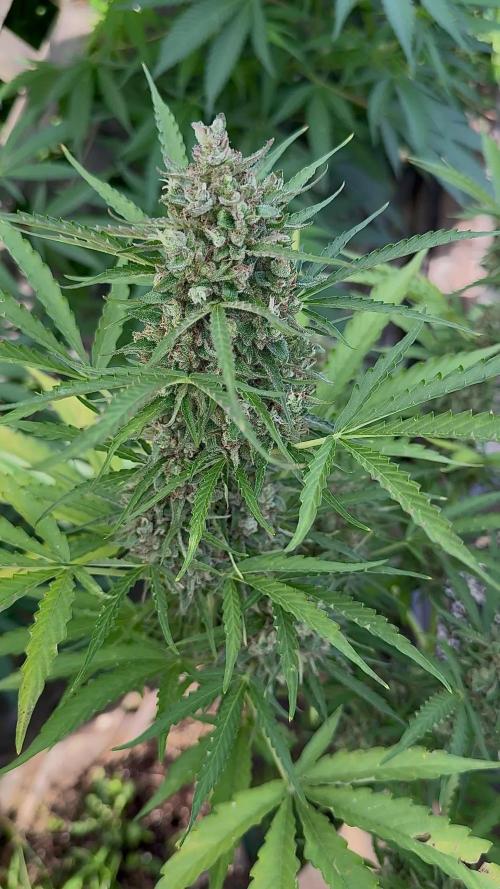
Эти девушки очень много сахара произвели за неделю и плотность бетоном очень увеличиваеться!
Прекрасный рост.
Likes
9
Share


@Garamantes
Follow
After 3 days, when the temperature rose above 11 degrees, I could finally remove the greenhouse from the pet bottle.
I did the first fertilizing with Advanced nutrients Voodoo juice, Piranha and Tarantula for better development and protection of the root.
Unfortunately, the pet bottle greenhouse, which was dewy and dirty from snail slime, caused the main stem to pull out more than I would have liked.
I like it when the main stem is low and immediately starts to form secondary branches

Likes
6
Share


@Santi_nf
Follow
Día 2 de abril ya tienen algunas 3 meses. Seguir ,como hasta ahora

Tutti Candy · Zmoothiez

Critical Widow · Pev Seeds

Sweet Skunk Fast Version · Sweet Seeds
Skywalker OG Runtz XL Auto · Sweet Seeds

Cheese Berry · 00seeds

Hard Diesel · Gea Seeds

Scrambler Haze · Blimburn Seeds
AK · Gea Seeds
Cachalote · Gea Seeds
Gealato Kush · Gea Seeds
Gorilla Glue #4 · Gea Seeds
Somango · Gea Seeds


Likes
8
Share

@BushDoctor740
Follow
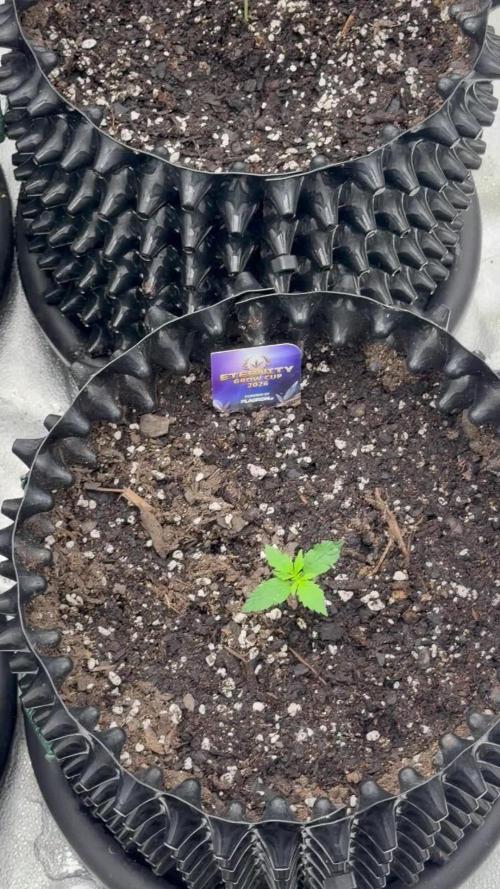
These 3 beautiful young ladies are developing nicely.Se7000 set at 30 percent power and they are loving it.I did a light feeding of 1 ml of advance nutrient line and a dose of recharge tea this week.I can already tell this is going to be an amazing journey :)

Likes
3
Share


@Ogbangbang2981
Follow
YEA!!!! That's what comes to mind every time I check out my grow space and see such beautiful plants growing especially my C4 Auto from fastbuds she coming along so beautifully it brings joy to my heart all I do is give her light and bat turd water mix and raw bat turd and let her take off I planted her sister on the outdoors to see the difference between the two indoor is looking a lot better to me . That's all I gotta say for this Thursday see you next week. Comment on my Ak48 Autoflower I got from persific seed bank
Likes
53
Share


@SativaSteve88
Follow
2 weeks into flower and looking well so far, plants are nice and healthy, added boost to my feed this week started at a low feed and will up it over the next couple of weeks

Likes
27
Share


@Frosty_farm
Follow
Week 15....day 106. She's just going to get plain pH 6.0 water for the next few days. I know she wouldn't yield a lot but this plant taught me a lot so I'm satisfied with that. I'm sure from here out you guys will see better yields and quality from me. Day 108.... nothing much has changed but some of her old leaves are getting yellow and brown. Her buds are looking better every day. Day 109... Nothing changed. Day 111.....this plant still looks healthy because my ppm was at 1000. Gave her a couple of flushes and bought it down to about 200. I'll chop her down at the end of this week. Day 112.....last day for this girl, trichomes are looking good, she's not big but I'm loving it. I trimmed most of the big leaves down, I'll chop her down tomorrow and put her in my diy dryer. Very sticky buds, my fingers were sticking together even the clippers were sticking too. See you guys at the harvest

Likes
283
Share


@love_2_grow
Follow
D35 - The first day in the fifth week of veg for #2 and the fourth for #1. I gave both girls around 1.2-liters of water @ pH 6.3.
I topped the second girl for the second time today, six days after her first topping, and I will top the first girl for the first time tomorrow. I also removed the large fan leaves from her fourth node as they have served their purpose.
D36 - Today, it was time to top the first girl for the first time. Exactly one week after the second girl.
She had grown a lot in four weeks to a height of 33 cm and a massive 50 cm wide, looking luscious and very healthy.
I topped her the same way as the second girl, just above the fourth node, and removed everything below it. I stripped her down to the bare essentials and honestly felt a bit bad for doing that to her.
I didn't keep any clones this time, as I still have the clones from the second girl. I might take a cut from her later, though, considering how vigorous she grew.
Finally, I gave her around 1.5-liters of water @ pH 6.5.
D40 - The first girl has recovered well from her abuse a few days ago, and I should be able to top her again in a couple of days.
The second girl is still a few days out from her third topping.
D41 - The end of the fourth week of veg for the first girl and the fifth week for the second girl. Sorry about the porno-light pics. I was a bit late, and my lights had already gone into sunset mode.

Likes
27
Share


@Smokwiri
Follow
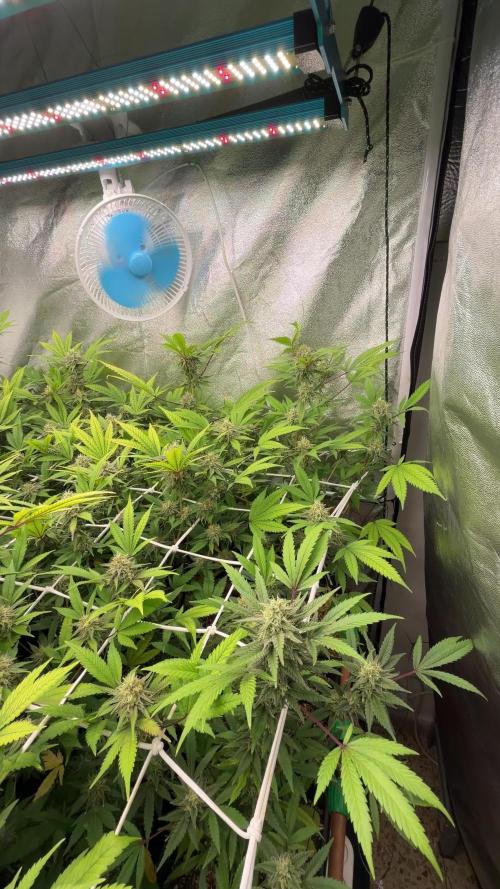
Almost finished
Amazon: http://url-9.cn/0y9i
Amazon US: https://amzn.to/3e0P2bk
Amazon CA: https://amzn.to/3bTnEJC
Amazon discount Code:
it10smokwiri XS1000 10%
XSsmokwiri XS1500 8%
it20smokwiri XS2000 5%
it40smokwiri XS4000 5%
ViparSpectra 8% DISCOUNT CODE on the viparspectra websites (.com/.eu)
RUFFSELEKTAH




Likes
Comments
Share

@DogDoctorOfficial
Follow
🍮 Chem Brûlée – Pheno B
Week 10 | She's Hungry for More… and She's Still Shining 🌸❄️🔥
Welcome back to another week of the 8×8 Adventure! 💚🌱
And I have to admit...
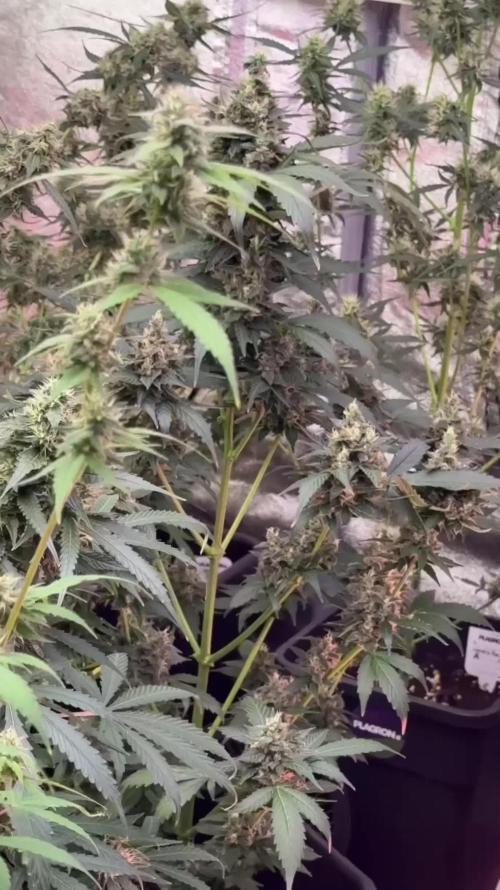
Chem Brûlée Pheno B is looking beautiful.
Really beautiful.
She's got that unmistakable personality we've been watching develop week after week, and the further we move into flower, the more clearly she's showing us exactly who she is.
She's demanding.
She's hungry.
She's definitely not the quiet girl in the room. 😂
But she's also growing amazingly.
The flower formation is getting better and better.
The structure is becoming more impressive.
And those developing flowers are giving us plenty of reasons to stop, grab the camera, and take another look.
So this week...
we're putting the spotlight right back where it belongs.
On this beautiful, demanding girl.
🍮🌿🌸
🌱 Week 10 – She's Still Doing Her Thing
Chem Brûlée Pheno B has never really been interested in following anybody else's schedule.
And honestly?
I wouldn't have it any other way.
She's continued moving forward in her own rhythm, building on the structure she created earlier in the run.
She's around 130 cm, and that taller, more open architecture remains one of the characteristics that immediately separates her from her sister.
But now the structure is becoming secondary to what it's carrying.
The flowers.
And they're looking fantastic.
This week, when I look at her, I don't see a plant that's simply flowering anymore.
I see a plant that's building flowers with purpose.
And that's a very exciting transition.
🌸 The Flower Formation Is Beautiful
This is probably the first thing I want to highlight this week.
Her flower formation.
It's getting seriously beautiful.
The developing buds are becoming much more defined, and the individual flowering sites are starting to show much more character.
Those long white pistils are still reaching out everywhere, creating that almost explosive appearance around the flowers.
And underneath them, the actual bud structure is becoming increasingly substantial.
You can see the plant putting everything together.
Layer by layer.
Week by week.
Flower by flower.
It's still not the finished product, obviously.
There's plenty of development ahead.
But we're getting to that point where the imagination starts doing some of the work.
You look at a flower today...
and start wondering what it's going to look like several weeks from now.
And with this girl?
I genuinely don't know.
😂
That's what makes it fun.
🌿 That Beautiful Green Is Coming Through
And there's another thing I really appreciate when I look at her now.
She's looking beautifully alive.
The foliage has a strong, healthy presence, and the whole plant has that feeling of being actively engaged in flowering.
She's not sitting there quietly.
She's working.
And working hard.
This phenotype has always had a different character from Pheno A, but now that we're deeper into flower, those differences are becoming even easier to appreciate.
She's got her own architecture.
Her own flower formation.
Her own rhythm.
And definitely...
her own appetite.
🍽️ She's Definitely a Hungry Girl
I have to admit it:
this one is demanding.
Looking at her progression, I get the feeling that she could happily sit down at the dinner table and ask:
"Is that all?" 😂🍽️🌿
She seems to be using everything the environment is giving her incredibly enthusiastically.
And while I'm not going to pretend that one visual observation tells us exactly what a plant needs, this girl certainly gives the impression that she has a strong appetite.
She's growing.
She's flowering.
She's developing.
She's capturing light.
And she's putting that energy somewhere.
The interesting thing is that she's doing all of this while still showing us that distinctive phenotype expression we've been following since the beginning.
So rather than trying to force her into someone else's idea of what she should look like, I'm simply continuing to watch her closely.
Because she's clearly got something to say.
And apparently she's saying it with an appetite. 😂
💡 She's Catching Every Photon She Can
And that brings us to one of my favourite subjects in these weekly reports:
photons.
Because when I look at this girl, I genuinely think about how much invisible energy is passing through her canopy every day.
The Black Series LEDs are sending photons into the room.
Those photons encounter leaves.
The leaves capture what they can.
And the plant uses that captured light energy to power its biological processes.
We don't see the photons.
We see the result.
The green leaves.
The developing flowers.
The increasing structure.
The growth.
The resin.
The plant itself becomes the visible record of all that invisible energy moving through the system.
And Chem Brûlée Pheno B?
She's clearly trying to catch every photon she can.
💡🌿
☀️ The Canopy Is Her Solar Field
I really like thinking about the canopy this way.
Every leaf represents another opportunity to intercept light.
Every angle matters.
Every layer of the plant creates a slightly different relationship with the light above it.
And this girl's architecture gives us a particularly interesting example.
She's taller.
She's more open.
Her branches occupy different heights.
Her flowers aren't all sitting in exactly the same place.
So the photons entering the canopy aren't interacting with one flat surface.
They're moving through a three-dimensional plant.
And that's why the additional lighting within the room is so interesting to me.
We're not simply thinking about the top of the plant.
We're thinking about how useful light reaches different parts of the entire structure.
The plant has built the architecture.
The lighting provides the photons.
And together...
we get to watch what happens.
💡 Same Photons. Different Stories.
And this is where the 8×8 Adventure gets really interesting.
The photons don't know which phenotype they're hitting.
The same general lighting environment is shared by the room.
But look at the results.
Pheno A tells one story.
Pheno B tells another.
Different height.
Different structure.
Different flower arrangement.
Different foliage expression.
Different appetite.
Different personality.
That's the beauty of having these plants growing side by side.
The environment gives us a common foundation.
The genetics write the individual story.
And Chem Brûlée Pheno B is writing hers in a very interesting way.
🌸 She's Putting That Energy Into Flowers
And when I look at the photographs this week, that's probably the most satisfying part.
She's not just producing foliage.
She's building flowers.
The developing buds have more definition.
The pistils are becoming increasingly prominent.
The flower structures are becoming more substantial.
And the whole plant has a sense of progression.
It's one of those moments where the photographs from previous weeks become extremely valuable.
Because when you see a plant every day, change can be difficult to appreciate.
But put Week 5 beside Week 8...
then Week 9...
then Week 10...
and suddenly you realize:
Wow.
She's really moving.
📸🌸
❄️ And the Frost Is Joining the Party
The developing resin is another part of the story that's becoming increasingly enjoyable.
Those close-up photographs reveal little details that disappear completely when you're standing across the room.
The sugar leaves.
The pistils.
The developing trichomes.
The texture of the flowers.
The little structures forming around the buds.
It's almost like looking at an entirely different plant.
And that's why macro photography has become such a big part of this adventure for me.
The wide photograph tells you:
where she is.
The macro photograph tells you:
what she's becoming.
And Chem Brûlée Pheno B is becoming increasingly interesting.
🌿 Her Architecture Is Working
One thing I really appreciate about this phenotype is that the architecture she created earlier in the grow is now becoming useful.
She's tall.
She's open.
She's got flowers distributed throughout her branches.
And as those flowers develop, the structure becomes easier to understand.
We're not trying to make her into Pheno A.
We're not trying to compress her.
We're not trying to make her follow another plant's blueprint.
This is her blueprint.
And it's working for her.
That's one of the biggest lessons this whole project continues giving me.
Sometimes the best thing you can do is create a good environment...
and then get out of the plant's way.
💨 Air, Space & Balance
As the flowers continue developing, I'm still keeping an eye on the overall canopy.
The goal remains balance.
Enough foliage to support the plant.
Enough space for air movement.
Enough light reaching productive areas.
And enough observation to notice when something actually needs attention.
We're not trying to strip the plant.
We're not trying to create an artificial shape.
We're simply watching how the canopy develops and responding when appropriate.
She's already built a beautiful structure.
Now we let that structure carry her forward.
⚗️ The Environment Keeps Providing the Foundation
The room remains broadly consistent:
🌡️ Day temperature: ~29.9°C
🌙 Night temperature: ~25°C
💧 Relative humidity: ~60%
🥥 Substrate temperature: ~26°C
💦 Solution temperature: ~25°C
⚗️ pH: ~6.0
⚡ EC: ~2.0 mS/cm
💨 CO₂: ~639 ppm
💡 Light schedule: 12/12
? Pot size: 15 L
💧 Watering: ~1.3 L/plant/24h
📏 Height: ~130 cm
And once again, the interesting thing isn't simply the numbers.
It's how the plant responds to the whole environment.
Chem Brûlée Pheno B is showing us that she's capable of putting a lot of that available energy toward continued flowering.
She's certainly not wasting the opportunity.
⚗️ Feeding – This Girl Has an Appetite
The nutrition strategy remains part of the shared-room approach:
🌱 Plagron Terra Bloom – 2.2 ml/L
🌱 Plagron Green Sensation – 1 ml/L
🌱 Plagron Power Buds – 1 ml/L
🌱 Plagron Sugar Royal – 1 ml/L
With pH adjustment as required.
Current solution:
pH ~6.0
EC ~2.0 mS/cm
And this is where I want to continue paying particular attention to her.
Because visually, she gives me the impression of a plant with a healthy appetite.
She's eating.
She's growing.
She's flowering.
She's using the resources available to her.
That doesn't automatically mean that changing anything is necessary, but it does make her an especially interesting phenotype to watch.
She's clearly telling us:
"I'm hungry." 😂
And I'm listening.
📸 Behind the Lens – She Deserves the Spotlight
The camera loves this girl.
Seriously.
😂📸
There's something about the combination of her longer structure and developing flowers that makes her incredibly fun to photograph.
You can photograph the entire plant...
and appreciate the architecture.
Then move closer...
and suddenly you're looking at those beautiful individual flowers.
Move closer again...
and the entire frame becomes pistils, resin and tiny details.
And that's when I really appreciate how unique she is.
She's not simply another Chem Brûlée.
She's this Chem Brûlée.
Pheno B.
Her own expression.
Her own story.
Her own little universe inside the 8×8.
🌿 Twelve Plants, Twelve Personalities
This is still one of my favourite parts of the project.
Twelve plants can share the same room...
and still feel like twelve completely different characters.
Some are quiet.
Some are demanding.
Some are tall.
Some are compact.
Some seem to drink like they're preparing for a marathon.
Others take things a little more slowly.
And then there's this girl.
She's basically standing there with an empty plate saying:
"More, please." 😂🍽️
But underneath the joke is something genuinely interesting.
The genetics influence how each plant uses the same environment.
And that's exactly what we're trying to document.
We're not creating twelve completely different worlds.
We're creating one environment...
and observing twelve different responses.
🔮 Where Are You Going, Pheno B?
And now I'm genuinely curious.
Because she's giving me a feeling that there could be something very interesting waiting further down the road.
The flowers are developing.
The structure is established.
The plant is active.
She's capturing photons.
She's consuming resources.
She's continuing to build.
So where does she go from here?
I honestly don't know.
And I'm not going to pretend I do.
That's the fun.
We'll keep watching.
We'll keep photographing.
We'll keep documenting.
And we'll let Chem Brûlée Pheno B reveal herself.
💭 Final Thoughts – Let the Hungry Girl Shine
If I had to summarize this week in a few words:
Beautiful. Hungry. Unique.
Chem Brûlée Pheno B is looking fantastic.
Her flower formation is getting better every week.
Her pistils are beautiful.
Her structure is impressive.
She's clearly making good use of the environment we've created.
And yes...
she's demanding.
😂🌿
I get the feeling she could happily take everything on the table and then ask what we're having for dessert.
But that's part of her personality.
And I like it.
She's not trying to be Pheno A.
She's not trying to be the greenest plant.
She's not trying to follow anyone else's story.
She's simply doing what she does.
And right now, what she does is grow beautifully.
The photons keep flying.
The canopy keeps capturing them.
The plant keeps converting that available light energy into biological work.
And those flowers keep getting more interesting.
So let's not rush her.
Let's not try to predict the ending.
Let's simply give her the spotlight...
and see where she takes us.
🍮🌸❄️💡🔥
She's got an appetite.
She's got personality.
She's got beautiful flowers.
And she's definitely got somewhere she's going.
I just can't wait to see where.
🙏 Thank You
As always, thank you so much to everyone following the 8×8 Adventure. 💚🌱
Thank you to GrowDiaries for giving us the space to document these individual journeys and share them with the growing community.
Thank you to Zamnesia for the Chem Brûlée genetics and for giving us the opportunity to discover these different phenotypes side by side.
Thank you to Plagron for the growing media and nutrition supporting the garden throughout this adventure.
Thank you to Future of Grow LED for providing the Black Series lighting and keeping those photons flying through our little jungle. 💡☀️🌿
Thank you to LumiFlora for helping bring additional light into the inner and lower areas of the canopy.
Thank you to TrolMaster for helping us keep track of the environment behind the scenes.
And thank you to everyone following along.
Every comment.
Every question.
Every message.
Every person who stops by to see how the girls are doing.
It genuinely means a lot.
And this week...
the spotlight belongs to Chem Brûlée Pheno B.
She's beautiful.
She's demanding.
She's hungry.
She's capturing every photon she can.
She's building some gorgeous flowers.
And she's still writing her own story.
So let's keep watching.
Let's keep learning.
Let's keep photographing.
Let's keep those photons flying.
And most importantly...
let's let this beautiful, hungry girl shine. 🍮🌸❄️💡🔥
Growers Love, my friends. 💚🌱
See you next week in the 8×8 jungle. 🌿📸
Likes
64
Share


@Prof_Weed
Follow
Die letzten Tage für die Sour Jealousy von FastBuds..
Nächsten Mittwoch setze ich noch 2 Tage FlashClean von Terra Aquatica hinzu.
Bis dahin nur Final Part.
Ich habe nun normales Leitungswasser genommen damit der Ph Wert nicht so nach unten fährt und dieser stabil bleibt.
Der EC Wert ist von 1 Tag von von 2.5 auf 6.0 gestiegen, die Pflanze hatte heute auf jeden Fall genug Nahrung..
Ph Wert fällt in wenigen Stunden um fast 1%.
Hab das Wasser heute gleich getauscht.
Wird auf jeden Fall ein guter Ertrag, jetzt kann nichts mehr schief gehen denn die Ernte wandert sofort in den Cannatrol Cool
Likes
3
Share


@Krautbauern
Follow
Send them into Flower at Day 36
Used Scrog net on Day 38 + 1.5l water fertilized with top-Max, BioBloom, BioGrow for every plant.
One Runtz got a little LST
Ladies looking great 💚
Likes
7
Share


@darb35
Follow
First week of veg and all 3 are growing at the same pace.
Will try to monitor and bend if one of then grows freakishly tall for some reason.
Likes
74
Share


@AsNoriu
Follow
Day 78. Girls is down. Dry trim chosen as to most smaller plants.
Overall I am happy with Urban Legend brand, only Gorilla will be meh.... ;)))
Day 88. Girl went to jars, amazing 62 g of her !!! Top quality all the plant through.
We are testing it with my friend's wife and it's pure joy, think after cure I'll keep it pure for myself, no share ;)))
Happy Growing !!!

