


Likes
Comments
Share

@Shivashamboom1
Follow
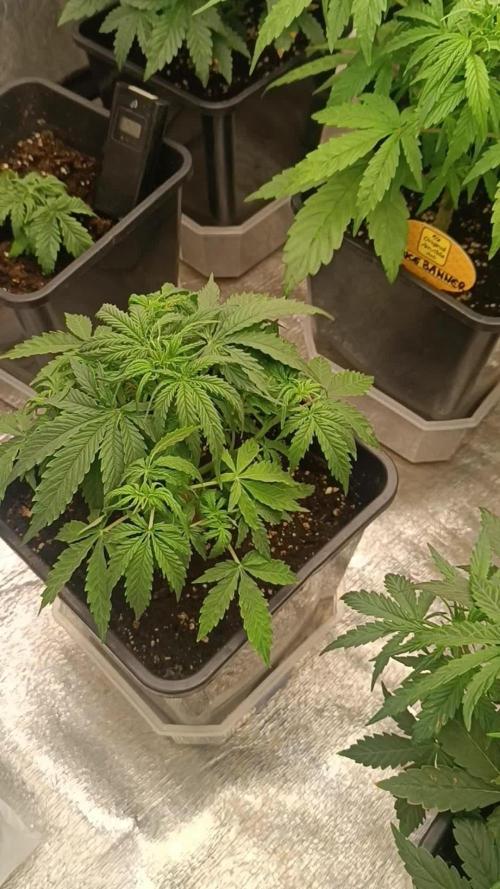
2 delle 4 Bruce banner sono rimaste in po' dietro con la crescita.. una sicuramente dovrò tirarla via

Likes
6
Share

@Fyno_TH
Follow
🌸 Flowering Week 2 — PM Battle & Bloom Progress
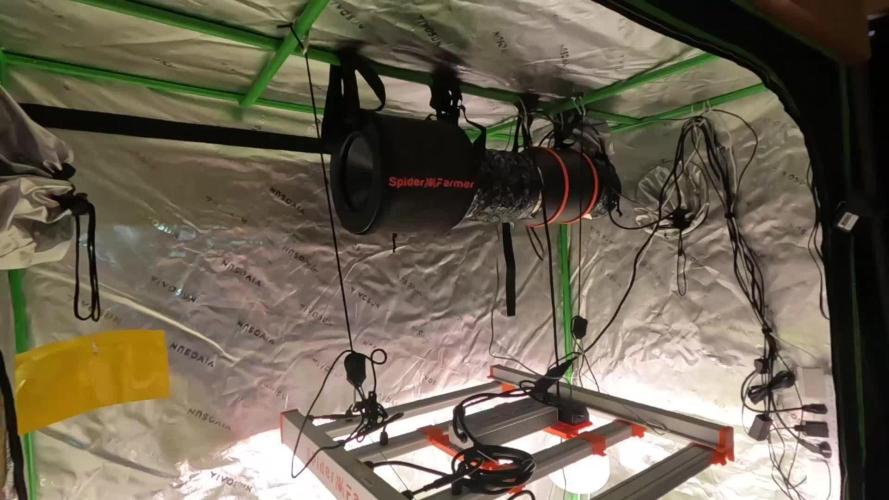
Week 2 of flower and the girls are stacking up beautifully 🌿🔥. The stretch continued strong — canopy looks full and healthy under the Spider Farmer G3000 💡. Bud sites are now clearly forming, and the structure is holding firm after earlier LST training.
This week I continued powdery mildew treatment — used Hydrogen Peroxide 3% (H₂O₂) spray about 3 times since it first appeared. Most spots are gone, only a few tiny areas left. I’ve been keeping RH low and airflow strong with clip fans and the new dehumidifier running 24/7 🌬️💧.
Feed mix (per L):
• Corex 1 ml/L
• CalMag 1 ml/L
• Mira 0.5 ml/L (pH adjust)
• Florex 1 ml/L
• Aurora 1 ml/L
• Bud Candy 2 ml/L
• Terpinator 5 ml/gal (~1.3 ml/L)
• Eldex 1 ml/L
💧 Watered around 15L total with 10–20% runoff, ppm ~1500–1600 @ pH 6.0.
Switched to pure RO water this week for cleaner feed and better control of mineral balance 🙌.
🌡️ Temps: 26–28 °C (day) / 23 °C (night)
💧 RH: 50–55% (after dehumidifier setup)
📝 Observation: PM almost gone — continuing light H₂O₂ misting until it’s fully cleared. Stretch slowing down, early flowers forming nicely 💪.
💡 Tip: For growers in Thailand — using an RO system helps stabilize ppm and pH in local water, especially if tap or street refill water fluctuates a lot.
Excited to see the flowers bulk up in Week 3 — hoping for a clean, healthy canopy ahead 🌸✨

Processing
Likes
43
Share


@Master_weeda
Follow
Jour42 defolliation
Stretch 10 centimètres
Jour47 arrosage avec de l'eau ph6.3 à laquelle j'ajoute 1ml par litre d'eau de topmax biobizz
Likes
8
Share


@Manijuana
Follow
Alright! I'm updating the journal a couple days early bc my birthday is this weekend!😁 Ms. Hypnotic is growing beautifully! Shes a little leggy so I'm going to create a bean pole out of a toothpick as I've done before to give her additional stability! I've still been feeding roughly around every 2 days but she really doesn't need much at all. Next week I will take her into bloom like he sisters if she holds steady this week! Please drop likes, comments, constructive criticism, encouragement and or Happy Birthday wishes! Happy growing!
Likes
6
Share


@Viridios
Follow
Wow...these plants are just monsters, i have never grown anything like it. I you do not control the growth or defoliant enough you in trouble. Th flowers are growing at a phenomenal rate, looking at the structure, it's going to be dense bud. I have treated the plants again against mildew, it's very crowded in there and is getting more so every day.
So far I'm very happy with the strain although not the easiest to grow.
If things are going this well at this point...another 4 weeks...😀..its going to be amazing.
Stay tuned.
😁

Likes
1
Share


@Greenpalace_420
Follow
La 4 semana de crecimiento las niñas están estupendas con un montón de baras y ramas para tofos lados y súper
Robustas ya dentro de 1 semana y media entramos en floración señores

Processing
Likes
6
Share


@mRJ519
Follow
Watering/ feeding every 4 day's... Alternating feed and water... Keeping it simple

Likes
3
Share


@Unculti_responsable
Follow
Esta semana hicimos poda de bajos a podas las puntas y una poda de bajos a todas las ramas , se recupera muy bien de las podas la Jack está semana ya arrancamos de a poco con los fertilizantes de flora , así hacemos el último trasplante a 10 litros para pasar a flora , yo creo q ta esta más que bien para entrar en floración ya , pero quiero hacer el último trasplante antes , vamos a ir viendo como vienen las siguientes semanas


Likes
5
Share

@GoldenCzechHands
Follow
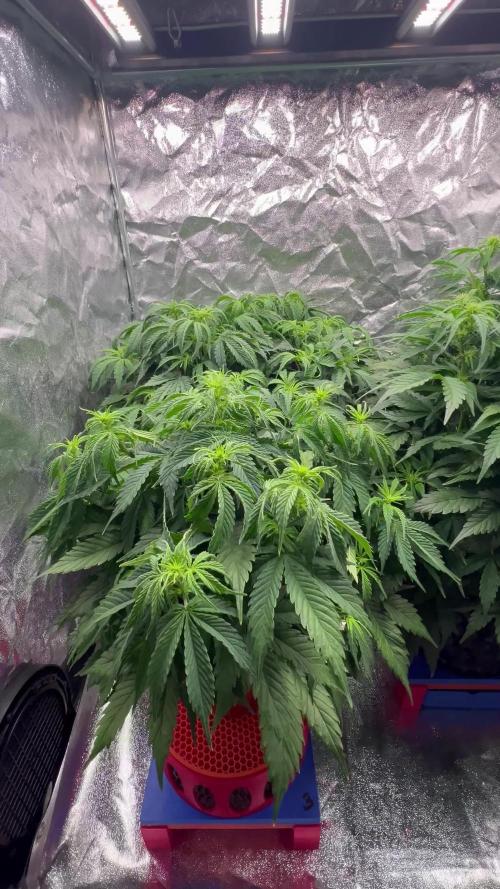
The plants are still growing beautifully, this week I will plant Power roots and Pure zim, I planted Bud candy, Carboload and Sticky Fingers, I am trying Hammerhead, some ingredients precipitated when mixing, I think Big bud and Carboload I will find out tomorrow when watering and I will plant one of them. Plant 1 and 2 drink 1.5 l, 1.5 dcl will flow out, Plant 3 - 0.5 l and 0.5 dcl will flow out
Likes
74
Share

@Schnabeldino
Follow
_____📅 Week 9 | 📅 🌼🌸🌺flower🌼🌸🌺 ______
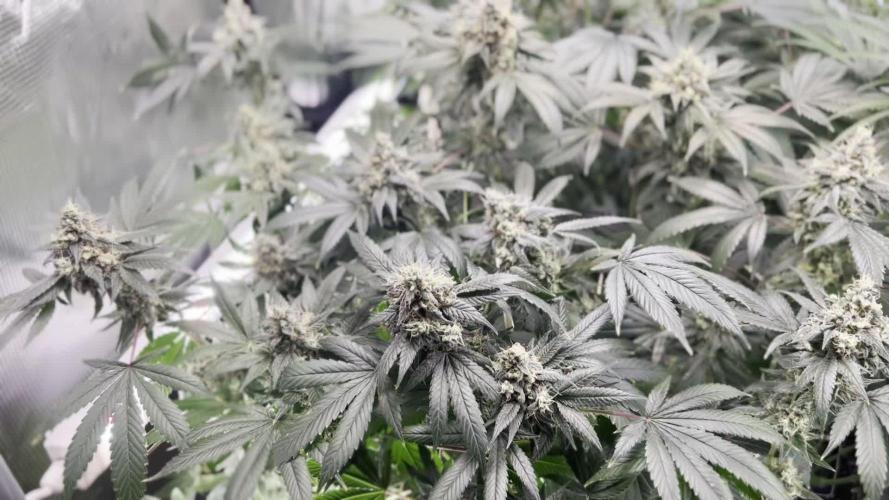
🔸Our lady is now entering her third week of flowering – and she's doing so with elegance! The buds are slowly developing volume, the white pistils stand proudly and are beginning to appear denser. The trichomes are becoming increasingly visible and already give her that fine, sugar-like shine. The leaves remain narrow and elegant, typical of sativa-dominant genetics. The reddish stems add beautiful accents – everything points to a healthy plant in full bloom. A real dance begins! 💃.
🔸The dehumidifier now maintains a constant relative humidity of 50-60%, which I am very satisfied with. It does make it 2-3 degrees warmer in the tent, but I can live with that.
🔸Now gets big bud from AN, becomes thirstier
______________________________________________________________________________________
📈 Current Conditions
🌡️🔆 = 27°C
🌡️🌜 = 20°C
💨 VPD Target = 1.4 - 1.6
💨 Humidity = 63% → Target: below 60%
🔦 PPFD = 900 µmol (12/12)
🔦⌚ DLI = ~38
🛠️ Setup (unchanged)
💡 Lights: 2 x Sanlight Evo 4-120 @ 90%
⛺ Tent: 120 x 120 x 180
🍯 Pot Size: 18 liters
🌱 Medium: Bio-Bizz Light Mix
💊 Nutrients: Advanced Nutrients
💧 Water: Tap water (EC 0.5)

Processing
Likes
3
Share


@BonusPackage
Follow
Day 17
She's the biggest of this grow. She's looking fantastic.
Day 19
Increasing the nutrients for "first leaves"
Day 20
Her leaves have some discolouring but I'm not going to worry too much about it yet
Day 21
She's the tallest so I started LST with her first. Anchored her below the first node and removed the smallest 2 branches from the bottom
Likes
164
Share


@Sour_D
Follow
Well, this grow has come to an end. I have mixed feelings about that, as I enjoyed the journey, but at the same time I can't wait to try this stuff. 😁 Man, I knew from the start it was likely I was going to get addicted to opium. 😶 But hey, what the hell, I gotta know. She was a bit of a job to trim, many breaks to clean the scissors, but me and my grow neighbor plus another bro got her done in about 3.5 hours. She's hanging pretty in the infamous spare bedroom and I can't wait for her to dry up and go into the Grove bags for a cure. Of course, strictly for quality control purposes, a sample will be tested by our expert panel of esteemed judges prior to the cure.
SMOKE REPORT
Well, the results are in! And it was unanimous I might add for the record. We have 4 esteemed judges who are now addicted to opium. I was worried that might happen, and my worries were well founded apparently.
First, let me go over the rigorous requirements our judges faced in making our decision. Aroma? Check. Flavor? Check. Stoniness Factor? Are two checks allowed? Yield? Check. Ease of grow? Check. The opium produced a very nice earthy and dank flavor. The aftertaste after indulging has a sweet undertone to it, very nice! This is a fairly strong strain, definitely couch-lock. Buy oh so tasty, love it! I will be growing it again, and soon. This one’s a winner.

Likes
47
Share


@Ultraviolet
Follow
Gave her a cocktail to help with stress. Added 1st net for lateral support, not so much now, but for later. Blue light is absorbed by photoreceptor proteins called phototropins, which trigger a hormonal response that causes cells on the shaded side to elongate, making the plant bend toward the light. Try and fill this side a little. She is quite big already, just needs to find her stride again after the undue torture.
The mind is constantly working and producing, just like a factory. It's not just a passive recipient of information but an active producer of ideas, attitudes, and beliefs. The "ingredients" in this factory are the information you consume, such as books, conversations, and the media you engage with. The "products" are your thoughts, beliefs, and actions. The quality of the ingredients directly influences the quality of the output.
5 apex stems with 20-30 mini cola, let them develop a little, with the apical dominance shattered, all those 20-30 will all compete with each other as soon as that stretch is initiated. Key to a good stretch is making sure the plant is cycling efficiently, with large ATP conversions occurring lights out.
For now, keeping light intensity high. A plant will slow its vertical growth in very high light intensities, leading to a more compact form with thicker stems and leaves. This response is a protective mechanism against light stress, which can damage the photosynthetic apparatus and lead to symptoms like leaf scorching, yellowing, and brittleness. Instead of growing taller, the plant invests its energy into creating a more robust, stress-tolerant structure.
Providing plants with necessary antioxidants helps protect the photosynthetic apparatus by scavenging reactive oxygen species (ROS) that cause damage from excess light.
UV light exposure can impact the xanthophyll cycle by either enhancing its photoprotective role or causing damage, depending on the intensity and type of UV radiation. UV exposure can trigger the synthesis of more xanthophyll cycle pigments to increase the plant's capacity to dissipate excess energy, but it can also cause direct damage, particularly to Photosystem II, and may lead to a decrease in the de-epoxidation state (DEPS ratio) which indicates a reduced capacity to dissipate excess energy.
Plants can respond to UV stress by increasing the synthesis of xanthophyll cycle pigments, such as violaxanthin and zeaxanthin, to improve their photoprotective capacity. UV-induced changes in xanthophyll cycle pigments can be linked to a plant's overall tolerance to high radiation stress. The xanthophyll cycle helps protect against photoinhibition, which is especially important when the plant is exposed to high levels of both UV and visible light. High doses of UV radiation can directly damage photosynthetic components, including the proteins, lipids, and pigments in the thylakoid membranes. Exposure to UV radiation can have a mixed effect on the de-epoxidation state (DEPS ratio) of the xanthophyll cycle pigments. In some cases, UV can inhibit the conversion of violaxanthin to zeaxanthin, resulting in a lower DEPS ratio and a reduced capacity for energy dissipation. However, the total pool of xanthophyll cycle pigments may increase, and this enhanced pool size could provide a greater potential for photoprotection despite a lower DEPS ratio.
The xanthophyll cycle works alongside other mechanisms, such as the accumulation of flavonoids (UV screens), to protect the plant from UV-induced damage.
Blue light repairs 100% UV-induced damage in plants through a process called photoreactivation, which uses a light-dependent enzyme called photolyase. This enzyme uses energy from blue and UV-A light to directly reverse the damaging pyrimidine dimers in the DNA caused by UV-B radiation, a key mechanism for maintaining the plant's genetic integrity.
After carbon, light, water, temperature, and nutrients, the limiting factor of a plant's growth is often its own internal factors or the amount of a key ingredient. Chlorophyll concentration is one such factor, as the amount of this pigment limits how much light can be captured for photosynthesis. Other factors include chloroplast number, respiration rate, and the concentration of carbon dioxide in the atmosphere, as plants are often in a CO2-deficient condition.
60x60x18=64800seconds x 700 = 45,360,000moles. 45DLI
Exposure to 165 µW/cm² of ultraviolet-B (UV-B) light for 3600 seconds = 1 hour, a extremely high, acute dose triggering stress responses and protective mechanisms.
.
The plant's photoreceptor protein, UVR8, senses the UV-B radiation. This triggers a signaling cascade that activates specific genes to protect the plant from damage. In response to the UV-B signal, the plant ramps up the biosynthesis of protective compounds like flavonoids, phenolic acids, and anthocyanins. These compounds absorb UV radiation and accumulate in the epidermal layers of leaves to shield inner photosynthetic tissues. The plant may increase leaf thickness or deposit more cuticular wax, creating a physical barrier to the radiation. The plant will produce more enzymatic and non-enzymatic antioxidants to neutralize the reactive oxygen species (ROS) produced by the UV-B radiation. The plant activates enzymes, including photolyases, to repair DNA damage caused by the UV-B. These repair mechanisms are critical for preventing permanent genetic mutations.
While protective measures are activated, a high dose delivered over a short period can cause stress that overwhelms the plant's defenses.
Photosynthesis is highly sensitive to UV-B. A high dose can inactivate Photosystem II (PSII), damage thylakoid membranes within the chloroplasts, and reduce chlorophyll content, which lowers the plant's overall photosynthetic capacity. Despite repair mechanisms, high UV-B doses can inflict persistent damage on the plant's DNA. The overproduction of reactive oxygen species can cause oxidative stress, leading to the oxidation of lipids and proteins and disrupting cellular function.
I am playing in the enchanted forest. A shift in perspective is what changes perception over time. By deliberately considering a situation from another point of view (perspective), you can challenge your initial, knee-jerk interpretation (perception). This is a valuable skill in both personal and professional life for fostering empathy, improving problem-solving, and making more informed decisions.
Move the mind off perception into perspective.
Thank you.


Likes
17
Share


@Kitties_and_Colas
Follow
She was transplanted into her final home (18 gallon), we added extra EWC to her new Promix..she's still having some nutrient uptake issues (definitely getting enough to eat)..we decided to drop her PH to 5.0 to see if this helps and we decided to hold off on flowering her until her color looks a little better... we gave a small dose of bloom, we like to do this 1-2 weeks before the start of flower with all our plants.. thanks for reading, happy growing 😻
Likes
81
Share


@JuanHaze_Arg
Follow
Las flores más lindas del condado son las de strawberry banana, que hermosa genética! Perdón por no cuidarla y alimentarla como correspondía
27/04 Se riega con 2.5 litros de agua + calmag + top auto. PH:5.5 EC:0.9
29/04 encontré una placa de saltahojas del mismo color que los tallos, por este motivo fue muy difícil darme cuenta. Se estaban chupando la sabia de mi planta, al menos 6 capture con mis dedos.
30/04 se riega con 2,5 L de agua + Monster Bloom 0.1g x L. PH:6.2 EC 0.8


Likes
22
Share


@Knert
Follow
D35: gave her 30 grams of organic granular phosphorous grains (6-16-0) and gave her a thorough watering untill it reached runoff.
D37: Days were with intense sunlight and a lot of wind. Gave her another good watering and 30g of organic granular potassium grains (2-0-20). Given that the days are all sunny the last days and they're bound to stay that way, I think I'll water her every 2 days as she's using a lot of water these days and that way the granular feeder gets dissolved more quickly into the soil.
D40: She's looking absolutely great. Really enjoying the sunshine and warm weather of the past week (she did get some really minor sunburn spots on +-4 fan leaves, but she did't seem stunted by it). She keeps on growing every day and she has a lot of promising tops. The LST has been working out really well! I'm doing my best trying to tuck away as many leaves blocking the sunlight from the bud sites, but there's starting to get a lot of them so I don't really know what I should do. Should I trim the ones that are in the way of the bud sites and that I can't really tuck away or should I leave them on for photosynthesis? The flowers are also really developing and she's really starting to give a good smell. Looking forward to the following days/weeks!
D42: I watered her again, around 3l, and added another 20g of potassium grains. That's going to be the final amount of fertilizer she's getting. First gave her 1,5l of plain tap water and then another 1,5l which was 50% tap water and 50% sparkling water, mixed with a teaspoon of molasse.
The overall nutrient scheme was thus:
* D20: 25g organic granular fertilizer (6-3-3)
* D28: 35g organic granular fertilizer (6-3-3)
* D35: 30g organic granular phosphorous grains (bone meal) (6-16-0)
* D37: 30g of organic potassium grains (2-0-20)
* D42: 20g of organic potassium grains (2-0-20)
