

Likes
9
Share
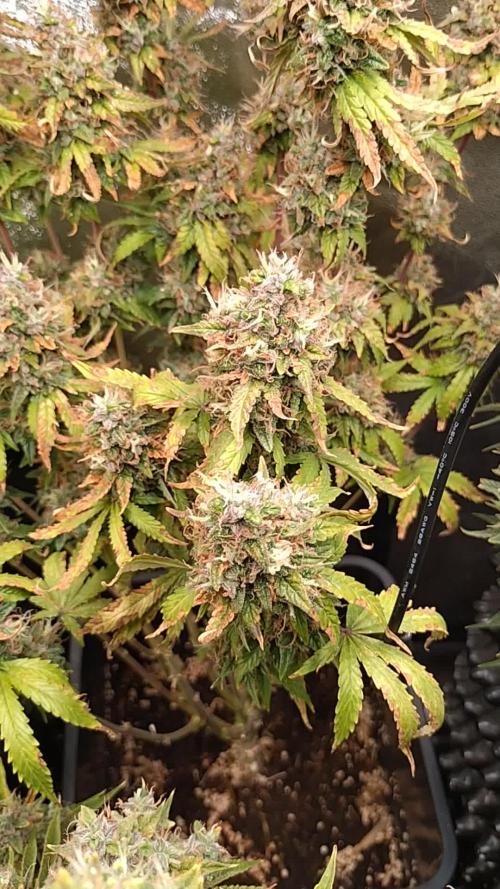
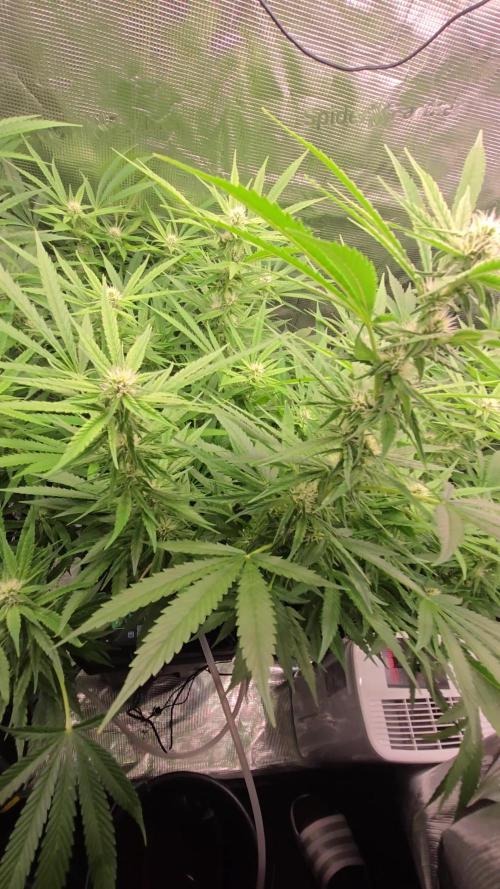
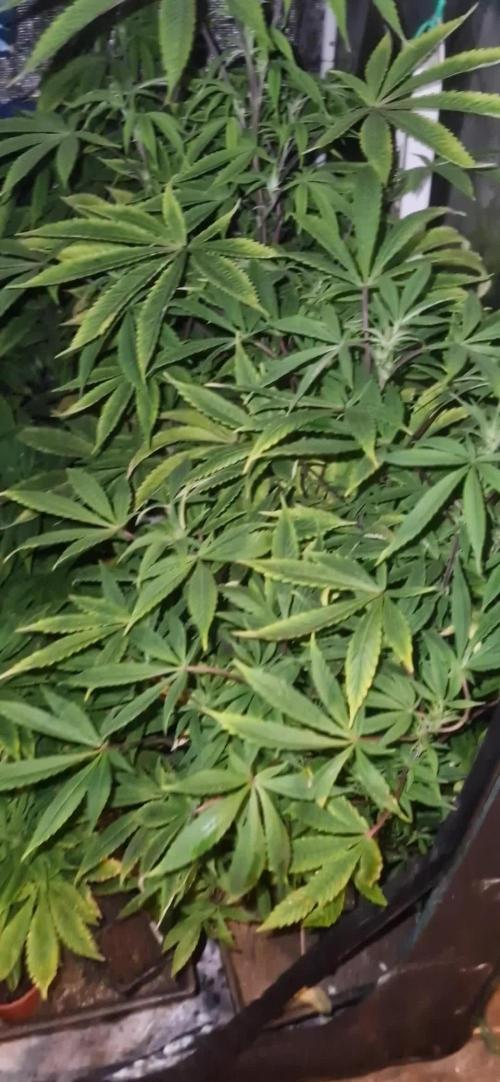
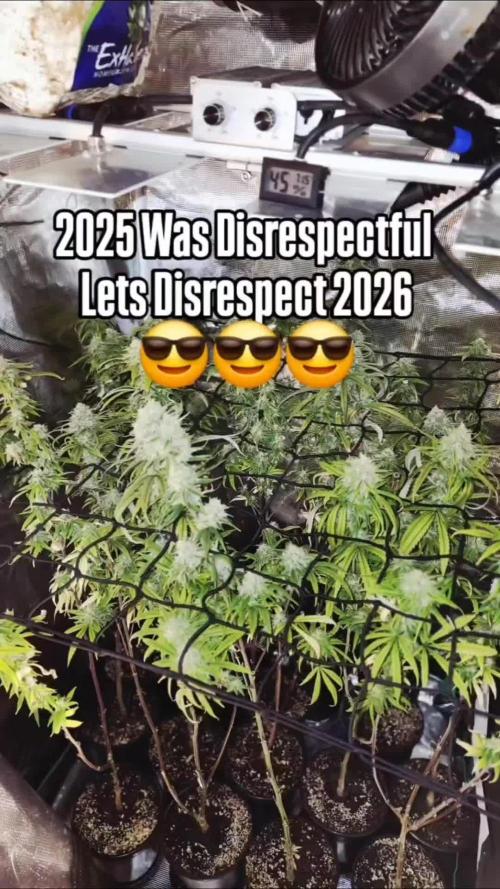
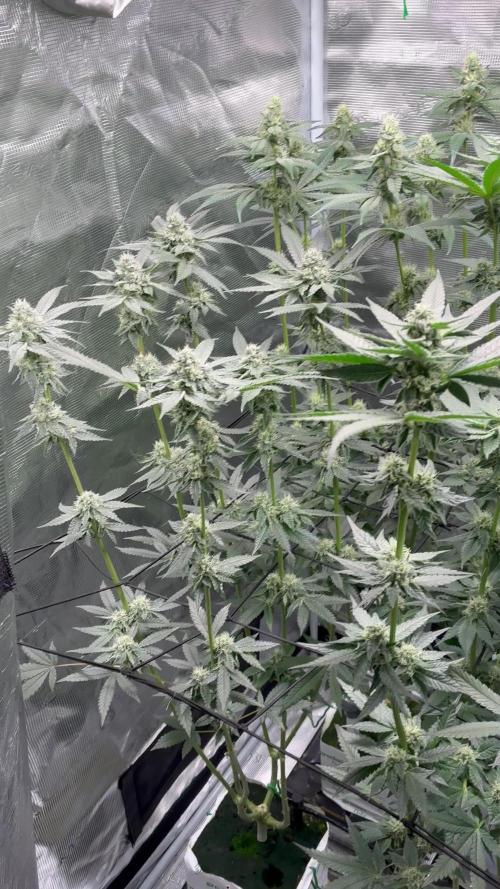
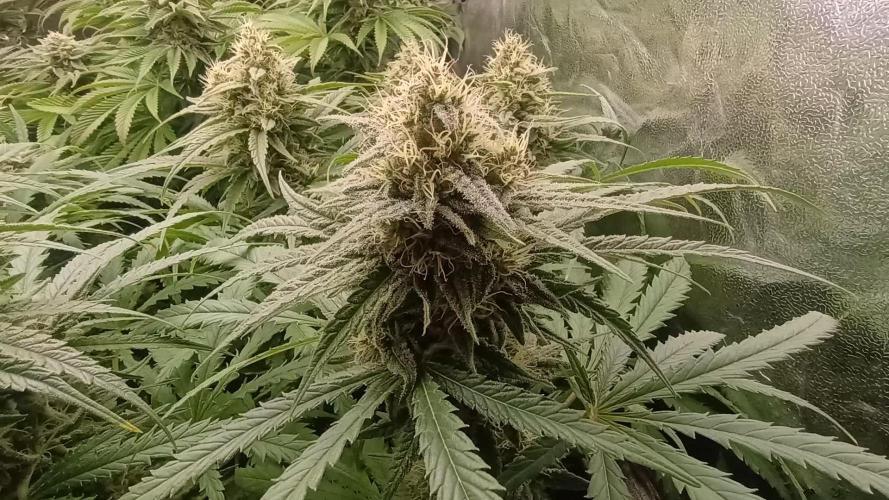
Als ich dachte, ich hätte noch Zeit, hab ich mich komplett verschätzt und damit warscheinlich auch den ersten richtigen Growfehler gemacht. Die Pflanze ist viel zu hoch gewachsen ... was meint Ihr? Was kann ich das nächste mal anders machen? 😞
Likes
2
Share
18 hours in seconds, 60x60x18 = 64,800 seconds, now multiply by the 833μMol/s reading off the PAR metre. μMol/s (micromol) is the unit in which P.A.R. is expressed. 64,800x833=53,784,000μMol 53,784,000μMol = 54 Mol 54 DLI @ 800ppm, powerful combination. Pushing photosynthesis to peak capacity, accelerated growth and increased biomass. Applied net, stretching her around for a week. Maintaining a minimum air velocity of 0.3m/s within the inner canopy. E=MC2 looks like a simple multiplication problem; it describes a fundamental physical truth: mass and energy are the same thing. The equation doesn't just calculate a value; it reveals that mass is effectively "congealed" energy. Energy is just numbers. Energy isn't a physical "substance" you can hold or touch. It is essentially an abstract, calculated number that we assign to a system to predict how it will change, interact, or move. A numerical label we attach to matter to track how it behaves. Because the universe runs on laws of symmetry (specifically, that the laws of physics don't change over time), a single global number must be conserved. We call that number "energy". How well a seedling grows is down to how much knowledge one can acquire to increase the level of conversion to occur. Applying knowledge effectively requires intuition, which comes from hands-on experience. A seasoned stoner learns to read subtle signs—like a slight change in leaf turgor (stiffness), subtle color shifts, or the specific texture of the soil—before a textbook diagnosis can be made. Ultimately, growing is the application of botanical science blended with active observation. Knowledge dictates your potential, but adaptability and attentiveness to the plant's immediate environment determine your results. The human eye is capable of distinguishing more shades of green than any other color in the visible spectrum. 1.618 Nature mathematically optimizes quantum energy transfer and light absorption efficiency within the photosynthetic machinery, as it naturally dictates energy scaling hierarchies and resonance dynamics. External vibration or electromagnetic wave that perfectly matches a plant's natural frequency directly influences plant growth. Low-frequency sound waves and targeted electromagnetic fields stimulate cellular processes and boost photosynthetic efficiency. An angular frequency aligned with the Golden Ratio is often used in wave mechanics and quantum physics to optimize energy transfer. Does it produce better yields? All I know is the IVM loves being aligned with it. Here is how I "think" of it to simplify it for myself when I give it thought. Quantum is the firmware, DNA is the software read/write expression. Alignment with that of which already exists. Law of nature, not my opinion: Constructive interference occurs when two or more overlapping waves meet in phase, meaning their crests and troughs perfectly align. Their amplitudes add together, creating a new, amplified wave with greater intensity than the individual components. Constructive interference is the foundational mechanism that establishes a resonance hierarchy across physical, structural, and acoustic systems. "Frequencies utilizing this ratio naturally minimize resistance (or impedance) and allow for highly efficient resonance, which can facilitate an increase in Electron Transfer Reactions (ETR) or energy pathways in molecular structures." Quantum coherence in photosynthesis occurs when a photon of sunlight strikes a leaf; the energy it carries must travel to a reaction center to be converted into chemical energy. This process operates at nearly 100% efficiency. If the energy moved in a traditional "bunching" or random hopping manner, a large portion of it would be lost as heat. Instead, plants utilize quantum superposition. The energy particle (exciton) doesn't just take one path; it exists in a wave state and explores multiple pathways simultaneously. It essentially "chooses" the most efficient route to the reaction center simultaneously. Research shows that molecular vibrations and the specific network arrangements of chlorophyll molecules (like the naturally evolved Chlorophyll A & B ratios) actively protect against energy overflow, optimizing light capture across different light intensities. Enzymes are the biological catalysts that speed up chemical reactions within a plant's cells, allowing them to grow, metabolize, and repair. Rather than relying solely on the classical kinetic energy of molecules colliding, plants use quantum tunneling. Subatomic particles like electrons and protons (hydrogen ions) can literally "teleport" through energy barriers that they normally wouldn’t have the energy to climb over. This makes vital metabolic reactions happen far faster than classical physics could ever explain! Chloryphyll b has peak absorption at 460nm (Blue) and at 647nm(Red). If we take the blue peak wavelength 460nm and a UV-B, UVR8 peak absorption wavelength 285nm, Tryptophan-285 (W285) Sensing protein. 460/285=1.618 Φ If we take chlorypyhll b's Red absorption peak 647nm and a UV-A of 400nm, we get 647/400=1.618 Φ. "Structure of light". The cryptochrome photoreceptor (CRY) is a UV-A/blue light receptor that shares this dual sensitivity with several other biological structures and functions, including significant sequence similarity and a common evolutionary ancestor with DNA photolyase enzymes. These are light-activated enzymes that use blue/UV-A light to repair DNA damage caused by UV-B radiation in plants. Synergistic. Effective quantum efficiency of photosystem II, often denoted as ΦPSII, represents the proportion of light absorbed by Photosystem II (ΦPSII) that is actually used in photosynthetic electron transport. It is a key indicator of how efficiently a plant is using light for photosynthesis, as opposed to losing it as heat or fluorescence. ΦPSII (effective quantum yield of photosystem II) functions primarily as a "multiplier" (a coefficient of efficiency) rather than an additive factor when estimating the overall photosynthetic electron transport rate (ETR). Multipliers are considered far more beneficial than additions because they generate exponential growth, leverage existing resources to their full potential, and create sustainable, self-multiplying capacity, rather than just incremental, linear increases. This fascinating observation is rooted in the intersection of subatomic geometry, fractal scaling, and quantum dynamics. In specific molecular arrangements—such as in conjugated polymer networks or biomolecular architectures—the Golden Ratio (PHI) naturally dictates energy scaling hierarchies and resonance dynamics. Mathematically tied to the fine-structure constant, which defines the strength of the electromagnetic interaction. The Golden Ratio can be mapped geometrically as the Golden Angle (137.5 degrees) in atomic structures, linking the charge of the electron to fundamental quantum constants like Planck's constant. An electromagnetic wave is neither electric nor magnetic, but a combination of both. 137.5 The Golden Angle (137.5) This angle is derived from the Golden Ratio (1.618). It is the smaller of two angles created when a circle is divided such that the ratio of the arcs equals the Golden Ratio. An electromagnetic wave (like light or radio waves) is not a static electric field or a static magnetic field, it is a self-propagating combination of both. An oscillating electric field creates an oscillating magnetic field, which then regenerates the electric field. They feed off each other and travel together through space at the speed of light, carrying energy without needing a material medium. The Fine-Structure Constant Alpha (Α/α): In quantum physics, is the approximate denominator of the fine-structure constant (often represented by the Greek letter Alpha (Α/α). It is a fundamental, dimensionless number that dictates how strongly charged particles (like electrons) interact with the electromagnetic field. Its value has puzzled physicists for over a century, as it bridges quantum mechanics, electromagnetism, and relativity. In quantum mechanics, Omega (Ω/ω) usually represents angular frequency. When applied to "quantum coherence"—the ability of particles to exist in overlapping states without immediately degrading—is key to calculating how long these states last. The Golden Angle, the value 137.5° is the geometric Golden Angle. It is derived from the Golden Ratio (1.618) and is famously responsible for the beautiful, mathematically optimized spiral patterns found in nature (such as sunflower seeds, pinecones, and leaf arrangements). Because of this, theoretical physicists and mathematicians have long speculated about why nature relies so heavily on the number 137 and the golden angle to govern everything from subatomic light interactions to the macroscopic geometry of the universe. Quantum coherence allows particles to maintain superposition and entanglement. In realistic, open environments, interactions with a noisy background typically cause decoherence, destroying the system's quantum information. A major challenge in quantum physics and quantum computing is preventing this decoherence at large scales. In quantum optics and driven systems, the Greek letter Omega (Ω/ω) often represents the Rabi frequency, which dictates the strength of the coherent driving laser or electromagnetic field interacting with the quantum system. The interaction of light and water generates specific Coherent Domains. Trapped electromagnetic fields cause water molecules to vibrate in unison at a coherent frequency, separating the liquid into structured quantum areas and an unstructured phase. When water interacts with hydrophilic (water-attracting) surfaces, the energy from UV and Infrared light can drive the formation of larger, structured layers known as Exclusion Zone (EZ) water. Exclusion Zone (EZ) water represents a structured, negatively charged phase of water critical to cellular biology. Driven by light energy and hydrophilic surfaces, this ordered state acts as a natural biological battery, with far-reaching implications for cell function and human health. In this domain, water molecules arrange themselves into a highly ordered, negatively charged lattice that excludes solutes and particles. At higher energy levels, UV light acts as a catalyst for photochemical reactions. Photons can provide enough energy to break the hydrogen and oxygen bonds in molecules, resulting in free radicals and a plasma of quasi-free electrons. This transfer of electrons forms the fundamental basis for redox reactions and energy metabolism in ALL biological systems. Input: The energy, time, and focus you dedicate. Process: Continuous growing, refining, and learning. Output: A superior, highly polished final product.
Likes
13
Share
Removed the 2 Xs 1500's (300watts) & replaced them with 2 P1000 (200watts) lights, now running 680 watts. These lights fit in better & have air space all around to help cool them, these lights run a lot cooler than the xs 1500s & only get warm not hot. Started some clones.
Likes
2
Share
@Aleks555
Follow
Humboldt - Golden Sands And so we begin the grow! We germinated the seed in a damp sponge, and it sprouted within a day. We've planted it in a 100-gram plastic cup, and now we wait for it to start growing. A huge thanks to Humboldt Seed Company Europe for providing us with such amazing genetics. We're excited to see how this beauty develops and are grateful for the opportunity to grow such a top-quality strain!
Likes
12
Share
10/08: I decided to go ahead and remove the little one from the grow. I decided to do this because i had originally planned to only grow one plant in here so i had room for my clones from my other grow. And so i stuck to my original plan. This lady is the smallest plant i have ever grown. She is basically just growing 3 large colas. They are each already nearly the size of a soda can and id guess there is still 3-4 weeks left at least. And so i am slightly nervous that they are going to get too big and that mold will ultimately become a problem. Will see how it goes.
Likes
22
Share
Que hay familia, Estas critical a granel están yendo de lujo , tienen un buen ritmo en cuanto a su crecimiento, y se ven sanas. . La humedad anda entre 60/70% la temperatura está entre 23/26 grados , y como siempre el ph , ya que es de lo más importante,está en 5,8/6,0. . AgroBeta: 0,8 ml x L Growth black line , vía radicular. 0,2 ml x L Tucán , vía radicular. 0,15 ml x L Flash Root , vía radicular. 0,05 ml x L Gold Joker, vía radicular. . Esto es todo fumetillas, muy pronto las veremos echando flores 💨💨💨 buenos humos.
Likes
5
Share
Some plants are showing sex always an exciting time right also did a topping and started some lst gonna keep them in 1 gallon pots awhile longer then final pots after I know how many females I’m working with
Likes
2
Share
@ukojesita
Follow
Ahoj, tak protože venku celí týden chčije, nechal jsem holky ještě ve stanu, vypadají, že jim nic nechybí i když některé listy jsou žihane až do modra , tak snad po neděli půjdou do kukuřičky. Zdares
Processing
Likes
6
Share
Flowering stage activated.
Likes
12
Share
@Bryankush
Follow
Probabilmente il topping del ramo apicale non è stata la migliore cosa per me, mi servirà di lezione per la prossima estate.
Likes
119
Share
@Natrona
Follow
*****DIVINE SEEDS ***** *****OPIUM***** Sponsored grow Week 2 Germination April 6. Week 1 water only Week 2 water only This week 14-20 consisted of plain ph 6.6-6.9 water only. I gave a capful in the morning and evening. Transplanted to final 5 gallon air pot using fox farm amended soil. At 2 weeks, they have a good root structure established. Pics on 14, 16,18 &20 Until the plants are big enough to go outside, I will be using my AC Infinity tent and equipment. Once outside, I will be watering with well water and recharge and any additional fertilizers or amendments will be determined at that time. Thank You @DivineSeeds for the opportunity to grow and try what looks like a winner on all profiles. Thanks for the likes and comments, I appreciate all the plant love💚. Have fun & love what you grow 💚 Sending love and light 💫 💫Natrona 💫 DIVINE SEEDS ***OPIUM*** Harvest:1000 g/m2 Divine Seeds developed Opium as a new champion strain, unprecedently powerful and loaded with unbelievable quantities of resin. Certainly, no average genetic base could be behind such brilliant parameters! Several Afghani Indica landraces, recognized as most potent and resinous, were bred together with a mighty Brazilian Sativa which Opium inherits its bright berry taste from. Then a great deal of work followed aiming for the highest THC level and endurability as well as a branchy structure that would provide maximal yields. Now we can proudly title Opium the best Indica you could dream of growing! Indoors these plants mostly stay mid-height (1.5 m), reaching up to 2.0 m out of doors. Depending on your height limitations, Opium flourishes universally in grow boxes, balconies, green houses and terraces. Due to its Afghani parentage, this strain can stand hot weather if provided enough water and some shadow. Responds well to any training techniques: ScroG and SoG, LST, topping and FIM, supercropping. The start of blooming is marked with a rush of growth, when plants stretch almost 1.4x. Expect heavy colas that often require additional supports. Whilst ripening, Opium gives off a pungent earthy stench with fruity and berry undertones, also a bit of pine. Ready for outdoor harvesting in October. The stoning psychedelic impact of Opium is like being hypnotized (unless you’ve had too much, then it feels more like a blackout). Stone-lovers will appreciate every minute with Opium: its spicy taste immerses your mind into daydreaming, while the body rests flat. Recreation with this psychedelic Indica means silent tripping from one insight to another. Mighty enough to kill chronical pains, Opium is also medically efficient against insomnia, nausea, appetite disorders, muscle spasms, headaches, irritation, fatigue, panic attacks, epilepsy. Best consumed at night time, the effects keep going for up to 4 hours. Equipment and nutrients Pots: 5gallon Air pots Soil Fox Farm Happy Frog Amended with worm castings, dolomite lime and mychorihiza Recharge Seeds provided by Divine Seeds Divine Seeds breeding company The link to Opium Feminized Seeds Opium - Divine Seeds breeding company The link to Opium Auto Seeds Auto Opium - Divine Seeds breeding company ================================= Equipment: AC Infinity CLOUDLAB 844 – Advance Grow Tent 48”x48”x80” CONTROLLER 69 PRO – Grow Tent Controller CLOUDLINE LITE 6 - Inline Fan 6" IONBOARD S44 – LED Grow Light Board 400W CLOUDRAY S6 – Oscillating Circulation Clip Fan Carbon Filter 6”
Likes
4
Share
I've been dealing with a lot of heat issues. I've tried different things and what seems to have helped is more fans in the tent, and I put a bucket of ice in daily. The video is a time-lapse from week 3 and part of four. Jenny had some slight leaf cupping most likely due to some heat stress which I've since corrected. I also come to realize in week 4 I was underwatering/feeding my plants. Raising the lights, adding fans, and daily ice buckets have made for really great looking plants in the tent. Once in a while, I have dropped some dry ice in and it seems to give the plants a little boost. It may be in my head, but the temp drop, the co2 release, and humidity bump seem to have helped. The only type of LST I have done is put a fan in to blow the plants around, and I have tucked some bigger leaves under smaller ones to expose the new growth or flowering site to more light. All in all, I have been hands-off with my plants. I do rotate them and shift them around the tent a lot.
Likes
Comments
Share
Likes
4
Share
@alexb420
Follow
flipped 11/27 got the feeding down, got the color back. buds starting to come in. smells are getting way stronger. hope this flower run goes good.
Likes
6
Share
Ready to harvest 👌🏼👶🏻👌🏼 2 Days without light than i cut them off. The mother is on 12/12 again. This will be hopefully an endless Grow Diarie. Clones and revegge from Punch Pie 🥊👶🏻👌🏼
Likes
218
Share
@ClubRiot
Follow
Start week 8 , Bio Bloom 4 ml/L + Sensi Cal-Mag Xtra 2 ml/L + CarboLoad 2 ml/L + Top Max 4 ml/L (Ph 6.7).