


Likes
Comments
Share


@DaveJohnson
Follow
Week 9: Flower - The First Harvest & Final Countdown! ✂️🌿
THE BIG CHOP IS DONE! Gorilla Z #1 has been harvested, and we're officially in the drying phase. Meanwhile, the remaining ladies are marching toward their own finish lines.
Gorilla Z #1 - HARVESTED! 🎉
She's down! After weeks of growth, recovery from overwatering, and pushing through to the end, this girl finally got the chop.
Trichome Check:
Mostly cloudy/milky (peak THC production ✓)
A few amber trichomes starting to show
Minimal clear trichomes
Harvest Timing: Honestly? I was in a rush—ran out of flower to smoke! 😅 But the trichomes were in a good window, so it worked out. Sometimes necessity makes the decision for you. Could've waited for more amber for a heavier effect, but she was ready enough.
What's Next:
Drying phase begins now
Aiming for slow dry (60°F, 60% humidity if possible)
Then comes the cure—patience will be tested again!
The Relief: Finally got some homegrown coming down the pipeline. The timing couldn't be better!
Gorilla Z #2 - End of Month Finish
She's still chugging along in mid-to-late flower. Based on her current progression, she should be ready by the end of the month.
Current Status:
Buds filling out nicely
Still getting full-strength bloom nutrients
Recovery from overwatering is complete—she's back to full health
Feeding Schedule:
Full strength General Hydroponics Bloom Trio
Cal-Mag
Liquid Kool Bloom
She'll stay on this program for another week or two, then transition to water-only flush before harvest.
Heisenberg - Two Weeks Out & Starting the Flush! 💧
She's in the final stretch! About 2 weeks away from harvest, which means it's time to transition to the flush.
The Flush Begins TODAY:
Water only from here on out
No more nutrients
Flushing helps the plant use up stored nutrients in the leaves and buds
Results in smoother smoke and cleaner taste
Why flush?
Removes excess salts and nutrients from the medium
Forces plant to metabolize stored nutrients
Improves final product quality (smoothness, taste, ash color)
The leaves will fade and yellow—this is GOOD and expected during flush
Current Status:
Buds are dense and frosty
Loving the Spider Farmer tent environment
Healthy and vigorous despite approaching finish
Key Observations & Real Talk
Harvest #1 in the books! There's something incredibly satisfying about chopping your first plant of the cycle. All the work, the stress, the learning—it all comes together in that moment with scissors in hand.
The staggered timeline is actually perfect:
Gorilla Z #1: Harvested (drying now)
Heisenberg: 2 weeks out (flush started)
Gorilla Z #2: End of month (~3 weeks out)
This spread means I won't be overwhelmed with trimming and drying all at once. Plus, continuous harvests = continuous supply!
Running out of smoke as motivation: Look, we've all been there. Sometimes the best harvest window is "I'm out and I need flower NOW." 😂 The trichomes were good enough, and that's what matters.
The Home Stretch Strategy
For Heisenberg (flush phase):
Plain water only, pH'd to 6.5
Monitor trichomes closely
Watch for fade (yellowing leaves = plant eating itself = good!)
Start thinking about chop day in 10-14 days
For Gorilla Z #2:
Continue full bloom nutrients for 1-2 more weeks
Then begin her flush
Harvest late February
For Gorilla Z #1 (drying):
Hang dry in dark, controlled environment
Check daily—don't rush it!
Stems should snap, not bend, when ready for cure
Then into jars for the cure (the hardest wait of all)
Next Week's Plan
Monitor Gorilla Z #1 drying progress (resist the urge to sample too early!)
Continue water-only flush on Heisenberg
Keep feeding Gorilla Z #2 full strength
Daily trichome checks on Heisenberg as harvest approaches
Prep trimming station and cure jars for upcoming harvests
Start planning the NEXT grow! 🌱
We're in the final stretch! One down, two to go. The finish line is in sight, and the reward is almost here. 🏁🔥
First harvest complete. Drying tent smells AMAZING. The wait for cure is going to be brutal but worth it! 💚✂️


Likes
7
Share


Likes
11
Share


@BrigadeDesTerps
Follow
Mise en route des graines pour ce test
Jour 1 : mise en pot 24/09/24
13graines ont germer
Recette du living soil pour 10l
5litre terreau compost équin bovin ovin végétal
5litre terreau intérieur
500gr biochar
900gr lombric
50gr luzerne
5gr micro granulée it45
5gr pollen d’abeille
5gr levure de bière
50gr tourteau karanja
10gr bactérie soluble
200 zeolith chabasit
10gr Levures Saccharomyces Cerevisiae
2gr Endomycorhizes RHIZOPHAGUS IRREGULARIS
2gr Bacillus IT35 Amyloliquefaciens
Il est actuellement en maturation depuis 2semaine j’attends que les graines germes et développe bien leur racines
Ensuite je rempoterai dans des pots de 300/400ml que je garderais pour une végétation de 3/4/5 semaines le temps que je récolte ce qui a dans la tente
Ça s’annonce beau !
Le terreau Terralba ou terre 4 composts est un terreau naturel exceptionnel. Il s'utilise tel quel en extérieur pour stimuler la vie de vos sols, planches de cultures, grands pots...
Augmente le stock d'humus dans le sol, la rétention d'eau et d'air. De la germination à la récolte. Sans risque de brûlure.
Ce terreau universel peur s'utiliser dans tous les cycles de cultures extérieures.
Nous vous conseillons un mélange à 50/50 avec notre terreau Horticole INNT pour une base de culture durable et réutilisable en intérieur.
Composition : composts équin, bovin, ovin et végétal maturés 24 mois minimum.
Composition :
1% (N) total
0,7% (P205)
0,9% (K20)
0,5% (MgO)
3,6 (CaO)
24% de MO
C/N : 11
PH : 8
Le terreau Terralba est un terreau universel exceptionnel.
Ce terreau innovant très drainant avec innovation fibre de mousse et fibre textile recyclées est comparable à un substrat de type fibre de coco. Il est aussi enrichi en compost. Il peut servir de la germination jusqu'à la récolte.
Nous vous conseillons un mélange à 50/50 avec notre terreau 4Xcomposts EXT&INT pour une base de culture durable et réutilisable.
Écologique, restructurant, la terreau enrichie et aère le sol durablement - notamment les sols argileux - tout en lui redonnant jeunesse !
Composition :
• 1,2% (N) total
• 0,4% (P205)
• 0,8% (K20)
• 49% de MO
• C/N : 22,4
• PH : 7,3
Le charbon végétal actif est capable d’absorber jusqu’à cinq fois son poids propre en eau ainsi que les éléments nutritifs qui s’y trouvent. Il joue ainsi le rôle de catalyseur et d'amplificateur pour les fertilisants traditionnels, qu'ils soient d'origine organique ou minérale. Ce pourquoi il est idéal pour activer un sol et pour les thés de compost oxygénés.
Le charbon végétal améliore la diffusion et la disponibilité des éléments nutritifs dans le sol et offre des conditions propices au développement des micro-organismes.
Le Biochar peut être introduit dans une grande variété de sols. Il est particulièrement efficace dans les sols pauvres, difficiles et acides.
Pour faire agir rapidement et efficacement sa capacité d’amendement, le charbon végétal est enrichi et biologiquement activé avec des micro-organismes. Le Biochar se comporte ainsi comme un structurateur et un activateur dans le but de valoriser les sols.
Composition :
• Charbon végétal actif 31%
• Matière organique 33%
• Matière sèche 75%
• C/N : 17
• PH : 7,2
• Azote (N) : 2,1 % dont 1,2 % azote organique
• Phosphore (P205) : 0,74%
• Potassium (K20) : 1,18%
• Calcium (Ca) : 6,8%
• Magnésium (MgO) : 0,65%
Le lombricompost apporte à la plante des éléments nutritifs tels que l'azote, le phosphore et le potassium, qui sont essentiels à sa croissance. En outre, il contient de nombreux oligo-éléments et micro-organismes qui peuvent être bénéfiques pour la plante.
Le lombricompost a également une forte capacité de rétention d'eau et peut améliorer la structure du sol, ce qui peut être bénéfique pour les plantes. En utilisant du lombricompost, vous pouvez ainsi favoriser la croissance de vos plantes de manière naturelle et écologique.
Le lombricompost est un fertilisant, amendement organique à la formule haut de gamme. Totalement naturel, il résulte de la digestion de fumier bovin et équin par des vers de terre. Les lombrics transforment ces déchets en un compost riche en nutriments et en micro-organismes bénéfiques pour les plantes.
Le lombricompost présente une texture fine et friable, regorgeant de nutriments essentiels tels que l’azote, le phosphore, le potassium et d’autres micro-organismes bénéfiques pour les plantes. Son utilisation améliore la qualité du sol, favorise la croissance des plantes et contribue à la conservation de l’environnement en réduisant les déchets organiques.
Le lombricompost est donc une source naturelle de nutriments et de matière organique pour les plantes, et peut être utilisé comme engrais ou comme amendement du sol. Il surpasse ainsi le compost, grâce au travail du lombric (E. Foetida) qui transforme le fumier en un super compost ! 10kg de fumier sont nécessaire pour obtenir 1kg de lombricompost.
Composition :
• Matière sèche 65,3%
• Matière organique 48,7%
• Ph 7,9 CE 5,98dS/m
• Azote (N) 2,4% dont NO3 0,28%
• Phosphore (P205) 3,2%
• Potasse (K2O) 3,8%
• Acides Humiques 6,2%
• Acides Fulviques 0,9%
• C/N 11,8
La luzerne fait un excellent paillis, c'est un inoculum de bactéries et de champignons ! Elle contient des niveaux élevés de protéines. Elle fournit de nombreux minéraux importants, dont l'azote, le potassium, le calcium, le fer, l’acide folique, etc.
Elle stimule la croissance saine des racines et elle contient des hormones naturelles qui aident à prévenir les maladies des racines. Idéal pour les thés de compost oxygénés (TCO)
Protéines : 16%.
Naturellement riche en protéines, minéraux, vitamines, enzymes et acides aminés.
Micro granules it45 Amendement calcaire, dolomie et gypse avec préparation microbienne à base de Bacillus Amyloliquefaciens IT45 et Saccharomyces cerevisiae LYCC6420
Formulation : micro granulés (1 – 1,6 mm) à base de rhizobactéries favorisant la croissance des plantes qui se multiplient et colonisent rapidement la zone des racines, et de levures Saccharomyces cerevisiae souche LYCC ayant un effet probiotique.
Les PGPR produisent des enzymes qui solubilisent le phosphore à partir de complexes inorganiques et organiques dans le sol et stimulent la croissance des racines efficaces augmentant ainsi la zone d'interception des éléments nutritifs. Les levures LYCC permettent une occupation de la rhizosphère par une flore bénéfique.
Composition :
• Matière sèche : 96,8%
• Matière organique : 91,5%
• N total : 6,6% dont N soluble dans l'eau 0,17%
• P total : 2%
• K total : 1,7%
Micro-granulés :
• Oxyde de calcium (CaO) total : 30%
• Oxyde de magnesium (MgO) total : 7%
• Anhydride sulfurique (SO3) : 13%
Le pollen d’abeille est l'ingrédient de base de la fabrication du miel par les abeilles. Riche en vitamines et minéraux, il est qualifié « d'aliment parfait », y compris pour les plantes !
La levure de bière est une matière vivante qui permet un meilleur fermentation pour les thés de compost oxygénés notamment conseillé pour accompagner les croissances ou apporter un gros coup de pousse pendant la floraisons.
La levure de bière stimule la vie des sols également à l'arrosage direct en apportant tout aussi bien que dans le TCO sa population l'espèce micro-bactérienne positive pour votre sols ainsi que des oligo-éléments et diverse vitamines.
Composition :
• 2,8% (N) total dont 1% (Norg),
• 2,3% (P205)
• 1,6% (K20)
• 35% de MO
• C/N : 8. PH : 8,4.
Le tourteau de Karanja est un complexe absorbant (argilo humique) qui renforce et stimule la vie microbienne du sol.
Riche en éléments fertilisants, il permet une assimilation lente et progressive de l'Azote et donc une régularité de l'apport.
Composition :
• 4,3% (N-Azote)
• 5,2% (P205-Phosphore)
• 2% (K2O-Potasse)
Matières Organiques : 67,3%
Carbone Organique : 33,7%
Les bactéries solubles sont utiles pour enrichir les sols, activer le processus de compostage et favoriser la création d'humus.
Avec plus de 55 éléments nutritifs, ce produit concentre un mélange de vie microbienne bénéfique à tous types de sols.
Véritable concentré de matières végétales et minérales, et d'une sélection de végétaux naturels compostés, nos bactéries solubles permettent une libération immédiate des nutriments.
• 2,8% (N) total dont 1% (Norg),
• 2,3% (P205)
• 1,6% (K20)
• 35% de MO
• C/N : 8. PH : 8,4.
Une zéolithe se comporte comme une « Super Argile » perméable qui retient l’Azote et les éléments minéraux nutritifs au voisinage des racines et les relâche lentement en fonction des besoins de la plante. Cela se traduit par une croissance constante mais rapide du végétal.
La zéolithe permet de réduire à la fois le nombre d’arrosages et la consommation en fertilisants car ces derniers sont moins soumis aux effets du lessivage et de l’évaporation. Améliore durablement la fertilité foncière des sols. Peut s’utiliser en mélange à tous types de substrats.
Récolte les surplus d’eau et réagit à la chaleur en suintant.
Diffuse lentement les éléments minéraux nutritifs et l’azote retenus dans l’eau (évite l’acidification des sols.
Riche en oligo-éléments, permet un développement racinaire soutenu. Retiens les pollutions des sols (nitrate, mercure).
Se mélange à tous types de substrats et toutes les cultures.
Idéal bonsaïs, plantes arides
Accroit la capacité d’échange globale du « complexe argilo-humique ».
Agit comme anti-mottant.
Allège les sols lourds et bloquants trop argileux en améliorant le drainage et le ressuyage en surface. Volume poral de 47%.
Améliore la structure des sols en s’opposant à l’acidification de ceux-ci par son effet tampon et par le retard de la nitrification de l’azote ammoniacal.
Apporte des oligo-éléments.
Augmente la résistance au piétinement.
Diminue la fréquence des rempotages.
Empêche le pourrissement des racines.
Favorise la ramification.
Modère le développement des mousses.
Permet des économies d’eaux et d’engrais.
Résiste au dessèchement et diminue la formation de « feutres ».
Retient l’eau sans changement de volume.
Sert de support aux microorganismes, ce qui contribue à la dégradation des déchets de coupes.
Les zéolithes sont des roches cristallines, présentant des capacités d'adsorption particulièrement importantes vis à vis des polluants que l'on rencontre dans l'eau et dans certains liquides, ainsi que dans l'air et les gaz. Elles sont extrêmement poreuses comme les charbons activés et elles peuvent être chargées électriquement pour opérer comme des échangeurs d'ions.
La zéolithe est un produit naturel qui respecte notre environnement. Utilisé dans le milieu industriel depuis de longues années déjà, ce minerai aux propriétés filtrantes particulières commence à se vulgariser dans le domaine de la piscine privée, de l'aquariophilie, des bassins d'agrément, de la récupération des eaux de pluie, ou encore de la culture des bonsaïs et autres plantations diverses par exemple...
4 points techniques majeurs :
- Grâce à leur propriété hydrophile, les zéolithes peuvent adsorber l'eau jusqu'à 30% de leur poids total et sans aucune variation de volume : pas de gonflement en présence d'eau ni de craquement en cas de déshydratation comme certaines argiles. Les zéolithes sont d'ailleurs de puissants agents anti-mottant (anti-agglomérant). Cette propriété est très appréciée dans le cas des terrains de golf et autres aires de jeux.
- Les zéolithes ne captent pas l'eau de façon irréversible, elles se comportent comme une réserve au voisinage des racines. Celles-ci peuvent capter l'eau en fonction de leur besoin. Les zéolithes permettent ainsi de réduire les besoins d'arrosage jusqu'à 35 %.
- Une zéolithe se comporte comme une "Zone de Stockage" qui retient l'azote et les éléments minéraux nutritifs au voisinage des racines et les relâche lentement en fonction des besoins de la plante. Cela se traduit par une croissance harmonieuse mais rapide du végétal.
- La capacité d'adsorption et l'énorme rapport surface/volume des zéolithes, vont permettre à la fois la rétention de la solution du sol et une bonne oxygénation au voisinage du système racinaire. Les zéolithes favorisent donc l'organisation biologique des sols en contribuant au développement de la micropopulation. L'apport en nutriments (N, P, K) est réduit de 20 à 25 %. Ces derniers, adsorbés par la zéolithe, sont beaucoup moins sensibles au lessivage et à l'évaporation.
Composition minéralogique :
Chabasite 70 %
Phillipsite 2 %
Feldspath 5 %
Augite 3 %
Illite - Mica 2%
Analyse atomique:
Sio2 52 %
AL2o3 17 %
CaO 5,7 %
K2O 6,1 %
MgO 2 %,
Na2O 0,6 %
Fe2O3 3,6 %
Cerevisiae Souche LYCC 6420
STIMULE LA VIE DU SOL PAR DÉCOMPOSITION 100% naturel, sans OGM et sans additifs, il a une action rapide qui permet la libération d'éléments nutritifs et la stabilisation des agrégats.
Conséquences ? Les besoins de la plante sont synchronisés, meilleur rendement et qualité à la clé !
• Stimule les population de micro-organismes « décomposeurs » : +32% de population 24 heures après apport
• Libère les éléments nutritifs fixés sur la matière organique : 40 à 50 U d’N, 5 à 15 U de P, 15 à 30 U de S libérées 1 à 3 mois après apport
• Améliore la structure du sol : stabilisation des agrégats
• Réduction de la fertilisation minérale et préservation de l’environnement
Sous forme de poudre mouillable. Il contient des spores du champignon mycorhizien Rhizophagus Irregularis MUCL57891 avec des levures inactivées spécifiques. 2000 spores/gramme d’endomycorhize Rhizophagus Irregularis MUCL57891 et Saccharomyces Cerevisiae LYC6420 inactivée. Se connecte efficacement au système racinaire et forme un vaste réseau souterrain de filaments, qui agissent comme des extensions pour atteindre les nutriments et l’eau au-delà de la rhizosphère
La bactérie Bacillus Amyloliquefaciens se fixe dans la rhizosphère en se nourrissant des exsudats racinaires. En contrepartie, elle stimule la croissance racinaire en sécrétant des métabolites de croissance et solubilise le phosphore en sécrétant des phytases (enzymes).
Effet probiotique consistant en l’utilisation de micro-organismes bénéfiques pour la nutrition et la santé des plantes.


Likes
3
Share

@Allancmwa
Follow
I'll upload everything on that beauty when I'll have the time.
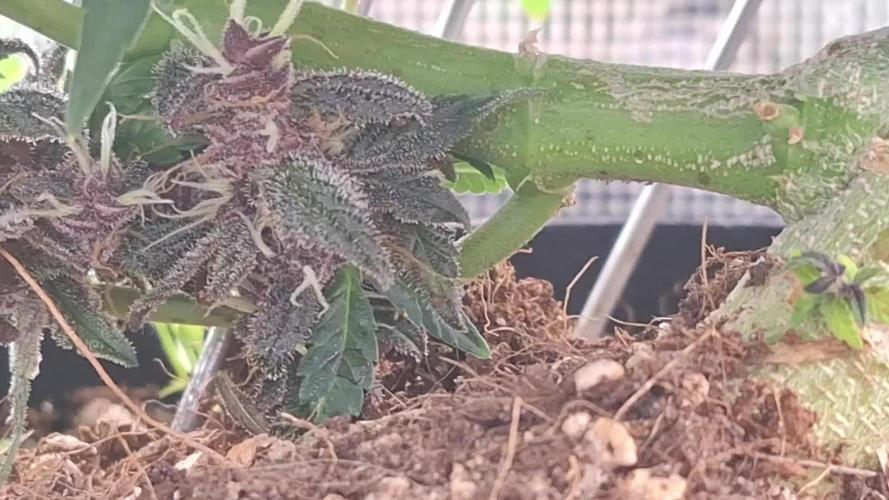
Instead of a 60 days I've seen her develop a new top apex (on the left) that I was waiting to mature a bit before cutting.
Now that I've been looking at everything she produced I'm absolutely stunned.
From top to bottom, the purple color is stunning, even at the base she managed to grow a new set of purple leaf this week.
She's been foxtailing like crazy, most of them are 1cm
She got plain water for a week now, but seems to refuse to even start to take out her leaves.
This genetic is insane.
Likes
17
Share


@STAYINGONMYMAINCBATORUNTWO
Follow
I’ll start by saying I’m NOT using both bud blood and bud ignitor in one solution, I am using bud blood on the rear wedding gelato plant and bud ignitor on the front one to test the outcome of them individually to see the best results! I tied down and defoliated twice in the week and have switched to 12-12 yesterday so they’re transitioning now and should be in bloom by week 7! I made some extract them made some gummies successfully I might add and added the photos in the diary!

Likes
1
Share


@JoeCNote
Follow
They ended up getting too tall and if I had let the cola's develop where they were, they would've outgrown my tent so instead I did some super cropping and bent over most of the top branches on pheno's 3 & 4 (left & right).
Processing
Likes
11
Share


@ganjaman24
Follow
They’re looking extremely healthy..gave em their first nute feed with the last watering seem to be doing fairly well..fimmed the GG and LST. Did not touch the unkown as it looks smaller to be the same age. Running GHE base line with few extra supplements.
****UPDATE****
Both are LST’d..might rethink the way I tie them. Going for a “coil” type look, we’ll see though. They’re looking great! Hoping for females!

Likes
2
Share


@Naujas
Follow
The girl looks amazing!!! The 28th day photo is missing because I went on vacation, I asked my friend to come water her next week, I think when I get back I will find her much older:) I like to just leave them sometimes and see them after about 10 days :) they change very quickly:) good luck to everyone.
Likes
2
Share


@CheeRz
Follow
The outdoor ladies are enjoying the nice weather and doing very well. Divine Rapier is also beginning to bloom. Unfortunately, it's supposed to rain a lot next week. We're hoping for the best!
Likes
5
Share


@Stoolboxx
Follow
This is the end of week 1. First time grow. Plant on the right was a little stunted, I think due to the taproot curling before being planted in the soil. Plant on the left seems to be growing steadily every day! (L for Left, R for Right)


Likes
5
Share


@Do_it_Dan
Follow
Nice week for the lady runtz, many many bud sights, the smell is getting there, had to give a little extra pk warrior but other than that she's doing well 😀 👍 happy growing and stay green ✌️ 💚 👌 peace

Likes
21
Share


@NSABND
Follow
Start of Week 12 😉
Day 86 autumn comes too fast 😵😲😪
Day 88 time is running out 😲😯😧
Day 89 the weather turns to epic fail 💀💀💀
Day 90 the sun comes back again 😍👌 oh lord
Likes
19
Share


@GoldenWeedGrower
Follow
Legend
Timestamp: 📅
EC - pH: ⚗️
Temp - Hum: 🌡️
Water: 🌊
Food: 🍗
pH Correction: 💧
Actions: 💼
Thoughts: 🧠
Events: 🚀
Media: 🎬
D: DAY, G: GERMINATION, V: VEGETATIVE, B: BLOOMING, R: RIPENING, D: DRYING, C: CURING
________________________________
📅 D70/B08 - 24/01/24
⚗️
🌡️
🌊
🍗
💼
🧠 pH is finally stable on the lower side (hopefully)
🚀 The Tent-X is on its way, I can't wait to get it..
🎬 Added Timelapse video
________________________________
📅 D71/B09 - 25/01/24
⚗️ EC: 1.2 pH: 5.6
🌡️ T: 23 °C H: 45%
🌊
🍗
💧
💼 I put T-H Sensor of TrolMaster on the SCroG net
🧠
🚀Tent-X from TrolMaster received, I'm going to set it up tomorrow
🎬 Added Timelapse video
________________________________
📅 D72/B10 - 26/01/24
⚗️ EC: 1.2 pH: 6
🌡️ T: 23 °C H: 40%
🌊 Added 6L
🍗 Added Bloom A-B - CalMag - Big Bud - Bud Candy - B52
💼 Tent-X set up done !
🧠 It works perfectly and as I just see so far, from now on, I'm going to experiment a new way to grow !
🚀
🎬 Added Timelapse video and Set-Up videos and pics
________________________________
📅 D73/B11 - 27/01/24
⚗️ EC: 1 pH: 5.5
🌡️ T: 23 °C H: 40%
🌊
🍗
💧 Added a little of pH-
💼
🧠
🚀
🎬 Added Timelapse video
________________________________
📅 D74/B12 - 28/01/24
⚗️ EC: 1 pH: 5.5
🌡️ T: 23 °C H: 35%
🌊 Added 4L
🍗 Added CalMag - Bloom A-B - B52 - Bud Candy - Big Bud
💧 Added some pH-
💼
🧠
🚀
🎬 Added Timelapse video and 4 pics
________________________________
📅 D75/B13 - 29/01/24
⚗️ EC: 1 pH: 6.0
🌡️ T: 23 °C H: 50%
🌊
🍗
💧
💼
🧠
🚀
🎬 Added Timelapse video and "TM+ Pro" App screenshots. This is the app used to monotoring the Tent-X controller
________________________________
📅 D76/B14 - 30/01/24
⚗️ EC: 1.2 pH 6.1
🌡️ T: 18-26 °C H: 30-55% (from now on, I'll put the Min-Max values of T-H as I can easily read them from the app.)
🌊 4L
🍗 CalMag - Bloom A-B - Bud Candy - Big Bud - B52
💧
💼 I added a Humidifier as the H falls down to 30%
🧠 With the help of Humidifier, according with "TM+ Pro" app, I got the perfect VPD (Vapor Pressure Deficit) rate !! (see screenshots)
🚀 I have to face a very low rate humidity of the external enviroment
🎬 Added Timelapse video and T-H values daily graph, and perfect VPD from the Tent-X controller
________________________________

Likes
15
Share


@BushDoctor740
Follow
Day 11 i feel like the girls are getting stronger so I top dressed with 4-4-4 Gaia Green and watered with recharged tea ph to 6.5.

Likes
27
Share


@adam_pawloski87
Follow
Over all was an amazing grow, super sticky dense nugs with smell of berries, highly recommended for everyone!!
Likes
8
Share


@Kawannabic
Follow
Esta ha sido una semana de intenso trabajo para las plantas a las que realicé poda apical y lst con un espacio de tiempo corto para la recuperación, pero respondieron genial. Parece que a esta variedad le puedes hacer cualquier cosa. Ni excesos ni carencias de nutrientes

Likes
5
Share


@Adrrys
Follow
Corte día 91, después de 5 días de lavado de raíz, 2 primeros dias de lavado con flawless finish de advanced nutrients, 50 gramos de flores en húmedo se congelaron y use para hacer bho, el efecto es relajante y fuerte

Likes
114
Share


@Natrona
Follow
Week 10
6/9-15 Lemon ladies love the outside. Both are showing yellowing leaves so everyone is getting nutrients with feedings.
6/13 heavy defoliation and limb removal for lemon cake since she's now in flower. Repositioned the scrog after defoliation so the thicker limbs are in the mesh. Drizzle, got light defoliation mostly yellowing fans. Before and after pics and vids.
I saw a Japanese beetle on my Lemon Cake and some small holes in the leaves so I added 1/2 tsp neem to the feed solution 6/12. Also started using fish & kelp.
I'm still watering 1 gal per plant when I feed. With the heat and humidity, I water daily.

Likes
54
Share


@nonick123
Follow
Bienvenidos a la semana #7 😀😬😐🙏
Día 46 (26/06)
CC & RB han reaccionado super bien a los nuevos abonos!
Tienen un verdor espectacular!
NL no para de engordar, y tiene el olor típico de las Northern Lights de la Old School. Vaya pasada! 😀
Las OF siguen consumiendo sus hojas de abanico y tienen el mismo tratamiento que el resto... Me da que es una cepa bastante débil... 😑
Día 47 (27/06)
Continuamos con organic way!
Se echa en la parte superior del sustrato
11 gramos de harina de huesos
11 gramos de guano de murciélago (por planta)
Se riega con la siguiente mezcla: 1 ml/l de Melaza + 30 ml/l de Té de Hummus
OF#1 = 250 m
lCC y RB = 500 ml
NL = 1.000 ml
NL está cogiendo un grosor de cogollos y un olor de la vieja escuela brutal! 😬
Día 48 (28/06)
Día nublado. Nada que decir
Día 49 (29/06)
Mi primer riego con EC controlada
Gracias maestro @deFharo por los consejos!
Mezcla: 1 ml/l de Melaza + 40 ml/l de Té de Hummus en agua del grifo reposada
ph = 6.5
EC = 1.6
OF#1 = 250 m
CC y RB = 250 ml
NL = 0 ml (la maceta está muy pesada)
Día 50 (30/06)
No hay necesidad de riego
Los colores son impresionantes y los cogollos están engordando y cubiertos de tricomas :-D
Día 51 (01/07)
Gracias al maestro @deFharo introduzco una nueva receta al cultivo: el Guanato
Os la dejo más abajo, pero el mérito es todo de @deFharo
Mezcla de riego: 1 ml/l de Melaza + 5 ml/l de Humato PK + 5 ml/l de Guanato en agua del grifo reposada
ph = 6.4EC = 1.680
OF#1 = 250 ml
CC y RB = 500 ml
NL = 1000 ml
__________________________________________________________________________________
Receta de Guanato
Ingredientes:
125 gr de guano de murcielago
1 litro de agua (osmosis o grifo reposada)
25 g de hidróxido de potasio
Pasos
1- Disolver el Hidróxido de Potasio en 500 ml de agua
2- Añadir el guano de murcielago y remover
3- Revolver o agitar varias veces
4- A las 24 horas añadir el resto del agua (500 ml) a 40 - 50 ºC
5- Revolver varias veces al día durante al menos 3 días (alargarlo hasta 6-7 días si no hay prisa)

Likes
34
Share


@gottagrowsometime
Follow
Was really easy to tell when she was close to harvest. Pre flower lasted about 15 Days and quickly stopped growing at 67cm coming into 3rd week of flower and quickly got nice a fat. All pistils were Amber on day 30-32 of flower. Could of pult it on day 60 or around that. Was a nice plant to grow, as I said, just feed her right, she doesn't ask for much but a bit of light and a steady dose of feed with micro nutrients and your golden. You don't need a mad powerful light to get some nice bud quality. This plant spent most of flowering under my SF 1000 and there was no larf. And other plants grown at the same time as this has larfy/airy bud still not done yet at the end but with this lady she likes to come along altogether. Really solid genetics. Haven't had to do much in the way of harvesting, as I hung dry it whole so I haven't had to trim yet but she's super sticky, very sweet and pungent with an earthy, musky smell with fruity undertones that are crying to come out after a good 4-6 week cure.
2 MONTH UPDATE
Well, hey there. Back to my runtz again. Just very closer creeping to be unlessed out into my puff box. I had to hold myself back. So, 2 months later. 20 little 3-5g jars. And the smell has just got really dank sweet smelling. Has dropped the earthy smell, and in it's place, is a slight citrus on the grind but still carries a heavy sweet taste that lingers on the your senses. I just wanna stick my head in a jar of this stuff. Yum yum yum. I'm gonna give it another month and I'll get back to ye with a decent smoke review, as I'm to high now. Thanks GFS. Your runtz has earned a place to be stored for that lonely night, when your mates are all home, 2am, can't sleep, but wait, "ggs remembers, there's still a nice big juicy runtz bud waiting to be puffed", wait what, just 1 bud, "actually yeah, let's have a jar", sure why not, today ends in a Y right!!.
Oct/11/22
3 month cure update
Wow, what a bud. So, 3 months in..and boy o boy. Has she released her goodness. I wish you could change the ratings. As bud changes upon a long cure. So, there's this really sweet, kinda damp musky citrus smell..the citrus really has taken over the bulk of the smell though. The sweet part is like tropical fruits. (All different kinds) as you grind it, a burst of sweet smelling dank musk, with all little small background scents are there. But she is dominated by a citrus, sweet dank musk smell, (im sorry, its the only way I can explain it) , it's really hard to describe. She has such a deep aroma that even thr most seasoned grower would find it had to compliment this auto. She really is in a class of her own guys. She's dank, very sweet, has a lovely citrus twang with all different flavours going on in your mouth. It's like a party in there. The smoke on the vape has only enhanced it. It's lovely and creamy on the inhale while tasting the citrus burst along with that dank almost earthy musky taste, that compliments the sweetness very very well.
As for the stone. It gives a real nice uplifting happy feeling. But as you vape on. I felt my eyes getting heavy and couch lock kicked in. The grows was done in day 65, but I gave it another 5 days or so, to get said affect. And man, on the vape, the stone is amazing. Best stone so far from any auto I've grown. And I'm not just saying that. And also, it tastes lovely to vape. As, I normally just roll doubles with weed, no tobacco. "Yuck". So, I will for sure, be growing this gal again. I have another pheno from this strain.. that's 3 months curing also. Also tastes very similar, bit more harsh but, still lovely.
