





Likes
9
Share


@Nachtjasmin
Follow
Zum ersten Mal habe ich mich im LST versucht. Denke dass ich darin noch etwas zu grob bin.
Für konstruktive Kommentare, Kritik und Verbesserungsvorschläge bin ich immer offen und dankbar :)


Likes
16
Share


@Magic_frequency
Follow
How i wish i didn’t topped these 2 plants. :( too high too high alert😂😂😂

Likes
1
Share


@NeanderStrainhunter
Follow
Die Pflanzen haben das LST gut vertragen, sind fast alle auf einer Ebene und etwickeln sich gut. Ich habe etwas PH-Down eingesetzt um den PH-Wert auf 6,0 zu reduzieren.
Likes
2
Share


@GrowerGaz
Follow
Started about four days ago . I got gifted some autoflower testers, so though I would do another run under the 100w Easy grow miracle. I have two of each strain one is Tangie Monkey Auto - Sourtangie x gg4 x bikerkush x ruderalis. The other is Bananangie - Strawberry banana x tangiemonkey x ruderalis .
Both sound good and I have grown two of their ( gg4 x biker kush ) crosses before. I am surprised more people don't grow island seed seeds.
Plants are in 7 litres two plants in Biobizz light mix with added perlite and two plants in dutch Vega lightmix with perlite. I have added an additional handful of perlite to each mix along with Bio grow from greenhouse feed. They have been given a water with Plagron roots. 0.5 ml per litre.
Processing
Likes
62
Share


@DudeGrowsWeed
Follow
Week 2 and the girls are looking more yellow and funky than I like. I also think the Baox clones may have died. So far the plants looking the best are the Cherry, Blackberry (one of them) and the baby NYC Diesel. I'm pretty sure my soil is just way too hot. I tried flushing it through, but that just seemed to lead to general overwatering issues. I'm planning on transplanting to larger pots with more neutral soil this weekend and hope that will help straighten things out.


Likes
14
Share


@MadeInGermany
Follow
Info:
Unfortunately, I had to find out that my account is used for fake pages in social media.
I am only active here on growdiaries.
I am not on facebook instagram twitter etc All accounts except this one are fake.
Flowering day 54
since time change
to 12/12 h.
Hi everyone :-) .
We are slowly getting closer to the end :-).
The lady puts her full energy into the flowers.
The leaves are beginning to fall.
I poured 3 times this week with 1.2 l each.
The trichomes were checked and the leaves were also checked for animals.
everything is great 👍.
The tent was cleaned and the electronics checked as well.
I wish you a lot of fun with this update.
Stay healthy 🙏🏻
You can buy this Strain at
https://www.amsterdamgenetics.com/product/super-silver-haze/
Type:
Super Silver Haze
☝️🏼
Genetics:
Haze x Skunk #1 x Northern Lights
Type:
70% Sativa – 30% Indica
👍
Vega lamp:
2 x Todogrow Led
Quantum Board 100 W
💡
Bloom Lamp :
2 x Todogrow Led
Cxb 3590 COB 3500 K 205W
💡💡☝️🏼
Soil :
Canna Coco Professional +
☝️🏼
Fertilizer:
Green House Powder Feeding
☝️🏼🌱
Water:
Osmosis water mixed with normal water (24 hours stale that the chlorine evaporates) to 0.2 EC. Add Cal / Mag to 0.4 Ec Ph with Organic Ph - to 5.5 - 5.8

Likes
29
Share


@BioGrowKing
Follow
Die Woche ist sehr gut verlaufen sie hat sich sehr gut gefallen die Herchen stehen ab sie blüht ich könnte auch hier leider nicht so viele Bilder diese Woche machen allerdings gibt es die nächste Woche wieder mehr

Likes
10
Share


@hobozoo
Follow
поменял отточный вентилятор на более мощный, температура в боксе снизилась.


Likes
24
Share


@DogDoctorOfficial
Follow
🌱 Divine Seeds Germination Report 🌱
Hey, fellow growers! 🌿✨
Welcome to the start of an exciting journey with Divine Seeds! We’ve kicked off our run with some incredible genetics: Moon Rock, Opium, Fractal, and Big Demon. Let’s dive into the germination process and introduce you to the amazing world of the CannaKan method!
🌟 The CannaKan Method: A Game-Changer! 🌟
The CannaKan method is revolutionizing the way we germinate seeds, ensuring higher success rates and stronger seedlings. Here’s why we love it:
1. Optimal Hydration: The CannaKan method ensures the seeds receive just the right amount of moisture, promoting rapid and healthy germination.
2. Temperature Control: By maintaining a stable environment, we provide the perfect conditions for our seeds to sprout.
3. Aeration: The method enhances air circulation, preventing issues like mold and damping-off.
4. Root Development: It encourages robust root growth, setting the foundation for vigorous plants.
🌱 Seed Germination Progress 🌱
Let’s check out how our Divine Seeds are doing with this stellar method:
1. Moon Rock 🚀
• Germination Rate: 100%
• Details: These seeds sprouted quickly, showing off their vibrant energy. The seedlings are already reaching for the stars!
2. Opium 🌸
• Germination Rate: 95%
• Details: Opium seeds are flourishing with elegance. Their delicate sprouts are a sight to behold, promising a beautiful journey ahead.
3. Fractal 🌀
• Germination Rate: 85%
• Details: Our shy Fractal seeds took a bit longer, but they’re coming through with unique patterns. They remind us that every growth journey is special.
4. Big Demon 💪
• Germination Rate: 100%
• Details: True to its name, Big Demon seeds are growing strong and bold. These seedlings are the powerhouse of our garden!
🌟 Key Observations 🌟
• Uniformity: The seedlings are consistent in their development, thanks to the precise conditions of the CannaKan method.
• Health: No signs of disease or malformation. The CannaKan method’s optimal environment is working wonders.
• Vigor: The seedlings exhibit vigorous growth, indicating a healthy start.
🌱 Next Steps 🌱
As our seedlings continue to grow, we’ll:
• Monitor their progress closely.
• Transition them to their next growing medium.
• Provide the best nutrients and care to support their journey.
Stay tuned for more updates as we nurture these incredible plants. We’re thrilled to see how they’ll flourish and share every step of the way with you.
Happy growing, and may your gardens be ever green! 🌿💚
#DivineSeeds #GerminationReport #CannaKanMethod #MoonRock #Opium #Fractal #BigDemon #GrowDiaries #PlantMagic #GreenThumb
Germination method 🌱 @thecannakan
Genetics
@divine.seeds
Nutrition
@aptusholland 🌿
@aptus_world 🌎
@aptus_es 🌍
@aptusbrasil 🌱
@aptus_thailand 🌿
@aptus_portugal 🌳
@aptususa_officiala 🍀
@aptusplanttechnz 🌺
@aptusplanttechaus 🍃
Ambient controls🎮
@trolmaster.eu @trolmaster.eu.support @trolmaster.support @trolmaster.agro
Soil @promix_growers_eur @promix_cannabis
LED - @lumatekeu
Watering- @autopot_usa @autopot_global
Love and attention- @dogdoctorofficial
#aptus #aptusplanttech #aptusgang #aptusfamily #aptustrueplantscience #inbalancewithnature #trolmaster #trolmastereurope #trolmastersecrets #Autopots
#GreenJoy
As always thank you all for stopping by, for the love and for it all , this journey of mine wold just not be the same without you guys, the love and support is very much appreciated and i fell honored and so joyful with you all in my life 🙏
With true love comes happiness 💚🙏 Always believe in your self and always do things expecting nothing and with an open heart , be a giver and the universe will give back to you in ways you could not even imagine so 💚
More info and complete updates from all my adventures can be found ⬆️link in the profile description ⬆️
Friendly reminder all you see here is pure research and for educational purposes only
💚Growers Love To you All 💚

Likes
2
Share


@Olduffybastard88
Follow
The tropicanna was meant to be an automatic flower but turned out to he a pheno having to take it out tent at certain time becoming a sore head

Likes
8
Share

@PrinceOfHerbs
Follow
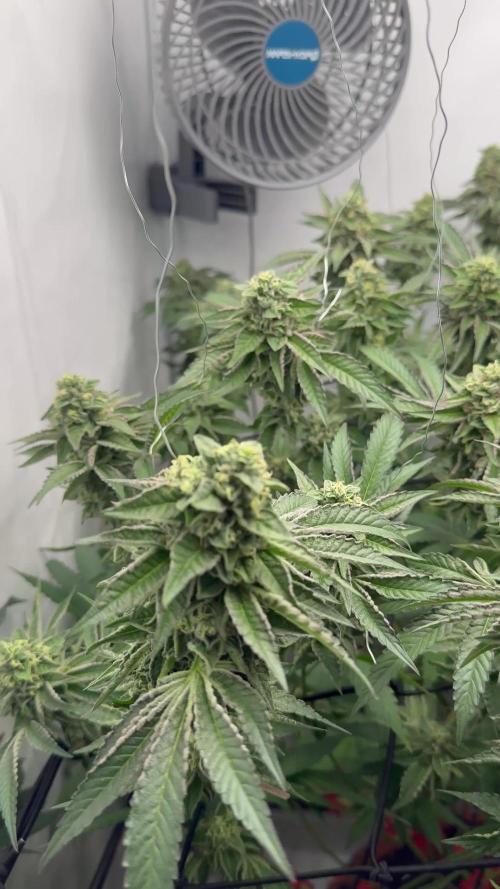
The plant smells extremely strong, and above all it is super sticky. The flowers became so heavy that I had to fix them with wires, otherwise they would hang.
The first pistils are turning a brownish color, a few leaves were also removed
Flowering day: 42

Likes
2
Share


@Ultraviolet_
Follow
67 days since April 16th, 2026
We become aware at such times of man's wonderful ability to bring seemingly unrelated elements into harmonic balance, and receive a glimpse into a world where everything exists in conscious sympathetic attunement to everything else. When we listen to a piece of music that seems to strike a beautiful chord somewhere inside us, or view a painting that simply glows with harmonic awareness well executed, we probably do not spare much time to contemplate the wonderfully intricate combination of vibrations that our sensors make it possible for us to perceive. We tend to appreciate the relationship between the parts of something by an awareness of the harmony or dissonance of the whole. This ability enables us to say "what a beautiful house!" instead of "analysis has proven that this collection of building materials exhibits certain elements of harmonic proportion." While this ability to instinctively appreciate the beauty of true harmony has an important role to play in evolution, a more analytical understanding of the laws involved can be most useful. This is especially so if we wish to create works of art where each part exists in true harmony, not only with the other part of that particular whole, but with the universe within which the creator and the created exist.
Everything vibrates. From the most dense matter to the most subtle cosmic rays, everything which our senses allow our thoughts to become aware of, can be specified in terms of wavelength or frequency of vibration. These two terms define the same thing, but from different points of view.
The following are the approximate wavelengths of various energy carriers:
Cosmic rays 0.000,000,001 mm
Gamma rays 0.000,000,1 mm
X rays 0.000,500 mm
Ultraviolet rays 0.003 mm
Visible light 0.006 mm
Infrared 0.01 mm
Sound waves 1 meter
Radio waves 300 meters
Violet light 400 nm to 450 nm
Blue light 450 nm to 500 nm
Green light 500 nm to 570 nm
Yellow light 570 nm to 590 nm
Orange light 590 nm to 610 nm
Red light 610 to 700 nm
1 nanometer (nm) = 0.000,000,1 cm = 1/10,000,000 cm
If a guitar string is plucked and we hear a sound, it is not too difficult for the human mind to associate this sound with the vibration of the guitar string. With color it is quite different. It is difficult for us to conceive that the color of a substance is not an inherent property of the substance itself, but an indication picked up by our senses of that substance's ability to absorb or reflect the light which happens to be shining on it at that moment. Neither the matter nor the light is colored. What happens is that the brain learns to differentiate between the frequencies reflected or transmitted by the substance the eyes are focused on. The same thing happens with sound. When we say "Oh! Listen, they're playing my favorite song," what we really mean is: "My brain has stored within it a particular pattern of frequencies. I have compared the new information being received with this stored pattern and have deduced the answer that the two patterns are similar within certain specified tolerances." The 'pleasure' involved could have something to do with our running the pre-recorded pattern at the same time, in 'sympathy' with the new pattern as it is received.
The word sympathy describes very well our ability to appreciate color and sound. It also describes the reason behind certain elements of harmony. For instance, if a substance vibrating at 100 cycles per second (tone 1) is in the proximity of another substance vibrating at 200 cycles per second (tone 2), we could perceive, if we had the right equipment, a certain sympathetic relationship between the two.
We will see from this that there is a uniform doubling of the first tone seen in the second. At various points along the waves, the two are the same in amplitude. At other points, they are at opposite poles to each other. This doubled frequency has more points of similarity to the original than any other frequency except the original itself. If the equipment we had available for measuring these two frequencies was a soundboard amplifier and a pair of ears, then we would hear what would sound to us like one tone. If we had the opportunity to hear one at a time, we would hear that although they sound the same, one is higher in pitch than the other. This characteristic of 'the same but different in pitch', musicians have called the octave. Any two tones produced where one has exactly doubled the frequency of the other is called an octave. Speaking in ratios, an octave would appear then as the ratio 2:1 or 1:2, depending on whether we are talking of an octave up or down.
A single note produced by almost any instrument will contain more than one wavelength or frequency. It will have a dominant frequency, the wavelength of which we would call the note's 'fundamental' or 1st harmonic. It will also have a varying number of upper harmonics, gradually fading in intensity into infinity or silence.
Natural harmonics always have the same pattern of intervals between them. The interval between the 1st and 2nd harmonic is a perfect octave; between the 2nd and 3rd a perfect fifth; between the 3rd and 4th a perfect 4th; and so on, the intervals becoming smaller and smaller until they lose any relationship with the western 12 tone scale as it exists at the moment. Just as an octave has certain elements of sympathy with its fundamental, so some intervals have been noted to be more perfectly in sympathy with the fundamental than others. The ratio of the 'perfect 5th' or interval of 7 semitones, as it occurs in the harmonic series, is 3:2 or 2:3, while that of the 'perfect fourth" is 4:3 or 3:4. All the tones in the western 12 tone scale can be expressed in terms of the ratio between the upper tone and its fundamental. This would seem to be an ideal way of generating a scale from any given fundamental and several attempts have been made to do this, the Pythagorean system being probably the most well known. Although when working with a single tone instrument playing on its own, the Pythagorean formula works wonderfully well, if we had several instruments tuned this way together and asked them to play almost any western music, we would find that at times they sounded quite out of tune to each other.
The lack of flexibility of the various scale systems based on the harmonic series has led to what is known as the 'tempered' scale. This uses as its primary unit of interval the ratio of the octave or 2:1. It then proceeds to divide the interval between any fundamental and its upper octave into 12 smaller intervals by applying the ratio: two to the one-twelfth power, to one (21/12:1). This equals 1.059463094, so by multiplying any frequency by this number, we will obtain the tempered semitone next up from our fundamental. We will also find that any tone twelve semitones up from any other tone, in a scale generated in this way, will have exactly double the frequency.
If we took the note middle C on a piano and halved the wavelength, we would have the note C one octave above. If we halved this, we would have the C above, and so on. However, within about 6 octaves, we would find that although a 'sound' was being produced, no human ear could perceive it. If we kept on going, halving and producing upper octaves of our fundamental C, we would proceed through the infrared band, into the visible light spectrum. If we happened to be outside during the day, we would, for one octave only, see the note C with our eyes. The next octave above would already be in the ultraviolet band, and outside the eye's sensitivity range. If we can think of color as being an indication of a substance's vibratory rate or wavelength, we may begin to see a relationship that could exist between the color and sound spectrums.
The logical extension of what has so far been said is that there exists a scale in the color spectrum that corresponds exactly to the scale in the sound spectrum, each color tone being an octave of the equivalent note in the sound range.
This is not the end of the story but only the beginning. If we can for the moment accept that any wavelength in one band has upper and lower octave stretching out to infinity, then the next question is 'fine, but what shall we use as our fundamental? A particular color? A particular sound frequency?' The musicians among us will probably say 'A 440'. This means that the note A should vibrate at 440 Hertz, or 440 times per second. They would tell us that this is standard pitch has been adopted by most orchestras around the world; pianos are tuned to it, instruments are constructed to formulas based on it, and so to them it would probably seem the most appropriate place to begin. Some of these musicians may know of the battle that is still raging with regards to this being the standard, but few would know why A = 440 Hz was chosen except that it worked when it was set to be a suitable compromise between the many different pitches in use at the time.
432 Hz is said to be mathematically consistent with the patterns of the universe. Studies reveal that 432 Hz tuning vibrates with the universe’s golden mean PHI and unifies the properties of light, time, space, matter, gravity, and magnetism with biology, the DNA code, and consciousness. When our atoms and DNA start to resonate in harmony with the spiraling pattern of nature, our sense of connection to nature is said to be magnified.
Another interesting factor to consider is that the A=432 Hz tuning correlates with the color spectrum, while the A=440 Hz is off. Audiophiles have also stated that A = 432 Hz music seems to be non-local and can fill an entire room, whereas A=440 Hz can be perceived as directional or linear in sound propagation.
Once you adopt the idea that sound (or vibration in general) can have an equalizing and harmonizing effect (as well as a disturbing effect), the science of harmony can be applied to bring greater harmony into one's life or tune to specific energies. There is a form of absolute and relative harmony. Absolute harmony can, for example, be determined by the tuning of an instrument. The ancients tuned their instruments at an A of 432 Hz instead of 440 Hz - and for a good reason. There are plenty of music examples on the internet that you can listen to in order to establish the difference for yourself.
Attuning the instrument to 432 Hz results in a more relaxing sound, while 440 Hz slightly tenses up the body. This is because 440 Hz is out of tune with both macro and micro cosmos. On the contrary, 432 Hz is in tune. To give an example of how this is manifested microcosmically: our breath (0,3 Hz) and our pulse (1,2 Hz) relate to the frequency of the lower octave of an A of 432 Hz (108 Hz) as 1:360 and 1:90.
It is interesting to note that 432 Hz was the standard pitch of many old instruments and that it was only recently (19th and 20th century) the standard pitch was increased. This was done in order to be able to play for bigger audiences. Bigger audiences (more bodies) absorb more of the lower frequencies, so the higher pitch was more likely to “cut through”. One of the oldest instruments of the world is the bell ensemble of Yi Zeng (dated 423 BC), tuned to a standard F4 of 345 Hz, which gives an A= 432 Hz. The frequency of 345 Hz is that of the platonic year! Similarly, many old organs are tuned in A=432 as well; for example, St. Peter’s Capella Gregoriana, St. Peter’s Capella Giulia, S. Maria Maggiore in Rome.
Maria Renold’s book “Intervals Scales Tones and the Concert Pitch C=128 Hz” claims conclusive evidence that 440 Hz and raising concert pitch above scientific “C” Prime=128 Hz (Concert A=432 Hz) disassociates the connection of consciousness to the body and creates anti-social conditions in humanity.
The difference between concert pitch A=440 Hz and Concert A=432 Hz is only 8 cycles per second, but it is a perceptible difference of awareness in the human consciousness experience of the dream we share called existence.
Processing
Likes
26
Share


@LongJohn420
Follow
Lots of pics not much to report. Flushing and starting to yellowing nicely. Trichomes are in check so I plugged light out and left these two girls in darkness for 36-48h. These yielded clearly most in this round. Nice job Barney's with this one 👌 Can't wait to smoke this one out once cured couple weeks 👊😍
Likes
177
Share


@DreamIT
Follow
Strong genetics, resistant, fast enough, easy to grow and never pretentious. I will try further training techniques on this strain, while waiting to make more room in the box to plant the Red hot cookie as well. If you like sweet flavors and fragrant plants this is definitely for you! Soon new updates for a cycle of only plants in "monstercropping", to continue my eternal red garden 😁🦄 thanks for following me up to here and leave a comment and suggestions 🦄👍🤘

Likes
13
Share

@Bncgrower
Follow
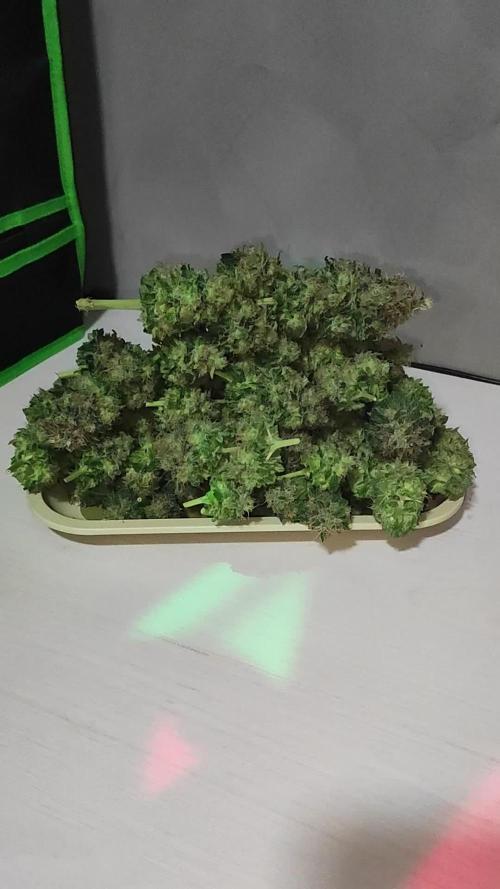
Harvested yesterday, truly strong smell, cultivation was absolutely perfect from start to finish. Very happy with the result, anxious for the drying and curing process! Thank you for following along.. 🤜🤛🌱🌿🌲
Likes
325
Share


@Metatronix
Follow
Hello to all my friends and usual visitors. Thank you for stopping by and all the likes and comments....you are the best! 😎
Everything goes according to plan i started adding PK 13/14 to the mix this week, the plant is in good condition and seems to recover nicely.
The excellent Mars Hydro TS 1000 is kept at 33 cm from the top of my plants is is running on full power.
TS 1000 gives a full spectrum of light to the plants and you can see that...the leaves are lush green and develop without any hindrance, Mars Hydro did a very good job producing this lamp.
Thanks to Mars Hydro for supplying the necessary equipment for this grow.
That's it for this week folks, have a wonderful week and please come beck visit in three days time. 🙏
Likes
21
Share


@MG2009
Follow
03/06/2022
#6 is (2 others 1 week behind) 43 days today hopefully go to 63-70 days.
Seed are looking good on #6 should be good amount to play with.
Processing
Likes
26
Share


@GrowGuy97
Follow
First auto run! Fastbuds , Seedsman & Victory seeds!
Never done autos before so excited to see how this goes!
Day 5 and 2 of the NHL’s from Victory seeds still hasn’t popped😫😬
