


Likes
Comments
Share


@obeee
Follow
Salut les growers dernière semaine de floraison avant la récolte j'ai hâte !
Les fleurs sont sublimes et l'odeurs est sucrée et épicée avec un fond de hash terreux miam.
Arrosage et rinçage à l'eau depuis 3 semaine la plante est très belle...
bonne semaine à tous

Likes
41
Share


@DOOBS_N_BREWS
Follow
Started the week with a NFTG Mid flower feed. She's looking healthy and I shaved her legs a bit ;) definitely flowering and still stretching! almost 40 " or so as of right now =) Added a video of how I mix my NFTG solution
Day 71-NFTG mid flower feed /Mammoth P/ Recharge @ 6.5 ph
Day 72-73 No watering
Day 74- Recharge/Cal-Mag/Mammoth P/ Bloom Khaos Feed @6.5ph
Day 75- No water

Likes
6
Share


@IamCy
Follow
Week 6...........
Getting frosty
Edit: on day 41,I already have amber but it's still packing on weight. I don't know what to do at this point.
Likes
1
Share

@RageTdavis
Follow
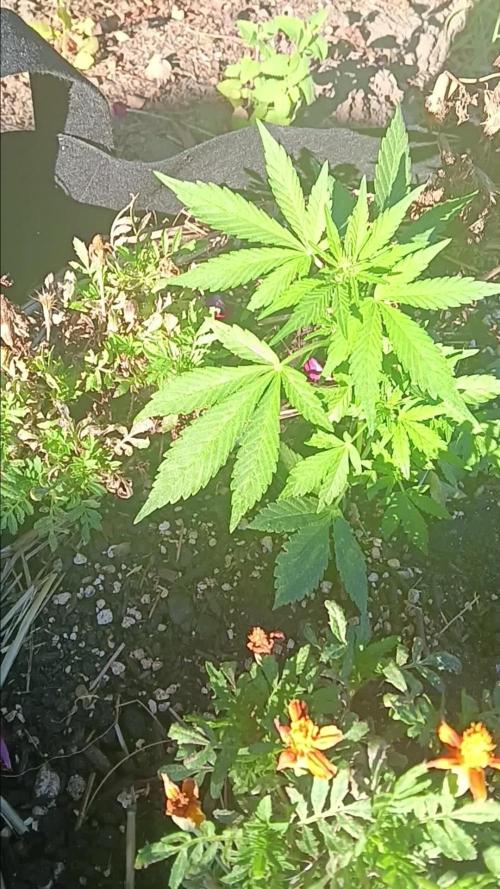
This week im off I've been debating on keeping up with the diary 😅 😩 just typing away sucks we any ways .5 in growth nothing to bad another update tomorrow promise

Likes
12
Share

@H0BBYGAERTNER
Follow
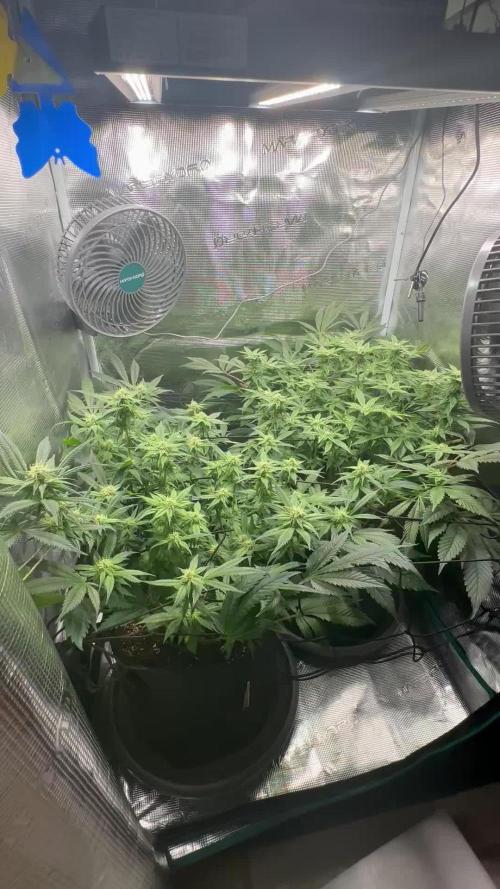
WEEK #15 — FIRST SIGNS OF FROST
Most „Standard“ Week so far, i guess. A Little grow, a little leaves removed (that shadowed other Branches), Water Water — same same all week.
The only new thing: A Little smell. Slush Mint cake very fresh and fruity (had the Impression of a light menthol Impression in the air a few times). Skywalker like lemon-soapy Style. Looking forward to how it will develop individually.
The Look: another clear difference is the appearance. SMC is very flat (like really flat), very dense, but mostly with distance between buds. Skywalker rather normal, but also dense. Both have „breakout“ Kolas, canopy rather uneven, so light Distribution not that great. Well, LED aint the sun, hu?
BUT: The underdog, Mint Cake, has the most frostied leaves, covered in trichomes. From shaft to the tip, ALL of them, what makes them appear light green, although the leaves are rather dark. Hope this will develop Even further, very impressive so far.
First few pistills turning brown already, However according to Dutch Passion, bloom is 8-9 weeks for SMC and 9-10 Weeks for Skywalker *Haze* on average. This should mean like half is already over. ☺️
Bonus: CUTE - SMC as well as Skywalker have slight purple tips (🍆) respectively tiny dark/ purple leaves. Fingers crossed i have a purple pheno!
Temperatures are hot at the Moment, humidity dry. Both Translate to very good conditions in the tent.
Guess thats it for this week, stay tuned.
Edit: For nutrients, i still have some calmag and phosphor around from my beginnimgs. They dont seem necessary at the Moment, but — so i assume — will Not harm the plants either, at least in a very light concentration.

Likes
9
Share


@SlickCityOrganics
Follow
They are stretching like crazy. Peach Crescendo is not getting much taller. Not a bad run. Haven't really ran into any major problems.


Likes
3
Share


@trerevilo
Follow
Bloom Week 10 - It's a wrap. About to enjoy another Oaxaca Old Fashioned to celebrate. Yeah - I'm into mixology too. These are the frostiest buds I've ever grown. I'm looking forward to harvest. Something tells me I won't be disappointed. Regardless, I'll be honest with the results.


Likes
7
Share


@DEEGREEN
Follow
DAY 26 I CHANGE MARSHYDRO TS1000 WITH 2X 150W. PLANT GROWTH LAMP / PGL150FAV

Likes
2
Share


@RFarm21
Follow
18/12 - Harvest Day!
One is very big and the otther is a miniature...i would love to master this One day 🤣

Likes
24
Share


@Samsemilla
Follow
Die siebte Blütewoche beginnt, den Ladies geht's relativ gut und ihre Knospen werden immer verlockender. 💚😍
Die Woche neigt sich dem Ende zu und es gibt nicht viel zu berichten.
Der Appetit steigt!
Likes
2
Share


@Krazy_K_Buds
Follow
Things are getting frostyyyyyyy and densing up nicely and smelling amazing. I'm looking forward to smoking these beautiful ladies! 🤤🤤🤤🤤


Likes
31
Share


@Ghost2022
Follow
Day 45. Plants have grown huge in last week. Tallest one about 65cm. At its closest point the light is 6 inch. The bud sites furthest away are about 18 inch. Trying g to even out the canopy with some success. Just using the string method of LST and also moving the pot around to get an even amount of strong light.


Likes
4
Share


@Ultraviolet
Follow
0.23v tuned to 7.83Hz Plants exposed to the Schumann resonance often show greater resistance to stress factors such as drought, diseases, and pests. It is possible that these natural electromagnetic waves strengthen plants' immune systems and increase their ability to resist disease.
Pretty neat, in the afternoon when the tent hovers around 84F the plants are 🙏, can visually see in time around 10 minutes after I opened the tent the temp had dropped to 76 pressure was lost, she is still chilling but she doesn't quite have that perk anymore.
*Salinity3.5% - 100ml H2O=100g The concentration of salt in a solution 3.5%= 3.5g in 100ml.
Growing well. Not going to top or do any training, I'll let the plant do its own thing, she is constructing foundations now for what she senses ahead. Smart girl. ✨️ Let her, do her thing, let me do mine.
The voltage that is needed for electrolysis to occur is called the decomposition potential. The word "lysis" means to separate or break, so in terms, electrolysis would mean "breakdown via electricity. Green hydrogen is hydrogen produced by the electrolysis of water, using renewable electricity. The production of green hydrogen causes significantly lower greenhouse gas emissions than the production of grey hydrogen, which is derived from fossil fuels without carbon capture.
Electrolysis of pure water requires excess energy in the form of overpotential to overcome various activation barriers. Without the excess energy, electrolysis occurs slowly or not at all. This is in part due to the limited self-ionization of water. Pure water has an electrical conductivity of about one hundred thousandths that of seawater. Efficiency is increased through the addition of an electrolyte (such as a salt, acid or base).
Photoelectrolysis of water, also known as photoelectrochemical water splitting, occurs in a photoelectrochemical cell when light is used as the energy source for the electrolysis of water, producing dihydrogen . Photoelectrolysis is sometimes known colloquially as the hydrogen holy grail for its potential to yield a viable alternative to petroleum as a source of energy. The PEC cell primarily consists of three components: the photoelectrode the electrolyte and a counter electrode. The semiconductor crucial to this process, absorbs sunlight, initiating electron excitation and subsequent water molecule splitting into hydrogen and oxygen.
Water electrolysis requires a minimum potential difference of 1.23 volts, although at that voltage external heat is also required. Typically 1.5 volts is required.
Biochar, a by-product of biomass pyrolysis, is typically characterized by high carbon content, aromaticity, porosity, cation exchange capacity, stability, and reactivity. The coupling of biochar oxidation reaction (BOR) with water electrolysis constitutes biochar-assisted water electrolysis (BAWE) for hydrogen production, which has been demonstrated to reduce the electricity consumption of conventional water electrolysis from 1.23v to 0.21v.
Biochar particles added to the electrolyte form a two-phase solution, in which the biochar oxidation reaction (BOR) has a lower potential (0.21 V vs. RHE) than OER (1.23 V vs. RHE), reducing the energy consumption for hydrogen production via biochar-assisted water electrolysis (BAWE).
BAWE produces H2 under 1 V while eliminating O2 formation: key word "eliminating". Air with a normal oxygen concentration of around 21% is not considered explosive on its own; however, if a flammable gas or vapor is present, increasing the oxygen percentage above 23.5% can significantly increase the risk of ignition and explosion due to the enriched oxygen environment.
The addition of ion mediators (Fe3+/Fe2+) significantly increases BOR kinetics.
Air:
Nitrogen -- N2 -- 78.084%
Carbon Dioxide -- CO2 -- 0.04%
Hydrogen in homosphere H -- 0.00005%
Hydrogen "GAS" H2 in homosphere - 0%
"Nitrogen, oxygen, and argon are the three main components of Earth's atmosphere. Water concentration varies but averages around 0.25% of the atmosphere by mass. Carbon dioxide and all of the other elements and compounds are trace gases. Trace gases include the greenhouse gases carbon dioxide, methane, nitrous oxide, and ozone. Except for argon, other noble gases are trace elements (these include neon, helium, krypton, and xenon). Industrial pollutants include chlorine and its compounds, fluorine and its compounds, elemental mercury vapor, sulfur dioxide, and hydrogen sulfide. Other components of Earth's atmosphere include spores, pollen, volcanic ash, and salt from sea spray."
Although the CRC table does not list water vapor (H2O), air can contain as much as 5% water vapor, more commonly ranging from 1-3%. The 1-5% range places water vapor as the third most common gas (which alters the other percentages accordingly). Water content varies according to air temperature. Dry air is denser than humid air. However, sometimes humid air contains actual water droplets, which can make it more dense than humid air that only contains water vapor.
The homosphere(where you live) is the portion of the atmosphere with a fairly uniform composition due to atmospheric turbulence. In contrast, the heterosphere is the part of the atmosphere where chemical composition varies mainly according to altitude. The lower portion of the heterosphere contains oxygen and nitrogen, but these heavier elements do not occur higher up. The upper heterosphere consists almost entirely of hydrogen, cool.
78%nitrogen as N2, a far too stable bond to be used by organisms.
20%oxygen
0.04%co2
0.00005% hydrogen
When lightning strikes, it tears apart the bond in airborne nitrogen molecules. Those free nitrogen atoms N2 nitrites then have the chance to combine with oxygen molecules to form a compound called nitrates N3. Once formed, the nitrates are carried down to the ground becoming usable by organisms. Will it react with the oxygen in the air spontaneously, the answer is no. The mixture is chemically stable indefinitely. A mixture with air near the release point can be ignited, but if this does not happen then when its concentration gets below 4% it will be unable to carry a flame. Taking a small detour into chemistry here, a key concept to understanding the health impact of nitrogen-based compounds is knowing the difference between nitrates and nitrites.
What Are Nitrates and Nitrites?
A nitrite (NO2) is a nitrogen atom bonded to only two nitrogen atoms. Very strong bond
A nitrate (NO3) is a nitrogen atom bonded to three oxygen atoms. Weaker bond The optimal pH for nitrate (NO3-) depends on the process and the type of bacteria involved.
Nitrification
The optimal pH for nitrification is between 7.5 and 8.6
Nitrification is the process of oxidizing ammonia to nitrate and nitrite
Nitrosomonas has an optimal pH between 7.0 and 8.0
Nitrobacter has an optimal pH between 7.5 and 8.0
Nitrification ceases at pH

Likes
36
Share


@sandspur
Follow
I'm not going to put in daily updates for this week. It was a slow week but I will highlight the following
- Watered every other day
- Fed twice this week according to Fox Farm feeding schedule
- Checked trichomes on day 62 because Sour Stomper is usually a quick grow. Seems we're a ways off still.
**** I also put up a video for day 60. You can see how crazy looking the Sour Stomper is. The entire top of the plant is bud with tiny leaves. It's turned into a mutant bush. The good news is that the buds are starting to thicken up on the bottom. ****



Likes
33
Share


@KnightRider
Follow
Hi Growmies,
Basically its not going well for the Cbd gal this week, whilst the other seeds have really taken off shes been stuck in her shell all week.
It did start cracking but then uas completely stopped over the past few days, so yesterday i removed the shell and shes stuck really tight in the shell membrane 😐 Im going to now wait for her to loosen this once shes gained some energy from the lamp.
As with the others shes not gone outside due to the weather and depending on recovery may have to become an indoor project, but we'll see.
Thanks for stopping by 😊✌️

Processing
Likes
9
Share


@Kushizlez
Follow
Day 69 (March 6th)
Just gave everyone their last watering. I’m going to harvest and wash everything tomorrow night on day 70. I‘m not going to do that whole 48 hours of darkness thing because I didn’t see a difference last time I did it. In fact, it made my plant under watered before drying which caused it to dry too fast. Slurricane and cheese will be washed with h2o2 and the rest will just be rinsed off in warm RO water and hung up. Before and after washing I’m going to go over each branch with a flashlight and make sure there is no dog hair or debris in or on the buds. I will be drying in my spare bathroom (that no one uses!) from hangers. Aiming to keep it around 60-62F and 50-60 RH. Hoping for that 10-12 day dry. I wanted to do a full plant hang but the tent got pretty dirty and I would feel more comfortable just cutting and rinsing everything off branch by branch. I’m going to try my best to keep the full plant intact. Got my humidifier hooked up and running RO water because with tap water it deposits calcium and lime all over the buds and walls. For air flow I’m just indirectly running a small usb fan. I’m not worried about air flow in the bathroom honestly. It stays nice and breezy down there anyway.
Got the food grade peroxide and RO water to wash up the slurricane and cheese. Everything except for the cheese and garlic#1 is looking more than done. Trichomes all look pretty well done. Some of them have even burst open. Smells are all super ripe and mature too. Can’t wait to smell each individually in jars.
Next week I will recap what went wrong and what I will do differently next time to keep it from happening again.
(Day 70F) Just got everything chopped, washed and hanging. The vast majority of the PM was washed out but I can still see very small amounts. When they dry out I can shake the branches a bit to get the rest off. At very least it’s sterile now. There is no question I lost some potency while washing but the amount is negligible for a much cleaner product.
I could see lots of dirt and other debris float to the surface of the water after being washed. And no those are not trichomes, those sink to the bottom. I could put that nasty water through a bubble bag and wouldn’t get all that much. Although it probably does remove a lot of the actual trichomes heads. I’ll have to check with the microscope.
Everything is rigged up for a nice slow dry. Temp is sitting at 64 and RH is at a nice 60%.
