Likes
8
Share
@Spliffi
Follow
Heya👍🤙👍🌱 The stretch is done. Check out my Facebook profile: https://www.facebook.com/share/v/H6PnoahTHrEzm63U/?mibextid=oFDknk Big BIG BIG thank you to Sebastien, Heather from Fastbuds420. You guys are the best. Can't wait for the next live. Even Bigger shout out to Hydroponic.co.za. My local Hydro Shop and Sponsor. Thank you Sir. 👍🤙👍🌱
Likes
17
Share
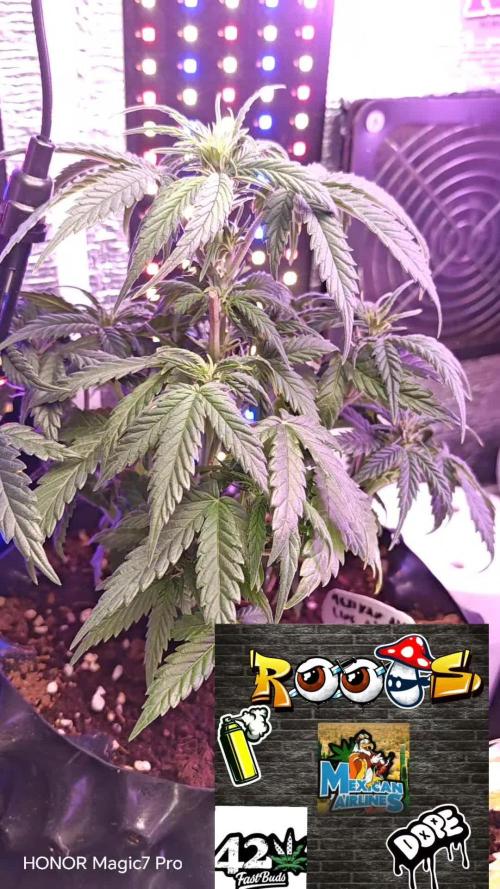
Week 5 and the lady is in full pre-flower. One more week of veg and LST. I’m upping her food hoping she makes a big jump this week. I can see a little purple staring in the center of the bud 😍
Likes
14
Share
Hello ! Gracias a mis amigos de sweet seeds, por sus semillas Esta es una nueva cepa en mis diarios espero que sean muy prospero el crecimiento de esta semilla. Fue germinada en exterior 3 días ( cosecha 12/2020) y posteriormente una semana puesta al sol natural y a hora en indoor 😃 . Feliz + feliz CHARLY GROWER 👨‍🌾💚
Likes
2
Share
12/09/2025 19:20 Unfortunately i finished space in my phone so i stopped doing video on the last 2 plants The end Is near for the gorilla z and the frostbanger,next time will be the chop day #1 gorilla z auto 78 days from seed This plant won't stop producing new pistils but i've seen something at the apical bud that looks like a start of bud rot,so i will harvest the next time i go here Smell Is at his peak,pure z terps with a hint of funky gas #2 frostbanger auto 71 days from seed This strain has some really solid buds and the trichomes ratio Is just perfect ,10/15% amber and the rest milky with almost no clear ones Having problems with spiders as i've seen a lot of webs on a particular bud Now Is 14/09 i think this one could be chopped right now but i will give her 2 more days so i can harvest both this and the gorilla z Smell is strong for real ,citrusy sherbet like so delicious #3 Coco fresh 43 days from seed Almost fully recovered from the damage and streched like crazy Pistils now forming on every site but it is toooooooo late for this period of the year #5 Coco Milk 55 days from seed Sadly there Is just a picture but the difference from the last time is noticeable Nice bud forming but not so much in the middle of the plant so i did a bit of lollipopping,i will continue cutting the internal sites at least for a week until her stops the stretching phase Resin fountain didn't open yet but the top bud started to smell like milk and coconut ,just like her name,never smelt something like this from a plant #6 apricot auto 52 days from seed So small compared to the others but the smell i now becoming something awesome Seems to have no problem with any kind of insects and some pistils are fading yet I do not know how much to wait on her because started to flower so soon,i think/hope 2 more weeks at least #4 #7 medium gorilla z Bud 14/09/2025 Took a bud in the middle of the plant that splitted in two,i wet trimmed the little one and the big i will let dry slowly Trichomes are 60% milky and the rest more clear than amber,hope 16/09 i will see more amber and milky ones but i will cut her down in every scenario No frostbanger samples as her Is ready with lots of milk and amber Crossing fingers guys next update will be harvest,we're at the end of this journey 🤟🤟
Likes
2
Share
The nighttime VPD does not need to mirror the daytime VPD. Daytime VPD dictates the pull of water and nutrients, while nighttime VPD acts mostly as a prevention tool. A high nighttime VPD increases the risk of the leaf temperature dropping below the dew point, which can trigger bud rot and powdery mildew. Switched down to 12's hours of light mid-week, changed spectrum, increased light intensity from 840umol up to 1150umol at current height. Overnight from 800ppm to 1500ppm, morning compensation point (microorganisms) 46-47 days from germination, she fills the canopy herself, once the apical dominance is broken. Measuring a plant's overnight CO2 emissions provides an accurate estimate of its dark respiration rate. Because photosynthesis stops in the dark, you are isolating the respiration process, which allows you to gauge how much stored energy (glucose) the plant has consumed and estimate the scale of oxidative phosphorylation. Oxidative phosphorylation is the final stage of respiration that generates the bulk of the plant's ATP (90%) and relies directly on the oxidation of these respiratory substrates NADH and FADH2 along with the consumption of oxygen. From a thermodynamic standpoint. Growth is an energy-capturing process, and the rate of that growth is bound by the available free energy (Gibbs free energy) and the First Law of Thermodynamics. While the ceiling or upper limit is dictated by free energy (such as photosynthetically active radiation), the actual amount of growth relies on how the plant balances that energy with other limiting factors. These are often described as the nine cardinal parameters of plant growth. 4 Above, 5 Below. If any one of the 9 becomes bottlenecked, the entire plant's cycle is restricted. Operating an 80F+ environment at night to force rapid carbon conversion comes with major drawbacks, as the biochemical processes work differently than the deductive logic suggests. While raising nighttime temperatures to 80F indeed accelerates respiration and speeds up the conversion of captured sugars (sink activity), doing so also radically increases the plant's overall metabolic baseline. If the plant's metabolic rate is artificially forced too high via heat, it can actually "burn" through more energy than it managed to assimilate during the day. This leads to carbohydrate starvation, stretching, and a net loss in final biomass yield. 400 ppm is near the standard ambient level; the plant's stomatal intake is the primary limiting factor, not the dark-reaction enzymes. To push 45 DLI without burning out the plant. Trying to force the conversion of a massive daylight DLI in a compressed time frame (12 hours) becomes highly inefficient because the Rubisco enzyme simply hits a saturation limit. To successfully convert a 45 DLI into dense, productive mass, the ambient CO2 generally needs to be elevated to the 1000 to 1200ppm range. This creates a steeper concentration gradient, driving the stomata to inhale CO2 fast enough to match the high photon energy. It's not all about the amount of light, but the ratio too, as this will dictate growth through the ratio of phytohormones. In order for correct bud development, there needs to be a correct ratio of RGB. Different wavelengths have different penetration depths. When one grows using top-down lighting, only the entire canopy is limited to 2-3 layers of leaf, meaning there will only be correct bud development in those layers, regardless of getting 45DLI. The biomass potential of a plant is linked to root mass. Generally, when a plant reaches its maximum biomass, you can help to chop off parts of the plant that are in less than efficient areas of the plant (low light) so that it can create new biomass growing towards the light. Strength is the maximum potential, and power is the rate of conversion. You can have the biggest veg period of 18 weeks, and it means nothing, as soon as you start flowering, the chronological clock starts ticking, the only metric that matters to bud size is how much energy you convert each cycle, not by how long it took you to build the framework, it helps a lot nonetheless. Not saying anyone should not defoliate for a reason, only that you should have one, and at the right time. Don't defoliate 30+% on autoflowers or 4 weeks into the flower period and expect an increase in yields; it doesn't work like that. There is room for dictating growth patterns and clearing out overcrowded nodes, but it needs to be done in veg because once that timer starts and buds start growing, it's all just energy conversion. One barely needs to defoliate at all in a 4x4 because with side lighting, turning a 2d canopy penetration into a 3d, even lower buds are 90% the quality and density of top ones. The rate of photosynthesis and the ultimate density of lower buds aren't just about the sheer number of photons PPFD. The specific ratio of R:G:B dictates canopy penetration and drives different photochemical reactions. The Electron Transport Rate (ETR) measures the speed at which electrons are driven through Photosystem II (PSII) during photosynthesis. The ratio of Red, Green, and Blue (RGB) light heavily dictates this rate. Plant leaves continuously perform cellular respiration regardless of the time of day, using energy and oxygen to fuel essential metabolic maintenance. If you over-defoliate, the remaining canopy may be unable to produce enough net sugars during the day to offset the constant respiratory demands of the plant. Must balance fixation with assimilation; there's no point in capturing 45 DLI if you only convert 20% every cycle due to an extreme lack of respiratory capacity to perform cellular oxidative phosphorylation. You can have a 4x4 canopy or a 4x4x4 canopy, yes, we know that side lights are not as effective at absorption from the sides or underneath, but it's not about DLI, it's never been just about efficiency, it's about the penetration ratios of RGB that drive ETR of/photosynthesis and trigger correct bud development. The size of each bud is its own ability to perform the ETR required for its own personal growth, and bud development is dictated by the ratio of RGB. It drives localised growth and acts as a regulatory switch for that development. Turgor pressure is another very important factor in understanding if you want big buds, for it is the "steam engine" that dictates the rate of bud expansion. Simply, a lot harder to achieve metabolically at ambient 75F than at say 86F Because buds have less chlorophyll, they do not suffer from the same photosynthetic shutdown that over-exposed, light-stressed leaves do. They can soak up direct light energy to swell in density and size. Their tolerance to intense light is heavily limited by the temperature and humidity, but if you can control those temps and keep the rot away, buds have a much, much higher tolerance to high light than leaves. Beneficial to hammer with high light before trichomes appear. Balancing this with trichome maturity is key for rich terpene and flavonoid profiles, want it just right, somewhere in the middle, not too much, not too little. Find cannabis plants can defoliate themselves come harvest, given the right signals. Every last ounce of potential is recycled into buds by the plant itself (senseceance), given you can keep the level of conversion high enough to prompt a need to do so. Get the canopy @ optimal PPFD range, 45-55DLI, then let the plant "stretch" the stems into a "PPFD range much higher, one that leaves don't like to grow in, but buds thrive in. What is optimal for a bud is different from what is optimal for a leaf photosynthetically. Genes provide the blueprint, but the environment dictates how, when, and if those genes are expressed. Must first signal the condition to increase the expression you want to exist through stress and response, cause and effect. A well-buffered CEC medium prevents extreme nutrient swings, allowing plants to maximise their dedicated genetic expression. A plant is either genetically expressing "growing" or "recycling" genes based on its nutrient starvation level in the medium. Constantly toggling between "growing" and "recycling" hormonal states creates a futile cycle that wastes valuable metabolic energy. Plants rely on sophisticated biochemical switches to manage this trade-off and prevent rapid fluctuations that disrupt that balance. This energy inefficiency is a recognised biological challenge. Plants avoid this costly "flip-flopping" by using hierarchical master regulators (like the TOR and SnRK1 protein kinases) that act as strict molecular switches. These networks enforce cellular commitment to either growth or survival, preventing mixed signals. This is something that was missing from previous grows. Under nutrient-rich conditions, TOR promotes protein synthesis, cell division, and structural expansion. Under starvation, TOR is inhibited, and SnRK1 is activated. This triggers autophagy—where the plant breaks down old macromolecules and organelles to scavenge and reallocate essential nutrients to critical sinks. "What's the point in flushing?" The core idea behind a PK booster is to deliver a massive, concentrated surge of P&K exactly when buds are swelling in conjunction with a N starvation. Because these are short, targeted windows, the nutrients must be highly bioavailable so the plant can process them immediately. As soon as you go "organic," that's out the window. Much slower release, uncontrolled, very difficult to "spike". to cause the ratio that will initiate a response. High-volume PK spikes rely strictly on the immediate uptake capabilities of mineral fertilisers. Making it far less efficient in organic/living soil setups. When you use organic nutrients, it changes the dynamic with which the plant delivers and trades its nutrients; organic is always releasing new nutrients into the immediate EC. This prevents a lot of autophagic responses from occurring due to a constant stream of new nutrients into the immediate medium's EC. This can prevent nutrient starvation from being signalled. PK boost is essentially just N starvation, triggering an autophagic response. Concentrated ratio of P&K while tapering off the Nitrogen base. To the plant, the sudden drop in Nitrogen registers as a severe environmental stressor—essentially, the beginning of starvation protocols. She aggressively strips nutrients and proteins from older leaves and vegetative structures and shuttles them directly to the developing flowers and fruit. Ta daaa. Call it a PK booster and sell it. Nothing to do with the P and K itself, it's the ratio immediately available in the medium triggering a nutrient recycling mechanism within the plant itself; all the "booster" sells is the trigger to the signal. PK BOOST with 50% ammoniacal N signals floral maturation. PK BOOST with N starvation signals nutrient recycling/sinking. Very difficult to initiate a response when organic nutes are doing their thing. It takes 4x5x more water significantly to leach or wash ammonia out than it does nitrates. This can prevent triggering N starvation from having its normal impact. Manipulating the C:N ratio in the medium. One autophagic response has multiple potential signal triggers. Nutrient starvation is not an option.
Likes
35
Share
@Growbody
Follow
Willkommen zu meinem Growbericht der Gorilla Cookies Auto von 2Fast4Buds. Der Strain wurde 2022 zur besten Indica beim Autoflower World Cup gewählt. Laut FastBuds deren meistverkaufter Strain. Grund genug, den Strain zu testen. Ganz Aktuell wurde die Gorilla Cookies Auto von 2Fast4Buds hier bei den Grow Awards 2026 in der Kategorie Best Strain auf Platz 3 und in der Kategorie Best Autoflowering Strain auf Platz 1 gewählt. Das macht mich noch neugieriger... Für den Grow verwende ich 15 Liter ROOTiES Stofftöpfe. Ich war sehr zufrieden mit der Sonnenerde, deshalb habe ich nachbestellt. Sonnenerde hat seine Mischung für die Bio Hanferde letzten Oktober/November geändert. Jetzt sind da kleine Tonkügelchen drin und kleine Gipsstückchen. Laut Sonnenerde soll das die Erde luftiger machen. Auf den Fotos kann man die unterschiedlichen Mischungen gut erkennen. In den AirPots ist die alte Sonnenerde, in den Stofftöpfen die neue. So kann man das Wachstum in den verschiedenen Erden schön vergleichen. Die Smart Start Plugs von zamnesia hab ich wieder verwendet. Tag 79: Die Gorilla Cookies Auto von 2Fast4Buds bekommt dicke, klebrige Blüten die nach Linoleum riechen und 1,0 Liter Wasser. Tag 82: 1,0 Liter Wasser. Tag 83: 1,0 Liter Wasser. Schön, das du dir meinen Bericht ansiehst. Schau gerne wieder rein 👋😎
Likes
33
Share
@Prof_Weed
Follow
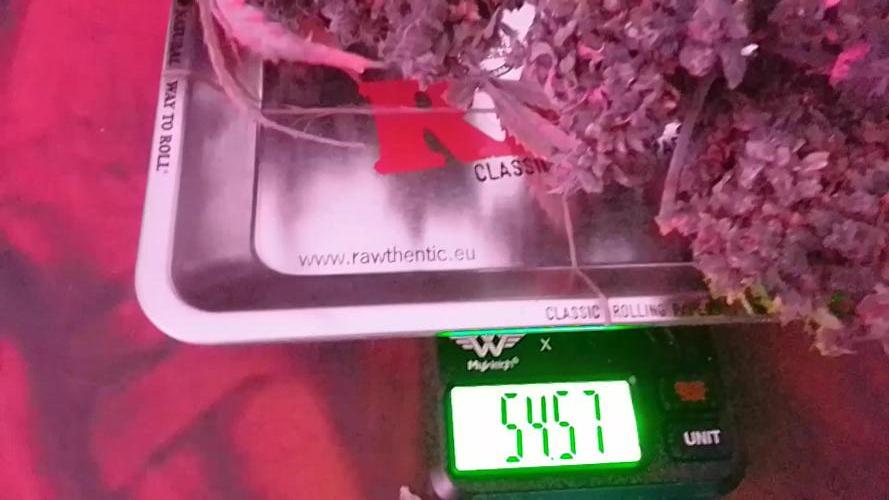
Geht langsam in Richtung Ernte, so 2 Wochen dann verpasse ich der Pflanze Flash Clean und Final Part von Terra Aquatica. Das ist dann auch nochmal 1 gute Woche. Die Trichome müssen für mich jetzt nicht Amber sein, bin mega ungeduldig.. Bin mal gespannt wieviel die Madame Orange Bud auf die Waage bringt.. Bye
Processing
Likes
12
Share
Likes
3
Share
@SgtDoofy
Follow
July 9 Mixed 1 tsp of RAW Grow with 1.25 gallons of water and PH'd to low 6s. Fed about 1 gallon. July 10 New nutrients seemed to take well. Leaves perked back up like usual. July 14 Got some RAW Bloom out for delivery. I think that will help with the yellowing lower leaf tips. Will feed 1 tsp per gallon tonight and will mix in 3 teaspoons of epsom salt too.
Likes
28
Share
Likes
2
Share
Si todo va bien en una semana deberíamos estar transplantando aquí están en sus 8 días de vida
Likes
98
Share
@Natrona
Follow
Sour Jealousy Auto FastBuds 2025 Outside Grow Week 12 June 15-21 FLOWER 6 Well, it was another rainy week. The Almanac pics show that our month to date rainfall is 3.11 inches and 2/3 of it was in the last week. The expected weather is supposed to be sunny next week. The anticipated sunny days are a mixed blessing. The temperatures for the next 10 days will exceed 90f and with this heat the humidity often exceeds 70-80%. This means the” feels like” temperatures exceed 100F, Checking Sour Jealousy today, I saw some bud rot, I treated her with Arbor fungicide to stop the spread. Fast Buds says 60 days of flower. She went into flower May 18 so it has only been a month and needs an additional 30 days or so. Fingers crossed she can withstand any more fungus spread. I would really hate to lose another plant. I pulled off 2 caterpillars from her top and side buds. One leaf at the top looks like it was eaten. Sour Jealousy Auto is a bright sativa dominant powerhouse, packing 29% THC and reaching heights up to 63 inches (150cm). I only grew one seed and it may be an outlier, but my Sour Jealousy is only 24 inches. Based on her short stature, she will not yield anything close to what FastBuds indicated as exceptionally high yields (up to 600g/m2 indoors and more outdoors depending on pot size. She is in a 5 gallon Air pot which is sufficient for autoflowers. They also indicated that odor is strong and herbs like mint, basil, marigold etc will help mask the scent. So far mine has minimal odor. Based on these differences observed so far, I wonder if this seed was correctly labeled? I’m genuinely looking of the effects this strain provides with 29% THC- a creative and uplifting high with energetic and euphoric effects. Despite its Indica-driven genetics the accompanying physical relaxation induces some hunger and sleepiness, but not much sedation. Medical patients hail Sour Jealousy Auto for treating chronic stress, depression, and ADHD. As aways, thank you all for stopping by, for the likes and most of al growers’ love and support. Stay green, growers love 💚🌿 💫Natrona💫
Likes
102
Share
@Aleks555
Follow
Let's talk about our Jealousy girls from Zamnesia Seeds. We have one Jealousy (1) at 15 weeks and another Jealousy (2) at 14 weeks. Jealousy (1), nicknamed 'the first,' has been on a water-only regimen for two weeks now. For the past three days, instead of regular watering, we've been adding ice to her pot to give her a little stress. Meanwhile, Jealousy (2), or 'the second,' is still enjoying her nutrient diet with TDS at 1800 ppm and pH at 6.2. However, Jealousy (1) has started showing signs of yellowing leaves and around 30% of her trichomes have turned brown. We're planning to harvest Jealousy (1) by the end of the week on March 3, 2024. As for Jealousy (2), she's still growing strong!
Likes
26
Share
Finaler Grow-Report – Lemon Cherry Gelato Mein erster legaler Grow mit Lemon Cherry Gelato von Barney’s Farm ist fast abgeschlossen – das Curing läuft noch, aber es ist Zeit für ein Fazit zum Anbau! Setup & Bedingungen: Ich habe in einer Spider Farmer 90x90x180 cm Growbox unter der Spider Farmer SF-G3000 (300W LED) angebaut. Als Medium kam BioBizz Light-Mix zum Einsatz, gedüngt wurde mineralisch mit Advanced Nutrients (Grow, Bloom, Micro). Um das volle Potenzial der Pflanzen auszuschöpfen, setzte ich auf Low-Stress-Training (LST) und ein ScrOG-Netz zur optimalen Lichtverteilung. Keimung & Wachstum: Die Keimung verlief problemlos – 4 von 5 Samen sind innerhalb von zwei Tagen aufgegangen. Während der Vegetationsphase entwickelten sich die Pflanzen kräftig und reagierten gut auf das Training. Die ScrOG-Methode half, ein gleichmäßiges Wachstum und eine bessere Lichtnutzung zu erzielen. Blüte & Ernte: Nach etwa 6 Wochen Vegetation leitete ich die Blütephase ein. Die Pflanzen zeigten eine starke Harzproduktion und eine beeindruckende Farbgebung mit einer Mischung aus dunklen Grüntönen, lila Highlights und frostigen Trichomen. Das Aroma war von Anfang an fruchtig und zitronig, mit phänotypischen Unterschieden in der Intensität. Die Ernte fiel mit 300-350 g trockenen Blüten sehr zufriedenstellend aus – für meinen ersten legalen Grow ein starkes Ergebnis. Curing (still in run ): Aktuell lagern die Blüten in 24 Mason Jars (16oz) und einem 2L-CVault, um das Aroma weiter zu entwickeln. Derzeit dominiert eine zitronige Note, während die erhofften Kirsch-Terpene langsam stärker hervortreten. Mein Ziel ist es, die Haze-Noten möglichst gering zu halten und das volle fruchtige Profil herauszuarbeiten – der Prozess ist also noch nicht abgeschlossen. Fazit: Ich bin sehr zufrieden mit dem Grow – die Kombination aus hochwertiger Genetik, gutem Training und präziser Nährstoffversorgung hat sich definitiv ausgezahlt. Die Buds sind harzig, aromatisch und vielversprechend, und ich bin gespannt, wie sich das Curing weiterentwickelt. Der nächste Schritt ist, das perfekte Terpenprofil zu treffen – und das Curing geduldig zu optimieren.
Likes
11
Share
@Zurbena
Follow
I installed a drip system, which I will use if necessary. It's a new year ahead, so a drip system is needed 😁 We are finishing the last week of vegetation.
Likes
10
Share
Start of week 6! Glueberry OG is growing strong however she's also getting hungrier and I made feed her an extra liter part way through this week. She's incredibly sticky, just like glue lol! Bud sites are looking good and development is strong.
Likes
27
Share
@WestOzzie
Follow
She's nearly all done,smells amazing,looks amazing