


Likes
19
Share


@HisHope
Follow
6/28 Week 10 and she is looking fantastic
Flush continues, nothing special just one gallon of h20 twice a day.
Looking at at least 3 days as tricones still at less than 100% white (@80%)
Deficiencies not bad yet, still building some bud
6/29
Looking well, just a bit of CA/MG def showing. Still building
Some lights out pics to show off the buds and trics
****
We have determined that best practice on coco DTW is to add a low dose of Cal-Mag once a week when in final container.
This will satisfy the cation sites as the coco breaks down and avoid mystery CA deficiencies allowing the CocoTek to do its work.
6/30
Just some Bud Pics
7/2
HARVEST DAY TOMORROW!

Likes
18
Share


@TheGreenLeopard
Follow
Great to grow - defoliate like a champ. Check out the sea of beam on thegreenleopard.com Twitter going wild for it - really nice addition to grow space - would take this strain to the moon - check out the light combo - world wide !

Likes
3
Share
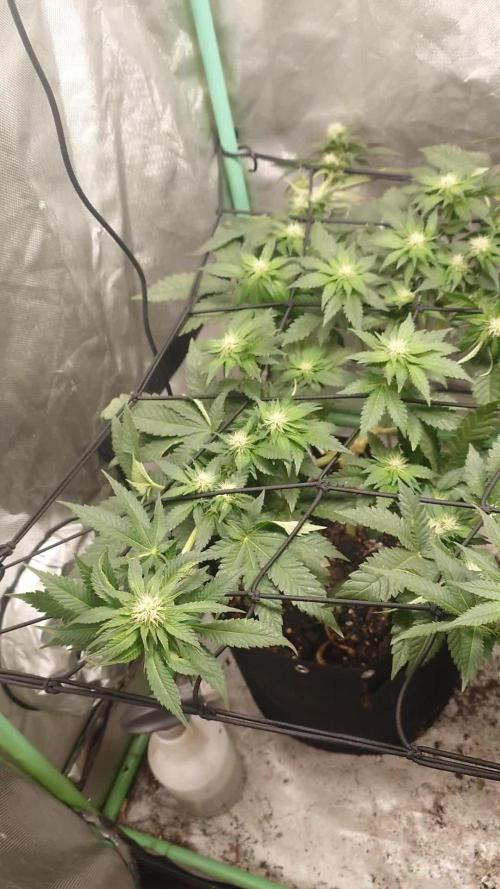

@Fruitgrower
Follow
30.6
Not much to report, she's shedding a few lower leaves, so have given her another nice feed.
1.7
Trimmed almost every large fan leaf off and a couple of lower shitters, spread them out some more
4.7
Looking good, gave them a feed, increased the bloom and top max and added green sensation,v lowering the light seems good so far👍


Processing
Likes
7
Share


@x_grower
Follow
Last week plants grew very healthy, as they got bushier the humidty raised providing a better enviroment, I could even reduce the amount of water I give them. Planning to move to flowering stage very soon.
Processing
Likes
12
Share


@MUDBUG
Follow
✍️✍️✍️✍️✍️🔥🔥🔥🔥🔥🔥🔥🔥🔥🔥❄️❄️❄️❄️❄️❄️❄️❄️❄️❄️❄️❄️❄️❄️💰💰💰💰💰💰💰💰💰💰💰💰💰💰💰💰💰💰Dam this is one shitty diary but the dank that will become will stand alone👊👊👊👊👊👊

Likes
5
Share


@hinterhofgrower
Follow
🌱: Loopking yellowish, no burnt tips, so switch tp 2ml/l Supermix
💧 : 8l
💡 : Dli: 45 mol/m²/d
🤔:
Likes
71
Share


@Herbz_Unkraut
Follow
22.12 • Cal/mag deficit looks solved, plants look healthy
23.12 • last watering was 1L / Pot right after repoting on 20.12 , right now soil feels moist
25.12 • added a bio CO2 reactor (4x 1L bottles with 800ml water, some mashed tomato and 100g sugar, 10g moist yeast)
25.12 • rotated one of the lights to maximize illumination
26.12 • watered all plants with 1L
26.12 • CO2 ppm went up from +-400 to +-600 i hope for some more as i increased room temperature to 26°C, (yeast should react more due to increased temp.)
27.12 • sunburn as the lights were under 30cm distance
27.12 • CO2 wasn't working when i arrived this evening, perhaps i used too much yeast, perhaps it was too cold, perhapy i need bigger bottles...either way: i removed 3/4 from the bottles and refilled water/sugar/tomato


Likes
6
Share


@field_nigga
Follow
Every week I take leaves off. Only the bigger ones tho
I water twice a week but fertilise once

Likes
8
Share


@Northern_Ent
Follow
Oct 17: close to ready but we’re running out of nice weather in two days. It’s been an absolutely great run of cannabis weather since July but first snow is forecast for 7 days from now, and then it’s below zero all day and there’s no hope at that point.
Oct 23: weather has still been good enough to keep going but I’ll take her down tomorrow. She’s the last plant in the grow area and potentially the biggest overall but I don’t think she’ll win that contest.
Oct 24: took it all 2,800 g wet. In keeping with Canadian outdoor tradition, there was a bit of snow falling as the plant was being chopped. She would have better buds with stronger sunlight but it’s all for hash and I’m happy with the total weight (of course).

Likes
5
Share


@Krissci
Follow
Day 1 -Very small and bushy. So stuff branches make LST harder but not impossible....tend to use metal wire to help slowly pull the branches instead of bend them straight away
Likes
2
Share


@ARAWAK972
Follow
Ça sent la banane trempée dans le fioul ... La Fat Banana Auto et la Royal Gorilla sentent déjà très fort 🤤
Likes
35
Share


@nonick123
Follow
Día 73 (12/08) Riego 500 ml H2O pH 6,55
Todas las plantas muestras las preflores hembras! (excepto LemonPaya)
Día 74 (13/08) Riego 250 ml H2O pH 6,55 . Están muy bien hidratadas
Pequeños ajustes de LST
Día 75 (14/08) Hoy día de lluvias torrenciales
Riego 250 ml H2O pH 6,55
Día 76 (15/08) Detecto mosca blanca en varias plantas. Aplico Spruzit a 10 ml/l ahora que aún no estamos en floración
Riego 500 ml H2O pH 6,55
Día 77 (16/08) Riego 500 ml H2O pH 6,55
La mosca blanca ha desaparecido completamente
Día 78 (17/08) No riego. Mañana a primera hora aplico Top Dress y riego profundo
Va a empezar la floración!
Día 79 (18/08) Alimentemos el suelo con Top Dress! 💥 Aplicamos 4 g/L sustrato de Tasty Flowers TD by Lurpe Solutions.
Total = 84 gramos / maceta
Riego con 1 Litro H2O pH 6,5 con 25 ml/L de Humus de Lombriz Liquido
Aplicación foliar Kelp hidrolizado de Lurpe Solutions a 0,25 ml/l
💦Nutrients by Lurpe Solutions - www.lurpenaturalsolutions.com
🌱Substrate PRO-MIX HP BACILLUS + MYCORRHIZAE - www.pthorticulture.com/en/products/pro-mix-hp-biostimulant-plus-mycorrhizae

Likes
1
Share


@Billy_Piff
Follow
Really kicking myself in the ass for not taking cuts of this. Probably some of the better outdoor/greenhouse flower i have produced.
Likes
36
Share

@nonick123
Follow
Día 87 (26/08) Aplicación foliar de Bacillus thuringiensis a 1 g / litro para evitar a las temidas orugas de los cogollos!
Hace un día nublado (29 ºC de maxima) y NO es necesario regar
Elimino la malla de sombreado de la cara sur, ya que las temperaturas son más suaves después de la canicula
Día 88 (27/08) Riego con 500 ml H2O pH 6,5
Empiezan a bajar las temperaturas a 29 ºC de máxima, y se nota en la demanda de agua por parte de las plantas!
OnionOG Se empiezan formar los erizos y se pueden apreciar los primeros tricomas sobre las futuras hojas de azucar 😍💥
Día 89 (28/08) Riego con 500 ml H2O pH 6,5
Cada planta empieza a ir un poco a su marcha en la demanda de riego dependiendo de su tamaño y estado de floración
Día 90 (29/08) Riego con 250 / 500 ml H2O pH 6,5
He detectado un gusano de los cogollos muerto sobre una hoja! 💥 Parece que los Bacillus thuringiensis funcionan estupendamente! 😁
Día 91 (30/08) Riego con 250 / 500 ml H2O pH 6,5
Día 92 (31/08) Riego con 1 litro H2O pH 6,5 + 25 ml de Humus de Lombriz Liquido
Día 93 (01/09) Aplicación foliar Bacillus Thuringiensis
No es necesario regar tras el litro de ayer y dia nublado con pequeños chubascos!
💦Nutrients by Lurpe Solutions - www.lurpenaturalsolutions.com
🌱Substrate PRO-MIX HP BACILLUS + MYCORRHIZAE - www.pthorticulture.com/en/products/pro-mix-hp-biostimulant-plus-mycorrhizae
Likes
10
Share


@StoneyMelony
Follow
Week 11 Autumn colours are really kicking in, trichomes are everywhere, i'm having 3 other plants in the room but the colorado cookies is def. the biggest plant.
Video Music: Activation
URL:https://icons8.com/music/


Likes
165
Share


@SlowpokeFuegobud
Follow
🐟 🐠 🐙 🐡 🐟 🐠 🐙 🐡 🐟 🐠 🐙 🐡 🐟 🐠 🐙 🐡
Welcome to week 2, my dear friends!! 😘
As you can see, I did a little digital firework with Chiron. 🐠 💥 Happy new year!!!
Every morning I sit with my little fish and water it and every evening as well. I used to fill a 300ml bottle which lasted for 2 days, now I use a 1L bottle. I guess atm it will last 3 days. 💧
I tilted the fish pot now, so the girl hast to change direction. I removed 3 shoots. I only want to keep the main shoot and those which will grow directly upwards.
Depending on how large the girl will decide to be. 😎
Maybe you have noticed the Yoga Sutra quotes. This ancient book is maybe the oldest written text in human history, conspirational voices are whispering it has been transferred to us by aliens (maybe they felt sorry for us). Patanjali is a mythical character, noone knows if he is a man, or maybe more than one..
The age of the Sutras can be determined very accurately because apparently there are star constellations described which can be backdated 6000 years backwards! Amazing, if you ask me, and I think that's pretty valid as a theory, it would explain a lot!
Anyway, the Sutras are a text of only 4 chapters, and they pretty much sum up what you can do to wake up and empower yourself 100%. Really down to earth and practical, but who wants to eat raw living food??? Aawweee.. (just joking) 😜 You'll get magic powers, eternal youth, everything, but noone reads it. I wonder why..
Thank you for visiting! 🔮 Hope to see you in week 3!! 💚 💚 💚
The soundtrack of the video is from a Guru Jagad Kundalini Yoga class on YT, the illustrious Guru Jagad is one of my favorite Yoga instructors and much more! 🙏 ❤️
https://www.youtube.com/watch?v=gfx66qbAj7s&t=1000s
____________________________________________________
Strain info:
Tropicana Cookies Auto is the perfect variety for growers of all levels, especially beginners as this strain performs very well outdoors and indoors, and can produce up to 500gr/m2 in 56-63 days without needing extra maintenance. Reaching up to 110cm, this strain grows fairly tall with medium-sized branching, showing its mixed heritage. Definitely the right choice for those with a high tolerance looking to get their hands on the strongest autoflowers out there. Thanks to the 27% THC, you can expect an extremely powerful and long-lasting high that’ll boost your mood and give you that extra push you need to start your days on the right foot. This variety offers the whole range of citrusy and woody flavors with a strong candy-sweet background that will keep you coming back for more and more.
Bud description
Tropicana Cookies Auto produces gorgeous dark purple flowers, so expect really dark buds with gorgeous hues of pink, purple and blue, and thick dark-orange hairs that get completely covered in resin by harvest time, giving them an almost shiny-white appearance.
This variety develops a typical Indica-like structure and very few sugar leaves that will make your trimming sessions a breeze. But make sure to store your trimmings as the gorgeous flowers reek of a mouth-watering blend of lemon peels, orange juice, and sandalwood that gives it almost a citrus candy-like flavor that makes for the most aromatic hash and extractions.Smoke report
Thanks to the 27% THC, Tropicana Cookies Auto’s effect starts with an energizing head rush that gets your mind up and running while leaving you in a nice calm state. As the Indica-dominant side kicks in, the powerful cerebral effect gradually moves downwards and hits your whole body with a deep relaxation that leaves you with a joyful stoney sensation that alleviates chronic pain while leaving you in an overall happy and positive state of mind.
It’s the perfect daytime and nighttime strain as it can boost your mood and enhance a night out with friends but can also quiet your mind as you get ready for a good night of sleep. No matter the scenario, expect a powerful high that lasts for hours on end.Plant appearance
Tropicana Cookies Auto reaches up to 110cm and develops a tall main cola with shorter side branches, typical of hybrid strains. You can expect a stocky yet tall main cola with medium-sized side branches and thin fan leaves that fade into a yellowish hue with a beautiful dark purple tint. Thanks to the excellent selection, this variety develops a short internodal spacing that makes the medium-sized flowers look like they’re growing stacked on top of each other. It’s the ideal choice for growers who want to get big yields without having to deal with huge plants, as this monster yielder can produce up to 150g per plant while growing relatively short.
Grow tips
This variety grows super dense buds so make sure to space out the branches by tying them down, this way you improve airflow which helps prevent mold and other pests. Tropicana Cookies auto reek of a delicious sweet and sour smell so make sure to flush thoroughly to enhance the aromas even more. This terpene heavyweight finishes with lots of resinous sugar leaves that make for fantastic hash and extractions so remember to have your trim bucket ready!Flavor
Tropicana Cookies Auto boasts remarkably sweet flavors that resemble a blend of lemon peels and fresh orange juice, with subtle floral undertones that make it the perfect choice for extractors looking for unique terpene profiles.
Expect an overall citrusy zest that’ll coat your whole mouth and leave a delicious tropical candy-like flavor aftertaste. The sweet and sour flavors get balanced out with a herbal background that gets stronger as you exhale and gradually opens up, bringing out the whole range of woody, floral, and spicy flavors, making it the perfect choice for the most flavorful extracts.
https://2fast4buds.com/seeds/tropicana-cookies-auto
_________________________________________________________________________________
SETUP:
80x80x180 cm Zelsius
240W Full Spectrum LED IR UV dimmable
DW240H-A6-HS
Heatsink color red
LED Chips:
512pcs SAMSUNG LM301H + 24pcs Osram 660nm + 8pcs Osram IR 730nm + 8pcs UV 385nm
Color mix: 2700K + 4000K
2,8umol/J
Driver HLG-240H-C2100B
Coverage: veg 5x3ft / flower 4x2ft
Product size: 628x205x68mm
Green Buzz Nutrients
Shouts go out to my sponsors @GreenBuzzNutrients, thanks so much for your support! ❤️
If anyone would like to try their amazing organic products, use code GD42025 for generous 25% discount (for orders of minimum 75€) ✨
https://greenbuzznutrients.com/
Mills Nutrients
Biobizz Lightmix
custom exhaust fan 320/270cm³/h
Carbon Active Granulate 240cm³/h
tab water pH 8 - EC 0,25 with Calmag to 0,5
Advanced Hydroponics pH minus Grow + Bloom to pH 6.2
🐟 🐠 🐙 🐡 🐟 🐠 🐙 🐡 🐟 🐠 🐙 🐡 🐟 🐠 🐙 🐡
Likes
4
Share


@pzwags420
Follow
On day 1 week 2 flower the Gals are really stretching now, hope I have enough room 😂They seem to be taking the flower nutes well even without a transition phase 😀. On day 3 the gals have stretched so much they are within 6 in of my light hoping The stretch will slow down soon yikes 😱. I defoliated the lower and upper canopy to bring in more light and air flow. On day 6 the stretch seems to be slowing down. I increased my light intensity from 75% to 100% to see if I can halt anymore stretching. I also bent my highest colas down as they were touching the grow light 😂. On day 7 flower clusters are forming and the stretch has slowed. I will continue to bend over the tallest colas and do my best to manage the canopy without too much loss of yield. It looks like some of my colas might get light stressed/burnt. There is not much else I can do except learn from my mistakes...next time I would flip the plants earlier and give them stronger light intensity before flowering stretch. The top leaves are canoeing so I reduced light intensity back to 75% to see if they improve. I got my first clog in my blumat systems main line... I will be switching to liquid based fertilizers for the next run as I believe my fertilizer caused the clog. I released the clog by using a pipette filled with water. I took the pipette and squeezed liquid through the main line exiting my reservoir. Then the lines were running smooth 😂


