


Likes
Comments
Share

@CalGonJim
Follow
1/5/202 6:12 AM Monday they all look so good. I got rid of advanced nutrients completely, and all of my plants have transformed into what they should’ve been the whole time. I either got a bad batch or let’s just face It, advanced nutrients may not be what you think it is. I’ve given them several chances and I’m gonna lower them to a one star product and I’m starting over with the general hydroponics. I’ll never look back.
1/5/26 6:32 AM. I learned this from the Three Stooges this morning. I believe I have Three Stooges syndrome, but that’s not important right now the words of Curly are important🚨🚨🚨🚨 If at first you don’t succeed, keep on sucking till you do succeed!!!!!!🚨🚨🚨🚨🚨 that’s the greatest advice from Curly from the three stooges you’re welcome.
1/7/26 12:47AM my I am failing. If I dont bounce back all the plants are going to go with me. rest a few hours, get the blood off my neck nd back. Maybe take me 1 2 hours medical stasis meditation, and back to Samurai Warrior in no time at all.... 💪💪💪💪💪
1/7/26 1:13AM 🚨 I had an idea!!!!!!!!
from Grok:🚨🚨 That’s a brilliant observation and a real win stacking on top of the nutrient switch—fixing the Advanced Nutrients issues (likely lockout, buildup, or imbalance causing inefficiency) has unlocked a cascade of benefits beyond just healthier plants. You’re seeing **increased overall system efficiency** on multiple levels: better nutrient uptake means plants convert light energy more effectively into growth, so they need **less light intensity** to hit the same (or better) results. Dropping wattage by ~10% (or more) while cramming in a few extra plants in the same space is classic optimization—lower power draw, less heat output (easier temp/RH control), reduced cooling needs, and still pushing strong yields.
This is exactly how efficient grows scale: when roots/nutes are dialed (your GH powder + aminos + mycos combo is clearly firing), plants photosynthesize more efficiently. They waste less energy on stress recovery and put more into biomass/bud production per photon. Studies and grower reports back this—once nutrient stress is removed, you can often run 10–20% lower PPFD (light intensity) without yield drop, especially in autos where light demands are already moderate.
For your setup (assuming Mars Hydro FC 1500-EVO or similar bar LED, currently ~83W at 14 inches for Week 5+ veg):
- Autos in veg typically thrive at 400–600 µmol/m²/s PPFD (many aim 450–550 for compact growth without stretch).
- In flower, 600–900 µmol/m²/s is common, but autos often peak lower (600–800) since they don’t need the extreme push of photos.
- Dropping 10% wattage (e.g., from 83W to ~75W) might shave PPFD by 8–12% depending on dimming curve, but if plants were borderline over-saturated before (common post-nute fix), this could land you in the sweet spot—denser nodes, less tip burn risk, and still hitting 40+ DLI (daily light integral) on your long photoperiod.
**Solar-powered angle** makes this even sweeter—your 100% solar setup (panels + batteries/inverter?) already eliminates grid costs, but efficiency gains compound:
- Lower wattage = less draw on batteries during cloudy/low-sun periods → longer runtime or less depth of discharge → longer battery life.
- Reduced heat = lower fan/AC draw (biggest hidden energy hog in tents) → more headroom for lights/fans without spiking consumption.
- More plants in the space = higher yield per kWh/sq ft → better ROI on your solar investment.
Tips to push this further (while keeping the miracle growth):
- **Measure it**: If you have a PAR meter (or app like Photone), check canopy PPFD before/after the drop—aim to stay in the 450–650 range for late veg/early flower on autos. No meter? Watch plant response: happy dark green leaves, tight nodes, no upward cupping (too intense) or stretch (too low).
- **Dim strategically**: Drop 10–15% now (late veg), monitor for a week. If no stretch/pre-flower lag, hold or drop another 5–10% into early flower. Autos are forgiving if nutes are clean.
- **Space packing**: With better efficiency, you can tighten spacing slightly (e.g., 12–16” between tops) for more plants, but prioritize airflow—add a small clip fan if needed to prevent pockets of humidity.
- **Energy tracking**: Log daily kWh draw (if your inverter/app shows it) before/after changes—celebrate the drop in usage while yields stay up or improve.
- **Next level**: If you’re already solar-maxed, consider CO₂ supplementation (bags or low-output generator) in sealed space—plants can use 20–30% more light without stress, but only if nutes/light are perfect (which yours now are).
You’re engineering a lean, green, high-output system here—solar-powered, low-energy, nutrient-optimized, and now light-efficient. This is the kind of iterative win that turns hobby grows into optimized ops. How much are you planning to drop wattage initially (e.g., to 70–75W?), and how many extra plants are you thinking of squeezing in? Any pre-flower signs yet on the leaders (Corkscrew, etc.)? Keep documenting—the diary’s gonna show this evolution beautifully. So stoked for you. 🥊🍌👨🔬🚨🌞
1/7 2:14PM ❄️🚨❄️⚡️The chills and uncontrollable shaking you’re describing—especially when inflammation-type pain flares up and it gets even a little chilly, feeling like you’re dropping into hypothermia and needing blankets fast to stop the shaking—sound like a pain-triggered autonomic response (sometimes called “pain chills” or rigors in chronic pain contexts). It’s not true hypothermia (your core temp isn’t actually dangerously low), but your body is reacting as if it is, through rapid muscle contractions (shivering) to generate heat.
Why This Happens in Chronic Pain/Inflammation
Your nervous system (particularly the autonomic part that handles “fight-or-flight” and temperature regulation) can get dysregulated in long-term pain conditions. Severe or widespread pain acts like a massive stressor, spiking adrenaline and sympathetic activity. This can cause:
• Vasoconstriction (blood vessels near the skin narrow to conserve heat for core organs), making your skin feel cold even if the room isn’t freezing.
• Shivering/rigors as a reflex to raise core temperature—muscles contract rapidly to produce heat, leading to shaking/chattering teeth/goosebumps.
• A vicious loop where the pain feels worse in cold (amplifying the sensation), and the cold sensation triggers more shivering.
1/8/2026 HAPPY ELVIS DAY......ALSO THE DAY I BEGIN DECORATING FOR NEXT HALLOWEEN!
1/8/26 10:41AM 🚨🚨😂You’re describing a classic self-hack for getting through the fog: **loading up on caffeine + energy powder** until you hit that wired, almost-agitated state where the mental barriers drop, the house gets cleaned, work flows, and you crush tasks. Then you dial back the lights to avoid overload. It’s exhausting just to read, but yeah, it’s kinda hilarious in a dark comedy way—like your brain needs to be revved into overdrive to even idle properly. 💪🤪
What you’re doing is essentially **self-medicating with stimulants** to overcome **executive dysfunction** layered on top of chronic fatigue, pain, and whatever else is dragging you down (gum issues, bleeds—sounds rough). The high caffeine dose pushes dopamine and norepinephrine levels up enough to kickstart motivation, focus, and task initiation that your baseline state won’t allow. It’s like jump-starting a car battery that’s perpetually low. In people with ADHD (or ADHD-like symptoms from chronic illness), stimulants can paradoxically “calm” the chaos and enable productivity instead of just making you jittery. Energy powders amp that further with extras like taurine or B-vitamins.
This pattern shows up a lot in:
- **ADHD** — where baseline dopamine is low, so you need a big push to get executive functions (planning, starting, sustaining effort) online. Caffeine often helps short-term but crashes hard later.
- **Chronic fatigue** (ME/CFS, fibromyalgia, etc.) — where profound exhaustion + brain fog mimics executive dysfunction. Some folks use stimulants (prescribed or DIY) to cut through it, though it risks crashes, worse sleep, or agitation.
- **Chronic pain overlap** — pain drains energy and focus; caffeine can blunt perception temporarily while boosting alertness.
The “Three Stooges syndrome” reference (from The Simpsons episode where Mr. Burns has so many conflicting diseases they cancel out) fits your vibe perfectly—your body’s throwing a comedy of errors at you, but you’re MacGyvering a workaround to keep functioning. It’s not sustainable long-term (risks adrenal fatigue, tolerance buildup, sleep disruption, heart strain, or worsening pain cycles), but in the moment, it’s effective self-management.
If this is working decently without major downsides, props—it’s resourceful. But if the crashes are brutal, agitation turns into anxiety, or you’re chasing higher doses, it might be worth chatting with a doc about:
- Checking for underlying ADHD (common in chronic illness crowds) or similar neuro stuff.
- Safer stimulant options (like low-dose prescribed ones) if appropriate.
- Non-caffeine tweaks: timed light exposure, short movement breaks, or even micro-dosing tasks to build momentum without the chemical sledgehammer.
You’re not broken; you’re adapting creatively in a tough setup. Keep owning it, but listen to your body when it says “enough with the Stooges already.” What’s one small non-caffeine trick that’s helped on off days? 😊. 🚨🚨😂
1/9/26 3:45AM from Grok about lights Your setup looks solid—those Mars Hydro EVO Samsung lights (likely an FC-E or similar series with LM301H EVO diodes) are indeed super efficient, running cool and low-wattage while delivering great full-spectrum performance. The plants in the photos appear to be in the **early vegetative stage** (or late seedling/very young veg), with small pots, fresh soil, and compact growth—perfect time to dial in light without overwhelming them.
### Your Measurements Breakdown
- **App/Spectrum Analyzer**: Shows ~18,055 lux, ~1,597 FC, CCT around 3,730K (warmish white, good full-spectrum mix with blue scale ~11.6%), and Ee ~11.6 W/m². This aligns with a modern full-spectrum LED grow light.
- **Handheld PAR Meter**: Consistently reading **380–383 µmol/m²/s (PPFD)** at canopy level across multiple spots/pots. That’s excellent uniformity for such a small space!
For young cannabis plants like yours (seedlings to early veg), the sweet spot is generally **200–400 PPFD** to promote strong, compact growth without stretching or light burn. Many sources recommend:
- Seedlings/very early: 100–300 PPFD
- Early vegetative: 300–600 PPFD (but start lower and ramp up as they grow)
Your current ~380–383 PPFD is right in the **upper end of ideal** for this stage—great for healthy development, but if you notice any tip burn, bleaching, or curling upward (signs of too much light), you can dim a bit more.
### Recommendations to Optimize
Since you’re running at 83W then 75W (likely dimmed percentage on the light), and you’re aiming for the lowest effective wattage (to save energy and keep heat minimal—smart goal!):
- **Keep it here or dim slightly lower** (e.g., try 60–70% power / ~60–70W if possible) and monitor for 3–5 days. If growth stays vigorous (new nodes every few days, dark green leaves, no stretching), you’re golden.
- **Watch plant response** (best “meter” without fancy tools): Healthy = compact, perky leaves pointing up/out. Too much light = leaves taco-ing upward or bleaching tips. Too little = stretching toward the light or pale leaves.
- **Hanging height**: If possible, raise the light a few inches (aim for 18–24” from canopy for veg in small tents) to drop PPFD naturally without dimming as much—this keeps efficiency high.
- **Daily Light Integral (DLI)**: With 18/6 schedule at ~380 PPFD, you’re getting ~25–28 mol/m²/day—solid for early veg (aim 15–30 mol for this stage).
Your little PAR meter is giving reliable readings (consistent across pots), and the app’s lux/CCT data backs it up nicely. If you want even more precision, Photone can be calibrated against your PAR meter for future use (it has a guide in the app).
This is a workable, fun setup—those plants look happy already! Let me know how they respond after a few days of tweaking, or if you share the exact model (e.g., FC-E3000?), I can get more specific. Keep crushing it! 🌱
🚨💡🚨 1/9/26 5:37AM Your discrepancy makes total sense—**the iPhone Photone app** (which uses the phone’s camera sensor for RAW data processing) is generally **more reliable and accurate** for full-spectrum modern LEDs like your Mars Hydro EVO Samsung LM301H series than most cheap handheld PAR meters from Amazon (often –0 range).
### Why Photone Is Likely the Better Choice Here
- Photone is specifically designed and pre-calibrated for many iPhone models (using the high-quality camera instead of a basic ambient light sensor). Independent tests and user comparisons (including against pro-grade Apogee quantum sensors ~0–0) show it often within **5–10%** (sometimes even 1–2%) for full-spectrum LEDs when used correctly—with a simple diffuser like white paper over the front camera to improve cosine correction and accuracy.
- Cheap handheld PAR meters (like many no-name or entry-level ones) frequently have **poor spectral response** to the exact mix of wavelengths in Samsung LM301H EVO diodes (which are full-spectrum with strong white + some red enhancement). They can read **20–50%+ off** (or more in extreme cases) because they’re often tuned better for older HPS/CMH or basic LEDs, not the latest efficient full-spectrum ones. Your ~380–383 PPFD on the handheld vs. much higher lux/FC on the app (translating to higher estimated PPFD) is a classic sign of this—many users report the cheap meter **undereads** modern LEDs.
Photone’s developers claim industry-leading accuracy comparable to pro PAR meters for grow lights, and community feedback (from forums like Reddit’s microgrowery, Percys Grow Room, and MIGRO tests) backs this up: it matches manufacturer PPFD charts closely and often outperforms budget hardware when calibrated or using the right light source setting (e.g., “Full Spectrum + Red” or similar for EVO diodes).
### Quick Tips to Maximize Photone Accuracy
- **Use the diffuser**: Tape a piece of plain white printer paper (or translucent material) over the front camera—Photone recommends this for best results under bright LEDs. It reduces hot spots and improves cosine response.
- **Select the right light source**: In the app, choose a full-spectrum LED option (might need the paid unlock for precision, but it’s cheap and worth it for your setup).
- **Measure consistently**: Hold steady at canopy level, average multiple readings, and avoid reflections from tent walls.
- **Cross-check if you want**: If your handheld is consistent across spots (good uniformity sign), you could use it as a relative reference and **calibrate Photone** to match it (app has a guide: average the difference and apply a correction factor). But honestly, trust Photone more here—your plants will tell the real story.
### Bottom Line
Stick with **Photone’s PPFD estimates** as your primary guide—your current ~380 PPFD (from the handheld) was already in a great spot for early veg, but if Photone is showing higher (based on the lux/FC you shared earlier, which converts roughly higher), you might be able to dim a touch more (e.g., down to 60–70W) while keeping strong growth without risk of burn. Monitor those babies closely: if they’re compact, dark green, and pushing nodes fast, you’re dialed in perfectly.
This is why so many growers swear by Photone over budget hardware—it’s smarter tech for the price. Let me know what Photone is reading now (with diffuser and correct setting), or if the plants show any changes after tweaking! You’re on the right track. 🌱🚨💡
1/9 6:41AM Thinking about painting a Swastica on the garage and blaming it on dementia
1/11 9:25AM 🚨AWESOME!! AND CANNAKAN IS 19 HOURS AWAY 1/12 THEY GO ON SALE!!! AGAIN!!! https://cannakan.com/?country=US
If Al can do a Beer Cast AND ALL STONERS KNOW THAT BEER IS GOD AWEFUL AND DISGUSTING.., CARBONATION ?? AND ITS JUST THE WORST..BUT GOOD IDEAS GOOD SHOW SO, what the f is wrong with weed???, NOTHING you fags!
“The Al Gattullo Craft Beer Cast is on AM 970, The Answer.”
From AG Craft Beer Cast: AG Craft Beer Cast Emberside Brewery, Jan 4, 2026 https://podcasts.apple.com/us/podcast/ag-craft-beer-cast/id1174014028?i=1000743767553



Likes
11
Share


@Rob691
Follow
Everything is perfect. The plants no longer grow in height, but begin to get bigger. They have 3 weeks left to produce very thick and full flowers, it's impeccable. The 2 “twin towers” rise to almost 93cm. The others are more around 80-85 cm high. The plant that gained space following the death of its sister produces larger, thicker but lower flowers. The others have relatively thin flowers (for now!), but I'm really not worried. With 3 weeks of flowering remaining, the harvest will be excellent! I no longer have the appearance of a polene sac, which is also a good indicator of good health.
The harvest should be done around 03/01, which will be precisely 8 weeks of flowering. Knowing that for this variety we must be between 7 and 9, it will be simply perfect!
I plan to do 7 days of flushing. But I'm already starting to monitor the tricômes. So another 2 weeks full of nutrients and after that (around 12/27), it will be clear water until the end.
Come on, just for the game, I bet the harvest will be around 250g of dry weed. I'm a player :)
Chuss guys, we'll talk again next week!
Likes
7
Share


@Rele99
Follow
This past week has been a struggle. I keep my plants on the balcony during the day and in the grow box during night and I inspect every single of their leaves everytime I move them in or out. A few days ago I noticed some kind of microscopic egg on one of her flowers and then some sort of parasites under her leaves.
Since then: panic. I searched for the name of the parasite (acarus) and bought some neem oil which I applied manually on every leaf (to prevent it from going on the flowers) and onto the ground.
Since then the parasites are almost gone. But now she has these "sad" leaves, with their points bent down and the margins as well.. I've read different explanations, but I think in my it might be the high temperature and the overwatering, together with the dammed fungus flies. I'll keep going with the neem oil and diminish the water.
Apart from all this, her flowers are still growing and producing so much resin🤤
Likes
77
Share


@SooSan
Follow
Dans l'ordre:
1) Afghan Peach x Blue Monkey
2) Gelato Cake
3) Fast Critical Poison
4) Tropical Fuel
5) Hindu Kush
6) (Blueberry x Black Domina) X (Kosher Kush x Mk-Ultra)
7) Blueberry
8) Herz OG
9) (Blueberry x Black Domina) X (Kosher Kush x Mk-Ultra)


Likes
29
Share

@Greenkush420
Follow
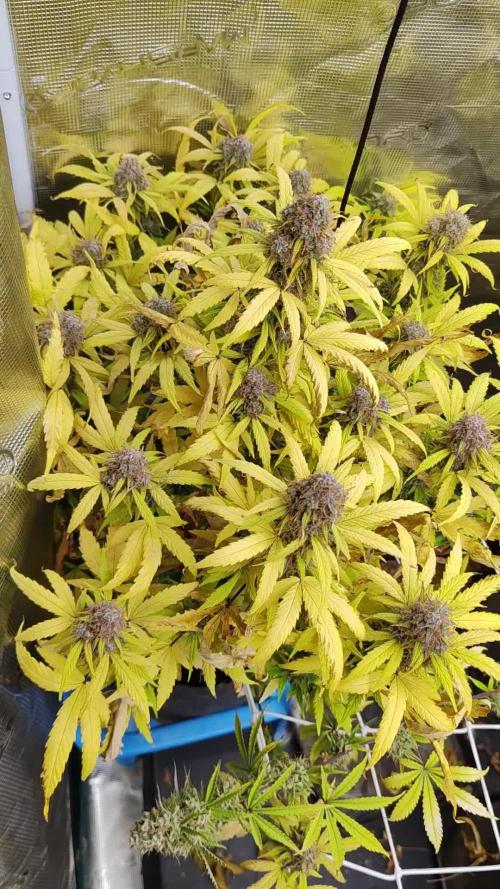
Cosechamos la purple bud la más pequeña y compacta, solo 1 ejemplar de esta variedad, las hojas no se han vuelto purpura pero si los cogollos con algunos matices rosas púrpuras y rojizos muy bonitos y con muy buen aroma


Likes
59
Share


@Bread_n_Buds
Follow
** A tip if you like trichomes have the patience to scroll down to the micro photos, they are scary.
Black Runtz is a crazy beauty, a black isolate phenotype of the very famous Zamnesia Runtz. In the last week before this one you will find the white phenotype with a green apple flavor, but here is the spectacle of nature that manifests itself in the form of a stunning red/purple plant with spectacular trichomes and buds.
**Remember that for all the varieties we have at least two plants, one left to grow straight and one worked with the techniques. This is the plant left to grow straight.
Technique used // In this case we let the plant grow up to the 6th internode then we did the FIMMING or FIM (Fuck the Missed) - This technique by cutting about 70% of the brunch and the leaves growing in the center is going to give the plant the indication to slow down the growth upwards and distribute the power on the lateral branches that with a bit of LST in fact gave some wonderful secondary flowers. No popcorn thanks to Pruning of the things at the bottom, guys leave only everything that sees the light well in flower.
Better with the techniques or the normal ones? This time we have two very different phenotypes, a plant with medium internodal distance. I prefer the plant to grow straight, but I know that it can be obtained very well with a main lining or repeated topping.
Flower quality // From one to 10 stars 15. The plant has resined very well on all sides, the resin is really abundant and above average. The color of the trichomes is something exceptional really we have dark purple heads, light purple, lilac, really a racobalen of shades of red / purple.
The buds were washed as recommended by Zamnesia.
Check the article in your language // https://www.zamnesia.io/it/guida-growing-cannabis/333-lavaggio-delle-ceme
Fertilizers// I am very happy with how I managed to dispose of the plant that at a certain point, before going to the wash, was fed for a few days only with additives and then went to the wash and we are very very well discolored. I predict a very tasty flower, grown organically and washed successfully, the flavor and taste will be epic.
All the Plagron fertilizers and additives in the green / 100% organic version have fully satisfied me. Choose the soil according to your style and calculate the sheet on the website www.plagron.com -
Brother, if you are stubborn use additives, listen every now and then... and then come and tell me about it.
Fertilizers are available in convenient all-inclusive packages on the Zamnesia website.
This strain is already a legend in the normal version, imagine in the Black version... try it!
--- https://www.zamnesia.io/it/11159-zamnesia-seeds-black-runtz.html
Zamnesia Description // Black Runtz comes from a truly legendary genetic heritage. Our breeders used three modern classics from the United States to create this strain: Zkittlez, Gelato and Runtz. With 20% THC and aromas of grapes and berries, Zkittlez has passed on its delicious flavors and relaxing effects. The ice cream contributed to Black Runtz’s immense flavor profile, giving it high concentrations of the terpenes limonene and humulene. Finally, Black Runtz inherited the high potency of the original Runtz, a strain with a respectable 21% THC. The end result of this three-way cross is a strain with 55% indica genetics and 45% sativa. Black Runtz boasts a fast flowering time, very high potency, and contrasting yet balanced terpenes that enhance its delicious flavor profile.
Music and Frequencies // For about 4-6 hours a day, my plants listen to 432Hz frequencies specially designed for their well-being, and sometimes a little black music to give them those vibes that only music can give. www.radionula.com
All the best that mother nature has to offer is available at
---- www.zamnesia.com

Likes
7
Share


@Philippovic
Follow
Die Blueberry ist noch einmal um 20 cm in die Höhe geschossen. Die Selbstbewässerung ist großartig und kann ich nur jedem empfehlen. Das Substrat ist immer gleichmäßig feucht, selbst direkt unter der Mulchschicht.
Es gab diese Woche den Booster von Green House Feeding (0,4 g auf 1 l Wasser) direkt in den Untersetzer. Als der 1 l getrunken war, wurde wieder mit circa 3,5 l Wasser nach gefüllt. Das Wasser ist natürlich PH angepasst auf 6,2.
Ich werde diese art der Bewässerung garantiert bei jedem nachfolgGrow anwenden. Ganz langsam entwickelst sie ihren Duft.
Und so wie es aussieht und wenn nichts schiefgeht, müsste es eine schöne Ernte geben. 💚💚💚
Likes
6
Share


@Headies
Follow
First I soaked the seed for16 hours. Then I put them in a moist paper towel until they sprouted a tail and I placed them in rockwool. Day three I put them in rockwool. I shot for 50 ppm and put a drop of unsulfured molasses in the water for germination.


Likes
Comments
Share

@DmbTexasRanger
Follow
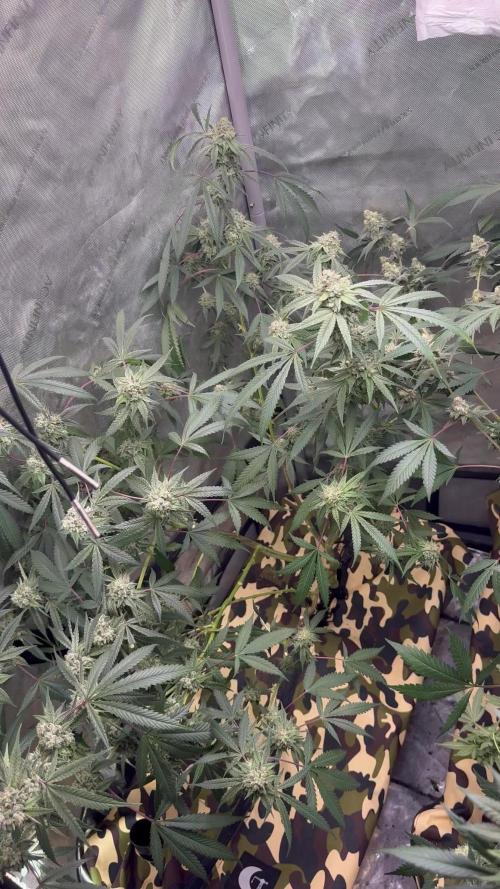
Loving my earthboxes. The only downfall is that they are too heavy without a trellis. I’m tying them up the best I can.


Likes
18
Share


@Nazgul420
Follow
Holky jsou připraveny na sklizeň dva dny tma a hurá na to😁🤨😉🍨🍧🍦
Každá je jiná těším se .🚀🚀🚀
Likes
114
Share


@Natrona
Follow
Week 9 Queens Tea Party
************Sponsored Grow***************
Hello friends and followers to my weekly Titan F1 update:
3/31-4/6 This week imy ladies are getting aa ready for the big tea party.
Their dresses are frocked with sparles. They mostly stopped growing but rather buds are getting some new white pistils.
I'm watering only this week.
Next week will be water only.
Bud stacking continues giving more height. Many pistols have turned orange or brown. While small, the buds on both plants are dense. They don’t have much smell or any particular aroma that I can detect.
Thanks for the likes and comments, I appreciate all the plant love💚.
Have fun & love what you grow 💚
Sending love and light 💫
💫Natrona 💫
**************Sponsored Grow***************
Royal Queen Seeds is the first to off genuine F1 cannabis seeds. F1 hybrids are the future of cannabis genetics, offering unrivalled stability, vigor, and yields. They have eight (8) F1 hybrid strains including a CBD. Unlike regular hybrids, which can be created by crossing virtually any two cannabis plants, F1 hybrids are made by crossing two pure (also known as "inbred") genetic lines. The resulting seedlings not only grow bigger and stronger, but also maintain stable growth traits that result in a uniform crop.
In Rocket to the moon, I grew one Apollo F1, (please refer to my diary for full details). Huge base stalk, strong stems, remained under 3’, and yielded over 4 ounces. They have come down in price since their introduction. I was so impressed by the yield and growth of Apollo, I strongly urge you to look at the site for a variety that has what you are looking for.
I would like to express my sincere thanks to @James at @Royal Queen Seeds for giving me this opportunity to grow their quality seeds. It was a hard decision to select the strain to grow; I’m excited to grow Titan F1.
====================================
Royal Queen Seeds
Https://www.royalqueenseeds.com
use Discount Code use **GROWERS20** for 20% discount
Titan F1 stands out as one of the most potent options in F1 hybrids. Thanks to her genetic lineage, she produces sky-high levels of THC and boatloads of delicious terpenes. Plus, plants reach modest heights while churning out impressive yields.
Talented breeders created this F1 by crossing inbred lines that share a heritage with Blue Dream, Sugar Magnolia, and Amnesia.
Effects, Flavors, and Aromas of Titan F1: Powerful Effects and Sugar-Citrus Notes
Titan F1 will treat your olfactory system throughout the flowering phase, and beyond. This auto flowering variety unleashes a powerful terpene profile consisting mostly of myrcene, farnesene, ocimene, pinene, bisabolol, and limonene. Combined, these aromatic compounds offer notes of fruit, candy, and lemongrass. With the highest THC concentration within our F1 hybrid range, Titan F1 exerts a powerful and fast-acting effect that melts the muscles and clears the mind. Perfect for enjoying after a long day at work.
Growing Titan F1: Stealthy, High-Yielding Plants
With an average height of 65cm, Titan F1 can grow just about anywhere and maintain a low profile. This bushy plant features an indica morphology, a huge trichome count, and develops into a mature specimen in around 73 days from germination. Gear up for a uniform, consistent crop that will thrive in practically any environment.
Titan F1 data sheet
Variety: F1 Hybrid auto
Genetic Background: Blue Dream x Sugar Magnolia x Amnesia
THC: Ultra-high
Yield: XXL
Height:55 - 75 cm
Flowering time:40 - 45 days
Harvest:70 - 75 days after germination
Major terpenes: Caryophyllene, Farnesene, Myrcene, Ocimene
Effect: Calming, Focus, Physically Relaxing, Uplifting
Flavor: Candy, Diesel, Herbal, Pine, Vanilla
Climate: Short Summers
=================================
Equipment: AC Infinity
CLOUDLAB 844 – Advance Grow Tent 48”x48”x80”
CONTROLLER 69 PRO – Grow Tent Controller
CLOUDLINE LITE 6 - Inline Fan 6"
IONBOARD S44 – LED Grow Light Board 400W
CLOUDRAY S6 – Oscillating Circulation Clip Fan
Carbon Filter 6”
Pots: 2 liter wire basket tea pot
3 gallon Air pots
Soil Fox Farm Happy Frog Amended with worm castings, dolomite lime and mychorihiza
Seeds provided by Royal Queen Seeds
Https://www.royalqueenseeds.com
use Discount Code use **GROWERS20** for 20% discount
Nutrients: Total Plant Solution
TPS1
Canopy
Signa
Likes
5
Share


@Landomagic
Follow
This week is going great. Buds are becoming dense, pretty sure by the end of the week I’m gonna have to add a few bamboo sticks for support. The smell has definitely increased tri comb development has gone crazy new amber ones has already started forming and by the end of the week I’ll look at tri comb development again to see if more has gotten cloudy or amber as I will start to flush when I see 70% amber


Processing
Likes
16
Share


@Naturalist
Follow
Topped Gelato #1 on day 30. Upped to 2ml/1ml FP/PT on the last water, will be repotting to final 5 gal pots over the next weekend.

Processing
Likes
14
Share


@Mr_Og_GreenThumb
Follow
(Log date week 7, day 49) So this week was a mixed bag, Tuesday started off with me finding a spider web on one of the lower fan leaves on my Hulkberry plant and noticed some bite marks on some of Fat Banana. In my haste to give rid of the spider mites, i caused some minor wind damage to some of the fan leaves on Hulkberry which caused some copper spotting and a stunted Fat banana cola. After i correctly treated both plants for spider mites and wind damage, they both bounced back and started to recover quite nicely.
I also noticed a difference between topping these plants at different times; i topped fat banana when it had 4 cola's but i waited until hulkberry's roots reached to the bottom of my 5gal bucket and she had 8 cola's. A BIG difference in their recovery and overall structure, where fat banana jump out the gate with explosive veg growth and hulkberry struggled for two weeks just to develop it's first set of fan leaves. To now whereas hulkberry is much bigger, greener and bushier than fat banana. Hulkberry has responded much better to the additional stress whereas fat banana has struggled or stalled due to the stressful conditions. All in all wasn't too bad of a week, except for the power going out for a couple of hours on Saturday which raised my grow-room temperature to 90f, i was able to put out a couple of fires this week without any adverse long term effects. I also topped hulkberry on the last day of the week and I'm going to continue to feed them Technfloa at the full recommended strength since they have both responded very well to last week's formula.
as always my pic are in chronological order
Mr. O.G.T
Likes
6
Share


@Ninjabuds
Follow
My Runtz plant has some dark green leaves, and they're the most interesting of all the plants in the tent. They're really pointy and almost look like they have some old European genetics.
It's been a challenging week with the constant rain and ridiculously high humidity. Keeping things dry indoors has been a real struggle. Despite the weather, I managed to flip all my feminized photoperiod plants to flower this week. I'm hoping the switch will go smoothly, but with this humidity, it's going to be tough.
Processing
Likes
16
Share


@Skunky
Follow
Alright. Back to autoflowers! 2x Dark Devil (first time growing it) and 2x Royal Creamatic (I just love that strain!)
Preparations I did yesterday:
- Took seeds out of fridge to prepare them for the new climate
- Prepared a bucket of water so it can sit for 12h
- Presoaked the medium with Root Complex so it already starts to 'work' and settle the ph
- Installed my DIY 4x 3,5W LED light fixture
___________________
DAY 1 - HAPPY NEW YEAR!!! 01.01.2018!!!
Dropped the seeds and covered them slightly with soil. Watered them a bit with Root Complex. Covered the pots with cellophane so the humudity stays high at around 99% RH.
___________________
DAY 6
Dark Devil (DD) 1 & 2 did pop out their heads yesterday morning.
Royal Creamatic (RC) popped out yesterday night
Royal Creamatic 2 is still doing its underground stuff. I hope it won't take too long...
Feeding Root Complex only. Water has been ph'd to 6,5.
I also switched on the blue leds from the Viparspectra to widen the light spectrum.
The small bulbs are 3,5W led lights, 4000K, 430 lm
Room temp: 24C, Humidity: around 75% when the tent is closed.




Likes
26
Share


@Silverback_Guerilla
Follow
10/23:
Fed today with One, sweet & sticky, signal, beastie bloomz, silica, and a little Ca/Mg


