Likes
Comments
Share
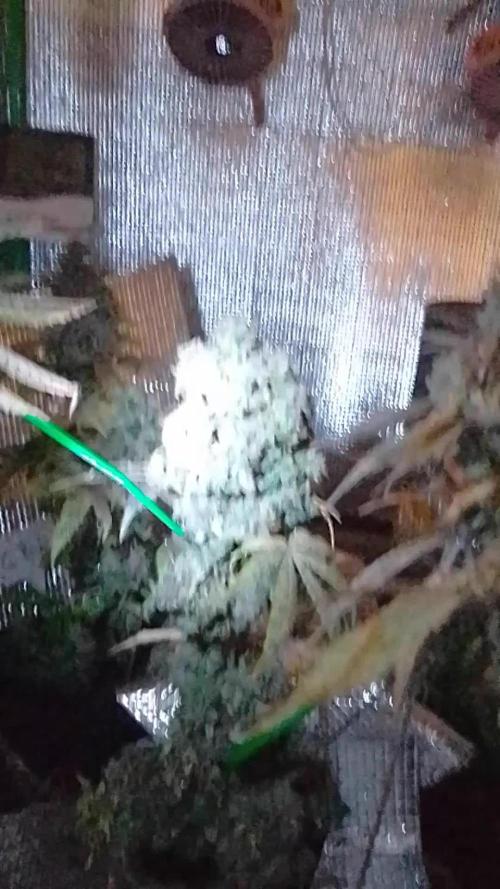
Fat @ss top! ♥️ She's staying white, I need her to turn shades This was the 3th and last seed. 3 succesful seeds out of 3, so couldn't be more happy!! ♥️♥️
Likes
7
Share
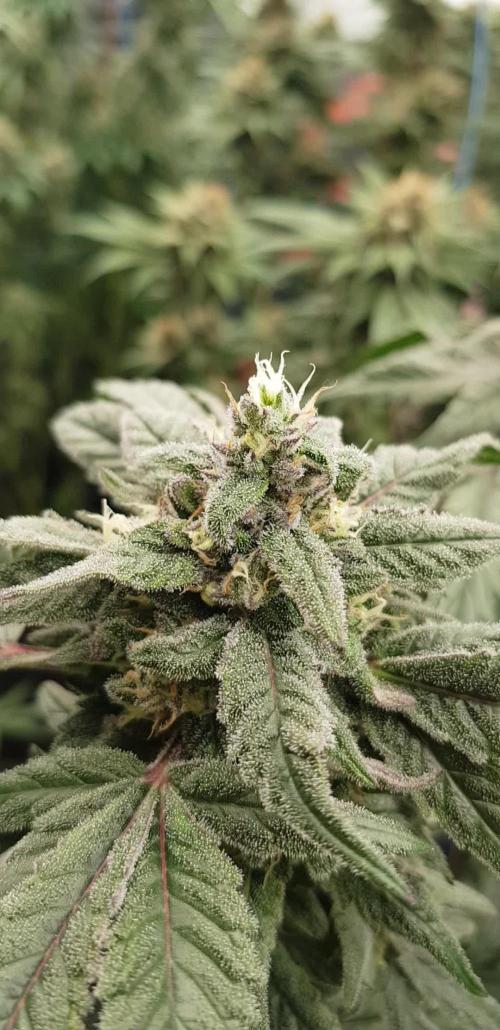
Temps were rough the last few nights but the girls look great tho, im hopping to achive some purple on them cause of the night temps, but other then that they are hopefully gone be done in the next month Date: 14.09.2024
Likes
10
Share
Likes
51
Share
Bueno resumiendo cookies gelato es una variedad híbrida muy fácil de cultivar pero ojo, cuidado con los últimos riegos si no queréis perder cosecha por moho. Lo demás de 10 pegada heavy sabor increíble, cogollos duros como rocas y bañados de una gran capa de polen. El ambiente del secado se mantuvo en 23 grados de media y la humedad estuvo por debajo de los 45% en todo momento. Poco más la verdad estuve encantado de poder cultivar una genética tan potente . Un saludazo que paséis un final de año increíble y por supuesto buenos humazooos💨💨💨.
Processing
Likes
25
Share
Ladies going smooth 1st week is behind and #1, #2, #4 are the best going. #5 stays behind and is the only one still in the 0.25cl cup the rest is 0.50cl now.
Likes
8
Share
Week 5: Pre-Flower Surge and Canopy Management Update: 27.06 2025 | Day 45 Consistent 32°C+ temperatures require watering every 2-3 days as roots fully occupy the 15L pots. Slow, edge-focused watering ensures lower soil activation without runoff. Strain Progress: Forbidden Runtz She's showing the furthest progress. Colas start to form and I only bend down branches that overshadow other parts of the plant. The smell develops a distinct fruity scent just by rubbing the stems. Can't wait for the full bloom aroma. This girl appears to be a definite winner in all aspects. Bruce Banner She's really pulling off the growth show now! Keeping up feels demanding - bending every new shoot while managing space constraints around the fabric pot. From above, numerous bud sites emerge through the canopy. The structure shows incredible potential - imagining this genetic as a photoperiod tree excites future plans. FastBuds delivers impressive genetics. Green Crack Last week's prediction holds true: overdrive mode engaged! While not matching Bruce's pace, she's nearly caught Forbidden Runtz in size. Within 48 hours, white pistils transformed nodes into defined bud sites. Strategic tie-downs on dominant tops redirected energy to younger shoots, creating a balanced canopy. Environmental Management: - Greenhouse humidity stabilized (25-28°C) - Evening watering with temperature-matched water - Zero runoff maintained to preserve soil biology Next Priorities: - Apply Bokashi juice (1:100) - microbes will activate Biotabs nutrients - Continue selective LST adjustments - Monitor lower canopy light penetration - Sniff aroma development daily The real bud porn begins when colas start stacking - patience and observation now pay dividends later. Catch ya next week. – Smoking_Joe_Frazier
Processing
Likes
18
Share
10/2: My soil mix was too hot and I accidentally killed 11 of the 12 Fastbuds seedlings I had going. So, I started about 20 Candy Cane hybrids in rapid rooters wetted with myco, tricho, and beneficial bacteria. All but one popped up. One of them did a cobra-basket and petered out. The beans all came from tray trash that accumulated while I was smoking three diff strains, so I probably won't know what they are until they are flowering. 10/4: Looks like I'll have enough growing that I have to cull the weakest few. I can feasibly (possibly) squeeze 14 into the lower section of the closet under 720w if they act right and if I do some training, and another 4 in the top under 200w if I keep them at 30" or less in height. 10/6: I think I'll veg everybody in the bottom section until I'm out of space, then move the shorter 4 or maybe 5 into the top section as necessary...and move the tiniest ones outdoors to finish. I just don't have the heart to kill anything that's got a potential yield of a half-ounce or more. Some of the most diminutive plants I've grown produced the stankiest buds.. I've currently got the 200w 3500k+660nm running at about 32" in the middle of the closet, and one of the 3 pairs of 120w 3000k+660nm quantum boards running at about 36" and should be sufficient coverage for the next week or so. Then I'll kick on the pair of boards closest to the doorway and spread them out a bit..and then I'll move the 200w light to the top section along with the best 4 short plants. At that point I'll turn on the center 2 qb's and install a 2 foot Solacure Flower Power UV light in the perpendicular center channel of my frame. 10/7: I installed my new AC Infinity 6" fan in the attic and hooked up a 16" carbon filter today. I used some sound deadening foam on the rafter that I mounted it to and removed 100% of the vibration. I haven't programmed the thermo/hygro stuff yet, but tested it on high and I can't hear a thing anywhere in the structure.👍 I'm also purchasing a dual 120mm fan system from AC Infinity in the door, behind the grille I already installed to serve as fresh air intake. It also has a thermostat feature that will allow me to set it to only come on when the temps are too high, so I'm optimistic that it will allow me to manage the temperatures in this closet with about 1000w running for 18-20 hours a day.🙏 I moved the 200w 3500k+660nm to the top section today and lowered my QB frame to 32" above the plants. I have two pairs of them running now, and received the replacement HLG 240-48A driver today for the third pair. I'll hook it up later..dont need it now.. 10/8: I fed most of them today for the first time...about 16 oz of solution containing grow big, big bloom, kelp me kelp you, boomerang, and armor si. I hooked up the 3rd pair of qb's today....wow that's bright....they're gonna love it!😎 The last of the sprouts has been planted and is growing. That's a total of 19.... 3 of them still in 1 liter pots and getting plain distilled water. I also foliar fed all of them with a little big bloom and kelp me kelp you. 10/9: I got some Axiom to apply onto them tomorrow. It's got a good amount of Harpin a|b proteins which trigger rapid plant growth and other defensive traits that are proven to be canna-friendly, like enhanced resin production and increased resistance to molds, mildews, and fungi. I foliar fed them today with big bloom kelp me kelp you, and the day following the Axiom application I plan to foliar feed them with Biotabs BoomBoom Spray to negate any initial ill-effects caused by the Axiom. I'll probably just mist them with distilled water for a day or two following that regimen to ensure that it's all rinsed off. But, following that break in the foliar feeding routine, I've got some Fulvic/Humic acid to rain gently over them for a couple of days. 10/11: End of week 1, and I'm happy with their progress thus far.😀 They had no trouble with the "Harpin protein attack" I engaged them with yesterday... at all, and even look quite a bit bigger than I expected. They also had their first "night time* last night...4 blissful hours in 74f temps with 48%RH.💤
Likes
8
Share
Ar first when she sprouted grows slowly and in early veg i made many stress and techniques in little pot before transplanted in big pot she grow really faster and get many inside stems whick i cut them all and stay only big n top ones it was very hard to make lst and somethimes i needed to make hst her stems are wildly hard as steel and not easy to give her nice bodybuilding she had many wound and cuts on stem. Flowering phase was amazing beautiful at first it was full white stretching so long middle stems nonstop growing whole 6week and only at last weeks she get many trichomes flavors and starting yellow pistils visually looked pineapple
Likes
30
Share
10/23: I fed today with One, sweet & sticky, signal, beastie bloomz, silica, and a little Ca/Mg 10/27: Fed today with one, signal, sweet & sticky, silica, beastie bloomz, kangaroots, and humic acid. Lowered the lights to no more than a foot from any cola..most are 7-9" away.
Likes
39
Share
Res change at day 29. Have to lower nitrogen a bit cause its clawing and pretty dark. Otherways everything is just fine and it grows nice. Ad calmag 5ml to 20L.
Processing
Likes
6
Share
@Flydope21
Follow
Week 2 veg. Starting some LST this week. Pretty new to this so hopefully all goes well!
Likes
2
Share
@TTerpz
Follow
Start of week 13 (Day 49 of flower) 9/20/25
Likes
21
Share
@Chubbs
Follow
420 Fastbuds Week 1 Amnesia Zkittlez Auto What up grow family. Started another yet amazing strain for this run. Looking forward to the weeks to come and see what they'll become. During the germination process 48hrs after putting the seeds in the soil I noticed a tap root coming out the top of the soil. So after digging the one out and realized it sprouted upside down the 2 codylindens do have a little yellowing on the tips but over all looks healthy. All in all Happy Growing
Likes
4
Share
@Roots89
Follow
🍁 Mexikan Airlines Automatik (42 Fast Buds) Endphase 💪🏻
Processing
Likes
14
Share
@Canadian
Follow
The plant is doing very well is filling up with flowers everywhere and it has a fruity skunky smell to it very nice I can't wait to see it fully developed . For now not much to talk about her except that she's doing pretty good developing good and very fast thank you for reading I will continue to update have a happy grow
Likes
41
Share
Well I have to say even though I had a few temperature issues in the night that I think may have stressed them. They took a lot longer than expected but after drying I don’t know how but I ended up with some fantastic tasty buds a few of the plants even came out purple!! I have to say the purple buds are my favourite 🤩 fastbuds never disappoints!!!!!
Likes
4
Share
RAW GROW is a tested blend of all 12 RAW Soluble plant nutrients, essential elements and supplements. This blend has been proven to be an optimal all-in-one base “Grow” horticultural fertilizer. RAW GROW is used through out the entire vegetative stage. Derived from: Plant protein hydrolysate, mono potassium phosphate, potassium sulfate, cane molasses, sodium borate, copper sulfate, iron DTPA, magnesium sulfate, manganese sulfate, zinc sulfate and azomite. Also contains non-plant food ingredients: Humic acids derived from leonardite and peat, kelp (ascophyllum nodosum), silicon dioxide derived from diatomite and yucca extract. When you overlap a copper wire to attract ions, it is called ion exchange. Copper wire is often used as a material for ion exchange because it has a high affinity for positively charged ions, such as copper, zinc, and nickel. When copper wire is overlapped or wound into a coil, it creates a surface area that attracts ions and allows them to bind to the wire or gather within the space. This process is used in various applications, such as electroplating, water treatment, chemical separation processes and cultivation. Electrolysis is a chemical process that involves passing an electric current through a liquid or solution containing ions. This process causes the ions to migrate towards the electrodes, where they undergo a chemical reaction. In the context of plant growth, electrolysis is used to increase the availability of your nutrient-rich solution that can be used to feed plants. Electrolysis and nutrient rich reservoirs work well together since your cannabis nutrients are salt based. The process involves passing an electric current through a solution of water and plant nutrients, which causes the water molecules to break down into their constituent parts, hydrogen, and oxygen. The hydrogen ions (H+) then combine with the nutrients in the solution to form a nutrient-rich substance that can be absorbed by the plant roots easier. This will only work in a nutrient rich solution as it requires the salt-based nutrients to engage. This process, known as hydrolysis, provides the plant with a continuous supply of nutrients and oxygen, which can help to increase plant growth and improve yields. By providing the plant with a more efficient method of absorbing nutrients, electrolysis can help to increase the uptake of essential elements such as nitrogen, phosphorus, and potassium. Additionally, electrolysis can help to maintain the pH balance of the growing medium, which is essential for optimal plant growth. One of the key advantages of using electrolysis to increase plant growth is that it allows for greater control over the growing system. This is exactly why this is generally a technique reserved for advanced hydroponics growers. By adjusting the voltage and current levels, cultivators can custom control the nutrient concentration and pH level of the solution, ensuring that the plant receives the optimal amount of nutrients sitting perfectly on potential hydrogen spectrum. Carotenoids absorb light in the blue-green range of the visible spectrum, complementing chlorophyll's absorption in the red range. Carotenoids protect photosynthetic machinery from excess light. They deactivate singlet oxygen, which is a harmful oxidant formed during photosynthesis. Carotenoids quench triplet chlorophyll, which can be harmful to photosynthesis. Carotenoids scavenge reactive oxygen species (ROS), which can damage cell membranes and proteins. Carotenoid derivatives signal plant development and responses to environmental cues. Carotenoids provide precursors for the biosynthesis of phytohormones like abscisic acid (ABA) and strigolactones (SLs). Carotenoids are pigments that give fruits and vegetables their orange, red, and yellow colors. They also act as free radical scavengers to protect plants during photosynthesis. Beta-carotene is the most common provitamin A carotenoid. It's found in orange and yellow fruits and vegetables like carrots, sweet potatoes, and mangos. Other carotenoids include lycopene, lutein, and zeaxanthin. These carotenoids have antioxidant and photoprotective properties. In plants, Vitamin A is found as carotenoids, which are pigments that give plants their color. Vitamin A is a fat-soluble vitamin. Vitamin B plays a vital role in plant growth and development. It acts as a coenzyme in many metabolic reactions, which are the basis for plant growth and maintenance. Vitamin B helps plants metabolize nutrients, which are essential for growth and development. Vitamin B helps plants respond to biotic and abiotic stress. Vitamin B can help plants grow new roots, which can reduce transplant shock. Vitamin B can help plants grow shoots, especially slow-growing plants. Vitamin B1 Also known as thiamine diphosphate, vitamin B1 is a key component of metabolic pathways like glycolysis and the tricarboxylic acid cycle. Vitamin B3 Also known as nicotinamide or niacin, vitamin B3 is a biostimulant that can improve plant growth and yield. Vitamin B6 Vitamin B6 acts as an antioxidant and cofactor, and is involved in plant stress responses. Vitamin C, also known as ascorbic acid, is a vital nutrient for plants that helps with growth and protects them from excess light. Vitamin C acts as a redox buffer, which is important for regulating photosynthesis. Vitamin C helps enzymes that regulate photosynthesis, hormone production, and regenerating antioxidants. Vitamin C is a coenzyme in the xanthophyll cycle, which converts excess energy into heat. This process helps plants protect themselves from too much light. seedlings to young plants can feed on 200-400 PPM, Teenage plants that have a maturing root zone can feed on 350-550 PPM and adults will feed 600-1000 PPM. The more you feed plants and watch them grow you'll get a feel for how much to give them. Less is more when trying to grasp this. High level of CEC in organic soil so I'm watering 5-gallon