


Likes
Comments
Share

@GermGrowFox
Follow
22. Dezember
Video ist von gestern, die restlichen Bilder von heute.
Wir neigen uns dem Ende zu :)
Alle drei sind sehr unterschiedlich weit in der Reife.
Nachdem ich doch eine milde Maus bin bin ich ganz happy über das Profil der Trichome:
Links: relativ viele durchsichtige Trichome, wenig milchig, Bernstein konnte ich keines finden
Mitte: die kleinste Pflanze die schon früher anfing zu blühen. Sie hat viele milchige Trichome und viele bernsteinfarbene. Durchsichtige habe ich kaum gefunden. Kann mir vorstellen das diese Lady für meinen Geschmack zu sehr klatscht x) aber das gilt es noch herauszufinden
Rechts: visuell gefällt sie mir am besten! Die Blüten und die Wachstumsstrucktur ist wunderschön! Trichome hier sind überwiegend milchig, sehr wenig bernsteinfarben und wenige durchsichtig. So hätten vermutlich alle drei werden sollen 😅 ich werde wohl auf meine klimatischen Bedingungen im Zeöt nochmal etwas Einfluss nehmen müssen damit sich das besser deckelt.
Die Lampe ist aus, die Töpfe furztrocken und der Zustand wird jetzt noch mindestens drei Tage gehalten.
Plan ist um die Weihnachtsfeiertage zu ernten.
Ich stelle mich auf einen langen schnippelprozess ein, da es doch schon viieeeel Pflanze ist x)
Ich update dann wieder sobald es soweit ist.
Euch wünsche ich schöne Feiertage ❤️ geniest eure Zeit ❤️

Likes
8
Share


@pzwags420
Follow
Week 12 has started well. The flowers are still growing and the smell is still great :) I applied weekly nutrients on day 1 of week 12. On week 12 day 4 I added Z7 enzyme to my reservoir and I defoliated the girls to bring in more light to the lower canopy. On day 5 I decided to harvest two colas from Pheno 2. It seems to be finishing faster than the other phenos(mostly amber hairs although trichomes are not mature after closer inspection... I want to experience what effect I get from early harvest so to compare to later harvest. From now on I will leave the plants alone until they are all closer to harvest. 😅

Likes
5
Share


@Bengrowerbr
Follow
this plant surprised me, its flowers became dense and heavy, much more than its mother's. The yield was much better than I imagined. I am really satisfied. I had never cloned an autoflowering plant and that sounds cool.


Processing
Likes
12
Share


@2Stones1Bird
Follow
Checkout my Instagram @smallbudz to see the Small budget grow setup for indoor use, low watt, low heat, low noise, step by step.
04/01/2020 - Did the last defoliation, removed about 1/4 of plant material.
06/01/2020 - Fed her 1.5l of 6.5PH water with 0,3ml Cal Mag (Atami) 0,25ml of Grow, 0,6ml of Bloom and 0,5ml Max, and 1ml of each: Heaven, Alga-mic and Vera, noticed some run off, I use about 1/3 of the nutrient dosage on the chart, to achieve about 200/300PPM (500 scale).

Likes
6
Share


@eldruida_lamota
Follow
Que pasa familia, vamos con la cuarta semana de crecimiento de estas Lemonpaya feminizadas de fastbuds.
Vamos al lío, de las 3 plantas, me quede con 2 por espacio, siempre pongo alguna semilla de más por si no abriese alguna por no perder ese hueco del indoor.
También se trasplantaron a su maceta definitiva, en este caso de 7 litros que además provocó un shock que también solucione.
El ph se controla en 6.2 , la temperatura la tenemos entre 20/22 grados y la humedad ronda el 50%.
Hasta aquí todo, Buenos humos 💨💨💨
Likes
4
Share

@DogDoctorOfficial
Follow
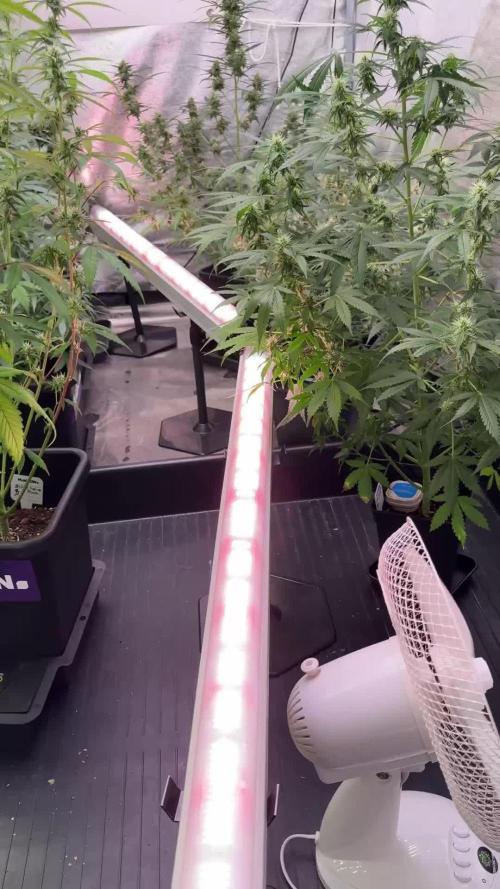
🌿 Frosted Guava Auto by Zamnesia | Pheno A | Week 9
✨ She's Shining — And Sometimes Beautiful Plants Need a Little Cleaning
Welcome back to another chapter of the 8×8 Adventure!
And our Frosted Guava girl?
She's still shining. 🌿✨
Actually...
She's shining more and more.
The flowers are developing beautifully, the plant remains lush and green, and those gorgeous flowering structures are becoming increasingly impressive.
But this week wasn't just about watching her grow.
This week, she told me something.
She needed a little attention.
Not because anything was wrong.
Not because she was struggling.
Simply because she had reached the point where some of the older, tired leaves had done their job and it was time to clean things up.
So...
we did exactly that.
A little defoliation.
A little cleaning.
A little maintenance.
And then?
Back to letting this beautiful girl do what she does best.
Grow.
Flower.
And shine. 💚
🌱 The 8×8 Adventure Continues
For anyone discovering this diary for the first time, welcome to the 8×8 Adventure.
This project is all about watching different genetics and phenotypes develop under the same general environment.
The same room.
The same 12/12 lighting schedule.
The same environmental philosophy.
The same nutrition strategy.
The same lighting ecosystem.
And yet...
every plant tells a completely different story.
Frosted Guava Pheno A has been writing hers beautifully.
She's not necessarily the biggest plant in the room.
She's not trying to compete with every phenotype around her.
She simply has her own personality.
And right now, that personality is becoming very easy to recognize:
lush, green, balanced, beautiful, and increasingly frosty.
✂️ This Week: Time for a Cleanup
Last week I was looking at her thinking:
"She's looking really good."
This week I was looking at her thinking:
"Okay girl... I think you need a little haircut." 😂
There were older leaves.
Leaves that had started to fade.
Leaves that were no longer contributing much to the plant.
And there were a few areas where the canopy simply benefited from a little more organization.
So we went in and cleaned her up.
Nothing extreme.
Nothing crazy.
No stripping the plant bare.
Just a sensible removal of the leaves that had reached the end of their useful life and a little bit of canopy maintenance.
Because there's an important difference between defoliating a plant because you think you should...
and cleaning a plant because you've actually looked at the plant and decided it needs it.
This week was the second one.
🍃 We Don't Need to Take Everything
One thing I always want to make clear when I talk about defoliation:
The goal isn't to remove every leaf.
Far from it.
Healthy leaves are still part of the plant's machinery.
They're capturing light.
They're contributing to photosynthesis.
They're supporting the developing flowers.
So even after the cleanup, plenty of healthy foliage remains.
I took what needed to come out.
I left what still had a job to do.
And that's the balance I'm looking for.
You don't need to make a plant look naked to call it clean.
You need to make the plant appropriate for the environment it's growing in.
And Frosted Guava now looks exactly where I want her.
Clean enough.
Open enough.
But still beautifully green and full of life.
The Job Isn't Finished When the Leaves Come Off
And here's something that I think deserves much more attention in grow diaries:
What happens after defoliation?
Because removing old leaves from the plant is only part of the job.
If those leaves fall onto the floor...
they don't magically disappear.
😂
They stay there.
They dry.
They break down.
They can accumulate underneath plants, around pots, in corners and in places where we don't necessarily notice them immediately.
And that's not what I want inside my growing environment.
So after cleaning the plant...
we clean the room.
Old leaves come out.
Plant debris comes out.
The floor gets cleaned.
The areas underneath the canopy get checked.
Anything that shouldn't be there...
gets removed.
Because maintaining a clean growing environment isn't about making the room look pretty for photographs.
It's about good hygiene.
It's about reducing unnecessary organic debris.
It's about making the environment less welcoming to unwanted problems.
And when you're running a full room like this...
cleanliness matters.
🌿 A Clean Plant in a Clean Environment
This is something I've learned more and more throughout the 8×8 Adventure.
The plants are only one part of the ecosystem.
The room itself matters.
The floor matters.
The pots matter.
The airflow matters.
The surfaces matter.
The little pieces of dead plant material hiding underneath the canopy matter.
Everything contributes to the environment.
So when we clean a plant, we're not finished when the scissors stop moving.
We clean the whole area.
And then we can close the tent and say:
"Okay. Now we're ready for another week."
That's exactly what we did with Frosted Guava.
🌸 And She's Looking Beautiful
And after all that maintenance...
the best part?
Look at her.
She's beautiful.
The green is still gorgeous.
The flower structures are developing beautifully.
The calyxes are becoming more pronounced.
The white pistils are still standing proudly throughout the flowers.
And the resin development continues becoming increasingly visible.
This is one of those plants where I genuinely enjoy looking at the photographs because there's so much going on.
From a distance, you see the overall structure.
Move closer...
and suddenly you're looking at individual flowers.
Move closer again...
and the calyxes and pistils become their own little world.
That's what makes this stage so fascinating.
The plant is still changing.
Every week.
❄️ Frosted Guava Is Living Up to Her Name
And yes...
the frost continues.
It's becoming increasingly easy to understand where the name Frosted Guava comes from.
The flowers are developing that increasingly sparkling appearance, with resin becoming more obvious across the developing structures.
We're still not at the finish line.
Not even close to making any final judgments.
But she's certainly giving us a beautiful preview.
And those white pistils?
I love them.
They're still fresh and prominent throughout the flowers, giving the plant that wonderful contrast between deep green foliage and bright flowering sites.
It's one of those combinations that never gets old.
☀️ Still Eating Photons
The lighting strategy remains the same.
The Future of Grow Black Series LED continues providing the primary overhead lighting, while Lumiflora continues contributing additional light into the lower portions of the canopy.
And Frosted Guava is still doing what plants do best:
turning photons into plant.
Leaves capture light.
The plant uses that energy.
Structure develops.
Flowers develop.
And eventually we get to see the result of all of that work.
At around 1,000 PPFD across the upper canopy, there is plenty of light available above.
The under-canopy lighting adds another interesting dimension to the experiment, particularly as the room becomes increasingly full.
And Frosted Guava has plenty of flowering sites to keep us interested.
💧 Feeding Continues
The nutrition program remains consistent.
🌱 Plagron Terra Bloom — 2.2 ml/L
🌿 Plagron Power Buds — 1 ml/L
✨ Plagron Green Sensation — 1 ml/L
🍯 Plagron Sugar Royal — 1 ml/L
⚗️ Plagron pH Plus — 0.03 ml/L
🍋 Plagron Lemon Kick — 0.03 ml/L
Current recorded parameters remain around:
pH: 6.0
EC: ~2.0 mS/cm
Watering: ~1.3 L per plant / 24h
Solution temperature: 25°C
Substrate temperature: 26°C
And visually, she continues responding beautifully.
There are no dramatic changes required.
No reason to reinvent the program.
She's growing.
She's flowering.
She's building.
So we're continuing to let consistency do its job.
🌡️ Week 9 Environment
Current conditions:
🌸 Flowering: Week 9
📏 Height: 120 cm
💡 Light schedule: 12/12
🌡️ Day temperature: 29°C
🌙 Night temperature: 25°C
💧 Relative humidity: 60%
⚗️ pH: 6.0
⚡ EC: ~2.0 mS/cm
🌡️ Solution temperature: 25°C
🌱 Substrate temperature: 26°C
🌬️ CO₂: 639 ppm
? Pot size: 15 L
💦 Watering: ~1.3 L per plant / 24h
Stable.
Consistent.
Predictable.
Exactly what I want while the plants continue doing their thing.
📸 This Week's Gallery
This week's photographs tell two stories.
The first is the plant itself.
Beautiful flowers.
Beautiful leaves.
Beautiful structure.
Beautiful colour.
Beautiful development.
The second story is what happened around the plant.
The cleanup.
The older leaves coming out.
The canopy becoming a little more organized.
And then the room being cleaned afterward.
I think that's worth documenting too.
Because growing isn't just about taking the beautiful photographs when everything looks perfect.
It's also about the work that happens behind those photographs.
The cleaning.
The observation.
The maintenance.
The little decisions.
The things nobody sees when they look at the final picture.
That's part of the 8×8 Adventure too.
Clean Room, Happy Room
There is something extremely satisfying about finishing a cleanup and looking around the tent.
No old leaves lying around.
No unnecessary plant debris.
The floor is clean.
The canopy is tidy.
The plants have room to breathe.
And then you step back...
and look at the whole 8×8.
That's when you realize how far this project has come.
What started as individual plants has become one enormous flowering garden.
Every phenotype different.
Every plant with its own personality.
And Frosted Guava has found her place right in the middle of it.
🔭 Looking Ahead
Now?
We let her work.
The cleanup is done.
The room is clean.
The healthy foliage remains.
The flowers continue developing.
And Frosted Guava can simply concentrate on the next stage of her journey.
I'm especially curious to see how much more those beautiful flowers will develop from here.
The calyxes.
The pistils.
The resin.
The density.
The final structure.
There is still plenty of story left to write.
And I have no intention of writing the ending before she does.
💚 Final Thoughts — She's Shining
Frosted Guava Pheno A is becoming one of those plants that doesn't need an introduction anymore.
You look at her...
and you know why she's here.
She's beautiful.
She's healthy.
She's balanced.
She's green.
She's flowering beautifully.
And she's getting increasingly frosty.
This week she needed a little attention.
So we gave it to her.
We removed the older leaves that needed to go.
We kept the healthy ones.
We cleaned the canopy.
And then we cleaned the room.
Because good cultivation isn't only about what happens on the plant.
It's also about what happens around the plant.
Old leaves don't belong on the floor.
Dead plant material doesn't belong underneath the canopy.
And unnecessary debris certainly doesn't belong inside the growing environment.
So we clean.
We remove.
We reset.
And then...
we let the plants shine again.
And Frosted Guava?
She's doing exactly that.
She's shining. ✨🌿❄️
The green is beautiful.
The flowers are beautiful.
The calyxes are beautiful.
The white pistils are beautiful.
The frost is coming.
And the whole plant is telling me the same thing:
"I'm not finished yet."
Good.
Because neither am I.
Let's see where this beautiful girl takes us next.
🙏 Thank You
A huge thank you to everyone following the 8×8 Adventure.
Thank you to Zamnesia for these Frosted Guava genetics.
Thank you to Plagron for supporting the flowering program.
Thank you to Future of Grow LED for the main lighting driving this garden.
Thank you to Lumiflora for bringing the under-canopy lighting dimension into the experiment.
Thank you to TrolMaster for helping maintain the environment behind the scenes.
And, of course, thank you to the incredible GrowDiaries community for following, commenting, sharing knowledge and growing alongside me.
This adventure isn't just about the final flowers.
It's about everything that happens along the way.
The experiments.
The phenotype differences.
The successes.
The mistakes.
The maintenance.
The cleaning.
The photographs.
And all those little lessons that appear when you stop and actually pay attention.
Frosted Guava Pheno A is giving me another one this week.
Sometimes you don't need to change the plant.
Sometimes you just need to clean the plant, clean the room, step back... and admire what you've built.
And damn...
she's beautiful. 💚🌿❄️
Growers Love & Happy Growing! 🌱💚

Likes
54
Share


@Fibro_Witch
Follow
I'm very happy to say that I had 100% germination rate across the board👏
All my ladies started to come up on April 24th, including an extra!
In the few years that I've been growing, I've probably started around 50+ seedlings, but having 2 seedlings come out of 1 seed is new for me. I'm curious to know if anyone else has come across this. Regardless, it's pretty cool and I'm happy. My only concern is how viable the 2nd seedling will be. I feel like I need to wait until she's stronger before I try extricating her from her twin, since she's a few days behind in this very sensitive stage. But at the same time I don't want to wait too long because their root systems will only become more intertwined. We'll just have to see.
Once these babies began getting upright on April 25 I put them under 3 Litever 24v grow light strips. On April 27th they were hitting the roof of the humidity dome so I took them off the heat mat and put them in a south facing window for the morning and put them under the lights in the afternoon. The next day on 4/28 it was absolutely gorgeous out, 60F clear and sunny so I put them in the south flower bed in front of my house and they drank in the sun. The 29th was overcast and chilly so they stayed in the house under the lights. Same thing today.
No nutes this week, as the potting soil still has a little more to give, but they'll be getting some Nitrogen soon. See y'all next week👋


Likes
6
Share


@KushClicks
Follow
Week 6 Update
Things are doing really nicely in my auto tent.The buds are starting to fatten up. The purple pheno looks amazing 😍. The Mixed Auto #3 is doing great even though her leaves are curled. I'm letting her dry out longer before I water her. Also the 2 autos to the back are 1 week behind the 2 to the front
Can't wait to see how they look this coming week.
See yall next week!
Don't forget to use my code STLVDXW for an extra 15% off your next order at fast buds
#fastbuds


Likes
101
Share


@morganfreeman420
Follow
Las temperaturas volvieron a bajar y llegan algunas tormentas que incrementan riesgo de botritis de hecho una de ellas cogió el hongo por lo que hice un lavado rapido de raices quite las zonas mas afectadas y corte la planta para ponerla a secar
Likes
28
Share


@PEAKYPLANTERS
Follow
Hello everyone, brother gardeners.
welcome back to queen peaky's diaries
this week we saw how autoflowering plants reacted to the high stress technique
now the buds are re-emerging from under the scrog net

Likes
33
Share


@LouShott
Follow
She is slowing down on the explosive growth now, and starting to ripen up, thinking 1 maybe 2 weeks till harvest!
Update- ive uploaded some pictures of the trichomes what do you guys think mainly cloudy?!?


Likes
6
Share


Likes
Comments
Share


@GrowDiaries
Follow
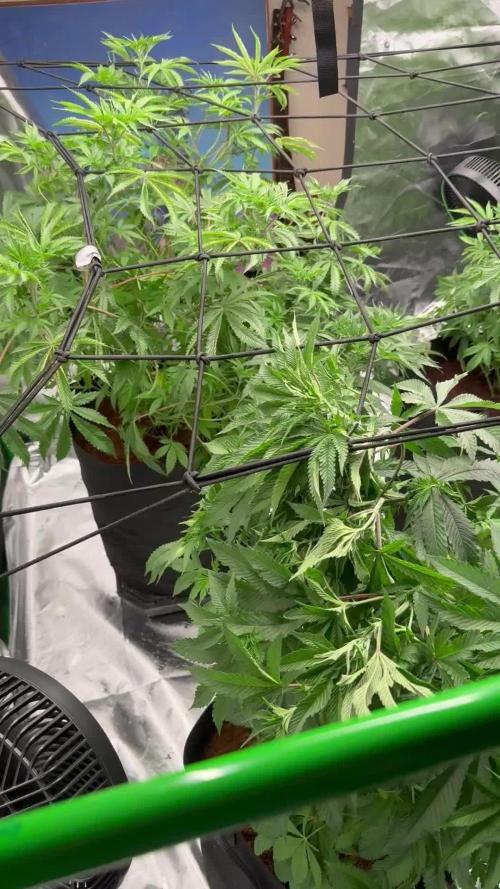
Best Ventilation Fans Brand 2025 AND Best Grow Tents Brand 2025
Double triumph! AC Infinity snags Best Ventilation Fans Brand 2025 AND Best Grow Tents Brand, voted by our growers! Huge shoutout to our community! #GrowDiaries
@acinfinityinc @spannabis_official
Likes
22
Share


@CampExotic
Follow
So my 5 plants have been split up. My first two chopped are now curing up. Preparing to chop the rest. Smells like nothing or gassy. Don’t overshock your plants people! 7 days of drying and stems were snapping. 3 in the pink isn’t quite ready yet.


Likes
Comments
Share

@1888lol
Follow
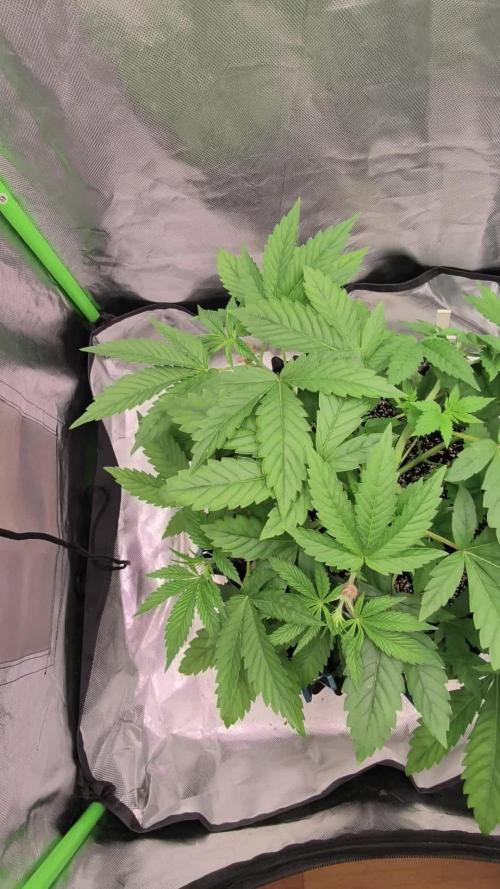
She has a nice progress, I'm very happy to watch how she grows, amazing strain, thanks for Fustbuds for this super genetics 😀
Likes
119
Share


@Natrona
Follow
Week 9 6/2-6/8
Now at the start of week 9, my outside gals, except L. Cake are now in flower. One of the last top view photos 6/2 of Opium shows flowers forming. She is over 6 feet tall. From the side view photo of Opium last week to the photos take 6/3 show a growth spurt compared to the zinnia in the flower stand behind Opium. This is the first week I’ve had to add nutrients to her feeding. Some lower leaves were yellow. Since I’ve been using amended soil, this indicates Opium is a heavy feeder. Nutrients in soils are used up and she is starting to use her own food sources.
Our temperatures are nearing mid 80's with high humidity. The plants are requiring at least a gallon of water a day.
5 gallons well water
TPS1 60ml used 1 gallon per plant =12ml
Cal-Mag 25ml used 1 gallon per plant =5ml
Recharge 5ml used 1 gallon per plant =1ml
Signal 1.25ml
PPM 1414, PH 6.93, Temp 82.5
Note I do not have to PH adjust my well water. However, our city water comes out of the tap at 8.2 ph so I must PH down using the hose or my inside grows,
============
Germination April 6.
Vegetation
Week 1 water only
Week 2 water only
Week 3 added recharge and TPS1 increased ppm to 570.
Week 4 continues with recharge and TPS1. I added Fox Cal mag increasing ppm to 685 - 805.
Week 5
TPS1 9ml/gal
Recharge 5 ml/gal
Fox Cal-mag 5 ml/gal
Week 6 5/12-19 Moved outside in 5 gal air pots receiving rain and well water.
Week 7 5/19-25
Since I was in Colorado last week, I feel very behind on my diaries. Opium received only rainwater for the last 2 weeks. She is 38 inches and has huge leaves. Some have 13 fronds on one leaf. She is taller than the cage support by 2 feet. I removed the peony cage support because Opium phenotype is tall and lanky. Sativa structure all the way.
Week 8 5/26-6-1
Fractal And Opium from Divine Seeds love the natural rain and sunshine evidenced by vigorous growth. Opium is over 52 inches tall and her crown is above my eye level so you may not get anymore top views
They love the natural rain and sunshine evidenced by vigorous growth.
Thank you @DivineSeeds
Thanks for the visits, likes and comments, I appreciate all the plant love💚.
Have fun & love what you grow 💚
Sending you good vibes of love, light, and healing 💫
💫Natrona 💫
DIVINE SEEDS
***OPIUM***
Harvest:1000 g/m2
Divine Seeds developed Opium as a new champion strain, unprecedently powerful and loaded with unbelievable quantities of resin. Certainly, no average genetic base could be behind such brilliant parameters! Several Afghani Indica landraces, recognized as most potent and resinous, were bred together with a mighty Brazilian Sativa which Opium inherits its bright berry taste from. Then a great deal of work followed aiming for the highest THC level and endurability as well as a branchy structure that would provide maximal yields. Now we can proudly title Opium the best Indica you could dream of growing!
Indoors these plants mostly stay mid-height (1.5 m), reaching up to 2.0 m out of doors. Depending on your height limitations, Opium flourishes universally in grow boxes, balconies, green houses and terraces. Due to its Afghani parentage, this strain can stand hot weather if provided enough water and some shadow. Responds well to any training techniques: ScroG and SoG, LST, topping and FIM, supercropping. The start of blooming is marked with a rush of growth, when plants stretch almost 1.4x. Expect heavy colas that often require additional supports. Whilst ripening, Opium gives off a pungent earthy stench with fruity and berry undertones, also a bit of pine. Ready for outdoor harvesting in October.
The stoning psychedelic impact of Opium is like being hypnotized (unless you’ve had too much, then it feels more like a blackout). Stone-lovers will appreciate every minute with Opium: its spicy taste immerses your mind into daydreaming, while the body rests flat. Recreation with this psychedelic Indica means silent tripping from one insight to another. Mighty enough to kill chronical pains, Opium is also medically efficient against insomnia, nausea, appetite disorders, muscle spasms, headaches, irritation, fatigue, panic attacks, epilepsy. Best consumed at night time, the effects keep going for up to 4 hours.
Equipment and nutrients
Pots: 5gallon Air pots
Soil Fox Farm Happy Frog Amended with worm castings, dolomite lime and mychorihiza Recharge
Seeds provided by Divine Seeds
Divine Seeds breeding company
The link to Opium Feminized Seeds
Opium - Divine Seeds breeding company