


Processing
Likes
Comments
Share


@AsNoriu
Follow
Day 141 of life and 56 of flower. This girl had hard times and i think to make it even harder.
From now on i will raise my ph to 7.0 for rest of her life. Hope to keep her for two more weeks and stab her on the last day before 3 night sleep and chop later.
She has a bit amber, hope i still have time , i keep an eye on her every day.
Thats all plans left, want to split stemp and put wood stick in that wound.
I know it would be smarter to make with next diary and compare with unmade, but ... I want to try this out , first date will be short, later i will increase time to a week before chop if it works like i think and many people tell..
Happy growing !
Day 142. All is good !
Day 145. Girl is fine, green fading slowly. But ..
She is skunk, she stinks like skunk, while smoke you feel it a lot plus a small aftertaste, maybe its strawberries, but cant tell for now.
Anyway - i like her, just her real genetic name is a mystery a bit ;)
While she was flowering, on week 3 you could smell strawberries, but now i am lost in that taste ...
Bag seed, you never know what it will be ...
Watered today still with 6.5, thinking to give her last two waterings and chop her next thursday or so ...


Likes
36
Share

@Comfrey
Follow
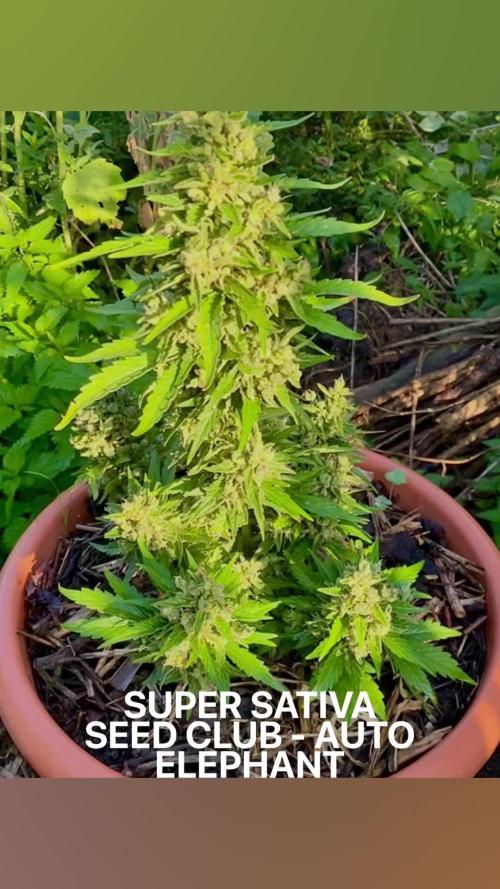
Der Duft lies etwas nach, die Luftfeuchtigkeit stieg an. Ende. Der Anbau dauerte nur 83 Tage vom Samen bis zur Ernte der reifen Blüten.
Auto Elephant ist leider in der Hitze bei über 37 Grad Mitte der dritten Woche in die Blüte gegangen. Ich werde sie nächstes Jahr wieder anbauen und auf stabileres und milderes Klima in der Vegetation hoffen. Auch der sehr stickstoffreiche Schwarzkohlekompost hat ihr Probleme bereitet, so vermute ich. Er eignet sich wohl besser für photoperiodische Sorten als für Autoflower Genetik. Ich werde den Kompost beim nächsten Mal anpassen müssen.
Die Blüten hängen zum Trocknen. Ich melde mich bald mit dem Ergebnis und in ein paar Wochen mit einem Vape Bericht. Es ist meine zweite Elephantendame und soviel kann ich schon jetzt sagen: Bombe! Super harzig, extrem lecker. Ein High, wie als wenn du auf einem Elephanten sitzend durch die Wolken schwebst und dabei einen Blick auf die Dinge bekommst, die dir ansonsten verborgen blieben. Ein High wie damals beim ersten Mal. ;-) 🍌😄
Danke für‘s vorbeischauen. Bis demnächst.
🐘🌱🌵🔥


Likes
10
Share


@Cr4zyElite
Follow
🌱 First week of my cannabis growing adventure with autoflowers! 🌟
As a newbie, I'm diving into the art of low stress training early on because autos have a shorter grow period and I'm curious to see how far I can push the limits. Just experimenting and gathering valuable experience in this rapid growing phase! 📚
✨ Planted in light mix soil with added worm castings in fabric and plastic pots to compare outcomes. Exciting times ahead! 🚀

Likes
50
Share


@Rwein93
Follow
Ciao ragazzi e bentornati da me per una nuova pagina di questo diario!😉
Che dire ragazzi tutte le sorelle sono fantastiche.😍
La numero 1 è il capo famiglia, davvero imponente.
La numero 2 ha staccato le altre di 5 cm, ora è lei la più alta con i suoi 155 cm.
La numero 3 invece ha i buds già bellissimi.
Nel complesso crescono bene e forti con una distanza intermodale marcata che le fanno respirare bene. Ora le fragoline misurano circa 1 cm di diametro e quelle della numero 3 misurano circa 1.5 cm💪
L odore inizia a marcare i suoi aromi, pungenti note di mapo (Citrus × tangelo) si mischiano a leggeri sentori di gasolio.😋
Ho defogliato loro nel giorno 67 e ho allargato tutti le apicale dalla pianta 1 con Lst, i nuts rimangono invariati.👍
Eh niente! Anche per questa settimana è tutto ragazzi.
Grazie a tutti per aver guardato e restate sintonizzati per nuovi aggiornamenti.🙏
Buona settimana e felice crescita 🌱 🌱 🌱

Processing
Likes
Comments
Share


@MOTB666
Follow
first day of putting into setup forgot to check water temp ended up getting to 77 may also be why #3 started teisting bad. Roots already coming out of bottom seem healthy. I am in growing in my garage I have an ac unit hooked up but still hit temps of just under 80 degrees a few days but got Temps back down around 75 during the day.

Likes
Comments
Share

@DogDoctorOfficial
Follow
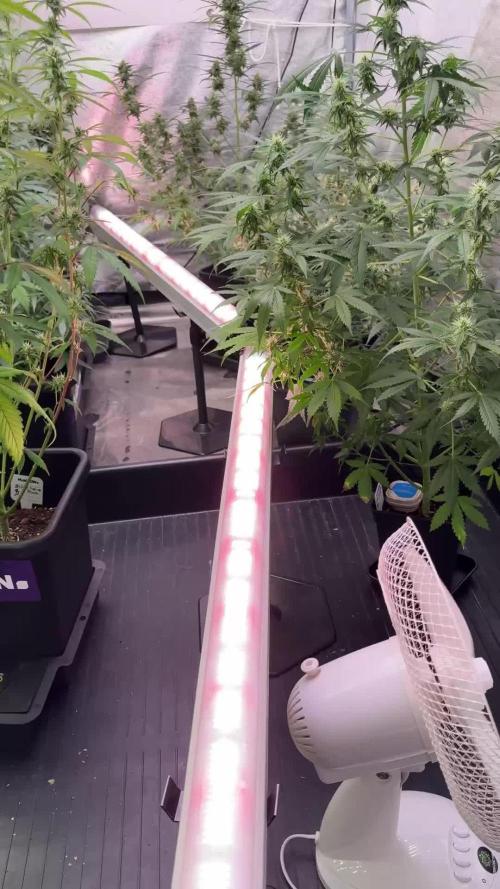
🌸 Pink Rosay Auto by Zamnesia | Pheno B | Week 9
💗 The Little Dwarf That I’m Very Glad I Kept
Some plants make you stop because they're enormous.
Some make you stop because they're covered in huge flowers.
And then there are plants that make you stop because you simply can't believe how much personality they've managed to fit into such a tiny body.
Pink Rosay Pheno B is one of those plants.
She's still a dwarf.
😂
There is no point pretending otherwise.
She's tiny.
She's compact.
She's becoming incredibly dense.
And honestly...
I absolutely love her.
When I look back at the beginning of this grow, I have to admit something.
If I had only been growing a few plants, I probably would never have given a phenotype like this the opportunity to finish.
She's just too small.
There would have been a temptation to look at her, compare her to the others, and think:
"Maybe this one isn't worth the space."
But that's exactly why I love having twelve different genetics in the 8×8 Adventure.
I didn't remove her.
I gave her time.
And now?
She's standing there covered in flowers and frost, looking absolutely adorable.
And I'm very, very happy I kept her.
🌸 Week 9 – Still Tiny. Still Beautiful.
Pink Rosay Pheno B is currently around 63 cm.
Sixty-three.
😂💗
Compared with some of the giants in this garden, she's practically a bonsai.
But here's the funny thing.
When I look at her now, I don't really see the height anymore.
I see the plant.
And the plant is beautiful.
Her structure is extremely compact, the internodes are tightly packed, and the flowers are becoming increasingly dense throughout that little framework.
She's not wasting much space.
She's not reaching endlessly upward.
She's simply putting everything she has into the structure she already built.
And that's becoming her signature.
Tiny frame. Dense flowers. Big personality.
💗 The Dwarf Is Getting Dense
This is probably the biggest change I'm seeing this week.
She's becoming really dense.
The flowers are no longer looking like little isolated flowering sites scattered across a miniature plant.
They're becoming proper little clusters.
The calyxes are becoming more pronounced.
The pistils are progressing.
And the resin is becoming increasingly visible across the flowers and surrounding sugar leaves.
There's a lovely contrast developing between the dark green foliage and the increasingly frosty flowers.
And honestly...
she looks fantastic.
Not fantastic for a dwarf.
Just fantastic.
That's an important distinction.
Because I don't want to judge her by the expectations I'd have for a much larger plant.
I'm judging her for what she is.
And what she is becoming is a beautiful, compact, heavily flowering little plant.
❄️ The Frost Is Starting to Take Over
And this is where things get particularly interesting.
The frost is becoming much more obvious.
The flowers have that increasingly sparkling appearance that makes you want to get closer and look again.
Then closer again.
And then...
"Okay, I need the macro lens." 😂📸
The resin is becoming part of her personality now.
It's no longer something you have to search for.
You can see it.
And I have a feeling she's going to become even more interesting as she continues toward maturity.
I wouldn't be surprised if, toward the end, she becomes one of those little plants where the amount of frost makes you completely forget how small she actually is.
She's certainly heading in that direction.
🌿 A Tiny Plant With Serious Density
One thing I really appreciate about this phenotype is how compressed everything is.
On a large plant, you can have flowers separated by considerable distances.
Here?
Everything is happening within a very small space.
Branches are short.
Nodes are close.
Flowers are packed into the architecture.
And now those flowers are gaining density.
It's almost like watching a miniature version of a full flowering plant.
Everything is there.
Just...
smaller.
😂
And that's what makes photographing her so much fun.
A wide photograph tells you the story:
"Look how tiny she is."
Then you get the camera close.
And suddenly...
"Holy shit, look at those flowers."
That's Pink Rosay Pheno B.
✂️ The Canopy – Now We Let Her Be
We already gave this little lady her selective defoliation when the canopy needed opening.
The objective was never to strip her.
It was to remove unnecessary congestion and give the remaining structure a little more room for light and airflow.
Now?
I'm leaving her alone.
She's doing exactly what I want her to do.
The remaining foliage is healthy.
The flowers are developing.
The structure is becoming denser.
And there is no reason to start interfering just because we have scissors available.
😂
This is another lesson this tiny plant has taught me.
Sometimes cultivation is intervention.
Sometimes cultivation is restraint.
And right now, restraint wins.
Let her finish.
💡 Small Canopy, Big Photon Story
The Future of Grow Black Series lighting continues providing the primary light from above, while the Lumiflora under-canopy system remains part of the overall flowering environment.
With a plant this compact, the relationship between light and structure is fascinating.
There isn't a huge vertical distance between the different parts of the plant.
Instead, everything is compressed into this little flowering package.
And as the flowers become denser, I'm very interested to see how she finishes under the same environmental philosophy as the much larger plants surrounding her.
She's another reminder that light doesn't dictate phenotype.
It gives the plant an opportunity.
The genetics decide what happens with that opportunity.
And Pink Rosay Pheno B decided:
"I'm going to stay tiny."
😂
Fair enough.
I respect the commitment.
🌱 The Experiment Is Working Exactly As Intended
This little plant is one of the best examples of why I wanted to run this 8×8 Adventure the way I did.
If I had selected plants purely based on early size, she probably wouldn't have made the cut.
And I would have missed this.
I would have missed watching an extreme compact phenotype develop.
I would have missed seeing how much flower she can actually carry inside that miniature architecture.
And most importantly...
I would have missed the lesson.
Not every plant needs to be a monster.
Not every phenotype needs to produce enormous numbers.
Sometimes the value of a plant is simply in what it teaches you.
And this little girl has already taught me plenty.
💗 The Sister Comparison Is Fascinating
Her sister is a completely different story.
Same genetic line.
Same room.
Same general cultivation philosophy.
And yet...
look at them.
One is compact.
The other is larger.
One has a very compressed architecture.
The other expresses herself differently.
One looks almost miniature.
The other carries herself like a more conventional flowering plant.
And that's exactly what phenotype hunting is about.
You don't grow two sisters to make them identical.
You grow them to discover how different they can become.
Pink Rosay Pheno B has certainly answered that question.
Very different.
And I'm glad she did.
💧 Feeding & Environment
The current conditions remain stable:
🌸 Flowering: Week 9
📏 Height: approximately 63 cm
💡 Light schedule: 12/12
🌡️ Day temperature: 29°C
🌙 Night temperature: 25°C
💧 Relative humidity: 60%
⚗️ pH: approximately 6.0
⚡ EC: approximately 2.0 mS/cm
🌡️ Solution temperature: 25°C
🌱 Substrate temperature: 26°C
🌬️ CO₂: approximately 639 ppm
? Pot size: 15 L
💦 Watering: approximately 1 L per plant / 24h
The feeding program remains centered around the same flowering nutrition approach used throughout the project.
No unnecessary changes.
No chasing numbers.
She's developing beautifully, so consistency remains the priority.
🌬️ Tiny Doesn't Mean Forgotten
One of the things I really enjoy about hand-watering this plant is that she gets exactly the same attention as the giants.
She may be tiny.
But she's still part of the experiment.
Every time I approach her, I get to look at the flowers.
Check the foliage.
Watch the resin.
Look for changes.
And because she's so compact, it's actually incredibly easy to observe her closely.
There aren't hundreds of centimetres of plant to inspect.
Everything is right there.
She's basically saying:
"Come on. You can't miss me."
😂💗
And I don't.
🔭 Looking Ahead – I Have a Feeling About This One
I'm not expecting a huge producer.
Let's be realistic.
She's 63 cm.
She's a dwarf phenotype.
Her total flowering structure is naturally limited by the amount of plant she has.
But that's not what I'm watching anymore.
I'm watching quality.
I'm watching density.
I'm watching resin development.
I'm watching how those flowers mature.
And I'm very curious to see where she ends up.
Because she has already exceeded what I expected from her.
She survived.
She flowered.
She developed.
She became dense.
And now she's getting increasingly frosty.
That's already a win.
And who knows...
perhaps by the end of this journey, she will become an even more interesting little specimen than I expected.
💗 Maybe I Should Have Kept More Dwarfs
This is something I've been thinking about.
If this had been a smaller garden, I probably wouldn't have grown a phenotype like this.
And that's exactly why having a larger project is so valuable.
You get to see the extremes.
You get to see the weird ones.
The tall ones.
The short ones.
The explosive ones.
The quiet ones.
The strange ones.
The beautiful ones.
And sometimes...
the tiny ones.
Pink Rosay Pheno B belongs firmly in that last category.
She's not here to win the height competition.
She's not here to dominate the tent.
She's here to show us what happens when her genetics decide:
"We're going small."
And honestly?
I'm loving every minute of it.
❤️ Final Thoughts – The Little Dwarf I Almost Didn't Keep
I think this might be my favourite part of Pink Rosay Pheno B's story.
Not how big she is.
Not how much she might produce.
Not whether she can compete with her sister.
It's the fact that she almost wouldn't have had this opportunity.
If I had fewer plants, I might have looked at her and decided she wasn't worth the space.
But because this is the 8×8 Adventure...
she stayed.
And now?
I'm really glad she did.
Because this little dwarf has become one of the plants I genuinely enjoy looking at.
She's cute as fuck.
😂💗
She's tiny.
She's compact.
She's becoming extremely dense.
She's getting frostier.
She's beautifully structured.
And she's completely comfortable being exactly what she is.
I don't need her to become a giant.
I don't need her to suddenly explode in size.
I don't need her to prove anything.
I just want to see her finish.
And I have a feeling that when she does, whatever she gives us is going to be very, very nice.
Perhaps later, when everything is finished and the entire garden has told its story, we'll decide what makes the most sense for this little harvest.
But that's a story for another day.
Right now...
she's still growing.
Still shining.
Still getting frostier.
Still being the tiniest girl in the room.
And still making me smile every time I look at her.
🌸💗❄️
Pink Rosay Pheno B.
The little dwarf.
The tiny survivor.
The compact beauty.
The one I almost didn't keep...
and the one I'm now very happy I did.
So let's give her the spotlight.
Because she has absolutely earned it.
A huge thank you once again to Zamnesia for these beautiful genetics, Plagron for the nutrition, Future of Grow for the Black Series lighting, Lumiflora for bringing the under-canopy lighting into the project, TrolMaster for the environmental control, and of course to everyone following the 8×8 Adventure on GrowDiaries.
Every phenotype doesn't have to be enormous.
Every plant doesn't have to be a champion.
Sometimes the smallest plant in the room gives you one of the biggest lessons.
And sometimes...
the little dwarf becomes one of your favourites.
This one certainly became one of mine.
Until next week...
Tiny plant. Huge personality. Getting seriously frosty. 💗❄️
Growers love and happy growing! 🌱💚

Likes
50
Share

@AsNoriu
Follow
Day 73 since seed touched soil.
Sparkles as THC BOMB should be by name ;)))
See few foxtails starting. Girl started to gain weight, but buds will be small, VERY small ;))) hopefully dense !!!
Tried to wave biggest top to feel how heavy it is - air ;))) BUT , OMG OMG OMG , how lovely she smells , gassy stinks and have few more aromas, mix of Kalini Asia and some good Girl Scout Cookie maybe ... anyways, even if she will be in 50g area - i will still LOVE HER, can guarantee it NOW !!!
Would love to push her at least 14 days more,but looks like she has less in her ...
Mars TSL2000 blasting them really nice, i liked that light, if good air movement and temp control is in , she will deliver LOADS ;)))
Happy Growing !!!

Likes
2
Share

@Ninjabuds
Follow
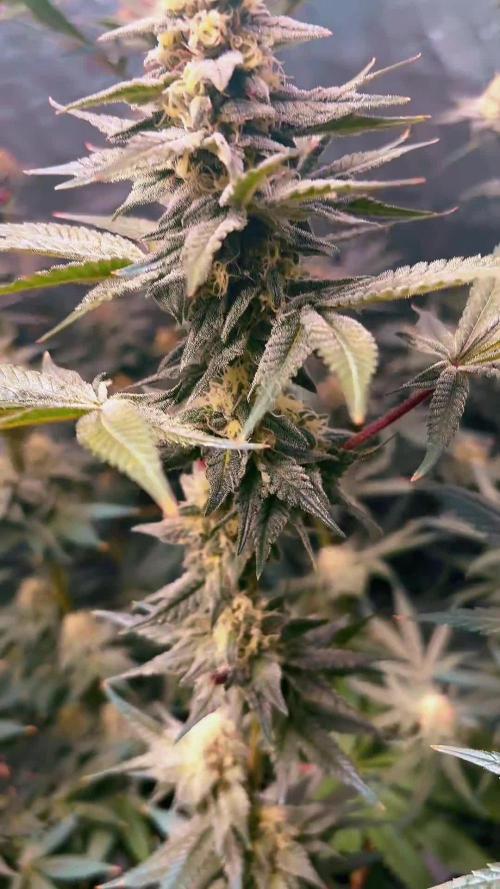
It’s day 43 of flower! All of the plants look great! I’m going to start dialing back the light intensity slowly over the next couple weeks. Harvest time is getting close
Likes
8
Share

@zenderman
Follow
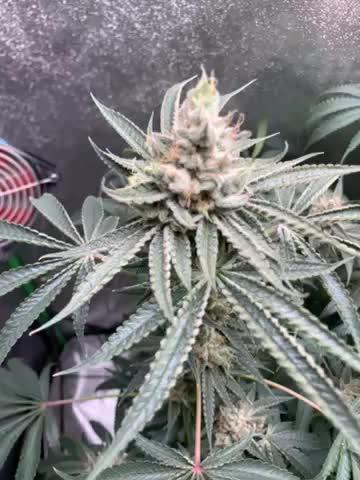
21/7/26. beginning week 8,day 50,last week of flowering.
yesterday was watered with "flawless finish ".



Likes
9
Share


@Pakkapon2477
Follow
ปรับไฟทำดอก 12/12 เข้าสู่ช่วง week2
Temp 26
Rh 65%
Ec 3.0
Ph 6.3
VPD 1.13
Co2 1500ppm


Likes
28
Share


@GaiaGreenGiant
Follow
Babies are almost ready! Starting to fade and getting denser by the day. There’s definitely noticeable differences between phenotypes. One smells like a woody kush, another smells like kush/diesel and the other one smells of pure grapes. Expected a little more genetic stability but still h@ppy with the variety.

Likes
20
Share


@CannaArchive
Follow
It’s the last week of flowering, and I’ve moved the plant into 48 hours of darkness to help boost trichome production before harvest. ✨
The plant has developed an incredibly deep purple color and is covered with trichomes—so much so that it sparkles under any light.
The scent is amazing, filling the room with a sweet, candy-like fragrance with a touch of diesel. 🍬
When I trimmed a few leaves to prep for harvest, my scissors actually turned purple from the resin! That’s a first for me and shows just how rich and sticky the trichomes are on this plant. 😮✂️💜
I’m so excited to see how it looks and smells once it’s fully dried. This grow has been unforgettable! 😁🌿✨
Likes
8
Share


@Australianbuds
Follow
In start week 4 flowering! Doing well! Starting to fatten out now! The 2 smaller ones are Bruce banner and are 2 weeks behind the rest in flower!


Likes
24
Share


@nonick123
Follow
Día 35 (10/06) N/A
Día 36 (11/06) Se va a quedar un pequeño gran cogollo porque ya se ha detenido el strecht
Día 37 (12/06) N/A
Día 38 (13/06) Avanza la floración para estas pequeñas
Día 39 (14/06) Riego 150 ml de H20 pH 6,5
Día 40 (15/06) N/A
Día 41 (16/06) 500 ml de Té de Floración con Healthy Harvest 8 ml/L + Insect Frass 16 ml/L + Melaza 1 ml/L
💦Nutrients by Lurpe Solutions - www.lurpenaturalsolutions.com
🌱Substrate PRO-MIX HP BACILLUS + MYCORRHIZAE - www.pthorticulture.com/en/products/pro-mix-hp-biostimulant-plus-mycorrhizae
Likes
9
Share


@High_Grade_Dadli
Follow
She ready to harvest ...the focus is the other two now.. the same stain look very promising now she getting into flowering branches are turning a bit purple.....just have to watch the purple paralysis n see wat she becomes
Likes
31
Share


@Kirsten
Follow
16.6.25:
Today is Harvest Day!
Well this has certainly been a fun one! Really pleased with how she turned out, when I cut her down, it was actually heavy. I'll be interested to see what we yielded here!
I did take all of the fan leaves off and some of the sugar leaves too. Just to make the trimming easier, and also help prevent mould during the drying process.
The trichomes were very hard for me to tell, but they have quite a lot of amber. So I may have grown some sleeping potion. We will soon find out I guess! 😅
I decided to leave the plant longer than I usually would, I did this to see the difference in effects.
This is a low THC strain, so in theory shouldn't produce a couch lock effect. So if it does, it will give me a better idea of the harvest windows.
Some of you helped choose this strain to grow, so if you've followed along, I hope you enjoyed this journey. Thank you, it was a great choice
Will update when I've finished drying, and then the smoke report!
😊💚✌️🌱👌🍃
Likes
58
Share


@biggreens420
Follow
This girl is packing the buds up she doing nicely removed very few leaves to get light to a few buds smell has just started to get strong hard to explain like a sweet diesely smell not smelt anything like it. Hoping she's stopped growing vertically because she's the same hight as the other two so now will have an evenish canopy lowered base notes down not much else to say thanks for reading happy growing guys
