


Likes
Comments
Share

@00110001001001111O
Follow
Total days above ground: 63
Total flower nights: 24
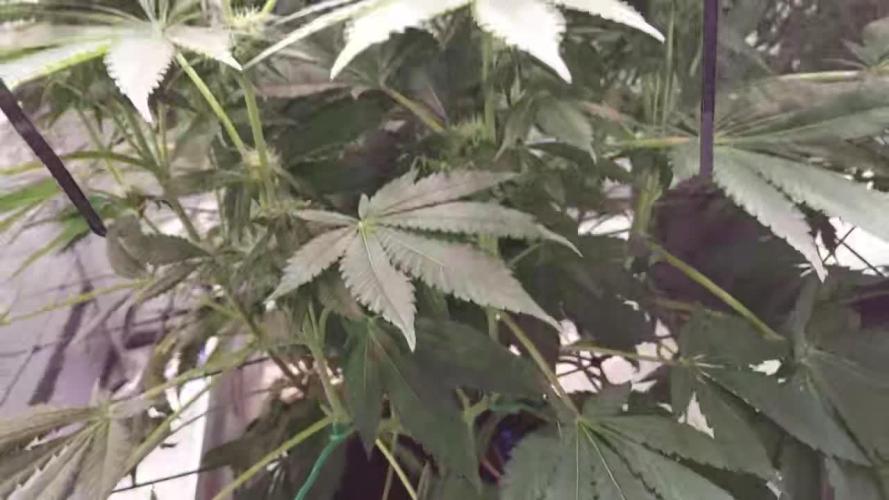
Just beyond 3 weeks into flower and the plants are showing their potential. The Mountaintop Mint has made great strides but is still a lanky bitch. I had to HST every branch, and may need to bend a couple more down before vegetative growth abates. Not a fan of this growth pattern and still unhappy about 2 out of 9 seeds providing a viable outcome. The bright side is that yield should be fine given the plethora of bud sites. Despite being difficult to grow next to other plants, I feel much better about its prospective outcome than I did just 1 week ago. That whole "crazy shit can happen in flower" thing rings true, again.
Overall the canopy has filled in nicely. I have a couple spots where light is wasted and I'll make some adjustments to the process to fix that for future grows. Now that I've settled on plant size and number of plants, improvements can be made each cycle until it's clockwork. I like the 12-cola vs 8 cola experiement. I've got a fairly long list of edits to make to various sections of my "bible," which means I liked the outcomes of most of my incremental adjustments. Continual, systematic improvement in action...
One other incremental change on the docket but not yet realized will be dropping nutrient concnetration once vegetative growth ends. Exact timing will be based on what I see in the foliage. I see some minor tip curl and its a bit darker than I want. So, it may come sooner than later. This'll be something I tweak over the next few grow cycles until I'm happy with the late-flower health.
I'll drop fertilizer concentration 10-15% on next refill and see how that plays out. It'll take a couple refills of reservoir to near 100% transition without draining it. If necessary, I'll drain and do a full refill for more pressing needs. A rez scrub before final stretch is coming, regardless.
Side note:
The impacts of VPD can be enormous. Last year (2025-2 diary) I had a humidifier wick get fouled and RH dropped while VPD spiked for more than a few days, thinking I could power through or that the canopy would soon provide more moisture. Nope, growth stalled in a significant way. By comparing day 34-42-49 of 2025-2 and day 38-42-49 of this diary, I can see a huge difference in growth at same point above ground. The consitency with which i do things makes it fairly certain it's the extende period with extremely high VPDs that caused the difference.
Also, interesting that it mostly catches back up by completion of third week of flower. The size difference is nearly undone by this point, though 2025-2 took 4 days longer vege phase to get there. Even so, I still think this grow is more than 4 days ahead of 2025-2 (the difference in vegetative phae duration). Time will tell if the development is ahead of the pace in 2025-2 or whether it's simply mostly an offset due to a less efficient vege phase for 2025-2.

Likes
22
Share

@Caertner
Follow
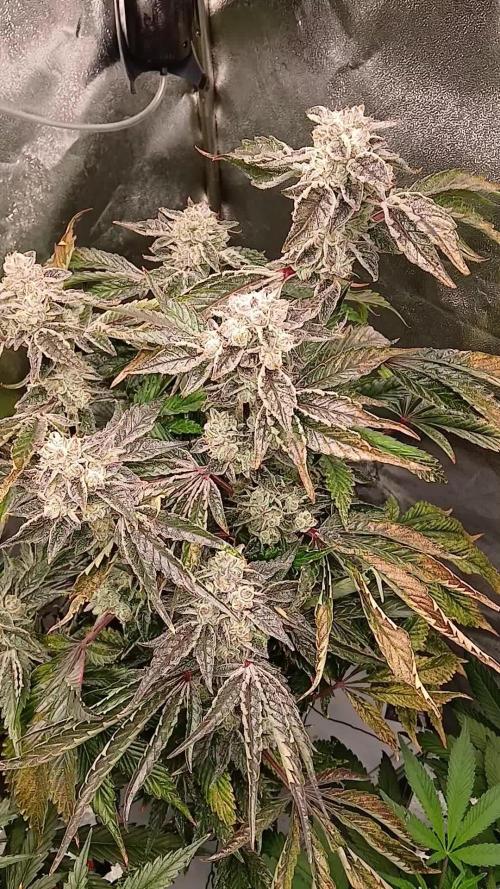
Die Ernre war mal der Wahnsinn!
Also erstmal: Ich habe 3 Paar Handschuhe verbraucht. Normalerweise reicht ein, max. zwei... hier war ich kurz vor Paar 4!
Harzig wie blöd, überall Trichome! Was aber bei dieser Genetik auffällt:
Es bilden sich sogar Blüten auf den Sonnensegeln!!! Bei ganz frechen Genetiken habe ich mal Trichome auf den Stielen und Blättern... aber nicht ganze Blüten.
Safe the fan leafs, they carry!!!
Der Geruch ist zu 100% Skunk... aber mit einem kleinen Twist. Die Cherry kommt schon etwas von der Farbe durch.

Likes
6
Share


@valiotoro
Follow
Super easy trim✂️
The buds are super dense & sticky🤩
For the smell it’s cherry & blackcurrant with a gassy touch the Cherry Cola Diesel ⛽️🍒

Likes
92
Share


@Roberts
Follow
Apple Fritter was doing good till air stone clogged up. Changed that and hopefully back on track. She has the polyploidy mutation. I am curious if it carried over in clone. I imagine it should. Question is should I clone the clone to keep mutation alive? She is growing in a New Level Hydro bucket, under a Spider Farmer SE5000 light. Thank you Spider Farmer, New Level Hydro, and Amsterdam Marijuana Seeds 💪❄️🌱🤜🤛
Thank you grow diaries community for the 👇likes👇, follows, comments, and subscriptions on my YouTube channel👇. ❄️🌱🍻 Happy Growing 🌱🌱🌱
https://youtube.com/channel/UCAhN7yRzWLpcaRHhMIQ7X4g
Www.amsterdammarijuanaseeds.com
SE5000
https://amzn.to/3qFpAML
Spider Farmer Official Website Links:
US&Worldwide: https://www.spider-farmer.com
UK: https://spiderfarmer.co.uk
CA: https://spiderfarmer.ca
EU: https://spiderfarmer.eu
AU: https://spiderfarmer.com.au
Coupon Code: saveurcash (is stackable in most cases)
Www.newlevelhydro.com
Www.hygrozyme.com

Likes
3
Share


@GrowinHome
Follow
I finally found the time to transplant the Bubblegum ladies to the flowering tent.
The seeds were planted on the 13th of Januari, all the seedlings have been topped on february 2nd and transplanted today.
They will remain under the 18-6 schedule for the oncoming days.

Likes
6
Share


@Luv2Grow
Follow
Day 51 - Into the beginnings of week 8 and all is looking good so far. She’s still got a few days before she needs any water and she’s really fattening up each day. Other than that, not much happening with her.
Day 52 - She’s definitely fattened up quite a bit the last couple of day but hard getting the light spread out to some of her outer branches so my new light should be here and installed tomorrow. She’ll be needing her watering tomorrow as well, she’s almost dry.
Day 53 - Gave her 2 gallons of plain pH’d water today and she seems to be the only one not really bothered by the heat in the tent. I’m doing what I can to keep things as cool as I can but not helping much. Either way, this girl still seems to be thriving so not complaining too much about her.
Day 54 - Looks good after watering yesterday, he next will be nutes. She is fattening up beautifully. Other than that, I think she’s really liking the second light in there and the heat doesn’t seem to bother her too much though it’s finally cooling down a bit.
Day 55 - Nothing major happening today, she’s doing good after her watering yesterday and it appears she’s still chunking up. Got some updated pictures today as well.


Likes
15
Share

@Radagast_
Follow
26.07.
Girl Scout Cookies
Day 92#
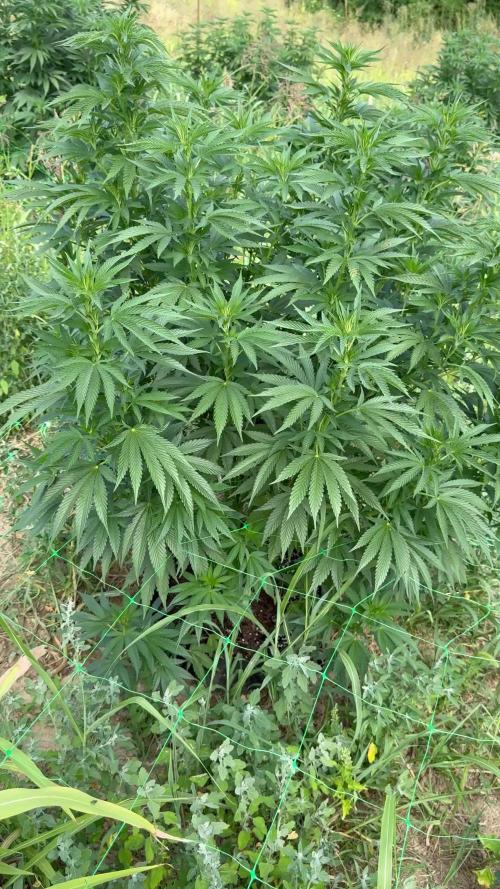
GSC is progressing well, it has slowly started to spread.
Yesterday was the end of its thirteenth week.
It is currently raining, there will be some storms in the next 2-3 days and rain in the next 4-5, so it will cool down a lot and the next 10 days will be quite normal weather, although the nights will not be very great.
Stay High and Keep Growing!!!

Processing
Likes
7
Share


@Smiffy
Follow
Not much to be done, watering this week at 6.0 just to ensure there is no nutrient lockout, feeling a little as though these two have been slow in the past week. Buds progressing but feel like it should be quicker at this point. Fourth week of flower
Likes
10
Share


@Colectivegrow
Follow
Día 15 de vegetación de Tropicanna Poison XL (Día 20 desde germinación)
El crecimiento de nuestra Tropicanna Poison XL sigue con un buen ritmo. Aparecieron algunos pulgones, pero los eliminamos con Bio Pets, un pesticida orgánico nacional (Chile). También agregamos micorizas, calmag, bio grow de BAC y Nirvana de Advanced Nutrients.
Actualizacion día 21 de VEGETA (Día 27 desde la germinación)
El FENO 2 se a espigado considerablemente, se pone una base para que este mas cerca de la luz led
Al parecer el FENO 3 es el mas estable de los 3 especimenes.
Likes
3
Share


@Joaka
Follow
como preventivo aplique tierra de diatomea via foliar. solo realice un apical por variedad de semilla ya que las otras aun según mi criterio les faltaba. se espera realizar la otra semana apical en las otras dos para dejar 2 sin manejo para comparar.
Likes
32
Share


@BigDaddyK
Follow
Spiderfarmer SF2000 - https://www.ebay.co.uk/itm/SF2000LED/223607946358


Likes
11
Share


@Souri93
Follow
Début du deuxième mois les pistils deviennent marron et les tricomes sont tous laiteux il leur reste un bon deux semaine de rinçage est elle sera prête elle dégage déjà une odeur agrume citronné sucre surtout quand je touche les tète avec mes doigt il ce colle entre eux magique cette tropicanna cookies
Likes
1
Share


@ThatGardnerLeo
Follow
Week 3: Noticed she started to look a little droopy on me and some slight yellowing on the lower leaves, she was outgrowing the solo cup and I think she needed some nutes so I transplanted her into some fresh soil, I am using a mix of ocean forest and coco so that should give her all the nutrients she needs for the next couple of weeks until it’s time to top dress with some Gaia green. This is an organic grow and I’m just using dechlorinated tap water. Confident she will bounce back and hopefully she didn’t stunt too much
Likes
25
Share


@gottagrowsometime
Follow
Welcome to my Purple Haze Autoflower diary sponsored by MSNL, Spider-Farmer, Mars-Hydro & Xpert Nutrients.
Days 1-14
Really happy with how she's moving. Good solid growth. Her DLI is 40. Having a lux meter has improved my grows so much. Knowing your DLI and where the hottest/coldest parts off your plants (ppfd wise) is just really the next step in adding that thing to your grow(s) that sets your next crop from your last. As I'm a long way from where I want to be. My next crop will focus on 2-3 plants. Doing 35 really is its too much work. Timing and moving plants around as there all at different stages. Like autos in pre fower will only take about 35-40dli before showing stress (drooping for ages after lights out or near the end of lights on) but, really you only see it about 20m after lights out. So its kinda of a ritual for me to check my girls after I put them to bed. Also doing 3-4 swaps and plant moves in and out of my dark room, or moving from the 70cm2 into my 1m2 (having a same spectrum of very close is a must if you're going to reg change lights/tents. As for this strain. She's really happy. Bit of wind burn you can see my 360degree ball fan is to powerful on its lowest setting. I'm thinking of putting something to break the wind on her. I did remove the 1st true leafs/nodes much later than I did with my 2 Fastbuds (that stalled for a wk) but they're back strong. And no early flip. Really only thing I can think of is the DLI and not stressing them day in day out with lights out has improved all my plants. (Lux meter id suggest any grower who wants to push their limits)
Maintenance
1st True leafs/nodes removed to help energy move to the next more important sets. Very little to no feed. I'm keeping her going with Fish force and Royal mix soil. This week I'll be adding Xpert Nutrients.
MAJOR DISCOUNT & FREE SHIPPING TO EU FROM XPERT NUTRIENTS 15% DISCOUNT (CODE:GGST)
Thanks to my many sponsors and friends. I thank you all. Its been a great platform to give me lots of opportunities to work with many great people in the industry. And to you, my viewers, I truly appreciate you. Without yous. Id have none of this. So drop a like. As id like to return the favour and drop by your pages and s what I can learn.
Thank you all very much.

Processing
Likes
27
Share


@LockDownGrow
Follow
Ok so I'm going too only feed pH water from here on out too force the plants too use up all that's in the soil , I am hoping I can carry them on now for the next 2 weeks like this before they are ripe ,


Likes
7
Share


@grazi2706
Follow
The terpenes are starting to come through. There is a delicious fruity smell pushing through the diesel smell. The leaves are beginning to yellow and I think we are coming to the end. I have some pretty big and sparkly colas coming through. I shut off my red lights on the LEDs to get a good video that shows off that sparkle. Trichomes on the sugar leaves are beginning to turn amber, the rest are almost completely milky. I'm giving it another week before I chop. I do a slow flush at 470ppm with only canna boost, cannazyme, and cal mag. I will be topping off with only phd water this week.