






@CCSAUTOGROW
Volgen
End of week 2 flower. I moved her into the larger grow space & she is HAPPY!!! Stacking up nicely and taking over the new space. She smells wonderful.


@Roberts
Volgen
Baked Bomb autoflower grew really well. I had a issue getting a seed going, then some ph issues in vegging. Beside that she just thrived. Big dense colas with a cherry vanilla fruity smell. Loaded with trichromes as well. Can't wait to give her a try. Thank you Bomb seeds, and Spider Farmer. 🤜🏻🤛🏻🌱❄️🌱
Thank you grow diaries community for the 👇likes👇, follows, comments, and subscriptions on my YouTube channel👇. ❄️🌱🍻
Happy Growing 🌱🌱🌱
https://youtube.com/channel/UCAhN7yRzWLpcaRHhMIQ7X4g




@Ultraviolet_
Volgen
We become aware at such times of man's wonderful ability to bring seemingly unrelated elements into harmonic balance, and receive a glimpse into a world where everything exists in conscious sympathetic attunement to everything else. When we listen to a piece of music that seems to strike a beautiful chord somewhere inside us, or view a painting that simply glows with harmonic awareness well executed, we probably do not spare much time to contemplate the wonderfully intricate combination of vibrations that our sensors make it possible for us to perceive. We tend to appreciate the relationship between the parts of something by an awareness of the harmony or dissonance of the whole. This ability enables us to say "what a beautiful house!" instead of "analysis has proven that this collection of building materials exhibits certain elements of harmonic proportion." While this ability to instinctively appreciate the beauty of true harmony has an important role to play in evolution, a more analytical understanding of the laws involved can be most useful. This is especially so if we wish to create works of art where each part exists in true harmony, not only with the other part of that particular whole, but with the universe within which the creator and the created exist.
Everything vibrates. From the most dense matter to the most subtle cosmic rays, everything which our senses allow our thoughts to become aware of, can be specified in terms of wavelength or frequency of vibration. These two terms define the same thing, but from different points of view.
The following are the approximate wavelengths of various energy carriers:
Cosmic rays 0.000,000,001 mm
Gamma rays 0.000,000,1 mm
X rays 0.000,500 mm
Ultraviolet rays 0.003 mm
Visible light 0.006 mm
Infrared 0.01 mm
Sound waves 1 meter
Radio waves 300 meters
Violet light 400 nm to 450 nm
Blue light 450 nm to 500 nm
Green light 500 nm to 570 nm
Yellow light 570 nm to 590 nm
Orange light 590 nm to 610 nm
Red light 610 to 700 nm
1 nanometer (nm) = 0.000,000,1 cm = 1/10,000,000 cm
If a guitar string is plucked and we hear a sound, it is not too difficult for the human mind to associate this sound with the vibration of the guitar string. With color it is quite different. It is difficult for us to conceive that the color of a substance is not an inherent property of the substance itself, but an indication picked up by our senses of that substance's ability to absorb or reflect the light which happens to be shining on it at that moment. Neither the matter nor the light is colored. What happens is that the brain learns to differentiate between the frequencies reflected or transmitted by the substance the eyes are focused on. The same thing happens with sound. When we say "Oh! Listen, they're playing my favorite song," what we really mean is: "My brain has stored within it a particular pattern of frequencies. I have compared the new information being received with this stored pattern and have deduced the answer that the two patterns are similar within certain specified tolerances." The 'pleasure' involved could have something to do with our running the pre-recorded pattern at the same time, in 'sympathy' with the new pattern as it is received.
The word sympathy describes very well our ability to appreciate color and sound. It also describes the reason behind certain elements of harmony. For instance, if a substance vibrating at 100 cycles per second (tone 1) is in the proximity of another substance vibrating at 200 cycles per second (tone 2), we could perceive, if we had the right equipment, a certain sympathetic relationship between the two.
We will see from this that there is a uniform doubling of the first tone seen in the second. At various points along the waves, the two are the same in amplitude. At other points, they are at opposite poles to each other. This doubled frequency has more points of similarity to the original than any other frequency except the original itself. If the equipment we had available for measuring these two frequencies was a soundboard amplifier and a pair of ears, then we would hear what would sound to us like one tone. If we had the opportunity to hear one at a time, we would hear that although they sound the same, one is higher in pitch than the other. This characteristic of 'the same but different in pitch', musicians have called the octave. Any two tones produced where one has exactly doubled the frequency of the other is called an octave. Speaking in ratios, an octave would appear then as the ratio 2:1 or 1:2, depending on whether we are talking of an octave up or down.
A single note produced by almost any instrument will contain more than one wavelength or frequency. It will have a dominant frequency, the wavelength of which we would call the note's 'fundamental' or 1st harmonic. It will also have a varying number of upper harmonics, gradually fading in intensity into infinity or silence.
Natural harmonics always have the same pattern of intervals between them. The interval between the 1st and 2nd harmonic is a perfect octave; between the 2nd and 3rd a perfect fifth; between the 3rd and 4th a perfect 4th; and so on, the intervals becoming smaller and smaller until they lose any relationship with the western 12 tone scale as it exists at the moment. Just as an octave has certain elements of sympathy with its fundamental, so some intervals have been noted to be more perfectly in sympathy with the fundamental than others. The ratio of the 'perfect 5th' or interval of 7 semitones, as it occurs in the harmonic series, is 3:2 or 2:3, while that of the 'perfect fourth" is 4:3 or 3:4. All the tones in the western 12 tone scale can be expressed in terms of the ratio between the upper tone and its fundamental. This would seem to be an ideal way of generating a scale from any given fundamental and several attempts have been made to do this, the Pythagorean system being probably the most well known. Although when working with a single tone instrument playing on its own, the Pythagorean formula works wonderfully well, if we had several instruments tuned this way together and asked them to play almost any western music, we would find that at times they sounded quite out of tune to each other.
The lack of flexibility of the various scale systems based on the harmonic series has led to what is known as the 'tempered' scale. This uses as its primary unit of interval the ratio of the octave or 2:1. It then proceeds to divide the interval between any fundamental and its upper octave into 12 smaller intervals by applying the ratio: two to the one-twelfth power, to one (21/12:1). This equals 1.059463094, so by multiplying any frequency by this number, we will obtain the tempered semitone next up from our fundamental. We will also find that any tone twelve semitones up from any other tone, in a scale generated in this way, will have exactly double the frequency.
If we took the note middle C on a piano and halved the wavelength, we would have the note C one octave above. If we halved this, we would have the C above, and so on. However, within about 6 octaves, we would find that although a 'sound' was being produced, no human ear could perceive it. If we kept on going, halving and producing upper octaves of our fundamental C, we would proceed through the infrared band, into the visible light spectrum. If we happened to be outside during the day, we would, for one octave only, see the note C with our eyes. The next octave above would already be in the ultraviolet band, and outside the eye's sensitivity range. If we can think of color as being an indication of a substance's vibratory rate or wavelength, we may begin to see a relationship that could exist between the color and sound spectrums.
The logical extension of what has so far been said is that there exists a scale in the color spectrum that corresponds exactly to the scale in the sound spectrum, each color tone being an octave of the equivalent note in the sound range.
This is not the end of the story but only the beginning. If we can for the moment accept that any wavelength in one band has upper and lower octave stretching out to infinity, then the next question is 'fine, but what shall we use as our fundamental? A particular color? A particular sound frequency?' The musicians among us will probably say 'A 440'. This means that the note A should vibrate at 440 Hertz, or 440 times per second. They would tell us that this is standard pitch has been adopted by most orchestras around the world; pianos are tuned to it, instruments are constructed to formulas based on it, and so to them it would probably seem the most appropriate place to begin. Some of these musicians may know of the battle that is still raging with regards to this being the standard, but few would know why A = 440 Hz was chosen except that it worked when it was set to be a suitable compromise between the many different pitches in use at the time.
432 Hz is said to be mathematically consistent with the patterns of the universe. Studies reveal that 432 Hz tuning vibrates with the universe’s golden mean PHI and unifies the properties of light, time, space, matter, gravity, and magnetism with biology, the DNA code, and consciousness. When our atoms and DNA start to resonate in harmony with the spiraling pattern of nature, our sense of connection to nature is said to be magnified.
Another interesting factor to consider is that the A=432 Hz tuning correlates with the color spectrum, while the A=440 Hz is off. Audiophiles have also stated that A = 432 Hz music seems to be non-local and can fill an entire room, whereas A=440 Hz can be perceived as directional or linear in sound propagation.
Once you adopt the idea that sound (or vibration in general) can have an equalizing and harmonizing effect (as well as a disturbing effect), the science of harmony can be applied to bring greater harmony into one's life or tune to specific energies. There is a form of absolute and relative harmony. Absolute harmony can, for example, be determined by the tuning of an instrument. The ancients tuned their instruments at an A of 432 Hz instead of 440 Hz - and for a good reason. There are plenty of music examples on the internet that you can listen to in order to establish the difference for yourself.
Attuning the instrument to 432 Hz results in a more relaxing sound, while 440 Hz slightly tenses up the body. This is because 440 Hz is out of tune with both macro and micro cosmos. On the contrary, 432 Hz is in tune. To give an example of how this is manifested microcosmically: our breath (0,3 Hz) and our pulse (1,2 Hz) relate to the frequency of the lower octave of an A of 432 Hz (108 Hz) as 1:360 and 1:90.
It is interesting to note that 432 Hz was the standard pitch of many old instruments and that it was only recently (19th and 20th century) the standard pitch was increased. This was done in order to be able to play for bigger audiences. Bigger audiences (more bodies) absorb more of the lower frequencies, so the higher pitch was more likely to “cut through”. One of the oldest instruments of the world is the bell ensemble of Yi Zeng (dated 423 BC), tuned to a standard F4 of 345 Hz, which gives an A= 432 Hz. The frequency of 345 Hz is that of the platonic year! Similarly, many old organs are tuned in A=432 as well; for example, St. Peter’s Capella Gregoriana, St. Peter’s Capella Giulia, S. Maria Maggiore in Rome.
Maria Renold’s book “Intervals Scales Tones and the Concert Pitch C=128 Hz” claims conclusive evidence that 440 Hz and raising concert pitch above scientific “C” Prime=128 Hz (Concert A=432 Hz) disassociates the connection of consciousness to the body and creates anti-social conditions in humanity.
The difference between concert pitch A=440 Hz and Concert A=432 Hz is only 8 cycles per second, but it is a perceptible difference of awareness in the human consciousness experience of the dream we share called existence.


@Hempcules
Volgen
Week 6 was somewhat challenging. Some of the plants showed signs of deficiency again, and throughout the week, I had to balance things out with repositioning and individual fertilization. This approach has worked well so far. Currently, all the plants are back on track and growing vigorously every day.
My PPFD level is now around 700 PPFD. I haven't changed the watering amount much, but I gave some plants additional nutrient water instead of just plain water.
Naturally, I also did a lot of defoliation in the lower areas and removed unnecessary shoots this week. Afterwards, I applied foliar fertilizer for the last time in this cycle. This time it was a mixture of Acti Vera, Alg a Mic, and Boomboom spray from Biotabs.
As always, it's pretty tight in my tent, but I'm quite satisfied with the general canopy of all the plants. A significant number of buds are already developing, which makes me optimistic about the future. I hope the next week goes a bit smoother, but overall, everything is fine.




@shwable
Volgen
Welcome to week 9!
Everything looking good, I removed the net and let them grow for themselves from now on.
Only using some LST clips.
Have a great week guys, see yall at Mary Jane!
shorts_status_processing


@Small_grow_297
Volgen
This is the first run. Much like a try out.
Like or comment..
Thank you....


@Arkain_Jenetics
Volgen
Everything is going good. Some are showing some sort of deficiency . Lowered lights a little bit. Going to start watering every other day. One of the critical thunder autos is like 8 inches tall lol definitely breeding her.


@CanarianGrow92
Volgen
Week 5 already 😁 but bad luck this week, the whole week we had rain on my island and very cloudy weather, which is obviously bad for the plant 😢🌱 hopefully the weather change soon as its already summer and it never rains in june here so it really screwed a week of flowering, specially the week 4-5-6 as the plant gets fatter.
The smell is amazing, this strain is incredible, cant wait to try some, im thinking about using this plant in an extraction 😁


@HoffmanShulgin
Volgen
Hoy quiero compartir mis pensamientos sobre el estado de mis plantas. Sinceramente, quería creer que no habían sufrido mucho por el frío, pero desafortunadamente la realidad resultó ser diferente. Algunas de ellas parecen un poco deprimidas y su crecimiento se ha ralentizado. Pero no me doy por vencido y sigo esforzándome por su recuperación. Además, no me gusta el régimen de luz que se ha utilizado desde el inicio de la siembra de las semillas, 12/12. La próxima vez utilizaré 18/6. Espero que esto ayude a estimular su crecimiento y desarrollo.
Ayer empecé a darles a las plantas PK13/14 en una dosis de 1 ml/l y Diamond Nectar en una dosis de 2 ml/l. Espero que estos aditivos les ayuden a obtener los nutrientes necesarios y a estimular el proceso de floración y crecimiento. A pesar de algunas dificultades, no me doy por vencido y sigo cuidando de mis plantas. Creo que con el cuidado adecuado y las condiciones apropiadas, podrán superar las dificultades y crecer saludables y fuertes. Sigo siendo optimista y seguiré creciendo junto con ellas.



@KannaGrowing
Volgen
Ha llegado la hora de empezar a fertilizar nuestras plantas.
Lo haremos con la gama de productos BIO de JUJU Royal by BioBizz, y siguiendo la guía de dosificaciones.
También trataremos con una solución de Propolix foliar, a modo preventivo de plagas en dosificación 2mlx1L de agua.
Continuamos con la potencia de las dos luminarias al 50% y el control de temperatura y humedad.



@Dineh
Volgen
high guys
SWEETSEEDS provided me with the previous seeds
now its one lady plus two clones out of a top of that weed
those girls
do not produce a lot of leaves
but its a
back to basics grow
and she is going strong
many greetings to secretflower
you are a die hard man
cheers mate
at the beginning of week 8
i have topped and defoliated heavy
i water now 1 liter whenever i feel like it
i think it, is an photoperiod and not an autoflower
still dont know of its a girl
i hope for the best
happy with the biobizz line
more to follow
cheers




@badboyodin
Volgen
Ascofol (root stimulant) strongly stimulates plant growth using natural hormones, resulting in both plants showing a slight nitrogen deficiency.
Day 1 Bloom
( # 1 ) The plants were trimmed before the light was set to a 12/12 cycle.
Day 2 Bloom
( # 2 ) Ascofol has a significant effect on the leaf formation of both plants.
Day 3 Bloom
( # 3 ) Ascofol has been reduced. The leaves are growing too quickly.
( # 4 ) The plants were trimmed again and inner leaves were removed.
( # 5 ) 6h later, the leaves have repositioned themselves.
Day 4 Bloom
( # 6 ) I moved the plants to the bigger tent and light and added my Chili (capsicum annuum) as a neighbor
Day 5 Bloom
( # 7 ) I placed the plants on pedestals so that I could put the fans between the pots.
( # 8 ) Short Clip
Day 6 Bloom
( # 9 ) The stretch is noticeable, and the plants are also much thirstier. I will now water them twice a day, giving them 2500 ml each time.
( # 10 ) I placed another SCrOG net over the plants and wove in the first branches. The fun begins.




@GoodTimesOrganics
Volgen
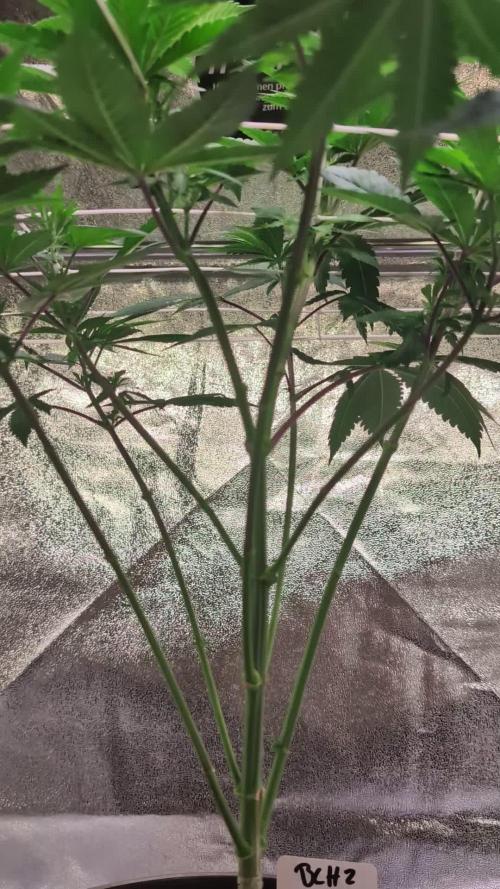
Die Blue Cream Haze hat nochmals einen kleinen Wachstumsschub hingelegt und es war nun Zeit die Ladys unter das Netz zu flächten.
Aktuell liegen die oberen 15 cm nun über dem Netz.
Unten herum wurde die Pflanze nochmals komplett ausgedünnt wie es sich für die Scrog Methode gehört. Hier folgen bis zur BW3 noch Nachbesserungen
Die aktuelle Temperatur liegt immer zwischen 22,5°C und 24°C und auf Grund des aktuellen vielen Regens, liegt die Luftfeuchtigkeit immer zwischen 60% RH und 63% RH was für den Anfang der Blüte völlig in Ordnung ist.
Die Blüte wurde nun am 25.07.2025 eingeleitet.





@Oyziphar
Volgen
😅
Another Hot Week 🌶️🌶️🌶️
High temperatures 🌡️🌡️🌡️and lots of sun 🌞🌞🌞 and no rain 🌧️
➡️ The buds are ripe and ready to harvest 🌰
➡️ Exquisite aromas of sweet mandarin, clementines, lemon verbena, and oranges. 🍊🍋
➡️ Just a little water at the beginning of the day 💧💧💧
📍 Plant #1 (140cm) is the biggest plant and probably the best yielder. Huge fat buds 😆
📍 Plant #2 (128cm) is also a very nice plant, but slightly less fat buds
📍 Plant #3 (111cm) is less impressive plant. Her pistils are orange-brownish-red, therefore clearly a different phenotype than the others
Eight week of Light Deprivation
👉👉👉👉Every morning at 9:00 am I move the plants to the greenhouse.
👉👉👉👉Every evening at 9:00 pm I move the plants (together with some other strains) inside the growroom (which I don't use in the summer)



@Organic710
Volgen
Week 3 is going as planned and it looks like the left side stacked better but its only 2plants on the right what are smaller I might take a few tops off try avoid larf I dont use and never end up blasting it or making bubblehash 😂 Top dressed with Dr Organics 2-8-10 40g per 20L pot and weekly doses of microbes and a combination of Organic growth reg and Trace + Flourish during every watering


@OrganicAutomatic
Volgen
Hi guys its week six and the girls are doing great. The two on the left stopped stretching and beginning to fatten up.
The two on the right seems to have another week or so to finish stretching.


@AsNoriu
Volgen
Day 29. Girls grow slow, but most important ....
Could be i overwatered with 2.5 liters of water or i stonly watered them twice ;)))
Girls didnt drop pot weight till day 31, on days 32 morning ill do new round of lst.
Will feed them hard, will defoliate all bigger old leaves which are covering new grow, plants are strong enough to take pain now ;)))
Its sad situation a bit, i got flue and with that corona madness my mood was very down and i didnt work with plants at all, anyway, they made to that stage where harm can be done and its time.
Gorillas looks okeish even without work, really good strain at least for now. Cookies are very picky, its hardest to veg strain from all i ever tried, lets see, maybe food and heavy training will make them fit ;)
Day 32. Girls are finaly light, so heavy training and huge feeding.
I dont know what hapend, but they refused to drink for 8 days almost, one cookie has obvious sighns of overwatering and if to be honest all cookies are crap, gorillas grow amazing, especially self toped one, she made natural mainlining and covers space perfectly.
Guess in next 2-3 days they will blast off, but i cant feed silica till more branches will grow up, cookies too small, lets wait and see...
Day 33. Girls loved food, plenty new grow, all tops are facing sun again , they will bush up in next few days.
Next watering - silica and cal mag and next after - fish mix.
Day 34. Girls are drinking again, so i gave 1ml/l fishmix.
Cookies show strange colours and on fresh grow you can see cal mag def. Next feed will give them extra, normaly TopMax should be enough...
I dont like Cookies genetics so much, that i planted last 5th bean ;))
Want to check two things :
1. Are my lights strong to grow something not under direct light
2. Are those Cookies such crap, that i should never try any seeds from RQS.
I planted 4 new girls, no work,no top - nothing will be done to them. Hope to see last Cookie bean growing beter than almost two years old Incredible Bulk x2 and last StrawberyCough bagseed bean, otherwise its sad quality for such big house.
Cant find why all 4 Cookies grow so slow compaired to all 4 perfect Gorillas. Was using new worm castings, too ritch ??
maybe thats the answer in test grow i put pure BIOBIZZ AllMix soil, nothing extra.
Had to top one Cookie, new grow was all damaged and didnt want to develop, will harm them even harder next time before silica and cal mag, which i thought not to use in this run ...
Lets see ....
Happy growing !


@hulkberry
Volgen
Last week of veg, the plant on the soil don’t look very good, let’s see what happen!!!